
International Relations
India’s Foreign Policy and Erosion of Multilateralism
For Prelims: World Trade Organization, QUAD, AUKUS, African Union, India–US Interim Trade Agreement
For Mains: Decline of multilateralism and implications for global governance, Evolution of India’s foreign policy from non-alignment to multi-alignment, India as a leader of the Global South and a “Third Pole” in world politics
Why in News?
In the Rajya Sabha, the Prime Minister of India formally acknowledged the new world order. As global power dynamics shift and multilateral structures continue to erode, India faces the complex challenge of reformulating its national identity and its approach to international relations to secure its future interests.
Summary
- Global governance is weakening due to unilateral actions, great power rivalry, UNSC and WTO paralysis, and the rise of minilateral groupings like QUAD and AUKUS, shifting the world from a rule-based order to power-driven geopolitics.
- India is adapting through assertive multi-alignment, supply chain diversification, technological sovereignty, and Global South leadership, aiming to emerge as a stabilising “Third Pole” while managing challenges from China, trade coercion, and regional instability.
What are the Key Facets of the Emerging World Order?
- Rise of Unilateralism and "Great Power" Rivalry:
- US "Isolationism": Significant actions like the US withdrawal from the World Health Organization (WHO), the Paris Climate Agreement, and the UN Human Rights Council have weakened these institutions.
- The United States, once one of the largest funders of the United Nations, has withdrawn from 31 UN institutions, reflecting its declining engagement with multilateral processes.
- Strategic Coercion: India warned against the strategic use of economic coercion, including tariff volatility and coercive supply-chain practices by major powers, as undermining trust in the international system and hurting the Global South’s autonomy.
- For example, the US has used tariff threats to influence India's energy trade with Russia.
- Major economies have shifted toward "America First" or "China First" policies, employing unilateral tariffs and trade barriers that bypass multilateral trade norms.
- US "Isolationism": Significant actions like the US withdrawal from the World Health Organization (WHO), the Paris Climate Agreement, and the UN Human Rights Council have weakened these institutions.
- Institutional Paralysis:
- UNSC Deadlock: The United Nations Security Council (UNSC) often fails to act on global conflicts (like those in Ukraine or Gaza) because of the veto power held by its permanent members.
- There is a growing demand for reforms to include rising powers like India and regions like Africa.
- WTO Crisis: The World Trade Organization (WTO) is facing a crisis because its dispute settlement mechanism (the Appellate Body) has been blocked, preventing countries from resolving trade wars through legal channels.
- Countries are increasingly using "National Security" as a reason to impose tariffs, which undermines the free trade principles of the WTO.
- UNSC Deadlock: The United Nations Security Council (UNSC) often fails to act on global conflicts (like those in Ukraine or Gaza) because of the veto power held by its permanent members.
- Rise of China: Since 2010, China has created alternative economic and security architectures (e.g., BRI, NDB, RCEP), challenging the Western-led "rules-based order."
- China now leads four of the 15 UN specialized agencies, and its aid volumes exceed those of the West.
- Minilateralism over Multilateralism: Instead of large, universal organizations (Multilateralism), countries are moving toward smaller, targeted groups known as Plurilateral or Minilateral forums.
- Preferential and functional groupings like QUAD, AUKUS, and I2U2 are increasingly replacing universal platforms for strategic and security coordination.
- Trade is shifting toward regional and plurilateral agreements such as Regional Comprehensive Economic Partnership, and bilateral Free Trade Agreements (FTAs), reflecting a move away from universal multilateral trade governance under the WTO.
- Failure of the "Post-War Vision": The original 1945 vision of the UN (based on equality, non-aggression, and self-determination) is being tested by reality as conflicts like Russia’s invasion of Ukraine expose the limits of collective security.
- The gap between the "Rule of Law" (international treaties) and the "Rule of Power" (military and economic might) has widened significantly.
- Weaponisation of Interdependence: Control over supply chains, financial networks (SWIFT), semiconductors, energy flows, and sanctions regimes allows major powers to coerce adversaries without kinetic warfare.
How has India’s Foreign Policy Evolved in Changing Global Order?
- Idealism and Non-Alignment (1947–1964): In the early years, India adopted non-alignment to avoid joining Cold War blocs while preserving sovereignty.
- Guided by Panchsheel and Afro-Asian solidarity, India focused on "Universalism of the Weak," advocating for decolonization and disarmament.
- However, the 1962 Sino-Indian War exposed limitations of idealism and highlighted the need for stronger defence and strategic planning.
- Security and Power Balancing (1964–1991): India moved toward realism, prioritising national security and regional stability.
- The 1971 Indo-Soviet Treaty and support for Bangladesh’s liberation reflected strategic alignment for security interests.
- India’s 1974 nuclear test (Pokhran-I) signalled technological capability and deterrence, marking a clear shift from moral politics to power-based diplomacy.
- Economic Diplomacy (1991–2000): Following the collapse of the Soviet Union in 1991, and the end of the Cold War and economic crisis led India to adopt economic diplomacy.
- The 1991 LPG reforms integrated India into the global economy, while the Look East Policy strengthened ties with Southeast Asia.
- Establishing relations with Israel and conducting the 1998 nuclear tests demonstrated India’s pursuit of strategic and economic autonomy.
- Multi-Alignment (2000–2014): The India–US Civil Nuclear Deal (2008), engagement with ASEAN, and participation in BRICS and G20 reflected India’s emergence as a global stakeholder.
- Energy security, diaspora engagement, and trade partnerships became central to foreign policy.
- Assertive Multi-Vector Diplomacy (2014–Present): India has adopted a more assertive and multi-vector approach. "Strategic Autonomy" is used as a rationalization tool for issue-based choices:
- The Dual Balancing Act: India’s participation in the US -led Quad (2017) while simultaneously purchasing the Russian S-400 system (2018) exemplifies its strategy of balancing partnerships to preserve strategic autonomy.
- De-hyphenated Diplomacy: India has moved away from viewing relationships through binary lenses (e.g., US–Russia or Israel–Palestine), engaging each country on its own merits.
- From "Voice" to "Leader" of the Global South: India has institutionalized its leadership through platforms like the Voice of Global South Summit and by inducting the African Union into the G20 during its 2023 presidency.
- Strategic Minilateralism: Moving away from bulky, slow multilateralism (like the UN) toward agile, issue-based groups like QUAD (security/tech), I2U2, and the International Solar Alliance (ISA).
- Technological Sovereignty: India is now setting global standards in Digital Public Infrastructure (DPI) and pushing for ethical AI Governance (e.g., the 2026 AI Impact Summit in New Delhi).
- Vishwa Bandhu (Friend of the World): Positioning itself as a stabilizer or "bridge" between the polarized West and the Global South.
- Transitioning from a "balancing power" to an independent center of global power (a "Third Pole").
What are the Challenges to India’s Foreign Policy in Changing Global Order?
- "Transactional" Trade Challenge: The shift from multilateralism to asymmetric relations has turned trade into a tool of political coercion.
- Unlike the EU trade agreement, which uses phased reciprocal reductions, the India–US Interim Trade Agreement demands "concessions first," unilaterally deciding on tariff relief only after India doubles industrial imports or adjusts its strategic ties.
- Expectation–Responsibility Gap: India’s ambition to become a major power brings with it heightened global expectations to take definitive stands on pressing international issues.
- Sustaining credibility and influence in the emerging world order will require India to balance strategic autonomy with greater normative and strategic clarity.
- Persistent China Challenge:
- Border Tensions: Despite ongoing dialogues, over 60,000 troops remain deployed along the Line of Actual Control (LAC). Tactical disengagements have not resolved the fundamental trust deficit.
- Economic Asymmetry: India remains heavily dependent on Chinese imports for critical sectors like pharmaceuticals and electronics.
- China has previously weaponized these supply chains, such as the 2025 halt on rare earth magnet exports.
- Maritime Encirclement: China's expanding naval footprint in the Indian Ocean Region (IOR) and its investments through the Belt and Road Initiative (BRI) challenge India's traditional role as the region's net security provider.
- Neighbourhood Volatility: India's "Neighbourhood First" policy is facing its toughest test in a decade.
- The "Iron-Clad" Alliance: The emboldened stance of Pakistan (following Operation Sindoor) and its interests to strengthen mutual defense ties with a volatile Bangladesh can increase the friction between India and Pakistan.
- Regional Encirclement: From the Maldives to Myanmar, China’s "investment-led diplomacy" often outpaces India’s project delivery, leaving New Delhi struggling to maintain its traditional sphere of influence.
- Technology & Energy Sovereignty Gap: Power in 2026 is defined by control over chips and AI and energy transition.
- Critical Mineral Dependency: China’s leverage over rare earths (essential for India’s missile and aerospace programs) is a major vulnerability.
- Digital Vulnerability: India leads in DPI but remains a "malware detection" hotspot and depends on Western platforms for core AI development.
How Should India Reframing its foreign Policy in Changing Global Order?
- Pursuing Viksit Bharat 2047: India must replace the outdated doctrine of 'strategic autonomy' with a purpose-driven foreign policy explicitly aligned with the economic transformation goals of 'Viksit Bharat 2047'.
- De-risking Supply Chains: India currently imports a massive share of critical components (electronics, APIs) from China.
- Foreign policy should prioritise friend-shoring through initiatives like the Supply Chain Resilience Initiative (SCRI) and expand partnerships such as the Pax Silica Initiative to build resilient semiconductor and technology value chains.
- Building Endogenous Capabilities: Taking a cue from the US and China in the early 1900s, India should maintain a low international profile and focus entirely on developing its domestic technological and industrial capabilities to become a 'cyber superpower'.
- India can reframe its foreign policy around its young, tech-driven workforce to emerge as a cyber and AI power. Securing critical minerals and forging partnerships in AI, semiconductors, and quantum technologies will help India become a rule-maker in the digital age.
- Aggressive Trade Diversification: Vulnerabilities in the US bilateral relationship make it imperative for India to prioritize trade diplomacy. India must aggressively diversify its exports and pursue Free Trade Agreements (FTAs) with Asia and Africa.
- Instead of trying to match China's massive "chequebook diplomacy" (BRI) dollar-for-dollar, India should focus on exporting its proven DPI to Africa and Southeast Asia, creating an ecosystem of trust and shared growth.
- Maintaining the Russia Link: Despite Western pressure, maintaining functional defense and energy ties with Russia is crucial to prevent Moscow from becoming entirely subservient to Beijing.
- Reframing Neighborhood Relations: Relations with Pakistan should be treated as a pragmatic foreign policy issue rather than purely a security challenge.
- Economic incentives, such as a new water-sharing arrangement, a trade agreement, or the revival of the Iran-Pakistan-India pipeline, could stabilize the region.
- Repositioning BRICS: As the chair of BRICS, India has the opportunity to shift the bloc away from being a political multilateral body and reposition it as an economic cooperation community, starting with initiatives like linking official digital currencies for smoother cross-border trade.
Conclusion
The erosion of multilateralism is not merely a crisis but an opportunity for India to shed its "reactive realism" and adopt a "purposeful narrative." By focusing on domestic strength and flexible, interest-based alignments, India can safeguard its strategic space and emerge as a stabilizer in a fragmented world.
|
Drishti Mains Question: Q. "In a fragmented global order, India’s 'Strategic Autonomy' is less about non-alignment and more about calibrated multi-alignment." Discuss. |
Frequently Asked Questions (FAQs)
1. Why is multilateralism weakening globally?
Rising unilateralism, great power rivalry, UNSC veto deadlocks, WTO dispute paralysis, and the shift toward minilateral groupings are undermining multilateral institutions.
2. What is minilateralism and why is it rising?
Minilateralism refers to small, issue-based coalitions like QUAD and I2U2 that enable faster decision-making and strategic coordination compared to large multilateral bodies.
3. How has India’s foreign policy evolved in response to global changes?
India has moved from non-alignment to multi-alignment and assertive strategic autonomy, balancing partnerships with the US, Russia, and Global South leadership.
4. What are the major challenges for India in the new world order?
China’s strategic assertiveness, trade coercion, supply chain dependence, neighbourhood instability, and technological vulnerabilities pose key challenges.
5. How can India strengthen its position in the changing global order?
By diversifying trade, securing supply chains, building domestic tech capacity, leading the Global South, and leveraging minilateral platforms for strategic influence.
UPSC Civil Services Examination Previous Year Question (PYQ)
Prelims
Q. With reference to the United Nations General Assembly, consider the following statements: (2022)
- The UN General Assembly can grant observer status to non-member States.
- Inter-governmental organisations can seek observer status in the UN General Assembly.
- Permanent Observers in the UN General Assembly can maintain missions at the UN headquarters.
Which of the statements given above are correct?
(a) 1 and 2 only
(b) 2 and 3 only
(c) 1 and 3 only
(d) 1, 2 and 3
Ans: (d)
Q. Consider the following statements: (2019)
- The United Nations Convention against Corruption (UNCAC) has a ‘Protocol against the Smuggling of Migrants by Land, Sea and Air’.
- The UNCAC is the ever-first legally binding global anti-corruption instrument.
- A highlight of the United Nations Convention against Transnational Organized Crime (UNTOC) is the inclusion of a specific chapter aimed at returning assets to their rightful owners from whom they had been taken illicitly.
- The United Nations Office on Drugs and Crime (UNODC) is mandated by its member States to assist in the implementation of both UNCAC and UNTOC.
Which of the statements given above are correct?
(a) 1 and 3 only
(b) 2, 3 and 4 only
(c) 2 and 4 only
(d) 1, 2, 3 and 4
Ans: (c)
Mains
Q. Critically examine the role of WHO in providing global health security during the COVID-19 pandemic. (2020)
Q. What are the main functions of the United Nations Economic and Social Council (ECOSOC)? Explain different functional commissions attached to it. (2017)
Indian Polity
Private Member’s Bill on Judicial Diversity
For Prelims: Private Member's Bill, Supreme Court of India, Judicial Appointments, Chief Justice of India, Collegium System
For Mains: Judicial appointments and Collegium system reforms, Diversity and representation in higher judiciary, Access to justice and regional benches of the Supreme Court
Why in News?
A Private Member's Bill has been introduced in Parliament seeking to amend the Constitution to mandate social diversity in higher judicial appointments and establish regional benches of the Supreme Court (SC) of India, aiming to make the highest court more accessible to citizens across the country.
Summary
- Private Member’s Bill proposes proportional representation for SCs, STs, OBCs, women, and minorities in higher judicial appointments, and regional Supreme Court benches to improve access to justice.
- The higher judiciary faces structural barriers such as opaque collegium processes, nepotism, absence of constitutional diversity mandates, gendered career constraints, and geographical centralisation in Delhi, which limit representation of marginalised groups.
What does the New Private Member Bill Propose for Judicial Diversity?
- Current Deficit: Proportional Representation: The Bill mandates that due representation must be given to Scheduled Castes (SC), Scheduled Tribes (ST), Other Backward Classes (OBC), religious minorities, and women in proportion to their population when appointing judges to both the Supreme Court and High Courts.
- Data shows that between 2018 and 2024, only about 20% of appointees to the higher judiciary belonged to the SC, ST, and OBC.
- Furthermore, women and religious minorities represent less than 15% and 5%, respectively.
- Data shows that between 2018 and 2024, only about 20% of appointees to the higher judiciary belonged to the SC, ST, and OBC.
- Time-Bound Appointments: It proposes a strict maximum timeline of 90 days for the Central government to formally notify the recommendations made by the collegium to avoid arbitrary delays.
- Regional Benches of the Supreme Court: The Bill proposes permanent regional appellate benches of the Supreme Court in New Delhi, Kolkata, Mumbai, and Chennai to handle regular appeals.
- Matters of national constitutional importance would remain exclusively with the Constitution Bench in Delhi.
- The Supreme Court currently sits exclusively in New Delhi, it severely restricts access to justice for common citizens and litigants living in distant southern, eastern, and north-eastern states.
Constitutional Provisions Regarding Supreme Court's Seat and Judicial Appointments
- Article 130: Declares that the seat of the Supreme Court shall be in Delhi, or at such other places as the Chief Justice of India (CJI) may decide with the prior approval of the President.
- Article 124: SC judges appointed by the President in consultation with the CJI and other judges.
- Article 217: High Court (HC) judges appointed by the President in consultation with CJI, Governor, and HC Chief Justice.
- Ad hoc Judges (Article 127): If quorum of SC judges is not available, CJI (with President’s consent) can request a HC judge to sit in SC.
- Acting CJI (Article 126): In case of vacancy/absence, senior most available SC judge appointed by the President.
- Retired Judges (Article 128): With President’s consent, CJI may request a retired SC judge to sit and act as SC judge for a specified period.
- Article 224A: A retired High Court judge may be requested to sit and act as an ad hoc judge of a High Court, with the prior consent of the President, on a reference made by the Chief Justice of the High Court.
- Appointment Procedures:
- CJI: Outgoing CJI recommends a successor, usually by seniority.
- SC Judges: CJI initiates the recommendation, consulting Collegium members and the senior-most judge from the candidate’s High Court. Their opinions are recorded in writing.
- The Collegium’s recommendation is sent to the Law Minister, then the Prime Minister, who advises the President for the appointment.
- HC Chief Justices/Judges: The Chief Justice of a High Court is appointed by the President in consultation with the CJI and the Governor of the State.
- The procedure for appointing puisne Judges is the same except that the Chief Justice of the High Court concerned is also consulted.
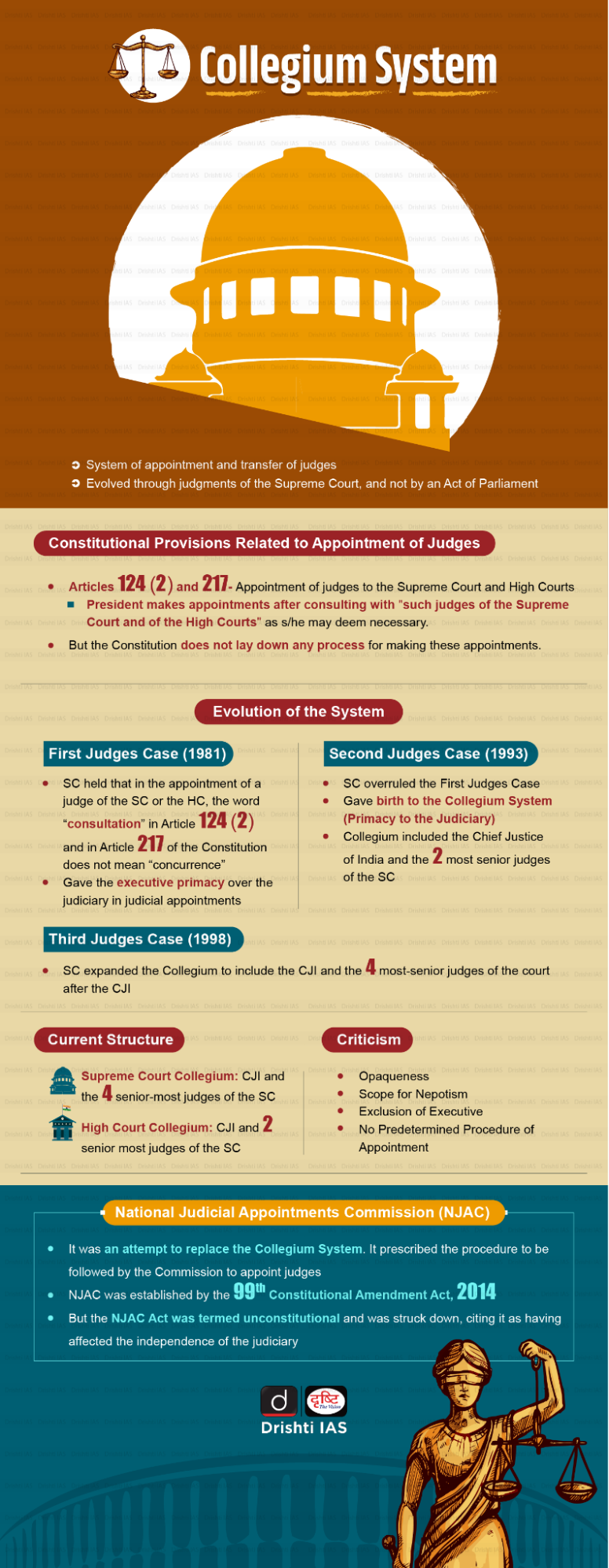
What are the Challenges Hindering Diversity in Judicial Appointments?
- Lack of Transparency: The Collegium, which holds the power to recommend judges for the higher judiciary, operates behind closed doors.
- Because there are no publicly defined criteria, binding diversity metrics, or published minutes for these selections, the process is highly susceptible to unconscious biases.
- The "Uncle Judge" Syndrome: Nepotism and familial influence are persistent criticisms. A significant percentage of judges in the higher judiciary are related to former judges or elite legal families.
- This creates an invisible, exclusionary barrier for first-generation lawyers, particularly those from marginalized backgrounds.
- No Constitutional Mandate: Unlike the legislature or public employment, the Indian Constitution does not mandate reservations for SC, ST, OBC, or women in the higher judiciary (under Articles 124 and 217).
- Without formal quotas, diversity relies entirely on the discretion of the Collegium, making SCs, STs, and minorities remain severely underrepresented.
- The "Leaky Pipeline": While women enter law schools and the lower judiciary in large numbers (often aided by state-level reservations), their presence drops drastically at the High Court and Supreme Court levels.
- As of late 2024, women constituted only about 14% of High Court judges. Only two of the 25 High Courts have women Chief Justices.
- Workplace Realities: The demanding nature of litigation, combined with disproportionate caregiving responsibilities and a lack of institutional support (such as childcare facilities or even basic infrastructure in some lower courts), forces many women to step away from the traditional, uninterrupted career paths required for elevation to the bench.
- "Old Boys' Club" Mentality: Elevation from the bar to the bench relies heavily on professional visibility, senior designations, and recommendations within elite legal circles.
- These circles are traditionally male-dominated and patriarchal. Lawyers outside these established networks struggle to gain the necessary recognition to be considered for judgeship.
- Geographical and Economic Centralization: Supreme Court practice is highly centralized in New Delhi.
- The immense financial and logistical cost of relocating and establishing a practice in the capital prevents highly talented lawyers from distant regions (such as the Northeast or deep South) from building the visibility required for elevation to the Supreme Court.
- Lack of Diversity Metrics and Audits: The current Memorandum of Procedure (MoP) for appointing judges does not require disclosure of candidates’ demographic data. Without regular audits, monitoring progress or ensuring accountability for inclusivity remains difficult.
What Measures can Strengthen Diversity in Judicial Appointments?
- Implementing Regional Benches via Article 130: As previously recommended by the 229th Law Commission of India Report (2009) and Parliamentary Standing Committees (2021-22), the Supreme Court does not necessarily need a constitutional amendment to set up regional benches.
- The CJI can establish them under the existing provisions of Article 130 in a phased, time-bound manner.
- Workplace Infrastructure: Improving basic infrastructure in lower and high courts (like crèches, safe washrooms, and strict anti-harassment committees) is crucial to preventing women from dropping out of the litigation sector before they reach the seniority required for judgeship.
- Formal Mentorship: Establishing institutional mentoring programs for first-generation, Dalit, Adivasi, and minority lawyers to help them build their practice, gain visibility, and prepare for judicial roles.
- NJAC: Experts advocate for reviving a modified version of the National Judicial Appointments Commission (NJAC).
- By including representatives from the judiciary, the executive, Bar Councils, and civil society/academia, the selection process becomes democratized, reducing nepotism and broadening the search for talent.
- Formal Metrics: The current MoP (the rulebook for appointing judges) focuses on merit and seniority but lacks binding diversity mandates.
- Amending the MoP to explicitly include demographic diversity (caste, gender, religion, and region) as a core criterion would force the Collegium to actively seek out diverse candidates.
Conclusion
Ensuring diversity in India's higher judiciary is essential to building a legal system that truly reflects the lived realities of all its citizens. Implementing structural reforms, such as transparent selection criteria and regional benches, will help dismantle historical barriers and elitism within the courts. Ultimately, a more representative bench strengthens the rule of law, enriches constitutional jurisprudence, and deepens public trust in the justice system.
|
Drishti Mains Question: Q. “Diversity in the judiciary is essential for substantive justice.” Examine in the context of India’s higher judicial appointments. |
Frequently Asked Questions (FAQs)
1. What does Article 130 of the Constitution provide?
It declares Delhi as the seat of the Supreme Court but allows the CJI, with Presidential approval, to hold sittings elsewhere.
2. What is the key objective of the proposed Private Member’s Bill?
To mandate social diversity in higher judiciary appointments and establish regional Supreme Court benches for better access to justice.
3. Why is diversity in the judiciary considered important?
It improves representation, enriches constitutional interpretation, and strengthens public trust in the justice system.
4. What is the main criticism of the Collegium system?
Lack of transparency, absence of diversity metrics, and susceptibility to nepotism (“Uncle Judge” syndrome).
5. How can regional benches reduce judicial pendency?
By decentralising appellate workload, improving accessibility, and enabling faster disposal of cases.
UPSC Civil Services Examination, Previous Year Questions (PYQs)
Prelims
Q. With reference to the Indian judiciary, consider the following statements: (2021)
- Any retired judge of the Supreme Court of India can be called back to sit and act as a Supreme Court judge by the Chief Justice of India with the prior permission of the President of India.
- A High Court in India has the power to review its own judgement as the Supreme Court does.
Which of the statements given above is/are correct?
(a) 1 only
(b) 2 only
(c) Both 1 and 2
(d) Neither 1 nor 2
Ans: A
Mains
Q. Critically examine the Supreme Court’s judgement on ‘National Judicial Appointments Commission Act, 2014’ with reference to the appointment of judges of higher judiciary in India. (2017)
Important Facts For Prelims
23rd Foundation Day of National Commission for Scheduled Tribes
Why in News?
The Ministry of Tribal Affairs observed the 23rd Foundation Day of the National Commission for Scheduled Tribes (NCST), highlighting NCST’s constitutional mandate and objectives to protect and promote the rights of Scheduled Tribes (STs).
What is the National Commission for Scheduled Tribes?
- About: NCST is a constitutional body established under Article 338-A of the Constitution through the 89th Constitutional Amendment Act, 2003, which bifurcated the earlier combined National Commission for SCs and STs to provide focused attention on the distinct problems and developmental needs of tribal communities.
- Composition: Consists of Chairperson, Vice-Chairperson, and 3 other members (including at least one woman Member) appointed by the President by warrant under his hand and seal; their conditions of service and tenure are determined by the President.
- Tenure and Service Conditions: The Chairperson, Vice-Chairperson, and other Members serve a 3-year term, with the Chairperson holding the rank of Union Cabinet Minister, the Vice-Chairperson the rank of a Minister of State, and other Members the rank of Secretary to the Government of India.
- Members are not eligible for appointment for more than two terms.
- Core Functions: Investigate and monitor constitutional/legal safeguards for STs; inquire into specific complaints regarding deprivation of rights; participate in socio-economic development planning; evaluate development progress; submit reports to the President; make recommendations to Union/state governments.
- Additional Functions (Specified by President in 2005): Include measures for minor forest produce ownership rights, safeguarding rights over mineral and water resources, preventing land alienation, implementing the PESA Act, 1996, improving relief and rehabilitation for displaced tribals, and eliminating shifting cultivation.
- Reporting Mechanism: Submits annual/periodic reports to President; President places reports before Parliament with memorandum on action taken; state-related reports forwarded to Governor for presentation before state legislature.
- Powers: Possesses civil court powers for investigations—can summon persons, require document production, receive affidavits, requisition public records; empowered to regulate its own procedure.
- Mandatory Consultation: Central and state governments must consult the Commission on all major policy matters affecting STs.
Provisions Related to STs in India
- About STs: The Constitution of India does not provide a specific definition for Scheduled Tribes (STs) but establishes a process for their identification through Article 342, while special administrative provisions are contained in the Fifth Schedule and Sixth Schedule along with protective legislations.
- Constitutional Provisions: Article 366(25) defines Scheduled Tribes (STs) as tribes or tribal communities, or parts thereof, that are deemed under Article 342 to be STs for the purposes of the Constitution.
- Article 342(1) empowers the President to specify tribes as STs in consultation with the Governor for states.
- Scheduled Areas: The Fifth Schedule governs Scheduled Areas and STs in states other than Sixth Schedule states (Assam, Meghalaya, Tripura and Mizoram).
- The Sixth Schedule provides Autonomous District Councils for tribal areas in Assam, Meghalaya, Tripura and Mizoram.
- Key Legislations: Protection of Civil Rights Act, 1955; SC/ST (Prevention of Atrocities) Act, 1989; PESA Act, 1996 extending Panchayats to Scheduled Areas; Forest Rights Act, 2006 recognizing forest rights.
Frequently Asked Questions (FAQs)
1. What is the constitutional basis of the National Commission for Scheduled Tribes (NCST)?
The NCST is established under Article 338-A by the 89th Constitutional Amendment Act, 2003 as a constitutional body to safeguard ST rights.
2. How are Scheduled Tribes identified under the Constitution?
Under Article 342, the President specifies STs in consultation with the Governor; Article 366(25) defines STs for constitutional purposes.
3. What is the difference between the Fifth and Sixth Schedules?
The Fifth Schedule governs Scheduled Areas in most states, while the Sixth Schedule provides Autonomous District Councils in Assam, Meghalaya, Tripura, and Mizoram.
UPSC Civil Services Examination Previous Year Question (PYQ)
Q. If a particular area is brought under the Fifth Schedule of the Constitution of India, which one of the following statements best reflects the consequence of it? (2022)
(a) This would prevent the transfer of land of tribal people to non-tribal people.
(b) This would create a local self-governing body in that area.
(c) This would convert that area into a Union Territory.
(d) The State having such areas would be declared a Special Category State.
Ans: (a)
Q. Under which Schedule of the Constitution of India can the transfer of tribal land to private parties for mining be declared null and void? (2019)
(a) Third Schedule
(b) Fifth Schedule
(c) Ninth Schedule
(d) Twelfth Schedule
Ans: (b)
Q. The provisions in Fifth Schedule and Sixth Schedule in the Constitution of India are made in order to (2015)
(a) protect the interests of Scheduled Tribes
(b) determine the boundaries between States
(c) determine the powers, authority and responsibilities of Panchayats
(d) protect the interests of all the border States
Ans: (a)
Important Facts For Prelims
7 New Interventions under Export Promotion Mission
Why in News?
The Ministry of Commerce & Industry launched 7 new interventions under the Export Promotion Mission (EPM) to empower Micro, Small and Medium Enterprises (MSMEs) and enhance India’s global export competitiveness.
- Following this launch, 10 of the 11 proposed EPM interventions are now operational, including the three—Market Access Support, Interest Subvention for Pre- and Post-Shipment Export Credit, and Collateral Support for Export Credit—that were already under implementation.
What are the 7 New Interventions Launched under the Export Promotion Mission?
Interventions Under Niryat Protsahan (Financial Enablers)
- Support for Alternative Trade Instruments (Export Factoring): Promotes export factoring as an affordable working capital solution for MSMEs by providing an interest subvention of 2.75% on the factoring cost for eligible transactions. Assistance is capped at Rs 50 lakh per MSME annually.
- Export factoring is a trade finance mechanism in which an exporter sells its foreign receivables (invoices) to a specialized financial institution called a factor at a discount, in order to receive immediate cash flow instead of waiting for the overseas buyer to make payment.
- Credit Assistance for E-Commerce Exporters: The Direct E-Commerce Credit Facility will provide support up to Rs 50 lakh with 90% guarantee coverage. The Overseas Inventory Credit Facility will extend support up to Rs 5 crore with 75% guarantee coverage.
- Interest subvention of 2.75% will be available, subject to an annual ceiling of Rs 15 lakh per applicant.
- Support for Emerging Export Opportunities: It enables exporters to access new or high-risk markets through various shared-risk and credit instruments. These structured mechanisms aim to strengthen exporter confidence and liquidity flows.
Interventions Under Niryat Disha (Non-Financial Enablers)
- Trade Regulations, Accreditation & Compliance Enablement (TRACE): Supports exporters in meeting international Testing, Inspections, and Certification (TIC) requirements. Provides partial reimbursement of 60% under the Positive List and 75% under the Priority Positive List for eligible expenses subject to an annual ceiling of Rs 25 lakh per Importer-Exporter Code (IEC).
- Facilitating Logistics, Overseas Warehousing & Fulfilment (FLOW): Supports exporters in accessing overseas warehousing and fulfilment infrastructure, including E-Commerce Export Hubs. Provides up to 30% of the approved project cost for a maximum of 3 years.
- Logistics Interventions for Freight & Transport (LIFT): Mitigates geographical disadvantages faced by exporters in low export intensity districts. Provides partial reimbursement of up to 30% of eligible freight expenditure subject to a ceiling of Rs 20 lakh per IEC per financial year.
- Integrated Support for Trade Intelligence & Facilitation (INSIGHT): Strengthens exporter capacity-building and district-level facilitation under the Districts as Export Hubs initiative.
- Financial assistance is upto 50% of project cost, with upto 100% support for proposals from Central and State Government institutions and Indian Missions abroad.
What is the Export Promotion Mission?
- About: EPM is an export-promoting initiative designed to consolidate fragmented export support mechanisms into a single, digitally monitored framework to enhance the global competitiveness of Indian MSMEs and labour-intensive sectors.
- EPM will span 6 years with a total outlay of Rs 25,060 crore covering FY 2025-26 to FY 2030-31.
- Governance Structure: The mission is anchored by the Department of Commerce, with the Directorate General of Foreign Trade (DGFT) serving as the nodal implementing agency.
- It involves coordination between the MSME Ministry, Ministry of Finance, Export Promotion Councils, and state governments.
- Integrated Sub-Schemes: EPM functions through two complementary streams:
- Niryat Protsahan: Focuses on financial enablers, including affordable trade finance, interest subvention, export factoring, and credit enhancement for MSMEs.
- Niryat Disha: Focuses on non-financial enablers, such as support for quality compliance, branding, participation in trade fairs, logistics, and district-level capacity building.
- Sectoral and Regional Focus: Prioritizes tariff-hit sectors like textiles, leather, gems & jewellery, engineering goods, and marine products.
- Under Niryat Disha, it provides targeted support to interior and low-export districts to broaden India's export base and promote inclusive participation.
- Significance: India's expanding network of Free Trade Agreements (FTAs) has made nearly 70% of global GDP and two-thirds of global trade accessible. The mission aims to ensure that MSMEs and startups can actually utilize these preferential access opportunities.
Frequently Asked Questions (FAQs)
1. What is the Export Promotion Mission (EPM)?
The EPM is a centrally sponsored umbrella scheme to consolidate fragmented export support schemes into a single, digitally monitored framework for MSMEs.
2. What are the two main sub-schemes under the EPM?
The EPM operates through Niryat Protsahan (focusing on financial enablers like interest subvention and credit) and Niryat Disha (focusing on non-financial enablers like compliance, logistics, and warehousing).
3. Why is EPM significant in the context of FTAs?
With nearly 70% of global GDP accessible through FTAs, EPM ensures that MSMEs can effectively utilize preferential market access by addressing credit, logistics, and compliance barriers.
UPSC Civil Services Examination, Previous Year Questions (PYQs)
Q. Consider the following statements with reference to India : (2023)
- According to the Micro, Small and Medium Enterprises Development (MSMED) Act, 2006, the ‘medium enterprises’ are those with investments in plant and machinery between 15 crore and 25 crore.
- All bank loans to the Micro, Small and Medium Enterprises qualify under the priority sector.
Which of the statements given above is/are correct?
(a) 1 only
(b) 2 only
(c) Both 1 and 2
(d) Neither 1 nor 2
Ans: (b)
Q. The SEZ Act, 2005 which came into effect in February 2006 has certain objectives. In this context, consider the following: (2010)
- Development of infrastructure facilities.
- Promotion of investment from foreign sources.
- Promotion of exports of services only.
Which of the above are the objectives of this Act?
(a) 1 and 2 only
(b) 3 only
(c) 2 and 3 only
(d) 1, 2 and 3
Ans: (a)
Rapid Fire
Statehood Day of Mizoram and Arunachal Pradesh
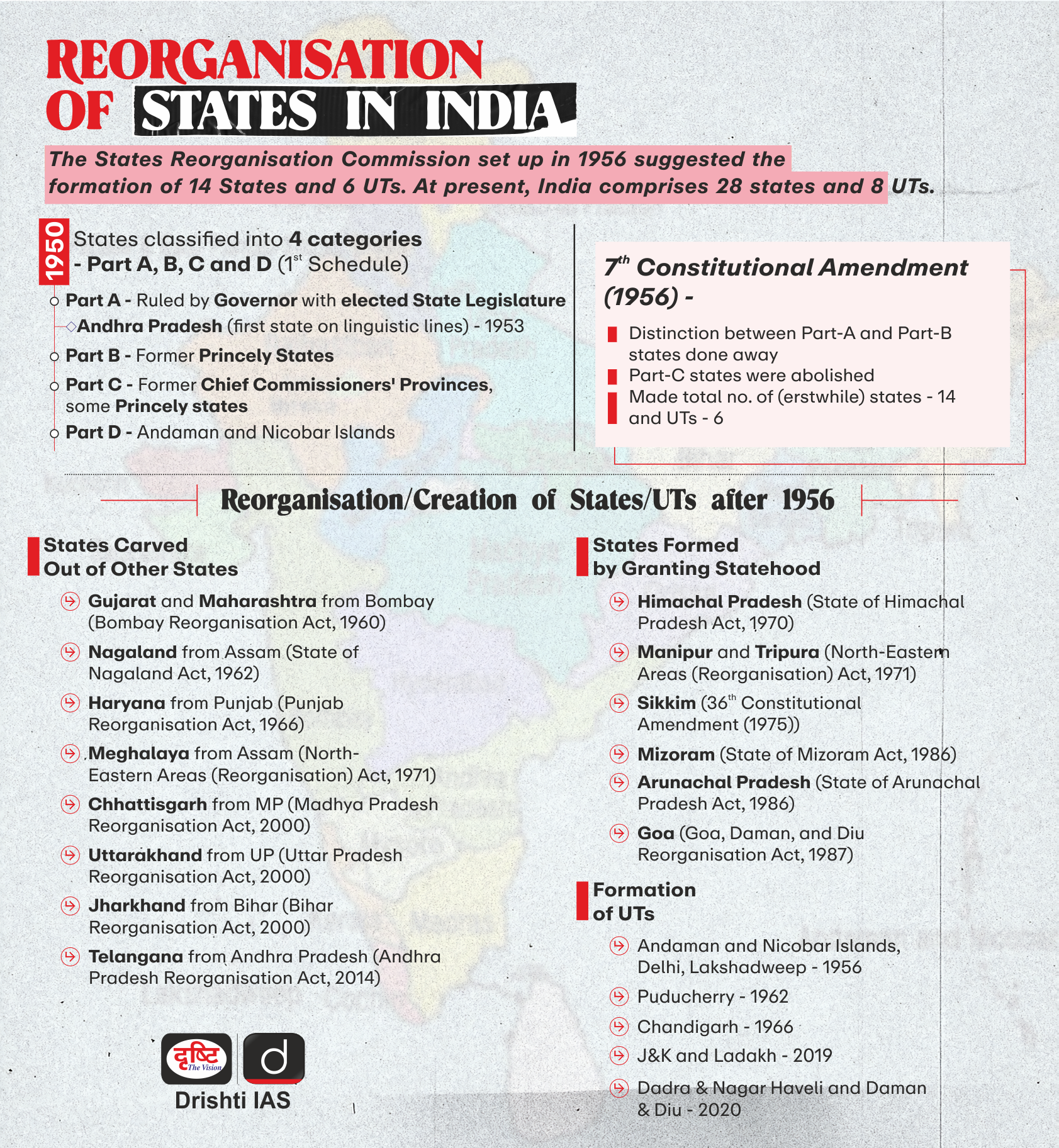
On 20th February, the Prime Minister extended greetings to the people of Arunachal Pradesh and Mizoram on their Statehood Day, marking the grant of full statehood to both states on 20th February 1987.
- Grant of Statehood: The 53rd Constitutional Amendment Act, 1986 granted statehood to Mizoram, while the 55th Constitutional Amendment Act, 1986 conferred statehood to Arunachal Pradesh.
Mizoram
- About: Mizoram became the 23rd state of the Indian Union on 20th February 1987, following the Mizoram Peace Accord (1986) signed between the Government of India and the Mizo National Front.
- The accord ended a period of insurgency and facilitated its transition from Union Territory status (1972) to full statehood.
- Historical Evolution: Mizoram was originally known as the Lushai Hills district of Assam and was renamed Mizo Hills in 1954.
- Constitutional Protection: Mizoram has been recognized as a “tribal area” under the Sixth Schedule of the Constitution of India (Article 244(2)), thereby ensuring the protection of tribal rights and regional autonomy.
Arunachal Pradesh
- About: Arunachal Pradesh attained statehood as the 24th state on 20th February 1987, having previously been known as the North-East Frontier Agency (NEFA) until 1972, when it was renamed and designated a Union Territory.
- Colonial Origin: The modern history of Arunachal Pradesh began with British control under the Treaty of Yandaboo (1826) after the First Anglo-Burmese War (1824–1826), and the 1914 Shimla Treaty demarcated the boundary between Tibet and NEFA (McMahon line).
- Historical Evolution: Until 1962, Arunachal Pradesh remained under Assam’s constitutional jurisdiction, after which it was made a separately administered Union Territory due to its strategic importance.
| Read More: Reorganisation of States in India |
Rapid Fire
International Criminal Court
Former Philippine President Rodrigo Duterte will face a pre-trial hearing at the International Criminal Court over alleged crimes against humanity related to his anti-drug campaign, in which the number of killings is believed to run into the thousands.
International Criminal Court
- About: ICC is the world's first permanent international tribunal, established to prosecute individuals for the most serious crimes of international concern, operating on the principle of complementarity to national judicial systems.
- The Principle of Complementarity establishes ICC as a court of last resort, which can only step in when national authorities are genuinely unwilling or unable to carry out proceedings.
- It does not serve as an appellate body to review or overturn decisions made by domestic courts.
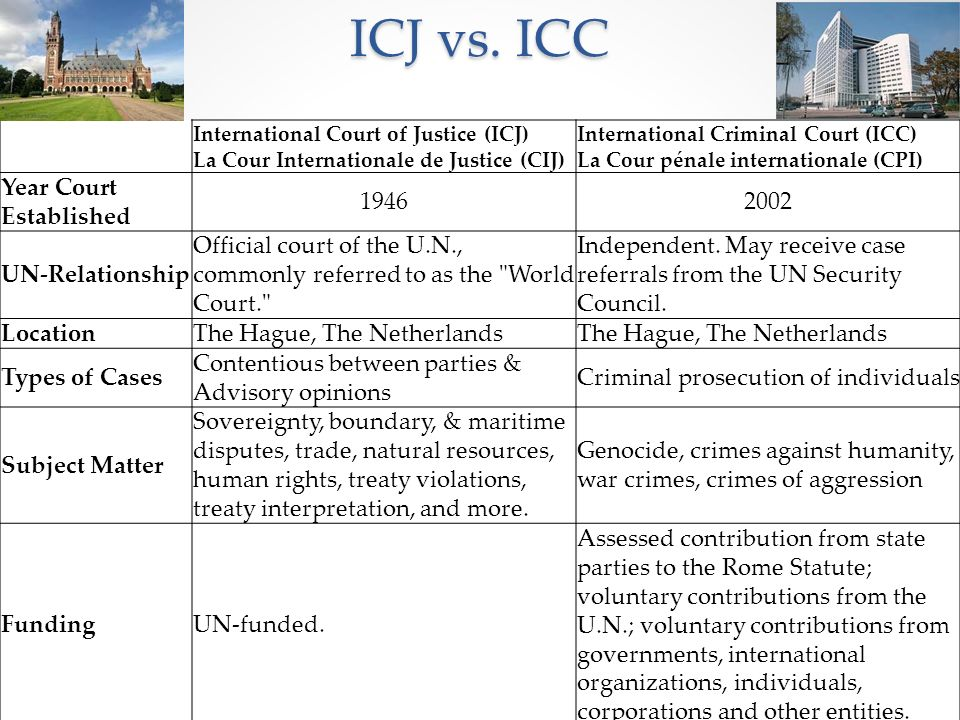
- Legal Basis & Establishment: Established by the Rome Statute, adopted on 17th July 1998 and entered into force on 1st July 2002. Headquartered in The Hague, Netherlands.
- Jurisdiction & Core Crimes: Prosecutes individuals, not states, for four core crimes i.e., Genocide, Crimes against Humanity, War Crimes, and the Crime of Aggression (jurisdiction for aggression activated in 2018). It has jurisdiction over crimes committed after 1st July 2002 (Rome Statute entered into force).
- Triggering Jurisdiction: Territory or national of a State Party.
- UN Security Council (UNSC) referral, even for non-member states.
- Proprio motu (on its own) investigation by the Prosecutor, authorized by the Pre-Trial Chamber.
- Membership and India's Stand: 125 countries (as of February 2026) are States Parties to the Rome Statute of the ICC. India, USA, China, and Israel are non-parties.
- India has objected due to concerns over national sovereignty and the UNSC's referral powers, which it views as politically motivated.
- Structure: Four main organs are the Presidency, Judicial Divisions, Office of the Prosecutor, and Registry.
- The Assembly of States Parties (ASP) provides legislative and management oversight.
- Enforcement: Lacks its own police force; relies on voluntary cooperation of member states for arrest, surrender of suspects, and enforcing sentences.
- Distinction from ICJ: The ICC prosecutes individuals for criminal acts, whereas the International Court of Justice (ICJ) resolves disputes between states.
| Read More: USA Sanctions Against the International Criminal Court |
Rapid Fire
Poland’s Exit from the Ottawa Convention
Poland has officially withdrawn from the 1997 Anti-Personnel Mine Ban Treaty (Ottawa Convention), reversing its earlier commitments after ratifying the treaty in 2012 and completing the destruction of its stockpiles in 2016.
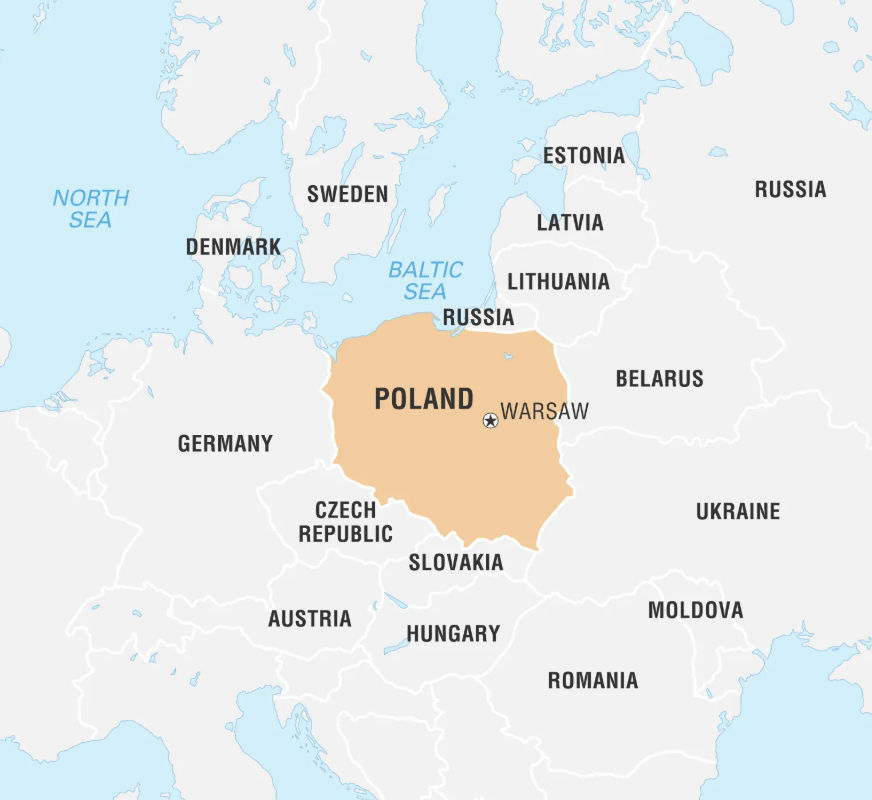
- Geopolitical Rationale: The move is driven by the need to secure the Eastern Shield, a fortification system on the borders with Russia (Kaliningrad) and Belarus, following the invasion of Ukraine.
- Ottawa Convention (1997): Emerged from the Canadian-led Ottawa Process after the First Review Conference of the 1980 Convention on Certain Conventional Weapons which failed to impose strict limits on anti-personnel mines.
- The Ottawa Convention bans the use, stockpiling, production, and transfer of anti-personnel mines due to their long-term civilian impact.
- Types of Landmines: Landmines are mainly anti-personnel and anti-vehicle (anti-tank); while anti-personnel mines are prohibited under the Ottawa Convention, anti-tank mines are not banned and are regulated under the Convention on Certain Conventional Weapons (CCW), 1980 – Amended Protocol II (1996).
- Domestic Production: Poland intends to achieve self-sufficiency by renewing domestic manufacturing of both anti-personnel and anti-tank land mines in cooperation with Polish producers.
- The Polish government stated that mines will remain in stockpiles and will only be deployed in the event of a "realistic threat of aggression" to minimize civilian risk.
- Regional Trend: Since Russia’s full-scale invasion of Ukraine, neighbouring countries have reassessed their commitment to the treaty.
- Poland joined Finland, Estonia, Latvia, Lithuania, and Ukraine in announcing its withdrawal.
- Global Context: India, Russia and the United States are among nearly three dozen nations that have never acceded to the Ottawa Treaty.
| Read more: Ottawa Landmine Convention |
Rapid Fire
India Attends Board of Peace Meet as Observer
India has reinforced its traditional stance on the Israel-Palestine conflict by participating as an ‘observer’ in the inaugural Board of Peace meeting in Washington D.C., while maintaining its commitment to a Two-State solution.
- Board of Peace: Established by the US as a potential rival to the United Nations, the Board includes 27 nations (e.g., Saudi Arabia, UAE, Argentina) and focuses on the redevelopment of the Gaza Strip with a USD 10 billion U.S. commitment.
- India attended the meeting, specifically identifying as an observer rather than a full member of the Board of Peace.
- Alignment with Global Initiatives: India’s participation aligns with its support for the Gaza Peace Plan and UNSC Resolution 2803, reflecting a desire to remain engaged in West Asian stability.
- After an initial delay, India signed a joint statement with over 100 entities criticizing Israel’s expansion of settlements in the West Bank, labeling them a violation of international law.
- Two-State Solution: India reiterated support for a “sovereign, independent, and viable State of Palestine based on 1967 borders,” living side-by-side with Israel.
- Diplomatic Balancing Act: These moves highlight India’s "de-hyphenated" yet principled approach to the India-Arab League relations and Israeli ties.
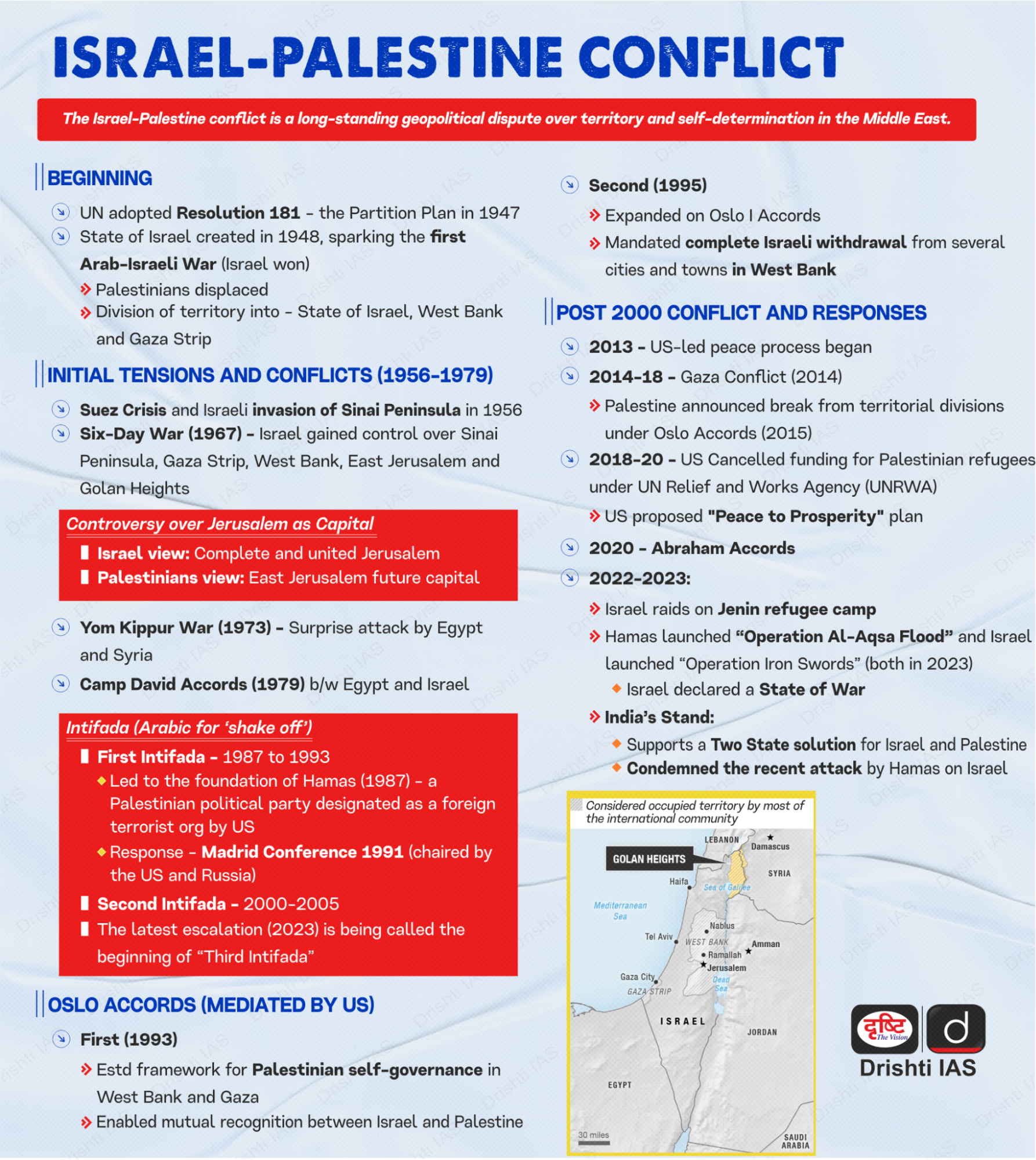
| Read more: Board of Peace for Gaza |
Rapid Fire
RBI to Revise Lead Bank Scheme (LBS)
The Reserve Bank of India (RBI) has released draft guidelines to revise the Lead Bank Scheme (LBS), aiming to streamline its operations, strengthen coordination mechanisms, and enhance its effectiveness.
- Objective of Revision: The focus is on strengthening the State Level Bankers' Committees (SLBCs) and Lead District Manager (LDM) offices for better coordination among banks, government bodies, and development agencies.
- Monitoring Credit-Deposit (CD) Ratio: Banks must monitor the CD ratio, with a draft benchmark set at 60% across rural and semi-urban branches nationwide.
Lead Bank Scheme
- About: LBS, introduced by RBI in December 1969, is a key institutional mechanism designed to promote coordinated banking development, priority sector lending, and financial inclusion at the district level through an "Area Approach."
- Origin: It originated from the recommendations of two 1969 committees: the Gadgil Study Group (which advocated an "Area Approach") and the Nariman Committee (which endorsed it and recommended that banks adopt specific districts).
- It was launched to operationalize the concept of "social banking," integrating developmental roles with commercial objectives for public sector banks.
- Core Objectives: Enhance the flow of bank credit to priority sectors (agriculture, MSMEs, weaker sections), coordinate efforts of banks and government agencies to address credit gaps, etc.
- Key Features:
- Basic Unit: The district serves as the primary unit for credit planning (excluding major metropolitan cities like Mumbai, Kolkata, and Chennai in early implementations).
- Lead Bank: One commercial bank (usually public sector) is designated by the RBI as the Lead Bank for each district.
- Lead District Manager (LDM): A dedicated officer from the Lead Bank oversees implementation.
- Service Area Approach (SAA): Introduced in April 1989, the SAA was an evolution of the Area Approach. It assigned specific clusters of villages (15-25 per branch) to individual bank branches to ensure planned development, prevent overlap, and avoid under-coverage in lending.
| Read More: Revised Priority Sector Lending Guidelines |



