


Governance
International Data Privacy Day
- 29 Jan 2026
- 19 min read
For Prelims: Council of Europe, International Data Privacy Day, Right to Privacy, Digital Public Infrastructure
For Mains: Data privacy and data protection law in India, Key provisions of Data Protection Act 2023 and Draft Digital Personal Data Protection (DPDP) Rules, 2025.
Why in News?
India observed International Data Privacy Day on 28th January, reaffirming its commitment to responsible data practices, public awareness, and trust-based digital governance amid the rapid expansion of digital platforms.
- The day was designated in 2006 by the Council of Europe to commemorate the signing of the Convention for the Protection of Individuals with Regard to Automatic Processing of Personal Data (Convention 108), the world’s first legally binding international treaty on data protection.
Summary
- On International Data Privacy Day India reaffirmed its commitment to responsible data practices and trust-based digital governance amid rapid digitalisation and expanding use of citizen data.
- While the DPDP Act, 2023 and supporting institutions strengthen India’s data protection framework, addressing gaps in regulatory independence, state exemptions, victim remedies, and AI-era risks is essential to translate legal safeguards into real privacy protection.
Convention 108
- It is a 1981 treaty that safeguards the right to privacy amid the growing cross-border flow of automatically processed personal data.
- The Convention has been modernised since 1985, with major updates approved in 2018, introducing mandatory data breach reporting, stronger accountability of data controllers, and new safeguards against risks from algorithmic decision-making and artificial intelligence.
- All Council of Europe members have ratified it, and several non-European countries have acceded to it. India has not signed or ratified the Convention 108.
What is Digital Footprint and How has the Indian Data Privacy Framework Evolved?
- Digital Footprint: It refers to the vast scale and depth of digital platforms that underpin governance, service delivery, and citizen participation across the country.
- India is the world’s third-largest digitalised economy, with 101.7 crore broadband users, ultra-low data costs of USD 0.10 per GB, and deep digital penetration across daily life, enabling mass digital inclusion at a population scale.
- Its Digital Public Infrastructure (including Aadhaar, UPI, MyGov and eSanjeevani (44+ crore digital health consultations) anchors participatory governance and large-scale service delivery.
- Imperative for Data Privacy: The massive scale and sensitivity of personal data generated across these platforms heighten risks of data misuse, cyber threats, and privacy breaches.
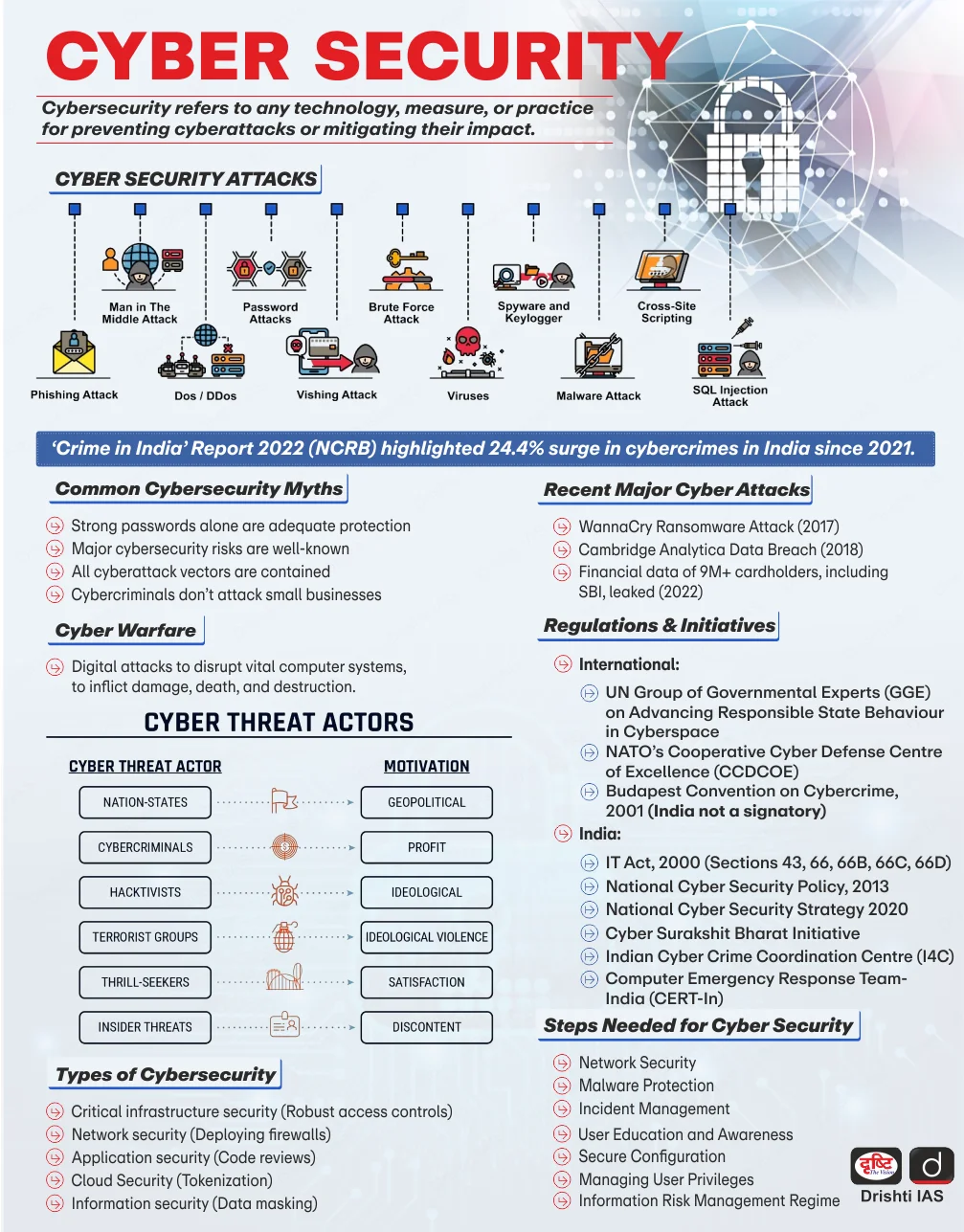
- India is witnessing a surge in phishing, ransomware, identity theft, UPI and online banking frauds. In 2024, the nation recorded 1.91 million cybercrime complaints, reflecting the scale of digital financial vulnerability.
- This makes privacy by design, strong legal frameworks, cybersecurity safeguards, and institutional accountability essential for sustaining public trust, inclusion, and secure digital governance.
- It builds public trust in government-led digital services, strengthens accountability and transparency, and ensures that digital innovation remains citizen-centric, ethical, inclusive, and non-exploitative.
Indian Data Privacy Framework
- Information Technology (IT) Act, 2000: Data protection in India governed by the IT Act, 2000, the country’s core cyberspace law that provides legal recognition to electronic records and digital signatures and enables e-governance and digital commerce.
- The IT Act, 2000, established CERT-In for cyber incident response, with key provisions supporting cybersecurity, adjudication, and content regulation.
- CERT-In is national nodal agency for cybersecurity with a vision of proactive prevention, incident response, and securing India’s communications & information infrastructure
- IT (Intermediary Guidelines & Digital Media Ethics Code) Rules, 2021 (amended in 2025): Prescribe due diligence obligations for intermediaries, mandate time-bound grievance redressal, and aim to ensure a safe, transparent, and accountable online ecosystem aligned with India’s data security needs.
- Intermediaries are defined as entities that store or transmit data on behalf of others, including telecom and internet service providers, online marketplaces, search engines, and social media platforms.
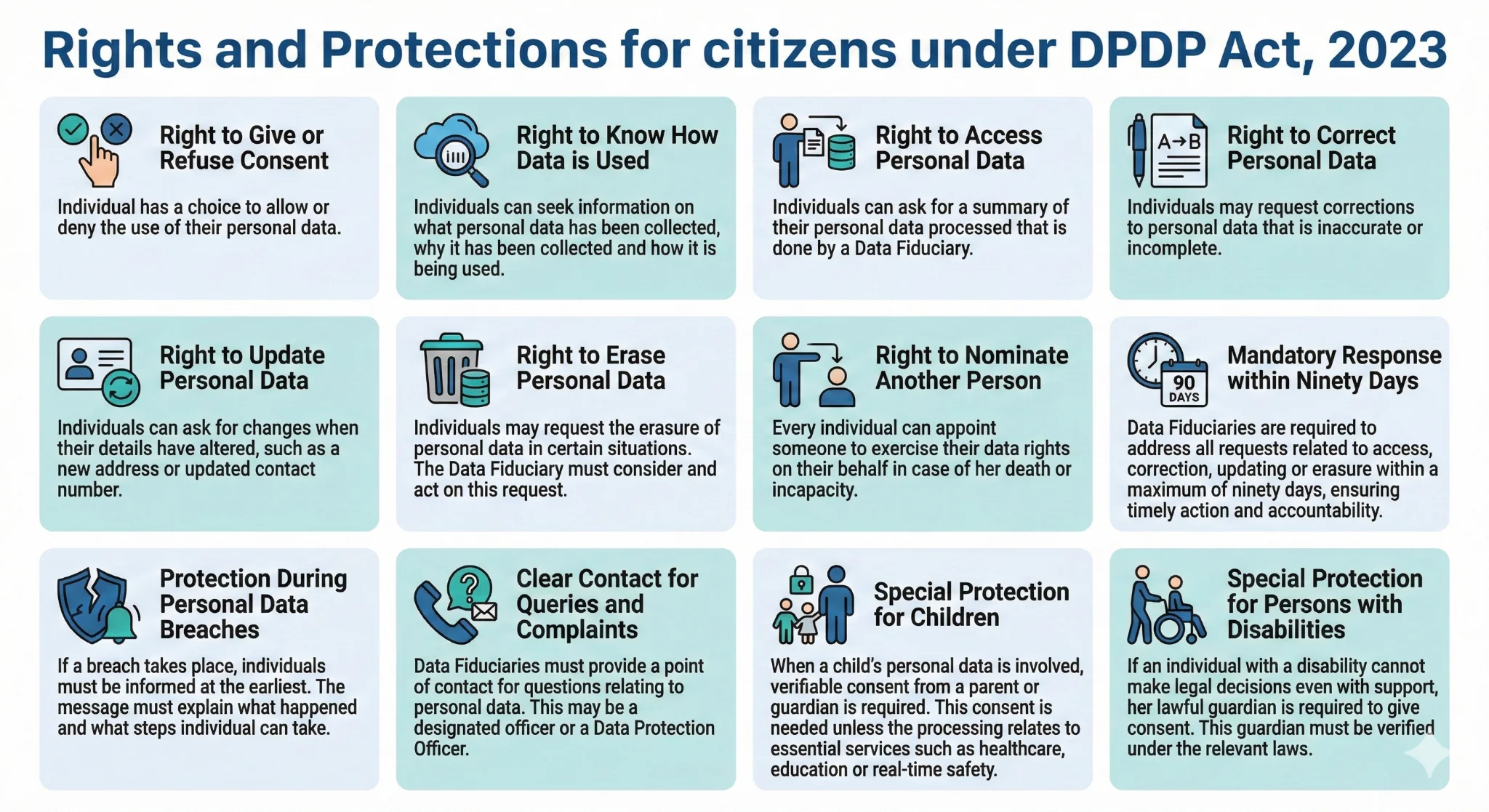
- Digital Personal Data Protection (DPDP) Act, 2023: The roots of this Act can be traced back to the 2017 Supreme Court ruling in Justice K.S. Puttaswamy vs. Union of India, where the right to privacy was officially recognized as a fundamental right under Article 21 of the Constitution. Prior to this, India lacked a dedicated privacy law.
- The Supreme Court held that the right to privacy flows from Article 21 and the freedoms under Part III of the Constitution, and can be restricted only if state action satisfies a three-fold test (it must have legislative backing, pursue a legitimate state aim, and meet the proportionality standard as the least intrusive measure in a democratic society).
- DPDP Act, 2023, governs digital personal data processing, balancing individual privacy with lawful data use for innovation and growth, and follows a SARAL (Simple, Accessible, Rational, Actionable) compliance approach.
- The Data Protection Board of India was established under the DPDP Act, 2023 to oversee compliance, inquire into data breaches and enforce corrective action. It strengthens accountability, grievance redressal and public trust.
- The Act empowers individuals as Data Principals, granting clear rights and greater control over personal data while ensuring organisations act responsibly, transparently, and accountably.
- Digital Personal Data Protection Rules, 2025: The Rules operationalise the DPDP Act, 2023, establishing a citizen-centric data protection regime that safeguards personal data while enabling innovation and responsible use.
- Along with the DPDP Act, the Rules clearly define rights, responsibilities, and enforcement mechanisms, strengthen institutional accountability, and ensure secure, transparent, and future-ready digital governance in India.
Data Privacy & Security Readiness Initiatives
|
Initiative / Mechanism |
Key Features & Significance |
|
MHA-led nodal body, it focuses on cybercrime prevention, detection & response, especially crimes against women & children. |
|
|
National Cyber Crime Reporting Portal (NCRP) & Citizen Financial Cyber Fraud Reporting and Management System (CFCFRMS) |
Enables real-time reporting of cybercrime & financial frauds; supported by Helpline 1930 for nationwide access |
|
Cyber Fraud Mitigation Centre (CFMC) |
Facilitates real-time coordination among banks, telecoms, and law enforcement to block accounts, SIMs, and devices |
|
Sahyog Platform & Suspect Registry |
Sahyog for expedited takedown of unlawful online content and Suspect Registry for identification of mule accounts & fraud-linked digital identifiers |
|
C-DAC Cybersecurity Solutions |
Development of indigenous tools to reduce dependence on foreign technologies and enhance digital sovereignty |
|
National Cyber Forensic Laboratories |
Provide forensic support for data breach analysis, evidence preservation, and cybercrime prosecution |
|
National Management Information System for cybercrime analytics, inter-State coordination, and geo-mapping of cybercrime infrastructure |
|
|
CyTrain (2019) & Cyber Commando Programme (2024) |
Strengthen skilled cybersecurity workforce across law enforcement and institutions |
|
It acts as a Botnet Cleaning and Malware Analysis Centre, providing free malware detection and removal tools. It also provides daily alerts, and best cyber security practices dissemination. |
What are the Key Challenges to Data Protection in India?
- State Exemptions and Constitutional Imbalance: The DPDP Act, 2023, allows the State to exempt itself from core obligations without independent or judicial oversight.
- This creates an uneven privacy regime where citizens are protected from private actors but not from the government. Such asymmetry weakens the constitutional right to privacy under Article 21.
- Executive-Controlled Regulator: The Data Protection Board is appointed and administered by the executive, which is itself the largest data fiduciary.
- This undermines regulatory independence and raises concerns of biased enforcement. Effective data protection requires an arm’s-length regulator, not executive supervision.
- Penalties Without Victim Compensation: While the law imposes heavy fines on data fiduciaries, affected individuals have no direct right to compensation.
- Penalties flow to the State, not to victims, turning data protection into a revenue mechanism rather than a rights framework.
- Citizens must approach civil courts for compensation, making privacy protection inaccessible in practice.
- AI and “Public Data” Grey Zones: The exemption of publicly available personal data creates ambiguity in AI training and data scraping.
- Personal information shared online can be reused without meaningful consent. This dilutes individual control in the age of generative AI and deepfakes.
- Weak Remedies and Complex Grievance Redressal: The grievance mechanism is multi-layered, requiring citizens to approach the company, regulator, and tribunal sequentially.
- This complexity discourages ordinary users from pursuing privacy violations. Access to justice remains limited in practice.
- Cybersecurity Capacity Deficit: Legal safeguards are undermined by weak cyber enforcement capacity and skill shortages.
- AI-enabled fraud, deepfakes, and social engineering exploit human trust rather than technical loopholes. Data protection without cyber capability remains largely symbolic.
What Measures can Strengthen Data Protection in India?
- Structural Independence of the Regulator: The Data Protection Board of India must function as an autonomous regulator rather than an executive body. Adopting a collegium-based appointment system would insulate it from political influence.
- Such institutional independence is essential for credible adjudication against the State, the largest data fiduciary.
- Judicial Oversight for Government Exemptions: Introducing prior judicial or independent authorization for surveillance would prevent misuse. This ensures security concerns are balanced with constitutional privacy safeguards.
- Victim-Centric Compensation Mechanism: Creating a dedicated Data Protection Compensation Fund from collected fines would enable swift victim compensation. Empowering the DPBI to grant ex-gratia relief would make privacy enforcement citizen-centric.
- Promote Bilateral Data Agreements: Support bilateral and multilateral agreements to facilitate safe data exchange, rather than adopting restrictive or isolationist policies.
- Privacy by Design for Consent Managers: Mandating open, interoperable, non-profit models (similar to Account Aggregators) would prevent manipulation and dark patterns. This ensures consent remains meaningful, informed, and user-driven.
Conclusion
Data Privacy Day highlights trust and data protection as core to India’s digital ecosystem. With the DPDP framework and stronger cybersecurity institutions, India is building a secure digital future. It reinforces the shared responsibility of the State, platforms, and citizens in safeguarding digital rights.
|
Drishti Mains Question: “Data protection is a democratic imperative in a digitally governed society.”Examine this statement in the context of India’s Digital Public Infrastructure. |
Frequently Asked Questions (FAQs)
1. What is International Data Privacy Day and why is it observed?
It is observed on 28 January to raise awareness on data protection and commemorate Convention 108, the world’s first legally binding data protection treaty.
2. What is meant by India’s digital footprint?
It refers to the population-scale use of digital platforms like Aadhaar, UPI, MyGov, and eSanjeevani in governance, services, and daily life.
3. What is the significance of the DPDP Act, 2023?
It establishes a citizen-centric data protection framework, empowering individuals as Data Principals and ensuring accountability of data handlers.
4. Which institution enforces data protection under the DPDP Act?
The Data Protection Board of India, which oversees compliance, investigates breaches, and enforces corrective action.
5. How does India strengthen cybersecurity beyond legislation?
Through CERT-In, I4C, NCRP, CFMC, Cyber Swachhta Kendra, and capacity-building programmes like CyTrain and Cyber Commando.
UPSC Civil Services Examination, Previous Year Question (PYQ)
Prelims
Q.1 In India, under cyber insurance for individuals, which of the following benefits are generally covered, in addition to payment for the loss of funds and other benefits? (2020)
- Cost of restoration of the computer system in case of malware disrupting access to one’s computer
- Cost of a new computer if some miscreant wilfully damages it, if proved so
- Cost of hiring a specialised consultant to minimise the loss in case of cyber extortion
- Cost of defence in the Court of Law if any third party files a suit
Select the correct answer using the code given below:
(a) 1, 2 and 4 only
(b) 1, 3 and 4 only
(c) 2 and 3 only
(d) 1, 2, 3 and 4
Ans: (b)
Q.2 In India, it is legally mandatory for which of the following to report on cyber security incidents? (2017)
- Service providers
- Data centres
- Body corporate
Select the correct answer using the code given below:
(a) 1 only
(b) 1 and 2 only
(c) 3 only
(d) 1, 2 and 3
Ans: (d)
Mains
Q. What are the different elements of cyber security ? Keeping in view the challenges in cyber security, examine the extent to which India has successfully developed a comprehensive National Cyber Security Strategy.(2022)



