


Biodiversity & Environment
10 Years of Paris Agreement
- 05 Jan 2026
- 15 min read
For Prelims: Paris Agreement, UNFCCC, Nationally Determined Contributions (NDCs), Kyoto Protocol vs. Paris Agreement, Climate Finance, Common but Differentiated Responsibilities (CBDR)
For Mains: Global Climate Governance: UNFCCC, Paris Agreement, Kyoto Protocol, India’s Climate Commitments and Energy Transition
Why in News?
The Paris Agreement(2015) completed ten years in November 2025, triggering a global re-evaluation of its effectiveness and relevance.
Summary
- The Paris Agreement created universal participation in climate action and mainstreamed mitigation, adaptation, and climate finance through NDCs, transparency, and global stocktakes.
- However, it continues to suffer from weak accountability, persistent finance and equity gaps, and inadequate ambition, underscoring the need for stronger commitments, predictable climate finance, and a better alignment between development priorities and climate action.
What is Paris Agreement?
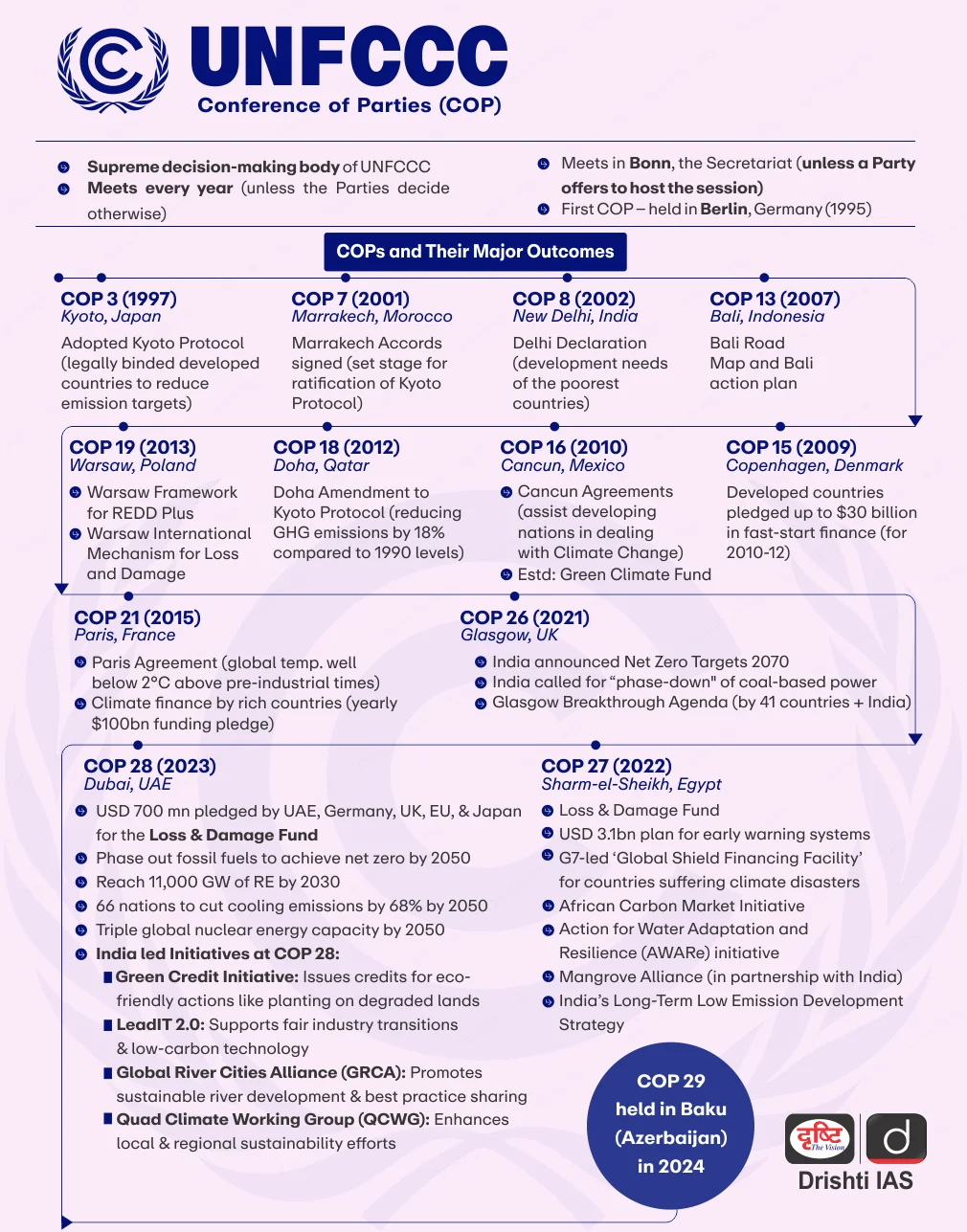
- About: The Paris Agreement is a legally binding global climate agreement adopted in 2015 (21st Conference of the Parties (COP)) under the UN Framework Convention on Climate Change.
- It replaced the Kyoto Protocol, expanding climate responsibility to all countries.
- Objective: It aims to limit global warming to well below 2°C, with efforts to restrict it to 1.5°C above pre-industrial levels.
- Working Procedure: The Paris Agreement follows a five-year cycle of progressively stronger climate action by countries.
- Every five years, countries submit updated Nationally Determined Contributions (NDCs), outlining plans for emission reduction (mitigation) and climate resilience (adaptation).
- In 2023, the first Global Stocktake concluded at COP28, calling for faster action on mitigation, adaptation, and climate finance by 2030, including a push to transition away from fossil fuels.
- Countries are encouraged to submit long-term low-emission development strategies, though these are voluntary.
- The Paris Rulebook, finalised at COP24 (Katowice, Poland) and COP26 (Glasgow, Scotland), laid down detailed rules for implementing the Agreement.
- Key Achievements:
- Universal Participation: Nearly all countries (194 States plus the European Union)committed to climate action under a single framework.
- Climate Finance Commitment: Developed countries committed to mobilising USD 100 billion per year up to 2025 to support developing countries in climate mitigation and adaptation.
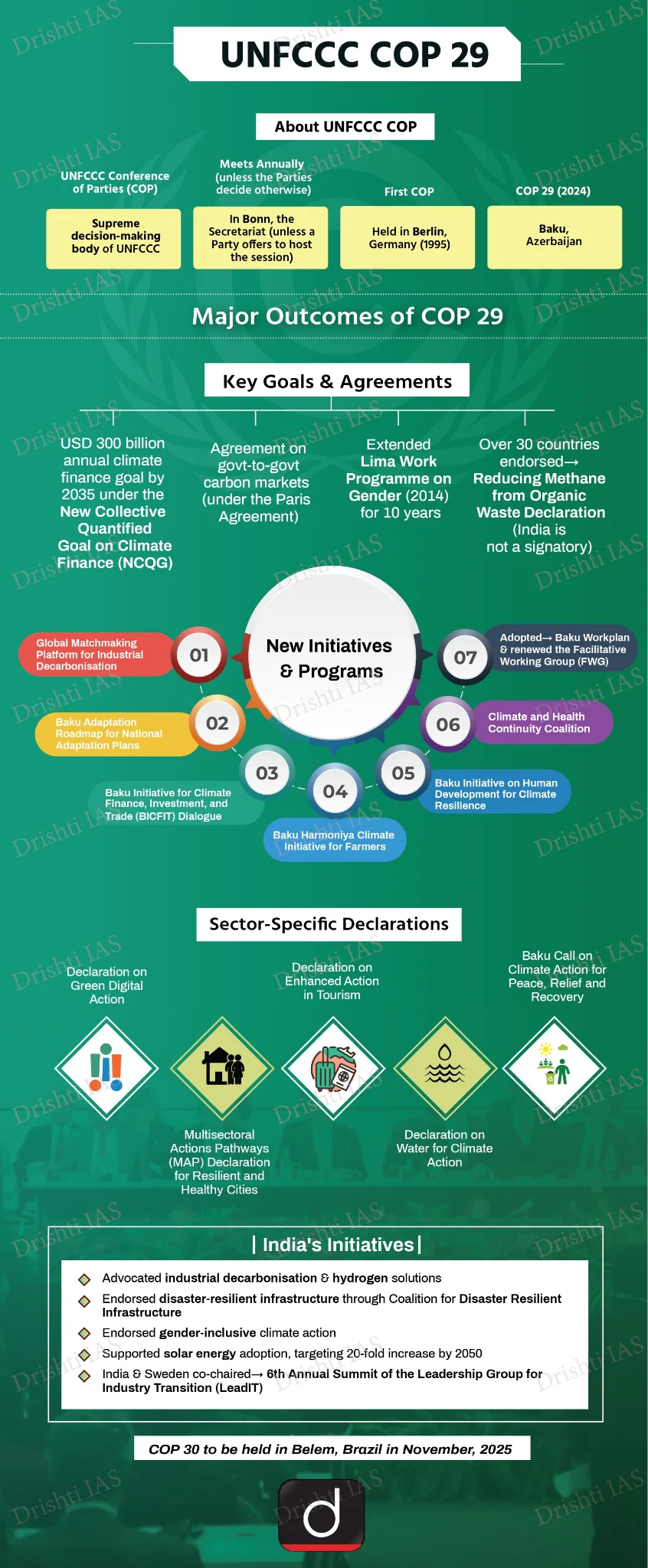
- At COP29 (Baku, Azerbaijan, 2024), a New Collective Quantified Goal (NCQG) was agreed, setting a higher target of at least USD 300 billion annually by 2035.
- Equity principle: The Paris agreement embedded Common But Differentiated Responsibilities (CBDR), recognising differing national capacities and responsibilities.
- Mainstreaming of Climate Policy: Climate action integrated into national laws, budgets, and development plans (e.g. EU Green Deal, India’s Mission LiFE).
- Boost to Climate Finance and Markets: Expansion of green bonds, carbon markets, and climate investments, though still inadequate.
India and Paris Agreement
- India submitted its Intended Nationally Determined Contribution (INDC) to the UNFCCC in 2015, which was adopted as its first Nationally Determined Contribution (NDC) under the Paris Agreement for the period up to 2030.
- The updated NDC commits India to promoting a sustainable lifestyle through the LIFE (Lifestyle for Environment) movement, following a cleaner and climate-friendly development pathway, reducing emissions intensity of GDP by 45% from 2005 levels by 2030, and achieving about 50% of installed electricity capacity from non-fossil fuel sources.
- It also aims to create an additional carbon sink of 2.5 - 3 billion tonnes of CO₂ equivalent, strengthen climate adaptation in vulnerable sectors, mobilise finance from domestic and developed-country sources, and enhance technology transfer and climate R&D.
- India reaffirmed its commitment to the UNFCCC and Paris Agreement, stating that this update is a key step toward its long-term net-zero target by 2070
- Achievements: India achieved 50% of its electricity capacity from non-fossil sources in 2025, well ahead of the 2030 target, and committed to Net Zero emissions by 2070 at COP26.
- It has demonstrated global leadership through initiatives such as the International Solar Alliance (ISA), Coalition for Disaster Resilient Infrastructure (CDRI), and the LiFE movement, while aligning its climate vision with “Viksit Bharat 2047” and positioning solar and green hydrogen as key drivers of growth and employment.
What are the Concerns Regarding the Paris Agreement?
- Voluntary Commitments: The Paris Agreement replaced the Kyoto Protocol’s legally binding emission targets for developed countries with voluntary NDCs, weakening accountability.
- Equity Concerns: Uniform emissions reduction expectations dilute the principle of CBDR and ignore historical emissions of developed countries, and LDCs (Least Developed Countries) and SIDS (Small Island Developing States) face existential risks without adequate support.
- Climate Finance Gap: India rejected the NCQG, criticising it for its inadequacy. The USD 300 billion pledge was deemed insufficient for addressing the climate challenges faced by developing nations.
- India, alongside other Global South countries, has been advocating for at least USD 1.3 trillion annually to meet the growing demands of climate change mitigation and adaptation in developing nations, with USD 600 billion as grants or grant-equivalent resources.
- Mitigation-centric Approach: Excessive focus on emission reduction sidelines adaptation and resilience, crucial for vulnerable nations.
- Development Constraints: Climate obligations and measures like carbon border taxes (e.g. (CABM) restrict energy and industrial choices of developing economies.
- Insufficient Ambition: Current NDCs place the world on a 2.5–2.9°C warming path, fall far short of the 1.5°C and even 2°C targets, risking severe climate impacts.
What Measures are Needed to Strengthen Climate Action?
- Shift From Voluntary To Enforceable Action: Climate commitments must move beyond voluntary pledges to legally backed, time-bound national policies, including sector-wise carbon budgets and measurable milestones.
- Balance Mitigation With Adaptation: Climate action should give equal priority to adaptation, with greater investment in climate-resilient infrastructure, agriculture, water systems, and early warning mechanisms.
- Bridge The Climate Finance Gap: Developed countries must fulfil and scale up climate finance commitments, while reforms in multilateral banks, green bonds, and blended finance reduce costs for developing nations.
- Reinforce Equity And Climate Justice: The principle of common but differentiated responsibilities and respective capabilities (CBDR-RC) must guide implementation, ensuring policy space for developing countries and fairness in trade measures like carbon border taxes.
- Accelerate Technology Access: Affordable access to renewables, storage, green hydrogen, and grid technologies should be expanded through technology transfer, patent pooling, and South–South cooperation.
- Strengthen Climate Science And Governance: Robust climate action requires credible science, transparent data, and countering climate misinformation, supported by strong monitoring and verification mechanisms.
China Model in Climate Action
- The China model of climate action follows a development-first approach, allowing emissions to rise during rapid industrialisation while simultaneously building massive capacities in renewable energy, electrification, and clean technologies.
- After achieving economic scale and energy security, China has committed to peaking emissions before 2030 and reaching net zero by 2060, demonstrating that early investment in clean energy can enable faster decarbonisation at a later stage.
Conclusion
The Paris Agreement enabled global participation but suffers from weak accountability, finance gaps, and equity concerns. Strengthening climate action requires enforceable commitments, assured finance, and equal focus on adaptation and mitigation. For India, aligning climate goals with development offers a balanced and pragmatic pathway forward.
|
Drishti Mains Question: Critically examine the effectiveness of the Paris Agreement after a decade. What structural limitations constrain its success? |
Frequently Asked Questions (FAQs)
1. What is the Paris Agreement and when was it adopted?
The Paris Agreement is a legally binding global climate treaty adopted in 2015 at COP21 under the UNFCCC to limit global warming to below 2°C, preferably 1.5°C.
2. What are Nationally Determined Contributions (NDCs)?
NDCs are country-specific climate action plans submitted every five years, outlining emission reduction and adaptation measures.
3. What was the significance of the first Global Stocktake at COP28?
The Global Stocktake (2023) assessed collective progress and called for faster action on mitigation, adaptation, and climate finance by 2030.
4. Why is the Paris Agreement criticised for weak accountability?
It relies on voluntary NDCs rather than legally binding emission targets, with no penalties for non-compliance.
UPSC Civil Services Examination, Previous Year’s Question (PYQs)
Prelims:
Q. The term ‘Intended Nationally Determined Contributions’ is sometimes seen in the news in the context of (2016)
(a) pledges made by the European countries to rehabilitate refugees from the war-affected Middle East
(b) plan of action outlined by the countries of the world to combat climate change
(c) capital contributed by the member countries in the establishment of Asian Infrastructure Investment Bank
(d) plan of action outlined by the countries of the world regarding Sustainable Development Goals
Answer: (b)
Q. With reference to the Agreement at the UNFCCC Meeting in Paris in 2015, which of the following statements is/are correct? (2016)
- The Agreement was signed by all the member countries of the UN and it will go into effect in 2017.
- The Agreement aims to limit the greenhouse gas emissions so that the rise in average global temperature by the end of this century does not exceed 2°C or even 1.5°C above pre-industrial levels.
- Developed countries acknowledged their historical responsibility in global warming and committed to donate $1000 billion a year from 2020 to help developing countries to cope with climate change.
Select the correct answer using the code given below.
(a) 1 and 3 only
(b) 2 only
(c) 2 and 3 only
(d) 1, 2 and 3
Answer: (b)
Mains
Q1. The Intergovernmental Panel on Climate Change (IPCC) has predicted a global sea level rise of about one metre by AD 2100. What would be its impact in India and the other countries in the Indian Ocean region? (2023)
Q2. Discuss global warming and mention its effects on the global climate. Explain the control measures to bring down the level of greenhouse gases which cause global warming, in the light of the Kyoto Protocol, 1997. (2022)
Q3. Describe the major outcomes of the 26th session of the Conference of the Parties (COP) to the United Nations Framework Convention on Climate Change (UNFCCC). What are the commitments made by India in this conference? (2021)



