Biodiversity & Environment
Rat-Hole Mining in Meghalaya
For Prelims: Rat-Hole Mining, National Green Tribunal, Sixth Schedule of the Constitution, Acid Mine Drainage
For Mains: Rat-hole Mining and Environmental Governance, Sixth Schedule and Challenges in Resource Regulation, Illegal Mining and Institutional Failure
Why in News?
A major disaster has unfolded in Meghalaya’s East Jaintia Hills, where at least 18 workers died following an explosion in an illegally operating rat-hole coal mine.
- The incident once again exposed the continued prevalence of rat-hole mining despite long-standing bans by the National Green Tribunal(NGT) and the Supreme Court (SC) of India.
Summary
- The recent rat-hole mining tragedy in Meghalaya exposes the continued prevalence of illegal, unsafe coal extraction despite bans by the National Green Tribunal and the Supreme Court, driven by thin coal seams, livelihood dependence and weak enforcement under Sixth Schedule autonomy.
- Rat-hole mining causes severe human rights violations and environmental damage, including deaths from flooding and suffocation, acid mine drainage, deforestation and river pollution, highlighting the need for stronger surveillance and sustainable livelihood alternatives.
What is Rat-hole Mining?
- About: Rat-hole mining is a primitive and hazardous method of coal extraction in which very narrow tunnels are dug just large enough for a person to crawl through.
- The tunnels are typically 3–4 feet high, forcing miners to work in squatting or crawling positions with basic tools.
- Rat-hole Mining involves no scientific planning, ventilation, or structural support, making it extremely dangerous.
- While predominantly practised in Meghalaya, reports of rat-hole mining have surfaced in other northeastern states of India as well.
- Types: Side-cutting, where horizontal tunnels are dug into hill slopes by following exposed coal seams.
- Box-cutting, where a deep vertical pit is first dug, and then multiple horizontal tunnels branch out in all directions like tentacles.
- The method involves no scientific planning, ventilation, or structural support, making it extremely dangerous.
- Legality: The National Green Tribunal (NGT) banned the practice in 2014, citing it as "unscientific and illegal" and highlighting the environmental damage.
- The ban has been upheld by the Supreme Court. All rat-hole mining operations today are illegal and constitute violations of the Mines and Minerals (Development and Regulation) (MMDR) Act, 1957.
- Reasons for Persistence:
- Geological Necessity: The coal seams in Meghalaya are very thin (often less than 2 meters).
- Open-cast mining, which is standard elsewhere, is economically unviable here because removing the vast amount of soil/rock to reach such thin seams is too expensive. Rat-hole mining targets the seam directly with minimal waste removal.
- Economic Dependence: For many local communities, this is the only known source of livelihood. The "quick money" from coal supports entire local economies.
- Lack of Alternatives: The region lacks significant industrial development or alternative employment opportunities, pushing locals back into the mines despite the risks.
- Demand: Local and regional industries continue to rely on this cheap, black-market coal.
- Reports often point to a collusion between mine owners, local authorities, and political figures, allowing the trade to continue despite official bans.
- Geological Necessity: The coal seams in Meghalaya are very thin (often less than 2 meters).
What are the Concerns Associated with Rat-hole Mining?
- Safety Hazards: The mines are death traps. They lack pillars for support, ventilation systems, or emergency exits.
- Common causes of death include roof collapses, flooding (as seen in the 2018 Ksan disaster), and asphyxiation from toxic gases.
- The employment of children in these hazardous conditions highlights serious child labour violations.
- Water Pollution: The most critical impact is Acid Mine Drainage (AMD). When sulfur-bearing minerals in coal interact with water and oxygen, they produce sulfuric acid.
- This contaminates nearby water bodies with heavy metals like Iron, Cadmium, and Chromium.
- Rivers such as the Kopili (Assam-Meghalaya border), Myntdu, and Lukha (Jaintia Hills) have turned too acidic to sustain aquatic life.
- Deforestation & Soil Erosion: Massive forest clearing for mining has led to biodiversity loss and topsoil erosion, rendering the land infertile.
- Air Pollution: Operations release fine particulate matter and toxic gases, severely degrading air quality in regions inhabited by Scheduled Tribes like the Jaintias, Khasis, and Garos.
- "Black Lung" Disease: Workers, who are often children, suffer from silicosis and pneumoconiosis due to prolonged exposure to coal dust without protective gear.
- Poor ventilation increases the risk of asphyxiation and poisoning from gases trapped in the mines.
- Regulatory Challenges: In Sixth Schedule areas, ownership of both land and minerals rests with local communities and Autonomous District Councils (ADCs), limiting central oversight and often leading to conflicts between ADC regulations and national frameworks such as the MMDR Act, 1957
- Although the MMDR Act, 1957 empowers states to curb illegal mining, enforcement is paralyzed by a lack of manpower, corruption, and political interference.
What Measures can Effectively End Rat-hole Mining Crisis?
- Technological surveillance: Use drones, satellite imagery and Geographical Information System (GIS) mapping to detect illegal mining in real time in remote areas, supported by a centralized database to track offenders and repeat violations.
- Alternative Livelihoods: The government must develop viable alternative livelihoods by promoting pineapple cultivation, eco-tourism, and other agri-horticulture sectors where Meghalaya has strong comparative potential, thereby reducing dependence on mining.
- Empowered "Mining EACs": Create a dedicated cadre of Extra Assistant Commissioners (EACs) whose sole KPI (Key Performance Indicator) is mining oversight. They should report directly to the NGT committee, bypassing local political pressure.
- MEPRF Utilization: The Meghalaya Environment Protection and Restoration Fund should be strictly ring-fenced to pay wages to former miners engaged in ecological restoration, creating a dedicated “Green Corps.”
- Open-cast Methods: If mining must continue for the economy, it cannot be rat-hole. The state must invest in open-cast methods in designated zones where the seam is thick enough.
- This allows for ventilation, safety pillars, and mechanized extraction, but it requires consolidating small land holdings into larger cooperatives to be viable.
Conclusion
Ending the rat-hole mining crisis demands a dual approach: enforcing strict technological surveillance while proactively funding sustainable livelihoods to break the economic dependence on illegal extraction.
|
Drishti Mains Question: Discuss the environmental and human health impacts of rat-hole mining. |
Frequently Asked Questions (FAQs)
1. What is rat-hole mining?
Rat-hole mining is a primitive coal extraction method involving narrow, unventilated tunnels dug manually, forcing workers to crawl and squat, posing extreme safety risks.
2. Why was rat-hole mining banned in Meghalaya?
It was banned by the National Green Tribunal in 2014 due to deaths from flooding and suffocation, severe environmental damage, and its unscientific nature.
3. Why does rat-hole mining continue despite the ban?
Thin coal seams, livelihood dependence, lack of alternatives, demand for cheap coal, and weak enforcement under Sixth Schedule autonomy enable its persistence.
4. What are the major environmental impacts of rat-hole mining?
It causes acid mine drainage, river acidification, deforestation, soil erosion, air pollution and loss of aquatic life.
5. What measures can help end the rat-hole mining crisis?
Technological surveillance, alternative livelihoods, empowered oversight officers, ecological restoration using MEPRF funds, and transition to scientific mining methods.
UPSC Civil Services Examination, Previous Year Questions (PYQ)
Mains
Q. In spite of adverse environmental impact, coal mining is still inevitable for development. Discuss. (2017)


Facts for UPSC Mains
Anti-Defection Law
Why in News?
The Supreme Court (SC) of India gave a final three-week deadline to the Telangana Assembly Speaker to decide pending disqualification petitions against defecting Members of the Legislative Assembly (MLAs) under the Anti-Defection Law, stating that non-compliance will invite contempt proceedings.
What is the Anti-Defection Law?
- About: Anti-Defection Law, introduced by the 52nd Amendment in 1985, adding the Tenth Schedule to the Constitution.
- It aimed to stop political defections for personal gain. It applies to both Parliament and State Assemblies.
- The law was strengthened by the 91st Constitutional Amendment Act, 2003, which omitted the provision related to a "split" (where 1/3rd members could defect) and retained only the "merger" provision.
- Objectives of the Law: Maintain political stability and prevent government toppling and curbs horse-trading by discouraging parties from luring legislators with incentives.
- Enforce party discipline via voting according to the party whip.
- Allow merger of parties without disqualification and strengthen democracy.
- Grounds for Disqualification: Voluntarily give up party membership (can be inferred from conduct, not just resignation).
- Voting or abstaining from voting against the party whip can lead to disqualification.
- A legislator can further be disqualified if he is an independently elected member and joins a political party.
- A nominated member is disqualified if they join a political party after six months of becoming a legislator.
- Exceptions to Disqualification: A party can merge with another if two-thirds of its legislators agree, with no disqualification for those who merge or stay.
- No disqualification for Speaker/Chairman/Deputy Chairman resigning from the party to remain neutral.
- Role of the Presiding Officer: Disqualification cases are decided by the Speaker/Chairman.
- The decision is subject to judicial review, courts can intervene only after the decision is made.
- Criticisms of the Law: No time limit specified in the law for the Speaker to decide.
- Courts have criticized delays, but can't intervene until the Speaker makes a decision.
- Speakers often belong to the ruling party and are accused of delaying disqualification petitions for years to favor the government (e.g., the "pocket veto" issue).
- It curbs dissent by limiting legislators' freedom to vote as per their conscience or represent their constituents, forcing them to follow party lines.
- It also discourages intra-party democracy by allowing party leadership to suppress internal criticism.
Supreme Court’s Stance on Anti-Defection
- Padi Kaushik Reddy v. State of Telangana (2025): SC urged Parliamentary reforms to ensure timely and fair adjudication of defection cases and re-examine the Speaker’s role.
- Keisham Meghachandra Singh vs The Hon’ble Speaker, Manipur Legislative Assembly (2020): Speaker must decide disqualification cases within 3 months; delays defeat the Tenth Schedule. SC also suggested an independent tribunal to ensure neutrality and speed.
- Ravi S. Naik v. Union of India (1994): Speaker must act as a neutral adjudicator, an MP/MLA can be disqualified without formally resigning if conduct shows defection.
- Kihoto Hollohan v. Zachillhu (1992): Speaker’s decisions under the Anti-Defection Law are subject to judicial review in cases of mala fide intent, procedural irregularity, or constitutional violation.
What Measures can Strengthen Anti-Defection Law?
- Stronger Enforcement: As recommended by committees like the Dinesh Goswami Committee (1990), Hashim Abdul Halim Committee (1994), and the Law Commission Reports (1999 & 2015), defection proceedings should be made time-bound, transparent, and open to public scrutiny to build trust, ensure accountability, and prevent misuse of the Anti-Defection Law.
- Decision-Making Power: Transfer the authority to decide disqualification cases from the Speaker to an independent body (a permanent tribunal headed by retired judges or the Election Commission), to reduce political bias.
- The 2nd Administrative Reforms Commission (ARC) recommended that defection cases be decided by the President or Governor on the Election Commission's advice.
- Intra-Party Democracy: Encourage internal party debates and reduce top-down decision-making, as recommended by the 170th Law Commission Report.
- Resignation Convention: Adopting the British convention where the Speaker resigns from their party upon election to the post could help ensure neutrality.
- Limiting the Scope of the "Whip": The Whip should only be binding for "Critical Motions" (e.g., No-Confidence Motion, Money Bills, or motions threatening the government's survival).
- On all other bills (developmental, social), MPs/MLAs should be free to vote according to their conscience and constituency interests. This restores the balance between stability and representative democracy.
Conclusion
The Supreme Court’s warning exposes delays and bias in enforcing the Anti-Defection Law. Reforms such as time-bound decisions and independent adjudication are needed to uphold democratic accountability.
|
Drishti Mains Question: “Delays in deciding disqualification petitions defeat the very purpose of the Anti-Defection Law.” Discuss in the light of recent Supreme Court interventions. |
Frequently Asked Questions (FAQs)
1. What is the Anti-Defection Law?
Introduced by the 52nd Constitutional Amendment (1985), it added the Tenth Schedule to curb political defections for personal or political gain.
2. On what grounds can an MP or MLA be disqualified?
Voluntarily giving up party membership, violating the party whip, an independent member joining a party, or a nominated member joining a party after six months.
3. Are the Speaker’s decisions on defection final?
No. As held in Kihoto Hollohan v. Zachillhu (1992), Speaker’s decisions are subject to judicial review for mala fide intent or constitutional violation.
4. What reforms have been suggested to improve the Anti-Defection Law?
Making decisions time-bound, shifting adjudication to an independent tribunal or Election Commission, and strengthening intra-party democracy.
UPSC Civil Services Examination, Previous Year Questions (PYQ)
Prelims:
Q. Which one of the following Schedules of the Constitution of India contains provisions regarding anti-defection? (2014)
(a) Second Schedule
(b) Fifth Schedule
(c) Eighth Schedule
(d) Tenth Schedule
Ans: (d)
Mains:
Q. The role of individual MPs (Members of Parliament) has diminished over the years and as a result healthy constructive debates on policy issues are not usually witnessed. How far can this be attributed to the anti-defection law which was legislated but with a different intention?(2013)


Important Facts For Prelims
Revised Startup Recognition Framework
Why in News?
India has revised the startup recognition framework under the Startup India Action Plan, marking a significant policy update as the Startup India initiative enters its second decade.
- In 2024, only about 10% of Department for Promotion of Industry and Internal Trade (DPIIT)-recognised startups were deep tech, a level flagged as too low, prompting reforms to build a future-ready ecosystem aligned with India’s innovation, manufacturing, and emerging technology goals.
What are the Key Revisions in India's Startup Recognition Framework?
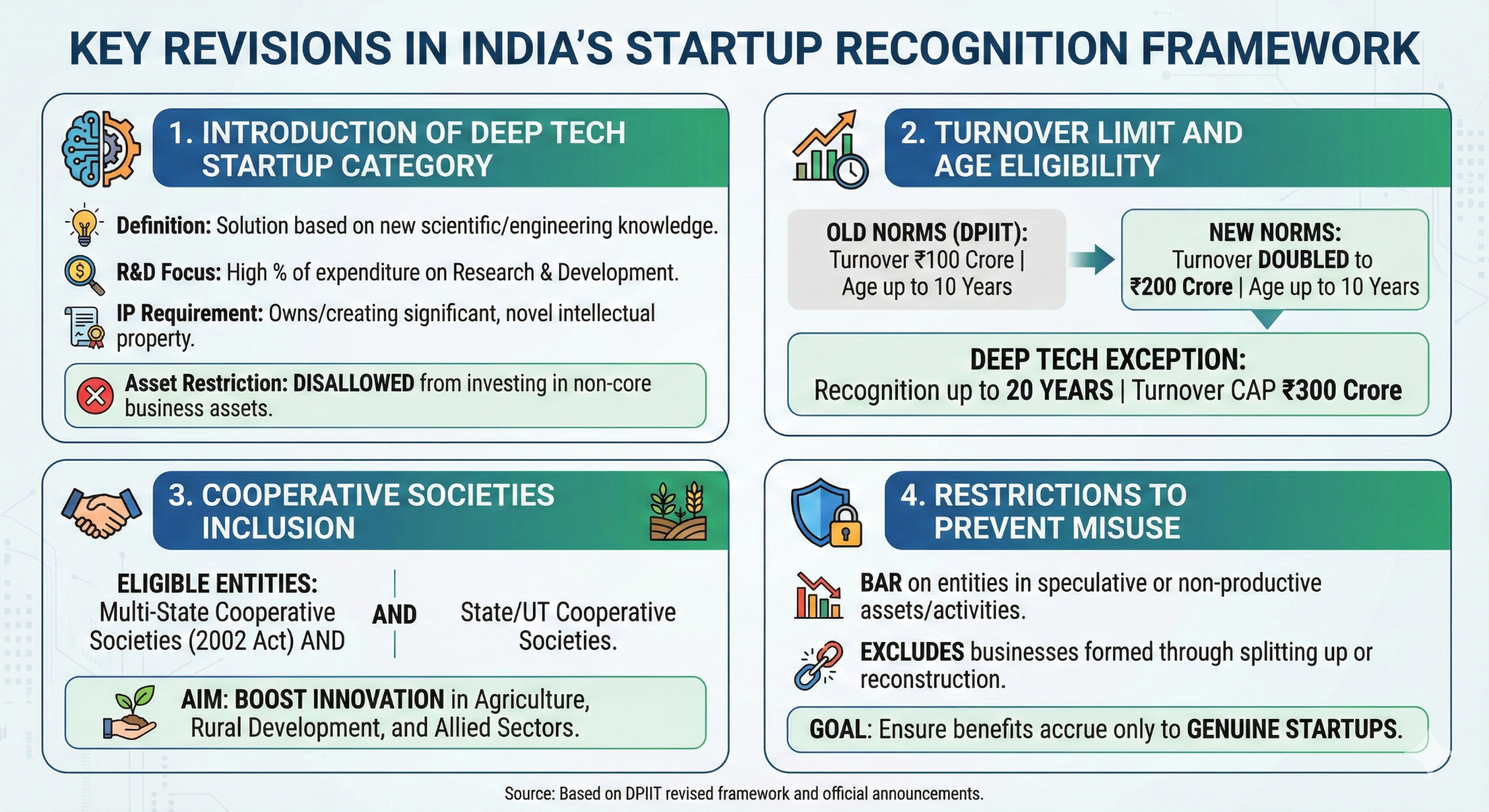
- Introduction of a Deep Tech Startup Category: A dedicated sub-category of startup has been introduced for "Deep Tech Startups" with specific criteria to identify genuine innovation:
- Definition: The entity must develop solutions based on new scientific or engineering knowledge, involving long development cycles, extended gestation periods, high capital and infrastructure needs, and significant technical or scientific uncertainty.
- R&D Focus: It must have a high percentage of expenditure on Research & Development relative to its revenue or funding.
- IP Requirement: The entity must own or be in the process of creating significant, novel intellectual property (IP) and be taking steps to commercialise it.
- Asset Restriction: During the recognition period, Deep Tech startups are explicitly disallowed from investing in assets or activities not integral to their core business.
- Authority: The DPIIT is the final authority that determines whether a company qualifies as a startup or a deep tech startup.
- It will decide this based on “guidance” from an Inter-Ministerial Board of Certification.
- Turnover Limit and Age Eligibility: Under the new DPIIT norms, the turnover limit for startup recognition has been doubled from Rs 100 crore to Rs 200 crore for entities up to 10 years from incorporation.
- For deep tech startups, the recognition period has been extended from 10 to 20 years from incorporation, with the turnover limit raised to Rs 300 crore.
- Cooperative Societies: Both Multi-State Cooperative Societies (under Multi-State Cooperative Societies Act, 2002) and Cooperative Societies (under State and Union Territory Cooperative Acts) are now eligible for startup recognition.
- This move specifically aims to boost innovation in agriculture, rural development, and allied sectors.
- Restrictions to Prevent Misuse: To ensure that benefits accrue only to genuine startups, the revised framework introduces stricter safeguards, including a bar on entities engaged in speculative or non-productive assets or activities, as notified by the government.
- It also clearly excludes businesses formed through the splitting up or reconstruction of existing enterprises from being recognised as startups.
Note: The Anusandhan National Research Foundation (ANRF) is the custodian of the Rs 1 lakh crore Research and Development Innovation (RDI) Fund that is expected to invest in emerging technology and fund research over seven years.
- A part of these investments, which will be through secondary fund managers such as financial institutions, will go to deep tech startups.
What is the Startup India Initiative?
- About: The Startup India Initiative launched on 16th January 2016, led by DPIIT under the Ministry of Commerce and Industry, has evolved into a full-stack platform supporting startups from ideation to scale.
- Startup India Action Plan: An Action Plan for Startup India was unveiled in 2016.
- The Action Plan comprises 19 action items spanning across areas such as “Simplification and handholding”, “Funding support and incentives” and “Industry-academia partnership and incubation”.
- The Action Plan laid the foundation of Government support, schemes and incentives envisaged to create a vibrant startup ecosystem in the country.
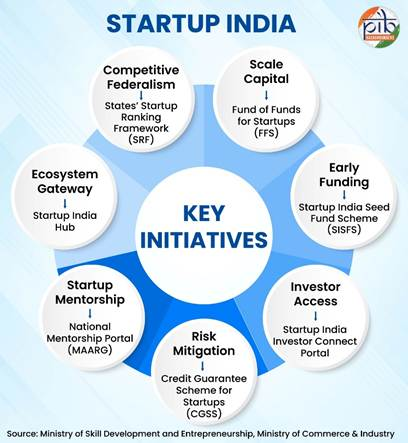
- Major Schemes & Support Pillars: The Fund of Funds for Startups channels a Rs 10,000 crore corpus through SEBI-registered Alternative Investment Funds to expand domestic risk capital.
- The Credit Guarantee Scheme for Startups enables collateral-free lending via eligible financial institutions.
- The Startup India Seed Fund Scheme provides early-stage funding for proof of concept, prototyping, and market entry.
- The Startup India Hub acts as a single-window digital platform linking startups with investors, mentors, incubators, corporates, and government bodies.
- At the federal level, the States’ Startup Ranking Framework promotes competitive federalism by assessing startup policy performance across States and UTs.
- Mentorship and networking platforms such as Mentorship, Advisory, Assistance, Resilience, and Growth (MAARG) and Startup India Investor Connect Portal bridge founders with mentors and investors, strengthening the overall startup ecosystem.
- Impact & Achievements:
- Scale: India is now one of the world's largest startup ecosystems with over 2 lakh recognized startups.
- Unicorns: The number of unicorns (startups valued at USD 1 Billion+) has grown from just 4 in 2014 to over 120.
- Inclusivity: Over 45% of startups have at least one woman director, and nearly 50% of recognized startups come from Tier II and Tier III cities.
Frequently Asked Questions (FAQs)
1. What is the key objective of revising the Startup Recognition Framework?
To create a predictable, inclusive, and innovation-focused ecosystem while ensuring benefits reach genuine startups.
2. Who qualifies as a Deep Tech Startup under the new framework?
Startups based on scientific or engineering advancements with high R&D spend and ownership of novel intellectual property.
3. What changes have been made to turnover and age limits for startups?
General startups can now have up to Rs 200 crore turnover and 10 years’ age, while deep tech startups get 20 years and Rs 300 crore cap.
4. Why are cooperative societies included in startup recognition?
To boost innovation in agriculture, rural development, and allied sectors through cooperative-led entrepreneurship.
UPSC Civil Services Examination Previous Year Question (PYQ)
Prelims
Q. With reference to ‘Stand Up India Scheme’, which of the following statements is/are correct? (2016)
- Its purpose is to promote entrepreneurship among SC/ST and women entrepreneurs.
- It provides for refinance through SIDBI,
Select the correct answer using the code given below.
(a) 1 only
(b) 2 only
(c) Both 1 and 2
(d) Neither 1 nor 2
Ans: C
Q. What does venture capital mean? (2014)
(a) A short-term capital provided to industries
(b) A long-term start-up capital provided to new entrepreneurs
(c) Funds provided to industries at times of incurring losses
(d) Funds provided for replacement and renovation of industries
Ans: (b)


Important Facts For Prelims
RBI MPC Keeps Repo Rate Unchanged
Why in News?
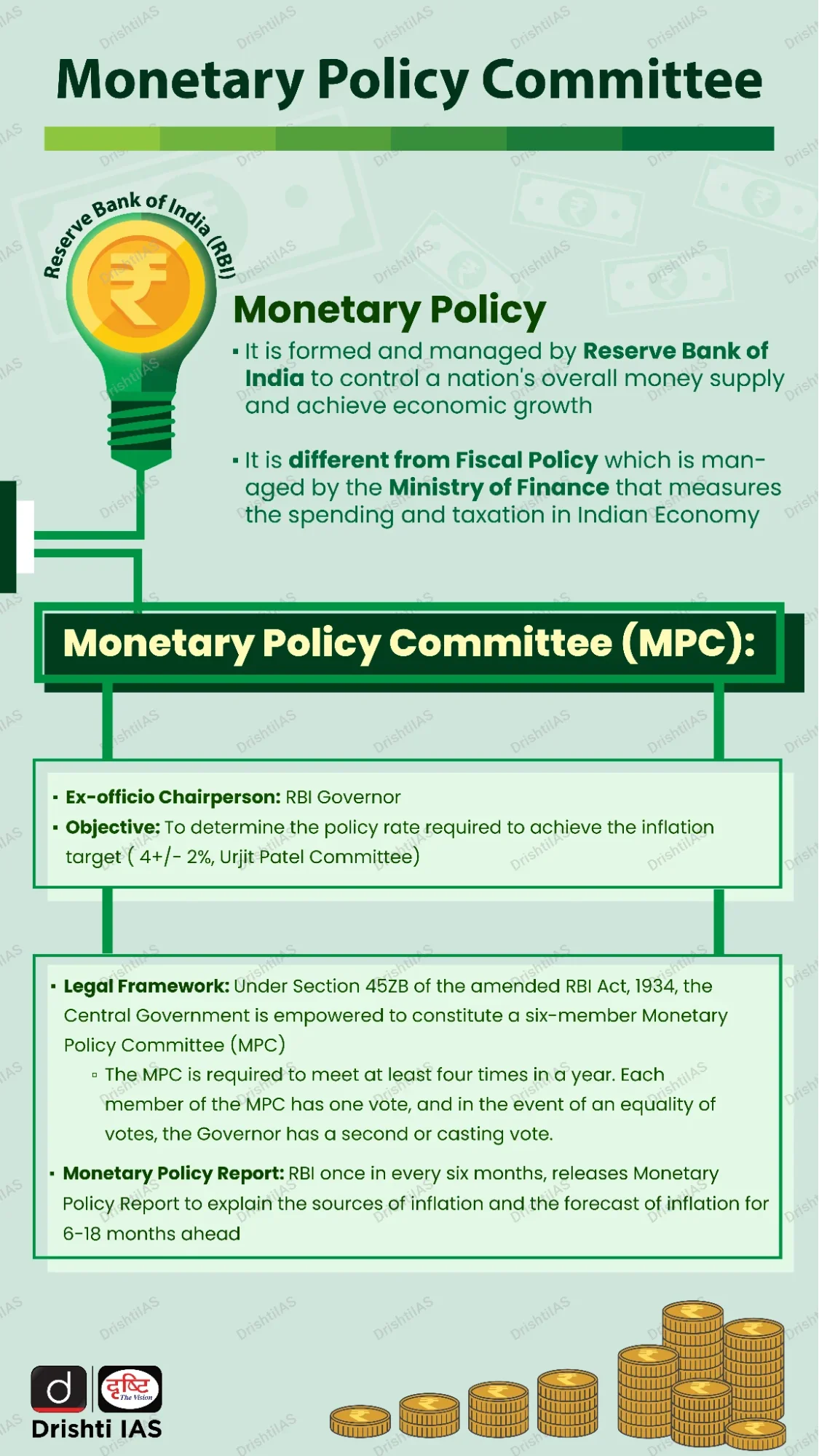
The Reserve Bank of India’s (RBI) Monetary Policy Committee (MPC), in its February 2026 meeting, kept the repo rate unchanged at 5.25%, following a 25 basis point cut in December 2025.
- The decision implies no immediate change in lending and deposit rates. EMIs on repo-linked loans (home, personal loans) are expected to remain stable.
What are the Key Announcements made by the RBI's Monetary Policy Committee (MPC)?
- Monetary Policy Stance: The committee chose to retain the "neutral" monetary policy stance. This indicates the RBI is not committed to a future rate hike or cut and will act based on incoming data.
- GDP Growth Forecast: The RBI raised its GDP growth projection for FY26 to 7.4% from the earlier estimate of 7.3%.
- Retail Inflation for FY26: The RBI marginally increased its retail inflation projection for FY26 to 2.1% from the earlier 2.0%.
Positive Domestic Conditions (Supporting the Pause)
- Strong and Upwardly Growth: The revised 7.4% growth forecast indicates strong momentum driven by robust consumption, projected to expand by about 7% in FY26. It is supported by budget stimuli (income tax cuts in FY26, GST rationalisation), past 125 bps rate cuts, and subdued inflation.
- The Economic Survey 2025–26 has forecast GDP to grow between 6.8-7.2% in the fiscal year 2026-27 on the back of strong domestic demand.
- Benign and Controlled Inflation: Headline inflation, at 1.33% in December 2025, remains comfortably below the RBI’s 2–6% band. The underlying inflation is low and benign, with the near-term outlook near the target.
- Recent Pro-Growth Stimuli: The Union Budget 2026–27’s pro-growth fiscal measures are expected to boost consumption. The RBI is pausing to assess their impact, as past monetary easing is still transmitting through the economy, reducing the need for immediate further action.
External Risks and Uncertainties (Justifying Caution)
- Intensifying Global Headwinds: Evolving geopolitical risks and global trade tensions threaten stability, requiring vigilant monitoring. E.g., Middle East instability (Israel-Hamas and related US-Iran-Israel dynamics).
- Need to Assess New Trade Pacts: New trade agreements with the US, EU, Oman, and New Zealand are a medium-term growth cushion, but their full impact is unrealized. The pause allows for impact assessment.
RBI's Monetary Policy Stances
- Accommodative Stance: This signals a deliberate bias towards lowering interest rates to stimulate growth by making credit cheaper, typically adopted when inflation is controlled but the economy requires support.
- Neutral Stance: A balanced, data-dependent position with no pre-set bias, giving the RBI flexibility to adjust policy rates in either direction based on incoming macroeconomic data.
- Calibrated Tightening: This indicates a cautious shift towards gradually tightening policy to curb inflation, signaling rate cuts are unlikely while potential hikes remain on the table.
- Hawkish Stance: A policy orientation that prioritizes controlling inflation, even at the potential cost of slower growth, often through higher interest rates.
- Dovish Stance: A policy approach that favors promoting growth and employment, typically through lower interest rates, even if inflation risks are elevated.
Frequently Asked Questions (FAQs)
1. What is the primary mandate of RBI's Monetary Policy Committee (MPC)?
The MPC’s primary mandate is to set the policy repo rate to maintain Consumer Price Index (CPI) inflation at the 4% target within the 2–6% tolerance band.
2. How does the RBI's 'neutral' monetary policy stance differ from an 'accommodative' stance?
A neutral stance allows the RBI flexibility to adjust rates based on incoming data, while an accommodative stance signals a deliberate bias towards lowering rates to support growth.
3. What key domestic factors enabled the RBI's MPC to hold the repo rate steady in its February 2026 review?
The hold was enabled by strong upwardly revised FY26 growth (7.4%), benign inflation (1.33% in Dec 2025), robust consumption, and the lagged impact of past rate cuts and fiscal measures.
UPSC Civil Services Examination, Previous Year Questions (PYQs)
Q. If the RBI decides to adopt an expansionist monetary policy, which of the following would it not do? (2020)
- Cut and optimize the Statutory Liquidity Ratio
- Increase the Marginal Standing Facility Rate
- Cut the Bank Rate and Repo Rate
Select the correct answer using the code given below:
(a) 1 and 2 only
(b) 2 only
(c) 1 and 3 only
(d) 1, 2 and 3
Ans: (b)
Q. Which of the following statements is/are correct regarding the Monetary Policy Committee (MPC)? (2017)
- It decides the RBI’s benchmark interest rates.
- It is a 12-member body including the Governor of RBI and is reconstituted every year.
- It functions under the chairmanship of the Union Finance Minister.
Select the correct answer using the code given below:
(a) 1 only
(b) 1 and 2 only
(c) 3 only
(d) 2 and 3 only
Ans: (a)


Important Facts For Prelims
Union Budget 2026–27 Push for Chemical Parks
Why in News?
The Union Budget 2026–27 announced India’s first dedicated budgetary support for chemical park infrastructure, proposing a ₹600 crore, challenge-based scheme to help States establish three Chemical Parks.
What are Chemical Parks?
- About: Chemical Parks are planned industrial clusters designed specifically for chemical and petrochemical manufacturing, where multiple units operate together using shared infrastructure and common facilities.
- Key Features: The parks will follow a cluster-based, plug-and-play model, offering ready industrial land, common utilities, logistics support, and standard environmental compliance facilities such as waste treatment and safety systems.
- The initiative builds on successful cluster models such as Plastic Parks, Bulk Drug Parks, and Petroleum, Chemicals and Petrochemical Investment Regions(PCPIRs), which have demonstrated the benefits of shared infrastructure, economies of scale, and faster project execution
- Objective: The initiative aims to strengthen domestic chemical manufacturing, reduce import dependence, improve supply-chain integration, and enhance India’s global competitiveness in bulk and specialty chemicals.
- India’s Status: India’s chemical industry is a core pillar of manufacturing, supplying key inputs to agriculture, pharmaceuticals, textiles, automobiles and construction, contributing about 7% to GDP, ranking sixth globally and third in Asia.
- Significance: Backed by targeted policy support and measures to encourage technology adoption, innovation, and sustainability, this integrated approach is expected to deepen domestic manufacturing capabilities and enhance India’s integration into global chemical value chains in the coming decade.

Related Cluster-based Initiatives
- Plastic Parks Scheme: Plastic Parks are dedicated industrial zones for plastic processing, created to promote recycling, value addition, exports, and employment through shared infrastructure and common facilities.
- Scheme for Promotion of Bulk Drug Parks: Bulk Drug Parks aim to strengthen domestic pharmaceutical manufacturing by providing common infrastructure such as effluent treatment plants, testing laboratories, and shared utilities, thereby reducing import dependence on APIs, with parks located in Gujarat, Himachal Pradesh, and Andhra Pradesh.
- Petroleum, Chemicals and Petrochemical Investment Regions (PCPIRs): PCPIRs are large, integrated industrial regions that support petroleum, chemical, and petrochemical manufacturing by co-locating production units with logistics, utilities, and environmental infrastructure, with major examples at Dahej (Gujarat), Visakhapatnam (Andhra Pradesh), and Paradeep (Odisha).
Frequently Asked Questions (FAQs)
1. What are Chemical Parks?
Chemical Parks are planned industrial clusters with shared infrastructure and plug-and-play facilities for chemical and petrochemical manufacturing.
2. How many Chemical Parks were announced in Union Budget 2026–27?
The Budget announced support for three Chemical Parks, to be set up by States through a challenge-based selection process.
3. What is the budgetary allocation for Chemical Parks?
An allocation of ₹600 crore has been made in Union Budget FY 2026–27 for establishing these parks.
4. Why are Chemical Parks important for India?
They help strengthen domestic manufacturing, reduce import dependence, improve environmental compliance, and enhance global competitiveness of the chemical sector.
UPSC Civil Services Examination, Previous Year Questions (PYQs)
Prelims
Q. In the ‘Index of Eight Core Industries’, which one of the following is given the highest weight? (2015)
(a) Coal production
(b) Electricity generation
(c) Fertilizer production
(d) Steel production
Ans: (b)


Rapid Fire
Frontier Nagaland Territorial Authority
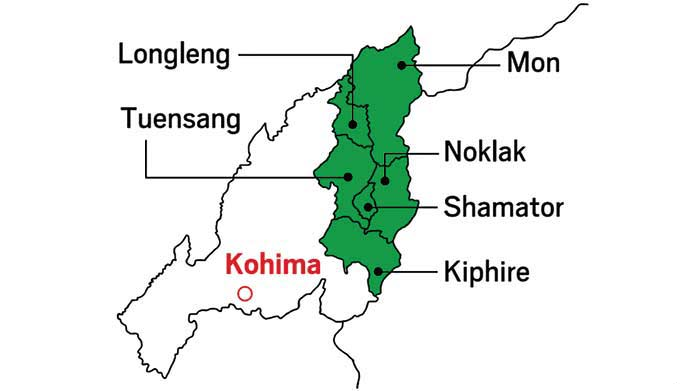
The Union Government, Nagaland State Government, and the Eastern Nagaland People’s Organisation (ENPO) have signed a historic tripartite agreement to establish the Frontier Nagaland Territorial Authority (FNTA), aimed at fulfilling the political and developmental aspirations of Eastern Nagaland.
- Peace Efforts: This marks one of 12 important agreements signed in the Northeast since 2019, contributing to a dispute-free region.
- Background and Necessity: ENPO (apex body representing eight recognised Naga tribes of the six eastern districts of Nagaland) had been demanding a separate state since 2010, citing prolonged neglect, lack of development, and socio-economic backwardness compared to the rest of the state.
- Instead of dividing the state, the Centre proposed the FNTA to provide financial autonomy and enhanced decision-making while keeping the geographical integrity of Nagaland intact.
- Territorial Jurisdiction: The FNTA covers six eastern districts of Nagaland (Tuensang, Mon, Kiphire, Longleng, Noklak, Shamator).
- Key Features of FNTA:
- Autonomy: The FNTA has been granted executive and legislative powers over 46 subjects (e.g., land, rural development, agriculture) to manage local affairs independently.
- Administrative Structure: It will have a mini-Secretariat located within the region.
- The administration will be headed by an officer of the rank of Additional Chief Secretary or Principal Secretary.
- Financial Mechanism: Development funds will be allocated proportional to the population and area of the region.
- The MHA will provide the initial establishment expenditure. This ensures that funds meant for the region are not diverted or delayed by the state capital.
- Constitutional Status: The agreement explicitly states that the FNTA does not affect Article 371(A) of the Indian Constitution.
- Article 371(A) gives special protection to Naga religious/social practices, customary law, and land ownership.
- The FNTA operates within this framework, ensuring that the unique cultural rights of the Nagas are preserved.
| Read more: Demand For Frontier Nagaland Territory |


Rapid Fire
Intermediate Range Ballistic Missile Agni-III
Intermediate Range Ballistic Missile ‘Agni-III’ was successfully test-fired from the Integrated Test Range, Chandipur, Odisha.
- The launch validated all operational and technical parameters. It was carried out under the aegis of the Strategic Forces Command.
- Agni III: Developed by the Defence Research and Development Organisation, the Agni-Three is a two-stage, solid-fuelled ballistic missile with a strike range exceeding 3000 Kms.
- The missile is capable of carrying both conventional and nuclear warheads.
- It can carry a payload of 1.5 tonnes, with an estimated yield of 200–300 kilotons.
- It is a surface-to-surface missile capable of deploying from rail and road mobile launchers, enhancing survivability and operational flexibility.
Agni Series
- The Agni missile series, conceptualised in the 1980s as a part of Integrated Guided Missile Development Program (IGMDP), forms the backbone of India’s credible nuclear deterrence.
- Beginning with a two-stage technology demonstrator tested in 1989, it evolved into Agni-I (700–1,250 km), Agni-II (2,000–2,500 km), and Agni-III (3,000–3,500 km) - all solid-fuel, mobile missiles inducted into the Indian Army.
- India later tested Agni-IV (3,000–4,000 km) in 2014, a two-stage Intermediate Range Ballistic Missile with advanced indigenous systems, currently in field trials.
- The Agni-V is an Intercontinental Ballistic Missile (ICBM) -class missile (~5,000+ km) with canisterised, road-mobile launch.
- Agni-VI, now under development, is expected to be launched from land and submarines with a strike range of 8,000–10,000 km, significantly strengthening India’s second-strike capability.
- Agni Prime is a nuclear-capable new-generation advanced variant of the Agni class of missiles. It is a two-stage canister missile with a maximum range of 1,000 to 2,000 km. It is lighter than all the earlier Agni series of missiles.
| Read more: Agni-5 Missile |


Rapid Fire
Private Bill Seeks Mandatory 10-Year Census
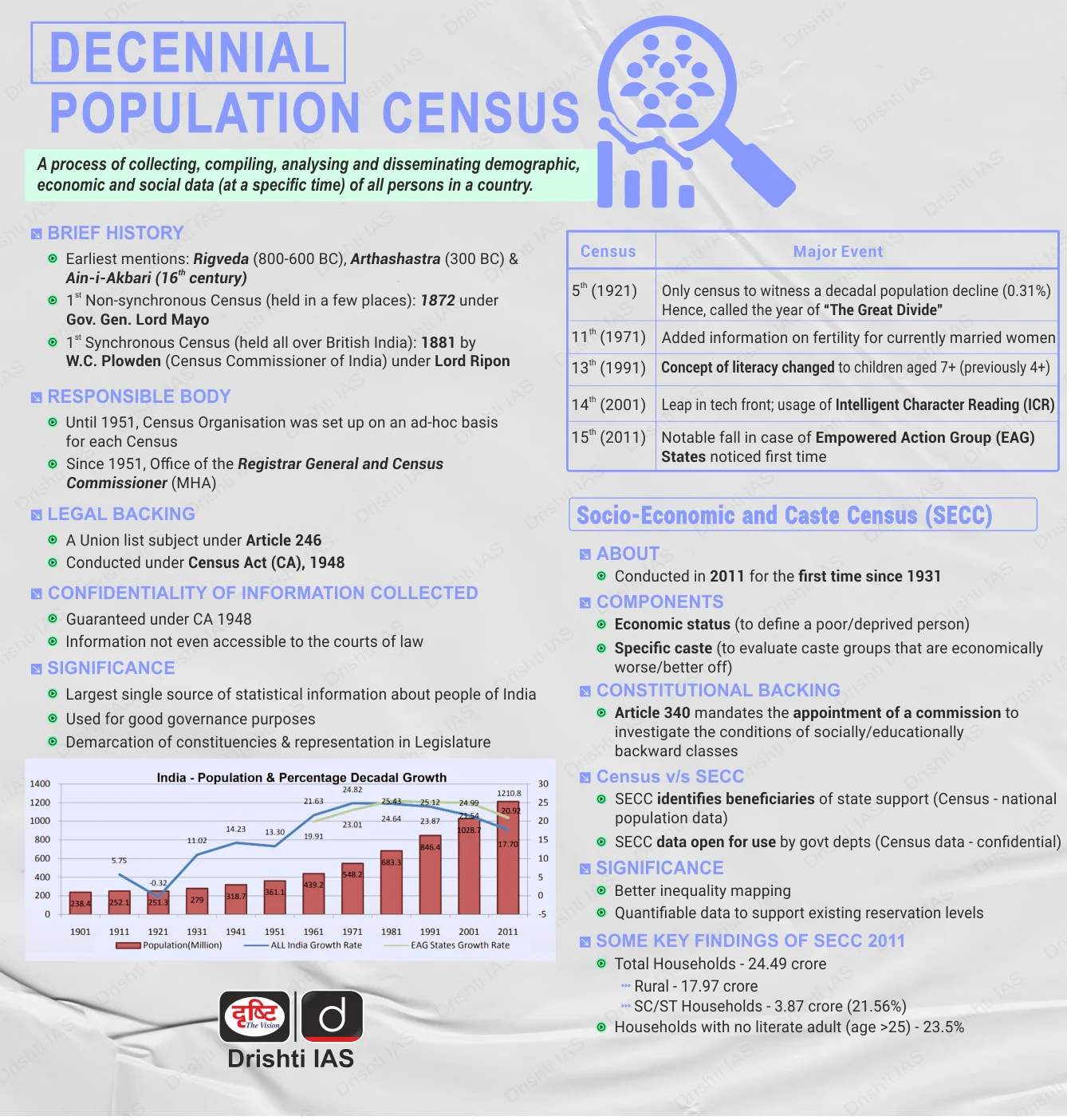
Recently, a Private Member’s Bill was introduced in the Rajya Sabha to amend the Census Act, 1948, to mandate a nationwide Census every ten years.
- The Bill highlights that although India has followed a decennial Census practice, it is not legally mandated, and stresses that regular Census data is crucial for effective delivery of welfare schemes and public services.
Private Member’s Bill
- About: Private Member’s Bills (PMBs) are legislative proposals introduced by Members of Parliament (MPs) who are not Ministers (i.e., not part of the government), enabling them to raise issues and suggest laws or amendments on matters significant to their constituencies.
- Key Features: Only non-government MPs can introduce these bills, offering a chance for independent legislative proposals.
- MPs can also introduce resolutions to call attention to specific matters.
- Procedure:
- Drafting and Notice: MPs draft and submit bills with at least one month's notice.
- Introduction: Bills are introduced in Parliament, followed by initial discussions.
- Debate: If selected, bills are debated, typically in limited Friday afternoon sessions.
- Decision: Bills may be withdrawn or proceed to a vote.
- Decline of PMBs: Since Independence, only 14 PMBs have been passed by both Houses and received Presidential assent. No PMB has passed both Houses since 1970.
| Read more: Census in India |


Rapid Fire
SC Flags Delay in Regular DGP Appointments
Recently, the Supreme Court observed that many States are continuing with “acting” Directors General of Police (DGPs), bypassing the appointment of regular DGPs in violation of the Prakash Singh judgment (2006).
Prakash Singh judgment(2006)
- In the Prakash Singh judgment, the Court ruled that DGP appointments must be insulated from political influence and that the concept of “acting” DGPs should not exist.
- The judgment mandated that DGPs be selected from among the three senior-most and meritorious officers empanelled by the UPSC, with a minimum fixed tenure of two years.
- Subsequent Supreme Court orders in 2018 and 2019 laid down a detailed procedure, requiring States to send proposals to the UPSC three months before the incumbent DGP’s retirement.
Superintendence over the State Police
- Police is a State subject under the 7th Schedule of the Constitution.
- Further, section 3 of the Police Act, 1861 states that the superintendence of police in each State rests with the State Government.
- At the district level, a dual system exists where both the District Magistrate and Superintendent of Police share authority.
- The State Police are generally headed by officers of the DGP (Director General of Police) rank.
| Read more: Tightening Regulations for Appointing State DGPs |