


International Relations
India-Oman Comprehensive Economic Partnership Agreement
- 20 Dec 2025
- 14 min read
For Prelims: Comprehensive Economic Partnership Agreement, Order of Oman, Tariff Rate Quotas, Gulf Cooperation Council (GCC), Al Najah, Eastern Bridge, Naseem Al Bahr
For Mains: India’s Free Trade Agreement strategy in the Gulf region, Significance of CEPA in India’s West Asia policy
Why in News?
India and Oman signed a Comprehensive Economic Partnership Agreement (CEPA), marking a major milestone in India’s trade diplomacy in the Gulf region.
- It is Oman’s first bilateral trade agreement since 2006 and India’s second CEPA in the GCC, after the UAE (2022).
- Additionally, the Prime Minister Narendra Modi was conferred with the Order of Oman by His Majesty Sultan Haitham bin Tarik (Sultan and Prime Minister of Oman) for his exceptional contribution to India–Oman relations.
- The award, instituted in 1970 by Sultan Qaboos bin Said, honours select global leaders for outstanding contributions to public life and bilateral ties.
Summary
- India–Oman CEPA strengthens India’s economic and strategic presence in the Gulf by providing near-universal duty-free access for Indian exports, ambitious services liberalisation, enhanced professional mobility, and new opportunities in investment, AYUSH, and MSME-led growth.
- While the agreement boosts trade facilitation and regional connectivity, key challenges remain in the form of a structural trade deficit, under-utilised services potential, and regional geopolitical risks, requiring focused diversification and deeper services engagement going forward.
What are the Key Features of the India–Oman Comprehensive Economic Partnership Agreement (CEPA)?
- Near-Universal Duty-Free Market Access: Oman has granted zero-duty access on 98.08% of its tariff lines, covering 99.38% of India’s exports by value.
- Immediate tariff elimination on nearly 98% of lines ensures quick and tangible benefits for Indian exporters, especially in the Gulf market.
- Boost to Labour-Intensive Sectors: Full tariff elimination for textiles, leather, footwear, gems & jewellery, engineering goods, plastics, furniture, agricultural products, pharmaceuticals, medical devices, and automobiles.
- Expected to generate employment and strengthen MSMEs, artisans, and women-led enterprises.
- Balanced Tariff Concessions by India: India has offered tariff liberalisation on 77.79% of its total tariff lines, covering 94.81% of imports from Oman.
- Sensitive sectors are protected through exclusion lists and Tariff Rate Quotas (TRQs), covering agriculture, bullion and jewellery, select labour-intensive goods, and base metal scrap , ensuring a balanced and calibrated trade framework.
- Ambitious Services Liberalisation: Oman commits to liberalisation across 127 services sub-sectors, including IT, business and professional services, R&D, education, health, and audio-visual services.
- These commitments are expected to unlock high-value opportunities and expand India’s services exports.
- Enhanced Mobility of Indian Professionals: For the first time, Oman has offered wide-ranging Mode 4 commitments, including an increase in the Intra-Corporate Transferees quota from 20% to 50% and extension of stay for Contractual Service Suppliers from 90 days to two years, with further extension possible, easing professional mobility.
- Under the General Agreement on Trade in Services (GATS), Mode 4 refers to the temporary movement of natural persons from one WTO member to another to supply services, including employees of service firms and self-employed professionals.
- 100% FDI in Services: The CEPA allows 100% Foreign Direct Investment by Indian companies in major services sectors in Oman through commercial presence, enabling Indian firms to expand operations and establish a long-term footprint in the Gulf region.
- Landmark Provision on Traditional Medicine: The agreement includes the world’s first comprehensive commitment on Traditional Medicine across all modes of supply, opening new avenues for India’s AYUSH and wellness sectors and promoting medical value travel.
- Trade Facilitation and Regulatory Cooperation: The CEPA addresses non-tariff barriers through fast-tracking of pharmaceutical approvals, acceptance of Good Manufacturing Practices (GMP) inspection documents, mutual recognition of Halal certification, acceptance of India’s National Programme for Organic Production (NOPO) organic certification, and enhanced cooperation in standards and conformity assessment.
Oman
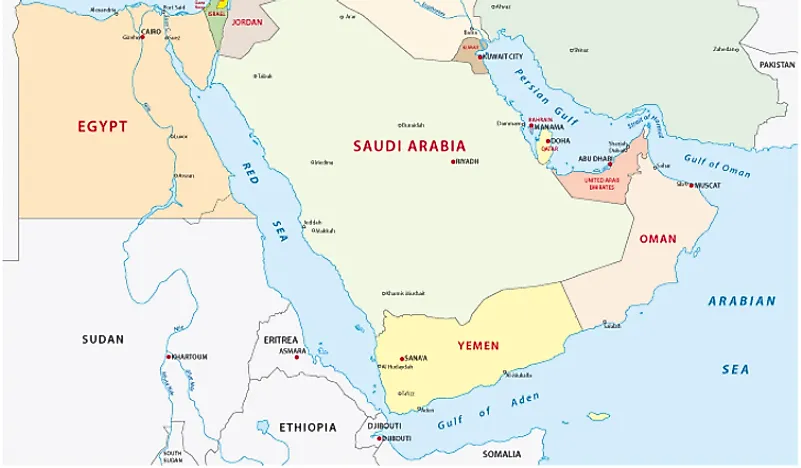
- Oman, with Muscat as its capital, is a member of the Gulf Cooperation Council (GCC) and the oldest independent state in the Arab world.
- It is bordered by Yemen to the southwest, the UAE to the northwest, and Saudi Arabia to the west, with maritime boundaries along the Arabian Sea to the south and east and the Gulf of Oman to the north.
- Geographically, Oman features the Rub al-Khali (Empty Quarter) desert, the Hajar and Dhofar mountain ranges, and is rich in natural resources such as petroleum, natural gas, copper, limestone, and asbestos.
Significance of India - Oman CEPA
- Oman acts as a gateway to the GCC, Eastern Europe, Central Asia, and Africa.
- The agreement strengthens India’s economic footprint in the West Asian region, complementing India’s broader FTA strategy.
- It enhances trade facilitation, supply chain resilience, and investment confidence, aligning with India’s vision of inclusive and sustainable growth.
How are India-Oman Relations?
- Strategic & Political Ties: India and Oman share warm, historic relations upgraded to a Strategic Partnership in 2008, with Oman being India’s oldest strategic partner in the Gulf and an important interlocutor at GCC, Arab League, and IORA.
- Defence & Maritime Cooperation: Oman is the first Gulf country to conduct tri-service exercises with India (Al Najah (Army), Eastern Bridge (Air Force), and Naseem Al Bahr (Navy)) reflecting strong cooperation in Indian Ocean maritime security.
- Economic & Trade Relations: Bilateral trade crossed USD 10.6 billion (FY 2024–25).
- In FY 2024–25, Oman was India’s 29th largest export market, 25th largest import source, and 28th largest overall trading partner, while India ranked as Oman’s 4th largest source of non-oil imports and 3rd largest market for non-oil exports.
- Trade Profile:
- India’s Exports: Petroleum products, aluminium oxide, rice, machinery, aircraft, electronics, plastics, steel
- India’s Imports: Crude oil, LNG, fertilisers, ammonia, chemicals, sulphur, iron ore
- People-to-People & Cultural Links: With a 6.7 lakh-strong Indian diaspora, centuries-old cultural links, and strong institutional support, people-to-people ties remain a key pillar of India–Oman relations.
What are the Challenges Constraining India-Oman Relations?
- Limited Utilisation of Services Potential: Although Oman imports USD 12.52 billion worth of services globally, India’s share is only 5.31%, indicating under-penetration of Indian IT, professional, education, and healthcare services despite India’s comparative advantage.
- Trade Imbalance: Bilateral trade remains energy- and mineral-dominated, leading to a structural trade deficit for India and limited diversification into high-value manufacturing and services.
- During FY25, India exported goods worth USD 4.1 billion to Oman and imported USD 6.6 billion, resulting in a trade deficit of about USD 2.5 billion.
- Regional Geopolitical Risks: Instability in West Asia and disruptions in maritime trade routes pose risks to energy security, trade continuity, and diaspora welfare.
- Omanisation and Labour Market Sensitivities: Oman’s policy emphasis on workforce nationalisation (Omanisation) creates periodic uncertainty for Indian professionals and skilled workers.
What Measures Can Strengthen and Deepen India–Oman Relations?
- Deepen Services Engagement: Actively leverage CEPA commitments to expand India’s footprint in IT, professional services, education, healthcare, and R&D, addressing the current under-utilisation of Oman’s large services import market.
- Diversify the Trade Basket: Move beyond energy-led trade by promoting manufacturing, engineering goods, pharmaceuticals, medical devices, and agri-value chains, helping reduce India’s structural trade deficit.
- Strengthen Investment & Industrial Partnerships: Encourage Indian firms to use Oman as a manufacturing and logistics hub for the Gulf and Africa, especially in green hydrogen, renewables, logistics, and advanced manufacturing.
- Forge a Strategic Maritime and Blue Economy Partnership: Leverage Oman’s geostrategic location at the confluence of the Persian Gulf and the Arabian Sea to safeguard India’s maritime security and energy sea lanes.
- Deepen cooperation in the Blue Economy through sustainable fisheries, deep-sea mining, marine research, and joint initiatives in desalination and coastal management to address shared climate risks.
Conclusion
The India–Oman CEPA represents a balanced, ambitious, and future-oriented trade agreement that strengthens India’s strategic presence in the Gulf region. The CEPA agreement aligns with India’s broader vision of inclusive growth, employment generation, and resilient global economic engagement.
|
Drishti Mains Question: How does the India–Oman CEPA reflect a shift in India’s trade diplomacy from tariff reduction to strategic economic partnerships? |
Frequently Asked Questions (FAQs)
1. What is the India–Oman CEPA?
It is a comprehensive trade agreement covering goods, services, investment, mobility, and regulatory cooperation between India and Oman.
2. What market access does India gain under the CEPA?
Oman grants zero-duty access on 98.08% of tariff lines, covering 99.38% of India’s exports by value.
3. How are India’s sensitive sectors protected under the agreement?
Through exclusion lists and Tariff Rate Quotas (TRQs) covering agriculture, bullion and jewellery, select labour-intensive goods, and base metal scrap.
UPSC Civil Services Examination Previous Year Question (PYQ)
Prelims:
Q. Which of the following is not a member of ‘Gulf Cooperation Council’? (2016)
(a) Iran
(b) Saudi Arabia
(c) Oman
(d) Kuwait
Ans: (a)
Mains:
Q. The question of India’s Energy Security constitutes the most important part of India’s economic progress. Analyse India’s energy policy cooperation with West Asian countries. (2017)



