


International Relations
India and New Zealand FTA
- 24 Dec 2025
- 16 min read
For Prelims: Free-trade Agreement (FTA), Foreign Direct Investment (FDI), Geographical Indication (GI), European Union, Five Eyes, ASEAN, MSMEs, Trade Deficit, Technical Barriers to Trade (TBT), Intellectual Property Rights (IPR), Anti-dumping, Carbon Credit, Friend Shoring.
For Mains: Key highlights of India and New Zealand (NZ) free-trade agreement (FTA) and its significance, Challenges posed to India from FTAs and way forward to fully utilise FTAs by India.
Why in News?
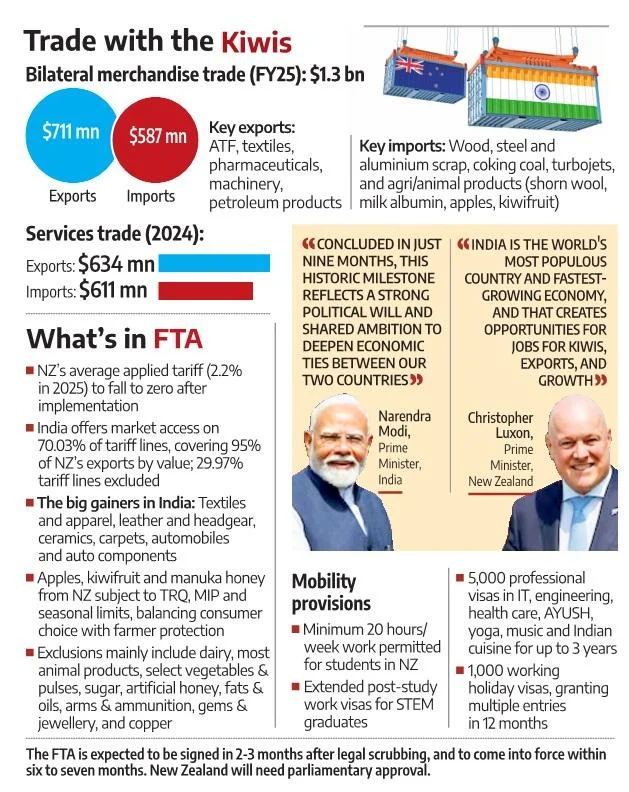
India and New Zealand (NZ) announced the conclusion of talks on a free-trade agreement (FTA), under which New Zealand will grant zero-duty access to 100% of Indian exports and commit USD 20 billion in foreign direct investment (FDI) over the next 15 years.
Summary
- The FTA provides zero-duty access for Indian exports, liberalizes 70% of NZ tariff lines, and safeguards sensitive sectors like dairy.
- It promotes USD 20 billion FDI, skill mobility, and services trade across 118 sectors, creating growth and employment opportunities.
- Strategically, the FTA strengthens India’s global trade diversification, regional influence, and long-term economic cooperation with developed economies.
What are the Key Highlights of the India-New Zealand Free Trade Agreement?
- Trade Liberalization: New Zealand’s commitments include granting zero-duty access on 100% of Indian exports and completely eliminating the current average tariff of 2.2%.
- India's Commitments: Liberalized duties across 70% of tariff lines (covering 95% of NZ exports by value). Immediate duty elimination on 30% of tariff lines for products including wood, wool, and sheep meat.
- Average tariff to drop from the current 16.2% to 13.18% initially, then 10.3% in 5 years and 9.06% by 10th year.
- Nearly 30% of tariff lines were excluded (dairy, certain animal products, vegetables, almonds, sugar) to protect India's dairy sector.
- India's Commitments: Liberalized duties across 70% of tariff lines (covering 95% of NZ exports by value). Immediate duty elimination on 30% of tariff lines for products including wood, wool, and sheep meat.
- Investment Commitment: New Zealand has committed to facilitating USD 20 billion in investment into India over 15 years backed by a rebalancing mechanism that allows India to suspend FTA benefits if the investment does not materialise within the stipulated period.
- Mobility Provisions: No numerical caps on Indian students in New Zealand. Guaranteed at least 20 hours of work per week during study. Extended post-study work visas (up to 3 years for STEM graduates, 4 years for PhD holders).
- A new Temporary Employment Entry visa pathway for up to 5,000 Indian professionals at any time (for up to 3 years). Covers AYUSH, yoga, Indian chefs, IT, engineering, healthcare, etc.
- 1,000 working holiday visas annually for young Indians.
- Ambitious services liberalisation: The agreement includes India’s most ambitious services offer, covering 118 services sectors, boosting services trade and professional mobility.
- Trade expansion target: The FTA aims to double bilateral trade from USD 2.4 billion to nearly USD 5 billion within 5 years, strengthening economic integration.
- Recognition of India’s IPR: New Zealand’s current Geographical Indication (GI) law permits registration only for India’s wines and spirits, but it has now committed to amending its law to enable registration of India’s wines, spirits, and other goods—on par with benefits granted to the European Union.
What is the Significance of the India and New Zealand FTA?
- Strategic Economic Rebalancing: The agreement represents India's 7th trade deal since 2021 and 3rd with a Five Eyes nation (after Australia and the UK), demonstrating New Delhi's strategic pivot toward diversifying trade relationships amid global realignment driven by protectionist policies.
- Beyond bilateral benefits, the FTA provides Indian companies a foothold across Pacific island economies, a strategically important region.
- Protection of Sensitive Sectors: India successfully fully excluded its politically and economically critical dairy sector, along with other sensitive agricultural items (like onions, almonds), demonstrating a firm line in protecting vulnerable domestic industries.
- Export Competitiveness: Sectors like textiles, apparel, leather, carpets, and auto components gain immediate duty-free access to NZ, which previously faced tariffs up to 10%.
- Access to 118 services sectors provides Indian IT, engineering, healthcare, and education firms with new opportunities.
- Managed Liberalization with Safeguards: India’s tariffs will gradually decrease over 10 years, giving domestic industries time to adjust.
- For sensitive imports such as apples, kiwifruit, and wine, India employs Tariff-Rate Quotas (TRQs) and seasonal access instead of full liberalization, balancing market access with producer protection.
- Framework for Deeper Cooperation: The agreement is less a trade breakthrough than a framework for deeper cooperation. Its significance lies in creating infrastructure for integrated supply chains, expanded services trade, stronger education and skills partnerships, and leveraging diaspora connections rather than immediate trade volumes.
What are Free Trade Agreements (FTAs)?
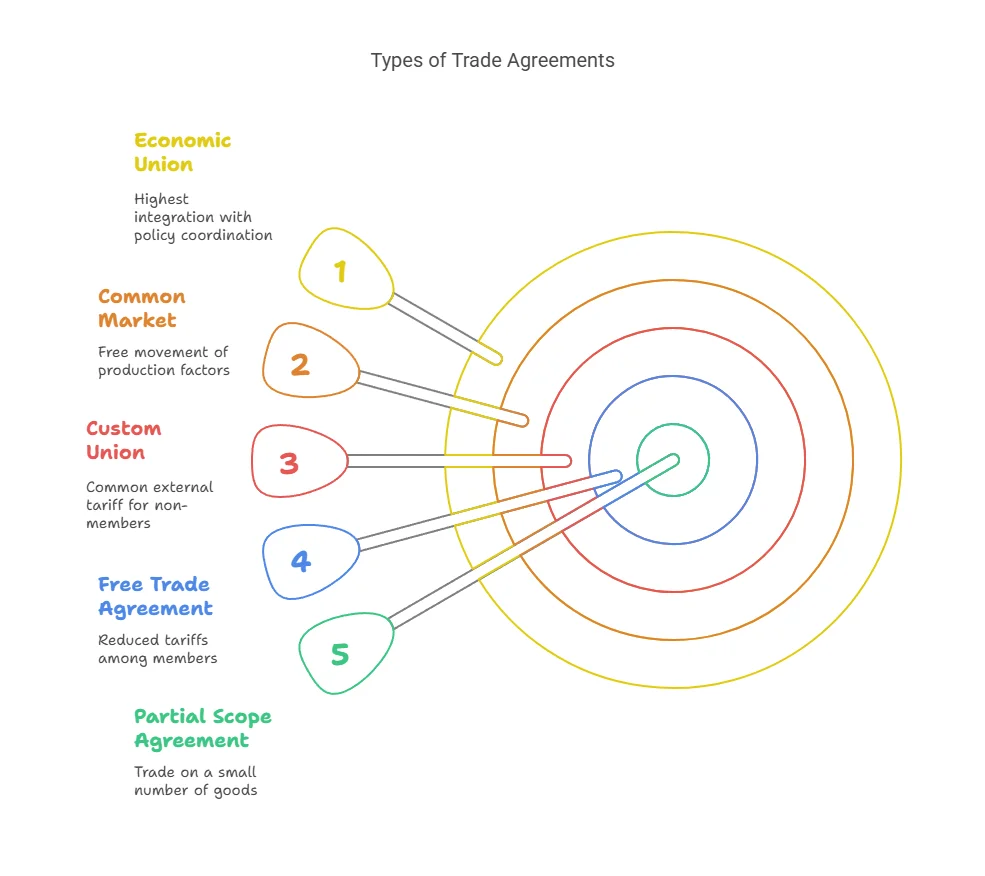
- About: An FTA is a pact between countries to remove or lower tariffs and barriers on nearly all goods traded between them.
- Unlike Preferential Trade Agreements, which only cut duties on a limited set of products, FTAs aim for comprehensive, near-total tariff elimination.
- Objectives:
- Tariff Reduction: Eliminates or lowers customs duties on the vast majority (90-95%) of goods.
- Streamlined Regulations: Reduce non-tariff barriers by harmonizing or easing restrictive rules.
- Market Access: Facilitates trade in services and promotes bilateral investment flows.
- Types of Trade Agreements:
What are the Key Challenges Associated with India's FTAs?
- Threat to Domestic Manufacturing: A key concern is that cheap imports from advanced partners (e.g., ASEAN, Australia) can harm India's MSMEs and key sectors like textiles, dairy, and agriculture.
- Critics highlight that FTAs have worsened India's trade deficits—from 2017-2022, imports from FTA partners grew 82% while exports rose only 31%.
- Limited Gains in Services and Mobility: Despite India's strong services sector, its FTAs often fail to secure meaningful market access.
- Key barriers—such as strict visa rules, licensing hurdles, and resistance to the movement of professionals—limit opportunities as partners prioritize protecting their domestic labor markets.
- Non-Tariff Barriers (NTBs) and Standards: Even after tariffs are eliminated, Indian exports often face technical barriers to trade (TBT), stringent standards, complex certification requirements, and opaque regulations in partner countries, negating the benefits of FTAs.
- Impact on Policy Sovereignty: New-generation FTAs include chapters on investment, intellectual property rights (IPR), government procurement, and environmental/labour standards.
- There is concern that these could limit India's policy space to enact public interest laws (e.g., affordable medicines, local procurement preferences, environmental regulations).
What Key Strategies can Improve the Effectiveness of India's FTAs?
- Strategic Negotiation & Design: Prioritize reciprocal market access for India’s strengths in services and digital trade, linking any goods concessions to these gains.
- Shield sensitive sectors—dairy, agriculture, and MSMEs—with strong safeguards such as tariff-rate quotas, seasonal tariffs, and rigorous anti-dumping measures.
- Strengthening Domestic Competitiveness: Boost competitiveness by investing in logistics, ports, and digital infrastructure to lower trade costs. Scale and upgrade manufacturing through PLI schemes and targeted policies, enabling industries to capitalize on FTA benefits.
- Leveraging New-Age Trade Elements: Secure cross-border data flows (with safeguards) to promote tech exports. Negotiate green technology partnerships, sustainable sourcing, and carbon credit market access.
- Following the India-NZ model, link FTAs to binding investments in manufacturing, green energy, and infrastructure to create jobs and build domestic capacity.
- Strategic Geoeconomic Alignment: Target FTAs with major consumer markets (EU, Canada) and key value-chain partners (Argentina, Chile for critical minerals) to diversify trade reliance.
- Foster resilient friend-shoring by integrating with trusted partners in critical sectors like electronics, pharma, and minerals.
- Address Non-Tariff Barriers (NTBs): Include enforceable chapters on technical standards, sanitary measures, and mutual recognition agreements to prevent NTBs from negating tariff concessions.
Conclusion
The India–New Zealand FTA strengthens bilateral trade, investment, and services mobility while protecting sensitive sectors like dairy. It reflects India’s strategic pivot toward developed economies, fostering economic cooperation, skill mobility, and regional influence. The agreement balances trade liberalization with safeguards, providing a framework for long-term sustainable growth and integration.
|
Drishti Mains Question: The protection of domestic agriculture, especially the dairy sector, has been a cornerstone of India’s recent FTAs. Discuss the associated economic and political rationale. |
Frequently Asked Questions (FAQs)
1. What is the key investment feature of the India-New Zealand FTA?
It includes a USD 20 billion investment commitment from New Zealand, backed by a rebalancing mechanism allowing India to suspend benefits if commitments are not met.
2. Which Indian sectors are excluded from the FTA?
Sensitive sectors like dairy, onions, almonds, and certain animal products are excluded to protect domestic industries.
3. What is the expected impact on bilateral trade?
The FTA aims to double bilateral trade from USD 2.4 billion to USD 5 billion within five years, boosting economic integration.
UPSC Civil Services Examination, Previous Year Questions (PYQs)
Prelims
Q. Consider the following countries: (2018)
- Australia
- Canada
- China
- India
- Japan
- USA
Which of the above are among the ‘free-trade partners’ of ASEAN?
(a) 1, 2, 4 and 5
(b) 3, 4, 5 and 6
(c) 1, 3, 4 and 5
(d) 2, 3, 4 and 6
Ans: (c)
Q. The term ‘Regional Comprehensive Economic Partnership’ often appears in the news in the context of the affairs of a group of countries known as(2016)
(a)G20
(b) ASEAN
(c) SCO
(d) SAARC
Ans: (b)
Mains
Q. How would the recent phenomena of protectionism and currency manipulations in world trade affect macroeconomic stability of India? (2018)
Q. Evaluate the economic and strategic dimensions of India’s Look East Policy in the context of the post Cold War international scenario. (2016)



