


Important Facts For Prelims
Southern Ocean Carbon Anomaly
- 24 Dec 2025
- 9 min read
Why in News?
A study published in Nature Climate Change reveals a striking Southern Ocean carbon anomaly, showing that the Southern Ocean has continued to absorb more carbon dioxide since the early 2000s, contrary to earlier climate model predictions that its carbon-sink capacity would weaken.
Summary
- A Nature Climate Change study shows the Southern Ocean continues to absorb CO₂, defying model predictions, due to surface stratification that traps carbon-rich deep waters below the surface.
- As a major global carbon and heat sink, weakening stratification could release trapped carbon, risking a shift from carbon sink to carbon source.
What is the Southern Ocean Carbon Anomaly?
- Contradiction to Model Projections: Climate models had long predicted that rising greenhouse gas concentrations, coupled with a thinning ozone layer, would intensify the westerly winds over the Southern Ocean and shift them poleward.
- This change in atmospheric circulation was expected to enhance oceanic upwelling (bringing deep, carbon-rich waters closer to the surface).
- The intensified meridional overturning circulation would thereby expose these carbon-laden waters to the atmosphere, potentially weakening the Southern Ocean’s function as a carbon sink.
- However, long-term observations since the early 2000s show that the Southern Ocean has continued to absorb more carbon dioxide, as rising Carbon-rich circumpolar deep waters remain trapped 100–200 metres below the surface, preventing atmospheric release.
- This change in atmospheric circulation was expected to enhance oceanic upwelling (bringing deep, carbon-rich waters closer to the surface).
- Role of Stratification: Increased rainfall, melting Antarctic ice, and sea-ice transport have added fresh water to the ocean surface. Fresh water is lighter than salty water, so it forms a stable upper layer.
- This layered structure, known as stratification, acts like a lid that prevents vertical mixing between surface waters and deeper carbon-rich waters, trapping the carbon below, preventing CO₂ from escaping into the atmosphere and allowing the Southern Ocean to continue functioning as a carbon sink.
- Significance: The study cautions that this situation may be temporary. If surface stratification weakens in the future, the trapped carbon could be released rapidly into the atmosphere, accelerating climate change.
- Since the early 2010s, thinning surface stratification and rising salinity in parts of the Southern Ocean have made it easier for winds to mix deep, carbon-rich waters upward, risking a shift from a carbon sink to a carbon source.
What are the Key Facts About the Southern Ocean?
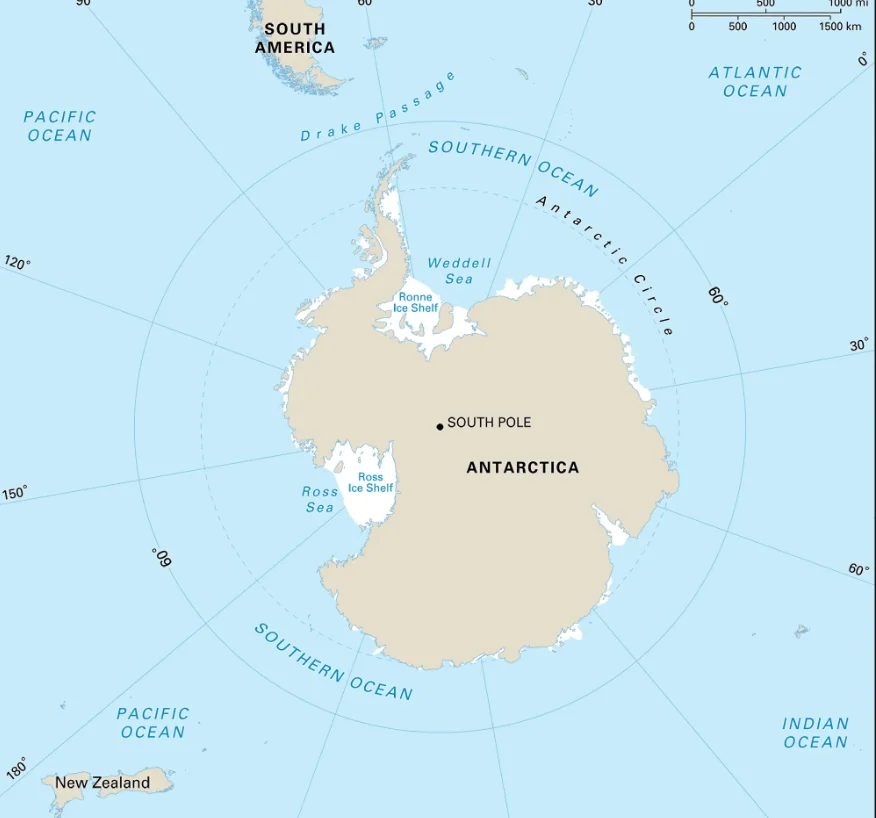
- Geographical Extent: The Southern Ocean (or Antarctic Ocean) is defined as the waters encircling Antarctica, generally extending from the Antarctic coast north to 60° South latitude, a boundary established by the International Hydrographic Organization (IHO) in 2000 and marked by the Antarctic Circumpolar Current (ACC), connecting parts of the Atlantic, Pacific, and Indian Oceans.
- It's unique for being defined by a current, not land, and plays a vital role in global climate.
- Key Geographic Features
- Narrowest chokepoint: Drake Passage (~1,000 km wide) between South America and the Antarctic Peninsula.
- The Southern Ocean includes Weddell Sea, Ross Sea, Amundsen Sea, Bellingshausen Sea, and parts of the Scotia Sea
- No continental landmass interrupts its flow.
- Size and Coverage: By area, it is the fourth largest ocean after the Pacific, Atlantic, and Indian, and larger than the Arctic Ocean.
- It covers approximately 25–30% of the global ocean area and accounts for about 5.4% of Earth's total ocean volume.
- Carbon Sink Role: The southern ocean absorbs nearly 40% of all anthropogenic CO₂ taken up by the world's oceans. It plays a critical buffer role against global warming.
- It is responsible for absorbing around 75% of the excess heat generated by greenhouse gas emissions.
- Ocean Circulation: The Southern Ocean’s circulation is dominated by the Antarctic Circumpolar Current (the world’s strongest current), which flows eastward around Antarctica and links the Atlantic, Indian, and Pacific oceans.
- Cold, dense Antarctic waters sink and flow northward along the ocean floor, while warmer surface waters from the Atlantic, Indian, and Pacific oceans move southward to replace them, meeting at the Antarctic Convergence.
- This zone supports high phytoplankton productivity dominated by diatoms, with Antarctic krill forming the core of the food web that sustains fish, seabirds, seals, and whales.
- The ocean is central to the global meridional overturning circulation (MOC), often referred to as the "conveyor belt" of the oceans.
- Cold, dense Antarctic waters sink and flow northward along the ocean floor, while warmer surface waters from the Atlantic, Indian, and Pacific oceans move southward to replace them, meeting at the Antarctic Convergence.
Frequently Asked Questions (FAQs)
1. What is the Southern Ocean carbon anomaly?
It refers to the continued increase in carbon dioxide absorption by the Southern Ocean since the early 2000s, contrary to climate model predictions of weakening uptake.
2. What role does stratification play in the Southern Ocean carbon sink?
Freshwater input from rainfall and ice melt creates a lighter surface layer that prevents vertical mixing, trapping carbon-rich waters 100–200 m below the surface.
3. Why is the Antarctic Circumpolar Current important?
It is the world’s strongest ocean current, linking the Atlantic, Indian, and Pacific oceans and driving global heat, nutrients, and carbon transport.
UPSC Civil Services Examination, Previous Year Questions (PYQs)
Prelims
Q. Tides occur in the oceans and seas due to which among the following (2015)
- Gravitational force of the Sun
- Gravitational force of the Moon
- Centrifugal force of the Earth
Select the correct answer using the codes given below.
(a) 1 only
(b) 2 and 3 only
(c) 1 and 3 only
(d) 1, 2 and 3
Ans: D
Q: Consider the following factors: (2012)
- Rotation of the Earth
- Air pressure and wind
- Density of ocean water
- Revolution of the earth
Which of the above factors influences the ocean currents?
(a) 1 and 2 only
(b) 1, 2 and 3 only
(c) 1 and 4 only
(d) 2, 3, and 4 only
Ans: B
Mains
Q. Account for variations in oceanic salinity and discuss its multidimensional effects. (2017)



