


Important Facts For Prelims
RBI MPC Keeps Repo Rate Unchanged
- 07 Feb 2026
- 8 min read
Why in News?
The Reserve Bank of India’s (RBI) Monetary Policy Committee (MPC), in its February 2026 meeting, kept the repo rate unchanged at 5.25%, following a 25 basis point cut in December 2025.
- The decision implies no immediate change in lending and deposit rates. EMIs on repo-linked loans (home, personal loans) are expected to remain stable.
What are the Key Announcements made by the RBI's Monetary Policy Committee (MPC)?
- Monetary Policy Stance: The committee chose to retain the "neutral" monetary policy stance. This indicates the RBI is not committed to a future rate hike or cut and will act based on incoming data.
- GDP Growth Forecast: The RBI raised its GDP growth projection for FY26 to 7.4% from the earlier estimate of 7.3%.
- Retail Inflation for FY26: The RBI marginally increased its retail inflation projection for FY26 to 2.1% from the earlier 2.0%.
Positive Domestic Conditions (Supporting the Pause)
- Strong and Upwardly Growth: The revised 7.4% growth forecast indicates strong momentum driven by robust consumption, projected to expand by about 7% in FY26. It is supported by budget stimuli (income tax cuts in FY26, GST rationalisation), past 125 bps rate cuts, and subdued inflation.
- The Economic Survey 2025–26 has forecast GDP to grow between 6.8-7.2% in the fiscal year 2026-27 on the back of strong domestic demand.
- Benign and Controlled Inflation: Headline inflation, at 1.33% in December 2025, remains comfortably below the RBI’s 2–6% band. The underlying inflation is low and benign, with the near-term outlook near the target.
- Recent Pro-Growth Stimuli: The Union Budget 2026–27’s pro-growth fiscal measures are expected to boost consumption. The RBI is pausing to assess their impact, as past monetary easing is still transmitting through the economy, reducing the need for immediate further action.
External Risks and Uncertainties (Justifying Caution)
- Intensifying Global Headwinds: Evolving geopolitical risks and global trade tensions threaten stability, requiring vigilant monitoring. E.g., Middle East instability (Israel-Hamas and related US-Iran-Israel dynamics).
- Need to Assess New Trade Pacts: New trade agreements with the US, EU, Oman, and New Zealand are a medium-term growth cushion, but their full impact is unrealized. The pause allows for impact assessment.
RBI's Monetary Policy Stances
- Accommodative Stance: This signals a deliberate bias towards lowering interest rates to stimulate growth by making credit cheaper, typically adopted when inflation is controlled but the economy requires support.
- Neutral Stance: A balanced, data-dependent position with no pre-set bias, giving the RBI flexibility to adjust policy rates in either direction based on incoming macroeconomic data.
- Calibrated Tightening: This indicates a cautious shift towards gradually tightening policy to curb inflation, signaling rate cuts are unlikely while potential hikes remain on the table.
- Hawkish Stance: A policy orientation that prioritizes controlling inflation, even at the potential cost of slower growth, often through higher interest rates.
- Dovish Stance: A policy approach that favors promoting growth and employment, typically through lower interest rates, even if inflation risks are elevated.
Frequently Asked Questions (FAQs)
1. What is the primary mandate of RBI's Monetary Policy Committee (MPC)?
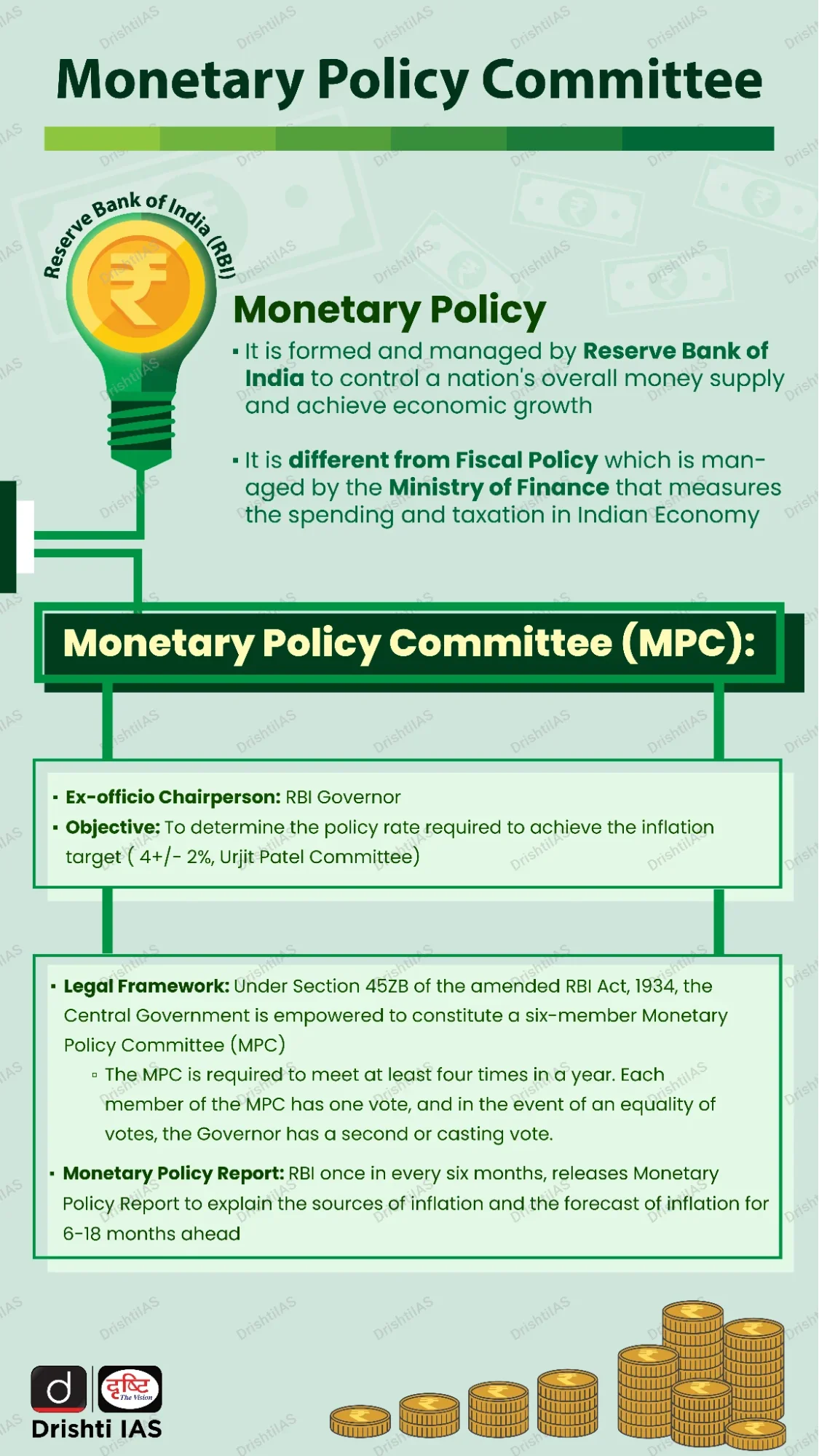
The MPC’s primary mandate is to set the policy repo rate to maintain Consumer Price Index (CPI) inflation at the 4% target within the 2–6% tolerance band.
2. How does the RBI's 'neutral' monetary policy stance differ from an 'accommodative' stance?
A neutral stance allows the RBI flexibility to adjust rates based on incoming data, while an accommodative stance signals a deliberate bias towards lowering rates to support growth.
3. What key domestic factors enabled the RBI's MPC to hold the repo rate steady in its February 2026 review?
The hold was enabled by strong upwardly revised FY26 growth (7.4%), benign inflation (1.33% in Dec 2025), robust consumption, and the lagged impact of past rate cuts and fiscal measures.
UPSC Civil Services Examination, Previous Year Questions (PYQs)
Q. If the RBI decides to adopt an expansionist monetary policy, which of the following would it not do? (2020)
- Cut and optimize the Statutory Liquidity Ratio
- Increase the Marginal Standing Facility Rate
- Cut the Bank Rate and Repo Rate
Select the correct answer using the code given below:
(a) 1 and 2 only
(b) 2 only
(c) 1 and 3 only
(d) 1, 2 and 3
Ans: (b)
Q. Which of the following statements is/are correct regarding the Monetary Policy Committee (MPC)? (2017)
- It decides the RBI’s benchmark interest rates.
- It is a 12-member body including the Governor of RBI and is reconstituted every year.
- It functions under the chairmanship of the Union Finance Minister.
Select the correct answer using the code given below:
(a) 1 only
(b) 1 and 2 only
(c) 3 only
(d) 2 and 3 only
Ans: (a)



