Indian Society
Urbanisation Beyond Megacities
For Prelims: Statutory Towns, Pradhan Mantri Gram Sadak Yojana (PMGSY), BharatNet, Shyama Prasad Mukherji Rurban Mission, Municipal Bonds, Ecologically Sensitive Zone, AMRUT, Demographic Dividend, Urban Local Bodies (ULBs), AMRUT 2.0, Swachh Bharat Mission-Urban 2.0, Finance Commission, Scheme for Formalisation of Micro Food Processing Enterprises (PMFME), VB-G RAM G.
For Mains: Status of urbanisation in India, Key factors driving the shift of urbanisation to small towns, associated challenges and way forward.
Why in News?
India is experiencing a significant shift of urbanization towards small towns. This rapid and unplanned growth presents both challenges and opportunities for balanced regional development.
- Out of nearly 9,000 census and statutory towns, only 500 are large cities, while the vast majority are small towns with populations under 1,00,000, playing a key role in shaping India’s urban future
What are the Key Factors Driving the Shift of Urbanisation to Small Towns in India?
- Saturation of Megacities: Megacities like Delhi, Mumbai, and Bangalore have become economically saturated, with skyrocketing land prices, crippling congestion, and unbearable living costs for workers and mid-sized industries pushing capital and people to seek alternatives.
- Decentralized Economic Growth: Small towns function as hubs for rural non-farm diversification, providing employment in agro-processing, logistics, and services to reduce agricultural dependence.
- Towns like Sattenapalle (Andhra Pradesh), Dhamtari (Chhattisgarh), and Bongaigaon (Assam) exemplify this shift, having evolved into key logistics nodes, and service centres.
- Infrastructure and Policy Enablers: Infrastructure like Pradhan Mantri Gram Sadak Yojana (PMGSY) and state highways have improved physical access, while digital connectivity (BharatNet, mobile penetration) integrates towns into broader networks. Policy initiatives such as the Shyama Prasad Mukherji Rurban Mission and state industrial and investment policies further incentivize development by providing urban amenities and encouraging units in Tier-2/3 towns.
- Demographic and Social Factors: Demographic pressures from a young rural population seeking education and employment drive migration to nearby small towns. At the same time, rising demand for better education, healthcare, and entertainment services accelerates the transformation of large villages into service-centric urban centres.
- Resilience against Climate Vulnerabilities: Their smaller scale enables better environmental management through decentralized systems and reduces the heat island effect, providing a climate-adaptive urbanization model aligned with sponge city goals.
- Compared to megacities, small towns are less prone to public health crises (e.g., Covid-19) and more effective at implementing disaster-resilient infrastructure.
- Preservation of Socio-Cultural Fabric: Small towns counter the homogenizing effect of metropolitan culture by integrating modern economic opportunities with the preservation of local languages, crafts, and traditions. For instance, Srirangapatna in Karnataka has developed as an urban centre while meticulously maintaining its cultural heritage and community structure.
Status of Urbanisation in India
- As per Census 2011, the total urban population of the country is over 377 million, constituting 31.16% of the total population.
- According to the United Nations Department of Economic and Social Affairs (UN DESA), about 36% of India’s population is estimated to live in cities in 2025, a share projected to reach 50% by 2050.
- India alone will contribute well over 20 crore new urban residents between 2025 and 2050.
- According to NITI Aayog, urban areas contribute around 63% to India’s GDP, a share projected to exceed 75% by 2030 and reach 80% by 2050.
Key Government Initiative to Support Urbanisation
- Smart Cities Mission (SCM): Aims to develop 100 selected cities with sustainable and inclusive infrastructure, clean environment, and smart urban management.
- AMRUT 2.0: Targets universal functional household tap water coverage in all statutory towns and 100% sewerage/septage management in 500 AMRUT cities.
- Pradhan Mantri Awas Yojana-Urban: Provide pucca houses with basic amenities, aiming for Housing for All. Target includes sanctioning and completing houses to meet demand (over 1.22 crore houses sanctioned, with PMAY-U 2.0 covering an additional 1 crore urban families).
- Deen Dayal Antyodaya Yojana - National Urban Livelihood Mission (DAY-NULM): Targets coverage of urban poor households across all district headquarters and cities with population ≥ 1 lakh through training, self-employment support, SHG mobilization, and formalization.
What Concerns are Associated with Shift of Urbanisation to Small Towns in India?
- Urbanization of Poverty: The primary concern is that small towns are becoming sites for the "urbanisation of rural poverty." They absorb poor populations but fail to provide pathways out of poverty.
- Employment is dominated by highly informal and precarious work. E.g., Construction labour work without contracts or social security.
- Emergence of Exploitative Local Hierarchies: New, unregulated economies allow local elites, real estate brokers, contractors, micro-financiers, and political intermediaries, to consolidate control over land, credit, and labour, leading to deepening local inequality and exploitation.
- Governance and Institutional Deficits: Small towns suffer from low own-source revenue and inadequate access to institutional finance like municipal bonds, creating a perennial dependence on state and central grants that hinders autonomous planning. Furthermore, most develop without Master Plans or Building Byelaws, resulting in haphazard construction, encroachment on ecologically sensitive zones, and inefficient land use.
- Infrastructure & Ecological Deficit: Flagship urban missions like AMRUT are metro-centric, leaving small towns with fragmented, inadequate infrastructure. Lack of piped water supply leads to dependence on private "tanker economies" and the indiscriminate mining of groundwater, creating severe ecological stress.
- There is a chronic deficit in water supply, sewage networks, solid waste management (SWM), and stormwater drainage.
- Missed Demographic Dividend: With a young population migrating to these towns, the lack of quality education, skill development, and formal job creation risks squandering the demographic dividend. E.g., delivery, ride-hailing jobs with no job security or benefits.
What Measures are Required to Achieve Sustainable Urbanisation?
- Formalizing the Informal Urban: To empower small towns, mandatorily notify qualifying census towns as statutory towns, followed by massive capacity building for the new Urban Local Bodies (ULBs) in planning and finance. Subsequently, develop simple, flexible, and enforceable Master Plans and Local Area Plans using GIS-based participatory mapping (e.g., SVAMITVA scheme) to integrate existing settlements and natural assets (water bodies, forests).
- Building Foundational Infrastructure: Achieve 100% coverage of sustainable basic services—water supply, decentralised Sewerage Treatment Plant (STP), and SWM—by converging funds from AMRUT 2.0, Swachh Bharat Mission-Urban 2.0, and Finance Commission grants. Planning must prioritize non-motorised transport networks (walkways, cycle tracks), avoiding car-centric models.
- Leverage Place-Based Economies: Strategically develop economies around local comparative advantage, agro-processing clusters, handloom & handicraft hubs, logistics centers, or eco-tourism, as envisioned under the Scheme for Formalisation of Micro Food Processing Enterprises (PMFME).
- Adopt a "Rurban" Cluster Approach: Implement the Shyama Prasad Mukherji Rurban Mission in true spirit by developing rurban clusters where small towns anchor villages for economies of scale in service delivery. Mandate convergence of all central and state schemes (PMGSY, VB-G RAM G) at the small-town ULB level for integrated development.
Conclusion
The rapid growth of small towns in India reflects a structural urban transformation driven by economic pressures, demographic shifts, and policy enablers. While they offer opportunities for localized growth and climate-resilient development, challenges of informality, governance deficits, infrastructure gaps, and urbanised poverty demand urgent policy intervention for sustainable urbanisation.
|
Drishti Mains Question: "The proliferation of small towns in India represents the 'urbanisation of rural poverty' rather than inclusive growth." Critically examine this statement in the context of India's recent urban transition. |
Frequently Asked Questions (FAQs)
1. What is driving the growth of small towns in India?
Growth is driven by saturation of megacities, decentralized economic opportunities, infrastructure connectivity, demographic pressures, and policy incentives like the Rurban Mission.
2. What role does the 74th Constitutional Amendment play in urbanising small towns?
It empowers municipalities to plan, deliver services, and mobilize resources, enabling institutional and financial capacity building for sustainable urban governance.
3. Why are small towns considered resilient against climate and public health crises?
Their smaller scale, decentralized systems, and lower density make them less vulnerable to heat islands, pandemics, and disasters compared to megacities.
UPSC Civil Services Examination, Previous Year Question (PYQ)
Prelims
Q. With reference to the Indian economy after the 1991 economic liberalization, consider the following statements: (2020)
- Worker productivity (Rs. per worker at 2004-05 prices) increased in urban areas while it decreased in rural areas.
- The percentage share of rural areas in the workforce steadily increased.
- In rural areas, the growth in non-farm economy increased.
- The growth rate in rural employment decreased.
Which of the statements given above is/are correct?
(a) 1 and 2 only
(b) 3 and 4 only
(c) 3 only
(d) 1, 2 and 4 only
Ans: (b)
Mains
Q. Does urbanization lead to more segregation and/or marginalization of the poor in Indian Metropolises? (2023)
Q. The frequency of urban floods due to high intensity rainfall is increasing over the years. Discussing the reasons for urban floods, highlight the mechanisms for preparedness to reduce the risk during such events. (2016)

Governance
Euthanasia Debate in India
For Prelims: Bharatiya Nyaya Sanhita (BNS), 2023, Supreme Court, Article 21, Law Commission, High Court, Ayushman Bharat, ASHA.
For Mains: Overview of euthanasia, covering its key definitions, the principal arguments for and against its legalization, and potential pathways forward.
Why in News?
The Supreme Court is hearing Harish Rana vs Union of India (2025), a plea seeking permission for passive euthanasia through withdrawal of life-sustaining treatment.
- The petitioner has been bedridden for over 13 years with 100% quadriplegic disability after sustaining severe head injuries from a fourth-floor fall.
Summary
- The Supreme Court has reserved its judgment in Harish Rana vs Union of India (2025), a crucial case seeking permission for passive euthanasia.
- Active euthanasia is illegal, but the Supreme Court has legalized passive euthanasia (withdrawing treatment) under strict guidelines to uphold the 'right to die with dignity' under Article 21.
- The case reignites the ethical conflict between upholding individual autonomy for a dignified death and preventing potential misuse against vulnerable populations.
What is Euthanasia?
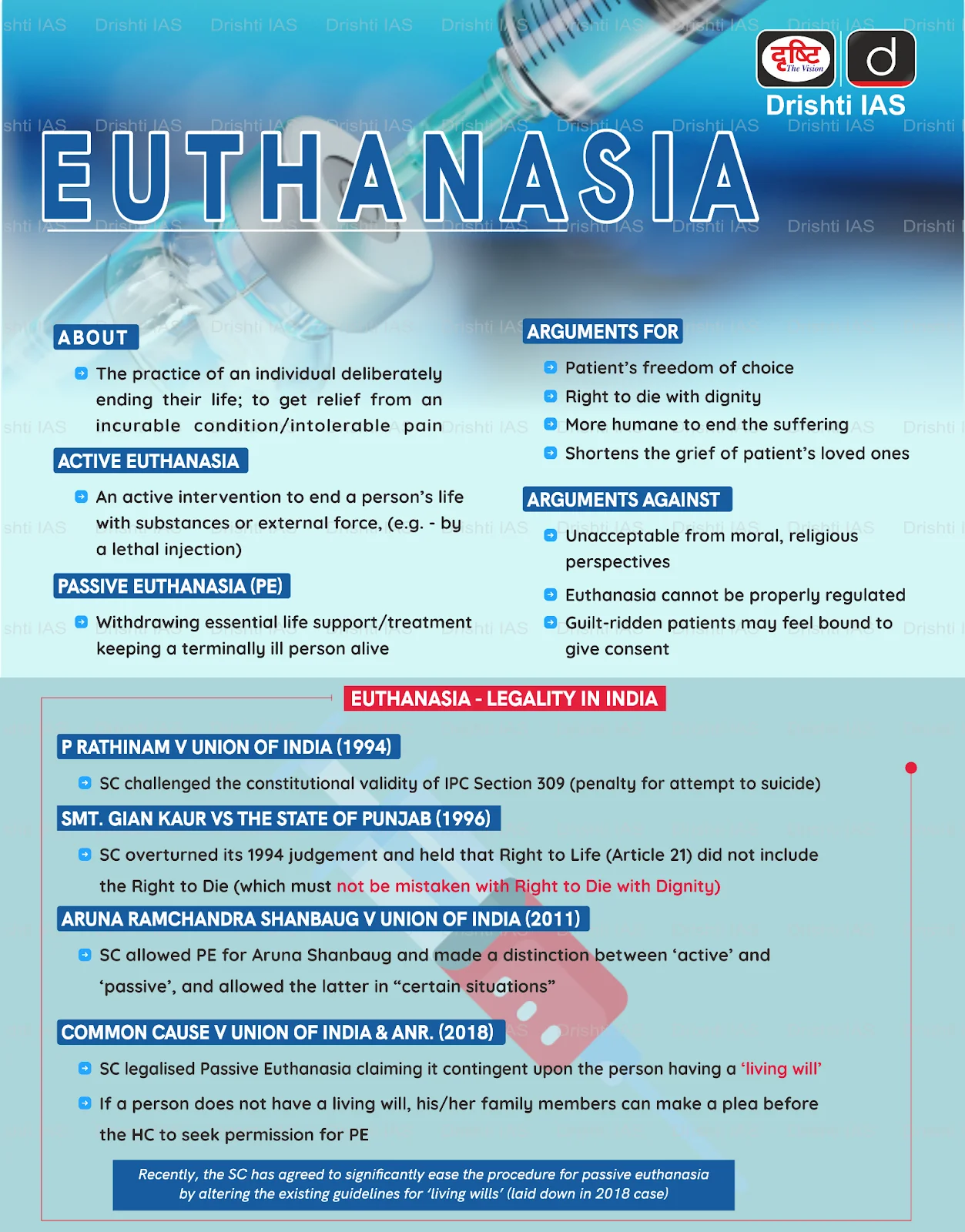
- About: Euthanasia refers to the intentional hastening of death to relieve unbearable suffering caused by an incurable or terminal illness. It aims to reduce physical pain, emotional distress, and spiritual suffering through a deliberate and painless intervention.
- The debate around euthanasia is not merely medical; it is deeply rooted in ethical values, human rights, and societal beliefs.
- Forms and Classifications of Euthanasia: It is primarily categorized into Active Euthanasia (a deliberate act like lethal injection) and Passive Euthanasia (withholding or withdrawing life-sustaining treatment).
- These are further divided into Voluntary (patient-consented), Non-voluntary (decision for an incompetent patient), and Involuntary (without consent, widely illegal) forms.
- Legal Framework in India:
- Indian law explicitly prohibits active euthanasia. The Bharatiya Nyaya Sanhita (BNS), 2023, treats any intentional causing of death as an offence under Section 100 (culpable homicide) or Section 101 (murder).
- The Supreme Court (SC) has legalized passive euthanasia under a strict regulatory framework, recognizing the right to die with dignity as part of Article 21 (Right to Life).
- The Law Commission's 241st Report (2012) clarified that a competent patient’s refusal of life-sustaining treatment is legally valid and doctors following such informed wishes cannot be charged with abetment or culpable homicide.
- Judgements Related to Euthanasia in India:
- Maruti Shripati Dubal v. State of Maharashtra (1987): The Bombay High Court held that the right to die is part of Article 21 (Right to Life), allowing terminally ill persons or those in severe pain to end their lives.
- Gian Kaur v. State of Punjab (1996): The SC reversed this view, holding that the right to life does not include the right to die, and emphasized preservation of life.
- Aruna Shanbaug v. Union of India (2011): The SC permitted passive euthanasia (withholding or withdrawing life support) under strict legal and medical safeguards, even for patients unable to consent.
- Common Cause v. Union of India (2018): The SC distinguished active euthanasia (not permitted) from passive euthanasia (permitted in rare cases) and recognized the right to die with dignity, including refusal of treatment through living wills (advance medical directives).
- Procedure for Passive Euthanasia in India:
- The SC 2018 directives mandated a two-stage medical review by a Primary and a Secondary Medical Board.
- Primary Medical Board: Formed by the hospital, comprising the Head of the treating department and at least three senior specialists from fields such as general medicine, cardiology, neurology, nephrology, psychiatry, or oncology, each with 20 years’ experience.
- Secondary Medical Board: Constituted by the District Collector, headed by the Chief District Medical Officer, along with three expert doctors from the same medical specialties.
- In 2023, the Supreme Court simplified the process by keeping both boards but reducing the required specialist experience from 20 years to 5 and setting a strict 48-hour deadline for their opinions.
- The Secondary Board was also modified, replacing the Chief District Medical Officer as chairman with a nominee from the District Medical Officer, and both boards now consist of three members each.
- The SC 2018 directives mandated a two-stage medical review by a Primary and a Secondary Medical Board.
- Global Legal Landscape on Euthanasia: The Netherlands, Belgium, Luxembourg, Spain, Quebec (Canada), and parts of Australia permit both euthanasia and physician-assisted suicide under strict conditions.
- Switzerland allows assisted suicide by non-physicians but prohibits active euthanasia.
- Sweden and France permit passive euthanasia, while Italy recognizes the right to refuse treatment.
- Ethical and Practical Controversies: The euthanasia debate is fundamentally polarized between arguments for personal autonomy and a "death with dignity" and opposing arguments grounded in the sanctity of life and the "do no harm" principle of the Hippocratic Oath.
- It is further complicated by practical concerns over accurately assessing a patient's mental competency and the ethical risks of potential misuse or a slippery slope in medical judgment.
What are the Key Arguments in Favor of Legalizing Euthanasia?
- Upholding Individual Autonomy: Central to the argument is the principle of patient autonomy and self-determination, which the Supreme Court upheld in Common Cause vs Union of India (2018) by recognizing the "right to die with dignity" under Article 21 and legalizing advanced medical directives.
- Alleviating Incurable Suffering: Euthanasia is advocated to relieve unbearable suffering in terminal illnesses, a position supported by data from permissive countries where its use is predominantly for severe conditions like advanced cancer.
- Curbing Futile Medical Intervention: It prevents futile, suffering-prolonging treatment, alleviating emotional and financial burdens on families and healthcare systems, as exemplified by the passive euthanasia permitted in India since the Aruna Shanbaug case (2011) for withdrawing non-beneficial interventions.
- Philosophical and Pragmatic Foundations: Libertarian principles (John Stuart Mill) defend the right to choose euthanasia based on bodily autonomy, while utilitarian ethics (Jeremy Bentham) support it to minimize suffering. This aligns with the medical duty to relieve pain and allows for a just allocation of healthcare resources.
What are the Principal Arguments Against the Legalization of Euthanasia?
- Ethical and Moral Conflict: Many view euthanasia as violating the sanctity of life, a stance rooted in religious, cultural, and deontological ethics (Immanuel Kant) that sees life as an inviolable end in itself.
- High Risk of Abuse and Coercion: Vulnerable populations, the elderly, disabled, and financially dependent, are at significant risk of being pressured into euthanasia, especially in a country with socioeconomic disparities and uneven healthcare access.
- Challenges in Assessing True Consent: Many Indian psychiatrists lack confidence in detecting depression or subtle coercion in terminally ill patients, raising the risk of inappropriate approvals.
- Stringent Legal Prohibitions and Ambiguity: The BNS, 2023, prosecutes such acts under Sections 100 (culpable homicide), 101 (murder), and 108 (abetment of suicide), creating legal peril for practitioners in the absence of clear regulatory legislation.
- Cumbersome and Inaccessible Procedures: Passive euthanasia, under the SC guidelines, involves a slow, court-driven process with multiple medical boards, making it inaccessible for many and increasing the judicial burden.
How can India Strengthen its End-of-life Care Framework?
- Legislative Clarity: Enact a clear parliamentary law codifying the SC's 2018 guidelines on passive euthanasia and Advance Medical Directives (Living Wills), providing legal protection for practitioners.
- Procedural Streamlining: Simplify processes by decentralizing oversight to district-level committees or multidisciplinary hospital ethics committees, and integrate living wills into the National Health Digital Record for easy access, as initiated by the Supreme Court's 2023 simplification.
- Universal Palliative Care Access: Prioritize and institutionalize hospice and palliative care by establishing a network of home-based, community-led, and hospital-based services, leveraging Ayushman Bharat for coverage and training ASHA workers in basic pain management.
- Rigorous Safeguards: Implement mandatory independent psychiatric evaluations, social worker assessments, and cooling-off periods to screen for coercion of vulnerable groups (elderly, disabled) and ensure genuine patient autonomy.
- Public Awareness and Consensus: Launch nationwide campaigns to educate the public and professionals about living wills and end-of-life choices, while fostering public dialogue involving medical bodies, legal experts, ethicists, and religious leaders to build an ethical consensus.
Conclusion
The Harish Rana case highlights the urgent need for a clear legislative framework on passive euthanasia and advanced medical directives. While patient autonomy and relief from suffering are compelling, the risk of misuse, coercion, and legal ambiguity demands strong safeguards, palliative care expansion, and procedural streamlining to protect vulnerable citizens.
|
Drishti Mains Question: The right to die with dignity is an extension of the right to live with dignity. Critically analyze this statement in the context of the judicial evolution of euthanasia jurisprudence in India. |
Frequently Asked Questions (FAQs)
1. What is passive euthanasia in India?
Passive euthanasia involves withdrawing or withholding life-sustaining treatment, permitted under strict safeguards by the Supreme Court since Aruna Shanbaug (2011) and Common Cause (2018).
2. Is active euthanasia legal in India?
No. Active euthanasia is illegal and treated as culpable homicide or murder under BNS 2023 Sections 100 and 101, with abetment of suicide under Section 108.
3. What is an advance medical directive (living will)?
It is a legal document allowing a competent adult to refuse life-sustaining treatment in advance, recognised by the Supreme Court in Common Cause (2018).
UPSC Civil Services Examination, Previous Year Questions (PYQs)
Prelims
Q. Right to Privacy is protected as an intrinsic part of Right to Life and Personal Liberty. Which of the following in the Constitution of India correctly and appropriately imply the above statement? (2018)
(a) Article 14 and the provisions under the 42nd Amendment to the Constitution.
(b) Article 17 and the Directive Principles of State Policy in Part IV.
(c) Article 21 and the freedoms guaranteed in Part III.
(d) Article 24 and the provisions under the 44th Amendment to the Constitution.
Ans: (c)
Mains
Q. In order to enhance the prospects of social development, sound and adequate health care policies are needed particularly in the fields of geriatric and maternal health care.Discuss. (2020)


Important Facts For Prelims
Central Vigilance Commission
Why in News?
The President, exercising powers under Section 4(1) of the Central Vigilance Commission Act, 2003, has appointed Shri Praveen Vashista as Vigilance Commissioner in the Central Vigilance Commission (CVC).
What is the Central Vigilance Commission?
- About: CVC is the apex statutory body mandated to combat corruption and ensure integrity within the Central Government of India, evolving from an executive recommendation to a key pillar of India's vigilance framework.
- Origin & Evolution: Established in 1964 based on the recommendations of the Santhanam Committee (1962–64), it was initially non-statutory.
- It was granted statutory status in 1998 via a Union government ordinance and was formalised under the CVC Act, 2003.
- Composition & Appointment: It is a multi-member body with a Central Vigilance Commissioner and up to two Vigilance Commissioners. They are appointed by the President based on recommendations from a committee headed by the Prime Minister, with the Union Home Minister and the Leader of the Opposition in Lok Sabha as members. They serve a tenure of 4 years or until attaining 65 years of age, whichever is earlier.
- Independence: The Central Vigilance Commissioner’s salary and service conditions are the same as those of the UPSC Chairman, while a Vigilance Commissioners are the same as those of a UPSC Member; in both cases, these cannot be altered to their disadvantage after appointment.
- All expenses of CVC, including salaries, allowances, and pensions of the Central Vigilance Commissioner, the Vigilance Commissioners, and the staff, are charged to the Consolidated Fund of India and are not subject to a Parliamentary vote.
- Removal: The President can remove the Central Vigilance Commissioner or any Vigilance Commissioner for specific grounds such as insolvency, conviction involving moral turpitude, paid outside employment, infirmity, or prejudicial financial interest.
- In addition, the President can remove the Central Vigilance Commissioner or any Vigilance Commissioner on the ground of proved misbehaviour or incapacity. In such cases, the matter must be referred to the Supreme Court for an enquiry, and removal can take place only if the Supreme Court upholds the grounds and advises removal.
- Core Functions: Its mandate includes:
- Inquiring into offences under the Prevention of Corruption Act, 1988 against central government employees, All India Services officers, and specified public sector officials.
- Exercising superintendence over the CBI in corruption cases and reviewing its investigations.
- Acting as the designated agency for whistle-blower complaints under the Public Interest Disclosure and Protection of Informers’ (PIDPI) Resolution.
- Advising the central government on vigilance matters and reviewing prosecution sanction requests.
- Being the notified authority for suspicious transactions under the Prevention of Money Laundering Act (PMLA), 2002.
- Post Lokpal and Lokayuktas Act, 2013 Role: The Lokpal and Lokayuktas Act, 2013 empowered the CVC to conduct preliminary inquiries into complaints referred by the Lokpal (national anti-corruption ombudsman) against Group A, B, C, and D employees, and to recommend appointments to key posts in the CBI and the Directorate of Enforcement.
- Jurisdiction: Extends to All India Services (Central deputation), Group A officers, senior officers in Public Sector Banks, RBI, NABARD, Public Sector Undertakings (PSUs), and insurance companies.
- Organisational Structure: It operates through a Secretariat, a Chief Technical Examiners’ Wing for technical audits, and Commissioners for Departmental Inquiries (CDIs) to conduct inquiries.
- Working & Reporting: It has powers of a civil court, advises departments on action, and its advice must be acted upon or rejected with recorded reasons. It submits an annual report to the President, which is placed before Parliament.
- Vigilance Network: Each ministry has a Chief Vigilance Officer (CVO) who acts as a link between the department, CVC, and CBI handling internal vigilance functions.
Frequently Asked Questions (FAQs)
1. What is the Central Vigilance Commission (CVC)?
The CVC is the apex statutory vigilance body tasked with preventing corruption and supervising vigilance administration in the Central Government.
2. When did the CVC become a statutory body?
It was granted statutory status in 1998 via a Union government ordinance and was formalised under the CVC Act, 2003.
3. Who appoints the Central Vigilance Commissioner?
The President of India, based on the recommendation of a committee comprising the Prime Minister, Union Home Minister, and Leader of Opposition in Lok Sabha.
4. What is the CVC’s role under the Prevention of Corruption Act, 1988?
It supervises CBI investigations, reviews prosecution sanctions, and inquires into corruption cases involving central government and senior public officials.
5. How did the Lokpal and Lokayuktas Act, 2013 affect the CVC?
It empowered the CVC to conduct preliminary inquiries on Lokpal references and strengthened its role in CBI and Enforcement Directorate appointments.
UPSC Civil Services Examination, Previous Year Question (PYQ)
Q. Consider the following statements: (2019)
- The United Nations Convention against Corruption (UNCAC) has a ‘Protocol against the Smuggling of Migrants by Land, Sea and Air’.
- The UNCAC is the ever-first legally binding global anti-corruption instrument.
- A highlight of the United Nations Convention against Transnational Organized Crime (UNTOC) is the inclusion of a specific chapter aimed at returning assets to their rightful owners from whom they had been taken illicitly.
- The United Nations Office on Drugs and Crime (UNODC) is mandated by its member States to assist in the implementation of both UNCAC and UNTOC.
Which of the statements given above are correct?
(a) 1 and 3 only
(b) 2, 3 and 4 only
(c) 2 and 4 only
(d) 1, 2, 3 and 4
Ans: (c)

Rapid Fire
India’s First State-Funded BSL- 4 Lab
Union Home Minister laid the foundation stone of India’s first state-funded Bio-Safety Level-4 (BSL-4) laboratory in Gandhinagar, Gujarat, marking a major milestone in strengthening the country’s health security, biotechnology research, and preparedness against deadly pathogens.
- BSL-4 Laboratory: BSL-4 represents the highest level of biological containment, designed to study highly infectious and deadly pathogens that often lack effective vaccines or treatments, under strict international safety protocols.
- The facility will enable research on Ebola, Nipah, Marburg, Crimean-Congo Hemorrhagic Fever (CCHF), and Kyasanur Forest Disease (KFD), strengthening India’s outbreak preparedness and bio-defence capacity.
- India’s First State-Funded BSL-4 Facility: It will be the second civilian Bio-Safety Level-4 (BSL-4) laboratory in India.
- Developed under the Gujarat State Biotechnology Mission (GSBTM) and operated by the Gujarat Biotechnology Research Centre (GBRC), which earlier decoded the SARS-CoV-2 genome.
- The complex will include BSL-4, BSL-3, BSL-2, ABSL-4, and ABSL-3 modules, along with high-end utilities and containment systems.
- Animal Bio-Safety (ABSL-4): The ABSL-4 unit will allow in-state testing and vaccine research on zoonotic diseases.
- National Facility Status: The Department of Biotechnology (DBT) has signed an MoU declaring it a national facility, enabling access to experts and institutions across India.
- India’s Existing High-Security Labs:
- Civilian BSL-4 lab: National Institute of Virology, Pune.
- Defence BSL-4 lab: DRDO, Gwalior.
- India currently has 154 BSL-2 labs and 11 BSL-3 labs under the VRDL network (as of March 2025).
- Strategic Importance for India: Enables real-time response to deadly outbreaks without dependence on limited central facilities.
- Reduces reliance on sending animal samples to ICAR-NIHSAD, Bhopal, strengthening domestic capacity.
- Supports vaccine and therapeutic development using animal models, crucial for future pandemics.
| Read more:Building a Resilient R&D Ecosystem in India |


Rapid Fire
Export Preparedness Index (EPI) 2024
NITI Aayog has released the Export Preparedness Index (EPI) 2024, assessing the export readiness of States and Union Territories, highlighting their critical role in achieving India’s USD 1 trillion merchandise export target by 2030 and the vision of Viksit Bharat @2047.
- Export Preparedness Index (EPI): First launched in 2020, the EPI assesses State and district-level export readiness through an evidence-based framework.
- It highlights the role of States and districts in driving exports, jobs, and global value chain integration, with emphasis on infrastructure, competitiveness, and cluster-led strategies.
- The Index links federalism with economic performance and highlights district-led export growth, supporting Make in India, Atmanirbhar Bharat, MSMEs, and trade competitiveness.
- Framework and Coverage of EPI 2024: It is structured around 4 pillars, 13 sub-pillars, and 70 indicators.
- The four core pillars are Export Infrastructure, Business Ecosystem, Policy & Governance, and Export Performance.
- Among these, the Business Ecosystem carries the highest weightage (40%), while the other three pillars have 20% each, highlighting the growing importance of cost efficiency, MSMEs, access to finance, and innovation in strengthening export competitiveness.
- For comparative assessment, States and UTs are grouped into Large States, Small States, North-Eastern States, and Union Territories, and classified as Leaders (High export preparedness), Challengers (Moderate preparedness with scope for improvement), and Aspirers (Early-stage export ecosystems) promoting peer learning, cooperative federalism, and focused reforms.
- The four core pillars are Export Infrastructure, Business Ecosystem, Policy & Governance, and Export Performance.
- EPI 2024 Top Performing States and UTs: The top-performing Large States are Maharashtra, Tamil Nadu, Gujarat, Uttar Pradesh, and Andhra Pradesh, while the leading Small States, North-Eastern States, and Union Territories include Uttarakhand, Jammu and Kashmir, Nagaland, Dadra & Nagar Haveli and Daman & Diu, and Goa.
| Read more: Reimagining India's Export Pathway |

Rapid Fire
Kaziranga Elevated Corridor and Bagurumba Dwhou
During the recent visit to Assam, the Prime Minister participated in the Bagurumba Dwhou 2026 cultural programme in Guwahati, laid the foundation stone of the Kaziranga Elevated Corridor Project, and virtually flagged off two Amrit Bharat Express trains.
- Bagurumba Dwhou: It is a major cultural festival in Guwahati celebrating the heritage of the Bodo community.
- Bagurumba dance is a classical Bodo folk form inspired by nature, symbolising harmony between humans and the environment.
- Performed mainly by women with male musicians, the dance imitates butterflies, birds and flowers through circular and linear formations and represents peace, fertility, and collective joy, closely associated with festivals such as Bwisagu (Bodo New Year).
- Kaziranga Elevated Corridor: It aims to ensure safe wildlife movement across Kaziranga National Park and Tiger Reserve, which hosts the world’s largest population of one-horned rhinoceroses and nearly 500 bird species, while reducing animal–vehicle collisions, improving road safety, easing congestion, and strengthening connectivity to Upper Assam.
- It is part of the four-laning of the 86.675 km Kaliabor–Numaligarh stretch of NH-715 along the Brahmaputra floodplains, includes about 34.5 km of elevated wildlife-friendly corridor with bypasses at Jakhalabandha and Bokakhat.
- Rail Connectivity Boost: To enhance regional connectivity, the Prime Minister also flagged off two Amrit Bharat Express trains, Kamakhya–Rohtak and Dibrugarh–Gomti Nagar (Lucknow), which will significantly improve long-distance rail links between the Northeast and northern India, reduce travel time, and provide modern passenger amenities.
| Read more: Bodoland Territorial Region (BTR) |


Rapid Fire
1.03 Crore New Workers Added to ESIC
Recently, the Union Labour Ministry announced that reforms in Employees' State Insurance Corporation (ESIC) and Employees’ Provident Fund Organisation (EPFO), particularly the Scheme to Promote Registration of Employers/Employees (SPREE), have extended social security coverage to over one crore workers.
- Under SPREE, a one-time, penalty-free window enabled unregistered employers and employees to enter the ESIC system without retrospective liabilities, resulting in the registration of 1.17 lakh employers and 1.03 crore employees(as of 11 January 2026).
- The Employees’ State Insurance Corporation (ESIC) administers the Employees’ State Insurance Scheme (ESI) under the Employees’ State Insurance Act, 1948, providing socio-economic protection against sickness, maternity, disablement, employment injury, and ensuring medical care for insured workers and their dependent families.
- Parallel EPFO reforms have eased access to provident fund benefits by allowing withdrawal of up to 75% of the balance while retaining 25% for retirement, alongside expanded auto-settlement of claims through simplified processes.
- The Employees’ Provident Fund Organisation (EPFO) is a statutory body under the Ministry of Labour & Employment, administering provident fund and pension schemes under the Employees’ Provident Fund & Miscellaneous Provisions Act, 1952, and is among the world’s largest social security organisations.
| Read more: ESIC Funds |

Rapid Fire
Climate Records Unearthed From Kondagai Lake
Recently, researchers reconstructed one of India’s most detailed inland climate records using sediment cores from Kondagai Lake, Sivaganga, a region highly sensitive to the Northeast Monsoon.
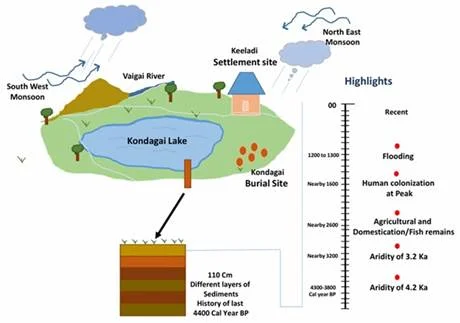
- Key Findings: The study reconstructed 4,500 years of Late Holocene climate history from Kondagai Lake using multiproxy techniques such as stable isotopes, pollen analysis, grain size and radiocarbon dating.
- It identified three major climatic phases- the 4.2 ka arid event, 3.2 ka dry phase and the Roman Warm Period, linking them to monsoon variability, lake hydrology and human activity.
- The long-term climate record provides a robust baseline for understanding Northeast Monsoon behaviour, supports flood risk mapping in the Vaigai basin, guides water resource management through insights into lake-level and groundwater changes, and strengthens wetland restoration and biodiversity conservation planning.
- Holocene Epoch: The Holocene is the current geological epoch, beginning about 11,700 years ago after the last Ice Age. It is characterised by relatively stable and warm climatic conditions and coincides with the rise of human civilisation. It forms part of the Quaternary Period, following the Pleistocene Epoch.
- Kondagai Lake: Kondagai is an inland lake in Sivaganga district, Tamil Nadu, located close to the archaeological site of Keeladi associated with the Sangam-era civilisation, dating back to the 6th century.
- The lake lies in an ancient settlement zone, offering insights into past monsoon variability, ecosystem responses and human–environment interaction.
| Read more: Carbon Dating |