


Rapid Fire
Climate Records Unearthed From Kondagai Lake
- 19 Jan 2026
- 2 min read
Recently, researchers reconstructed one of India’s most detailed inland climate records using sediment cores from Kondagai Lake, Sivaganga, a region highly sensitive to the Northeast Monsoon.
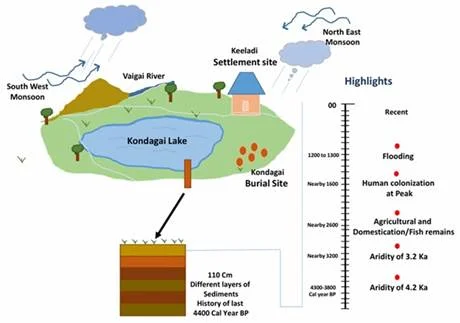
- Key Findings: The study reconstructed 4,500 years of Late Holocene climate history from Kondagai Lake using multiproxy techniques such as stable isotopes, pollen analysis, grain size and radiocarbon dating.
- It identified three major climatic phases- the 4.2 ka arid event, 3.2 ka dry phase and the Roman Warm Period, linking them to monsoon variability, lake hydrology and human activity.
- The long-term climate record provides a robust baseline for understanding Northeast Monsoon behaviour, supports flood risk mapping in the Vaigai basin, guides water resource management through insights into lake-level and groundwater changes, and strengthens wetland restoration and biodiversity conservation planning.
- Holocene Epoch: The Holocene is the current geological epoch, beginning about 11,700 years ago after the last Ice Age. It is characterised by relatively stable and warm climatic conditions and coincides with the rise of human civilisation. It forms part of the Quaternary Period, following the Pleistocene Epoch.
- Kondagai Lake: Kondagai is an inland lake in Sivaganga district, Tamil Nadu, located close to the archaeological site of Keeladi associated with the Sangam-era civilisation, dating back to the 6th century.
- The lake lies in an ancient settlement zone, offering insights into past monsoon variability, ecosystem responses and human–environment interaction.
| Read more: Carbon Dating |



