


Important Facts For Prelims
Foundation Day of Lokpal of India
- 17 Jan 2026
- 11 min read
Why in News?
The Lokpal of India observed its Foundation Day on 16th January, marking the coming into force of Section 3 of the Lokpal and Lokayuktas Act, 2013, which provided for the establishment of the Lokpal in 2014.
What are the Key Facts About Lokpal of India?
- Establishment of Lokpal of India: The idea of a Lokpal was first mooted in 1963, inspired by the Ombudsman model, and was formally recommended by the First Administrative Reforms Commission in 1966.
- India ratified the UN Convention Against Corruption in 2011, leading to the passage of the Lokpal and Lokayuktas Act in 2013, which came into force on 16th January 2014, formally establishing the Lokpal under Section 3 of the Act.
- Before the enactment of the Lokpal and Lokayuktas Act, 2013, several states had already set up Lokayukta institutions through their own laws, with Maharashtra being the first to establish a Lokayukta in 1971.
- Composition of Lokpal: The Lokpal consists of a Chairperson and up to eight Members, with at least 50% being Judicial Members and a mandatory 50% representation from SC, ST, OBC, minorities, and women.
- Members hold office for five years or until attaining the age of 70 years, whichever is earlier, ensuring both expertise and social inclusivity in the institution.
- Appointment Process: The Chairperson and Members of the Lokpal are appointed by the President of India based on the recommendations of a Selection Committee comprising the Prime Minister, Speaker of the Lok Sabha, Leader of Opposition, the Chief Justice of India or a nominee, and one eminent jurist nominated by the President.
- Eligibility Criteria: The Chairperson must be a serving or former Chief Justice of India or a Supreme Court Judge.
- Judicial Members are drawn from serving or former Supreme Court Judges or Chief Justices of High Courts.
- Non-Judicial Members must possess impeccable integrity and at least 25 years of experience in fields specified under the Act.
- Jurisdiction of Lokpal: The Lokpal has jurisdiction over the Prime Minister (with exclusions relating to national security, foreign relations, atomic energy, space, and public order), Union Ministers, Members of Parliament, and Group A to D Central Government officials.
- It also covers entities receiving substantial government funding or foreign contributions under specified conditions.
- Powers and Functions: The Lokpal has powers of superintendence over investigations conducted by the Central Bureau of Investigation (CBI) in cases referred to it and exercises powers of a civil court during preliminary inquiries.
- It can authorise search and seizure, recommend prosecution or disciplinary action, issue guidelines to the CVC, and suggest systemic reforms to address institutional corruption.
- Filing of Complaints: Any individual, NGO, company, trust, limited liability partnership (LLP) even foreign nationals (with passport) can file complaints.
- Complaints must relate to offences under the Prevention of Corruption Act, 1988.
- Complaints can be submitted online or offline in the prescribed format under the Lokpal (Complaint) Rules, 2020, within a limitation period of seven years.
- Confidentiality and Safeguards: The Lokpal ensures strict confidentiality of complainants, witnesses, and public servants during inquiry and investigation.
- Complaint Handling Mechanism: Complaints are generally placed before the Lokpal Bench within 15 working days after scrutiny.
- Even defective complaints are considered, with opportunities given for rectification, and public servants are granted multiple stages to present their defence, ensuring adherence to principles of natural justice.
- Significance of Lokpal: The Lokpal strengthens India’s anti-corruption framework by providing an independent, statutory mechanism to hold high public functionaries accountable.
- By combining investigative authority with procedural fairness and confidentiality, it reinforces public trust and ethical governance in a democratic system.
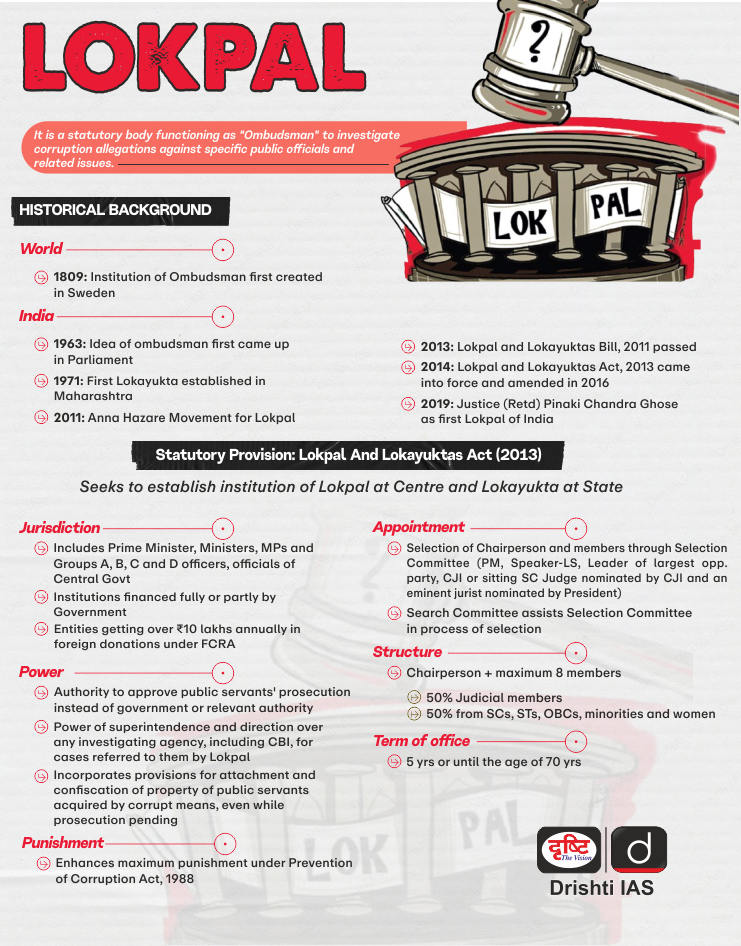
Lokpal and Lokayuktas Act, 2013
- The Lokpal and Lokayuktas Act, 2013 mandates the establishment of the Lokpal at the Union level and Lokayuktas at the State level to inquire into complaints of corruption against specified public functionaries.
- The Act aims to strengthen transparency, accountability, and integrity in public administration through an independent and statutory anti-corruption framework.
- The Act was amended in 2016 to allow the leader of the single largest opposition party in the Lok Sabha to be a member of the Lokpal Selection Committee in the absence of a formally recognised Leader of Opposition.
- The Lokayukta is a state-level anti-corruption authority established to investigate complaints and allegations against public servants.
- The Lokayukta and Upalokayukta are appointed by the Governor after consultation with the Chief Justice of the State High Court and the Leader of the Opposition in the State Legislative Assembly.
- In most states, the Lokayukta holds office for a non-renewable term of five years or until attaining the age of 70 years, whichever is earlier, and enjoys security of tenure, as removal is possible only through an impeachment motion passed by the state legislature.
Frequently Asked Questions (FAQs)
1. What is the Lokpal of India?
The Lokpal is an independent statutory body established under the Lokpal and Lokayuktas Act, 2013 to inquire into corruption complaints against specified public functionaries.
2. Who comes under the jurisdiction of the Lokpal?
The Lokpal covers the Prime Minister (with exceptions), Union Ministers, MPs, and Group A–D Central Government officials, along with certain funded bodies.
3. How are the Chairperson and Members of the Lokpal appointed?
They are appointed by the President based on recommendations of a Selection Committee comprising the PM, Speaker, Leader of Opposition, CJI or nominee, and an eminent jurist.
4. What powers does the Lokpal have in corruption cases?
The Lokpal can order inquiries and investigations through agencies like the CBI, exercise civil court powers, and recommend prosecution or disciplinary action.
5. What was the significance of the 2016 amendment to the Lokpal Act?
It allowed the leader of the single largest opposition party in the Lok Sabha to be part of the Selection Committee in the absence of a recognised Leader of Opposition.
UPSC Civil Services Examination, Previous Year Question (PYQ)
Prelims
Q. Consider the following statements: (2019)
- The United Nations Convention against Corruption (UNCAC) has a ‘Protocol against the Smuggling of Migrants by Land, Sea and Air’.
- The UNCAC is the ever-first legally binding global anti-corruption instrument.
- A highlight of the United Nations Convention against Transnational Organized Crime (UNTOC) is the inclusion of a specific chapter aimed at returning assets to their rightful owners from whom they had been taken illicitly.
- The United Nations Office on Drugs and Crime (UNODC) is mandated by its member States to assist in the implementation of both UNCAC and UNTOC.
Which of the statements given above are correct?
(a) 1 and 3 only
(b) 2, 3 and 4 only
(c) 2 and 4 only
(d) 1, 2, 3 and 4
Ans: (c)
Mains
Q. ‘A national Lokpal, however strong it may be, cannot resolve the problems of immorality in public affairs.’ Discuss (2013)



