Governance
One Health Approach
For Prelims: One Health approach, World Health Organization, Nipah, Avian Influenza (H5N1), Rabies, Indian Council of Medical Research
For Mains: One Health Approach: Concept, significance, and applicability, Integrated disease surveillance systems, Environmental degradation and health linkages
Why in News?
On World Health Day 2026, experts stressed the need for a One Health approach to strengthen pandemic preparedness and ensure equitable healthcare access.
Summary
- On World Health Day 2026, the need for a One Health approach was highlighted to tackle zoonotic diseases, climate-linked risks, and strengthen pandemic preparedness in India.
- Through initiatives like the National One Health Mission, India is moving towards a coordinated, preventive, and sustainable public health system.
World Health Day
- World Health Day is celebrated annually on 7th April to mark the anniversary of the founding of the World Health Organization (WHO) in 1948. It aims to draw global attention to a specific health topic of concern to people all over the world, mobilizing efforts to address critical health challenges.
- World Health Day 2026 is themed “Together for health. Stand with science”, highlighting the role of scientific collaboration and the One Health approach in protecting global health.
- Global Campaigns:
- International One Health Summit: Hosted by France (under the French G7 Presidency), prioritizing multilateral cooperation across human, animal, and environmental sectors.
- Global Forum of WHO Collaborating Centres: A massive gathering of 800 scientific institutions from 80+ countries.
- These events create the largest scientific network in UN history, emphasizing science-driven partnerships as the primary tool for global health security.
What is One Health Approach?
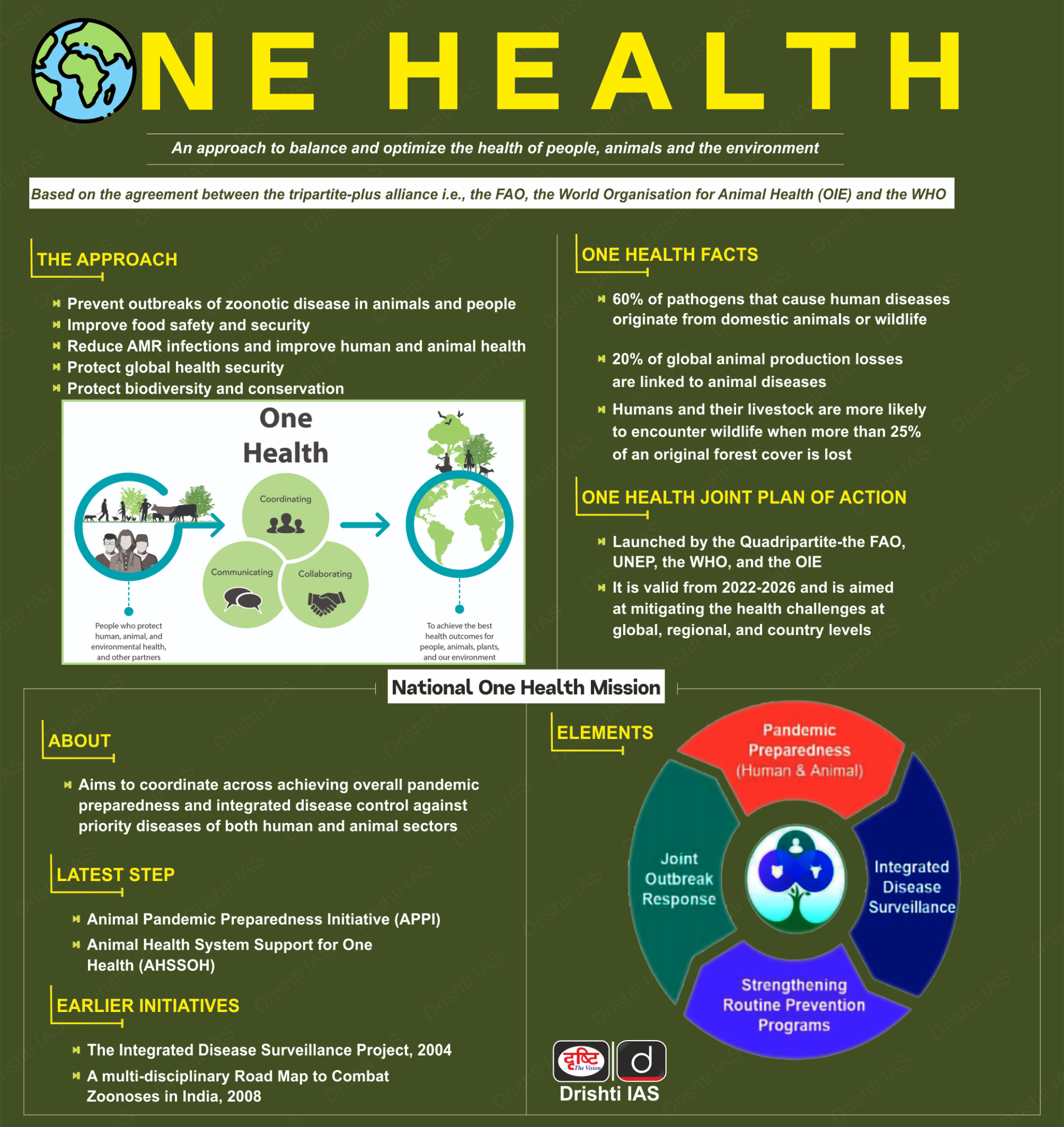
- One Health: It is an integrated, unifying approach that aims to sustainably balance and optimize the health of people, animals, and ecosystems.
- It recognizes that the health of humans, domestic and wild animals, plants, and the wider environment are closely linked and interdependent.
- One Health enables comprehensive disease control and strengthens global health security.
- It is applied at community, subnational, national, regional, and global levels, and relies on coordination, collaboration, and shared governance for holistic and equitable solutions.
- Need of One Health Approach for India:
- High Biodiversity & Interaction: With 2.4% of the world's land but 8% of its species, India has high human-wildlife contact, increasing the risk of zoonotic diseases (diseases that spread from animals to humans).
- Outbreaks of Nipah, Avian Influenza (H5N1), and Rabies show that over 60–70% of emerging infectious diseases in India are animal-borne.
- Massive Livestock Population: India has one of the world's largest livestock populations, which are often the bridge between wildlife and human infections.
- Antimicrobial Resistance (AMR): The overuse of antibiotics in both humans and livestock leads to "superbugs" that travel through the environment and food, making common infections untreatable.
- Climate Change & Vector-Borne Diseases: Deforestation, changing land use, and global warming are altering vector habitats (such as mosquitoes and ticks), leading to the spread of diseases like Dengue and Malaria to new areas, while also bringing forest diseases like Kyasanur Forest Disease (KFD) into human settlements.
- High Biodiversity & Interaction: With 2.4% of the world's land but 8% of its species, India has high human-wildlife contact, increasing the risk of zoonotic diseases (diseases that spread from animals to humans).
- National One Health Mission (NOHM): The National One Health Mission (NOHM), a cross-ministerial initiative approved by the 21st PM-STIAC (Prime Minister’s Science, Technology, and Innovation Advisory Council), represents India’s shift toward an integrated bio-security architecture.
- As of 2026, the mission is anchored by the National Institute for One Health in Nagpur and implemented by the Indian Council of Medical Research (ICMR), utilizing a two-tiered governance structure comprising an Executive Committee (policy-focused) and a Scientific Steering Committee (technical-focused).
- By integrating over 13 government departments, the NOHM aims to address India's high zoonotic burden.
- Its operational focus spans the "full spectrum" of disease control: leveraging AI-enabled tools for early pathogen detection, streamlining R&D for vaccines and diagnostics, and establishing a National Wildlife Health Policy to monitor spillover risks.
- Ultimately, the mission moves beyond reactive healthcare to a proactive, holistic model that secures the health of humans, the world's largest livestock population, and the environment simultaneously.
What are the Challenges in Implementing the One Health Approach in India and the Measures to Strengthen?
|
Challenges |
Measures to Strengthen |
|
Siloed Governance: Human, animal, and environmental sectors work independently with weak coordination and limited data sharing |
Institutionalising Coordination: Establish a statutory body with representation from key ministries to ensure integrated policy-making |
|
Resource Constraints: Veterinary and wildlife health systems suffer from inadequate funding, infrastructure, and skilled manpower |
Integrated Surveillance: Develop a unified, real-time system to monitor diseases across humans, livestock, and wildlife |
|
Low Public Health Spending: Health expenditure (~2.1% of GDP) remains below the National Health Policy target of 2.5%, limiting capacity |
Strengthening Primary Care: Enhance Ayushman Arogya Mandirs to improve early detection, prevention, and grassroots healthcare delivery |
|
Ecological Degradation: Deforestation and urbanisation increase human-wildlife interaction, raising zoonotic disease risks |
Regulating Antibiotic Use: Implement strict controls on antibiotic use in livestock and poultry to tackle antimicrobial resistance (AMR) |
Conclusion
For India, the One Health approach is the best defense against the "Triple Threat" of pandemics, climate change, and drug resistance. By treating the health of the farmer, the cow, and the forest as one single system, India can move from "crisis management" to "prevention."
|
Drishti Mains Question: “One Health approach is critical for addressing emerging public health threats in India.” Discuss. |
Frequently Asked Questions (FAQs)
1. What is the One Health approach?
An integrated framework linking human, animal, and environmental health to improve disease control and global health security.
2. What is the National One Health Mission (NOHM)?
A cross-ministerial initiative integrating 13 departments to strengthen zoonotic disease control, surveillance, and pandemic preparedness.
3. Why is One Health Important for India?
Due to high biodiversity, large livestock population, and rising zoonotic diseases, increasing health risks at the human-animal interface.
4. What is Antimicrobial Resistance (AMR)?
Resistance developed by microbes due to overuse of antibiotics, making infections harder to treat and increasing mortality risks.
5. What are key challenges in implementing One Health?
Siloed governance, low funding, weak veterinary infrastructure, and ecological degradation leading to increased zoonotic spillovers.
UPSC Civil Services Examination, Previous Year Questions (PYQs)
Mains
Q. “Besides being a moral imperative of a Welfare State, primary health structure is a necessary precondition for sustainable development.” Analyse. (2021)


Facts for UPSC Mains
India’s Green Pathway: From Conservation to Climate Action
Why in News?
India’s evolving environmental strategy, highlighted in its “Green Pathway” approach, reflects a shift from conservation to integrated climate action. Amid rising climate challenges, India is aligning biodiversity protection with economic growth and sustainability.
- The country is also emerging as a key global voice on climate justice and sustainable development.
How is India Advancing Biodiversity Conservation and Sustainable Development?
- India's Biodiversity & Conservation Framework:
- Rich Biodiversity: Despite occupying only 2.4% of the global land area, India hosts about 8% of the world's recorded species (over 96,000 animal and 47,000 plant species).
- Legal Foundation: Conservation is governed by the Biological Diversity Act (2002), aligning with the 1992 Convention on Biological Diversity (CBD).
- NBSAP 2024–2030: Launched at United Nations Convention to Combat Desertification (UNCCD) – COP 16 (Saudi Arabia) the updated National Biodiversity Strategy and Action Plan (NBSAP) aims to halt and reverse biodiversity loss by 2030, with a vision of living in harmony with nature by 2050.
- The roadmap targets ecosystem restoration, species recovery, wetland/coastal conservation, and stronger governance through local and national biodiversity committees.
- Protected Areas and Wildlife Conservation Programmes:
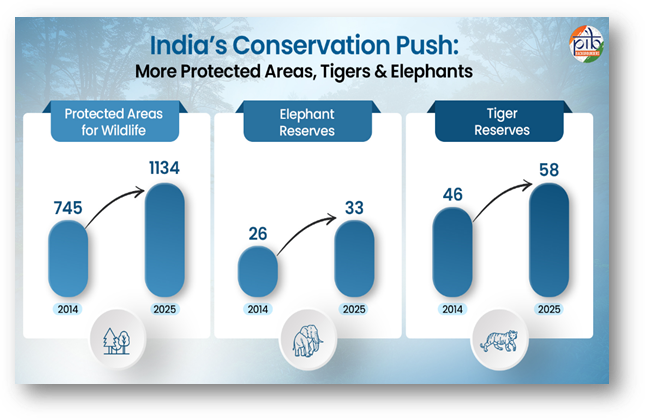
- Protected Areas: Expanded significantly from 745 in 2014 to 1,134 in 2025, with a focus on wildlife corridors for safe animal movement.
- Key Species Projects:
- Project Tiger: Tiger Reserves increased to 58 (the newest being Madhav Tiger Reserve).
- Project Elephant: Expanded to 33 reserves, securing 150 elephant corridors across 15 states.
- Project Cheetah: The population has reached 30 (including 19 cubs born in India). The project is expanding to new areas like Gandhisagar Wildlife Sanctuary.
- Project Snow Leopard: The first assessment estimated 718 snow leopards (highest in Ladakh). Phase 2.0 was launched in late 2025.
- Project Dolphin: Estimated 6,327 riverine dolphins (2021–2023). A second range-wide survey covering major rivers launched in January 2026.
- International Big Cat Alliance (IBCA): India led multi-country, multi-agency coalition that brings together 95 big cat range countries, non-range nations interested in conservation, creating a unified platform for collaborative action and knowledge sharing.
- Launched by India in 2023 during the 50 years of Project Tiger, IBCA was later approved by the Union Cabinet with its Secretariat headquartered in India.
- Wildlife Week 2025 Launches: Introduced new national projects for the Sloth Bear and Gharial, emphasizing a landscape-level strategy that combines species protection with forest ecosystem restoration.
- Forest and Biosphere Conservation:
- Biosphere Reserves: India maintains a network of 18 Biosphere Reserves. Of these, 13 are recognized under UNESCO’s World Network of Biosphere Reserves, with the Cold Desert Biosphere Reserve (Himachal Pradesh) being the latest addition in September 2025.
- Forest Fire Management: To mitigate climate-induced risks, the Forest Survey of India operates a 24x7 satellite-based, real-time fire monitoring system that issues instant SMS and email alerts.
- Mass Afforestation Drive: The citizen-led Ek Ped Maa Ke Naam (Plant4Mother) campaign became a massive environmental movement, resulting in the planting of 262.4 crore saplings by the end of 2025.
- Wetlands and Coastal Ecosystems:
- Mangrove Restoration: Recognizing mangroves as natural buffers, Under the Mangrove Initiative for Shoreline Habitats and Tangible Incomes (MISHTI) India restored 4,536 hectares in 2025 and identified another 22,560 hectares across 13 States/UTs for future plantation.
- Ramsar Sites: India declared 11 new Ramsar Sites in 2025, bringing the total to 98 (the highest in Asia and 3rd globally).
- Notably, Udaipur and Indore became India’s first Ramsar-accredited Wetland Cities.
- National Coastal Mission: Extended for 2025–2031 to enhance coastal climate resilience, manage erosion, and protect coral reefs.
- Blue Flag Beaches: By the 2025–26 season, 18 beaches across 7 states and 4 Union Territories achieved the international Blue Flag certification for cleanliness, safety, and sustainable management.
- Human-Wildlife Conflict Management: The government has issued strict advisories to identify conflict hotspots, mandate coordinated action, and establish rapid response teams.
- To support affected communities, the government ensures that ex gratia relief for death or injury is paid within 24 hours.
- India launched a dedicated "Centre of Excellence for Human-Wildlife Conflict Management" and a specific project addressing "Tigers Outside Tiger Reserves."
- Pollution Control & Circular Economy Initiatives:
- Clean Air Success (NCAP): Out of 130 targeted cities, 103 successfully reduced PM10 concentrations by 2024–25 (compared to 2017–18).
- Notably, 64 cities saw a 20% drop, and 25 cities achieved a 40% reduction.
- Fly Ash Utilization: The government mandates 100% utilization of thermal power plant fly ash.
- In 2024–25, out of 340 million tonnes generated, a massive 332.63 million tonnes were successfully repurposed into roads (32%), cement (27%), and bricks (14%).
- Recycling Infrastructure Boom: To support sustainable development, the number of waste recycling plants in India nearly quadrupled from 2019–25.
- Extended Producer Responsibility (EPR): By December 2025, over 71,000 producers and 4,400 recyclers registered, facilitating the recycling of over 375 lakh tonnes of waste.
- India’s Plastic Waste Management Rules, 2016 introduced EPR targets up to 100% by 2024–25. The 2026 amendments allow flexibility by permitting carry-forward of unmet targets for three years, with at least one-third cleared annually.
- Clean Air Success (NCAP): Out of 130 targeted cities, 103 successfully reduced PM10 concentrations by 2024–25 (compared to 2017–18).
- Sustainable Development and Inclusive Growth: Guided by NITI Aayog, India's overall composite SDG score has steadily increased from 57 in 2018 to 71 in 2023–24.
What is India’s Strategy for Climate Action?
- Climate Policies & Targets:
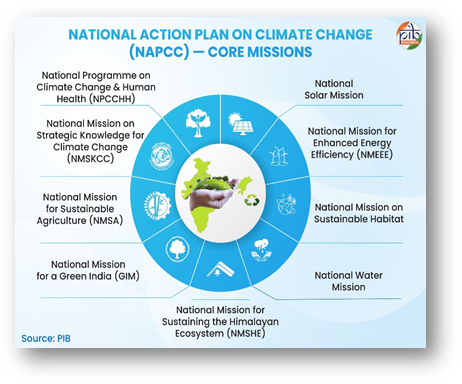
- NAPCC: The National Action Plan on Climate Change (NAPCC) serves as the overarching framework, featuring nine sectoral missions to balance adaptation and mitigation.
- NDCs: Under Nationally Determined Contribution (NDC 3.0) for the period 2031-2035.
- India pledges to achieve 60% of its cumulative installed electricity capacity from non-fossil sources (including solar, wind, hydro, biomass, and nuclear) by 2035.
- India has already reached 52.57% as of February 2026, successfully meeting its previous 2030 target (50%).
- India aims to reduce the emissions intensity of its GDP by 47% by 2035, compared to 2005 baseline levels.
- India had already achieved a 36% reduction by 2020, keeping it well on track to beat its earlier 45% reduction target for 2030.
- India targets the creation of an additional carbon sink of 3.5 to 4.0 billion tonnes of CO2 equivalent through enhanced forest and tree cover by 2035.
- As of 2025, India has created an additional carbon sink of 2.29 billion tonnes CO2 equivalent from forest and tree cover.
- India pledges to achieve 60% of its cumulative installed electricity capacity from non-fossil sources (including solar, wind, hydro, biomass, and nuclear) by 2035.
- Net-Zero & Hydrogen: India aims for Net-Zero by 2070. The National Green Hydrogen Mission targets 5 million metric tonnes of annual production by 2030.
- Mission LiFE: A grassroots movement for sustainable living that has engaged over 6 crore people and secured nearly 5 crore pledges by December 2025.
- Clean Energy Expansion:
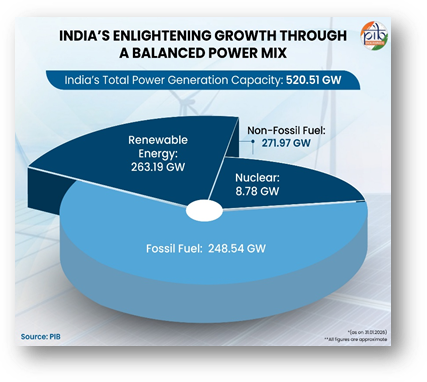
- Current Capacity (Jan 2026): Non-fossil sources officially power the majority of India. Out of ~520.5 GW total capacity, non-fossil fuels account for ~272 GW, overtaking fossil fuels (~248.5 GW).
- Global Rankings (2025): India ranks 3rd globally in solar power and 4th in both wind and total renewable energy.
- Milestone Projects: Modhera (Gujarat) became India’s first 24x7 solar-powered village, and Omkareshwar (Madhya Pradesh) houses the nation's largest floating solar park.
- Efficiency: CO₂ emission intensity in the power sector dropped significantly from 61.45 to 40.52 tonnes per ₹ crore of GDP between 2015 and 2023.
- Carbon Markets & Industrial Decarbonization
- Carbon Trading: India operationalized its domestic Carbon Credit Trading Scheme to ensure compliance and offset mechanisms.
- Industrial Accountability: In January 2026, the government expanded Greenhouse Gas Emission Intensity targets to cover 490 major emission-intensive entities.
- Carbon Capture (CCUS): The 2026–27 Union Budget allocated a massive Rs 20,000 crore over five years to develop Carbon Capture, Utilisation, and Storage technologies.
- Global Leadership & Multilateral Engagement
- Diplomacy: At COP30 (Brazil, 2025), India pushed for tech transfers and joined the Tropical Forests Forever Facility (TFFF).
- Solar & Ozone: India hosted the 8th International Solar Alliance (ISA) Assembly in late 2025. Under the Montreal Protocol, it successfully phased down 67.5% of HCFCs (ozone-depleting substances) by 2025.
Conclusion
India is successfully blending robust domestic action such as renewable energy expansion, pollution control, habitat restoration, and massive citizen engagement with global cooperation. Backed by measurable achievements across all sectors, India is firmly on track to realize its ultimate 2050 vision of "living in harmony with nature."
|
Drishti Mains Question: “India’s environmental strategy reflects a shift from conservation to climate action.” Critically examine. |
Frequently Asked Questions (FAQs)
1. What is NBSAP 2024–2030?
India’s biodiversity roadmap to halt biodiversity loss by 2030 and achieve harmony with nature by 2050.
2. What is the significance of MISHTI?
A mangrove restoration initiative enhancing coastal resilience and protecting against climate risks.
3. What is the target of India’s National Green Hydrogen Mission?
To produce 5 million metric tonnes of green hydrogen annually by 2030.
4. What is the objective of the National Clean Air Programme (NCAP)?
To reduce particulate pollution (PM10/PM2.5) across 130 cities through targeted action plans.
5. What is Extended Producer Responsibility (EPR)?
A framework making producers responsible for recycling and disposal of plastic, e-waste, tyres, and batteries.
UPSC Civil Services Examination, Previous Year Question (PYQ)
Prelims
Q. With reference to the Indian Renewable Energy Development Agency Limited (IREDA), which of the following statements is/are correct? (2015)
- It is a Public Limited Government Company.
- It is a Non-Banking Financial Company.
Select the correct answer using the code given below:
(a) 1 only
(b) 2 only
(c) Both 1 and 2
(d) Neither 1 nor 2
Ans: (c)
Q. With reference to the Agreement at the UNFCCC Meeting in Paris in 2015, which of the following statements is/are correct? (2016)
- The Agreement was signed by all the member countries of the UN, and it will go into effect in 2017.
- The Agreement aims to limit greenhouse gas emissions so that the rise in average global temperature by the end of this century does not exceed 2ºC or even 1.5ºC above pre-industrial levels.
- Developed countries acknowledged their historical responsibility in global warming and committed to donate $ 1000 billion a year from 2020 to help developing countries to cope with climate change.
Select the correct answer using the code given below:
(a) 1 and 3 only
(b) 2 only
(c) 2 and 3 only
(d) 1, 2 and 3
Ans: (b)
Mains
Q. Describe the major outcomes of the 26th session of the Conference of the Parties (COP) to the United Nations Framework Convention on Climate Change (UNFCCC). What are the commitments made by India in this conference?(2021)
Q. Explain the purpose of the Green Grid Initiative launched at the World Leaders Summit of the COP26 UN Climate Change Conference in Glasgow in November 2021. When was this idea first floated in the International Solar Alliance (ISA)?(2021)
Q. “Access to affordable, reliable, sustainable and modern energy is the sine qua non to achieve Sustainable Development Goals (SDGs)”.Comment on the progress made in India in this regard.(2018)


Important Facts For Prelims
Jyotiba Phule
Why in News?
Recently, the bicentenary of Jyotiba Phule(1827–1890) highlighted his contributions as a social reformer and a pioneer of constitutional thought.
- Phule’s ideas reimagined society based on equality, dignity, and redistribution of power, highlighting the interlinkage of social hierarchy, economic exploitation, and state indifference.
What are the Key Facts about Jyotiba Phule?
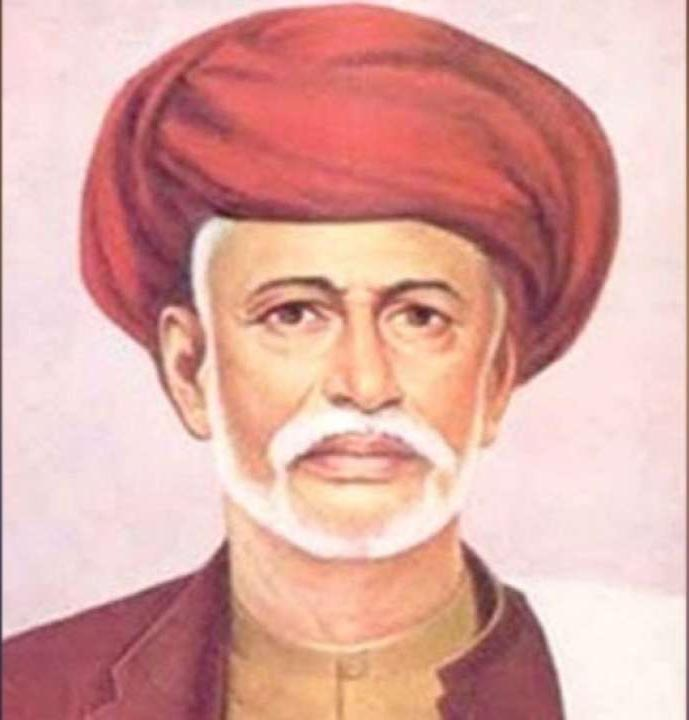
- About: He was born on 11th April, 1827, and emerged as a pioneering social reformer who challenged Brahmanical orthodoxy, fought for the rights of Dalits and women, and laid the foundation for India’s social justice movements.
- Key Contributions:
- Educational Reforms: Phule and his wife Savitribai, opened India’s first girls’ school in 1848 and later started night schools (1855) for workers, farmers, and women in Pune.
- Social Reforms:
- Opposed Orthodoxy: Phule opposed caste oppression, criticized Brahminical figures like Chiplunkar and Tilak, and supported the British to uplift the oppressed and women.
- Anti-Caste Movement: Phule founded Satyashodhak Samaj (1873) to fight caste hierarchy and, in Gulamgiri, compared caste oppression to American slavery.
- Deenbandhu, a Marathi weekly newspaper founded by Krishnarao Pandurang Bhalekar in 1877, served as an outlet for Satyashodhak Samaj.
- 1857 Revolt Critique: Viewed it as an upper-caste effort to restore Brahmin rule.
- Economic Reforms: Advocated compulsory education for lower castes and economic upliftment to dismantle caste hierarchies.
- Religious Freedom: In his Satsar (The Essence of Truth), Phule defended the right of Pandita Ramabai to convert to Christianity.
- Farming Reforms: In Shetkaryanche Asud (Farmer’s Whip), Jyotirao Phule critiqued the exploitation of Shudra peasantry by a British and Brahmin bureaucratic alliance.
- Rationalism: In Sarvajanik Satya Dharma Pustak, he advocated for a just and equitable society where God is seen as a loving and rational creator. It dismantled traditional hierarchies.
- Major Publications: Tritiya Ratna (1855), Powada: Chatrapati Shivajiraje Bhosle Yancha (1869), Gulamgiri (1873), Shetkarayacha Aasud (1881).
- Inspiration: He was influenced by Thomas Paine’s The Rights of Man, and saw education of women and lower castes as key to ending social evils.
- Recognition: He was bestowed with the title of Mahatma on 11th May, 1888 by a Maharashtrian social activist Vithalrao Krishnaji Vandekar.
Frequently Asked Questions (FAQs)
1. When was Mahatma Jotirao Phule born?
He was born on April 11, 1827.
2. What were Mahatma Jotirao Phule’s key contributions?
He was a social reformer, educator, and a strong critic of the caste system.
3. Why is Mahatma Jotirao Phule significant in women’s education?
He pioneered and promoted women’s education in India.
4. What was Mahatma Jotirao Phule’s role in social reform?
He worked towards eradication of caste discrimination and upliftment of marginalized sections.
UPSC Civil Services Examination, Previous Year Questions (PYQs)
Q. Satya Shodhak Samaj organized (2016)
(a) a movement for upliftment of tribals in Bihar
(b) a temple-entry movement in Gujarat
(c) an anti-caste movement in Maharashtra
(d) a peasant movement in Punjab
Ans: (c)


Rapid Fire
PFBR at Kalpakkam Attains Criticality
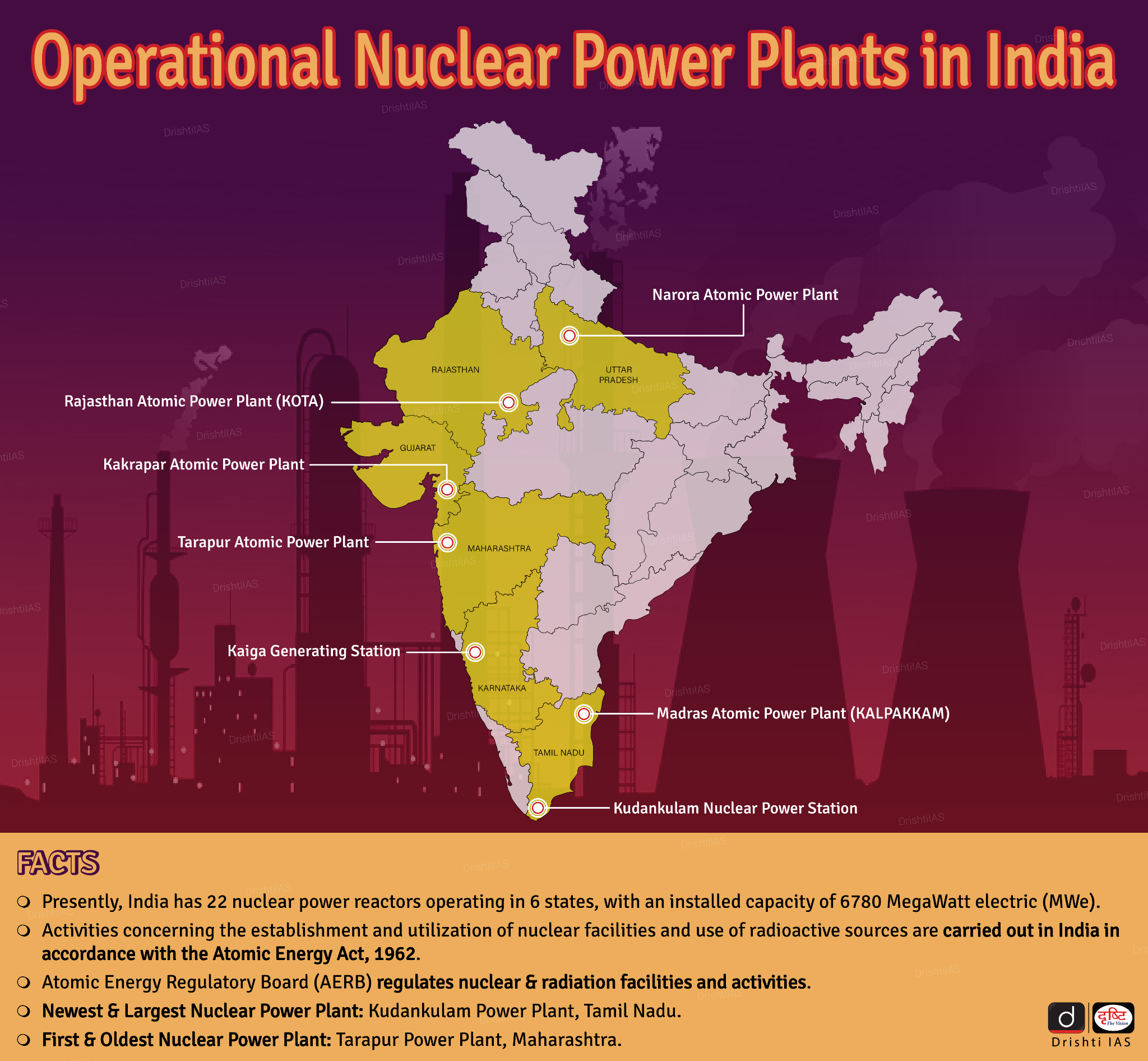
Recently, the indigenously developed Prototype Fast Breeder Reactor (PFBR) at Kalpakkam, Tamil Nadu, attained criticality, marking progress in India’s nuclear energy programme.
- Criticality is the stage when a nuclear reactor achieves a self-sustaining chain reaction, indicating that the reactor core is functioning as designed and can proceed toward power generation.
India’s 3-Stage Nuclear Programme
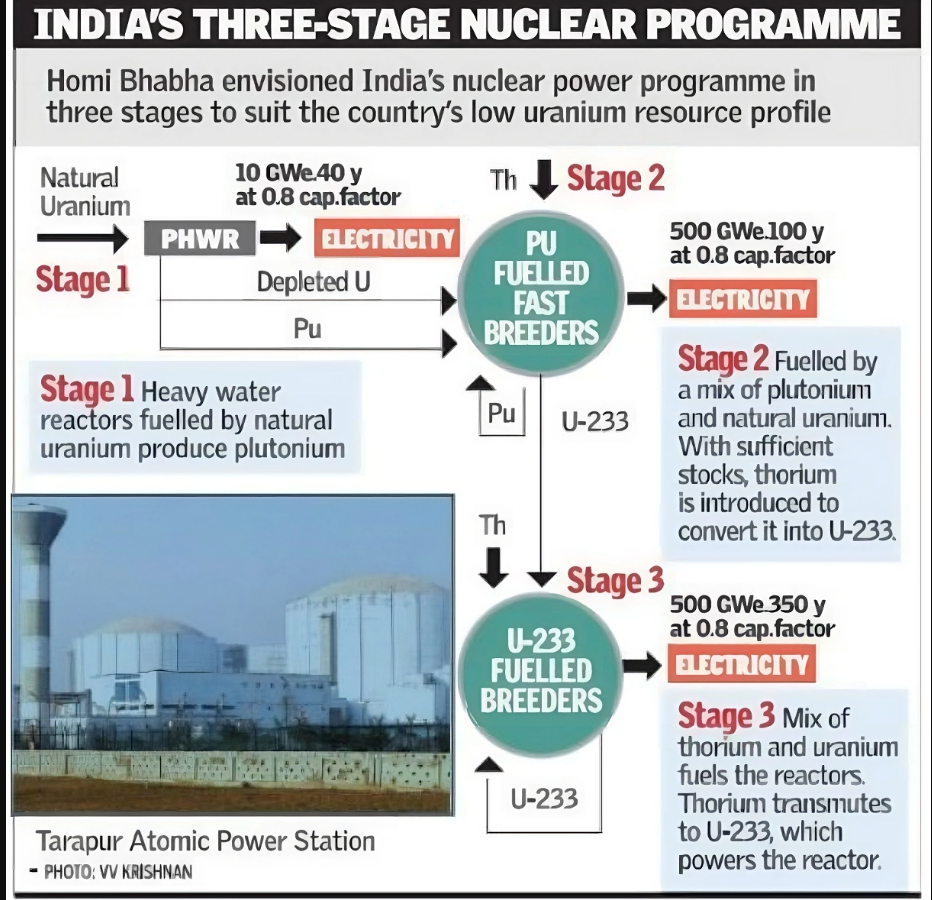
- About: India’s nuclear programme is designed to utilise its limited uranium and abundant thorium resources through a sequential three-stage approach: PHWRs → Fast Breeder Reactors → Thorium-based reactors.
- Pressurised Heavy Water Reactors (PHWRs): They use natural uranium as fuel and heavy water as coolant and moderator. They form the backbone of India’s current nuclear power capacity (8,180 MWe) and represent the first stage of the programme.
- India aims to produce 22,400 MWe of nuclear power by 2032 and expand PHWR capacity through fleet-mode construction.
- Fast Breeder Reactor (FBR): A Fast Breeder Reactor produces more fuel than it consumes by converting fertile material (like U-238) into fissile material (like plutonium). It uses MOX fuel and plays a critical role in expanding nuclear fuel availability.
- FBRs act as a bridge between uranium-based reactors and thorium-based reactors by generating plutonium and enabling the production of U-233, which is essential for the third stage.
- India’s prototype 500 MWe FBR at Kalpakkam is in advanced commissioning. Plans include six more FBRs of 600 MWe each, along with a dedicated fuel cycle facility.
- Once operational, India will be only the second country after Russia to run a commercial FBR, while many countries have discontinued such programmes due to safety concerns.
- Thorium: Thorium (Th-232), a fertile material, is converted into fissile U-233 through irradiation in reactors. This enables long-term energy generation using India’s vast thorium reserves.
- India has one of the largest thorium reserves globally, found in coastal and inland sands. Harnessing thorium is key to achieving long-term energy security and reducing dependence on imported fuel.
- Strategic Significance: PFBR advancement strengthens the second stage of India’s nuclear programme and enables future utilisation of vast thorium reserves, while use of PHWRs with imported uranium and advanced fuels like HALEU allows earlier thorium utilisation without waiting for full FBR deployment.
- Future plans include thorium-based reactors, molten salt reactors (MSRs), and expanded fuel recycling, aiming for energy independence and sustainable nuclear growth.
| Read more: Criticality of Prototype Fast Breeder Reactor |


Rapid Fire
Artemis II Surpasses Apollo 13 Distance Record
NASA’s Artemis II Mission has set a new record for the farthest distance travelled by humans in space, surpassing the Apollo 13 milestone of 1970.
- The crew travelled beyond 248,655 miles from Earth, reaching a maximum distance of about 252,756 miles.
Artemis II Mission
- About: Artemis II is NASA’s first crewed lunar mission since Apollo 17 (1972) and the 1st human flight under the Artemis programme, aimed at advancing human space exploration.
- Collaboration: The mission includes four astronauts, three from NASA and one from the Canadian Space Agency, on board the Orion spacecraft.
- Mission Type: Launched on 1st April, using the Space Launch System (SLS), the spacecraft follows a free-return lunar flyby trajectory around the Moon.
- Key Events: The mission includes a close lunar approach (~4,067 miles), observation of the Moon’s far side, a solar eclipse, and a planned communication blackout.
- Significance: Data collected (images, telemetry, observations) will support future Artemis missions, including crewed lunar landings, and contribute to establishing a sustained human presence on the Moon.
| Read more: Artemis II Mission |


Rapid Fire
Prakash Purb of Guru Teg Bahadur
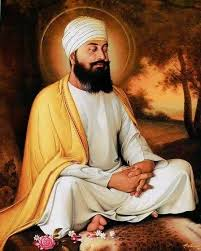
Union Home Minister and Minister of Cooperation has extended greetings on the Prakash Purb of the 9th Guru of Sikhism, 'Hind di Chadar' Guru Teg Bahadur Ji.
- Prakash Purab (also known as Prakash Utsav) translates to the "Festival of Light" and is the term used in Sikhism to celebrate the birth anniversary of a Sikh Guru.
- Early Life and Succession: Born as Tyag Mal on 1st April 1621, in Amritsar, he was the son of the 6th Sikh Guru, Guru Hargobind.
- He earned the title ‘Tegh Bahadur’ (best wielder of the sword) for his valour in the Battle of Kartarpur (1634) against Mughal forces, and he later succeeded the 8th Guru, Guru Harkrishan, to become the 9th Guru of the Sikhs.
- Core Philosophy: He perpetuated Guru Nanak’s doctrine of ‘Ik Onkar’ (unity of God) and advocated a life based on ‘nirbhau’ (fearlessness) and ‘nirvair’ (absence of enmity).
- His spiritual temperament was deeply influenced by his father's concept of Miri and Piri (temporal and spiritual authority).
- Travels and Establishments: He travelled extensively across Northern and Eastern India (including Assam and Dacca) to spread Sikhism.
- He founded Chak Nanaki in the Shivalik foothills, which later became famous as Anandpur Sahib.
- Literary Contributions: His spiritual compositions include hymns in 15 Raags, comprising 59 Shabads and 57 Shaloks, which were later formally incorporated into the Guru Granth Sahib by Guru Gobind Singh.
- Supreme Sacrifice: During the reign of Mughal Emperor Aurangzeb, who enforced strict policies of religious persecution and forced conversions, Guru Tegh Bahadur stepped forward to protect the religious freedom of Kashmiri Brahmins.
- In 1675, refusing to convert to Islam, he was publicly beheaded in Delhi, alongside his loyal followers Bhai Mati Das, Bhai Sati Das, and Bhai Dayal Das.
- Historical Legacy: His martyrdom sites in Delhi are marked by Gurudwara Sis Ganj (marking his execution and the rescue of his head by Bhai Jaita) and Gurudwara Rakab Ganj (where his body was cremated by Lakhi Shah).
- Often revered as "Hind di Chadar" (Shield of India), his sacrifice directly catalyzed his son, Guru Gobind Singh, to militarize the Sikh community by creating the Khalsa.
| Read more: Guru Tegh Bahadur Prakash Purab |


Rapid Fire
Indian Army’s Technology Roadmap
The Indian Army has officially released a strategic technology roadmap in New Delhi, specifically focusing on Unmanned Aerial Systems (UAS) and Loitering Munitions, to align military operational needs with domestic industrial capabilities.
- Strategic Indigenization: The roadmap provides actionable, long-term visibility to industry, academia, and R&D institutions, allowing them to channelize investments into the Army's specific priority areas.
- Operational Bridge: It acts as a critical link between operational requirements and technological development, ensuring the evolution of a structured, demand-driven drone ecosystem in India.
- Modern Warfare Tactics: Highlighting lessons from global conflicts, the roadmap emphasizes the essential balance between mass deployment and precision targeting using drone technology.
- Self-Reliance (Atmanirbharta): The initiative fosters a "whole of nation approach" by uniting the armed forces, defense industry, and start-ups to build a resilient and self-reliant defense manufacturing sector.
| Read more: India's Defence Modernisation Drive |