


Important Facts For Prelims
Carbon Capture and Utilisation Technologies
- 26 Feb 2026
- 8 min read
Why in News?
Carbon Capture and Utilisation (CCU) is an emerging climate mitigation technology that captures industrial CO₂ emissions and can help power India's journey toward a circular economy and net-zero by 2070.
What is Carbon Capture, and Utilisation?
- About CCU: CCU refers to technologies that capture CO₂ emissions from industrial sources or directly from the air and convert them into useful products like fuels, chemicals, and building materials.
- Unlike Carbon Capture and Storage (CCS), which permanently stores CO₂ underground, CCU puts the captured carbon to economic use.
- Relevance for India: As the world's 3rd-largest CO₂ emitter (after China, the United States), with emissions driven by power, cement, steel, and chemicals, India needs CCU to decarbonize "hard-to-abate" industrial processes that are difficult to transition with renewable energy alone.
- Current Status and Initiatives in India:
- Government Initiatives: An allocation of Rs 20,000 crore has been announced in the Union Budget 2026-27 to support the development and deployment of Carbon Capture, Utilisation and Storage (CCUS) technologies across key industries, including the chemicals sector, over the next 5 years.
- The Department of Science and Technology has created a specific R&D roadmap for CCU.
- The Ministry of Petroleum and Natural Gas has presented a draft 2030 roadmap for CCUS.
- Private Sector Projects: Ambuja Cements (with IIT Bombay) is working on an Indo-Swedish pilot to convert captured CO₂ into fuels and materials.
- JK Cement is collaborating on a CCU testbed to capture CO₂ for applications such as lightweight concrete blocks and olefins.
- Organic Recycling Systems Limited (ORSL) is leading India’s first pilot-scale Bio-CCU platform, valorising CO₂ from biogas streams into bio-alcohols and speciality chemicals.
- Government Initiatives: An allocation of Rs 20,000 crore has been announced in the Union Budget 2026-27 to support the development and deployment of Carbon Capture, Utilisation and Storage (CCUS) technologies across key industries, including the chemicals sector, over the next 5 years.
- Global Best Practices: The EU Bioeconomy Strategy and Circular Economy Action Plan explicitly support CCU for converting CO₂ into feedstocks, linking it to circularity and sustainability targets.
- A project in Belgium is trialing technology to convert captured CO₂ into carbon monoxide for steel and chemical production.
- The US uses a combination of tax credits and funding to scale CCUs.
- The UAE’s Al Reyadah project and planned CO₂-to-chemicals hubs leverage CCU with green hydrogen.
- Key Challenges for India:
- Cost Competitiveness: CCU is energy-intensive and expensive; without policy incentives, products cannot compete with cheaper fossil-based alternatives.
- Infrastructure Readiness: Requires co-located industrial clusters and reliable CO₂ transport, which are unevenly developed.
- Policy and Standards Gap: The absence of clear standards, certification, and market signals creates investor uncertainty.
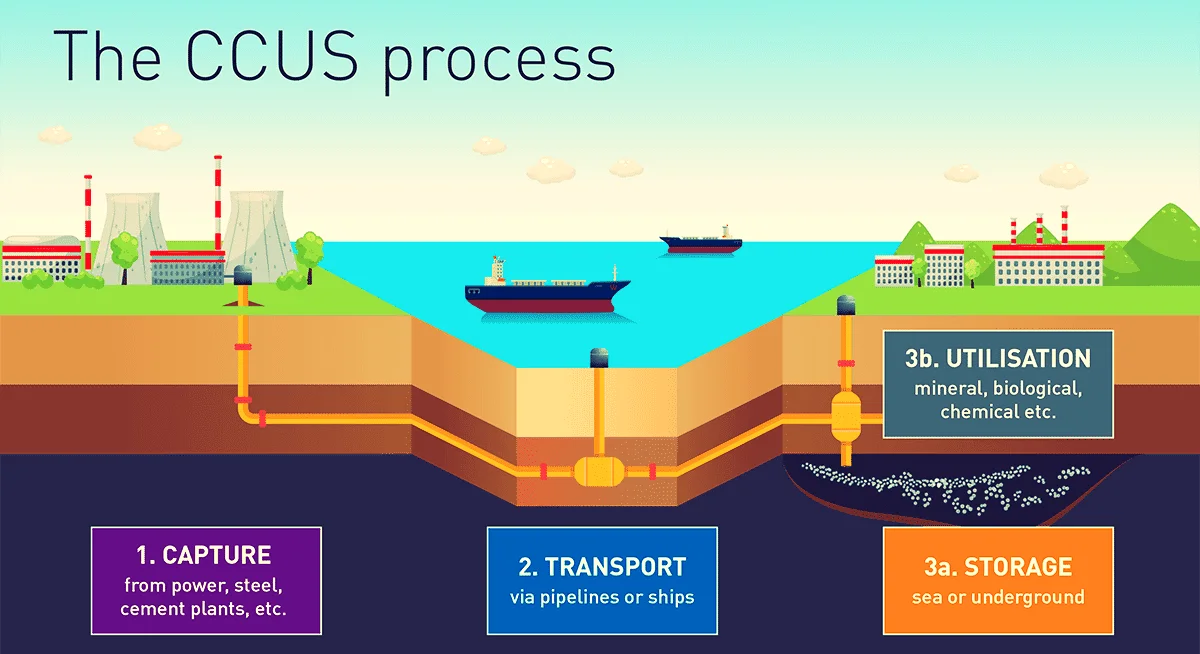
What are the Various Carbon Capture Utilisation Technologies?
Capture Phase
- Post-combustion capture: Separation from flue gases after fuel combustion, typically using chemical solvents (e.g., amine-based absorption).
- Pre-combustion capture: Conversion of fuel into a syngas mixture, followed by CO₂ separation before combustion.
- Oxy-fuel combustion: Burning fuel in nearly pure oxygen to produce a CO₂-rich exhaust stream for easier capture.
- Direct air capture (DAC): Extraction of CO₂ directly from ambient air using sorbents or solvents, though more energy-intensive due to lower atmospheric concentrations.
Utilisation Phase
- Direct Use (Non-Conversion): This pathway leverages CO₂ for its physical properties without altering its molecular structure. Key applications include:
- Enhanced Oil Recovery (EOR): Injecting captured CO₂ into depleting oil fields to extract more oil. It is the most mature application but is controversial as it enables further fossil fuel extraction.
- Food and Beverage Industry: Used for carbonating drinks and in modified atmosphere packaging to extend shelf life.
- Greenhouses and Algae Cultivation: CO₂ acts as a fertiliser to boost plant growth and cultivate algae.
- Refrigerants and Dry Ice: Used in industrial cooling systems and for transport cooling.
- Conversion into Chemicals and Fuels: This involves chemically transforming CO₂ into complex molecules, requiring significant energy and catalysts.
- Synthetic Fuels (E-fuels): Combining captured CO₂ with green hydrogen creates "drop-in ready" fuels like methanol, gasoline, or jet fuel. However, they are energy-intensive to produce and release CO₂ back into the atmosphere when burned.
- Chemicals: CO₂ can be used to produce polymers, plastics, and urea (a key fertilizer ingredient).
- Mineralisation (CO₂ to Minerals): This mimics natural processes by reacting CO₂ with minerals or industrial alkaline wastes to form stable, solid carbonates, permanently locking the CO₂ away.
Frequently Asked Questions (FAQs)
1. What is Carbon Capture and Utilisation (CCU)?
CCU captures CO₂ from industrial sources or air and converts it into useful products like fuels, chemicals, and building materials, supporting a circular carbon economy.
2. How is CCU different from CCS?
CCS stores CO₂ underground permanently, whereas CCU reuses captured CO₂ for economic applications.
3. Why is CCU important for India?
India, the 3rd-largest CO₂ emitter, needs CCU to decarbonise hard-to-abate sectors like cement and steel that cannot rely solely on renewable energy.
UPSC Civil Services Examination, Previous Year Questions (PYQs)
Prelims
Q1. Consider the following agricultural practices: (2012)
- Contour bunding
- Relay cropping
- Zero tillage
In the context of global climate change, which of the above helps/help in carbon sequestration/storage in the soil?
(a) 1 and 2 only
(b) 3 only
(c) 1, 2 and 3
(d) None of them
Ans: (b)
Q2. In the context of mitigating the impending global warming due to anthropogenic emissions of carbon dioxide, which of the following can be the potential sites for carbon sequestration? (2017)
- Abandoned and uneconomic coal seams
- Depleted oil and gas reservoirs
- Subterranean deep saline formations
Select the correct answer using the code given below:
(a) 1 and 2 only
(b) 3 only
(c) 1 and 3 only
(d) 1, 2 and 3
Ans: (d)



