Biodiversity & Environment
India’s Nationally Determined Contribution (2031-2035)
For Prelims: Nationally Determined Contributions, Paris Agreement, Green Hydrogen Mission, International Solar Alliance (ISA), Coalition for Disaster Resilient Infrastructure (CDRI), National Action Plan on Climate Change
For Mains: India’s Climate Commitments under Paris Agreement, Carbon Markets and Climate Finance
Why in News?
The Union Cabinet approved India’s updated Nationally Determined Contribution (NDC 3.0) for the period 2031-2035, to be officially communicated to the United Nations Framework Convention on Climate Change (UNFCCC) under the Paris Agreement.
What are the Key Highlights of India’s NDC 3.0?
- International Mandates: As a Paris Agreement signatory, India was required to issue an updated NDC by 2025.
- By December 2025, 128 parties (representing 78% of global emissions) had submitted their updates, leaving India and Argentina as the last G-20 nations to do so.
- NDC 3.0 targets were shaped by the outcomes of the 2021 Global Stocktake (GST), which concluded that the world is currently not on track to limit global warming to 1.5 degrees Celsius.
- The Environment Ministry emphasized that the new goals balance developmental priorities and energy security with the principle of "Common but Differentiated Responsibilities and Respective Capabilities" (CBDR-RC).
- Targets Under India’s NDC 3.0:
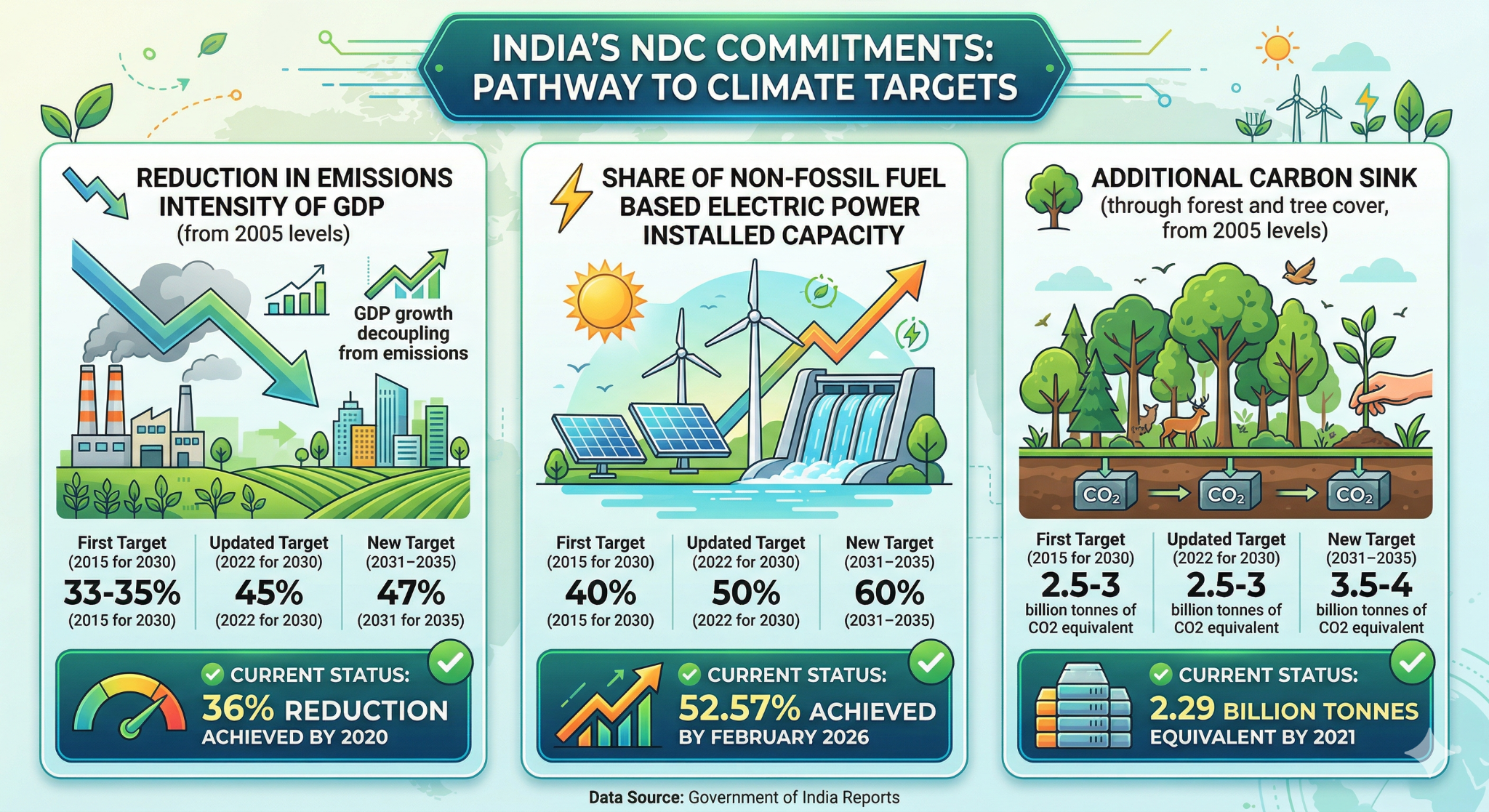
- Expansion of Non-Fossil Energy Capacity: India pledges to achieve 60% of its cumulative installed electricity capacity from non-fossil sources (including solar, wind, hydro, biomass, and nuclear) by 2035.
- India has already reached 52.57% as of February 2026, successfully meeting its previous 2030 target (50%).
- Reduction in Emissions Intensity: The government aims to reduce the emissions intensity of its GDP by 47% by 2035, compared to 2005 baseline levels.
- India had already achieved a 36% reduction by 2020, keeping it well on track to beat its earlier 45% reduction target for 2030.
- Enhancement of Carbon Sink: India targets the creation of an additional carbon sink of 3.5 to 4.0 billion tonnes of CO2 equivalent through enhanced forest and tree cover by 2035.
- As of 2025, India has created an additional carbon sink of 2.29 billion tonnes CO2 equivalent from forest and tree cover.
- Expansion of Non-Fossil Energy Capacity: India pledges to achieve 60% of its cumulative installed electricity capacity from non-fossil sources (including solar, wind, hydro, biomass, and nuclear) by 2035.
Significance
- Global Climate Leadership: At a time when several developed nations are experiencing a "rollback of climate policies" and imposing unilateral trade measures, India's updated NDC demonstrates concrete Global South leadership and a strong commitment to climate multilateralism.
- Strategic Alignment: The new targets act as a stepping stone toward India's overarching long-term goal of achieving Net-Zero emissions by 2070 and align with the broader economic vision of Viksit Bharat @2047.
Nationally Determined Contribution (NDC)
- A Nationally Determined Contribution (NDC) is a country’s official climate action plan submitted under the Paris Agreement, outlining its efforts to reduce greenhouse gas emissions and adapt to climate change impacts.
- It is self-determined, meaning each country sets its own targets based on national circumstances, and is time-bound and progressive, with updates every 5–10 years that must reflect increasing ambition.
- NDCs typically include emission reduction goals, renewable energy targets, adaptation strategies, and financial or technological needs.
- They form the core operational mechanism of the Paris Agreement, as global climate action depends on the collective ambition and effective implementation of these national commitments.
- India’s NDC Journey: First NDC (2015), using 2005 as the baseline year, targeting a 33–35% reduction in emissions intensity, ~40% non-fossil capacity, and creation of a 2.5–3 billion tonne carbon sink by 2030.
- It was strengthened through the Updated NDC (2022), raising ambition to a 45% emissions intensity reduction (from 2005 levels) and 50% non-fossil power capacity, aligned with announcements at the COP26 (Glasgow).
What is India’s Approach to NDC (2031-35)?
- Equity and CBDR-RC: The approach is rooted in the principle of CBDR-RC. This ensures that the targets reflect equity and harmonize with India's national realities, developmental priorities, and energy security needs.
- Whole-of-Society Approach: The government prioritized a "whole-of-government" and "whole-of-society" framework, ensuring that climate objectives are seamlessly aligned with national development priorities.
- Strategic Government Schemes: Climate goals are being integrated across the economy through initiatives like the Green Hydrogen Mission, PM Surya Ghar: Muft Bijli Yojana, Production Linked Incentive (PLI) schemes, and PM-KUSUM.
- Advanced Technologies: India is pushing for newer mitigation methods, including Carbon Capture, Utilization and Storage (CCUS), alongside expanding its nuclear energy capabilities.
- International Leadership: The country continues to forge global partnerships through initiatives such as the International Solar Alliance (ISA), the Coalition for Disaster Resilient Infrastructure (CDRI), and the Global Bio-fuel Alliance (GBA).
- Coastal Protection: Vulnerable coastlines are being secured through mangrove restoration (via the MISHTI initiative), coastal regulation, and advanced early warning systems for cyclones.
- Coordinated Frameworks: Adaptation is driven by the National Action Plan on Climate Change (NAPCC) and integrated into grassroots programs like the Jal Jeevan Mission, National Mission on Sustainable Agriculture, and the Soil Health Card.
- Promoting Mass Movements: India’s climate efforts are deeply rooted in the "Lifestyle for Environment (LiFE)" principle, transforming sustainable living and tree plantation drives (like ‘Ek Ped Maa Ke Nam’) into citizen-led actions.
What are the Challenges for India in Achieving its NDC (2031-35)?
- Capacity vs. Generation Gap: While non-fossil sources make up over 52% of installed capacity, they currently account for only about 25% of the actual electricity generated.
- This discrepancy is primarily due to the intermittent nature of renewable energy (like solar and wind) and the current lack of large-scale battery storage solutions.
- Storage and Grid Bottlenecks: The transition to renewables is constrained by the lack of affordable large-scale battery storage and heavy dependence on imported materials like lithium, along with significant challenges in building transmission infrastructure to connect remote renewable sites to demand centres.
- Dependence on Coal: Coal continues to account for nearly 75% of electricity generation, making it crucial for energy security, while a rapid transition risks economic disruption, job losses, and challenges in decarbonising hard-to-abate sectors like steel and cement.
- Financial Constraints: India requires massive investments of around USD 40–50 billion annually for clean energy expansion, but faces challenges due to limited and uncertain global climate finance and trade barriers such as carbon border taxes.
- Land and Afforestation Challenges: Large-scale renewable projects face land acquisition issues, while achieving carbon sink targets of 3.5–4 billion tonnes is difficult due to land scarcity and challenges in sustaining afforestation efforts.
What Measures can Strengthen India’s Efforts in Achieving its NDC (2031-35)?
- Round-the-Clock (RTC) Renewables: Move beyond capacity addition to reliable supply by mandating RTC Power Purchase Agreements (PPAs) that bundle solar and wind with Battery Energy Storage Systems (BESS) or Pumped Hydro Storage (PHS) is critical.
- Repurposing Legacy Infrastructure: Abandoned or decommissioned coal mines can be scientifically repurposed into Pumped Hydro Storage sites or large-scale solar parks, solving both the land acquisition and energy storage challenges simultaneously.
- Protecting Coal-Dependent Ecosystems: A rapid phase-down of coal threatens millions of livelihoods in states like Jharkhand, Chhattisgarh, and Odisha.
- India needs a statutory Just Transition Fund to reskill workers, diversify local economies, and manage the socio-economic fallout of closing older, inefficient thermal plants.
- Unlocking Blended Finance: Since traditional debt is too expensive for green infrastructure, India must leverage "Blended Finance" using concessional capital from multilateral banks to de-risk projects and crowd-in private capital.
- Maturing the Carbon Market: The immediate operationalization and strict regulation of the domestic Carbon Credit Trading Scheme (CCTS) will create a financial incentive for hard-to-abate sectors (steel, cement, fertilizers) to adopt Carbon Capture, Utilisation, and Storage (CCUS) technologies.
- Agri-Voltaics: To bypass the fierce competition for land between agriculture and mega-solar parks, India must scale "Agri-Voltaics"—installing elevated solar panels over farmland.
- This generates clean power, reduces water evaporation, and provides farmers with dual income streams.
- Agroforestry for Carbon Sinks: Achieving the 3.5–4 billion tonne carbon sink target solely through traditional afforestation is unviable due to land scarcity.
- Integrating trees into agricultural landscapes (agroforestry) on private lands, incentivized by carbon credits, is the most pragmatic solution.
|
Drishti Mains Question: “India’s Nationally Determined Contribution(NDC) 3.0 reflects a fine balance between climate ambition and developmental needs.” Analyse. |
Frequently Asked Questions (FAQs)
1. What is NDC 3.0?
India’s updated climate action plan for 2031–35 under the Paris Agreement, with enhanced mitigation and adaptation targets.
2. What are the key targets of India’s NDC 3.0?
60% non-fossil power capacity, 47% emissions intensity reduction (from 2005), and 3.5–4 billion tonnes of carbon sink by 2035.
3. What is CBDR-RC?
A principle ensuring climate responsibility is shared but differentiated based on countries’ capacities and historical emissions.
4. What is the major challenge in the renewable energy transition?
The gap between installed capacity and actual generation due to intermittency and lack of storage infrastructure.
5. What is a Just Transition?
A framework to support workers and regions dependent on fossil fuels through reskilling, diversification, and social protection.
UPSC Civil Services Examination, Previous Year’s Question (PYQs)
Prelims:
Q. The term ‘Intended Nationally Determined Contributions’ is sometimes seen in the news in the context of (2016)
(a) pledges made by the European countries to rehabilitate refugees from the war-affected Middle East
(b) plan of action outlined by the countries of the world to combat climate change
(c) capital contributed by the member countries in the establishment of Asian Infrastructure Investment Bank
(d) plan of action outlined by the countries of the world regarding Sustainable Development Goals
Answer: (b)
Q. With reference to the Agreement at the UNFCCC Meeting in Paris in 2015, which of the following statements is/are correct? (2016)
- The Agreement was signed by all the member countries of the UN and it will go into effect in 2017.
- The Agreement aims to limit the greenhouse gas emissions so that the rise in average global temperature by the end of this century does not exceed 2°C or even 1.5°C above pre-industrial levels.
- Developed countries acknowledged their historical responsibility in global warming and committed to donate $1000 billion a year from 2020 to help developing countries to cope with climate change.
Select the correct answer using the code given below.
(a) 1 and 3 only
(b) 2 only
(c) 2 and 3 only
(d) 1, 2 and 3
Answer: (b)
Mains
Q.1 Describe the major outcomes of the 26th session of the Conference of the Parties (COP) to the United Nations Framework Convention on Climate Change (UNFCCC). What are the commitments made by India in this conference? (2021)
Q.2 ‘Climate Change’ is a global problem. How will India be affected by climate change? How Himalayan and coastal states of India are affected by climate change? (2017)

Facts for UPSC Mains
SC Strikes Down Arbitrary Disability Ceiling
Why in News?
In Prabhu Kumar v. State of Himachal Pradesh case, 2026, the Supreme Court (SC) held that the State cannot impose an arbitrary upper limit on disability percentage for public employment when the Rights to Persons with Disabilities (RPwD) Act, 2016 only prescribes a minimum threshold of 40% benchmark disability.
- The Appellant, despite clearing Himachal's Assistant District Attorney (ADA) exam with 90% locomotor disability, was denied appointment due to a 60% disability cap. The Himachal Pradesh High Court subsequently upheld this exclusionary limit.
What are the Key SC Observations on Benchmark Disability in the Prabhu Kumar Case 2026?
- Reasonable Accommodation: The judgment emphasized that the State is under a positive obligation to provide reasonable accommodation, ensuring that suitability for a post is based on functional requirements rather than the disability percentage alone.
- Constitutional Validity: Restricting eligibility to a 40%–60% bracket was deemed manifestly arbitrary, violating Article 14 (Equality before law) and Article 16 (Equality of opportunity in public employment) of the Constitution.
- Functional Competence: For roles requiring mental alacrity and legal acumen (like an Assistant District Attorney), a 90% locomotor disability does not inherently impair professional performance, as evidenced by the appellant’s decade-long legal practice.
Previous SC Observations on Disability Rights
- Om Rathod vs Director General of Health Services Case, 2024: The SC ruled that a functional assessment of a candidate's actual capabilities must override rigid eligibility percentages.
- V. Surendra Mohan v. State of Tamil Nadu Case, 2019: SC upheld a 50% disability limit on hearing and visually impaired candidates for District Judge appointments. The Himachal Pradesh High Court had denied relief to the appellant, relying on this judgement.
- Vikash Kumar v. UPSC Case, 2021: The V. Surendra Mohan judgement was overruled by SC in the Vikash Kumar v. UPSC Case, 2021.
- Govt. of India v. Ravi Prakash Gupta, 2010: The SC held that non-identification of posts could not be a reason for the government to evade its obligation to reserve 3% of posts for persons with disabilities.
What are the Key Facts Regarding the Rights to Persons with Disabilities (RPwD) Act, 2016?
About
- RPwD Act, 2016 is a landmark legislation that replaced the earlier Persons with Disabilities (Equal Opportunities, Protection of Rights and Full Participation) Act, 1995. It brought Indian law in line with the United Nations Convention on the Rights of Persons with Disabilities (UNCRPD), which India ratified in 2007.
- It shifted the legal framework from a "medical model" (disability as a tragedy to be treated) to a "social/human rights model" (disability as a result of societal barriers).
Salient Features
- Definition of Disability: A person with long-term physical, mental, intellectual, or sensory impairment that, in interaction with barriers, hinders full and effective participation in society on an equal basis with others.
- Benchmark Disability: A person with not less than 40% of a specified disability (as certified by the competent authority). This threshold determines eligibility for specific benefits, reservations, and schemes.
- Recognition of Disabilities: The Act significantly expands the scope by recognizing 21 specified disabilities (compared to 7 in the 1995 Act). The Central Government may notify additional categories as needed. The recognized disabilities broadly cover:
- Physical: Locomotor, Cerebral Palsy, Dwarfism, Muscular Dystrophy, Acid Attack victims.
- Sensory: Visual impairment, Hearing impairment, Speech and Language disability.
- Intellectual & Neurological: Specific Learning Disabilities (like Dyslexia), Autism Spectrum Disorder, Multiple Sclerosis, Parkinson’s Disease.
- Mental: Mental Illness.
- Blood Disorders: Thalassemia, Hemophilia, Sickle Cell Disease.
- Others: Multiple disabilities and "deaf-blindness."
- Key Mandates and Provisions: The Act provides a robust legal shield to ensure dignity and equal opportunity:
- Equality and Non-Discrimination: Persons with disabilities have the right to equality, life with dignity, and protection from discrimination on the grounds of disability. Discrimination includes denial of reasonable accommodation.
- Reservation: It increased the reservation in government jobs from 3% to 4% and in higher education institutions from 3% to 5% for "Benchmark Disabilities".
- Education: Every child with a benchmark disability between the ages of 6 and 18 has the right to free education.
- Accessibility: Mandatory standards for public buildings, transport, information and communication technology (ICT), and services to ensure barrier-free access.
- Guardianship: It introduced the concept of "Limited Guardianship," a system of joint decision-making between the guardian and the person with a disability, rather than the "Plenary Guardianship" (total control).
- Institutional Framework: It established:
- Central and State Advisory Boards: To serve as peak policy-making bodies.
- Chief Commissioner and State Commissioners: To monitor implementation and handle grievances.
- National and State Funds: To provide financial support to persons with disabilities.
- Special Courts: Designated in each district to ensure speedy trials for offenses committed against persons with disabilities.
- Penalties for Violations: Any person who intentionally insults or humiliates a person with a disability in public, or assaults/uses force with the intent to dishonor them, can face imprisonment between 6 months and 5 years, along with a fine.
Significance
- This Act is crucial for achieving inclusive development. It mandates that all government schemes—whether they are for rural housing, urban planning, or digital literacy—must have a disability-inclusive lens.
Conclusion
By invalidating arbitrary disability caps, the Supreme Court has transitioned disability jurisprudence from rigid medical percentages to functional capability. This strengthens the constitutional guarantee of equal opportunity, ensuring that the RPwD Act serves as a tool for empowerment rather than a mechanism for systemic exclusion.
|
Drishti Mains Question: Assess the role of the Rights to Persons with Disabilities (RPwD) Act, 2016 in making an inclusive society? |
Frequently Asked Questions (FAQs)
1. What constitutes a "Benchmark Disability" under the RPwD Act, 2016?
It refers to a person having not less than 40% of a specified disability as certified by a competent medical authority.
2. How does the RPwD Act, 2016, differ from the 1995 Act regarding the scope of disabilities?
The 2016 Act expanded the number of recognized disabilities from 7 to 21, including blood disorders like Thalassemia and neurological conditions like Parkinson’s.
3. What is the legal mandate for reservation in government jobs for PwDs?
The Act mandates a 4% reservation in government establishments for persons with benchmark disabilities, an increase from the previous 3%.
UPSC Civil Services Examination, Previous Year Question (PYQ)
Q. India is home to lakhs of persons with disabilities. What are the benefits available to them under the law? (2011)
- Free schooling till the age of 18 years in government run schools.
- Preferential allotment of land for setting up business.
- Ramps in public buildings.
Which of the statements given above is/are correct?
(a) 1 only
(b) 2 and 3 only
(c) 1 and 3 only
(d) 1, 2 and 3
Ans: (d)

Important Facts For Prelims
Fall in Gold Prices
Why in News?
Despite the escalation of the West Asian conflict, global and domestic gold prices have witnessed a sharp and anomalous decline. Traditionally, gold acts as a safe-haven asset during geopolitical or financial crises, but current macroeconomic dynamics have forced a deviation from this historical trend.
What are the Key Factors Driving the Fall in Gold Prices?
- Oil Price Shock & Inflationary Pressures: The West Asian conflict has severely disrupted global oil supply chains, pushing crude oil prices significantly higher (crossing USD 120/barrel in recent trends).
- Higher energy costs translate to broader macroeconomic inflation. To combat oil-driven inflation, major central banks (like the US Federal Reserve) have shifted away from expected rate cuts.
- The market now anticipates a hawkish monetary policy, where interest rates will remain elevated for a prolonged period to cool down demand.
- Surging Bond Yields: With the expectation of sustained high interest rates, U.S. Treasury bonds (which offer guaranteed, fixed returns) have become highly attractive.
- Investors are pivoting capital away from zero-yield gold and into high-yielding government bonds.
- Strengthening of the US Dollar: As global capital flows into US debt markets to capture high yields, the US Dollar index strengthens.
- A stronger dollar makes gold fundamentally more expensive for foreign buyers, dampening global physical and investment demand.
- Liquidity Crunch and Profit Booking: Prior to the current crash, gold was trading at record highs. As the geopolitical conflict triggered a massive sell-off in global stock markets, investors faced a liquidity crunch.
- To cover margin calls and equity portfolio losses, investors resorted to profit booking by selling their highly profitable gold holdings, flooding the market with excess supply and driving prices down further.
Gold as a Traditional Safe Haven
- Safe-Haven Asset: Historically (e.g., during the 2008 financial crisis, the Covid-19 pandemic, and the 2022 Russia-Ukraine war), investors flock to gold to preserve wealth when equity markets and fiat currencies become volatile.
- Inverse Relationship with Interest Rates: Gold is a non-yielding asset (it does not pay interest or dividends).
- It typically performs best when interest rates are low, as the opportunity cost of holding gold decreases compared to interest-bearing assets like government bonds.
- Inverse Relationship with the US Dollar: Gold is globally priced in US Dollars (USD). A weaker dollar makes gold cheaper for buyers holding other currencies, thereby driving up demand and prices.
US Dollar the New Safe Haven
- Short-Term Dollar Dominance: In the immediate term, the USD is acting as the primary safe haven. Because global oil trade is primarily dollar-denominated (Petrodollar), rising oil prices force countries to acquire more dollars to pay for their energy imports, structurally boosting dollar demand over gold.
- Long-Term De-dollarization: Despite the current price correction, central banks across the globe (especially in emerging markets) continue to aggressively accumulate physical gold.
- The Reserve Bank of India (RBI) has aggressively increased its gold holdings as a strategic component of its foreign exchange (forex) reserves, with total gold holdings surpassing 880 metric tonnes by late 2025, accounting for 15.17% of total reserves.
- This is driven by a long-term strategic shift toward De-dollarization—diversifying foreign exchange reserves to protect against Western financial sanctions and weaponization of the dollar.
Gold
- Elemental Basics: Gold’s chemical symbol is Au (derived from the Latin word aurum, meaning "shining dawn"). Its atomic number is 79, making it one of the naturally occurring elements with the highest atomic numbers.
- Gold is extremely rare and largely originated from meteorite impacts.
- Malleability and Ductility: Gold is the most malleable and ductile of all known metals.
- The Noble Metal: It is chemically unreactive. Gold does not tarnish, rust, or corrode. It remains unaffected by air, moisture, and most acids, dissolving only in a specific, highly corrosive mixture of nitric and hydrochloric acids known as aqua regia.
- Conductivity: It is an outstanding conductor of both thermal and electrical energy.
- Economic & Financial Significance: Gold’s purity is measured in karats (24K = 99.9% pure), and it is often alloyed for durability.
- It serves as a safe-haven asset, historically linked to the Gold Standard, and is widely held by central banks as a strategic reserve.
- Technological & Industrial Applications: Due to its conductivity and resistance to corrosion, gold is widely used in electronics, aerospace applications for heat reflection, and in medicine and dentistry, including advanced uses like gold nanoparticles.
Gold Reserves in India
- Gold in India is a vital mineral resource with economic and strategic importance, found mainly in auriferous rocks and alluvial deposits, and concentrated in the Peninsular Plateau.
- Karnataka is the leading producer with major fields like Kolar and Hutti, while Andhra Pradesh follows with Ramagiri.
- The Kolar Gold Fields (KGF) in the Kolar district is one of the world's oldеst and deepest gold minеs.
- In terms of reserves, Bihar holds the largest share (~45%), followed by Rajasthan (~23%), with smaller contributions from Jharkhand, West Bengal, Madhya Pradesh, and Kerala, often in alluvial forms.
Frequently Asked Questions (FAQs)
1. What determines gold’s safe-haven status?
Gold acts as anon-yielding, inflation-hedging asset, gaining demand during economic and geopolitical uncertainty.
2. What is the key reason for the recent fall in gold prices?
High US interest rates and rising bond yieldshave shifted investments away from gold to interest-bearing assets.
3. How do crude oil prices influence gold prices?
Rising oil prices fuelinflation, prompting tighter monetary policy, which negatively impacts gold demand.
4. What is the significance of gold in central bank reserves?
Gold serves as astrategic reserve asset, aiding diversification and supporting de-dollarization efforts.
5. Where is gold mainly found in India?
Gold deposits are concentrated in thePeninsular Plateau, especially in Karnataka, Andhra Pradesh, Bihar, and Rajasthan.
UPSC Civil Services Examination, Previous Year Questions (PYQs)
Prelims:
Q. What is/are the purpose/purposes of Government’s ‘Sovereign Gold Bond Scheme’ and ‘Gold Monetization Scheme’? (2016)
- To bring the idle gold lying with Indian households into the economy.
- To promote FDI in the gold and jewellery sector.
- To reduce India’s dependence on gold imports.
Select the correct answer using the code given below:
(a) 1 only
(b) 2 and 3 only
(c) 1 and 3 only
(d) 1, 2 and 3
Ans:(c)
Q. Which one of the following groups of items is included in India’s foreign-exchange reserves? (2013)
(a) Foreign-currency assets, Special Drawing Rights (SDRs) and loans from foreign countries
(b) Foreign-currency assets, gold holdings of the RBI and SDRs
(c) Foreign-currency assets, loans from the World Bank and SDRs
(d) Foreign-currency assets, gold holdings of the RBI and loans from the World Bank
Ans: (b)
Q. Indian Government Bond Yields are influenced by which of the following? (2021)
- Actions of the United States Federal Reserve
- Actions of the Reserve Bank of India
- Inflation and short-term interest rates
Select the correct answer using the code given below.
(a) 1 and 2 only
(b) 2 only
(c) 3 only
(d) 1, 2 and 3
Ans: (d)

Important Facts For Prelims
World Bank Fast-Tracks Aid Amid Middle East Crisis
Why in News?
The World Bank is fast-tracking aid for countries navigating the Middle East conflict, warning that rising commodity prices and logistical disruptions are severely straining emerging market economies and widening the global fallout.
- The World Bank will combine immediate financial relief, policy expertise, and private sector support to recover jobs and growth by leveraging its active portfolio, crisis toolkit, and pre-arranged financing facilities.
What are Key Facts Regarding the World Bank?
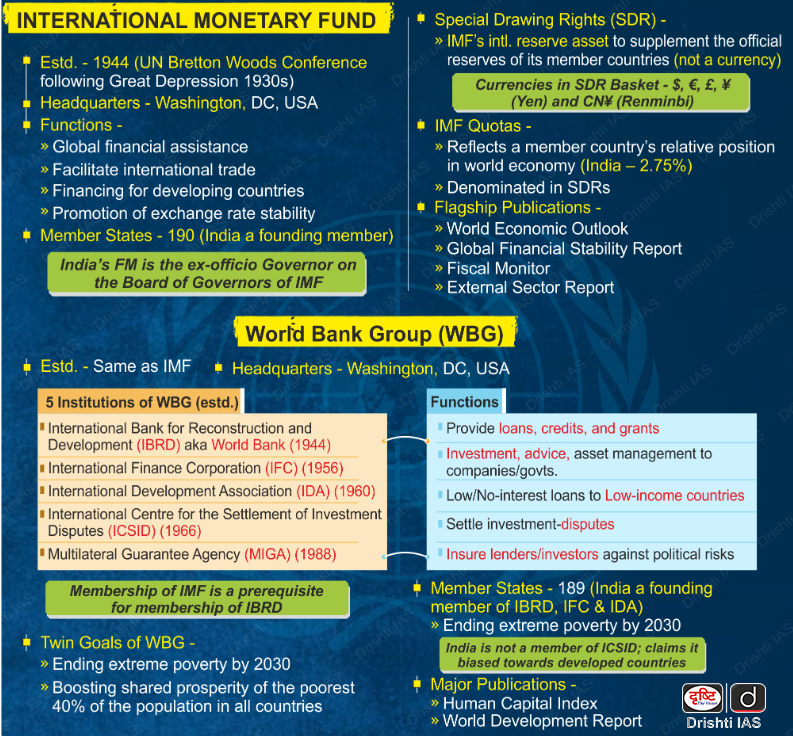
- About: The World Bank is an international financial institution that provides loans, grants, and technical assistance to the governments of low- and middle-income countries. It forms the core of the World Bank Group (WBG).
- Goals: Its primary goals are to eradicate extreme poverty and promote shared prosperity by fostering sustainable economic growth.
- This involves addressing intertwined global challenges like climate change and inequality through financial products, grants, and research.
- Historical Background: The World Bank was established in 1944 at the Bretton Woods Conference in the United States, initially as the International Bank for Reconstruction and Development (IBRD). Its early focus was on financing the reconstruction of Europe and Japan following World War II.
- It officially began operations in 1946 and has evolved significantly since the 1970s to address direct poverty alleviation.
- World Bank Group: It is a family of 5 specialised organisations that collaborate to provide financing, technical expertise, policy advice, and knowledge to member nations.
- IBRD (International Bank for Reconstruction and Development): Provides loans and assistance to middle-income and creditworthy low-income countries.
- IDA (International Development Association): Provides interest-free loans (credits) and grants to the world’s poorest countries. The IBRD and IDA together make up the "World Bank."
- IFC (International Finance Corporation): Focuses on the private sector in developing countries.
- MIGA (Multilateral Investment Guarantee Agency): Promotes foreign direct investment by offering political risk insurance.
- ICSID (International Centre for Settlement of Investment Disputes): Settles investment disputes between investors and countries.
- Key Functions: Its core activities include:
- Project Financing: Funding infrastructure (roads, bridges), health programs (vaccines, clinics), and education. E.g., USD 830 million loan to support Pradhan Mantri Skilling and Employability Transformation Through Upgraded ITIs (PM-SETU) Program in India.
- Policy Advice: Helping governments reform their economies or improve public administration.
- Research and Data: It is a major source of global economic data, such as the World Development Report, Global Economic Prospects (GEP), etc.
- Membership: It has 189 member countries. To be a member of the World Bank, a country must first join the International Monetary Fund (IMF). India is a member country of both the World Bank and the IMF.
Note: India is a member of four of the five institutions in the World Bank Group, but is not a member of the ICSID, an international arbitration institution.
What is the Difference between the World Bank and the IMF?
|
Feature |
World Bank |
IMF |
|
Primary Goal |
Long-term growth and poverty reduction (development). |
Global monetary cooperation and financial stability. |
|
Leadership |
Historically led by a US citizen. |
Historically led by a European. |
|
Voting Power |
Based on Capital Shares (one vote per share of the Bank's stock). The United States holds the largest share (~15.85% of voting power). |
Based on Quotas (reflecting a country’s relative size in the global economy). The United States is the largest quota holder (~16.5% of voting power). |
|
Core Activity |
Finances roads, schools, and green energy infrastructure. |
Provides loans to stabilize currencies and fix Balance of Payments (BoP) crises. |
|
Nature of Loans |
Loans typically span 15 to 40 years (long-term). |
Loans are usually for 3 to 5 years for crisis management (short/medium-term). |
|
Funding Source |
Primarily raises money by selling bonds to private investors. |
Funded by membership "subscriptions" paid by member nations. |
Frequently Asked Questions (FAQs)
1. Where was the World Bank established, and in which year?
The World Bank was established in 1944 at the Bretton Woods Conference in the United States, initially as the International Bank for Reconstruction and Development (IBRD)
2. Which entities specifically constitute the "World Bank"?
The "World Bank" refers specifically to the IBRD (International Bank for Reconstruction and Development) and the IDA (International Development Association) combined.
3. What is the primary difference between the lending nature of the World Bank and the IMF?
The World Bank provides long-term loans (15–40 years) for development projects, while the IMF offers short-to-medium-term loans (3–5 years) to manage Balance of Payments (BoP) crises.
UPSC Civil Services Examination, Previous Year Question
Q. With reference to ‘IFC Masala Bonds’, sometimes seen in the news, which of the statements given below is/are correct? (2016)
- The International Finance Corporation, which offers these bonds, is an arm of the World Bank.
- They are the rupee-denominated bonds and are a source of debt financing for the public and private sector.
Select the correct answer using the code given below:
(a) 1 only
(b) 2 only
(c) Both 1 and 2
(d) Neither 1 nor 2
Ans: (c)
Q. India’s ranking in the ‘Ease of Doing Business Index’ is sometimes seen in the news. Which of the following has declared that ranking? (2016)
(a) Organization for Economic Cooperation and Development (OECD)
(b) World Economic Forum
(c) World Bank
(d) World Trade Organization (WTO)
Ans: (c)

Place In News
Bab-el-Mandeb Strait
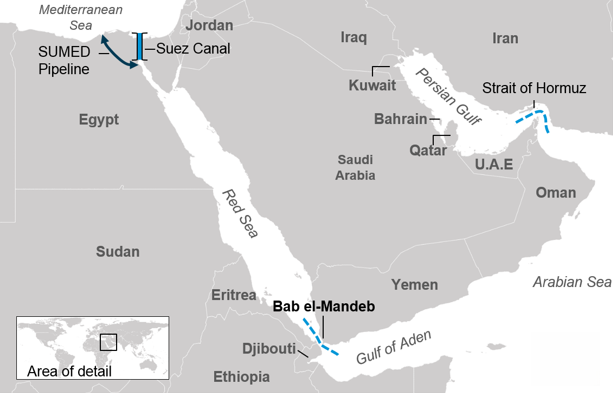
Amid the escalating Crisis in West Asia, Iran has threatened to weaponize the strategic Bab el-Mandeb Strait alongside the Strait of Hormuz, posing a severe risk to global maritime trade and energy security if its territories are invaded.
- Role of Non-State Actors: The Iran-aligned Houthis in Yemen are geographically and militarily positioned to execute disruptions in the Red Sea and Bab el-Mandeb, effectively expanding the conflict's scope far beyond the Persian Gulf and the Sea of Oman.
- Bab-el-Mandeb Strait: In Arabic, it translates to the "Gate of Tears" or "Gate of Grief," historically referring to the dangers of navigating its waters.
- It is a narrow maritime chokepoint situated between the Arabian Peninsula and the Horn of Africa.
- It connects the Red Sea (to the northwest) to the Gulf of Aden and the Arabian Sea/Indian Ocean (to the southeast).
- Bordering Nations: It separates Yemen (on the Asian side) from Djibouti and Eritrea (on the African side).
- Key Islands: The strait is 20 miles (32 km) wide and is divided into two channels by Perim Island, which belongs to Yemen.
- Economic Significance: The Red Sea to the Suez Canal via the Bab-el-Mandeb is one of the world's most critical maritime trade routes.
- The Bab-el-Mandeb Strait is the only entry point to the Red Sea from the Indian Ocean and connects to the Suez Canal, forming a vital trade route between Asia and Europe.
- Bab-el-Mandeb is a key chokepoint for the movement of crude oil, petroleum products, and liquefied natural gas (LNG) from the Persian Gulf to global markets.
- Approximately 10-12% of global trade and nearly 30% of global container traffic passes through here.
- It is a crucial transit chokepoint for crude oil, petroleum products, and liquefied natural gas (LNG) moving from the Persian Gulf and Asia to Europe and the Americas.
- When this strait is threatened, global shipping companies are forced to reroute vessels around the Cape of Good Hope in South Africa. This adds 10 to 14 days to the journey, significantly driving up global freight rates, insurance costs, and ultimately causing inflation.
- The Bab-el-Mandeb Strait is the only entry point to the Red Sea from the Indian Ocean and connects to the Suez Canal, forming a vital trade route between Asia and Europe.
| Read more: The Escalating Crisis in West Asia |

Rapid Fire
S-400 Triumf (Sudarshan) System
India is fast-tracking the procurement and induction of its remaining S-400 Triumf air defence systems from Russia to significantly fortify its national airspace security.
- About: The S-400 Triumf, officially designated as 'Sudarshan' in Indian service, is a state-of-the-art long-range air defence system procured from Russia to establish an impenetrable, multi-layered security umbrella over the nation's critical airspace.
- It is developed by Russia, and is widely considered one of the world's most advanced mobile Surface-to-Air Missile (SAM) systems.
- Multi-Tiered Defence Network: The system provides layered air defence using missiles with ranges of 40–400 km, capable of neutralizing a wide spectrum of aerial threats, including stealth fighter jets, unmanned aerial vehicles (UAVs), and ballistic or cruise missiles.
- Simultaneous Engagement: Equipped with advanced panoramic radar capabilities, the S-400 can simultaneously track up to 300 targets and actively engage up to 36 threats at once with exceptional precision.
- India's Procurement Status: India signed a landmark USD 5.43 billion deal in 2018 for five squadrons.
- As of 2026, three squadrons are fully operational and strategically deployed along the western and northern borders, with the final two scheduled for delivery by the end of 2026.
- Operation Sindoor: The system proved its operational dominance during the recent Operation Sindoor, successfully intercepting and neutralizing hostile cross-border drones and missiles, thereby validating India's strategic investment.
- Indigenous Synergy: The S-400 integrates seamlessly with India's existing networks, complementing the DRDO-developed Ballistic Missile Defence (BMD) system and parallel indigenous initiatives like Project Kusha (Extended Range Air Defence System) to counter the two-front threat from China and Pakistan.
| Read more: S-400 Missile and Project Kusha |

Rapid Fire
RBI Rejects Treasury Bill Bids to Manage Liquidity
The Reserve Bank of India (RBI) rejected all bids at a Treasury Bill (T-Bill) auction to bolster banking system liquidity as the current financial year concludes on 31st March 2026.
- The move is designed to boost the liquidity surplus by preventing an outflow of Rs 35,000 crore, ensuring banks have sufficient cash during the critical year-end period.
- It will also prevent a spike in yields, as accepting high-interest bids could have "spooked" the market and increased borrowing costs.
Treasury Bills (T-Bills)
- About: Treasury Bills (T-Bills) are short-term debt instruments issued by the Government of India to manage temporary mismatches in its cash flows.
- Tenors: T-Bills are money market instruments with a maturity period of less than 1 year. Currently, the Government of India issues T-Bills in 3 specific maturities: 91 days, 182 days, and 364 days.
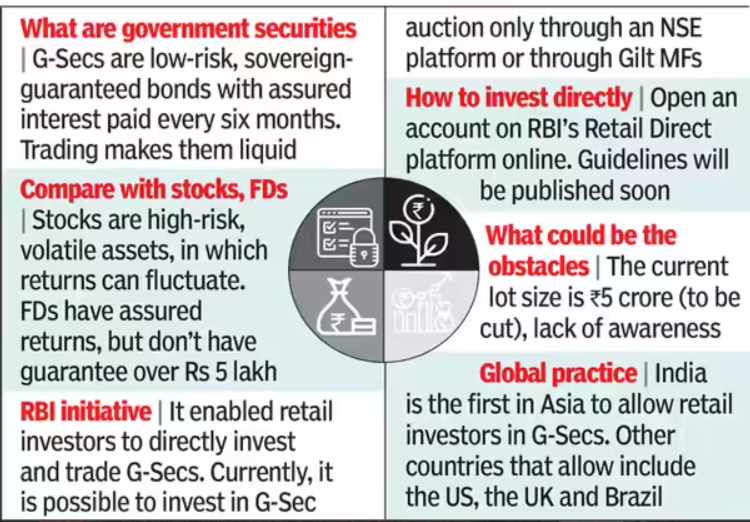
- Eligibility: Unlike in the past, retail investors can now buy T-Bills directly through the RBI Retail Direct portal, though the primary buyers remain banks, insurance companies, and mutual funds.
- Zero-Coupon Securities: T-Bills pay no interest. Instead, they are issued at a discount to their face value and redeemed at par (face value) on maturity.
- The difference between the issue price and the maturity value is the "interest" earned by the investor.
- Issuing Authority: While the RBI manages the auction and issuance, they are issued on behalf of the Central Government. State governments in India do not issue T-Bills.
- Minimum Investment: The minimum bid amount is Rs 10,000 and in multiples of Rs 10,000 thereafter.
- Significance: Commercial banks in India are allowed to hold T-Bills to meet their Statutory Liquidity Ratio (SLR) requirements. The RBI uses T-Bill auctions to regulate systemic liquidity by increasing or decreasing the supply of T-Bills.
| Read More: India Rolls Over USD 50 Million Treasury Bill to Support Maldives |

Rapid Fire
Grameen Credit Score for Rural Lending
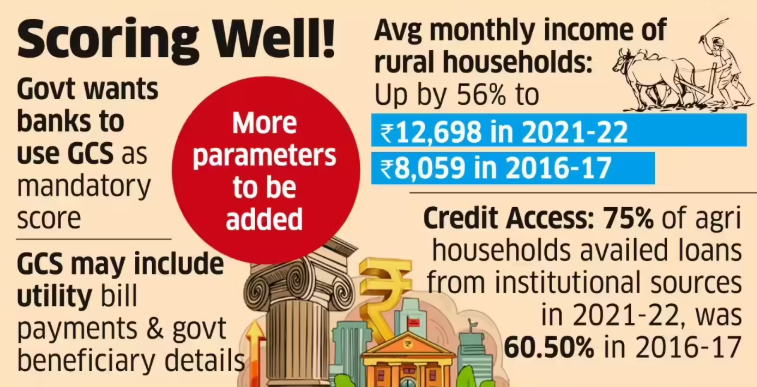
The government has mandated banks to adopt the Grameen Credit Score (GCS) as the default assessment tool for rural borrowers to enhance financial inclusion with a major focus on first-time borrowers who lack a traditional credit history.
Grameen Credit Score
- About: Announced in the Union Budget 2025-26, the Grameen Credit Score is an alternative credit scoring model designed to assess the creditworthiness of individuals who lack a traditional formal credit history—often referred to as the "unbanked" or "underbanked" population.
- Unlike traditional credit scores (like CIBIL) that rely heavily on bank loans and credit card repayment history, this model looks at social and behavioural data (social collateral like trust and pressure from a peer group) within a community or microfinance framework.
- Objective: The GCS aims to broaden access to formal credit for self-help groups (SHGs), small farmers, marginalized communities, and rural micro-enterprises.
- Its primary objective is to promote financial inclusion by enabling more accurate and tailored credit assessments where traditional scoring models often fall short due to irregular income patterns or reliance on group-based lending (e.g., SHGs).
- Key Features:
- Customized Credit Cards: As part of this initiative, the government is launching Credit Cards for Micro-Enterprises with a limit of up to Rs 5 lakh.
- Range: The score follows the traditional 300–900 range, making it easily understandable for formal lenders.
- Data Integration: Developed by Credit Information Companies (CICs) like TransUnion CIBIL, Experian, and Equifax, its phase I utilizes existing data from Kisan Credit Cards (KCC), SVAMITVA Scheme, priority sector loans, and tractor loans.
- Significance: It moves from "group-based" credit (where only the SHG had a record) to individual credit identities for nearly 100 million SHG members. E.g., an individual woman in a village can show her SHG repayment track record to demand a personal bank loan, independent of the group.
| Read More: Grameen Credit Score |