


Biodiversity & Environment
India’s Nationally Determined Contribution (2031-2035)
- 28 Mar 2026
- 16 min read
For Prelims: Nationally Determined Contributions, Paris Agreement, Green Hydrogen Mission, International Solar Alliance (ISA), Coalition for Disaster Resilient Infrastructure (CDRI), National Action Plan on Climate Change
For Mains: India’s Climate Commitments under Paris Agreement, Carbon Markets and Climate Finance
Why in News?
The Union Cabinet approved India’s updated Nationally Determined Contribution (NDC 3.0) for the period 2031-2035, to be officially communicated to the United Nations Framework Convention on Climate Change (UNFCCC) under the Paris Agreement.
What are the Key Highlights of India’s NDC 3.0?
- International Mandates: As a Paris Agreement signatory, India was required to issue an updated NDC by 2025.
- By December 2025, 128 parties (representing 78% of global emissions) had submitted their updates, leaving India and Argentina as the last G-20 nations to do so.
- NDC 3.0 targets were shaped by the outcomes of the 2021 Global Stocktake (GST), which concluded that the world is currently not on track to limit global warming to 1.5 degrees Celsius.
- The Environment Ministry emphasized that the new goals balance developmental priorities and energy security with the principle of "Common but Differentiated Responsibilities and Respective Capabilities" (CBDR-RC).
- Targets Under India’s NDC 3.0:
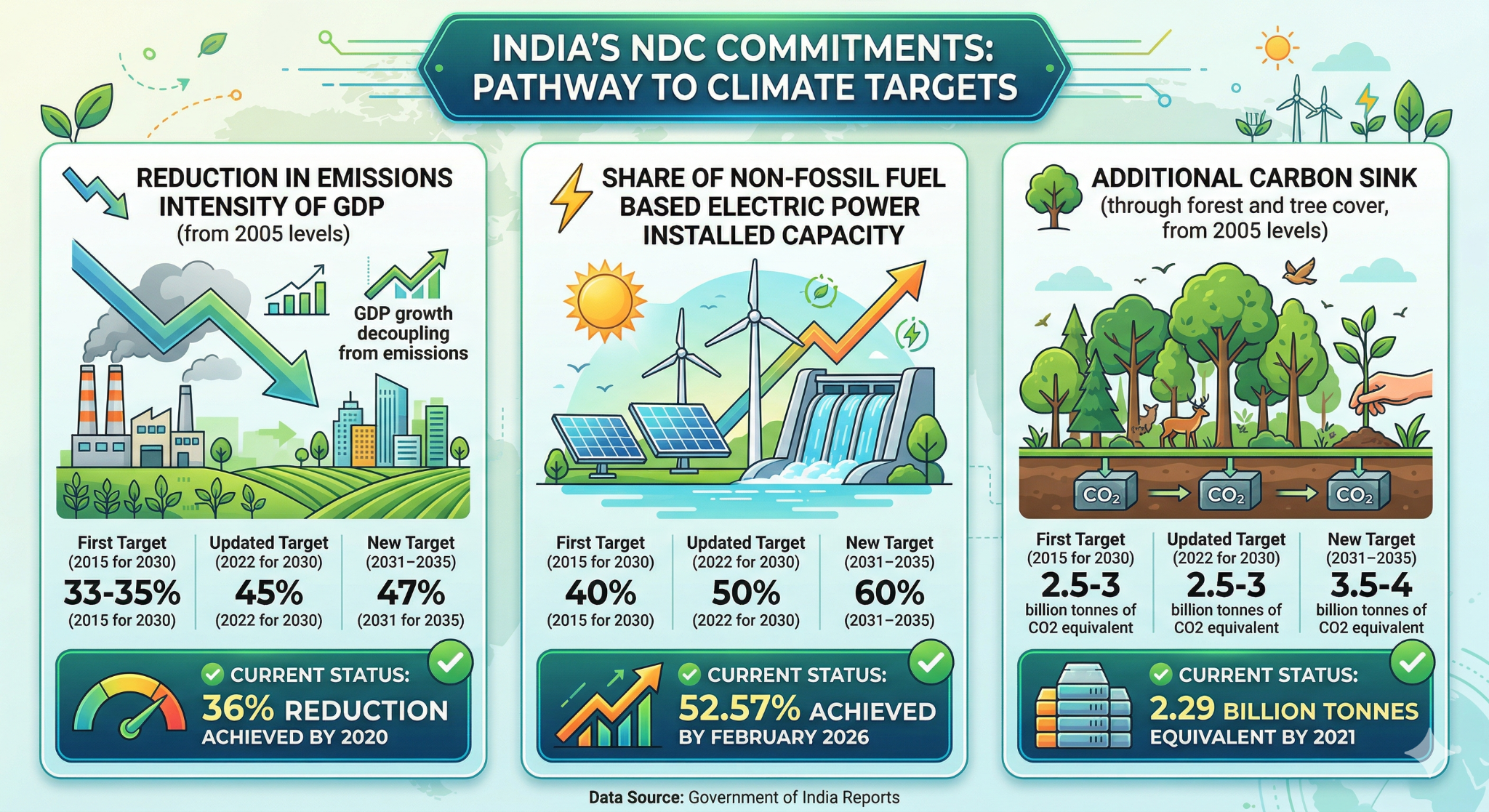
- Expansion of Non-Fossil Energy Capacity: India pledges to achieve 60% of its cumulative installed electricity capacity from non-fossil sources (including solar, wind, hydro, biomass, and nuclear) by 2035.
- India has already reached 52.57% as of February 2026, successfully meeting its previous 2030 target (50%).
- Reduction in Emissions Intensity: The government aims to reduce the emissions intensity of its GDP by 47% by 2035, compared to 2005 baseline levels.
- India had already achieved a 36% reduction by 2020, keeping it well on track to beat its earlier 45% reduction target for 2030.
- Enhancement of Carbon Sink: India targets the creation of an additional carbon sink of 3.5 to 4.0 billion tonnes of CO2 equivalent through enhanced forest and tree cover by 2035.
- As of 2025, India has created an additional carbon sink of 2.29 billion tonnes CO2 equivalent from forest and tree cover.
- Expansion of Non-Fossil Energy Capacity: India pledges to achieve 60% of its cumulative installed electricity capacity from non-fossil sources (including solar, wind, hydro, biomass, and nuclear) by 2035.
Significance
- Global Climate Leadership: At a time when several developed nations are experiencing a "rollback of climate policies" and imposing unilateral trade measures, India's updated NDC demonstrates concrete Global South leadership and a strong commitment to climate multilateralism.
- Strategic Alignment: The new targets act as a stepping stone toward India's overarching long-term goal of achieving Net-Zero emissions by 2070 and align with the broader economic vision of Viksit Bharat @2047.
Nationally Determined Contribution (NDC)
- A Nationally Determined Contribution (NDC) is a country’s official climate action plan submitted under the Paris Agreement, outlining its efforts to reduce greenhouse gas emissions and adapt to climate change impacts.
- It is self-determined, meaning each country sets its own targets based on national circumstances, and is time-bound and progressive, with updates every 5–10 years that must reflect increasing ambition.
- NDCs typically include emission reduction goals, renewable energy targets, adaptation strategies, and financial or technological needs.
- They form the core operational mechanism of the Paris Agreement, as global climate action depends on the collective ambition and effective implementation of these national commitments.
- India’s NDC Journey: First NDC (2015), using 2005 as the baseline year, targeting a 33–35% reduction in emissions intensity, ~40% non-fossil capacity, and creation of a 2.5–3 billion tonne carbon sink by 2030.
- It was strengthened through the Updated NDC (2022), raising ambition to a 45% emissions intensity reduction (from 2005 levels) and 50% non-fossil power capacity, aligned with announcements at the COP26 (Glasgow).
What is India’s Approach to NDC (2031-35)?
- Equity and CBDR-RC: The approach is rooted in the principle of CBDR-RC. This ensures that the targets reflect equity and harmonize with India's national realities, developmental priorities, and energy security needs.
- Whole-of-Society Approach: The government prioritized a "whole-of-government" and "whole-of-society" framework, ensuring that climate objectives are seamlessly aligned with national development priorities.
- Strategic Government Schemes: Climate goals are being integrated across the economy through initiatives like the Green Hydrogen Mission, PM Surya Ghar: Muft Bijli Yojana, Production Linked Incentive (PLI) schemes, and PM-KUSUM.
- Advanced Technologies: India is pushing for newer mitigation methods, including Carbon Capture, Utilization and Storage (CCUS), alongside expanding its nuclear energy capabilities.
- International Leadership: The country continues to forge global partnerships through initiatives such as the International Solar Alliance (ISA), the Coalition for Disaster Resilient Infrastructure (CDRI), and the Global Bio-fuel Alliance (GBA).
- Coastal Protection: Vulnerable coastlines are being secured through mangrove restoration (via the MISHTI initiative), coastal regulation, and advanced early warning systems for cyclones.
- Coordinated Frameworks: Adaptation is driven by the National Action Plan on Climate Change (NAPCC) and integrated into grassroots programs like the Jal Jeevan Mission, National Mission on Sustainable Agriculture, and the Soil Health Card.
- Promoting Mass Movements: India’s climate efforts are deeply rooted in the "Lifestyle for Environment (LiFE)" principle, transforming sustainable living and tree plantation drives (like ‘Ek Ped Maa Ke Nam’) into citizen-led actions.
What are the Challenges for India in Achieving its NDC (2031-35)?
- Capacity vs. Generation Gap: While non-fossil sources make up over 52% of installed capacity, they currently account for only about 25% of the actual electricity generated.
- This discrepancy is primarily due to the intermittent nature of renewable energy (like solar and wind) and the current lack of large-scale battery storage solutions.
- Storage and Grid Bottlenecks: The transition to renewables is constrained by the lack of affordable large-scale battery storage and heavy dependence on imported materials like lithium, along with significant challenges in building transmission infrastructure to connect remote renewable sites to demand centres.
- Dependence on Coal: Coal continues to account for nearly 75% of electricity generation, making it crucial for energy security, while a rapid transition risks economic disruption, job losses, and challenges in decarbonising hard-to-abate sectors like steel and cement.
- Financial Constraints: India requires massive investments of around USD 40–50 billion annually for clean energy expansion, but faces challenges due to limited and uncertain global climate finance and trade barriers such as carbon border taxes.
- Land and Afforestation Challenges: Large-scale renewable projects face land acquisition issues, while achieving carbon sink targets of 3.5–4 billion tonnes is difficult due to land scarcity and challenges in sustaining afforestation efforts.
What Measures can Strengthen India’s Efforts in Achieving its NDC (2031-35)?
- Round-the-Clock (RTC) Renewables: Move beyond capacity addition to reliable supply by mandating RTC Power Purchase Agreements (PPAs) that bundle solar and wind with Battery Energy Storage Systems (BESS) or Pumped Hydro Storage (PHS) is critical.
- Repurposing Legacy Infrastructure: Abandoned or decommissioned coal mines can be scientifically repurposed into Pumped Hydro Storage sites or large-scale solar parks, solving both the land acquisition and energy storage challenges simultaneously.
- Protecting Coal-Dependent Ecosystems: A rapid phase-down of coal threatens millions of livelihoods in states like Jharkhand, Chhattisgarh, and Odisha.
- India needs a statutory Just Transition Fund to reskill workers, diversify local economies, and manage the socio-economic fallout of closing older, inefficient thermal plants.
- Unlocking Blended Finance: Since traditional debt is too expensive for green infrastructure, India must leverage "Blended Finance" using concessional capital from multilateral banks to de-risk projects and crowd-in private capital.
- Maturing the Carbon Market: The immediate operationalization and strict regulation of the domestic Carbon Credit Trading Scheme (CCTS) will create a financial incentive for hard-to-abate sectors (steel, cement, fertilizers) to adopt Carbon Capture, Utilisation, and Storage (CCUS) technologies.
- Agri-Voltaics: To bypass the fierce competition for land between agriculture and mega-solar parks, India must scale "Agri-Voltaics"—installing elevated solar panels over farmland.
- This generates clean power, reduces water evaporation, and provides farmers with dual income streams.
- Agroforestry for Carbon Sinks: Achieving the 3.5–4 billion tonne carbon sink target solely through traditional afforestation is unviable due to land scarcity.
- Integrating trees into agricultural landscapes (agroforestry) on private lands, incentivized by carbon credits, is the most pragmatic solution.
|
Drishti Mains Question: “India’s Nationally Determined Contribution(NDC) 3.0 reflects a fine balance between climate ambition and developmental needs.” Analyse. |
Frequently Asked Questions (FAQs)
1. What is NDC 3.0?
India’s updated climate action plan for 2031–35 under the Paris Agreement, with enhanced mitigation and adaptation targets.
2. What are the key targets of India’s NDC 3.0?
60% non-fossil power capacity, 47% emissions intensity reduction (from 2005), and 3.5–4 billion tonnes of carbon sink by 2035.
3. What is CBDR-RC?
A principle ensuring climate responsibility is shared but differentiated based on countries’ capacities and historical emissions.
4. What is the major challenge in the renewable energy transition?
The gap between installed capacity and actual generation due to intermittency and lack of storage infrastructure.
5. What is a Just Transition?
A framework to support workers and regions dependent on fossil fuels through reskilling, diversification, and social protection.
UPSC Civil Services Examination, Previous Year’s Question (PYQs)
Prelims:
Q. The term ‘Intended Nationally Determined Contributions’ is sometimes seen in the news in the context of (2016)
(a) pledges made by the European countries to rehabilitate refugees from the war-affected Middle East
(b) plan of action outlined by the countries of the world to combat climate change
(c) capital contributed by the member countries in the establishment of Asian Infrastructure Investment Bank
(d) plan of action outlined by the countries of the world regarding Sustainable Development Goals
Answer: (b)
Q. With reference to the Agreement at the UNFCCC Meeting in Paris in 2015, which of the following statements is/are correct? (2016)
- The Agreement was signed by all the member countries of the UN and it will go into effect in 2017.
- The Agreement aims to limit the greenhouse gas emissions so that the rise in average global temperature by the end of this century does not exceed 2°C or even 1.5°C above pre-industrial levels.
- Developed countries acknowledged their historical responsibility in global warming and committed to donate $1000 billion a year from 2020 to help developing countries to cope with climate change.
Select the correct answer using the code given below.
(a) 1 and 3 only
(b) 2 only
(c) 2 and 3 only
(d) 1, 2 and 3
Answer: (b)
Mains
Q.1 Describe the major outcomes of the 26th session of the Conference of the Parties (COP) to the United Nations Framework Convention on Climate Change (UNFCCC). What are the commitments made by India in this conference? (2021)
Q.2 ‘Climate Change’ is a global problem. How will India be affected by climate change? How Himalayan and coastal states of India are affected by climate change? (2017)



