International Relations
India’s Opposition to WTO’s IFD Agreement
For Prelims: World Trade Organization, Investment Facilitation for Development (IFD) Agreement, Foreign direct investment, Belt and Road Initiative, Bilateral Investment Treaties
For Mains: WTO Reforms and Crisis of Multilateralism, Food Security vs Global Trade Rules (Public Stockholding issue), India’s Trade Policy and Strategic Autonomy, Role of Plurilateral Agreements in Global Governance
Why in News?
India, along with South Africa, Türkiye, and around 37 other countries, raised strong objections at the World Trade Organization (WTO) against the China-backed Investment Facilitation for Development (IFD) Agreement.
Summary
- India opposes the IFD Agreement due to concerns over plurilateralism, erosion of WTO consensus, and threats to policy sovereignty and food security (PSH issue).
- Its stance is also strategic, aiming to leverage negotiations to secure Doha Development Agenda priorities and counter China’s growing economic influence.
What is the Investment Facilitation for Development (IFD) Agreement?
- About: Launched in 2017 by a group of developing and least-developed countries (LDCs) led by China, the IFD initiative aims to develop a global agreement to improve the investment and business climate.
- Objective: Its primary goal is to make it easier for investors to invest, conduct day-to-day business, and expand operations by streaming bureaucratic procedures and cutting red tape and supporting developing and least-developed countries (LDCs).
- Key Features:
- Plurilateral Nature: It is proposed as a plurilateral agreement (under Marrakesh Agreement).
- This means it would be legally binding only on the WTO members who voluntarily accept and ratify it, rather than the entire WTO membership.
- Exclusions: Proponents claim the agreement explicitly excludes controversial issues like market access, investment protection, investor-State dispute settlement (ISDS), and government procurement.
- Plurilateral Nature: It is proposed as a plurilateral agreement (under Marrakesh Agreement).
What are India's Concerns Regarding the IFD Agreement?
- Non-Mandated Issue: India argues that investment facilitation is a "non-trade issue".
- The WTO was founded to regulate global trade in goods, services, and intellectual property.
- Expanding the WTO’s mandate to govern foreign direct investment (FDI) without a unanimous multilateral mandate violates the foundational Marrakesh Agreement.
- Threat to Multilateralism and Consensus: The WTO traditionally operates on multilateralism and consensus, where every member has an equal voice.
- India fears that pushing the IFD through a "plurilateral route" (supported by a coalition of the willing) will erode this consensus-based mechanism.
- It could create a "two-tier" WTO heavily dominated by major economies, sidelining the collective voice of the Global South.
- Erosion of Sovereign Policy Space: The IFD framework proposes a pre-investment appeal system and independent screening bodies.
- India is concerned that legally binding global rules on FDI will constrain the domestic policy autonomy of developing nations.
- Governments need the flexibility to regulate foreign investments according to their unique macroeconomic conditions, national security concerns (e.g., lack of carve-outs for atomic energy and defense), and local development goals.
- Tactical Stance for Core Demands: Trade experts highlight that India’s opposition is tactical.
- India is leveraging its block on IFD to force the WTO to address long-pending issues from the Doha Development Agenda (DDA).
- Foremost among these is securing a Permanent Solution for Public Stockholding (PSH) for food security (essential for India's MSP regime and schemes like Pradhan Mantri Garib Kalyan Anna Yojana (PMGKAY)), which remains unresolved despite the 2013 Bali "Peace Clause."
The "China Angle"
- Of the 128 countries supporting the IFD, 98 are also members of China’s flagship Belt and Road Initiative (BRI).
- By standardizing regulatory procedures across participating economies, the IFD could indirectly strengthen the operational environment for China's large-scale cross-border infrastructure networks.
- Incorporating the IFD into the WTO could enhance regulatory coordination that heavily favors China’s expanding overseas investment footprint, particularly in regions of strategic interest to India (e.g., South Asia and the Indian Ocean Region).
Way Forward
- Prioritizing the Doha Agenda: The WTO must prioritize resolving existential multilateral issues such as agricultural subsidies, special and differential treatment (S&DT) for developing nations, and the restoration of the defunct Dispute Settlement Appellate Body before adopting new, non-mandated plurilateral treaties.
- Bilateral Investment Treaties (BITs): Instead of a rigid global framework, India should continue negotiating flexible Bilateral Investment Treaties that attract FDI while safeguarding its sovereign right to regulate and protect national security interests.
- Building Coalitions: To avoid diplomatic isolation, India must actively engage with the African Union and other developing nations to explain the long-term pitfalls of the IFD and build a consensus around protecting the multilateral ethos of the WTO.
- Leveraging IFD for Public Stockholding (PSH): India can use its veto power over the IFD as a high-value bargaining chip. India's primary demand at the WTO is securing a Permanent Solution for Public Stockholding for food grains.
- India can signal that it will only reconsider its hardline stance on plurilateral agreements if developed nations concede to a permanent PSH solution.
Conclusion
India’s stance reflects a careful balancing of economic, developmental, and strategic interests. While the IFD offers benefits in easing investments, India remains cautious about preserving WTO’s multilateral structure and safeguarding domestic priorities like food security.
|
Drishti Mains Question: Discuss India’s opposition to the IFD Agreement in the context of food security and policy sovereignty. |
Frequently Asked Questions (FAQs)
1. What is the IFD Agreement at WTO?
A plurilateral agreement aimed at facilitating FDI by simplifying procedures and improving transparency.
2. Why is India opposing the IFD Agreement?
Due to concerns over erosion of multilateralism, policy sovereignty, and neglect of food security issues.
3. What is the Public Stockholding (PSH) issue?
It relates to government procurement and subsidised distribution of food grains, exceeding WTO subsidy limits.
4. What is the ‘Peace Clause’ (2013 Bali)?
It allows developing countries like India to temporarily breach subsidy limits without legal action.
5. How is China linked to the IFD Agreement?
Many IFD members are part of China’s BRI, raising concerns about increasing Chinese economic influence.
UPSC Civil Services Examination, Previous Year Questions (PYQs)
Q1. The terms ‘Agreement on Agriculture’, ‘Agreement on the Application of Sanitary and Phytosanitary Measures’ and ‘Peace Clause’ appear in the news frequently in the context of the affairs of the (2015)
(a) Food and Agriculture Organization
(b) United Nations Framework Conference on Climate Change
(c) World Trade Organization
(d) United Nations Environment Programme
Ans: (c)
Q2. In the context of which of the following do you sometimes find the terms ‘amber box, blue box and green box’ in the news? (2016)
(a) WTO affairs
(b) SAARC affairs
(c) UNFCCC affairs
(d) India-EU negotiations on FTA
Ans: (a)
Mains:
Q1. What are the key areas of reform if the WTO has to survive in the present context of ‘Trade War’, especially keeping in mind the interest of India? (2018)
Q2. “The broader aims and objectives of WTO are to manage and promote international trade in the era of globalisation. But the Doha round of negotiations seem doomed due to differences between the developed and the developing countries.” Discuss in the Indian perspective. (2016)


Governance
Balancing the North-South Divide in Delimitation
For Prelims: Delimitation, Constitutional Amendment, Women Reservation Act, 2023, Census, Article 82, Chief Election Commissioner, 42nd Amendment Act, 1976, Finance Commission, Total Fertility Rate (TFR), Human Development Index (HDI).
For Mains: Key facts regarding delimitation and key developments regarding the delimitation exercise, Concerns associated with the delimitation exercise and way forward.
Why in News?
The Union government is set to expedite a delimitation exercise and a constitutional amendment to the Women Reservation Act, 2023, aiming to increase the strength of the Lok Sabha and State Assemblies based on the 2011 Census.
- While, Article 82 mandates delimitation based on the 1st Census after 2026, the amendments could enable the use of 2011 Census data, allowing constituency redrawing before the current Census is completed.
Summary
- The Union government aims to expand the Lok Sabha to 816 seats using 2011 Census data to expedite 33% women’s reservation by the 2029 elections.
- This strategy maintains proportional state weightage to prevent penalizing southern states for successful population control while increasing SC/ST quotas.
- However, the move faces significant hurdles regarding federalism, fiscal devolution, and the need for a weighted representation formula.
What are the Key Developments Regarding the Delimitation Exercise?
- Seat Augmentation: The government proposes to increase the number of seats in the Lok Sabha and State Assemblies by 50% on a pro-rata basis using the 2011 Census. The Lok Sabha seats may be increased from 543 to 816.
- To prevent penalizing southern states for successful population control, the relative weightage of states will remain constant (e.g., Uttar Pradesh increasing from 80 to 120; Tamil Nadu from 39 to 59).
- Decoupling from New Census: A proposed amendment will delink women's reservation from the requirement of a fresh census, shifting the base year to 2011 for immediate implementation.
- The Women Reservation Act, 2023 tied implementation to the decadal census and delimitation. With the Covid 19-delayed 2021 Census now starting in April 2026, rollout could slip beyond 2030—prompting fresh amendments to expedite it.
- Women’s Representation: Approximately 33% of seats will be reserved for women in the revised Lok Sabha; specifically, 273 out of a projected 816 seats.
- Seats for women will be determined by lottery and will remain valid for a period of 15 years.
- Revised SC/ST Quotas: Seats reserved for Scheduled Castes (SC) are expected to rise from 84 to 136, and for Scheduled Tribes (ST) from 47 to 70.
- The women's quota will be applied vertically, ensuring that one-third of the seats within the SC and ST categories are also reserved for women. The opposition demanded that the reservation benefit also be extended to women from Other Backward Classes (OBCs).
- Implementation Timeline: These new provisions and the revised seat strengths are likely to come into effect starting from the 2029 General Elections. A Delimitation Commission is expected to be established by June 2026 to redraw boundaries before the 2029 polls.
Delimitation
- About: Delimitation is the process of fixing or redrawing the boundaries of territorial constituencies for the Lok Sabha and State Legislative Assemblies to ensure that each seat represents a roughly equal number of voters.
- Objective: To operationalize the democratic principle of “one person, one vote, one value” by adjusting boundaries as population densities shift over time.
- Constitutional Mandate: Article 82 mandates Parliament to enact a Delimitation Act after each census, readjusting Lok Sabha seat allocation to States and dividing States into territorial constituencies.
- Article 170 provides for a similar readjustment of seats and constituencies in State Legislative Assemblies.
- Delimitation Commission: It is a high-powered, independent body appointed by the Central Government, consisting of 3 members i.e., a Chairperson (a serving or retired Supreme Court Judge), the Chief Election Commissioner (or an Election Commissioner nominated by them), and State Election Commissioners of the concerned states.
- The orders of the Commission have the force of law and cannot be challenged in any court. Its orders are presented to the Lok Sabha and State Assemblies but cannot be modified.
- It has been set up four times till March 2026 i.e., 1952, 1963, 1973, and 2002.
- Freeze on Delimitation: 42nd Amendment Act, 1976 froze the total number of seats in the Lok Sabha on the 1971 Census to ensure that states implementing population control measures (primarily in the South) were not penalized with reduced political representation.
- 84th Amendment Act, 2001 extended the freeze on the total number of seats until the first census after 2026.
- While the 2002 Commission redrew internal boundaries within states (based on the 2001 Census), the inter-state allocation of seats remains based on 1971 data.
- Judicial Review: In the Kishorchandra Chhanganlal Rathod Case, 2024, the Supreme Court held that an order by the Delimitation Commission can be reviewed if it is clearly arbitrary and violates constitutional values.
What Concerns are Associated with the Delimitation Exercise?
- Demographic Penalty: Southern states (Tamil Nadu, Kerala, Andhra Pradesh, Telangana, Karnataka) have successfully implemented national population control policies. A delimitation based strictly on current population figures would reduce their seat share, effectively "punishing" them for their developmental success while rewarding Northern states with higher fertility rates.
- E,g., Basing delimitation solely on population would give Kerala 0% seat increase, Tamil Nadu 26%, and Madhya Pradesh and Uttar Pradesh 79% each.
- Threat to Federalism: A significant shift of parliamentary seats toward northern states could undermine India's federal character, potentially enabling northern states to form governments or pass constitutional amendments without southern consensus. Smaller northern and northeastern states—including Punjab, Himachal Pradesh, and Uttarakhand—would also be adversely affected.
- Fiscal Disadvantage: Since population is a key criterion for tax devolution in Finance Commission’s formula, Southern states fear they will continue to contribute high revenues but receive even less political and financial say.
- Risk of Gerrymandering: There are concerns that redrawing boundaries could be manipulated to favor specific political parties or communal blocks ("packing" or "cracking" opposition voters), as highlighted by opposition parties in recent regional delimitation in J&K.
- Increased Regional and Political Tensions: The exercise risks deepening the North-South divide, with southern states’ leaders calling it a "Damocles' sword" and forming joint forums to oppose population-only criteria. This has raised fears of political disenchantment, demands to extend the freeze (such as until 2056), and potential federal deadlocks.
- Operational Strain: Increasing the Lok Sabha strength to 800+ members (as proposed to prevent any state from losing seats) raises questions about the efficacy of parliamentary debates and the quality of deliberation in a much larger house.
What Steps are Needed for a Consensus-Based Delimitation?
- Weighted Representation Formula: To achieve a balanced delimitation, the seat allocation formula could transition from a purely population-based model to a weighted approach that rewards demographic and developmental performance.
- This would involve integrating criteria like Total Fertility Rate (TFR), Human Development Index (HDI), and economic contribution (GST/Fiscal discipline) to ensure successful states are not politically penalised.
- Strengthening the Rajya Sabha: Reforming the Rajya Sabha into a stronger federal safeguard could include fixed state representation—akin to the US Senate model—where each state gets an equal or more balanced number of seats regardless of population.
- Additionally, restoring domicile requirements would ensure that members are genuine residents of the states they represent.
- Safeguards through the Finance Commission: The Finance Commission could increase the weightage of "Demographic Performance" and "Forest Cover" to protect the share of central taxes for southern and hill states.
- Bifurcation of Large States: Some experts suggest that dividing massive states like Uttar Pradesh into smaller administrative units could prevent a single geographic block from dominating national politics.
- Institutional Transparency: Involve a broader spectrum of stakeholders—including civil society and regional parties—in the Delimitation Commission’s draft process to avoid allegations of gerrymandering or political bias.
Conclusion
The accelerated delimitation exercise is a double-edged sword that seeks to fulfill a democratic mandate for women's empowerment without destabilizing cooperative federalism. Success hinges on moving beyond a purely population-centric model toward a weighted formula that recognizes developmental performance, ensuring that India’s democratic expansion remains inclusive and politically acceptable across all regions.
|
Drishti Mains Question: Examine India’s constitutional framework for delimitation and how the 2026 exercise fuels southern states' fears of political marginalization due to their successful population control and developmental achievements. |
Frequently Asked Questions (FAQs)
1. What is delimitation?
Process of redrawing constituency boundaries to ensure equal representation; mandated by Article 82 and Article 170 of the Constitution.
2. What is the constitutional freeze on delimitation?
The 42nd Amendment (1976) and 84th Amendment (2001) froze Lok Sabha seats based on the 1971 Census until the first census after 2026.
3. What is the constitutional difference between Article 82 and Article 170?
Article 82 empowers Parliament to enact a Delimitation Act for Lok Sabha seats after a census, while Article 170 dictates the seat readjustment for State Legislative Assemblies.
UPSC Civil Services Examination Previous Year Question (PYQ)
Prelims
Q. How many Delimitation Commissions have been constituted by the Government of India till December 2023? (2024)
(a) One
(b) Two
(c) Three
(d) Four
Ans (d)
Q. With reference to the Delimitation Commission consider the following statements:
- The orders of the Delimitation Commission cannot be challenged in a Court of Law.
- When the orders of the Delimitation Commission are laid before the Lok Sabha or State Legislative Assembly, they cannot effect any modification in the orders.
Which of the statements given above is/are correct?
(a) 1 only
(b) 2 only
(c) Both 1 and 2
(d) Neither 1 nor 2
Ans: (c)
Mains
Q. “Demographic Dividend in India will remain only theoretical unless our manpower becomes more educated, aware, skilled and creative.” What measures have been taken by the government to enhance the capacity of our population to be more productive and employable? (2016)
Q. “While we flaunt India’s demographic dividend, we ignore the dropping rates of employability.” What are we missing while doing so? Where will the jobs that India desperately needs come from? Explain. ? (2014)


Important Facts For Prelims
India Retains 4% Inflation Target for RBI
Why in News?
The Government of India has retained the 4% retail inflation target (with +/- 2% band) for the next 5-year period (1st April, 2026, to 31st March, 2031), reinforcing the flexible inflation targeting (FIT) framework adopted in 2016. This marks the 2nd such extension since March 2021, ensuring long-term macroeconomic stability.
What is Flexible Inflation Targeting (FIT)?
- About: Flexible Inflation Targeting (FIT) is a monetary policy framework where the central bank uses its tools—primarily interest rates—to keep the inflation rate within a specific, publicly announced target range while also considering other economic factors like growth and employment.
- Unlike "strict" inflation targeting, which focuses solely on price stability, the "flexible" aspect allows the central bank to tolerate short-term deviations from the target to avoid causing excessive volatility in the real economy (like a sudden spike in unemployment or a crash in GDP).
- Legal Backing: Section 45-ZA of the amended RBI Act, 1934 mandates that the primary objective of monetary policy is to maintain price stability while keeping in mind the objective of growth.
- While New Zealand was the first to adopt inflation targeting globally in 1990, India formally shifted to FIT in 2016 following the recommendations of the Urjit Patel Committee.
- Components of FIT in India:
- Target: The Government of India, in consultation with the RBI, sets a numerical target for inflation. Currently, this is 4% with a tolerance band of +/- 2% (meaning a range of 2% to 6%).
- Anchor: The framework uses the Headline Consumer Price Index (CPI) (with base year 2024) as the primary anchor to measure inflation.
- Decision Maker: MPC meets at least 4 times a year to decide the Repo Rate—the rate at which the RBI lends to commercial banks—to influence overall inflation.
- Accountability: If the RBI fails to meet the target (inflation stays outside the 2%–6% range for 3 consecutive quarters), it must submit a report to the government explaining the reasons, remedial actions, and an estimated time frame for returning to the target.
- Performance Review: Over 9 years (2016-2025), FIT followed a hump-shaped performance, with the first and last three-year segments remaining aligned to the 4% target. Conversely, the middle three years saw an inclination towards the 6% upper tolerance band due to the Covid-19 pandemic and the Russia-Ukraine conflict.
- Since the adoption of FIT in 2016, average inflation dropped to 4.9%, compared to 6.8% in the pre-FIT period.
Monetary Policy
- About: Monetary Policy is the process by which a country’s central bank (the Reserve Bank of India in India) manages the money supply and interest rates to achieve specific macroeconomic goals. If there is too much money, inflation rises; if there is too little, the economy slows down.
- Core Objectives:
- Price Stability: Keeping inflation within a target range (currently 4% +/- 2%) to protect the purchasing power of citizens.
- Economic Growth: Ensuring that productive sectors like agriculture and industry have access to affordable credit.
- Exchange Rate Stability: Managing the value of the Rupee against foreign currencies like the Dollar to facilitate international trade.
- Key Instruments:
|
Instrument |
Action to Reduce Inflation |
Effect on the Economy |
|
Repo Rate |
Increase |
Borrowing becomes expensive; consumption and investment slow down. |
|
Cash Reserve Ratio (CRR) |
Increase |
Banks must keep more cash with the RBI, leaving less for lending. |
|
Open Market Operations (OMO) |
Sell Government Securities |
RBI sucks out excess liquidity from the banking system. |
|
Statutory Liquidity Ratio (SLR) |
Increase |
Banks must invest more in safe government assets, reducing private credit. |
- Types of Monetary Policy: Monetary policy is generally classified into two categories based on its objective, i.e., whether the central bank wants to speed up or slow down economic activity.
- Expansionary (Dovish) Monetary Policy: This policy is used during economic slowdowns or recessions to boost demand and increase the money supply. Under it, the RBI reduces policy rates (like the Repo Rate) to stimulate economic growth.
- Contractionary (Hawkish) Monetary Policy: This policy is used when the economy is "overheating" and inflation is rising above the tolerance band. Under it, the RBI increases policy rates which discourages spending and "sucks" excess liquidity out of the system.
- Monetary Policy Stances in India: Monetary Policy Committee (MPC) often uses specific "stances" to communicate its future intentions to the market:
- Accommodative: Ready to cut rates or keep them low to support growth (Expansionary).
- Neutral: Rates could move in either direction (up or down) depending on incoming data.
- Hawkish: Focused strictly on controlling inflation, likely to hike rates (Contractionary).
- Withdrawal of Accommodation: A transition phase where the RBI starts removing the excess money it pumped into the system during a crisis (like the post-pandemic period).
Frequently Asked Questions (FAQs)
1. What is the current inflation target for the RBI under the FIT framework?
The target is 4% with a tolerance band of +/- 2% (effectively 2% to 6%) for the period from April 1, 2026, to March 31, 2031.
2. What is the statutory basis for Inflation Targeting in India?
It is mandated under Section 45-ZA of the RBI Act, 1934, which requires the Government, in consultation with the RBI, to set the inflation target every five years.
3. What happens if the RBI fails to maintain inflation within the tolerance band?
If inflation stays outside the 2%-6% range for three consecutive quarters, the RBI must submit a report to the government explaining the reasons and outlining remedial actions.
4. How does the MPC influence inflation?
The six-member MPC, headed by the RBI Governor, decides the Repo Rate. By altering this policy rate, the MPC controls money supply and borrowing costs to align inflation with the target.
UPSC Civil Services Examination, Previous Year Questions (PYQs)
Q1. In India, which one of the following is responsible for maintaining price stability by controlling inflation? (2022)
(a) Department of Consumer Affairs
(b) Expenditure Management Commission
(c) Financial Stability and Development Council
(d) Reserve Bank of India
Ans: (d)
Q2. Consider the following statements: (2020)
- The weightage of food in Consumer Price Index (CPI) is higher than that in Wholesale Price Index (WPI).
- The WPI does not capture changes in the prices of services, which CPI does.
- Reserve Bank of India has now adopted WPI as its key measure of inflation and to decide on changing the key policy rates.
Which of the statements given above is/are correct?
(a) 1 and 2 only
(b) 2 only
(c) 3 only
(d) 1, 2 and 3
Ans: (a)
Q3. If the RBI decides to adopt an expansionist monetary policy, which of the following would it not do? (2020)
- Cut and optimize the Statutory Liquidity Ratio
- Increase the Marginal Standing Facility Rate
- Cut the Bank Rate and Repo Rate
Select the correct answer using the code given below:
(A) 1 and 2 only
(B) 2 only
(C) 1 and 3 only
(D) 1, 2 and 3
Ans: B
Q4. Which of the following statements is/are correct regarding the Monetary Policy Committee (MPC)? (2017)
- It decides the RBI’s benchmark interest rates.
- It is a 12-member body including the Governor of RBI and is reconstituted every year.
- It functions under the chairmanship of the Union Finance Minister.
Select the correct answer using the code given below:
(a) 1 only
(b) 1 and 2 only
(c) 3 only
(d) 2 and 3 only
Ans: (a)
Q5. The lowering of Bank Rate by the Reserve Bank of India leads to (2011)
(A) More liquidity in the market
(B) Less liquidity in the market
(C) No change in the liquidity in the market
(D) Mobilization of more deposits by commercial banks
Ans: A


Important Facts For Prelims
Modified UDAN Scheme
Why in News?
The Union Cabinet has approved the Regional Connectivity Scheme – Modified UDAN with a Rs 28,840 crore outlay for 2026–2036, aiming to strengthen regional aviation and address viability issues in earlier phases.
What is the Regional Connectivity Scheme – Modified UDAN?
- About: The Modified UDAN scheme, introduced in the Union Budget 2025–26, is a revamped version of the UDAN (Ude Desh ka Aam Nagrik) initiative, aimed at ensuring affordable air travel, improving connectivity to Tier-2 and Tier-3 cities, and promoting both infrastructure development and long-term operational sustainability.
- Need for the Modified UDAN: While the original UDAN scheme, launched in October 2016, successfully operationalized 663 routes and carried over 162.47 lakh passengers, it faced significant sustainability challenges:
- High Discontinuation Rates: According to a Comptroller and Auditor General of India report, only 7% to 10% of routes remained financially viable after their initial subsidy period ended.
- The original three-year cap on subsidies was not long enough for airlines to develop self-sustaining markets on Tier-2 and Tier-3 routes.
- Abandoned Routes and Airports: Out of the 663 routes launched since 2017, 327 had fallen into disuse by February 2026.
- Furthermore, 15 of the 95 airports revived under the scheme had ceased operations.
- High Discontinuation Rates: According to a Comptroller and Auditor General of India report, only 7% to 10% of routes remained financially viable after their initial subsidy period ended.
- Core Pillars of the Modified UDAN:
- Extended Subsidies (Viability Gap Funding): To keep airfares affordable (historically capped at Rs 2,500 per hour of flight for half the seats), the government subsidizes airline operators.
- The modified scheme extends this subsidy window from three to five years, giving airlines a longer runway to establish profitable routes.
- Direct Government Funding: Instead of funding these subsidies through an extra levy added to passenger tickets on major routes, the financial support will now come directly from the government exchequer.
- Operations & Maintenance (O&M) Support: Moving beyond just building airports, the government will now actively subsidize the day-to-day running costs of low-traffic aerodromes to prevent them from shutting down.
- Massive Infrastructure Expansion: The scheme targets the development of 100 airports from currently unserved airstrips and the construction of 200 modern helipads specifically designed for remote, hilly, and island regions.
- Focus on Indigenous Aviation: Aligning with the Atmanirbhar Bharat initiative, the program includes provisions to procure locally manufactured aircraft, such as HAL Dhruv helicopters and HAL Dornier planes, to navigate difficult terrains.
- Extended Subsidies (Viability Gap Funding): To keep airfares affordable (historically capped at Rs 2,500 per hour of flight for half the seats), the government subsidizes airline operators.
What is the Background of UDAN Scheme?
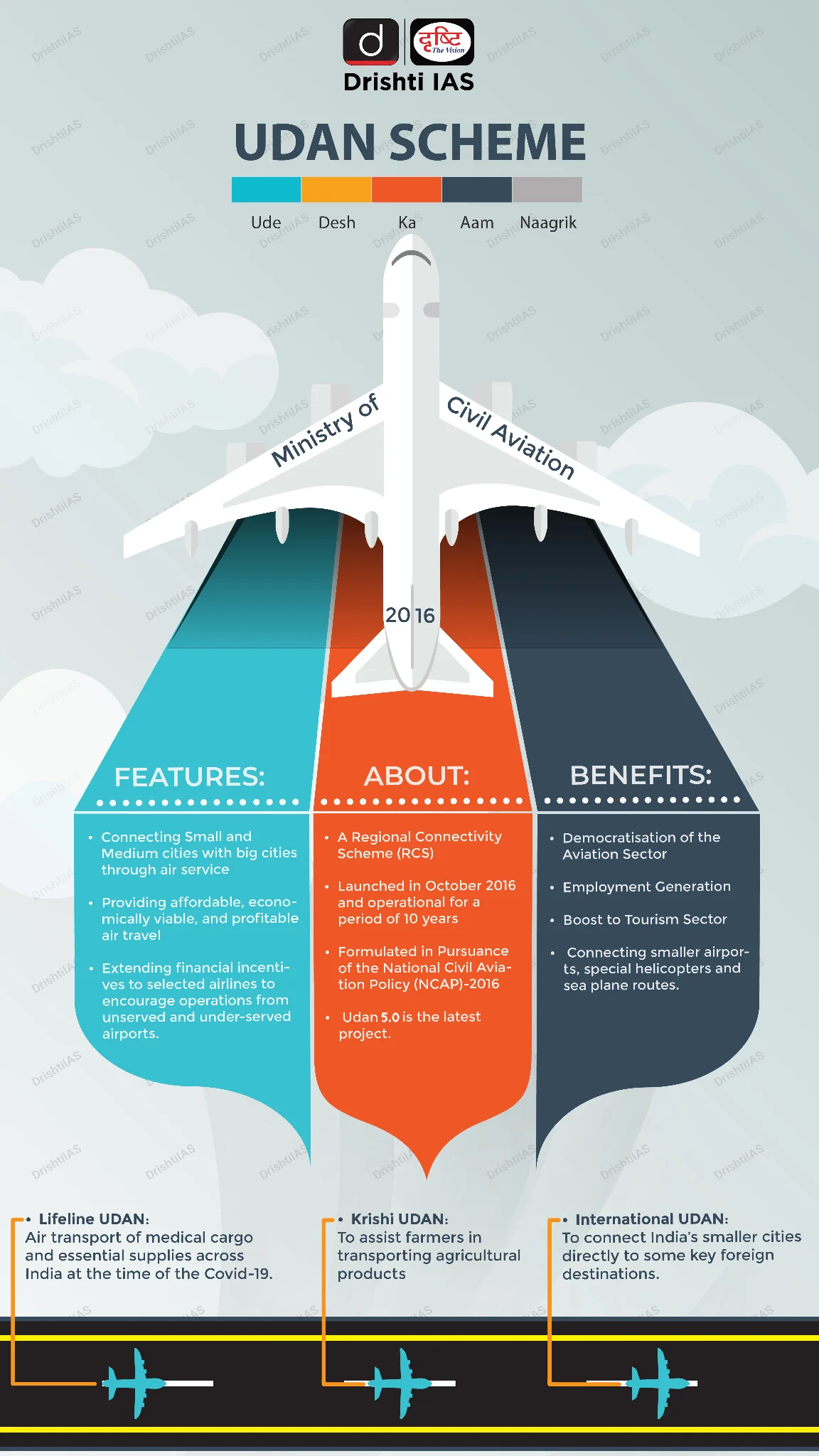
- About: UDAN is a flagship scheme of the Ministry of Civil Aviation aimed at democratising aviation and enhancing regional connectivity, ensuring access to air travel even in remote areas.
- Launched under the National Civil Aviation Policy (NCAP) 2016, it focuses on connecting Tier-2 and Tier-3 cities through a market-driven yet financially supported model, with the Airports Authority of India (AAI) as the nodal implementing agency.
- Core Mechanism & Funding: The scheme sustains affordable air travel through an airfare cap, financially supported by Viability Gap Funding (VGF) from the Centre.
- This is backed by collaborative governance, including waived landing charges and state commitments to reduce VAT on Aviation Turbine Fuel (ATF) to 1% or less.
- Massive Infrastructure Expansion: India’s overall airport network has more than doubled, growing from 74 airports in 2014 to 159 airports in 2024.
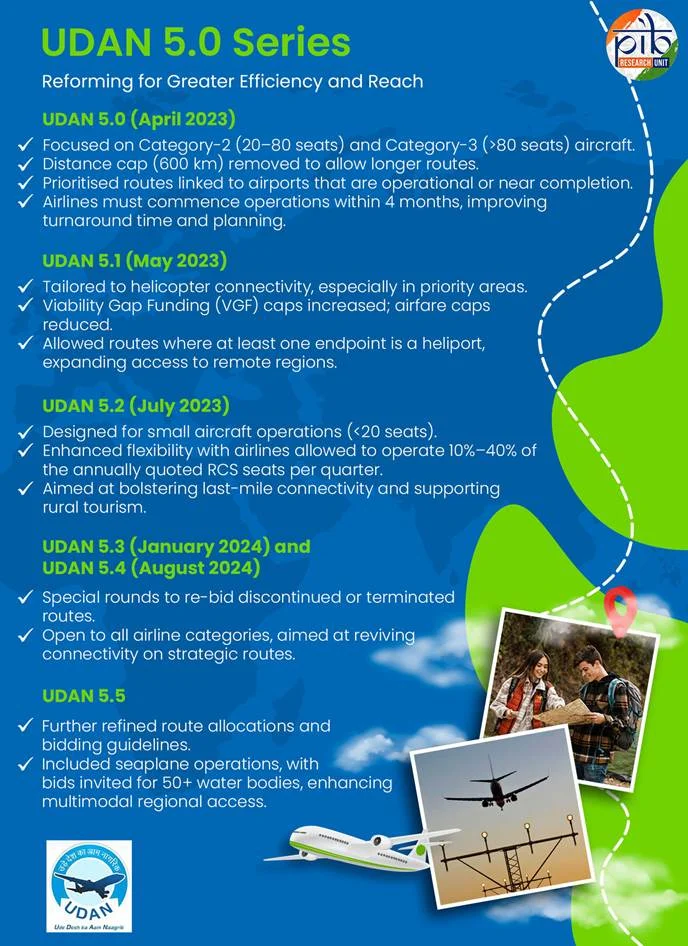
- Strategic Evolution (UDAN 1.0 to 5.0): The initiative systematically expanded its scope from connecting underserved airports to including helipads in UDAN 2.0, introducing tourism routes in UDAN 3.0, focusing on hilly regions, the North-East, and island territories in UDAN 4.0, and further promoting seaplane operations under UDAN 5.0 series.
- Krishi UDAN Integration: A crucial multi-ministry convergence scheme, Krishi UDAN, leverages this network to provide timely and cost-effective air logistics for agricultural produce, heavily focusing on value realization for farmers in tribal, hilly, and North-Eastern regions across 58 airports.
Frequently Asked Questions (FAQs)
1. What is the objective of the UDAN scheme?
It aims to make air travel affordable and enhance regional connectivity, especially in Tier-2 and Tier-3 cities.
2. What is the key change in the Modified UDAN scheme?
It extends subsidy duration from 3 to 5 years and shifts funding to the government exchequer.
3. What is Viability Gap Funding (VGF) in UDAN?
It is a government subsidy to airlines to keep airfares affordable and support unviable routes.
4. Which policy launched the UDAN scheme?
It was launched under the National Civil Aviation Policy (NCAP), 2016.
5. What is the role of Krishi UDAN?
It facilitates air transportation of agricultural produce, improving market access and farmer income.
UPSC Civil Services Examination Previous Year Question (PYQ)
Q. Examine the development of Airports in India through joint ventures under Public–Private Partnership (PPP) model. What are the challenges faced by the authorities in this regard? (2017)


Rapid Fire
Dwarka Basin
Researchers have recently uncovered fossil beds in the Dwarka Basin that provide a window into the early Miocene epoch (23 million to 5.3 million years ago), and identified 42 species of snails, suggesting the region was historically warm and nutrient-dense.
- Beyond snails, the sedimentary layers are rich in foraminifera (tiny ocean organisms with shells). The basin is a point of interest for energy companies exploring for oil and gas deposits beneath volcanic rock layers.
Dwarka Basin
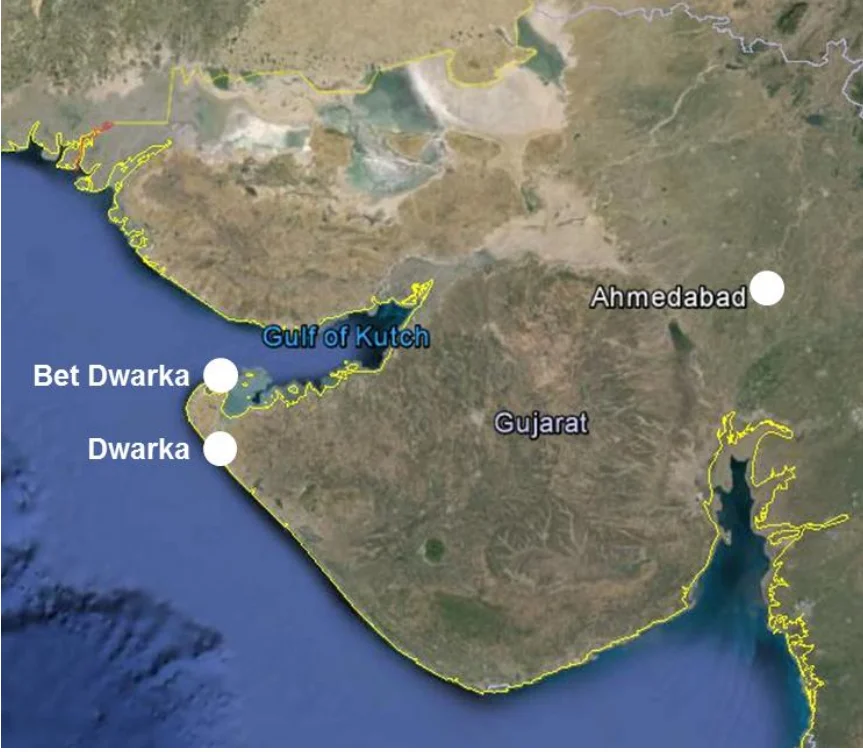
- About: Dwarka Basin (submerged Dwarka city) refers to a series of underwater archaeological remains located off the coast of modern-day Dwarka and Bet Dwarka in Gujarat, India (western tip of Gujarat's Saurashtra Peninsula).
- Geologists suggest the city may have been submerged due to post-glacial sea-level rise, tectonic activity, or coastal erosion over thousands of years.
- However, it is widely believed by many to be the legendary kingdom of Lord Krishna, which, according to the Mahabharata and Puranas, was swallowed by the Arabian Sea following his departure from the world. This is traditionally viewed as the transition to the Kali Yuga.
- Timeline: Some archaeologists, like the late Dr. SR Rao, dated the remains to approximately 1500–2000 BCE (the protohistoric period), aligning it with the end of the Harappan civilization.
- Archaeological Heritage: Since the 1980s, the Archaeological Survey of India (ASI) has documented massive sandstone blocks, semicircular structures, and wall-like formations. Over 120 stone anchors of various types (triangular, grapnel, and ring-stone) have been discovered, confirming that the area was a major ancient port and jetty.
- Excavations have yielded pottery shards, copper objects, iron ingots, and beads. A notable find was a seal depicting a 3-headed animal.
- Modern Significance: The current Dwarka town houses the Dwarkadhish Temple (Jagat Mandir), a major Krishna Bhakti shrine rebuilt in the 15-16th century after destruction by Mahmud Begada in 1472, and the Sharada Peeth, the western matha established by Adi Shankaracharya.
- The Gujarat government plans to introduce submarine tourism to allow public access to these underwater structures.
- It is one of the four Char Dham pilgrimage sites, alongside Badrinath in the north, Jagannath Puri in the east, and Rameswaram in the south.
| Read More: Dwarka & Beyt Dwarka |


Rapid Fire
India’s 1st Repository of Psychiatric Disorders: CALM-Brain
India has launched CALM-Brain, the country’s first digital repository of major psychiatric disorders, aimed at transforming research, diagnosis, and treatment of mental illnesses.
- CALM-Brain: It is a first-of-its-kind open-source database that compiles detailed information on brain structure and function in psychiatric disorders, enabling advanced scientific research and clinical applications.
- The repository has been developed by the National Institute of Mental Health and Neuro Sciences (NIMHANS) and the National Centre for Biological Sciences (NCBS) - TIFR under the Rohini Nilekani Centre for Brain and Mind (CBM).
- The repository traces its roots back to 2016 as part of the Accelerator program for Discovery in Brain disorders using Stem cells (ADBS project), which was jointly funded by the Department of Biotechnology and the Pratiksha Trust.
- Data Coverage: The platform integrates clinical, neuro-imaging, behavioural, and genetic datasets, covering key disorders such as addiction, bipolar disorder, dementia, and schizophrenia, making it comprehensive in scope.
- The repository includes data from over 2,000 individuals across 900 families, enabling robust comparative analysis between affected and unaffected individuals.
- Biorepository Linkage: It is linked with a stem cell biobank, allowing researchers to explore the biological basis of psychiatric disorders and advance experimental research in mental health.
- Research Objective: The primary goal is to identify biomarkers and neurocognitive indicators of psychiatric illnesses, understand disease progression, and study treatment responses for better clinical outcomes.
- Significance: CALM-Brain has the potential to enable early diagnosis, personalised treatment, and precision psychiatry, thereby improving mental healthcare delivery in India.
| Read more: Brainoware |


Rapid Fire
Preah Vihear Temple
The Preah Vihear Temple, a masterpiece of Khmer architecture, currently faces severe structural degradation following intense military skirmishes between Cambodia and Thailand.
Preah Vihear Temple
- About: It is an ancient Hindu temple built by the Khmer Empire, situated atop a 525-meter cliff in the Dangrek Mountains along the border between Cambodia and Thailand.
- Originally dedicated to the Hindu god Shiva, the temple later transitioned into a Buddhist site, reflecting the region's religious evolution.
- Construction: While construction began in the early 9th century, the most significant structures were built during the reigns of Khmer kings Suryavarman I and Suryavarman II, the latter of whom also built Angkor Wat (Hindu-Buddhist temple complex built in Cambodia).
- Unique Layout: Unlike most Khmer temples, which have a rectangular plan facing east, Preah Vihear is built on an 800-meter long north-south axis.
- It consists of a series of sanctuaries linked by pavements and staircases that rise toward the cliff’s edge, symbolizing the sacred Mount Meru (a sacred, five-peaked mountain present within Hindu, Jain and Buddhist cosmologies).
- UNESCO Status: It was designated a UNESCO World Heritage Site in 2008 for being an "outstanding masterpiece of Khmer architecture" and for its exceptional carved stone ornamentation.
- Territorial Dispute: A 1904 treaty between France (ruling Cambodia) and Siam (Thailand) placed the Preah Vihear Temple in Thailand. However, a 1907 map drawn by French officers placed it in Cambodia, and Thailand did not officially protest the map for decades.
- ICJ Ruling: The International Court of Justice (ICJ) ruled in 1962 that the temple belonged to Cambodia and reaffirmed its 1962 ruling in 2013. Currently, the temple is under Cambodian administration.
- In late 2025 and early 2026, all five gateway pavilions (Gopuras) were damaged in renewed military tensions between Cambodia and Thailand.

| Read More: The Preah Vihear and Prasat Ta Muen Thom |