


Rapid Fire
Dwarka Basin
- 27 Mar 2026
- 4 min read
Researchers have recently uncovered fossil beds in the Dwarka Basin that provide a window into the early Miocene epoch (23 million to 5.3 million years ago), and identified 42 species of snails, suggesting the region was historically warm and nutrient-dense.
- Beyond snails, the sedimentary layers are rich in foraminifera (tiny ocean organisms with shells). The basin is a point of interest for energy companies exploring for oil and gas deposits beneath volcanic rock layers.
Dwarka Basin
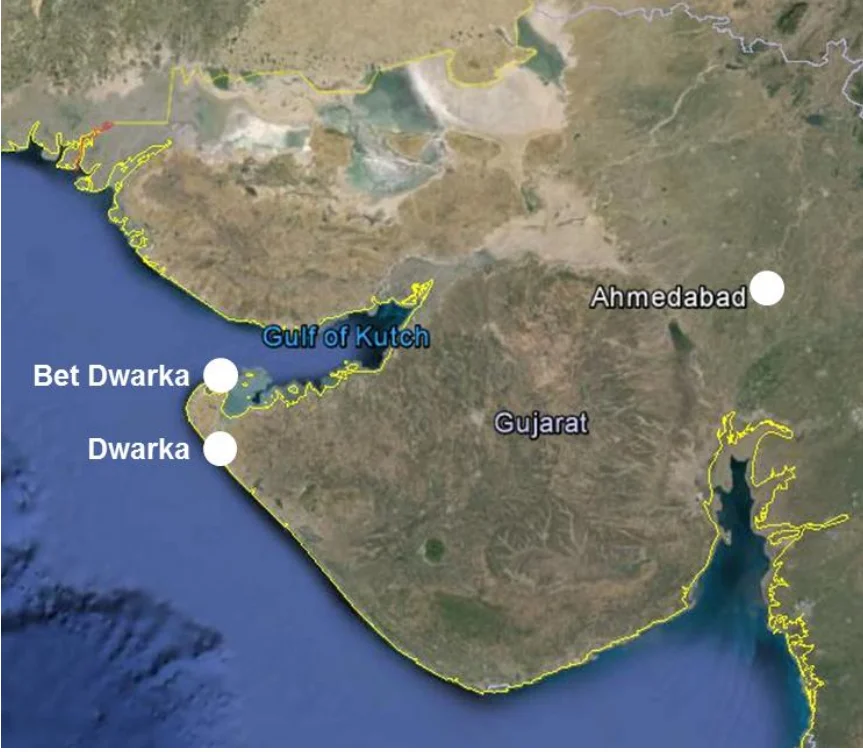
- About: Dwarka Basin (submerged Dwarka city) refers to a series of underwater archaeological remains located off the coast of modern-day Dwarka and Bet Dwarka in Gujarat, India (western tip of Gujarat's Saurashtra Peninsula).
- Geologists suggest the city may have been submerged due to post-glacial sea-level rise, tectonic activity, or coastal erosion over thousands of years.
- However, it is widely believed by many to be the legendary kingdom of Lord Krishna, which, according to the Mahabharata and Puranas, was swallowed by the Arabian Sea following his departure from the world. This is traditionally viewed as the transition to the Kali Yuga.
- Timeline: Some archaeologists, like the late Dr. SR Rao, dated the remains to approximately 1500–2000 BCE (the protohistoric period), aligning it with the end of the Harappan civilization.
- Archaeological Heritage: Since the 1980s, the Archaeological Survey of India (ASI) has documented massive sandstone blocks, semicircular structures, and wall-like formations. Over 120 stone anchors of various types (triangular, grapnel, and ring-stone) have been discovered, confirming that the area was a major ancient port and jetty.
- Excavations have yielded pottery shards, copper objects, iron ingots, and beads. A notable find was a seal depicting a 3-headed animal.
- Modern Significance: The current Dwarka town houses the Dwarkadhish Temple (Jagat Mandir), a major Krishna Bhakti shrine rebuilt in the 15-16th century after destruction by Mahmud Begada in 1472, and the Sharada Peeth, the western matha established by Adi Shankaracharya.
- The Gujarat government plans to introduce submarine tourism to allow public access to these underwater structures.
- It is one of the four Char Dham pilgrimage sites, alongside Badrinath in the north, Jagannath Puri in the east, and Rameswaram in the south.
| Read More: Dwarka & Beyt Dwarka |



