


Important Facts For Prelims
Modified UDAN Scheme
- 27 Mar 2026
- 7 min read
Why in News?
The Union Cabinet has approved the Regional Connectivity Scheme – Modified UDAN with a Rs 28,840 crore outlay for 2026–2036, aiming to strengthen regional aviation and address viability issues in earlier phases.
What is the Regional Connectivity Scheme – Modified UDAN?
- About: The Modified UDAN scheme, introduced in the Union Budget 2025–26, is a revamped version of the UDAN (Ude Desh ka Aam Nagrik) initiative, aimed at ensuring affordable air travel, improving connectivity to Tier-2 and Tier-3 cities, and promoting both infrastructure development and long-term operational sustainability.
- Need for the Modified UDAN: While the original UDAN scheme, launched in October 2016, successfully operationalized 663 routes and carried over 162.47 lakh passengers, it faced significant sustainability challenges:
- High Discontinuation Rates: According to a Comptroller and Auditor General of India report, only 7% to 10% of routes remained financially viable after their initial subsidy period ended.
- The original three-year cap on subsidies was not long enough for airlines to develop self-sustaining markets on Tier-2 and Tier-3 routes.
- Abandoned Routes and Airports: Out of the 663 routes launched since 2017, 327 had fallen into disuse by February 2026.
- Furthermore, 15 of the 95 airports revived under the scheme had ceased operations.
- High Discontinuation Rates: According to a Comptroller and Auditor General of India report, only 7% to 10% of routes remained financially viable after their initial subsidy period ended.
- Core Pillars of the Modified UDAN:
- Extended Subsidies (Viability Gap Funding): To keep airfares affordable (historically capped at Rs 2,500 per hour of flight for half the seats), the government subsidizes airline operators.
- The modified scheme extends this subsidy window from three to five years, giving airlines a longer runway to establish profitable routes.
- Direct Government Funding: Instead of funding these subsidies through an extra levy added to passenger tickets on major routes, the financial support will now come directly from the government exchequer.
- Operations & Maintenance (O&M) Support: Moving beyond just building airports, the government will now actively subsidize the day-to-day running costs of low-traffic aerodromes to prevent them from shutting down.
- Massive Infrastructure Expansion: The scheme targets the development of 100 airports from currently unserved airstrips and the construction of 200 modern helipads specifically designed for remote, hilly, and island regions.
- Focus on Indigenous Aviation: Aligning with the Atmanirbhar Bharat initiative, the program includes provisions to procure locally manufactured aircraft, such as HAL Dhruv helicopters and HAL Dornier planes, to navigate difficult terrains.
- Extended Subsidies (Viability Gap Funding): To keep airfares affordable (historically capped at Rs 2,500 per hour of flight for half the seats), the government subsidizes airline operators.
What is the Background of UDAN Scheme?
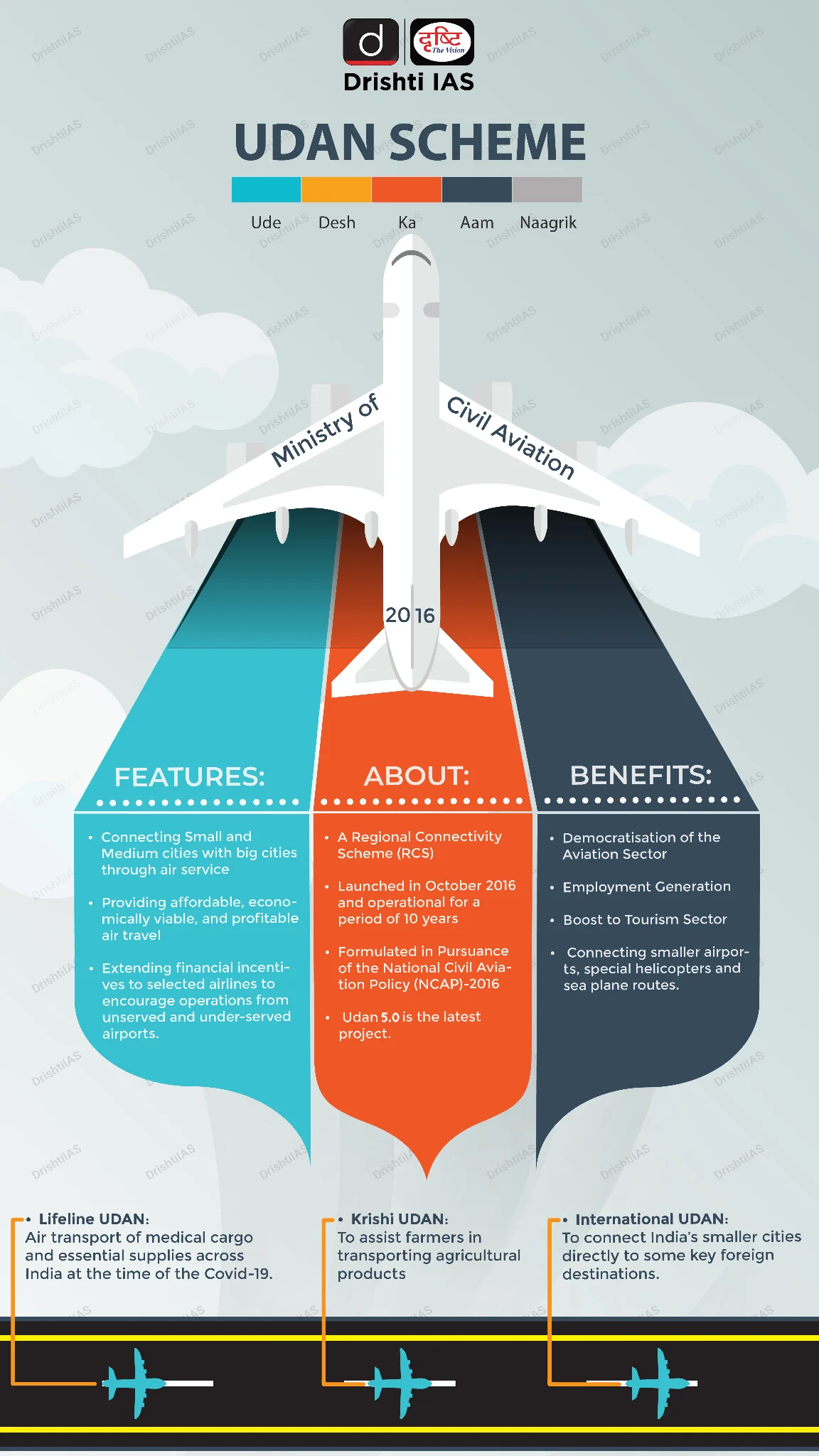
- About: UDAN is a flagship scheme of the Ministry of Civil Aviation aimed at democratising aviation and enhancing regional connectivity, ensuring access to air travel even in remote areas.
- Launched under the National Civil Aviation Policy (NCAP) 2016, it focuses on connecting Tier-2 and Tier-3 cities through a market-driven yet financially supported model, with the Airports Authority of India (AAI) as the nodal implementing agency.
- Core Mechanism & Funding: The scheme sustains affordable air travel through an airfare cap, financially supported by Viability Gap Funding (VGF) from the Centre.
- This is backed by collaborative governance, including waived landing charges and state commitments to reduce VAT on Aviation Turbine Fuel (ATF) to 1% or less.
- Massive Infrastructure Expansion: India’s overall airport network has more than doubled, growing from 74 airports in 2014 to 159 airports in 2024.
- Strategic Evolution (UDAN 1.0 to 5.0): The initiative systematically expanded its scope from connecting underserved airports to including helipads in UDAN 2.0, introducing tourism routes in UDAN 3.0, focusing on hilly regions, the North-East, and island territories in UDAN 4.0, and further promoting seaplane operations under UDAN 5.0 series.
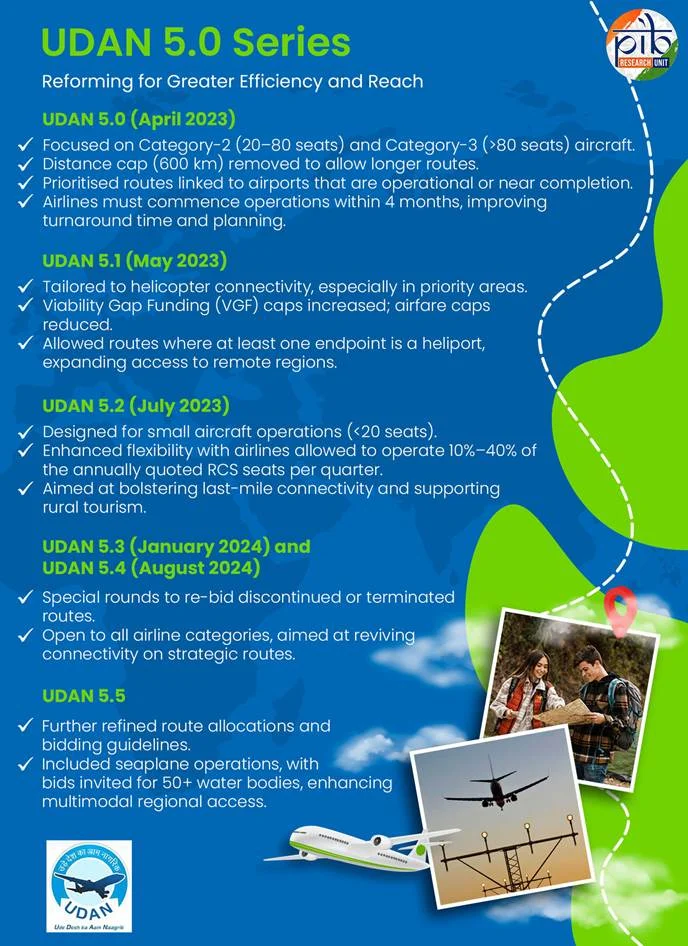
- Krishi UDAN Integration: A crucial multi-ministry convergence scheme, Krishi UDAN, leverages this network to provide timely and cost-effective air logistics for agricultural produce, heavily focusing on value realization for farmers in tribal, hilly, and North-Eastern regions across 58 airports.
Frequently Asked Questions (FAQs)
1. What is the objective of the UDAN scheme?
It aims to make air travel affordable and enhance regional connectivity, especially in Tier-2 and Tier-3 cities.
2. What is the key change in the Modified UDAN scheme?
It extends subsidy duration from 3 to 5 years and shifts funding to the government exchequer.
3. What is Viability Gap Funding (VGF) in UDAN?
It is a government subsidy to airlines to keep airfares affordable and support unviable routes.
4. Which policy launched the UDAN scheme?
It was launched under the National Civil Aviation Policy (NCAP), 2016.
5. What is the role of Krishi UDAN?
It facilitates air transportation of agricultural produce, improving market access and farmer income.
UPSC Civil Services Examination Previous Year Question (PYQ)
Q. Examine the development of Airports in India through joint ventures under Public–Private Partnership (PPP) model. What are the challenges faced by the authorities in this regard? (2017)



