Governance
Viksit Bharat- Guarantee For Rozgar And Ajeevika Mission (Gramin) Bill, 2025
For Prelims: Mahatma Gandhi National Rural Employment Guarantee Act, 2005, PM Gati Shakti, Poverty
For Mains: Rural employment policy in India, Rights-based vs supply-driven welfare models, Role of public works programmes in poverty reduction
Why in News?
The Ministry of Rural Development introduced the Viksit Bharat- Guarantee For Rozgar And Ajeevika Mission (Gramin) (VB-G RAM G) Bill, 2025 in the Lok Sabha as an upgrade to the Mahatma Gandhi National Rural Employment Guarantee Act, 2005 (MGNREGA).
- The proposed law marks a fundamental shift from a rights-based, demand-driven rural employment scheme to a budget-capped, supply-driven framework aligned with the vision of Viksit Bharat @2047.
- Rural poverty has declined sharply from 25.7% in 2011–12 to nearly 5% in 2023–24, reducing the need for MGNREGA as a pure distress-relief programme and warranting a shift towards productivity-linked employment.
Summary
- The VB–G RAM G Bill, 2025 shifts from a universal, demand-driven right to work to a budget-capped, supply-driven model with planned asset creation.
- While aimed at fiscal predictability and livelihood integration, it raises concerns over coverage, State finances, and income security for vulnerable rural households.
What are the Key Provisions of the Viksit Bharat- Guarantee for Rozgar and Ajeevika Mission (Gramin) Bill, 2025?
- Statutory Wage Employment Guarantee: Provides a legal guarantee of 125 days of wage employment per rural household per financial year to adult members willing to undertake unskilled manual work.
- Conditional and Non-Universal Coverage: Unlike MGNREGA’s universal coverage, employment under the Bill will be available only in rural areas notified by the Union Government, making the guarantee conditional rather than nationwide.
- Bottom-Up Planning through VGPPs: Mandates preparation of Viksit Gram Panchayat Plans (VGPPs) using spatial technology, aggregated at Block, District, and State levels, and integrated with PM Gati Shakti for coordinated infrastructure planning.
- Centrally Sponsored Scheme (CSS) Structure: Significantly increases the financial burden on States by revising the cost-sharing pattern to 60:40 for most States (from the earlier 10% share under MGNREGA), while retaining 90:10 only for North-Eastern and Himalayan States/UTs.
- State-wise allocations will be determined annually by the Union Government based on objective parameters, curtailing flexibility to expand spending in response to distress or rising demand.

- Flexibility during Agricultural Seasons: The Bill empowers States to pause the programme for up to 60 days in a financial year during peak sowing and harvesting seasons, ensuring the availability of farm labour for agricultural activities.
- Unemployment Allowance Provision: Mandates payment of unemployment allowance by State Governments if employment is not provided within 15 days of demand.
What are the Expected Benefits of VB–G RAM G?
- Labour Market Rationalisation: As per Periodic Labour Force Survey (PLFS 2022–23), nearly 45% of rural workers remain self-employed in low-productivity agriculture, with disguised unemployment persisting. VB–G RAM G Bill, 2025 supports farm productivity while balancing non-farm employment.
- Fiscal Predictability and Better Planning: A budget-capped, supply-driven framework limits open-ended fiscal liabilities seen under MGNREGA.
- It enables advance planning of works, funds, and assets instead of reactive expenditure.
- Improved Asset Quality and Productivity: The shift from distress-driven employment to planned asset creation through VGPPs, along with integration with PM Gati Shakti, can improve durability, convergence, and the long-term economic value of rural assets.
- Greater State Ownership and Accountability: Higher State financial contribution may incentivise better supervision, timely completion, and quality control.
- It can also reduce moral hazard associated with a largely Centre-funded open-ended scheme.
- Administrative Efficiency through Technology: Use of spatial planning, digital monitoring, and AI-based systems can reduce ghost beneficiaries and leakages, improving transparency and administrative efficiency when implemented inclusively.
.png)
What are the Potential Challenges of VB–G RAM G?
- Dilution of a Rights-Based Employment Guarantee: MGNREGA created a legal right to employment with unemployment allowance.
- VB-G RAM G shifts to administratively sanctioned, supply-driven work, weakening enforceability and labour security.risks becoming a discretionary welfare scheme, undermining predictability, and legal safeguards for workers.
- Retreat from Progressive Welfare Commitments under Article 41: Article 41 places the right to work under Directive Principles, subject to State capacity. MGNREGA went beyond this by creating a statutory, justiciable right to work.
- VB–G RAM G aligns employment support more closely with State capacity, which critics see as a rollback of welfare guarantees.
- Weakening of India’s Rural Shock-Absorber Mechanism: MGNREGA functioned as India’s largest rural safety net, especially during Covid-19, when employment peaked at ~389 crore person-days (2020–21).
- VB–G RAM G, with its budget-capped, supply-driven model, may weaken the shock-absorber role earlier provided by MGNREGA.
- From Universal Entitlement to Selective Coverage: MGNREGA applied to all rural areas by default, ensuring universal access.
- VB–G RAM G restricts coverage to Union-notified rural areas, raising risks of exclusion, uneven development, and central bias.
- Erosion of Year-Round Income Security: MGNREGA allowed demand-driven, year-round employment.
- However, VB–G RAM G introduces capped, time-bound work with “agricultural pause” provisions, potentially reducing income security for poor rural households.
- Increased Fiscal Burden on States: VB–G RAM G increases the financial responsibility of States, which may strain poorer States, causing delayed wages, fewer workdays, and uneven implementation, and raising concerns of Union discretion in allocations.
- Centre argues that higher State stake improves ownership and accountability, replacing open-ended liabilities with predictable funding.
- Cosmetic Expansion of Workdays without Structural Reform: Although VB–G RAM G raises the ceiling to 125 days, critics note that even under MGNREGA, most households did not receive 100 days, making the increase appear largely cosmetic without fixing implementation gaps.
- Techno-Administrative Exclusion Risks: Mandatory biometrics, AI-based monitoring, and GPS-linked attendance under the VB–G RAM G risk excluding the poorest workers—especially older persons, migrants, and those in low-connectivity areas, by denying work for technical reasons rather than lack of need.
Other Key Government Initiatives to Promote Rural Growth and Employment
- Deendayal Antyodaya Yojana-National Rural Livelihoods Mission (DAY-NRLM): Promotes self-employment through SHGs, financial inclusion, and livelihood diversification in rural areas.
- Deen Dayal Upadhyaya Grameen Kaushalya Yojana (DDU-GKY): Focuses on skill development and placement-linked employment for rural youth.
- Survey of Villages and Mapping with Improvised Technology in Village Areas: Provides property cards to rural households, enabling access to credit and investment.
- PM Vishwakarma: Supports traditional artisans through skilling, toolkits, and credit linkage to generate rural non-farm employment.
What Measures Can Be Adopted to Further Strengthen VB–G RAM G?
- Hybrid Rights–Planning Model: Introduce a hybrid model where a minimum number of workdays remain demand-driven for vulnerable households, while additional employment is planned and supply-based.
- Transparent and Inclusive Area Notification: Notify rural areas using transparent, data-driven criteria such as poverty pockets, climate vulnerability, and migration trends.
- Allow States limited discretionary expansion during localised distress, natural disasters, or agrarian downturns. Periodically review notified areas to avoid permanent exclusion.
- Safeguards Against Tech Exclusion: Make technology assistive, not exclusionary, with offline alternatives and human oversight. Treat technical failures as administrative lapses, not worker defaults.
- Outcome-Based Monitoring: Prioritise climate-resilient and income-generating assets under VGPPs rather than only infrastructure works.
- Track outcomes like income stability, asset durability, and skill transition, not just expenditure efficiency.
- Crisis-Responsive Flexibility: Build automatic triggers for temporary expansion of workdays and budgets during economic or climate shocks. Preserve the scheme’s role as a rural stabiliser in extraordinary situations.
Conclusion
The reform reflects changing rural realities but risks weakening income security for the poorest. A balanced model that protects the right to work while creating productive, climate-resilient assets is crucial to achieve SDG 1 (No Poverty) and SDG 8 (Decent Work).
|
Drishti Mains Question: Evaluate the role of rural employment programmes in creating climate-resilient assets. |
Frequently Asked Questions (FAQs)
1. What is the objective of the VB–G RAM G Bill, 2025?
It seeks to replace an open-ended, demand-driven employment guarantee with a budget-capped, supply-driven programme aligned with long-term rural development goals.
2. How many days of wage employment are guaranteed per rural household under VB–G RAM G Bill, 2025?
The framework provides a statutory guarantee of125 days of unskilled wage employment per rural household per financial year.
3. What are Viksit Gram Panchayat Plans (VGPPs)?
VGPPs are bottom-up plans prepared using spatial technology, aggregated at higher levels and integrated with PM Gati Shakti for coordinated infrastructure planning.
UPSC Civil Services Examination, Previous Year Question (PYQ)
Prelims
Q. Among the following who are eligible to benefit from the “Mahatma Gandhi National Rural Employment Guarantee Act”? (2011)
(a) Adult members of only the scheduled caste and scheduled tribe households
(b) Adult members of below poverty line (BPL) households
(c) Adult members of households of all backward communities
(d) Adult members of any household
Ans: (d)
Mains
Q. “An essential condition to eradicate poverty is to liberate the poor from the process of deprivation.” Substantiate this statement with suitable examples. (2016)
Q. “Poverty alleviation programs in India remain mere showpieces until and unless they are backed up by political will.” Discuss with reference to the performance of the major poverty alleviation programmes in India. (2015)

Indian Polity
Strengthening Central Information Commission
For Prelims: President, Chief Information Commissioner, Central Information Commission (CIC), Right to Information Act, 2005, Quasi-judicial Body, Prime Minister, Office of Profit, Public Information Officers.
For Mains: Key facts regarding the Central Information Commission (CIC) and provisions of Right to Information Act, 2005. Concerns associated with CIC and steps needed to strengthen it.
Why in News?
The President appointed Raj Kumar Goyal as Chief Information Commissioner and 8 new Information Commissioners, thereby fully constituting the Central Information Commission (CIC) for the first time in 9 years.
Summary
- The CIC, constituted under the RTI Act, 2005, ensures citizen access to information, enhancing transparency and accountability across central government and public institutions.
- Strengthening the CIC requires timely appointments, digital case management, stricter enforcement powers, and proactive disclosure initiatives.
What is the Central Information Commission (CIC)?
- About: It is a statutory body constituted under provisions of the Right to Information Act, 2005 and functions as a quasi-judicial body to handle complaints and appeals regarding information access.
- Jurisdiction covers Central Government offices, financial institutions, public sector undertakings, and Union Territories (UTs).
- Composition: Comprises one Chief Information Commissioner and up to 10 Information Commissioners (ICs).
- Appointment: Appointed by the President of India on recommendation of a committee consisting of:
- Prime Minister (Chairperson)
- Leader of Opposition in Lok Sabha
- Union Cabinet Minister (currently Home Minister) nominated by the Prime Minister.
- Eligibility criteria: Must be persons of eminence in public life with wide knowledge and experience in law, science and technology, social service, management, journalism, mass media, administration, or governance.
- Disqualifications: Cannot be Member of Parliament or Member of the Legislature of any State or UT; cannot hold any office of profit, be connected with political parties, carry on business, or pursue any profession.
- Tenure and Service Conditions: The Chief ICs or ICs shall hold office for a term prescribed by Central Government or until age 65 years, whichever is earlier.
- Not eligible for reappointment after completing term.
- Removal: Removal by President under specific circumstances:
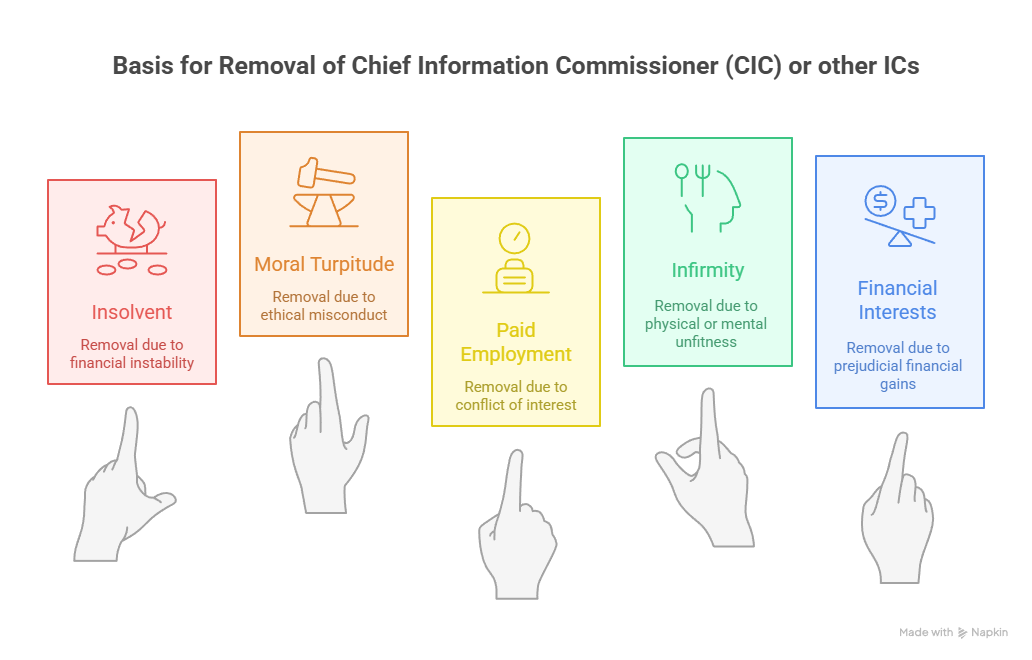
- Removal for misbehavior or incapacity requires Supreme Court (SC) inquiry and recommendation before the President can remove.
- Powers and Functions:
- Receives and inquires complaints from citizens regarding refusal of information requests, incomplete, misleading, or false information provided under the RTI Act, 2005.
- Quasi-judicial powers equivalent to civil court including summoning and enforcing attendance of persons.
- Unrestricted access to records: Can examine any record under public authority's control; no record may be withheld on any grounds during inquiry.
- Reporting obligation: Submits annual report to Central Government on RTI Act, 2005 implementation, which is placed before both Houses of Parliament.
Right to Information Act, 2005 (RTI Act, 2005)
- About: The RTI Act, 2005 was enacted to give citizens the right to access information from public authorities.
- It seeks to enhance transparency, accountability, and good governance in the operations of government bodies and public authorities.
- Key Provisions: The Act applies to all levels of government, including central, state, and local bodies.
- Section 8(2) allows for the disclosure of information when the public interest outweighs confidentiality of information.
- Section 22 ensures that the RTI Act, 2005 takes precedence over any inconsistencies with other laws.
- Right to Information (Amendment) Act, 2019: Under the RTI Act, 2005, the term of the Chief IC and ICs was fixed at 5 years or until the age of 65, whichever is earlier. After the 2019 Amendment, the term is decided by the Central Government.
- Originally, the CIC's salary and terms of service aligned with the Chief Election Commissioner (CEC), and the IC's with an Election Commissioner. After the amendment, salaries, allowances, and terms of service for both CICs and ICs are prescribed by the Central Government.
What Concerns are Associated with the Central Information Commission (CIC)?
- Poor Transparency in the Appointment: The selection process for ICs has faced criticism for insufficient disclosure of criteria and candidate details. In Anjali Bhardwaj v. Union of India (2019), the SC directed greater transparency in appointments to ensure public scrutiny.
- Perceived Compromise of Independence: The RTI (Amendment) Act, 2019 allows the Central Government to set tenure, salaries, and service conditions of commissioners, raising concerns about executive influence over the CIC’s quasi-judicial autonomy.
- Ineffective Enforcement: While the Chief Information Commissioner can order disclosure and impose penalties, its powers are not sufficiently coercive, with limited ability to enforce compliance, especially when public authorities ignore its directions. Reports show they were applied in only about 2.2% of disposed cases.
- Backlog and Delays: As of November 2024, due to vacancies and staff shortages, around 22,000 cases remain pending at the CIC, resulting in long waiting periods for appellants.
- Adjudication Issue: Decisions become overly procedural, with technical dismissals, repeated adjournments, and wide use of exemptions such as privacy or national security, which if not carefully balanced, can reduce information disclosure and weaken the CIC’s role in ensuring transparency.
What Steps are Needed to Strengthen the Central Information Commission (CIC)?
- Timely and Transparent Appointments: Establish a predictable, time-bound, and participatory process for appointing commissioners by following the SC guidelines in Anjali Bhardwaj v. Union of India Case, 2019, and ensure the timely filling of vacancies.
- Reduce Pendency: Increase the number of ICs in proportion to case volume and establish specialized sectoral benches (e.g., for defense and finance).
- Implement mandatory case disposal timelines and a comprehensive digital management system with video conferencing.
- Strengthen Enforcement and Compliance: Empower the CIC with contempt or direct enforcement powers to secure compliance from public authorities. Introduce a compliance tracking system, requiring department heads to report on directives, monitored by parliamentary committees.
- Proactive Disclosure: The CIC must actively enforce Section 4 of the RTI Act to enhance proactive disclosure and reduce appeals. Detailed CIC performance data—bench disposal, penalty trends, compliance rates, and reasoning patterns—must be made public, as an institution that enforces transparency must practice it to preserve its own credibility.
- Administrative Dependence: It performs quasi-judicial functions but remains administratively dependent on the executive for staffing, and infrastructure. Critics argue this duality subtly influences institutional behaviour even without direct interference.
Conclusion
The recent full constitution of the CIC is a positive step, but its effectiveness depends on addressing key issues: ensuring genuine autonomy from executive influence, enforcing penalties to deter non-compliance, and implementing systemic reforms to reduce the massive backlog of appeals that undermines the RTI Act’s objectives.
|
Drishti Mains Question: Q. How can the CIC's enforcement powers be strengthened to ensure effective implementation of its orders, addressing low penalties and poor compliance? |
Frequently Asked Questions (FAQs)
Q. What is the Central Information Commission (CIC)?
The CIC is a statutory quasi-judicial body under the RTI Act, 2005, handling complaints and appeals related to citizen access to information from public authorities.
Q. Who appoints the Chief Information Commissioner and Information Commissioners?
The President of India appoints them based on recommendations from a committee chaired by the Prime Minister, including the Leader of Opposition and a nominated Union Minister.
Q. What was the significance of the Supreme Court's ruling in the Anjali Bhardwaj v. Union of India case 2019?
The Supreme Court directed the government to ensure transparency and timeliness in appointing Information Commissioners, filling vacancies proactively to prevent the CIC from becoming dysfunctional.
UPSC Civil Services Examination, Previous Year Question (PYQ)
Mains
Q. The Right to Information Act is not all about citizens’ empowerment alone, it essentially redefines the concept of accountability.” Discuss. (2018)


Facts for UPSC Mains
Year End Review-2025: Department of Biotechnology
Why in News?
The Department of Biotechnology's (DBT) 2025 Year-End Review shows India's biotechnology sector grew from USD 10 billion in 2014 to over USD 165.7 billion in 2024, with a USD 300 billion projection for 2030.
- This growth has positioned India as the world's 12th largest biotech hub, the 3rd largest in the Asia-Pacific, the 3rd largest startup ecosystem globally, and the largest vaccine manufacturer.
Summary
- India’s biotech sector grew from USD 10 billion (2014) to 165.7 billion (2024), aiming for USD 300 billion by 2030.
- Key advances include healthcare innovations, high-yield gene-edited crops, space biomanufacturing, and technology transfers.
- Strategic initiatives like BioE3 Policy, National Biofoundry Network, regulatory reforms, and E-YUVA scheme have strengthened innovation, commercialization, and youth-led biotech development.
What are the Key Initiatives in India’s Biotechnology Sector?
- Infrastructure and Policy Initiatives: India’s 1st National Biofoundry Network launched to strengthen indigenous biomanufacturing capabilities.
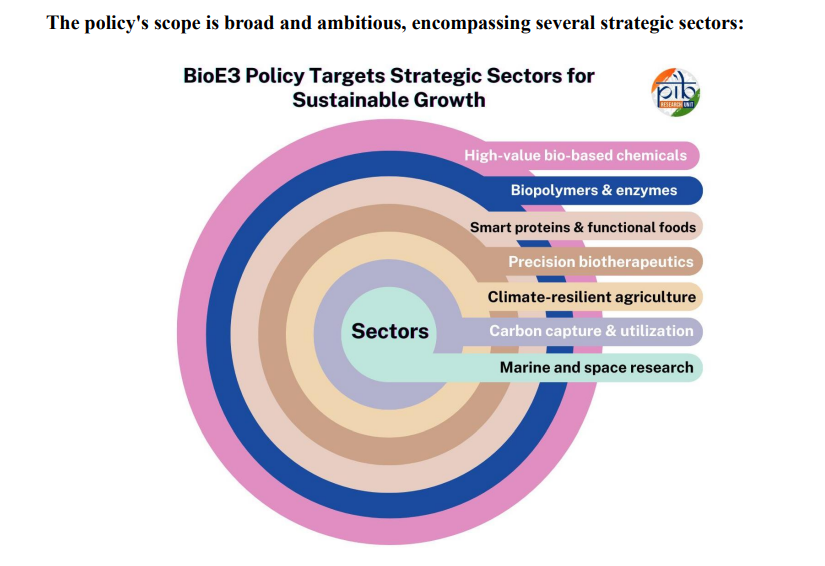
- BioE3 Policy implementation across 6 thematic sectors including bio-based chemicals, precision biotherapeutics, and climate-resilient agriculture.
- D.E.S.I.G.N for BioE3 Challenge launched to empower youth-led innovation for sustainable bioeconomy.
- BioE3 Policy implementation across 6 thematic sectors including bio-based chemicals, precision biotherapeutics, and climate-resilient agriculture.
- Guidelines on Stacked Plants: Guidelines on Genetically Engineered Plants Containing Stacked Events, 2025 notified to ensure biosafety and innovation.
- Stacked refers to combining two or more transgenes—such as those for herbicide tolerance (HT) and insect resistance (Bt)—into a single crop.
- GenomeIndia Project 2020: Creation of a national genomic database with 10,000 accessible whole genome samples under the GenomeIndia Project.
- One Day One Genome Project 2024: It highlights India's unique microbial diversity and its vital roles in ecosystems, agriculture, and health. A core feature is the daily public release of one fully annotated microbial genome, focusing on bacterial strains isolated in India.
- Biomedical Research Career Programme (BRCP) Phase-III (2025-26 to 2037-38): It aims to nurture top scientific talent for cutting-edge and translational biomedical research, strengthen research systems, reduce regional disparities, and build globally impactful research capacity.
Biotechnology
- About: Biotechnology harnesses cellular and biomolecular processes to develop products and technologies that improve human life and protect the environment.
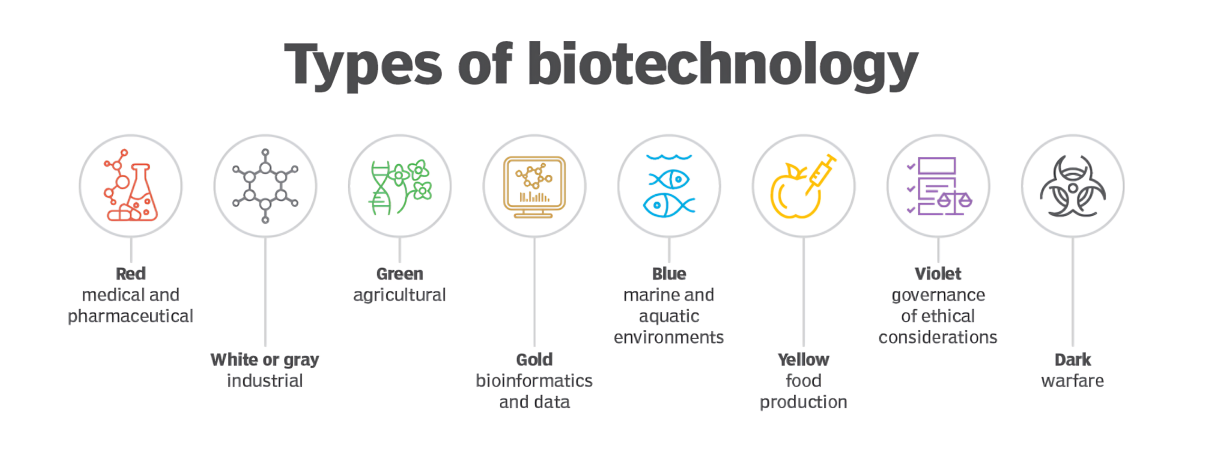
- Types:
- Applications:
- Healthcare (Red): Enables advanced drugs, vaccines (e.g., rapid Covid-19 production), personalized/gene therapies, and stem cell research for tissue regeneration.
- Agriculture (Green): Develops crops resistant to pests, drought, and diseases, and enhances nutritional profiles (e.g., vitamin-A fortified Golden Rice) to improve food security.
- Environment (White): Uses microorganisms for bioremediation (cleaning pollutants) and produces sustainable biofuels, bioplastics, and biodegradable materials to support a circular economy.
- Economic Growth: Creates jobs and provides a competitive global edge through innovation.
- Climate & Materials: Helps capture CO₂, produces cleaner biofuels, and engineers novel bio-based materials for industries like fashion and aerospace.
What are the Key Achievements of the Department of Biotechnology (DBT) in the Year 2025?
- Healthcare & Research: Indigenous AI-driven models developed for pregnancy dating and preterm birth prediction with 66 genetic markers identified.
- Dare2eraD TB programme: 18,000 Mycobacterium tuberculosis (MTB) isolates sequenced for comprehensive drug-resistant TB mapping.
- GARBH-INi Cohort: 12,000 pregnant women enrolled with 14 lakh biospecimens and 1 lakh ultrasound images archived.
- Commercialization of Lactobacillus Crispatus: Consortia of beneficial Lactobacillus crispatus (lactic acid-producing bacteria) isolates have been developed and transferred to a leading Indian nutraceutical company for application in nutraceutical and cosmetic products.
- Agricultural Biotechnology Innovations: High-yielding gene-edited rice cultivar (DEP1 mutation) showing 20% increased yield over wild type developed.
- Rice variety ADT 39-Sub1 with submergence tolerance released in 2025. Drought-resistant rice variety 'Arun' developed for variable climatic conditions.
- Two drought-tolerant chickpea varieties (ADVIKA and SAATVIK) contributed to 30% of total breeder seed indent developed.
- Space Biomanufacturing: Microalgae demonstrated two-fold growth increase in microgravity.
- A proof of concept for growing cyanobacteria on urea in microgravity has been achieved, potentially enabling the use of human waste (CO2 and urea) to produce nutritional supplements for astronauts on long-term space missions.
- India’s 1st human muscle stem-cell experiment revealed microgravity as an accelerated model of muscle aging (sarcopenia).
- Technology Transfer and Commercialization: Engineered Glucoamylase Secreting yeast strain developed for 1G ethanol production (50% reduction in external glucoamylase requirement).
- Multiple technology transfers including white rust resistance mustard varieties to eight seed companies.
- E-YUVA scheme scaled to 19 pre-incubation centres across 15 states, supporting 460+ Fellows.
- North-Eastern Region Development: Value-added products from wild apples and theaflavin extraction technology developed. 218 beneficiaries including farmers trained through targeted interventions.
- A Network project on Large Cardamom is under implementation with the Sikkim State S&T Council in collaboration with iBRIC+.
- Strategic Partnerships: Centre-State BioE3 Cells initiated. International collaborations with the United Kingdom (FEMTECH, (Women-Orientated Health Tech)), Switzerland (One Health).
Conclusion
Driven by policies like BioE3, cutting-edge research, and strong public-private partnerships, India's biotechnology sector has grown transformatively, positioning the country as a global leader in sustainable bio-economy and self-reliance.
|
Drishti Mains Question: Analyze the contributions of biotechnology to climate-resilient agriculture in India, with reference to recent developments in gene-edited crops and drought-resistant varieties. |
Frequently Asked Questions (FAQs)
Q. What is the projected value of India’s biotechnology sector by 2030?
India’s biotechnology sector is projected to reach USD 300 billion by 2030, positioning it among the world’s top biotech hubs.
Q. What is the National Biofoundry Network?
The National Biofoundry Network is a DBT initiative to strengthen indigenous biomanufacturing capabilities and support innovation in biotech startups.
Q. What are the key objectives of the BioE3 Policy?
The BioE3 Policy focuses on six thematic sectors, including bio-based chemicals, precision biotherapeutics, and climate-resilient agriculture, promoting a sustainable bioeconomy.
UPSC Civil Services Examination, Previous Year Question (PYQ)
Prelims
Q. Other than resistance to pests, what are the prospects for which genetically engineered plants have been created? (2012)
- To enable them to withstand drought
- To increase the nutritive value of the produce
- To enable them to grow and do photosynthesis in spaceships and space stations
- To increase their shelf life
Select the correct answer using the codes given below:
(a) 1 and 2 only
(b) 3 and 4 only
(c) 1, 2 and 4 only
(d) 1, 2, 3 and 4
Ans: (c)
Mains
Q. What are the research and developmental achievements in applied biotechnology? How will these achievements help to uplift the poorer sections of the society? (2021)
Q. How can biotechnology help to improve the living standards of farmers? (2019)
Q. Why is there so much activity in the field of biotechnology in our country? How has this activity benefited the field of bio pharma? (2018)

Important Facts For Prelims
Google’s Project Suncatcher
Why in News?
Google has announced Project Suncatcher, a long-term research initiative to test solar-powered data centres in space, with the first experimental launches planned for 2027.
Summary
- Google’s Project Suncatcher aims to develop solar-powered data centres in space using satellite constellations equipped with AI chips and laser-based communication to process data directly in orbit.
- The initiative seeks to cut the rising energy burden of Earth-based data centres, support climate-friendly computing, and reshape digital and space governance under the Outer Space Treaty, 1967.
What is Google’s Project Suncatcher?
- About: The project aims to test solar-powered data centres in space by deploying small computing racks on satellites, with Google planning to launch two prototype satellites by early 2027 as part of a learning mission in partnership with Planet Labs, an Earth imaging company.
- It will rely on Tensor Processing Units (TPUs), Google’s patented custom chips designed for high-volume, low-precision Artificial Intelligence (AI) processing, and use laser-based optical links to interconnect satellites into a constellation capable of data centre–level computation.
- Functioning of Data Centres in Space:
- Solar energy generation: Satellites will use continuous solar radiation to power computing systems, reducing dependence on Earth-based electricity.
- Onboard AI computing: Each satellite will carry AI chips (such as TPUs/GPUs) to process data directly in space rather than transmitting everything to Earth.
- Satellite Constellations: Multiple satellites will work together as a distributed data centre, sharing workloads across nodes.
- Inter-satellite laser communication will enable high-speed, low-latency data transfer within the constellation.
- Edge Processing in Space: Data from satellites (e.g., Earth observation) will be processed in orbit, reducing bandwidth needs and response time.
- Radiation-hardened Systems: Hardware will be designed to withstand radiation, vacuum, and temperature extremes.
- Downlink to Earth: Processed data will be selectively transmitted to ground stations, minimising data load and latency challenges.
- Significance of Data Centres in Space:
- Reduces pressure on Earth-based data centres, lowering demand for electricity and water amid the AI boom.
- Goldman Sachs estimates that electricity demand from data centres may rise by 165% by 2030.
- Enables clean, solar-powered computing, supporting climate mitigation efforts.
- Offers potential solutions to data sovereignty constraints, as outer space is not subject to national jurisdiction under Outer Space Treaty, 1967.
- Improves resilience of digital infrastructure against natural disasters, cable cuts, and power outages on Earth.
- Marks a shift toward next-generation space-based digital infrastructure, with implications for global AI, cloud computing, and governance.
- Reduces pressure on Earth-based data centres, lowering demand for electricity and water amid the AI boom.
Data Centres
- About: Data centres are specialised facilities that store, process, and manage large volumes of digital data using servers, storage, networking, and supporting systems for power, cooling, and security.
- They provide reliable and scalable infrastructure for cloud computing, AI, and other digital services.
- Global Advancements Towards Data Centres in Space:
- OpenAI (Sam Altman):Proposed a Dyson sphere–like network of AI data centres powered by solar energy
- Nvidia: Launched the Starcloud satellite carrying the H100 GPU, optimized for AI workloads
- Lonestar Data Holdings: Sent a 1 kg mini data centre with 8 TB SSD storage to the Moon
Frequently Asked Questions (FAQs)
1. What is Project Suncatcher?
Project Suncatcher is Google’s research initiative to test solar-powered data centres in space using satellite-based AI computing systems.
2. How will data centres function in space?
They will use continuous solar energy, onboard AI chips, satellite constellations, and laser-based inter-satellite links for distributed computing.
3. Why are space-based data centres considered climate-friendly?
They reduce reliance on Earth’s electricity and water resources while using clean, uninterrupted solar power for computing.
UPSC Civil Services Examination, Previous Year Questions (PYQs)
Q. With the present state of development, Artificial Intelligence can effectively do which of the following? (2020)
- Bring down electricity consumption in industrial units
- Create meaningful short stories and songs
- Disease diagnosis
- Text-to-Speech Conversion
- Wireless transmission of electrical energy
Select the correct answer using the code given below:
(a) 1, 2, 3 and 5 only
(b) 1, 3 and 4 only
(c) 2, 4 and 5 only
(d) 1, 2, 3, 4 and 5
Ans: (d)


Rapid Fire
54th Anniversary of Vijay Diwas
India observed the 54th Vijay Diwas on 16th December to mark its historic military victory in the 1971 Indo-Pakistan War, a 13-day conflict that resulted in the creation of Bangladesh.
Indo-Pakistan War 1971
- Cause & Intervention: Operation Searchlight, a pre-planned military crackdown, was launched by the Pakistan Army on 25th March 1971 in East Pakistan to seize major cities, disarm Bengali forces, and arrest or eliminate Awami League leaders and supporters.
- It led to mass atrocities causing hundreds of thousands of deaths and forcing about 10 million refugees into India.
- This humanitarian crisis prompted India's intervention in support of Bangladesh's independence struggle.
- Decisive Victory & Surrender: The conflict concluded with the surrender of about 93,000 Pakistani soldiers in Dhaka on 16th December, 1971—one of the largest military surrenders since World War II.
- Strategic Leadership & Operations: The victory was led by Field Marshal Sam Manekshaw and featured key operations like Operation Trident (naval operation) against Karachi port and iconic battles such as the Battle of Longewala 1971.
- Outcome & Sacrifice: The war resulted in the liberation and formation of Bangladesh, cementing India's regional standing.
- The Shimla Agreement was signed on 2nd July 1972, in Shimla, following the 1971 war between India and Pakistan, with both nations resolving to end conflict and confrontation.
- Significance: Vijay Diwas honors the bravery of the Indian Armed Forces and the Mukti Bahini (Bengali guerrilla resistance movement), reinforces national unity, and serves as a reminder of the human cost of freedom.
| Read More: Indo-Pak War: 1971 |

Rapid Fire
Diving Support Craft A20
The Indian Navy commissioned the first indigenous Diving Support Craft (DSC), DSC A20, at Naval Base Kochi (Southern Naval Command), marking a significant enhancement of its underwater operational capabilities.
- About: A Diving Support Craft (DSC) is a specialised vessel designed to facilitate underwater diving operations, primarily in coastal and harbour environments.
- Primary Role: The craft is equipped with advanced diving gear for critical missions like underwater repairs, harbour clearance, inspections, and diving operations in coastal waters.
- Technical Features: The vessel is designed as per the Indian Register of Shipping (IRS) classification rules, ensuring safety and performance standards.
- It is a catamaran-hull ship with a displacement of approximately 390 tonnes, optimized for stability and underwater operations.
- Strategic Significance: It significantly augments the Navy's operational flexibility and self-sufficiency in conducting vital underwater and salvage missions.
- The project aligns with the national Aatmanirbhar Bharat vision, aiming to reduce dependency on defence imports and build domestic industrial expertise.
- Other Recent Inductions in the Indian Navy: INS Nistar, INSV Kaundinya, Frigate Himgiri, INS Surat, INS Udaygiri etc.
| Read More: Indigenisation Efforts of Navy |


Rapid Fire
Anthropause and Evolution in Urban Birds
The Covid-19 lockdowns created an “anthropause”, offering a rare natural experiment that revealed how reduced human activity can rapidly alter wildlife morphology, as seen in urban dark-eyed juncos.
- Anthropause: It refers to the global, temporary slowdown of human activity, especially travel, during the Covid-19 pandemic lockdowns (early 2020).
- Anthropause Effects on Wildlife: A study shows that dark-eyed juncos (a group of small, grayish new world sparrows) living in cities developed short, thick beaks because they fed on human food.
- During Covid-19 lockdowns, when people and food waste disappeared, birds born in 2021–22 developed longer, natural (wild-type) beaks.
- Once human activity returned, the urban beak shape reappeared, proving that human presence can drive rapid evolutionary changes in wildlife.
- Similar pandemic impacts included quieter bird songs, closer wildlife movement to cities, and altered animal behaviour, reinforcing the concept of human-driven ecosystems.
- The study supports the idea that evolution need not take millennia; under strong selective pressures such as urbanisation, evolutionary changes can occur within a few generations.
| Read more: Anthropause Period |