
Indian Economy
Gross Domestic Product and Net Domestic Product
For Prelims: Gross Domestic Product, GDP deflator, GDP per capita, Gross Fixed Capital Formation , Net Domestic Product (NDP)
For Mains: GDP vs NDP: Conceptual differences and policy implications, Limitations of GDP as a welfare and sustainability indicator
Why in News?
The Ministry of Statistics and Programme Implementation (MoSPI), through the National Statistics Office, has released the First Advance Estimates of Gross Domestic Product (GDP) for Financial Year (FY) 2025–26, projecting a robust 7.4% growth in real GDP.
- Alongside, India is planning to shift from GDP to Net Domestic Product (NDP) as the primary measure of economic activity, in line with the United Nations’ System of National Accounts (SNA) 2025, with implementation expected from 2029–30, to better reflect the real cost of production.
Summary
- The First Advance Estimates for FY 2025–26 project a robust 7.4% real GDP growth, driven mainly by the services sector, with healthy private consumption and investment momentum.
- India plans to transition from GDP to Net Domestic Product (NDP) in line with SNA 2025 to better capture net, sustainability-adjusted economic growth, addressing limitations of GDP such as depreciation, environmental costs, and inequality.
What is Gross Domestic Product (GDP)?
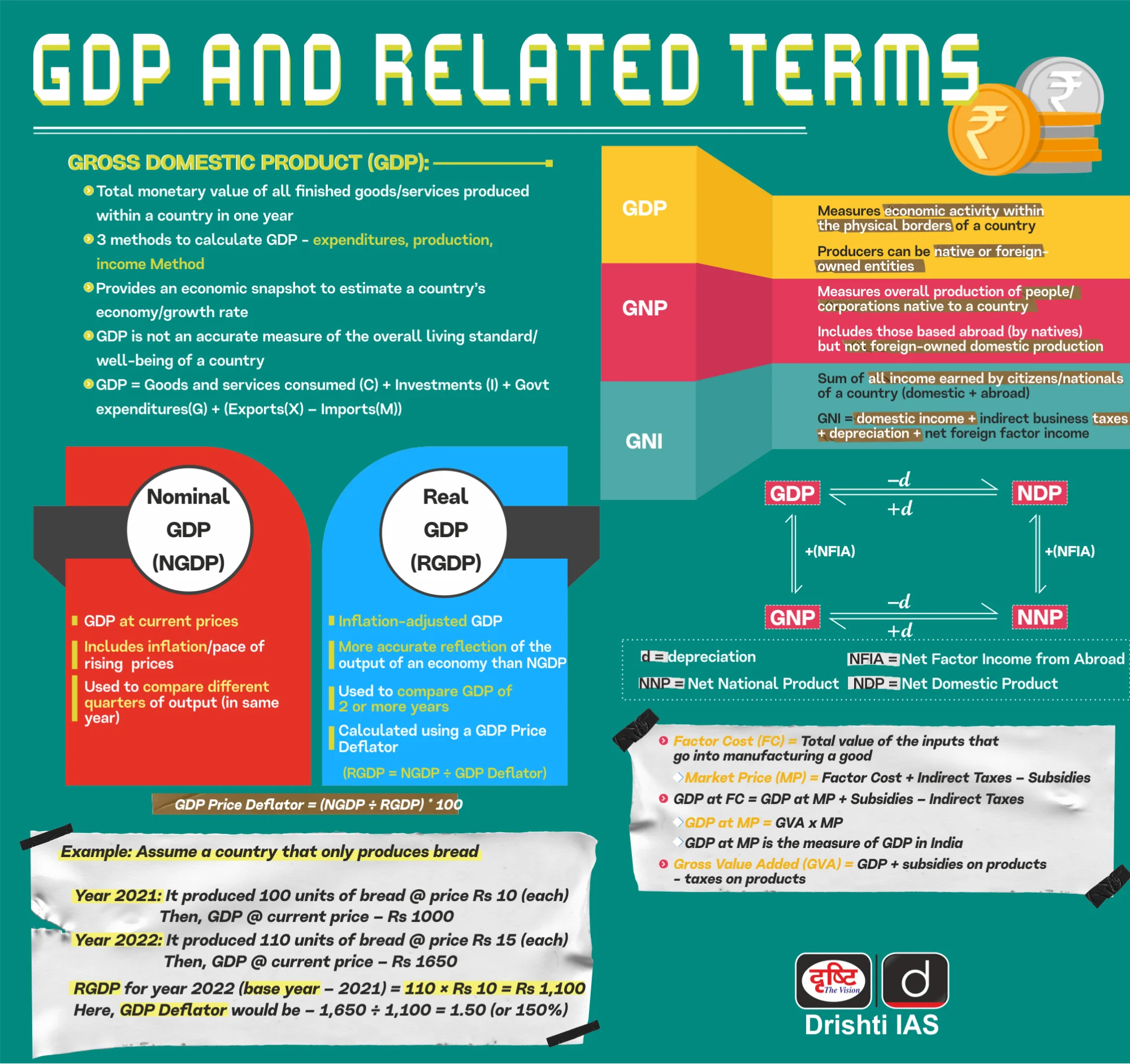
- About: GDP is the total monetary value of all final goods and services produced within a country’s borders during a specific period (usually a year or a quarter).
- Types of GDP:
- Nominal GDP: Measured at current market prices, without adjusting for inflation. Useful for same-year comparisons but not reliable across years.
- Real GDP: Adjusted for inflation using the GDP deflator. Reflects the actual quantity of goods and services produced. It enables comparison of economic growth over time.
- GDP Computation Methodology in India:
- Before 2015: India computed GDP with 2004–05 as the base year, and measured GDP at factor cost, excluding indirect taxes and subsidies.
- Sectoral coverage was narrower, and labour income was estimated uniformly without distinguishing worker types.
- After 2015: GDP computation shifted to a 2011–12 base year, and adopted GDP at market prices, including taxes and subsidies. Labour income estimation improved through effective labour input, and coverage expanded in agriculture and financial services.
- Before 2015: India computed GDP with 2004–05 as the base year, and measured GDP at factor cost, excluding indirect taxes and subsidies.
- Potential GDP: It is the maximum sustainable output an economy can produce using all its resources (labor, capital, technology) efficiently, without causing accelerating inflation.
- Significance: It is a key indicator of economic size, productivity, growth, and macroeconomic performance. GDP growth rate reflects the pace of economic expansion or contraction.
- Base year Revision: India is revising its GDP base year from 2011–12 to 2022–23 to better reflect current economic realities, with the revised GDP series scheduled for release in February 2027.
- The revised GDP series will continue to follow SNA 2008, while the NDP shift aligns with SNA 2025.
Limitations of GDP
- Non-adjustment for Capital Depreciation: GDP measures gross output and does not deduct depreciation of physical capital such as machinery, infrastructure, and buildings, thereby overstating the net income generated by the economy.
- Exclusion of Environmental Costs: GDP treats resource extraction and pollution-intensive activities as value addition, without accounting for depletion of natural capital or environmental degradation, despite their adverse implications for long-term economic welfare.
- GDP focuses on short-term economic output and neglects intergenerational costs, making it an inadequate measure for assessing sustainable and inclusive long-term development.
- Underrepresentation of Unpaid Work: Non-market activities such as household labour, care work, and large segments of the informal economy are either undervalued or excluded, leading to an incomplete estimation of total economic activity.
- Insensitivity to Income Distribution: GDP aggregates output without reflecting how income is distributed across different sections of society, allowing economic growth to coexist with widening income and wealth inequalities.
- Emphasis on Output Quantity over Growth Quality: GDP captures the volume of production but fails to measure qualitative dimensions of development such as health outcomes, educational attainment, social well-being, and environmental sustainability.
- In 2025, India has become the world’s fourth-largest economy by nominal GDP (USD 4.18 trillion), surpassing Japan. However, Japan remains far ahead in per-capita terms, with India’s GDP per capita at USD 2,694 in 2024 compared to Japan’s USD 32,487, highlighting a sharp gap in average income levels.
- Inclusion of Defensive and Remedial Expenditures: Expenditures on disaster recovery, pollution control, healthcare due to accidents, or crime prevention raise GDP figures, even though they represent costs incurred to mitigate social or environmental damage rather than genuine welfare gains.
Key Highlights of the First Advance Estimates of GDP for the FY 2025-26
- Real GDP Growth: Estimated at 7.4% in FY 2025–26, compared to 6.5% in FY 2024–25.
- Nominal GDP Growth: Estimated at 8.0% in FY 2025–26.
- Real GVA Growth: Estimated at 7.3%, driven mainly by buoyant growth in the services sector.
- High-Growth Tertiary Segments:
- Financial, Real Estate & Professional Services and Public Administration, Defence & Other Services: Estimated growth of 9.9% at constant prices.
- Trade, Hotels, Transport, Communication & Broadcasting: Estimated growth of 7.5% at constant prices.
- Secondary Sector Performance:
- Manufacturing and Construction: Estimated to grow by 7.0% at constant prices.
- Primary and Utilities Sector:
- Agriculture & Allied Activities: Estimated growth of 3.1%.
- Electricity, Gas, Water Supply & Other Utility Services: Estimated growth of 2.1%, indicating moderate expansion.
- Private Consumption: Private Final Consumption Expenditure (PFCE) estimated to grow by 7.0%, reflecting sustained household demand.
- Investment: Gross Fixed Capital Formation (GFCF) has been estimated to have 7.8% growth rate at Constant Prices during FY 2025-26, compared to 7.1% growth rate in previous FY.
What is Net Domestic Product (NDP)?
- About: Net Domestic Product (NDP) is a measure of a country's economic output, representing the value of all final goods and services produced within its borders in a given period, minus the value of depreciation of capital assets.
- Under SNA 2025, NDP = GDP – (depreciation of fixed capital + depletion of natural resources), making it a more sustainability-aware indicator.
- Significance: Shows the actual net income generated by the economy rather than gross output.
- Accounts for wear and tear of physical capital and exhaustion of natural resources.
- Helps assess whether economic growth is genuine or achieved by running down assets.
- Supports long-term planning, fiscal sustainability, and intergenerational equity.
- NDP’s Superiority Over GDP: Adjusts for depreciation, while GDP ignores capital consumption.
- Internalises environmental costs by deducting natural resource depletion under SNA 2025.
- Provides a more realistic measure of economic welfare and productive capacity.
- Prevents overestimation of growth by focusing on net value addition, not mere expansion of output.
United Nations’ System of National Accounts (SNA) 2025
- The SNA 2025 is a comprehensive international framework for compiling national accounts that replaces SNA 2008 and moves beyond GDP to better capture sustainability, distribution, and non-market activities.
- Under the SNA 2025, the Reserve Bank of India’s output will be classified as non-market activity, and regulatory payments by banks will be treated as transfers, not service fees.
- It introduces natural capital accounting, treating depletion of minerals, coal, oil, and gas as production costs while recognising renewables as assets, and adds distributional accounts showing income, wealth, consumption, and savings across household groups.
- By incorporating unpaid household and care work in extended accounts, SNA 2025 enhances policy relevance by linking economic growth with equity, ecological balance, and inclusiveness.
|
Drishti Mains Question: Q. Critically examine the limitations of GDP as a measure of economic welfare in the Indian context. |
Frequently Asked Questions (FAQs)
1. What is Net Domestic Product (NDP)?
NDP measures net output by deducting capital depreciation and natural resource depletion from GDP, reflecting true income generation.
2. How did India’s economy perform in FY 2025–26 as per Advance Estimates?
Real GDP grew 7.4%, led by services; Real GVA grew 7.3%, with strong private consumption and investment.
3. What are the key limitations of GDP?
GDP ignores depreciation, environmental costs, unpaid work, income distribution, and counts remedial spending as growth.
UPSC Civil Services Examination, Previous Year Questions (PYQs)
Prelims
Q1. With reference to Indian economy, consider the following statements: (2015)
- The rate of growth of Real Gross Domestic Product has steadily increased in the last decade.
- The Gross Domestic Product at market prices (in rupees) has steadily increased in the last decade.
Which of the statements given above is/are correct?
(a) 1 only
(b) 2 only
(c) Both 1 and 2
(d) Neither 1 nor 2
Ans: (b)
Q2. A decrease in tax to GDP ratio of a country indicates which of the following? (2015)
- Slowing economic growth rate
- Less equitable distribution of national income
Select the correct answer using the code given below:
(a) 1 only
(b) 2 only
(c) Both 1 and 2
(d) Neither 1 nor 2
Ans: (a)
Mains
Q1. Define potential GDP and explain its determinants. What are the factors that have been inhibiting India from realizing its potential GDP? (2020)
Q2. Explain the difference between computing methodology of India’s Gross Domestic Product (GDP) before the year 2015 and after the year 2015. (2021)
Governance
NITI Aayog on Internationalisation of Higher Education in India
For Prelims: National Education Policy 2020, National Institutional Ranking Framework, Bharat Vidya Kosh
For Mains: Internationalisation of higher education and national development, Brain drain vs brain circulation, Education and economic growth linkages, Role of higher education in soft power and diplomacy
Why in News?
NITI Aayog has released a report titled Internationalisation of Higher Education in India: Prospects, Potential, and Policy Recommendations, outlining a comprehensive road map to make India a global destination for higher education.
Summary
- NITI Aayog’s report highlights internationalisation of higher education as a strategic necessity to address India’s brain drain, student mobility imbalance, and large foreign exchange outflows, and to strengthen research, innovation, and global competitiveness.
- The road map proposes scholarships, a USD 10-billion research fund, regulatory and visa reforms, and global academic partnerships to transform India from a net exporter of students into a global education hub aligned with NEP 2020 and SDGs.
Why is Internationalisation of Higher Education Critical for India?
- Addressing Brain Drain: India has a 1:28 inbound–outbound student ratio, indicating a major skew toward outward migration.
- This reflects a significant brain drain and loss of domestic academic capacity.
- Over 16 lakh Indians have renounced citizenship since 2011, partly due to overseas education–migration pathways. Internationalisation can convert brain drain into brain circulation.
- Reducing Economic and Foreign Exchange Outflow: Indian students’ overseas education spending is projected at Rs 6.2 lakh crore by 2025.
- This equals nearly 2% of GDP and about 75% of India’s trade deficit (FY 2024–25).
- Strengthening India’s Global Competitiveness: Concentration of Indian students in high-income strategic countries (US, UK, Australia) (over 8.5 lakh Indian students) risks weakening India’s long-term knowledge economy and innovation base.
- Attracting global talent improves research quality and institutional rankings.
- Boosting Research and Soft Power: India hosts about 47,000 international students (2022), but with stronger policy support, inbound numbers could rise to 7.89–11 lakh by 2047.
- Since 2001, international student inflow has grown by 518%, highlighting India’s significant yet underutilised potential as a global education hub.
- Inflow of international students and faculty enhances research output, cross-cultural learning, and global collaborations.
- It positions India as a global knowledge hub and strengthens educational diplomacy.
- Since 2001, international student inflow has grown by 518%, highlighting India’s significant yet underutilised potential as a global education hub.
- Supporting National Development Goals: Internationalisation aligns with National Education Policy 2020 and India’s 2047 development vision.
- It helps build a high-skilled workforce essential for economic growth and technological leadership.
What are the Challenges in Internationalisation of Higher Education in India?
- Limited Scholarships and Financial Aid: 41% of Indian institutions surveyed by NITI Aayog reported inadequate scholarships as the biggest constraint.
- Countries like Germany and France offer low-cost education with strong scholarship support, making India less competitive.
- Weak Global Perception Of Education Quality: Indian universities face a weak global perception of quality.
- Despite strong performers such as the IITs and IISc, the QS World University Rankings: Asia 2026 show that no Indian university features in the top 50, highlighting gaps in global competitiveness and international brand credibility.
- Complex Regulatory and Visa Framework: Multiple regulators, slow visa approvals, and lack of a single-window system discourage foreign students and faculty.
- Unlike Australia’s student-friendly visa regime, India lacks fast-track academic visas.
- Inadequate International Campus Infrastructure: Many institutions lack international hostels, labs, libraries, and student services.
- Only a handful of campuses like IIT Madras offer facilities comparable to global standards.
- Difficulty In Attracting Foreign Faculty: Rigid recruitment rules, salary caps, and lack of tenure security deter international academics.
- Indian universities struggle to compete with US and European institutions offering flexible contracts and higher pay.
- Shortage of interdisciplinary, research-intensive, and globally benchmarked courses taught in international formats.
- Joint degrees and dual-campus programmes are common in Europe but rare in India.
- Weak International Branding And Outreach: India lacks coordinated global marketing and alumni ambassador networks.
- Countries like Canada aggressively brand themselves as global education hubs through embassies and digital campaigns.
- Cultural And Social Adjustment Issues: International students often encounter language barriers and cultural isolation, making India less attractive compared to student-friendly destinations.
What are the Recommendations Proposed By NITI Aayog For Internationalisation Of Higher Education?
- Scholarships and Fellowships for Global Talent: NITI Aayog recommends launching Vishwa Bandhu Scholarships for international students and Vishwa Bandhu Fellowships for foreign faculty and researchers to improve India’s global academic attractiveness.
- Creation of a National Research Fund: Proposes a Bharat Vidya Kosh, a USD 10 billion sovereign research fund, with half the corpus mobilised from diaspora and philanthropy and the remaining half contributed by the Government of India.
- Multilateral Academic Mobility Framework: NITI Aayog has proposed an Erasmus+-style mobility programme, named the Tagore Framework, to promote student and faculty exchanges between India and regions such as ASEAN, BRICS, and BIMSTEC.
- Erasmus+ Programme is an extensive European Union initiative that offers a wide variety of educational, training, youth, and sport mobility opportunities for individuals and organizations.
- Regulatory and Visa Reforms: The report calls for simplified entry–exit norms, fast-track tenure pathways, competitive salaries for foreign faculty, and a single-window system for visas, tax IDs, banking, and housing.
- NITI Aayog recommends easing regulations to allow international universities to establish campuses in India, including innovative models like campus-within-campus arrangements.
- Reforms in Rankings and Quality Metrics: It suggests expanding the National Institutional Ranking Framework (NIRF) parameters to include indicators such as Outreach and Inclusivity and Globalisation and Partnerships to better capture international engagement.
- Branding, Outreach, and Alumni Engagement: Proposes the creation of Bharat ki AAN (Alumni Ambassador Network) is proposed to leverage the Indian diaspora as global ambassadors for Indian higher education.
- Institutional and Cultural Readiness: Finally, it highlights the need to strengthen international student support systems, cultural integration, and institutional capacity for sustained internationalisation.
Conclusion
India’s higher education internationalisation is now strategic, impacting GDP, innovation, and global influence, and aligned with SDG 4 (Quality Education) and SDG 17 (Global Partnerships). NITI Aayog’s road map seeks to transform India from a net exporter of students into a global education hub through systemic reforms and global engagement.
|
Drishti Mains Question: Q. Why has the internationalisation of higher education become a strategic imperative for India? Examine in light of economic and geopolitical factors. |
Frequently Asked Questions (FAQs)
1. What prompted NITI Aayog to release a report on higher education internationalisation?
India faces a 1:28 inbound–outbound student ratio, rising foreign exchange outflows, and growing brain drain, necessitating a strategic policy response.
2. What are the key challenges in internationalising Indian higher education?
Major constraints include limited scholarships, weak global perception, complex visas, inadequate infrastructure, and difficulty in hiring foreign faculty.
4. What are the flagship recommendations of NITI Aayog?
Key proposals include Vishwa Bandhu Scholarships, Bharat Vidya Kosh ($10 billion research fund), an Erasmus+-like Tagore Framework, and easing norms for foreign campuses.
UPSC Civil Services Examination, Previous Year Question (PYQ)
Prelims
Which of the following provisions of the Constitution does India have a bearing on Education? (2012)
- Directive Principles of State Policy
- Rural and Urban Local Bodies
- Fifth Schedule
- Sixth Schedule
- Seventh Schedule
Select the correct answer using the codes given below:
(a) 1 and 2 only
(b) 3, 4 and 5 only
(c) 1, 2 and 5 only
(d) 1, 2, 3, 4 and 5
Ans- (d)
Mains
Q1. Discuss the main objectives of Population Education and point out the measures to achieve them in India in detail. (2021)
Q2. How have digital initiatives in India contributed to the functioning of the education system in the country? Elaborate on your answer. (2020)
Q3. The quality of higher education in India requires major improvements to make it internationally competitive. Do you think that the entry of foreign educational institutions would help improve the quality of higher and technical education in the country? Discuss. (2015)


Important Facts For Prelims
Akash-NG Missile
Why in News?
The Defence Research and Development Organisation (DRDO) successfully completed User Evaluation Trials (UET) of the Akash-NG (Next Generation) , clearing the path for its induction into the Indian Air Force (IAF).
- The development cycle of systems from DRDO broadly consists of three phases: developmental trials, user-assisted trials in various conditions, and UETs.
- The successful UET clears the way for the induction of the system, and an acceptance of necessity (AoN) is issued by the user, which, in Akash-NG’s case, is the IAF.
Summary
- DRDO has successfully completed User Evaluation Trials of Akash-NG, clearing the way for its induction into the Indian Air Force and marking a major step in India’s indigenous air defence capability.
- Akash-NG is a lighter, longer-range, and more lethal upgrade over the original Akash, designed to counter high-speed, low-RCS aerial threats and strengthen India’s layered air defence under Atmanirbhar Bharat.
What are the Key Facts About the Akash-NG?
- About: Akash-NG is a next-generation surface-to-air missile (SAM) designed for the IAF to intercept high-speed, high-manoeuvring, low radar cross-section (RCS) aerial threats, including aircraft, drones, and cruise missiles, with a range of up to 70 km and faster response time.
- Development and Production: The system is indigenously developed by DRDO (with 96% indigenous components) and produced by Bharat Dynamics Limited (BDL) and Bharat Electronics Limited (BEL), reinforcing India’s push for self-reliance in defence manufacturing.
- Performance Features: Akash-NG can fly at Mach 2.5, strike targets at around 60–70 km, operate beyond 20 km altitude, and achieve a kill probability of nearly 90%, making it far more lethal than earlier variants.
- The canisterised Akash-NG missile is stored and launched from sealed containers, which ease transport and storage while enhancing shelf life and operational readiness.
- Technological Advancements: It features built-in electronic counter-counter measures (ECCM), which means it has onboard mechanisms that can counter electronic systems that deceive detection systems.
- It features an indigenous Radio Frequency (RF) seeker, dual-pulse solid rocket motor, and fully homegrown radars and command-and-control systems, enabling precision strikes against low-RCS and high-manoeuvring targets.
- Operational Capabilities: The missile can be launched from mobile platforms, engage multiple targets simultaneously, and counter threats at low altitude, near-boundary, and high-altitude long-range scenarios.
- Strategic Significance: Akash was inducted into the IAF in 2014, and into the Indian Army the next year. Both the IAF and the Army currently operate multiple squadrons and groups of missiles, respectively.
- Akash-NG significantly enhances India’s layered air defence architecture, improves readiness against modern aerial threats, and strengthens Atmanirbhar Bharat in critical missile technologies.
- In December 2020, India approved Akash missile exports after interest from several countries, including Armenia, the Philippines, Vietnam, Egypt, and Brazil, highlighting the global acceptance of India’s indigenous defence systems.
- The export version of Akash will be different from those in service with the Indian Armed Forces.
- Difference from Earlier Akash: Compared to the original Akash, the NG version is lighter ( now 350 kg vs earlier 700 kg), has longer range (extended range up to 70 km (earlier ~30 km), replaces ramjet propulsion with a solid rocket motor, and offers improved mobility and survivability.
- The DRDO has also developed Akash Prime, an upgraded version of the Akash missile with the same range but equipped with an indigenous active RF seeker, significantly improving accuracy against aerial targets.
Integrated Guided Missile Development Programme (IGMDP)
- The IGMDP (1983-2012) was launched under the leadership of A. P. J. Abdul Kalam to achieve self-reliance in missile technology and led to the development of 5 missiles (P-A-T-N-A):
- Prithvi (short-range surface-to-surface), Akash (medium-range surface-to-air), Trishul (short-range surface-to-air), Nag (third-generation anti-tank missile), and Agni-I.
- The Prithvi series included Prithvi-I (150 km, now withdrawn), Prithvi-II (250–350 km, liquid-fuelled, nuclear-capable), and Prithvi-III (up to 750 km with lighter payload), with Dhanush as its naval variant.
- Trishul had a limited range of 12 km for point air defence, while Akash emerged as a key medium-range SAM with a 30 km intercept range.
- Owing to its strategic importance, the Agni missile programme was later separated from IGMDP and expanded independently, marking a major milestone in India’s strategic deterrence capability.
Frequently Asked Questions (FAQs)
1. What is Akash-NG?
Akash-NG is a next-generation surface-to-air missile (SAM) designed to intercept high-speed, high-manoeuvring, low-RCS aerial threats up to 70 km.
2. Why are User Evaluation Trials (UETs) important?
Successful UETs confirm operational readiness under real conditions and clear the system for induction into the IAF.
3. How is Akash-NG different from the original Akash?
Akash-NG is lighter (350 kg vs 700 kg), has a longer range, uses a dual-pulse solid rocket motor, and offers better mobility and survivability
4. Who developed Akash-NG and who produces it?
It was developed by DRDO and is produced by Bharat Dynamics Limited (BDL) and Bharat Electronics Limited (BEL).
5. What is IGMDP, and why is it significant?
The Integrated Guided Missile Development Programme, led by A. P. J. Abdul Kalam laid the foundation for India’s indigenous missile systems like Prithvi, Akash, Nag, and Agni, enhancing strategic self-reliance.
UPSC Civil Services Examination Previous Year Question (PYQ)
Q1. What is “Terminal High Altitude Area Defense (THAAD)”, sometimes seen in the news? (2018)
(a) An Israeli radar system
(b) India’s indigenous anti-missile programme
(c) An American anti-missile system
(d) A defence collaboration between Japan and South Korea.
Ans: (c)
Q2. With reference to Agni-IV Missile, which of the following statements is/are correct? (2014)
- It is a surface-to-surface missile.
- It is fuelled by liquid propellant only.
- It can deliver one-tonne nuclear warheads about 7500 km away.
Select the correct answer using the code given below:
(a) 1 only
(b) 2 and 3 only
(c) 1 and 3 only
(d) 1, 2 and 3
Ans: (a)
Rapid Fire
Indian Railways’ Electrification Drive
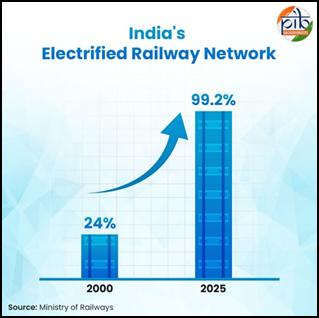
Indian Railways has electrified 99.2% of its Broad Gauge (1.676 metre distance between the inner faces of the two parallel rail lines) network, covering 69,427 Route Kilometres (RKMs) out of 70,001 RKMs as of November 2025, aligning infrastructure growth with sustainability.
- Historical Significance: Railway electrification in India began in 1925 with the first electric train running between Bombay Victoria Terminus and Kurla Harbour, laying the foundation for energy-efficient rail mobility.
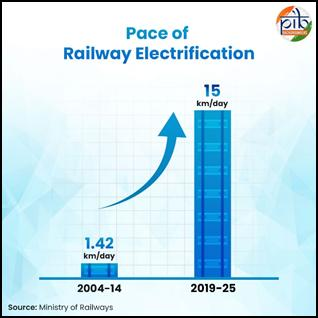
- Acceleration in the Last Decade: Electrification pace surged from 1.42 km/day (2004–2014) to over 15 km/day (2019–2025). The share of electrified railway tracks increased from 24% in 2000 to over 96% by 2024, reaching 99.2% by November 2025.
- Near-Universal State Coverage: Railways' networks in 25 States/UTs are 100% electrified, with only 5 States (Rajasthan, Tamil Nadu, Karnataka, Assam, and Goa) having residual non-electrified sections totalling 574 RKMs (0.8%).
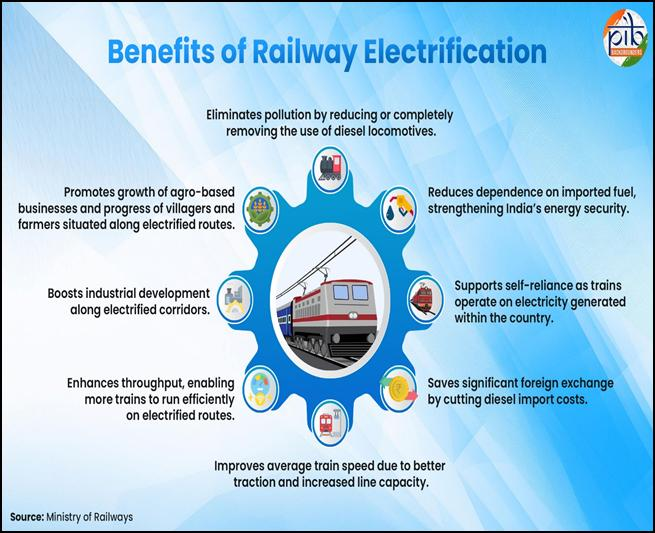
- Economic and Environmental Gains: Electric traction is about 70% more economical than diesel and significantly reduces carbon emissions, air pollution, and fossil fuel dependence.
- Global Railway Electrification (as of June 2025): Switzerland leads with 100% railway electrification, followed by China (82%), Spain (67%), Japan (64%), France (60%), Russia (52%), and the United Kingdom (39%).
- Integration of Renewable Energy: As of November 2025, Indian Railways has commissioned 898 MW of solar capacity, up from 3.68 MW in 2014, representing a nearly 244-fold increase. Solar installations now cover 2,626 railway stations across India.
| Read More: Reforming Indian Railways |
Rapid Fire
Mpemba Effect
Scientists from the Jawaharlal Nehru Centre for Advanced Scientific Research (JNCASR), an autonomous institute under the Department of Science and Technology (DST), have developed the first supercomputer-powered simulations to explain the Mpemba effect.
- Mpemba effect: It is the phenomenon where hotter water freezes faster than colder water.
- Aristotle first noted the effect in Meteorologica, and it was rediscovered in the 20th century by Erasto Mpemba, after whom it is named.
- JNCASR Study Findings: The study shows that water does not freeze directly but passes through short-lived intermediate molecular states.
- Depending on the starting temperature, water can remain trapped in these states for different durations.
- Hotter water can sometimes bypass these delays and reach ice nucleation faster than colder water, explaining why hot water may freeze first.
- The findings confirm that the Mpemba effect is real and not limited to water, as it can occur in other fluid-to-solid phase transitions.
- The study deepens understanding of out-of-equilibrium phenomena, offers insights for better cooling and thermal control in next-generation electronics, and marks a major breakthrough in nonequilibrium physics, resolving long-standing experimental and theoretical debates.
| Read more: Mpemba Effect |
Rapid Fire
Ayush Export Promotion Council
Recently, the Ayush Export Promotion Council (AYUSHEXCIL) observed its 4th Establishment Anniversary on 4th January 2026.
- About: It is the nodal Export Promotion Council for the AYUSH sector, launched by the Prime Minister during the Global AYUSH Investment and Innovation Summit, Gandhinagar in 2022.
- It functions in consultation with the Ministry of AYUSH with support from the Ministry of Commerce & Industry.
- Functions: The Council undertakes exporter capacity building, regulatory compliance facilitation, B2B meetings, international exhibitions, seminars and overseas outreach programmes to strengthen global market access.
- Coverage: The Council oversees exports of Ayurveda, Yoga & Naturopathy, Unani, Siddha, Sowa-Rigpa, Homeopathy, herbal products and Indian traditional healthcare services.
- Ayush Quality Mark: AYUSHEXCIL anchors the Ayush Quality Mark programme of the Ministry of AYUSH, strengthening global quality assurance and product credibility.
- Trade Agreement Integration: AYUSH systems have received formal recognition in bilateral trade agreements, including the India–Oman CEPA and the India–New Zealand FTA, with dedicated annexes on traditional medicine and health-related services.
- Achievement: AYUSH and herbal product exports grew by 6.11%, rising from USD 649.2 million (2023–24) to USD 688.89 million (2024–25), reflecting rising global demand for India’s traditional medicine systems.
| Read more: AYUSH Sector's Growth |
Rapid Fire
BIS Foundation Day 2026
Recently, the Bureau of Indian Standards (BIS) celebrated its 79th Foundation Day on 6th January 2026.
- About: BIS is India’s National Standards Body under the Department of Consumer Affairs, Ministry of Consumer Affairs, Food & Public Distribution, responsible for ensuring product safety, reliability and global competitiveness.
- It was initially set up as the Indian Standards Institution (ISI) that came into being on 6th January 1947.
- Legal Foundation: The Bureau of Indian Standards (BIS) Act, 2016, provides statutory backing for standardisation, certification and hallmarking.
- Vision: To transform “Made in India” into “Trusted by India and Trusted by the World” through a digitally enabled and globally harmonised quality ecosystem.
- Reforms: It provides Annual Minimum Marking Fee concessions (80%–Micro, 50%–Small, 20%–Medium), relaxes in-house laboratory requirements for large industries.
- The Silver HUID Hallmarking Scheme strengthens consumer protection and transparency making HUID-based marking mandatory while silver hallmarking remains voluntary.
- Key Initiatives:
- BIS Standardisation Portal: End-to-end digital platform integrating standards formulation, review and expert collaboration.
- SHINE Scheme (Standards Help Inform & Nurture Empowered Women): Women-centric quality awareness and empowerment initiative through SHGs and NGOs.
- BIS–SAKSHAM (Scheme for Acknowledging Knowledge, Skills and High-impact Merit): Annual excellence recognition framework.
- Standards National Action Plan (SNAP) 2022–27: A national roadmap that steers standardisation for emerging technologies, sustainability and climate action, positioning standards as enablers of India’s economic growth and quality culture.
- Achievements: 94% of Indian standards have been harmonised with the International Organisation for Standardisation (ISO) and the International Electrotechnical Commission (IEC) standards.
| Read more: Bureau of Indian standards (BIS) Act 2016 |



