Social Issues
Acid Attacks in India
For Prelims: National Crime Records Bureau, National Legal Services Authority, Bharatiya Nyaya Sanhita
For Mains: Gender-based violence and crimes against women, Criminal justice system reforms and judicial delays
Why in News?
The acquittal of the accused in the 2009 Shaheen Malik acid attack case highlighted the harsh realities faced by survivors, as her 16-year legal battle exposed serious flaws in investigation, prosecution, and judicial sensitivity in India’s justice system.
Summary
- The Shaheen Malik acid attack case acquittal exposed serious gaps in India’s response to acid violence, including weak investigations, prolonged trials, low conviction rates, poor regulation of acid sale, and delayed compensation, despite strong laws and Supreme Court directions.
- Ending acid attacks requires strict control of acid sale, faster and sensitised judicial processes, timely compensation, and comprehensive lifelong rehabilitation, with lessons from Bangladesh’s successful prevention model.
What is an Acid Attack?
- About: An acid attack involves the deliberate throwing of any corrosive substances such as sulphuric, hydrochloric, or nitric acid on a person with the intent to cause harm. Such attacks result in severe burns and permanent disfigurement, particularly of the face, often leading to blindness and long-term physical disability.
- Beyond the intense physical pain, survivors suffer deep psychological trauma, social stigma, and isolation.
- Many lose their livelihoods and become dependent on lifelong medical care, while also being forced into prolonged legal battles in their pursuit of justice.
- Law Commission of India’s 226th Report (2009) recognised acid attacks as crimes causing permanent physical and psychological harm, stressed their gendered nature, and called for distinct penal provisions and rehabilitation support.
- Victims and Perpetrators: Acid attack victims are predominantly women and young girls, while men are almost always the perpetrators, making it a form of gender-based violence.
- A 2024 Acid Survivors Trust International (ASTI) analysis of Indian cases found that about three-fourths of attacks on women were driven by personal relationship conflicts, with dowry disputes, suspicion of infidelity, and domestic abuse also cited.
- In contrast, attacks on men were more often linked to property disputes, professional jealousy, or political rivalry.
- A 2024 Acid Survivors Trust International (ASTI) analysis of Indian cases found that about three-fourths of attacks on women were driven by personal relationship conflicts, with dowry disputes, suspicion of infidelity, and domestic abuse also cited.
- Menace of Acid Attacks in India: According to the National Crime Records Bureau (NCRB), 207 acid attacks were reported in India in 2023, up from 202 in 2022 and 176 in 2021, along with 65 attempted attacks.
- The crime remains severely underreported due to stigma, family pressure, and fear of retaliation, with ASTI estimating around 1,000 attacks annually.
- West Bengal, Uttar Pradesh, and Gujarat were the worst-affected States, where researchers link higher incidence to easy acid availability in industrial regions and weak law enforcement.
What are the Laws Against Acid Attacks in India?
- Bharatiya Nyaya Sanhita, 2023: Acid attacks are now treated as a specific and serious offence under Section 124 of BNS, prescribing a minimum punishment of ten years’ imprisonment, extendable to life, along with a just and reasonable fine to meet the victim’s medical expenses.
- The law also penalises attempted acid attacks with five to seven years’ imprisonment and mandates that all public and private hospitals provide free first aid and medical treatment to victims, with denial attracting criminal liability.
- NALSA (Legal Services to Victims of Acid Attacks), Scheme, 2016: Under the Legal Services Authorities Act, 1987, the National Legal Services Authority (NALSA), through the NALSA (Legal Services to Victims of Acid Attacks) Scheme, 2016, provides priority legal aid, support, and assistance to acid attack victims and their heirs.
- Model Poisons Possession and Sale Rules, 2013: The 2013 Supreme Court (SC) of India order mandated strict regulation of the sale and availability of acid, requiring buyers to produce a photo identity proof and sellers to maintain detailed purchase registers.
- Pursuant to this order, the Ministry of Home Affairs issued an advisory to all States and framed the Model Poisons Possession and Sale Rules, 2013 under the Poisons Act, 1919, directing States to formulate their own rules since the subject falls within the State domain.
- However, despite these directions and model rules, implementation remains weak and uneven across most States, allowing easy access to acid to persist.
Judicial Precedents
- Laxmi vs Union of India (2013): The Supreme Court gave acid attacks a specific recognition in criminal law, moving them out of general injury provisions and treating them as a distinct and serious offence.
- SC mandated that acid attack survivors are entitled to a minimum compensation of Rs 3 lakh, with Rs 1 lakh payable within 15 days for immediate medical treatment and the remaining Rs 2 lakh within 2 months for aftercare and rehabilitation, including reconstructive surgeries.
- It prohibited over-the-counter sale unless the seller maintained a register/logbook recording the buyer’s details and quantity sold.
- Parivartan Kendra vs Union of India (2015): The Supreme Court flagged poor implementation of acid sale regulations and directed States to ensure effective enforcement and timely compensation for survivors.
- Justice JS Verma Committee (2013): In the aftermath of the Nirbhaya case, the Justice JS Verma Committee examined structural failures in addressing violence against women and explicitly highlighted acid attacks as a gendered crime.
- The Committee recommended stringent punishment, and a national survivor fund for compensation, directly influencing later reforms on acid violence.
What are the Challenges in Providing Justice to Survivors of Acid Attacks in India?
- Weak Police Investigation: Acid attack cases often suffer from delayed FIRs, poor forensic collection, ignored medical evidence, and failure to trace the source of acid, leading to weak prosecution and acquittals.
- Chronic Judicial Delays Defeating Justice: Despite acid attacks being treated as grave offences, trials routinely stretch for years.
- The 16-year delay in Shaheen Malik’s case shows how procedural delays turn justice into a prolonged ordeal for survivors.
- As per the National Crime Records Bureau, in 2023 only 16 convictions and 27 acquittals were recorded out of 703 acid attack cases pending in courts, signalling near-impunity for offenders.
- Victim-blaming: Survivors frequently face character assassination, intrusive questioning, and lack of gender-sensitive adjudication, which weakens testimony and discourages legal pursuit.
- Social stigma, fear of retaliation, and family pressure prevent reporting. While official figures show a few hundred cases annually, independent estimates suggest around 1,000 attacks per year.
- Poor Enforcement of Acid Sale Regulations: Supreme Court–mandated controls on acid sale remain largely on paper.
- Easy access persists, especially in regions with textile, rubber, and chemical industries, enabling repeat offences.
- Normalization of Out-of-court Settlements: Police and accused often pressure survivors to accept large monetary compensation instead of prosecution, allowing perpetrators to evade criminal accountability.
- Delayed and Inadequate Victim Compensation: State compensation meant for immediate medical and rehabilitation needs is often released after several years, pushing survivors into financial distress and weakening access to justice.
How can India Effectively Prevent Acid Attacks and Support Survivors?
- Stricter Regulation of Acid Sale (Preventive measure): Enforce a comprehensive ban or tighter control on retail acid sale.
- Fix administrative accountability of Sub-Divisional Magistrates responsible for monitoring acid sales.
- India can draw lessons from Bangladesh’s model of sealing illegal acid-selling shops within 30 days, combined with public awareness campaigns since 2002, which reduced acid attacks from 494 cases to just 13 by 2024, as per the Acid Survivors Foundation.
- Judicial Sensitisation and Faster Trials (Justice delivery): Mandatory gender-sensitisation training for judges and public prosecutors. Establish fast-track courts for acid attack cases.
- Penalise unreasonable judicial delays to improve conviction rates and deterrence.
- Strengthening Legal and Psychological Support (Survivor-centric justice): Ensure free legal aid, counselling, and hand-holding through the trial process. Reduce pressure on survivors to accept out-of-court settlements.
- Modify disability assessment norms under the Rights of Persons with Disabilities Act, 2016, so that acid attack victims are not restricted by a rigid 40% disability threshold, but are assessed based on their functional impairment, psychological trauma, and lifelong medical and reconstructive care needs, recognising that burn injuries cannot be measured solely by skin percentage.
- Release compensation within months, not years, to enable timely surgeries and treatment. Link compensation directly to medical and rehabilitation needs, not just ex-gratia relief.
- Long-term Rehabilitation Framework (Sustainable recovery): Implement the Justice JS Verma Committee (2013) recommendations for a national survivor fund to cover lifelong medical care, psychological counselling, education, skill training, and livelihood support.
Conclusion
The Shaheen Malik case highlights that acid attacks in India persist despite strong laws due to weak enforcement and low conviction rates. Strict regulation of acid sale, fast-track courts, and timely survivor compensation are critical to deterrence. A victim-centric justice and rehabilitation framework is essential to end acid violence.
|
Drishti Mains Question: Despite stringent laws, acid attacks continue in India. Examine the institutional and judicial factors responsible for low conviction rates. |
Frequently Asked Questions (FAQs)
1. What legal provision currently governs acid attacks in India?
Acid attacks are covered under Section 124 of the Bharatiya Nyaya Sanhita, 2023, prescribing a minimum of 10 years’ imprisonment up to life, along with a fine for medical expenses.
2. What was the significance ofLaxmi vs Union of India (2013)?
The Supreme Court recognised acid attacks as a distinct offence, mandated regulation of acid sale, free medical treatment, and minimum compensation of Rs 3 lakh for survivors.
3. Why are acid attacks underreported in India?
Due to social stigma, fear of retaliation, family pressure, and lack of faith in the justice system; actual cases may be around 1,000 annually, far above official NCRB data.
4. What support does NALSA provide to acid attack victims?
Under the NALSA (Legal Services to Victims of Acid Attacks) Scheme, 2016, victims receive priority legal aid, counselling, and assistance in accessing compensation and rehabilitation.
UPSC Civil Services Examination, Previous Year Questions (PYQs)
Mains
Q. We are witnessing increasing instances of sexual violence against women in the country. Despite existing legal provisions against it, the number of such incidences is on the rise. Suggest some innovative measures to tackle this menace. (2014)
Facts for UPSC Mains
Year End Review-2025: Ministry of Parliamentary Affairs
Why in News?
In 2025, the Ministry of Parliamentary Affairs successfully steered a robust legislative agenda, achieving significant milestones in digital governance of legislatures and expanding democratic engagement.
What are the Key Achievements of the Ministry of Parliamentary Affairs in the Year 2025?
- High Legislative Output: Facilitated the passage of 39 Bills by both Houses, including major reforms like the Income-tax Bill, 2025 (to simplify the tax code), the VB-G-Ram-G Bill, 2025 (for rural employment), and the Promotion and Regulation of Online Gaming Bill, 2025.
- Substantive Parliamentary Discourse: Organized and facilitated high-level debates beyond legislation, including discussions on Operation Sindoor, Election Reforms, India's space program, and the 150th anniversary of Vande Mataram, ensuring Parliament remained a forum for national dialogue on critical issues.
- Pioneering Digital Governance: Achieved a landmark in e-governance by making 20 State/UT Legislatures fully live on the National e-Vidhan Application (NeVA), a Digital India Mission Mode Project. Conducted the 3rd National Conference on NeVA and capacity-building workshops for state officials.
- Efficient House Management & Accountability: Effectively managed mechanisms like Rule 377 of Lok Sabha and Zero Hour, and ensured 100% disposal of RTI and public grievances. The Online Assurance Monitoring System (OAMS) tracked implementation of parliamentary assurances.
- Expanded Youth Engagement: Scaled up the Youth Parliament Programme significantly through the upgraded National Youth Parliament Scheme (NYPS) 2.0 portal, recording over 1,800 institutional registrations and 15,800 individual participations nationwide.
- National Celebrations & Outreach: Actively coordinated the nationwide Constitution Day 2025 and organized events for the 150th anniversary of 'Vande Mataram, reinforcing constitutional and patriotic values.
- Diplomatic & Coordination Functions: Facilitated inter-parliamentary exchanges, hosting delegations from the UK, Russia, and Saudi Arabia, and provided clearances for state government delegations travelling abroad.
- National Initiatives: Executed Special Campaign 5.0 for cleanliness and cleared 100% of identified pendencies. Promoted Official Language implementation through committees, workshops, Hindi Pakhwada, and seminars.
- Committee Management: Constituted and supported 42 Consultative Committees of Members of Parliament (MPs) for various ministries, organizing 85 meetings and nominating MPs to numerous advisory boards and committees.
Conclusion
The Ministry's 2025 performance was multifaceted, securing a high legislative output, pioneering digital governance with NeVA, and expanding democratic engagement through youth programs and substantive national discourse, thereby strengthening India's parliamentary framework.
|
Drishti Mains Question: Discuss the role of the Ministry of Parliamentary Affairs in strengthening legislative functioning and accountability in India. |
Frequently Asked Questions (FAQs)
1. What is the National e-Vidhan Application (NeVA)?
NeVA is a Digital India Mission Mode Project aimed at making legislatures paperless, transparent, and efficient through end-to-end digital solutions.
2. Why is Rule 377 of Lok Sabha important in Parliament?
Rule 377 allows MPs to raise issues of urgent public importance, strengthening executive accountability without formal debates.
3. Name two landmark bills passed by Parliament in 2025 under the Ministry's management.
The Income-tax Bill, 2025 (to simplify the tax code) and the VB-G-Ram-G Bill (for a statutory rural employment guarantee aligned with Viksit Bharat 2047).
UPSC Civil Services Examination, Previous Year Questions (PYQs)
Prelims
Q. The Parliament of India exercises control over the functions of the Council of Ministers through (2017)
- Adjournment motion
- Question hour
- Supplementary questions
Select the correct answer using the code given below:
(a) 1 only
(b) 2 and 3 only
(c) 1 and 3 only
(d) 1, 2 and 3
Ans: (d)
Mains
Q. To what extent, in your view, the Parliament is able to ensure accountability of the executive in India? (2021)


Important Facts For Prelims
Design Linked Incentive (DLI) Scheme
Why in News?
India’s Design Linked Incentive (DLI) Scheme for Semiconductors has shown strong on-ground outcomes, highlighting rapid progress in building a self-reliant semiconductor design ecosystem amid global supply-chain vulnerabilities.
What are the Key Facts About the Design Linked Incentive (DLI) Scheme?
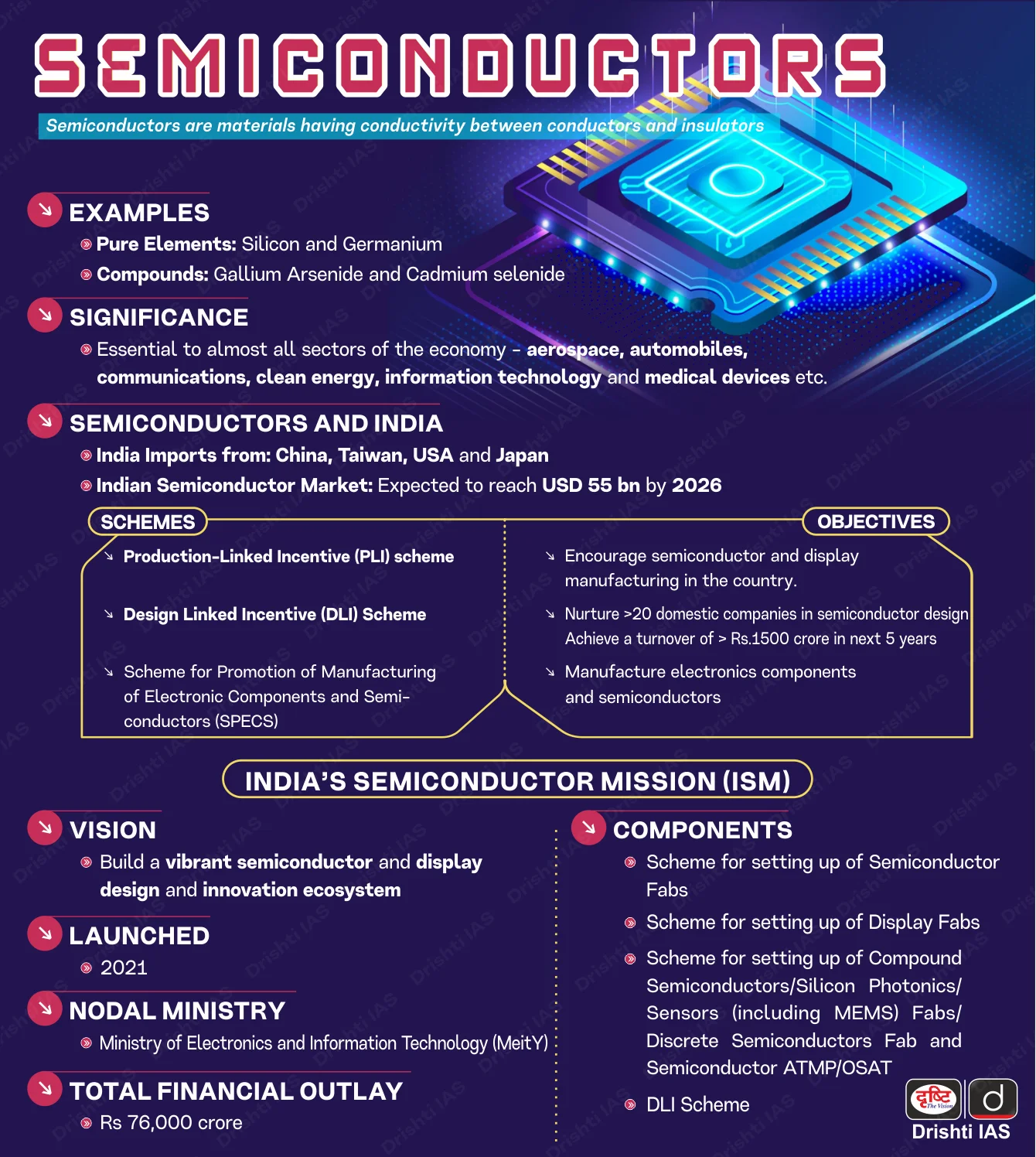
- About: The DLI Scheme is a central government initiative implemented by the Ministry of Electronics and Information Technology (MeitY) under the Semicon India Programme to promote indigenous semiconductor chip design by providing financial incentives and advanced design infrastructure to domestic startups and MSMEs.
- Objective: The DLI scheme aims to create a globally competitive, self-reliant chip design ecosystem focused on fabless semiconductor design.
- Fabless semiconductor design means designing and developing semiconductor chips without owning manufacturing plants, with fabrication outsourced to specialised foundries.
- Need for DLI Scheme: Fabless semiconductor companies occupy the most strategic position in the electronics value chain, as design and IP contribute over half of a chip’s value, account for up to 50% of value addition and 20–50% of the Bill of Materials, and drive nearly 30–35% of global semiconductor sales.
- Since design and IP determine performance, efficiency, security, and long-term competitiveness, the absence of indigenous design capabilities leaves countries dependent on imported core technologies even with local manufacturing, underscoring the need to build a strong domestic fabless ecosystem through the DLI Scheme.
- Eligibility The DLI Scheme covers startups (as per Department for Promotion of Industry and Internal Trade (DPIIT) notification, 2019), MSMEs (as per MSME notification, 2020), and domestic companies owned by resident Indian citizens in line with Foreign Direct Investment (FDI) Policy Circular, 2017 or extant norms.
- This inclusive design allows participation across stages of enterprise maturity.
- Scope of Support: Support is provided across the entire semiconductor design lifecycle, including Integrated Circuits (ICs), chipsets, Systems-on-Chip (SoCs), systems, and IP cores.
- The scheme emphasises indigenous design, IP ownership, and deployment in electronic products.
- Financial Incentives: The scheme offers two major incentives. The Product Design Linked Incentive reimburses up to 50% of eligible expenditure, capped at ₹15 crore per application.
- The Deployment Linked Incentive provides 4–6% of net sales turnover for five years, capped at Rs 30 crore, subject to minimum sales and successful product deployment.
- Design Infrastructure Support: Provided through the ChipIN Centre operated by Centre for Development of Advanced Computing (C-DAC).
- This includes access to advanced National EDA (Electronic Design Automation) Tool Grid, IP core repositories, MPW prototyping, and post-silicon validation, significantly lowering entry barriers for chip design.
- Key Achievements of DLI: Under the DLI scheme, 24 chip-design projects have been sanctioned across areas such as video surveillance, drone detection, energy meters, microprocessors, satellite communications, and broadband and Internet of Things System on a Chip (IoT SoC).
- The ChipIN Centre has democratised access to chip design infrastructure, supporting about 1 lakh engineers and students across 400 organisations, while the national EDA Grid has seen extensive usage, reflecting strong ecosystem adoption.
Key Institutional Frameworks for Semiconductor Design in India
- Semicon India Programme (SIM): With an outlay of Rs 76,000 crore, SIM supports semiconductor and display manufacturing as well as chip design.
- Centre for Development of Advanced Computing (C-DAC) acts as the nodal implementing agency.
- Chips to Startup (C2S) Programme: A national capacity-building initiative across academic institutions to create ~85,000 industry-ready professionals at BTech, MTech, and PhD levels in semiconductor chip design.
- Microprocessor Development Programme: Led by C-DAC, IIT Madras, and IIT Bombay, this programme has delivered open-source, indigenous microprocessors such as VEGA, SHAKTI, and AJIT, advancing technological self-reliance.
Frequently Asked Questions (FAQs)
1. What is the Design Linked Incentive (DLI) Scheme?
It is a central government scheme implemented by the Ministry of Electronics and Information Technology under the Semicon India Programme to promote indigenous semiconductor chip design via incentives and shared infrastructure.
2. Why is the DLI Scheme necessary for India?
Design and IP contribute over half of a chip’s value, up to 50% value addition, and 20–50% of BOM, while fabless firms drive ~30–35% of global sales—making indigenous design critical for competitiveness and security.
3. Who is eligible under the DLI Scheme?
Startups (DPIIT), MSMEs, and domestic companies owned by resident Indian citizens as per FDI norms, enabling participation across enterprise maturity.
UPSC Civil Services Examination, Previous Year Question (PYQ)
Prelims:
Q. Which one of the following laser types is used in a laser printer? (2008)
(a) Dye laser
(b) Gas laser
(c) Semiconductor laser
(d) Excimer laser
Ans: (c)
Mains
Q. India aims to become a semiconductor manufacturing hub. What are the challenges faced by the semiconductor industry in India? Mention the salient features of the India Semiconductor Mission. (2025)
Rapid Fire
ICGS Samudra Pratap
The Defence Minister commissioned Indian Coast Guard Ship (ICGS) Samudra Pratap, the first of two indigenously constructed pollution control vessels for the Indian Coast Guard, marking a significant step in strengthening India’s marine environmental protection capabilities.
- Designed for pollution response operations within the Exclusive Economic Zone (EEZ) and beyond, the vessel will be homeported at Kochi under the operational control of the Commander, Coast Guard Region (West).
- ICGS Samudra Pratap: It is built by Goa Shipyard Limited, with over 60% indigenous content.
- ICGS Samudra Pratap, meaning “Majesty of the Seas”, symbolises the ICG’s commitment to safe, secure, and clean seas while safeguarding India’s maritime interests.
- The vessel, capable of speeds above 22 knots and an endurance of 6,000 nautical miles, is the largest ship in the ICG fleet.
- It functions as a multi-role platform for pollution response, oil spill containment, fire-fighting, maritime safety, coastal patrol, and surveillance.
- Equipped with advanced pollution detection systems, specialised response boats, modern firefighting equipment, and aviation facilities, including a helicopter hangar.
- It significantly strengthens marine environmental protection, safeguards coral reefs, mangroves, and fisheries, and supports the blue economy.
| Read more: Launch of Samudra Pratap |


Place In News
Popocatépetl Volcano
A National Autonomous University of Mexico (UNAM) has produced the first 3D seismic image of the internal structure of Mexico’s Popocatépetl volcano, improving understanding of magma movement and eruption behaviour in a high-risk volcanic zone.
- Artificial Intelligence and machine learning algorithms were used to classify and analyse seismic signals (tremors). The imaging reveals multiple magma reservoirs at different depths (up to 18 km below the crater) rather than a single magma chamber.
- The volcano functions as a “natural laboratory”, helping scientists refine models of volcanism, magma dynamics, and hazard mitigation.
- Popocatépetl Volcano: Also known as “Smoking Mountain”, it is a steep-sided stratovolcano in central Mexico, located on the border of the states of México and Puebla.
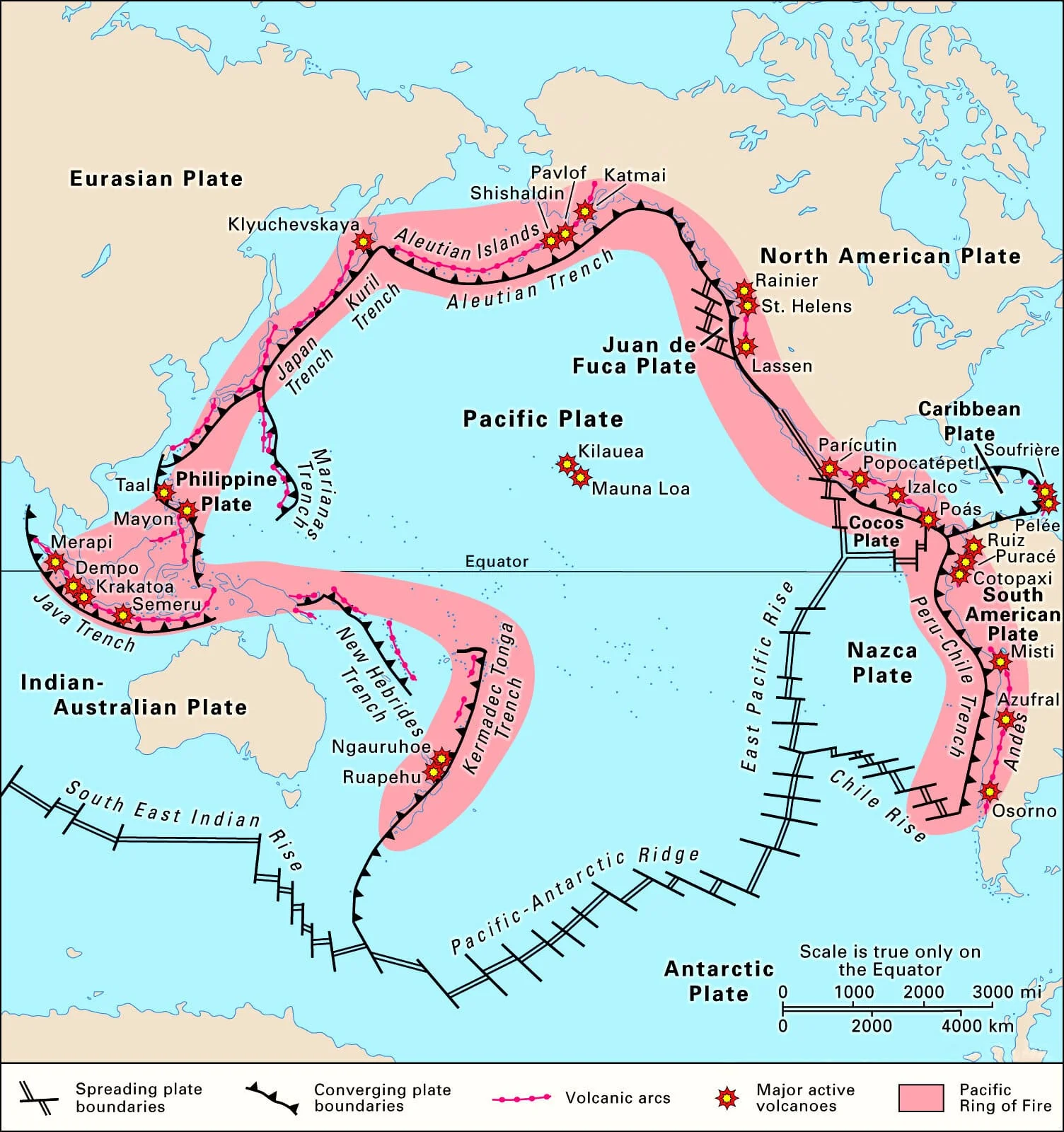
- It lies on the Trans-Mexican Volcanic Belt, formed due to the subduction of the Cocos Plate beneath the North American Plate.
- Rising to an elevation of 5,452 m above sea level, Popocatépetl is Mexico’s second-highest volcano after Pico de Orizaba, and is one of the country’s most active and dangerous volcanoes, with recorded eruptions since 1519, forming part of the Pacific Ring of Fire.
- The Pacific Ring of Fire, or Circum-Pacific Belt, is a horseshoe-shaped zone of intense seismic and volcanic activity around the Pacific Ocean, accounting for ~75% of active volcanoes and ~90% of earthquakes worldwide.
| Read more: Pacific Ring of Fire |
Rapid Fire
Wolf Supermoon
The first full moon of 2026, the Wolf Supermoon, peaked on 2nd January, highlighting a full moon that appeared slightly larger and brighter. A Wolf Supermoon is a combined term referring to the occurrence of the Wolf Moon at the time of a Supermoon.
- The Wolf Moon is the traditional name for January’s first full moon, rooted in indigenous, Celtic and Old English folklore, and popularised by almanacs such as the Old Farmer’s Almanac.
- It is associated with mid-winter beliefs of wolves being heard howling more frequently, though the Moon itself undergoes no physical change.
- Wolf supermoons are relatively uncommon and occur only when the January full moon aligns with a supermoon.
- A Supermoon occurs when the Moon reaches its closest point to the Earth at the same time that it is in its full phase, making it appear slightly larger and brighter in the night sky.
- As the Moon travels around the Earth in an elliptical orbit, it passes through two distinct points in its orbit: perigee, the point of closest approach, and apogee, the point of farthest distance.
- A common visual effect during a supermoon is the moon illusion, which makes the Moon appear larger near the horizon due to human perception of distance and scale rather than any physical change in the Moon.

| Read more: Total Lunar Eclipse and Supermoon |


Rapid Fire
India’s Braille Ecosystem
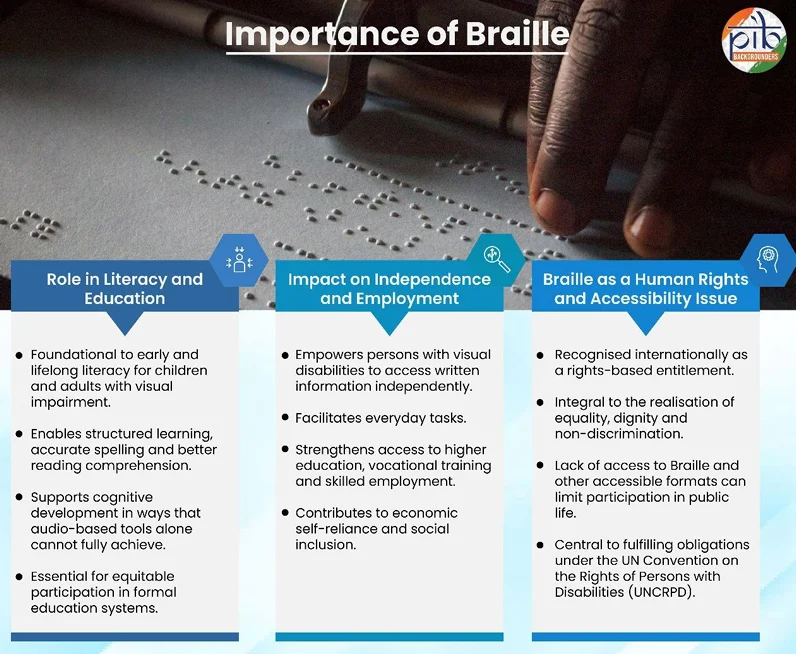
World Braille Day, observed annually on 4th January, highlights Braille as a tactile literacy system that enables education, dignity, independence, and equal participation for persons with visual disabilities.
- About: Braille is a tactile system of reading and writing based on a six-dot cell, arranged in two columns of three dots each. Different combinations of raised dots represent letters, numerals, punctuation, and symbols, allowing reading through touch.
- It is not a language but a code, enabling multiple languages to be read and written in tactile form.
- It was introduced in India in the late 19th century and has since remained central to literacy and empowerment for the visually impaired, with India being home to 50.32 lakh persons with visual impairment (Census 2011).
- Legal Foundation : The Rights of Persons with Disabilities Act, 2016 ensures accessibility, inclusive schooling and provision of Braille and assistive devices.
- Government Initiatives:
- Bharati Braille (Standard Bharati Braille Code, 2025): India’s unified Unicode-mapped Braille script enabling digital accessibility across Indian languages.
- Sugamya Bharat Abhiyan & Sugamya Pustakalaya: National framework ensuring Braille-enabled public infrastructure and multilingual digital learning resources for persons with print disabilities.
- National Institute for Empowerment of Persons with Visual Disabilities (NIEPVD): It has released Draft Bharati Braille 2.1 (2026) for technological upgradation and digital compatibility of national Braille standards.
- International Commitment: India, as a State Party to the United Nations Convention on the Rights of Persons with Disabilities (UNCRPD), ensures access to information and education in accessible formats, including Braille.
| Read more: World Braille Day 2025 |