


Rapid Fire
India’s Braille Ecosystem
- 07 Jan 2026
- 2 min read
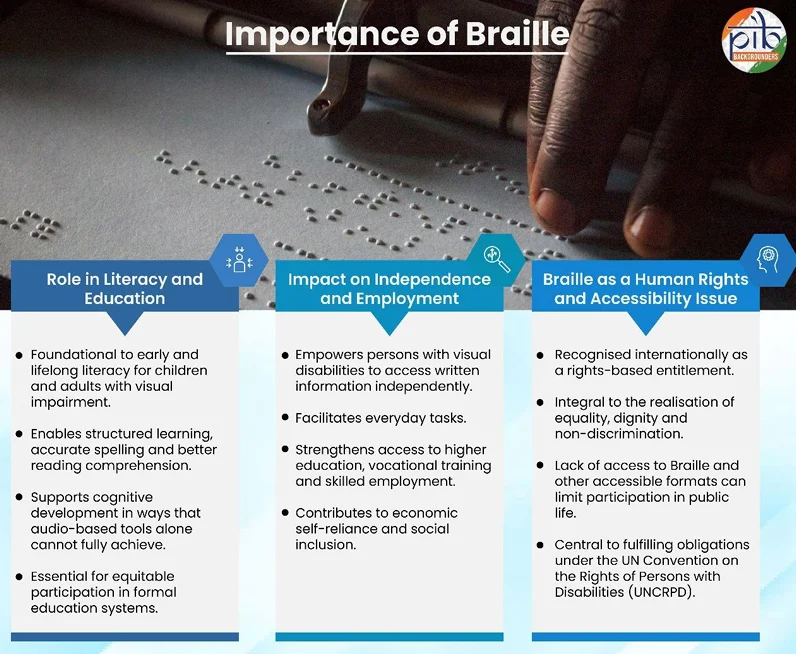
World Braille Day, observed annually on 4th January, highlights Braille as a tactile literacy system that enables education, dignity, independence, and equal participation for persons with visual disabilities.
- About: Braille is a tactile system of reading and writing based on a six-dot cell, arranged in two columns of three dots each. Different combinations of raised dots represent letters, numerals, punctuation, and symbols, allowing reading through touch.
- It is not a language but a code, enabling multiple languages to be read and written in tactile form.
- It was introduced in India in the late 19th century and has since remained central to literacy and empowerment for the visually impaired, with India being home to 50.32 lakh persons with visual impairment (Census 2011).
- Legal Foundation : The Rights of Persons with Disabilities Act, 2016 ensures accessibility, inclusive schooling and provision of Braille and assistive devices.
- Government Initiatives:
- Bharati Braille (Standard Bharati Braille Code, 2025): India’s unified Unicode-mapped Braille script enabling digital accessibility across Indian languages.
- Sugamya Bharat Abhiyan & Sugamya Pustakalaya: National framework ensuring Braille-enabled public infrastructure and multilingual digital learning resources for persons with print disabilities.
- National Institute for Empowerment of Persons with Visual Disabilities (NIEPVD): It has released Draft Bharati Braille 2.1 (2026) for technological upgradation and digital compatibility of national Braille standards.
- International Commitment: India, as a State Party to the United Nations Convention on the Rights of Persons with Disabilities (UNCRPD), ensures access to information and education in accessible formats, including Braille.
| Read more: World Braille Day 2025 |



