
International Relations
India-Republic of Korea Strategic Vision 2026–2030
For Prelims: Republic of Korea, Indo-Pacific Oceans Initiative, Pax Silica initiative, Global Green Growth Institute, K-9 Vajra
For Mains: India’s Act East Policy and Indo-Pacific Strategy, Bilateral Relations: India–South Korea
Why in News?
India and the Republic of Korea (ROK) have unveiled a Joint Strategic Vision for 2026–2030 during the state visit of South Korean President Lee Jae Myung to India.
- The vision outlines an ambitious roadmap to deepen the India–ROK Special Strategic Partnership across political, economic, technological, and cultural domains.
Summary
- The India–Republic of Korea (ROK) Joint Strategic Vision (2026–2030) marks a shift from economic ties to a comprehensive strategic partnership spanning Indo-Pacific security, emerging technologies, defence, and climate cooperation.
- Its success depends on addressing trade imbalances, deepening defence and tech collaboration, and aligning geopolitical priorities to fully realise the partnership’s potential.
What are the Key Highlights of the India-Republic of Korea (ROK) Joint Strategic Vision (2026-2030)?
- Strengthening Political and Institutional Engagement: India and the ROK agreed to reinforce ties through annual leader-level meetings, expanded ministerial dialogues, and the launch of an India–ROK Industrial Cooperation Committee as a new mechanism for industry-level engagement, while promoting parliamentary exchanges, youth interactions, and deeper state-to-province partnerships.
- India and the ROK agreed to deepen strategic coordination by building on the Foreign Policy and Security Dialogue and operationalising cooperation through the Defence Industry Joint Committee and the inaugural 2+2 Dialogue at the Vice Minister level.
- Geopolitical and Strategic Alignment:
- Act East meets New Southern Policy: The Vision officially synchronizes India’s "Act East Policy" with South Korea’s "New Southern Policy," transitioning the relationship from purely economic ties to a broader Indo-Pacific security partnership.
- Entry into Minilateral Frameworks: India and the ROK reaffirmed their shared vision of a free, open, and rules-based Indo-Pacific, and welcomed the ROK’s participation in India-led Indo-Pacific Oceans Initiative (IPOI).
- Economic Security Dialogue: The India–ROK Economic Security Dialogue aims to de-risk supply chains by reducing dependence on China and promoting diversification of critical resources and technologies.
- Maritime and Defense Production: The Vision explicitly outlines a roadmap for joint defense R&D, focusing on co-production under the Atmanirbhar Bharat initiative, moving past the bureaucratic hurdles that stalled previous naval deals (like the minesweepers project).
- They welcomed the opening of the office of Korea Marine Equipment Association (KOMEA) in Mumbai, the first such office that will contribute to the development of ancillary ecosystem to support the maritime industry.
- Digital Integration and Next-Gen Tech:
- India-Korea Digital Bridge: The India-Korea Digital Bridge is a new initiative targeting critical and emerging technologies (CET).
- It establishes joint task forces focused on Artificial Intelligence (AI), data governance, and semiconductor design and fabrication guided by the principles of “AI for All” and “MANAV”.
- Cross-Border Financial Linkage: A landmark Memorandum of Understanding (MoU) was signed integrating India’s National Payment Corporation of India Limited (NPCIL) with Korea’s KFTC (Korea Financial Telecommunications and Clearings Corporation).
- This allows for seamless, real-time cross-border payments, bypassing traditional Western financial clearing houses.
- Space: India and the ROK agreed to enhance space cooperation by establishing an Indian Space Research Organisation (ISRO) - Korea Aerospace Administration (KASA) Joint Working Group and promoting collaboration through initiatives like the India–ROK Space Day held in Bengaluru on 20th April 2026.
- India-Korea Digital Bridge: The India-Korea Digital Bridge is a new initiative targeting critical and emerging technologies (CET).
- Trade and Economic Rebalancing: A Joint Declaration was issued to formally restart and expedite the stalled upgrade of the Comprehensive Economic Partnership Agreement (CEPA).
- The outcome document specifically acknowledges the need to address the "trade asymmetry" and dismantle Non-Tariff Barriers (NTBs) hindering Indian exports.
- Climate Change and Energy Security:
- Energy Resource Security: ROK welcomed India’s participation in the Pax Silica initiative, while India appreciated ROK’s leadership in Forum on Resource Geostrategic Engagement (FORGE).
- The FORGE is a United States-led multinational initiative launched in February 2026 to secure and diversify global supply chains for critical minerals. India is a supporter and participant of FORGE.
- Both agreed to enhance cooperation on securing critical materials like naphtha during supply disruptions and expand bilateral trade in such resources.
- Article 6.2 Cooperative Approach: The two nations established a framework under Article 6.2 of the Paris Agreement to cooperate on carbon credit trading and joint emissions reduction projects.
- Institutional Climate Memberships: South Korea officially joined the India-headquartered International Solar Alliance (ISA), while India reciprocated by formally joining the Seoul-headquartered Global Green Growth Institute (GGGI), cementing a two-way institutional climate partnership.
- Energy Resource Security: ROK welcomed India’s participation in the Pax Silica initiative, while India appreciated ROK’s leadership in Forum on Resource Geostrategic Engagement (FORGE).
- Partnership for Global Good: India and the ROK agreed to enhance cooperation in multilateral forums such as the G20, especially in light of the ROK’s upcoming presidency in 2028.
- Reaffirmed commitment to resolving disputes peacefully in accordance with international law, including UNCLOS.
- Enhancing Cultural and Soft Power Ties: India and the ROK agreed to deepen cultural cooperation by extending the Cultural Exchange Programme (2026–2030), declaring 2028–29 as the Year of Friendship.
How are India- ROK Relations?
- Historical Connection: In 48 AD Princess Suriratna from Ayodhya traveled to Korea to marry King Kim-Suro, and many Koreans trace their ancestry to this lineage. Additionally, Buddhism serves as a strong historical link.
- Nobel Laureate Rabindranath Tagore's 1929 poem "Lamp of the East" is fondly remembered by Koreans and features in their school textbooks.
- India played a significant role during the Korean War (1950-53) by deploying an Army medical unit and facilitating the ceasefire and repatriation of prisoners.
- Economic Relations: Trade has gained significant momentum following the implementation of the Comprehensive Economic Partnership Agreement (CEPA) in 2010. In 2024, bilateral trade stood at USD 25.1 billion.
- The ROK is the 15th largest FDI investor in India, with total investments in 2024 reaching USD 929 million, predominantly in the manufacturing sector.
- Initiatives like "Korea Plus" and the "India-Korea Fast Track Mechanism" promote and ease business for investors.
- South Korean conglomerates like Samsung, Hyundai, Kia, and LG have a massive and highly successful footprint in India.
- They have heavily integrated into the "Make in India" initiative, using India not just as a consumer market but as an export hub.
- Defense and Security Cooperation: The standout success is the K-9 Vajra, a 155mm self-propelled howitzer built in India by Larsen & Toubro (L&T) in collaboration with South Korea’s Hanwha Defense.
- The IN-ROKN Bilateral Exercise is the first-ever naval exercise between India and the ROK, held in October 2025.
- Cultural and Soft Power: There is a vibrant Indian community in the ROK estimated at around 18,000, largely comprising STEM students, researchers, and professionals.
- The "Hallyu" (Korean Wave) has swept India. K-pop (BTS, Blackpink), K-dramas, Korean cosmetics (K-beauty), and Korean cuisine have massive, dedicated followings among Indian youth, creating immense grassroots goodwill.
What are the Key Challenges and Way Forward in India–ROK Relations?
|
Challenges |
Way Forward |
|
Widening Trade Deficit: Bilateral trade remains skewed in favour of ROK, with Indian exports facing non-tariff barriers (NTBs) and limited access despite strong sectors like pharma, IT, and agriculture. |
Value Chain Integration: Instead of focusing only on tariffs, India should push for sector-specific integration (electronics, auto, green tech) so Indian firms become part of Korean supply chains, reducing asymmetry. |
|
Stalled CEPA Upgrade: Negotiations to upgrade CEPA and achieve the USD 50 billion trade target by 2030 remain delayed due to tough bargaining and structural imbalances. |
Targeted CEPA Reform: Focus on priority sectors and market access commitments rather than broad negotiations to ensure faster and more meaningful outcomes. |
|
Limited Defence Cooperation Depth: Success like K9 Vajra is an exception, while major deals are stalled due to concerns over technology transfer and intellectual property. |
Defence Co-Production & ToT: Shift from buyer–seller to co-development by mandating technology transfer, joint R&D, and building indigenous manufacturing capabilities. |
|
Geopolitical Constraints (China Factor): ROK’s economic dependence on China and North Korea security concerns lead to cautious Indo-Pacific alignment with India. |
Issue-Based Minilateralism: Strengthen cooperation through flexible groupings (India–ROK–US/ASEAN) focusing on maritime security, supply chains, and critical minerals. |
|
Implementation Deficit: Many agreements and MoUs face delays due to bureaucratic hurdles and weak follow-up mechanisms. |
Dedicated Economic Corridors: Establish Korea-specific industrial clusters and fast-track approval systems to improve execution and investment outcomes. |
|
Low Societal Linkages: Limited diaspora presence and lack of awareness among businesses constrain deeper engagement and trust. |
Human Capital & Mobility Partnerships: Develop skill corridors and ease mobility for professionals to strengthen socio-economic integration. |
|
Technology Collaboration Gap: Relationship remains largely FDI-led (assembly-based) with limited innovation or high-end collaboration. |
Strategic Technology Alliance: Promote joint R&D in semiconductors, AI, and 6G, with IP-sharing frameworks to transform ties into a high-technology partnership. |
Conclusion
The India–ROK Joint Strategic Vision signals a shift from traditional bilateral engagement to a multi-dimensional, future-oriented partnership. With strong alignment in technology, trade, security, and global governance, both countries are positioning themselves as key players in shaping the Indo-Pacific and global order in the coming decade.
|
Drishti Mains Question: “India–ROK relations are transitioning from economic engagement to strategic convergence.” Discuss. |
Frequently Asked Questions (FAQs)
1. What is the India–ROK Joint Strategic Vision (2026–2030)?
It is a roadmap to enhance bilateral cooperation across trade, defence, technology, and culture with an Indo-Pacific focus.
2. What is CEPA between India and South Korea?
A trade agreement (2010) aimed at boosting bilateral trade, currently under negotiation for upgrade to address trade imbalance.
3. What is the India-Korea Digital Bridge?
A framework for cooperation in AI, semiconductors, and digital technologies guided by “AI for All” and “MANAV”.
4. What is the significance of K9 Vajra?
It is a successful India–ROK defence co-production model under Make in India, showcasing technology transfer.
5. How do ISA and GGGI strengthen climate cooperation?
They institutionalize bilateral climate action, focusing on renewable energy, sustainability, and green growth.
UPSC Civil Services Examination, Previous Year Questions (PYQs)
Mains
Q. Evaluate the economic and strategic dimension of India’s Look East Policy in the context of the post-cold war international scenario. (2016)


Governance
Welfare vs Development
For Prelims: Direct Benefit Transfers, Revenue Expenditure, Capital Expenditure, JAM (Jan Dhan–Aadhaar–Mobile), Finance Commission
For Mains: Welfare vs Development debate in Indian polity and economy, Welfare populism and its economic implications, Human capital formation.
Why in News?
There is growing concern over the blurring of welfare and development in political discourse, where short-term welfare schemes are increasingly projected as long-term development achievements.
- This has triggered debates on welfare populism, fiscal sustainability, and the risk of prioritising electoral gains over genuine structural transformation.
Summary
- The Welfare vs Development debate highlights the tension between welfare (short-term relief) and development (long-term capacity building), where excessive focus on populist schemes can strain fiscal health and hinder structural growth.
- A balanced approach is essential, where targeted welfare supports human capital and demand, while maintaining fiscal discipline and prioritizing capital expenditure for sustainable development.
What is the Difference Between Welfare and Development?
Welfare
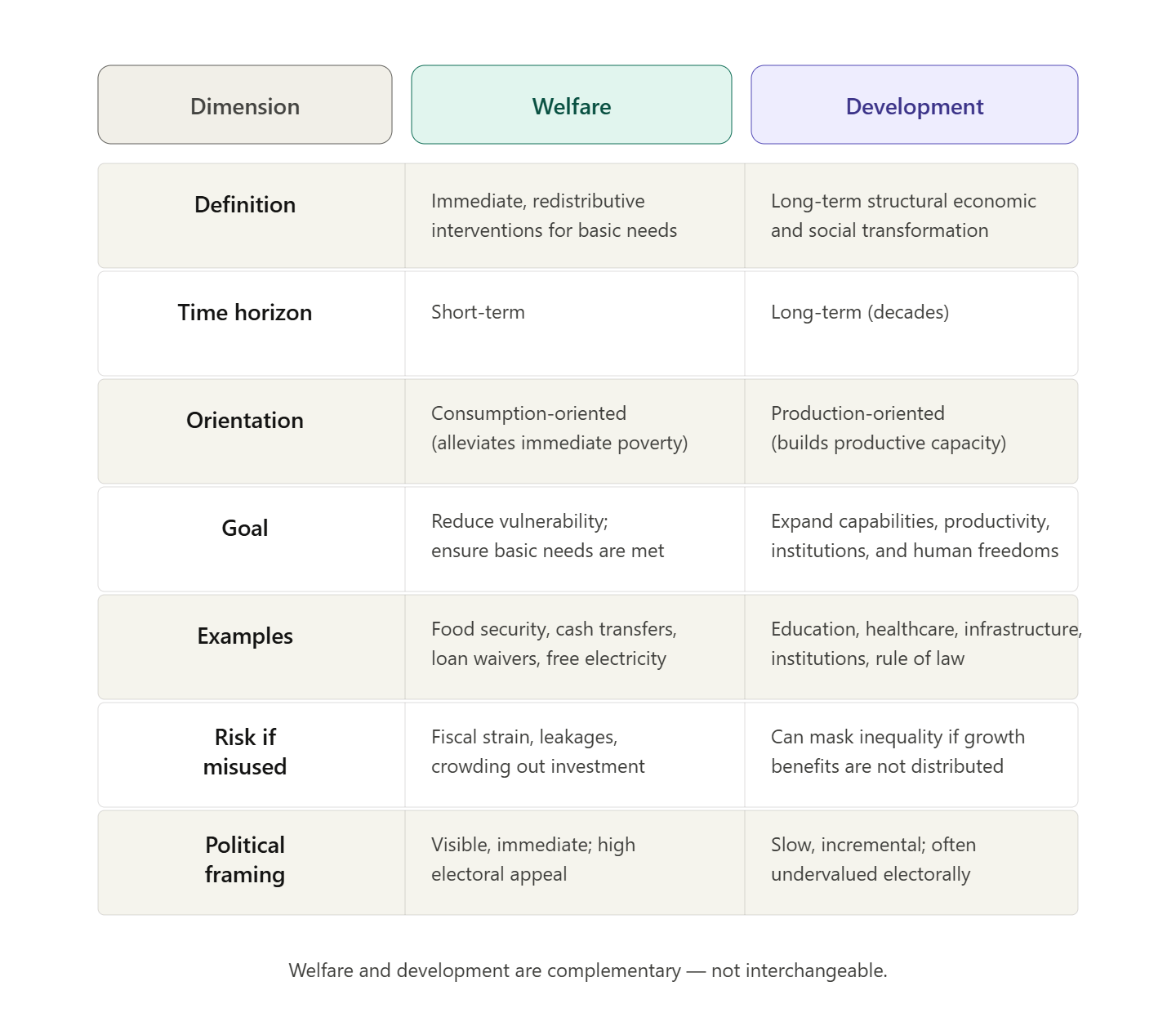
- About: Welfare refers to the state's intervention to ensure a basic safety net for its vulnerable populations. It is fundamentally about redistributive justice and alleviating immediate distress.
- It is often short-to-medium term, focusing on consumption and survival.
- Objective: To fulfill basic human needs (food, shelter, basic health), reduce inequality, and provide a buffer against poverty and systemic shocks.
- Examples: Public Distribution System (PDS), Direct Benefit Transfers (DBTs) for vulnerable groups, Old Age Pensions, Viksit Bharat Guarantee for Rozgar and Aajivika Mission Gramin (VB-G RAM G) (providing immediate wage security).
Development
- About: Development goes beyond mere economic growth; it encompasses structural transformation, capacity building, and the expansion of human freedoms (as advocated by Amartya Sen’s Capability Approach).
- It is long-term, focusing on capital formation, productivity enhancement, and systemic empowerment.
- Objective: To build long-term capabilities, generate wealth, create employment, and ensure sustainable economic growth that empowers citizens to be self-reliant.
- Examples: Building highways and ports, establishing IITs/AIIMS, investing in R&D, skilling initiatives (Skill India), and industrial corridors.
Differentiating Welfare and Development
How do Welfare and Development Conflict and Complement Each Other?
Conflict
- 'Crowding Out' of Capex: Under the Fiscal Responsibility and Budget Management (FRBM) Act, 2003, states have strict borrowing limits (usually 3-4% of GSDP).
- When states prioritize high Revenue Expenditure (un-targeted subsidies, loan waivers), it directly "crowds out" Capital Expenditure (Capex).
- For instance, in Maharashtra, the Majhi Ladki Bahin Yojana, announced ahead of the Maharashtra Assembly elections in 2024, has added to fiscal strain, potentially limiting the state’s ability to invest in infrastructure and long-term development projects.
- A state spending heavily on free electricity and bus rides leaves negligible fiscal space for building state highways or modernizing agriculture, fundamentally stalling long-term structural transformation.
- When states prioritize high Revenue Expenditure (un-targeted subsidies, loan waivers), it directly "crowds out" Capital Expenditure (Capex).
- Market Distortions & Dependency: When welfare is delivered purely as unconditional populist "freebies" rather than linked to work or capacity-building, it may weaken labour incentives in certain contexts.
- For instance, in some agricultural regions like Punjab and Uttar Pradesh, schemes such as Pradhan Mantri Garib Kalyan Anna Yojana have ensured basic food security, but farmers report difficulty in finding farm labour during peak seasons, suggesting a shift in work participation patterns and growing dependence on government support.
- It shifts the political economy from a "productive state" to a "rent-seeking state," creating a permanent voter dependency rather than demographic empowerment.
- Inter-generational Inequity: Economic Survey has consistently cautioned that funding populist welfare via off-budget borrowings (Extra-Budgetary Resources) creates massive state debt.
- This means the current generation consumes the welfare, but the future generation pays the debt, robbing them of their developmental potential.
Complement
- Builds Human Capital: Welfare measures like nutrition, healthcare, and education create a healthy and skilled workforce essential for long-term development.
- Boosts Demand: Cash transfers and schemes like VB-G RAM G increase purchasing power, driving consumption and economic growth.
- Cash transfers and schemes like PM-KISAN help farmers manage seasonal distress, such as purchasing seeds, inputs, and meeting short-term agricultural needs.
- Ensures Social Stability: Welfare reduces poverty and inequality, preventing unrest and creating a stable environment for investment and development.
- Promotes Risk-taking: A basic safety net encourages people to take economic risks, adopt new skills, and pursue better opportunities.
What Measures can be Taken to Balance Welfare and Development?
- Striking a Balance (The DPSP Mandate): The Constitution mandates Welfare and Development. Article 38 and 39 demand equity (Welfare), while the broader constitutional framework aspires for a modern, prosperous nation (Development).
- The state must act as a welfare provider for the destitute and a developmental facilitator for the youth.
- From 'Freebies' to 'Merit Goods': Public policy must differentiate between unproductive freebies (like free televisions or endless electricity subsidies) and "merit goods" (like free education, healthcare, and basic nutrition), which have positive developmental externalities.
- Invest in schemes like Ayushman Bharat, PM POSHAN, and PM SHRI Schools to strengthen human capital.
- Institutionalize Fiscal Discipline: The competitive populism of state elections has led to severe off-budget borrowings and debt accumulation.
- The 16th Finance Commission recommended states to rationalise subsidies, especially unconditional cash transfers, introduce clear exclusion criteria, stop off-budget financing, and adopt uniform accounting and disclosure of subsidies and transfers.
- Strict adherence to the FRBM Act is non-negotiable. Furthermore, future Finance Commissions should introduce a framework that directly links the devolution of central taxes to a state’s capital expenditure ratio, thereby financially penalizing extreme fiscal profligacy.
- Utilize the JAM (Jan Dhan–Aadhaar–Mobile) framework to ensure targeted, transparent, and leakage-free cash transfers, improving the efficiency of welfare schemes.
- Focus on the Capability Approach: Transition from a purely 'subsidy-based' approach to a 'capability-enhancing' approach.
- For instance, transitioning from providing free agricultural power (welfare/subsidy) to investing in solar micro-grids and modern irrigation (development).
- Replace subsidies with long-term solutions like PM-KUSUM and PM Krishi Sinchayee Yojana.
- Empowering Local Governance (Decentralization):: Top-down, "one-size-fits-all" welfare schemes often fail to address localized developmental bottlenecks.
- Devolve greater financial and functional autonomy to Panchayati Raj Institutions (PRIs) and Urban Local Bodies (ULBs). Localized decision-making ensures that state funds are spent on community-specific developmental needs rather than broad, populist handouts.
- Empower PRIs and ULBs for better-targeted spending through schemes like Rashtriya Gram Swaraj Abhiyan and SVAMITVA Scheme.
Conclusion
As India strives for upper-middle-income status, the political discourse must mature beyond the "quick development" fallacy. Prioritizing long-term economic capacity over short-term political gains is essential to ensure that the welfare state empowers citizens to participate in the growth story, rather than creating a perpetual cycle of dependency.
|
Drishti Mains Question: “Welfare and development are complementary yet conflicting objectives.” Critically examine in the Indian context. |
Frequently Asked Questions (FAQs).
1. What is welfare in public policy?
Welfare refers to redistributive state interventions like PDS, DBT, and MGNREGA aimed at poverty alleviation and social protection.
2. What distinguishes development from welfare?
Development focuses on long-term structural transformation, productivity, and human capability expansion, unlike short-term welfare support.
3. What is welfare populism?
It refers to politically motivated freebies and subsidies that prioritise short-term electoral gains over fiscal sustainability and development.
4. Why is the FRBM Act important?
The Fiscal Responsibility and Budget Management (FRBM) Act ensures fiscal discipline by limiting deficits and preventing excessive borrowing.
UPSC Civil Services Examination, Previous Year Questions (PYQs)
Prelims
Q. Among the following who are eligible to benefit from the “Mahatma Gandhi National Rural Employment Guarantee Act”? (2011)
(a) Adult members of only the scheduled caste and scheduled tribe households
(b) Adult members of below poverty line (BPL) households
(c) Adult members of households of all backward communities
(d) Adult members of any household
Ans: (d)
Q. Which of the following are the objectives of ‘National Nutrition Mission’? (2017)
- To create awareness relating to malnutrition among pregnant women and lactating mothers.
- To reduce the incidence of anaemia among young children, adolescent girls and women.
- To promote the consumption of millets, coarse cereals and unpolished rice.
- To promote the consumption of poultry eggs.
Select the correct answer using the code given below:
(a) 1 and 2 only
(b) 1, 2 and 3 only
(c) 1, 2 and 4 only
(d) 3 and 4 only
Ans: (a)
Mains
Q. Performance of welfare schemes that are implemented for vulnerable sections is not so effective due to absence of their awareness and active involvement at all stages of policy process. Discuss. (2019)
Q. “Besides being a moral imperative of a Welfare State, primary health structure is a necessary precondition for sustainable development.” Analyse. (2021)


Important Facts For Prelims
Privilege Notice and Parliamentary Privileges in India
Why in News?
A privilege notice has been submitted against the Prime Minister of India, alleging breach of parliamentary privilege following remarks made after the defeat of the Constitution (131st Amendment) Bill, 2026.
What is the Privilege Notice?
- About: A Privilege Notice (or Motion) is a formal notice submitted by a member of parliament (MP) alleging a breach of their parliamentary rights, immunities, or the dignity of the House.
- It is used to initiate action against members or outsiders who have committed a breach of privilege or contempt of the House (e.g., misleading the House, withholding facts, or casting aspersions on members).
- Rules: It is moved under Rule 222 in the Lok Sabha and Rule 187 in the Rajya Sabha.
- Role of Presiding Officer: The Speaker (Lok Sabha) or the Chairman (Rajya Sabha) is the first level of scrutiny.
- The Presiding Officer examines it and may give or withhold consent for it to be raised in the House.
- After the Speaker/Chairman admits the notice, the member seeks leave of the House (formal permission of the House to allow a member to raise a particular matter (like a privilege issue) for discussion) and if no objection or if at least 25 members support, leave is granted.
- Privilege Notice is usually raised after Question Hour, but can be allowed anytime in urgent cases.
- Consideration: Once admitted, the House may debate directly or refer to the Committee of Privileges of the House for examination, investigation, and report. However, the final decision rests with the House itself.
- Committee of Privileges:
- Nature: It is a Standing Parliamentary Committee. Its function is semi-judicial.
- Lok Sabha: Consists of 15 members nominated by the Speaker.
- Rajya Sabha: Consists of 10 members nominated by the Chairman.
- Function: It examines every question involving a breach of privilege, determines the facts, and makes recommendations to the House regarding the action to be taken.
- Fair Hearing: The accused member is given an opportunity to present their explanation.
What are Parliamentary Privileges?
- About: Parliamentary privileges are special rights, immunities, and exemptions enjoyed by each House of Parliament, its committees, and its members.
- These privileges extend to the Attorney General of India but not to the President of India, even though an integral part of Parliament (The President has separate constitutional immunities under Article 361).
- Objective: They are necessary for the effective discharge of parliamentary functions and exceed those possessed by other bodies or individuals.
- Types of Privileges:
- Collective Privileges: Rights of the House as a whole (e.g., right to regulate proceedings, punish for contempt, exclude strangers).
- Individual Privileges: Rights of members (e.g., freedom of speech in Parliament, freedom from arrest in civil cases).
- Sources of Parliamentary Privileges:
- Constitutional Basis: Article 105, Article 122, Article 194 and Article 212 provides various types of privileges to Members of Parliament (MPs) and Members of the Legislative Assemblies (MLAs).
- Legal Basis: Article 105(3) leaves the definition of the powers, privileges, and immunities of Parliament and its members to be defined by Parliament by law.
- No comprehensive law has been enacted by Parliament to codify these privileges to date.
- The Code of Civil Procedure, 1908, grants freedom from arrest in civil cases during and around parliamentary sessions.
- Committee of Privileges of the Lok Sabha Recommendations (1994 & 2008): Extensively studied the matter and consistently recommended against the codification of parliamentary privileges.
- The consensus is that codification would subject every matter of privilege to judicial review, thereby diminishing the exclusive jurisdiction and sovereignty of the House over its own affairs.
- Breach of Privileges: A breach of privilege (BoP) occurs when any individual or collective parliamentary privilege is violated or disregarded.
Judicial Position on Parliamentary Privileges
Privileges vs. Fundamental Rights
- The Keshav Singh Case (1964): Under Article 143, the Supreme Court established that the powers and privileges of State Legislatures under Article 194(3) and by extension Parliament under Article 105(3) are subject to Fundamental Rights.
- Established that conflicts between privileges and rights must be resolved through harmonious construction.
- The Sharma Case (1959): Also known as the, the Supreme Court clarified the hierarchy of rights in case of a conflict:
- Article 19(1)(a) (Freedom of Speech and Expression) does not automatically override parliamentary privileges.
- However, the Court clarified that Article 21 (right to life and personal liberty) still applies.
Convention on Legal Process (Notices from Courts)
- No Appearance by Presiding Officers: As a well-established parliamentary convention, the Chairman of the Rajya Sabha (or Speaker of the Lok Sabha) does not respond to or put in an appearance upon receiving a notice from the Supreme Court or any High Court.
- This was prominently demonstrated when the Chairman declined to appear before the Supreme Court during the Keshav Singh reference in 1964, and again during the Presidential Election reference in 1974.
- Procedure: Instead of appearing, the matter is usually discussed in the House, and the relevant papers are forwarded to the Minister of Law and Justice for appropriate action, upholding the separation of powers and the dignity of the House.
Privilege Jurisdiction Over Foreign Nationals
- The Swaraj Paul Case Precedent (1984): Parliament can exercise privilege jurisdiction over a foreign national.
- According to the Attorney-General's opinion, Parliament exercises jurisdiction in personam against a foreign national only if the contempt or breach of privilege is committed by them within the country (India).
Frequently Asked Questions (FAQs).
1. What is a Privilege Notice?
A formal motion by an MP alleging breach of privilege or contempt of the House, moved under Rule 222 (Lok Sabha).
2. What are Parliamentary Privileges?
Special rights and immunities under Articles 105 and 194 ensuring free functioning of Parliament and its members.
3. What is the role of the Committee of Privileges?
It investigates breaches, examines evidence, and recommends action to the House.
4. Are Parliamentary Privileges absolute?
No, they are subject to Fundamental Rights, as clarified in the Keshav Singh case, using harmonious construction.
5. What did the Sharma Case (1959) establish?
It held that parliamentary privileges override Article 19(1)(a) but remain subject to Article 21.
UPSC Civil Services Examination, Previous Year Questions (PYQ)
Prelims
Q. The Parliament of India exercises control over the functions of the Council of Ministers through (2017)
- Adjournment motion
- Question hour
- Supplementary questions
Select the correct answer using the code given below:
(a) 1 only
(b) 2 and 3 only
(c) 1 and 3 only
(d) 1, 2 and 3
Ans: (d)
Q. In the context of India, which of the following principles is/are implied institutionally in the parliamentary government? (2013)
- Members of the Cabinet are Members of the Parliament.
- Ministers hold the office till they enjoy confidence in the Parliament.
- Cabinet is headed by the Head of the State.
Select the correct answer using the codes given below:
(a) 1 and 2 only
(b) 3 only
(c) 2 and 3 only
(d) 1, 2 and 3
Ans: (a)
Mains
Q. The ‘Powers, Privileges and Immunities of Parliament and its Members’ as envisaged in Article 105 of the Constitution leave room for a large number of un-codified and un-enumerated privileges to continue. Assess the reasons for the absence of legal codification of the ‘parliamentary privileges’. How can this problem be addressed? (2014)


Rapid Fire
World Earth Day 2026
World Earth Day also known as International Mother Earth Day is a global observance held annually on 22nd April to foster awareness and drive collective action against pressing environmental challenges like climate change, pollution, and biodiversity loss.
- 2026 Theme: The theme for 2026 is “Our Power, Our Planet”, which heavily emphasizes community action, the transition to renewable energy, and boosting accountability for environmental damage.
- Historical Origins: The Earth Day observance began on 22nd April 1970, marking the birth of the modern environmental movement. It was initiated by U.S. Senator Gaylord Nelson following a 1969 Santa Barbara oil spill.
- The initial 1970 rallies and protests directly contributed to the creation of key environmental laws and the Environmental Protection Agency (EPA) in US.
- The United Nations General Assembly designated 22nd April as International Mother Earth Day through a resolution adopted in 2009.
- Global Reach: It is now observed in over 190 countries, uniting governments, NGOs, and individuals.
- Core Significance: It serves as a vital platform to push for policies protecting natural resources and educates the masses on adopting sustainable habits for future generations.
- India’s Commitment to Protect Earth: India’s shift towards sustainability is reflected in its Panchamrit commitments, including net-zero emissions by 2070, achieving 50% renewable energy capacity by 2030, and reducing carbon intensity, signalling a move from rhetoric to responsibility while aligning development with global climate goals.
- This is complemented by a multi-sectoral approach to environmental protection, with initiatives such as solar expansion, electric mobility under FAME, biodiversity conservation through Project Tiger, and pollution control via National Clean Air Programme (NCAP) collectively providing practical pathways for sustainable development.
| Read more: World Earth Day 2025 |


Rapid Fire
Japan Eases Defense Export Rules
In a historic shift from its post-World War II pacifist stance, Japan officially scrapped the "five-category" restriction on arms exports in April 2026. This move authorizes the export of lethal weapons to third-party nations.
- After World War II, in the shadow of the devastation of Hiroshima and Nagasaki, Japan adopted a pacifist constitution. Article 9 renounces war and prohibits maintaining forces with war potential, expressing a commitment to non‑aggression and international peace.
- End of the 'Five Categories': Previously, exports were restricted to five non-lethal areas: Rescue, Transport, Warning, Surveillance, and Minesweeping.
- The 2026 revision allows for the export of missiles, destroyers, and fighter jets. The shift aims to revitalize Japan’s domestic defense industry, which has faced stagnation due to the limited "Self-Defense Forces only" market.
- GCAP Catalyst: The decision was accelerated by the Global Combat Air Programme (GCAP), a trilateral project with the UK and Italy to build a 6th-generation stealth fighter by 2035.
- Japan needs the ability to export this jet to third countries to manage production costs and remain a viable project partner.
- Recipients & Safeguards: Lethal exports are restricted to 17 countries (as of April 2026) that have signed bilateral defense-tech transfer agreements with Tokyo (including India, Australia, Philippines, and the US).
- Furthermore, such transfers require approval by Japan’s National Security Council and are generally prohibited to countries involved in active conflicts or under UN restrictions, while recipients must commit to using the equipment in accordance with the UN Charter.
India–Japan Defence Cooperation
- Defence Technology Cooperation: India–Japan collaboration has deepened through the Joint Working Group on Defence Equipment and Technology Cooperation (JWG-DETC) and growing B2B engagements since 2017, with increased industry and MSME linkages, further boosted by the 2023 amendment to Japan’s “Three Principles for Transfer of Equipment and Technology,” enabling greater defence technology collaboration.
- Enhanced Military Interoperability: Regular tri-service engagements and joint exercises such as JIMEX, MALABAR, Dharma Guardian, and Veer Guardian (Air Force), along with Coast Guard cooperation, have improved coordination and operational synergy.
| Read more: Revisiting India-Japan Relations |


Rapid Fire
SC Forms Panel for Disabled-Friendly Prison Reforms
The Supreme Court has directed a high-powered committee, chaired by Justice S. Ravindra Bhat, to formulate a comprehensive plan to make prisons disabled-friendly, integrating reform with security considerations.
- About: The committee was originally constituted to reform open correctional institutions, and its scope has now been expanded to include disability-inclusive prison reforms, reflecting a broader systemic approach.
- The committee has now been tasked with creating uniform norms for procurement, maintenance, and security of assistive devices, tailored to prisoners’ specific needs.
- Measures: Building on earlier orders, the Court mandated provision of assistive devices, specialised medical care, and enhanced visitation rights, while warning of penalties under the Rights of Persons with Disabilities Act, 2016 for violations.
- The Court emphasised a rights-based approach, stating that prisoners with disabilities must be protected under Articles 14 and 21, ensuring equality and dignity are not diluted during incarceration.
- Composition: The committee’s composition has been expanded to include key ministries and departments related to social justice and disability empowerment, ensuring coordinated institutional response.
- Assessment: The Court envisaged a structured, continuous, and expert-driven review of existing laws, practices, and facilities across States and Union Territories to ensure cohesive implementation.
- A time-bound mechanism has been set with the committee required to submit a consolidated status report within four months.
| Read More: Accessibility and Empowerment of PwDs, Prison Reforms |


Rapid Fire
Pradhan Mantri Gram Sadak Yojana-III (PMGSY-III)
Recently, the Union Cabinet approved the continuation as well as increased the budget of PMGSY-III beyond March 2025 till March 2028 to enhance rural connectivity.
- About: PMGSY is a central government scheme launched in 2000 to provide all-weather road connectivity to unconnected rural habitations.
- The scheme was originally a 100% centrally-sponsored initiative, but starting from the financial year 2015-16, the funding has been shared between the Central and State governments in a 60:40 ratio.
- Around 800,000 kilometres of rural roads have been built and 180,000 habitations were connected under various phases of the PMGSY scheme.
- PMGSY-III Focus: It focuses on consolidation of through routes and major rural links connecting habitations with Gramin Agricultural Markets, higher secondary schools and healthcare facilities.
- Timeline: The scheme extends completion timelines till March 2028 for roads and bridges in plain areas and roads in hilly areas, and till March 2029 for bridges in hilly areas.
- Benefits: The scheme will boost the rural economy, improve market access, reduce transportation costs, generate employment, enhance access to essential services, bridge the rural-urban divide, and support the vision of Viksit Bharat 2047.
| Read more: Pradhan Mantri Gram Sadak Yojana |





