


Governance
Welfare vs Development
- 22 Apr 2026
- 13 min read
For Prelims: Direct Benefit Transfers, Revenue Expenditure, Capital Expenditure, JAM (Jan Dhan–Aadhaar–Mobile), Finance Commission
For Mains: Welfare vs Development debate in Indian polity and economy, Welfare populism and its economic implications, Human capital formation.
Why in News?
There is growing concern over the blurring of welfare and development in political discourse, where short-term welfare schemes are increasingly projected as long-term development achievements.
- This has triggered debates on welfare populism, fiscal sustainability, and the risk of prioritising electoral gains over genuine structural transformation.
Summary
- The Welfare vs Development debate highlights the tension between welfare (short-term relief) and development (long-term capacity building), where excessive focus on populist schemes can strain fiscal health and hinder structural growth.
- A balanced approach is essential, where targeted welfare supports human capital and demand, while maintaining fiscal discipline and prioritizing capital expenditure for sustainable development.
What is the Difference Between Welfare and Development?
Welfare
- About: Welfare refers to the state's intervention to ensure a basic safety net for its vulnerable populations. It is fundamentally about redistributive justice and alleviating immediate distress.
- It is often short-to-medium term, focusing on consumption and survival.
- Objective: To fulfill basic human needs (food, shelter, basic health), reduce inequality, and provide a buffer against poverty and systemic shocks.
- Examples: Public Distribution System (PDS), Direct Benefit Transfers (DBTs) for vulnerable groups, Old Age Pensions, Viksit Bharat Guarantee for Rozgar and Aajivika Mission Gramin (VB-G RAM G) (providing immediate wage security).
Development
- About: Development goes beyond mere economic growth; it encompasses structural transformation, capacity building, and the expansion of human freedoms (as advocated by Amartya Sen’s Capability Approach).
- It is long-term, focusing on capital formation, productivity enhancement, and systemic empowerment.
- Objective: To build long-term capabilities, generate wealth, create employment, and ensure sustainable economic growth that empowers citizens to be self-reliant.
- Examples: Building highways and ports, establishing IITs/AIIMS, investing in R&D, skilling initiatives (Skill India), and industrial corridors.
Differentiating Welfare and Development
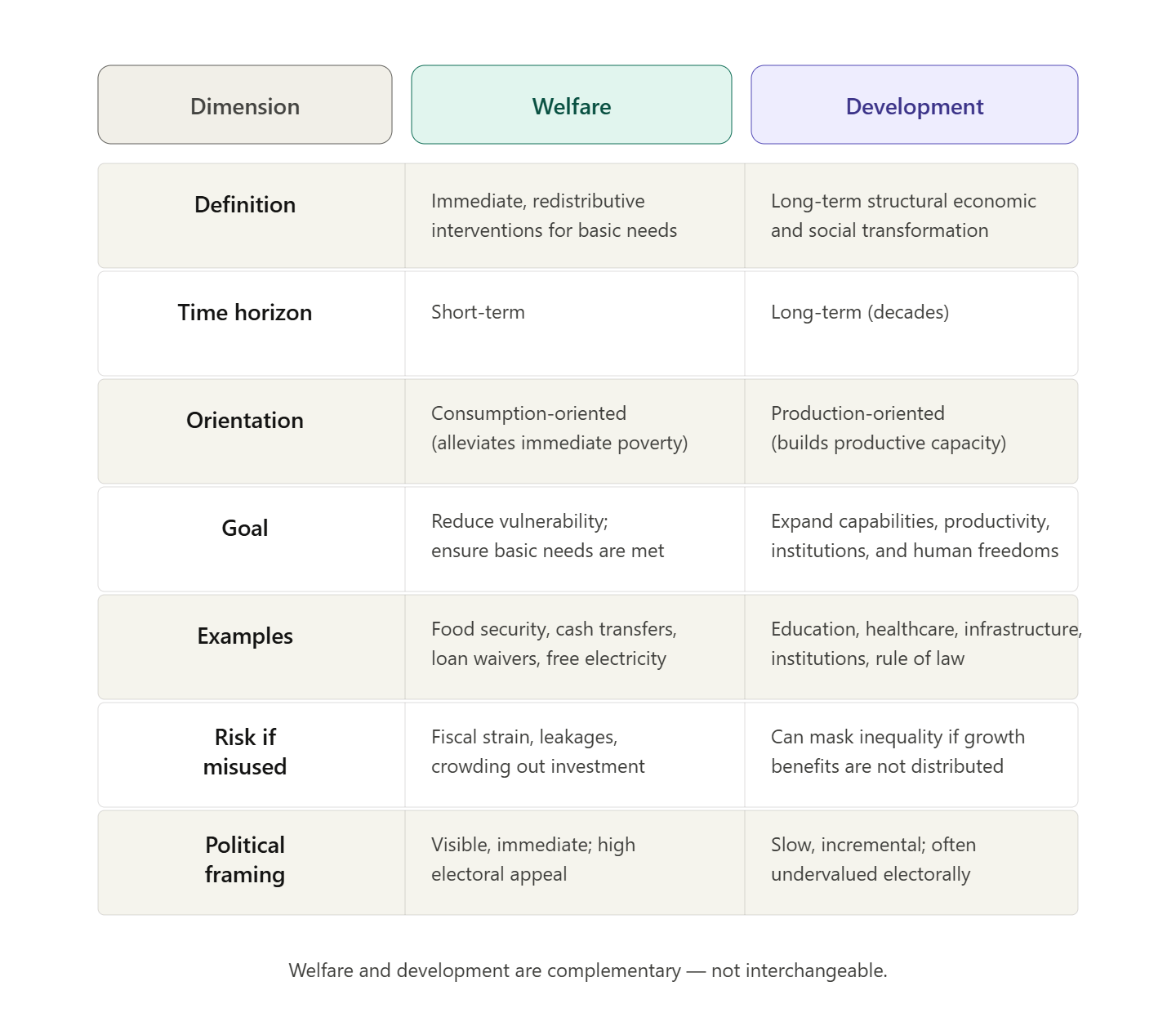
How do Welfare and Development Conflict and Complement Each Other?
Conflict
- 'Crowding Out' of Capex: Under the Fiscal Responsibility and Budget Management (FRBM) Act, 2003, states have strict borrowing limits (usually 3-4% of GSDP).
- When states prioritize high Revenue Expenditure (un-targeted subsidies, loan waivers), it directly "crowds out" Capital Expenditure (Capex).
- For instance, in Maharashtra, the Majhi Ladki Bahin Yojana, announced ahead of the Maharashtra Assembly elections in 2024, has added to fiscal strain, potentially limiting the state’s ability to invest in infrastructure and long-term development projects.
- A state spending heavily on free electricity and bus rides leaves negligible fiscal space for building state highways or modernizing agriculture, fundamentally stalling long-term structural transformation.
- When states prioritize high Revenue Expenditure (un-targeted subsidies, loan waivers), it directly "crowds out" Capital Expenditure (Capex).
- Market Distortions & Dependency: When welfare is delivered purely as unconditional populist "freebies" rather than linked to work or capacity-building, it may weaken labour incentives in certain contexts.
- For instance, in some agricultural regions like Punjab and Uttar Pradesh, schemes such as Pradhan Mantri Garib Kalyan Anna Yojana have ensured basic food security, but farmers report difficulty in finding farm labour during peak seasons, suggesting a shift in work participation patterns and growing dependence on government support.
- It shifts the political economy from a "productive state" to a "rent-seeking state," creating a permanent voter dependency rather than demographic empowerment.
- Inter-generational Inequity: Economic Survey has consistently cautioned that funding populist welfare via off-budget borrowings (Extra-Budgetary Resources) creates massive state debt.
- This means the current generation consumes the welfare, but the future generation pays the debt, robbing them of their developmental potential.
Complement
- Builds Human Capital: Welfare measures like nutrition, healthcare, and education create a healthy and skilled workforce essential for long-term development.
- Boosts Demand: Cash transfers and schemes like VB-G RAM G increase purchasing power, driving consumption and economic growth.
- Cash transfers and schemes like PM-KISAN help farmers manage seasonal distress, such as purchasing seeds, inputs, and meeting short-term agricultural needs.
- Ensures Social Stability: Welfare reduces poverty and inequality, preventing unrest and creating a stable environment for investment and development.
- Promotes Risk-taking: A basic safety net encourages people to take economic risks, adopt new skills, and pursue better opportunities.
What Measures can be Taken to Balance Welfare and Development?
- Striking a Balance (The DPSP Mandate): The Constitution mandates Welfare and Development. Article 38 and 39 demand equity (Welfare), while the broader constitutional framework aspires for a modern, prosperous nation (Development).
- The state must act as a welfare provider for the destitute and a developmental facilitator for the youth.
- From 'Freebies' to 'Merit Goods': Public policy must differentiate between unproductive freebies (like free televisions or endless electricity subsidies) and "merit goods" (like free education, healthcare, and basic nutrition), which have positive developmental externalities.
- Invest in schemes like Ayushman Bharat, PM POSHAN, and PM SHRI Schools to strengthen human capital.
- Institutionalize Fiscal Discipline: The competitive populism of state elections has led to severe off-budget borrowings and debt accumulation.
- The 16th Finance Commission recommended states to rationalise subsidies, especially unconditional cash transfers, introduce clear exclusion criteria, stop off-budget financing, and adopt uniform accounting and disclosure of subsidies and transfers.
- Strict adherence to the FRBM Act is non-negotiable. Furthermore, future Finance Commissions should introduce a framework that directly links the devolution of central taxes to a state’s capital expenditure ratio, thereby financially penalizing extreme fiscal profligacy.
- Utilize the JAM (Jan Dhan–Aadhaar–Mobile) framework to ensure targeted, transparent, and leakage-free cash transfers, improving the efficiency of welfare schemes.
- Focus on the Capability Approach: Transition from a purely 'subsidy-based' approach to a 'capability-enhancing' approach.
- For instance, transitioning from providing free agricultural power (welfare/subsidy) to investing in solar micro-grids and modern irrigation (development).
- Replace subsidies with long-term solutions like PM-KUSUM and PM Krishi Sinchayee Yojana.
- Empowering Local Governance (Decentralization):: Top-down, "one-size-fits-all" welfare schemes often fail to address localized developmental bottlenecks.
- Devolve greater financial and functional autonomy to Panchayati Raj Institutions (PRIs) and Urban Local Bodies (ULBs). Localized decision-making ensures that state funds are spent on community-specific developmental needs rather than broad, populist handouts.
- Empower PRIs and ULBs for better-targeted spending through schemes like Rashtriya Gram Swaraj Abhiyan and SVAMITVA Scheme.
Conclusion
As India strives for upper-middle-income status, the political discourse must mature beyond the "quick development" fallacy. Prioritizing long-term economic capacity over short-term political gains is essential to ensure that the welfare state empowers citizens to participate in the growth story, rather than creating a perpetual cycle of dependency.
|
Drishti Mains Question: “Welfare and development are complementary yet conflicting objectives.” Critically examine in the Indian context. |
Frequently Asked Questions (FAQs).
1. What is welfare in public policy?
Welfare refers to redistributive state interventions like PDS, DBT, and MGNREGA aimed at poverty alleviation and social protection.
2. What distinguishes development from welfare?
Development focuses on long-term structural transformation, productivity, and human capability expansion, unlike short-term welfare support.
3. What is welfare populism?
It refers to politically motivated freebies and subsidies that prioritise short-term electoral gains over fiscal sustainability and development.
4. Why is the FRBM Act important?
The Fiscal Responsibility and Budget Management (FRBM) Act ensures fiscal discipline by limiting deficits and preventing excessive borrowing.
UPSC Civil Services Examination, Previous Year Questions (PYQs)
Prelims
Q. Among the following who are eligible to benefit from the “Mahatma Gandhi National Rural Employment Guarantee Act”? (2011)
(a) Adult members of only the scheduled caste and scheduled tribe households
(b) Adult members of below poverty line (BPL) households
(c) Adult members of households of all backward communities
(d) Adult members of any household
Ans: (d)
Q. Which of the following are the objectives of ‘National Nutrition Mission’? (2017)
- To create awareness relating to malnutrition among pregnant women and lactating mothers.
- To reduce the incidence of anaemia among young children, adolescent girls and women.
- To promote the consumption of millets, coarse cereals and unpolished rice.
- To promote the consumption of poultry eggs.
Select the correct answer using the code given below:
(a) 1 and 2 only
(b) 1, 2 and 3 only
(c) 1, 2 and 4 only
(d) 3 and 4 only
Ans: (a)
Mains
Q. Performance of welfare schemes that are implemented for vulnerable sections is not so effective due to absence of their awareness and active involvement at all stages of policy process. Discuss. (2019)
Q. “Besides being a moral imperative of a Welfare State, primary health structure is a necessary precondition for sustainable development.” Analyse. (2021)



