
Science & Technology
Sarvam AI and the Sovereign AI in India
For Prelims: Artificial Intelligence, Sarvam AI, Sovereign AI, India AI Mission, Large Language Model
For Mains: Sovereign AI and Strategic Autonomy, IndiaAI Mission and Indigenous LLM Development, AI Governance
Why in News?
In a major boost to India’s Artificial Intelligence (AI) ambitions, Bengaluru-based startup Sarvam AI’s latest models Sarvam Vision and Bulbul V3 have reportedly outperformed Google Gemini and OpenAI’s ChatGPT on India-specific AI benchmarks, marking a significant step toward building sovereign AI ecosystems tailored to Indian needs.
Summary
- Sarvam AI’s Sarvam Vision and Bulbul V3 have outperformed global models on India-specific benchmarks, advancing India’s push for Sovereign AI under the IndiaAI Mission.
- Building a strong sovereign AI ecosystem requires focus on data sovereignty, semiconductor capability, multilingual inclusion, frugal innovation, and AI governance reforms to achieve true technological Atmanirbharta.
What is the Sarvam Vision and Bulbul V3?
- Sarvam Vision: It is a 3 billion-parameter vision-language model capable of a range of visual understanding tasks, including image captioning, scene text recognition, chart interpretation, and complex table parsing.
- It focuses on digitizing physical Indian records—including manuscripts, financial tables, and historical texts.
- Key Features:
- While traditional Optical Character Recognition (OCR) only extracts text, Sarvam Vision performs "Knowledge Extraction."
- It understands the structure of a document, interpreting complex tables, charts, and reading orders (e.g., distinguishing between a caption and a headline).
- It is trained on datasets covering all 22 official Indian languages, making it capable of handling documents with mixed scripts (e.g., a government form in Hindi and English).
- Performance: Under olmOCR-Bench, which evaluates how accurately AI converts PDFs and complex document images into structured text, Sarvam Vision scored 84.3%, outperforming Google Gemini 3 Pro and DeepSeek OCR v2.
- On OmniDocBench v1.5, which tests document parsing across diverse real-world formats, it achieved 93.28% accuracy, demonstrating strong capability in handling complex layouts.
- Bulbul V3: It is Sarvam’s upgraded text-to-speech (TTS) AI model designed to generate natural, region-sensitive speech across India’s diverse linguistic landscape.
- It supports over 35 professional-quality voices across 11 Indian languages, with plans to expand to all 22 Scheduled Languages.
- Bulbul V3 captures prosody (pauses, tone, and emphasis )for natural speech and is optimized for Indian accents and linguistic nuances.
- It handles code-switching, regional variations, abbreviations, and emotional tone, making it well-suited for India’s multilingual environment.
- It is part of India’s broader push for sovereign AI models under the Rs 10,300-crore India AI Mission.
Note: The Government of India has selected Bengaluru-based startup Sarvam to develop the country’s first indigenous Large Language Model (LLM) under the IndiaAI Mission.
- Sarvam is building three variants: Sarvam-Large (advanced reasoning), Sarvam-Small (real-time applications), and Sarvam-Edge (on-device use) to develop a 70-billion-parameter AI model, aimed at population-scale deployment in Indian languages.
- Sarvam has launched a suite of AI tools tailored for multilingual and enterprise use.
- Sarvam Samvaad: Conversational AI agents that integrate with enterprise tools to generate insights and take actions using proprietary data.
- Sarvam Audio: An audio extension of the 3B language model, supporting English and 22 Indian languages.
- Sarvam Dub: An AI dubbing model with zero-shot voice cloning and cross-lingual speech capability for multilingual content creation.
What is Sovereign AI?
- About: Sovereign AI refers to a nation’s capability to develop, deploy, and govern AI technologies using its own infrastructure, data, workforce, and regulatory frameworks, rather than relying heavily on foreign technology giants.
- Core Philosophy: It is based on the premise of "Strategic Autonomy," ensuring that a country’s critical digital infrastructure is not held hostage to the geopolitical interests or corporate policies of other nations.
- Significance for India:
- Data Security: By building models indigenously, sensitive Indian data (like Aadhaar details or financial records) does not need to cross borders to servers in the US or China.
- Cultural Context: Global models often suffer from "Western Hallucinations" (giving answers relevant to US culture). Models like Sarvam Vision are grounded in the Indian context, reducing cultural bias.
- Frugal Innovation: Sarvam Vision achieves high performance with just 3 billion parameters, whereas models like Gemini use trillions.
- This makes the technology cheaper and energy-efficient to run, crucial for a developing economy.
- Digital Inclusion: Tools like Bulbul V3 can bridge the digital divide by allowing illiterate populations to interact with the internet through voice in their native dialect.
What are the Challenges in Scaling Up the Sovereign AI Ecosystem in India?
- Linguistic Exclusion: The internet is dominated by English/Latin scripts. The lack of high-quality, tokenized datasets for India’s 22 scheduled languages and thousands of dialects leads to "Token Inequality," where AI models perform poorly on vernacular tasks.
- Bias Reinforcement: Indigenous models trained on uncurated societal data may inadvertently amplify caste, gender, or religious biases, leading to algorithmic discrimination in welfare delivery.
- Riskless Capitalism: Indian Venture Capital (VC) often prioritize safe, low-risk bets in "consumer tech" (quick commerce, fintech) over R&D-heavy "deep tech."
- Sovereign AI requires "Patient Capital" with long gestation periods, which is currently scarce.
- Data Quality & Accessibility: Although India generates vast data, much of it is unstructured or siloed in government files. Creating high-quality, machine-readable datasets remains a hurdle.
- The "Moat" Sustainability Challenge: If global tech giants (Google, Meta) decide to fine-tune their massive foundational models specifically on high-quality Indic datasets, the performance gap could close rapidly, eroding Sarvam's "moat."
What Measures are Needed to Strengthen India’s Sovereign AI Ecosystem?
- Link AI with Semiconductor Mission: India must not just build AI models (software) but also secure the underlying hardware. The India Semiconductor Mission (ISM) should prioritize the fabrication of AI-specific chips (ASICs/TPUs) domestically.
- Design-Led Manufacturing: Incentivize the design of indigenous AI accelerators (like the 'Shakti' and 'Vega' microprocessor series by IIT Madras) to reduce reliance on NVIDIA/Intel, creating a fully "Atmanirbhar" compute stack.
- Focus on "Frugal AI": Instead of blindly copying massive western models, India should focus on Small Language Models (SLMs) that are highly efficient, require less energy, and can run on consumer devices (Edge AI).
- GPAI Leadership: Leverage India’s position as the Lead Chair of the Global Partnership on Artificial Intelligence (GPAI) to champion a "Global South" AI framework—one that prioritizes developmental goals (poverty, disease) over mere commercial profit.
- Data Residency: Strict enforcement of the Digital Personal Data Protection (DPDP) Act, 2023 will force global giants to process data locally, further incentivizing the growth of domestic AI infrastructure providers.
- Moving Beyond Pilots: A major hurdle for Indian AI startups is "Pilot Purgatory"—where enterprises run endless tests without deploying. The government can lead by example, mandating the use of indigenous AI solutions (under the Make in India initiative) for public procurement in railways, defence, and postal services.
- AI Safety Institute: Establish a statutory body similar to the UK’s AI Security Institute to test and certify "High-Impact" models for safety and bias before they are deployed in public services.
Conclusion
Sovereign AI is not just a tech upgrade but a strategic necessity for India to move from being a data supplier to a creator of indigenous intelligence. By embedding AI within Digital Public Infrastructure and frugal innovation, India can ensure true Atmanirbharta by owning its algorithms and data in the 21st century.
|
Drishti Mains Question: "Sovereign AI is the digital equivalent of national defense in the 21st century." Discuss this statement in light of recent developments in indigenous AI models |
Frequently Asked Questions (FAQs)
1. What is Sovereign AI?
Sovereign AI refers to a nation’s ability to develop, deploy, and regulate AI using domestic infrastructure, data, talent, and legal frameworks to ensure strategic autonomy.
2. What is the IndiaAI Mission?
The ₹10,300-crore IndiaAI Mission aims to build indigenous AI capabilities, including foundational Large Language Models, AI compute infrastructure, and innovation ecosystems.
3. Why is Sarvam Vision significant?
Sarvam Vision is a 3B-parameter vision-language model trained on 22 Indian languages, excelling in document intelligence and outperforming global models on India-specific OCR benchmarks.
4. How does the DPDP Act, 2023 support Sovereign AI?
The Digital Personal Data Protection Act, 2023 strengthens data residency and local processing requirements, encouraging domestic AI infrastructure development.
5. What are the key challenges in building India’s Sovereign AI ecosystem?
Challenges include linguistic data gaps, algorithmic bias, limited patient capital for deep tech, data silos, and dependence on foreign AI hardware and foundational models.
UPSC Civil Services Examination Previous Year Question (PYQ)
Prelims
Q. With the present state of development, Artificial Intelligence can effectively do which of the following?(2020)
- Bring down electricity consumption in industrial units
- Create meaningful short stories and songs
- Disease diagnosis
- Text-to-Speech Conversion
- Wireless transmission of electrical energy
Select the correct answer using the code given below:
(a) 1, 2, 3 and 5 only
(b) 1, 3 and 4 only
(c) 2, 4 and 5 only
(d) 1, 2, 3, 4 and 5
Ans: (b)
Mains:
Q. Introduce the concept of Artificial Intelligence (AI). How does AI help clinical diagnosis? Do you perceive any threat to privacy of the individual in the use of AI in healthcare? (2023)
International Relations
India-Greece Relations
For Prelims: Information Fusion Centre-Indian Ocean Region, Alexander, Gandhar Art, India-Middle East-Europe Economic Corridor
For Mains: India–Greece Strategic Partnership and Defence Diplomacy, Maritime Security in the Indo-Pacific and Mediterranean, India’s Defence Industrial Policy and Aatmanirbhar Bharat
Why in News?
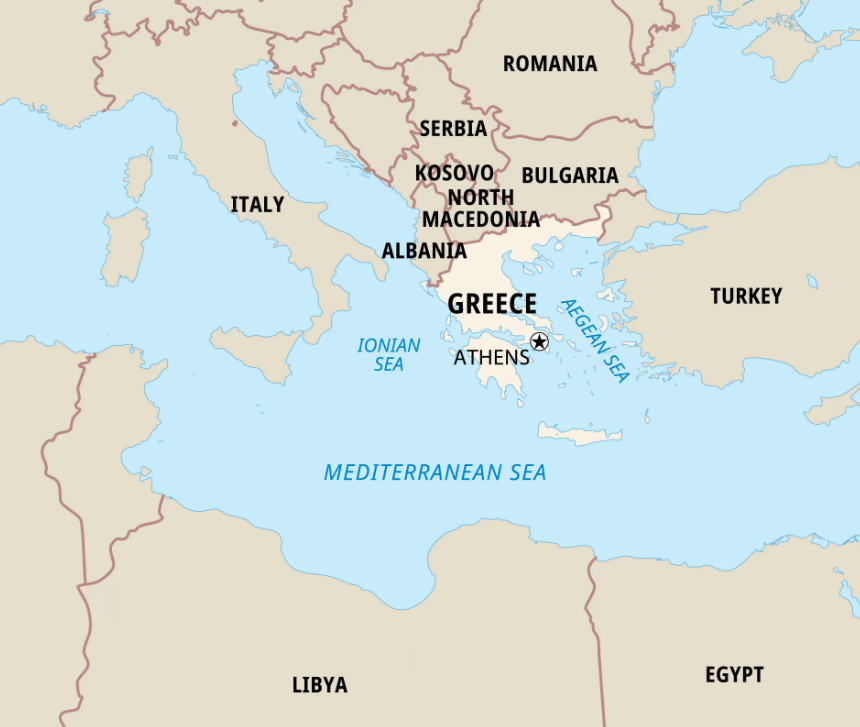
The Defence Minister of India held bilateral talks with the Minister of National Defence of Greece in New Delhi.
- The meeting resulted in the signing of a Joint Declaration of Intent (JDI) to strengthen defence industrial cooperation.
- This step highlights the growing strategic convergence between the two ancient maritime nations and marks a significant boost to their strategic partnership.
Summary
- India and Greece strengthened their Strategic Partnership by signing a Joint Declaration of Intent on defence industrial cooperation and exchanging a Military Cooperation Plan for 2026, marking a shift toward structured, long-term engagement.
- The partnership enhances maritime security collaboration through IFC-IOR, supports India’s Aatmanirbhar Bharat vision, and positions Greece as a key gateway to Europe under the IMEC framework.
What are the Key Highlights of the India - Greece Bilateral Talks?
- Joint Declaration of Intent: India and Greece signed a JDI to strengthen bilateral defence industrial cooperation, which will lay the foundation for a structured five-year roadmap to guide long-term collaboration.
- Alongside this, both sides exchanged the Bilateral Military Cooperation Plan for 2026, outlining planned military engagements between their armed forces.
- The cooperation aims to link India’s 'Aatmanirbhar Bharat' (Self-Reliant India) initiative with Greece’s defence reforms under Agenda 2030, aiming to expand the capacity of indigenous defence industries in both countries.
- By formalizing sustained industrial collaboration instead of ad-hoc arrangements, the move reflects India’s broader strategy of diversifying defence partnerships beyond traditional suppliers.
- Together, these steps signal a clear shift from dialogue-driven engagement to structured, time-bound cooperation.
- Maritime Security Collaboration: Greece announced the positioning of a Greek International Liaison Officer at the Information Fusion Centre-Indian Ocean Region (IFC-IOR) in Gurugram.
- This move aims to enhance Maritime Domain Awareness (MDA) and information sharing, reflecting the shared maritime interests of both nations in the Indo-Pacific and the Mediterranean.
How are India-Greece Relations?
- Historical Linkages: India–Greece ties go back nearly 2,500 years, with trade links between the Mauryan Empire and Greece reflected in ancient coinage and texts.
- In 326 BC, Alexander reached northwestern India up to the Hyphasis (Beas River) and fought Raja Puru, King of Pauravaa (between the Jhelum and Chenab) and King Ambhi who ruled at Taxila.
- The Mauryan dynasty was contemporary to Alexander. Chanakya’s Arthashastra mentions the Greek (Yavana) ambassador Megasthenes at Chandragupta Maurya’s court.
- The Gandhara school of art later emerged as a blend of Indian and Greek cultural influences.
- Strategic Partnership: The bilateral relationship was elevated to a "Strategic Partnership" in August 2023.
- Diplomatic Support: Greece has consistently supported India’s stance on Kashmir and India’s bid for a permanent seat in the UN Security Council (UNSC). Conversely, India supports Greece’s position on the Cyprus issue.
- India supports a bi-zonal, bi-communal federation for the Cyprus issue, in line with UNSC resolutions, and international law
Significance of the Cooperation
- Gateway to Europe: Greece’s strategic location in the Eastern Mediterranean serves as a vital gateway for India to Europe.
- Greece, having a massive merchant shipping fleet (controlling ~20% of global shipping tonnage), offers India a logistical partner to penetrate the EU market.
- It is a crucial node in the proposed India-Middle East-Europe Economic Corridor (IMEC), with Greek ports (like Piraeus) potentially acting as entry points for Indian goods.
- Countering Geopolitical Adversaries: Closer ties with Greece provide a strategic counterbalance to the Turkey-Pakistan axis.
- Turkey’s close military cooperation with Pakistan makes India’s partnership with Greece (Turkey’s traditional rival) geopolitically significant.
- Indo-Pacific & Mediterranean Convergence: Both nations are maritime powers advocating for a rules-based international order and freedom of navigation, aligning their interests in the Indo-Pacific and the Mediterranean Sea.
- Greece’s interest in the Indo-Pacific Oceans Initiative (IPOI) and India’s naval presence in the Mediterranean (e.g., INS Tabar exercises) create a security continuum stretching from the Arabian Sea to the Aegean.
What are the Challenges in India-Greece Relations?
- Economic Underperformance: Despite the potential, bilateral trade stands at approximately USD 2 billion (2022-23).
- This is significantly lower than India’s trade with other European nations like Germany, France, or Italy.
- The trade is heavily skewed towards primary products (aluminum, mineral fuels, cotton) rather than high-value technology or services, limiting economic depth.
- Connectivity Deficit: The absence of direct shipping lines necessitates trans-shipment, increasing the time and cost for Indian exports to reach Greek ports.
- The "China Factor": Greece is positioned as India's "Gateway to Europe" via the IMEC.
- However, the largest Greek port, Piraeus, is majority-owned by COSCO Shipping, a Chinese state-owned enterprise.
- India’s strategic reliance on a port controlled by a geopolitical rival (China) poses a long-term security dilemma for its European supply chains.
- Institutional Lag: Despite elevation to a Strategic Partnership, India–Greece ties lack regularised high-level mechanisms such as a 2+2 Dialogue and foreign policy review frameworks.
- This limits continuity, policy follow-up, and long-term strategic coordination.
What Steps can Enhance India-Greece Relations?
- Operationalize IMEC: With the Red Sea crisis destabilizing traditional routes, accelerating the India-Middle East-Europe Economic Corridor will automatically resolve connectivity issues, making Greece the primary entry point for Indian goods into the EU.
- Develop a Green Maritime Corridor between Indian and Greek ports, focusing on green hydrogen, ammonia bunkering, and decarbonised shipping.
- Labor Arbitrage: Greece faces a severe demographic crisis and labor shortage (agriculture, construction, tourism), while India has a surplus of skilled workforce.
- Swift implementation of the Migration and Mobility Partnership Agreement (MMPA) will legalize Indian labor flows, curbing illegal migration while boosting remittances.
- Strategic Grouping: India should formalize a minilateral grouping involving India, Greece, Cyprus, and Israel (or France). This "Mediterranean Quad" would focus on energy security and joint naval patrols, effectively extending India’s security perimeter.
- Digital Connectivity: Collaborate on the Blue-Raman cable system (submarine cables) to link India’s digital infrastructure with Europe via Greece, bypassing the vulnerable Suez choke-point.
Conclusion
India–Greece ties are steadily evolving from historical goodwill into a structured and strategic partnership anchored in defence, maritime security, and connectivity. If both sides address economic and logistical gaps while leveraging shared geopolitical interests, this partnership can emerge as a key bridge linking the Indo-Pacific with Europe.
|
Drishti Mains Question: India–Greece defence cooperation reflects a shift from symbolic diplomacy to structured strategic engagement. Discuss |
Frequently Asked Questions (FAQs)
1. What is the significance of the Joint Declaration of Intent (JDI) signed between India and Greece?
It institutionalizes defence industrial cooperation and lays the groundwork for a five-year roadmap aligned with Aatmanirbhar Bharat and Greece’s Agenda 2030 reforms.
2. What role does IFC-IOR play in India–Greece maritime cooperation?
The Information Fusion Centre–Indian Ocean Region enhances Maritime Domain Awareness through real-time information sharing and coordinated maritime surveillance.
3. How does IMEC strengthen India–Greece ties?
IMEC positions Greece as a gateway to Europe, with ports like Piraeus serving as potential entry points for Indian goods into the EU market.
4. Why is Greece strategically important for India in geopolitical terms?
Greece offers a counterbalance to the Turkey–Pakistan axis and strengthens India’s presence in the Eastern Mediterranean.
5. What are the major challenges in India–Greece relations?
Low bilateral trade (~USD 2 billion), lack of direct shipping connectivity, EU regulatory constraints, and China’s control of Piraeus port limit deeper engagement
Indian Economy
Capital Goods Sector
Prelims: Capital Goods, Public Capital Expenditure, Index of Industrial Production, PLI Scheme, Customs Duty, Lithium-Ion Batteries
Mains: Role of capital goods in industrial growth, Infrastructure-led development, Public investment and private investment crowding-in, Industrial policy and Energy transition
Why in News?
The Union Budget 2026–27 announced a major push to the capital goods sector through higher public capital expenditure, targeted manufacturing schemes, and tax and customs duty incentives.
Summary
- The Union Budget 2026–27 positions the capital goods sector as a core driver of infrastructure creation and manufacturing growth.
- Public capital expenditure is increased to ₹12.2 lakh crore, reinforcing investment-led economic expansion.
- New manufacturing schemes and fiscal incentives aim to build domestic capacity, reduce import dependence, and support long-term industrial competitiveness.
What Are the Key Announcements in the Union Budget 2026–27 for Strengthening the Capital Goods Sector?
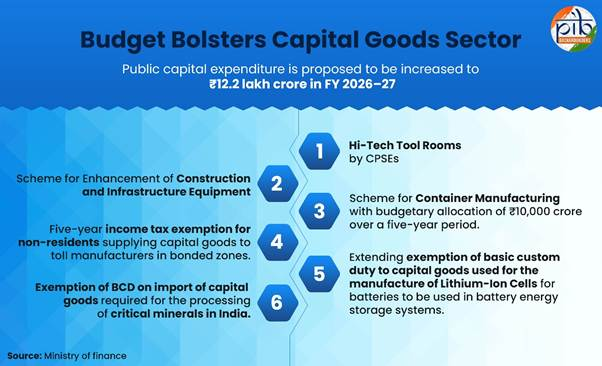
- Public Capital Expenditure: The Union Budget 2026–27 increases public capital expenditure to ₹12.2 lakh crore to accelerate infrastructure-led growth.
- Government capital outlay has risen 4.2 times from FY18 to FY26 (Budget Estimates), reflecting sustained policy focus on public investment.
- Higher public capex is expected to crowd in private investment and expand productive capacity across sectors.
- Manufacturing Capacity Enhancement: The budget proposes the establishment of Hi-Tech Tool Rooms by Central Public Sector Enterprises to support high-precision manufacturing.
- These facilities will provide digitally enabled design, testing, and manufacturing services at lower costs.
- A Scheme for Enhancement of Construction and Infrastructure Equipment is introduced to promote domestic manufacturing of advanced construction machinery.
- Container Manufacturing Scheme: The budget announces a ₹10,000 crore Container Manufacturing Scheme to be implemented over five years.
- The scheme aims to develop a globally competitive container manufacturing ecosystem in India.
- It is expected to strengthen logistics infrastructure and support export growth.
- Support to Toll Manufacturing and Electronics Manufacturing: The budget provides a five-year income tax exemption to non-resident entities supplying capital goods and equipment to toll manufacturers operating in bonded zones.
- Additional tax exemptions are extended to foreign suppliers supporting electronics manufacturing in bonded zones.
- These measures aim to reduce capital investment costs and promote electronics manufacturing in India up to the tax year 2030–31.
- Energy Transition and Critical Minerals: The budget extends customs duty exemptions on capital goods used for manufacturing lithium-ion cells for battery energy storage systems.
- It also exempts customs duty on capital goods required for processing critical minerals in India.
- These measures are intended to strengthen domestic value chains and support energy security and energy transition goals.
Capital Goods
- Capital goods include plant, machinery, and equipment used for production or service delivery, including for modernisation, technological upgradation, and capacity expansion.
- They are utilised across manufacturing, infrastructure, agriculture, mining, allied activities, and the services sector.
Significance of Capital Goods Sector
- High Economic Multiplier Effect: Public capital expenditure generates strong spillover effects across the economy, with studies estimating a multiplier of 2.5–3.5 times.
- Foundation of Manufacturing: Capital goods provide the machinery backbone for sectors such as automobiles, electronics, textiles, and heavy industry.
- Catalyst for Technological Upgradation: The sector enables diffusion of advanced technologies such as automation, robotics, AI, and IoT into the wider industrial ecosystem.
- Strategic Role: Capital goods are essential for renewable energy systems, EV batteries, and critical mineral processing.
- Employment and Skill Development Engine: Capital goods manufacturing is skill-intensive, generating employment across engineering, fabrication, and technical trades.
Initiatives for Capital Goods Sector
- Make in India: Promotes domestic manufacturing of capital goods to reduce import dependence and strengthen industrial self-reliance.
- National Capital Goods Policy, 2016: Provides a comprehensive roadmap to increase production, exports, and technological depth of the capital goods sector.
- Capital Goods Scheme: Phase I focused on addressing skill gaps, technology development, and industry–academia collaboration through shared facilities.
- Phase II expands the scope of Phase I by scaling up indigenous technology development, skilling, testing, and industry participation.
- Production Linked Incentive Schemes: PLI schemes boost demand for advanced capital goods by incentivising large-scale manufacturing in key sectors such as automobiles, batteries, and electronics.
What are the Challenges Faced by the Capital Goods Sector?
- Inverted Duty Structure: Higher import duties on raw materials than on finished capital goods raise domestic production costs, discouraging local value addition and making imports more competitive than indigenous manufacturing.
- Technology Gap and Low R&D Intensity: Limited domestic technological depth and low R&D expenditure constrain high-precision manufacturing, leading to dependence on imported advanced components and restricting movement up the value chain.
- High Logistics and Infrastructure Costs: Elevated logistics costs and inefficiencies in transport and ports increase delivery timelines and operational expenses, reducing global competitiveness—particularly for heavy and over-dimensional capital goods.
- Fragmented Industry Structure: Dominance of MSMEs limits economies of scale, access to affordable finance, and ability to invest in advanced testing, certification, and technology upgradation required for global markets.
- Dependence on Government Capex: Sectoral growth remains closely linked to public capital expenditure cycles, making it vulnerable to fiscal tightening.
What are the Measures Required to Strengthen the Capital Goods Sector?
- Expansion of Hi-Tech Tool Rooms and Shared Infrastructure: The government should strengthen and expand digitally enabled Hi-Tech Tool Rooms and Common Engineering Facility Centres to provide MSMEs access to high-precision “mother machinery.” This will enhance manufacturing quality, precision, and global competitiveness.
- Promotion of Indigenous Manufacturing of Advanced Machinery: Targeted schemes are needed to encourage domestic production of technologically advanced infrastructure and construction equipment such as tunnel-boring machines and heavy industrial systems, thereby reducing import dependence.
- Reduction in Cost of Capital: Fiscal incentives, tax exemptions, and easier access to credit should be provided to reduce the upfront capital burden on manufacturers and facilitate acquisition of advanced global technology.
- Strengthening R&D and Industry–Academia Collaboration: Greater investment in Centres of Excellence and innovation hubs is essential to develop import-substitute technologies, promote skill development, and enhance technological self-reliance.
- Development of Robust Logistics: Improving logistics infrastructure and promoting domestic container manufacturing will reduce transportation costs, enhance supply chain resilience, and improve overall cost competitiveness of the sector.
Conclusion
The Union Budget 2026–27 reinforces the capital goods sector as a pillar of India’s investment-led growth strategy. Sustained public capital expenditure, manufacturing incentives, and support for energy transition position the sector to drive long-term industrial and infrastructure development.
|
Drishti Mains Question “The capital goods sector is central to infrastructure creation and investment-led growth in India.” Comment. |
UPSC Civil Services Examination, Previous Year Question (PYQ)
Mains:
Q. Distinguish between Capital Budget and Revenue Budget. Explain the components of both these Budgets. (2021)
Q. The public expenditure management is a challenge to the Government of India in the context of budget-making during the post-liberalization period.(2019)
Important Facts For Prelims
PMO’s Directive on PM CARES and Relief Funds
Why in News?
The Prime Minister’s Office (PMO) informed the Lok Sabha Secretariat that questions regarding the Prime Minister's Citizen Assistance and Relief in Emergency Situations Fund (PM CARES Fund), the Prime Minister’s National Relief Fund (PMNRF), and the National Defence Fund (NDF) are inadmissible in the Lok Sabha.
- The PMO argued that these funds are financed through voluntary public contributions and do not draw from the Consolidated Fund of India, placing them outside the direct concern of the Government of India, and cited Rule 41(2)(viii) and Rule 41(2)(xvii) of the Rules of Procedure and Conduct of Business in Lok Sabha to support this position.
Note: Rule 41 of the Rules of Procedure and Conduct of Business in Lok Sabha allows Members of Parliament to ask questions to Ministers to obtain information on matters of public importance that are within their special cognizance.
- Rule 41(2)(viii): Questions should not relate to matters not primarily the concern of the Government of India.
- Rule 41(2)(xvii): Questions should not deal with bodies not primarily responsible to the Government of India.
What is a Question in the Parliamentary Context?
- About: A "Question" is a powerful tool used to hold the Government accountable. It is an inherent parliamentary right that allows members to elicit information on administration, government activities, and policy decisions.
- Generally, the first hour of a sitting of Lok Sabha is devoted to the Questions and this hour is called the Question Hour.
- Types of Questions:
|
Type |
Description |
Key Feature |
|
Starred Question |
A question for which the member desires an oral answer in the House. |
Distinguished by an asterisk (*). Allows supplementary questions to follow. |
|
Unstarred Question |
A question for which a written answer is desired. |
Deemed laid on the Table. No supplementary questions can be asked. |
|
Short Notice Question |
Relates to a matter of urgent public importance. |
Can be asked with less than 10 days' notice (shorter than the usual minimum) for oral answer by a Member. |
|
Question to Private Member |
Addressed to a Member who is not a Minister. |
Subject matter must relate to a Bill or Resolution for which that specific Member is responsible. |
- Admissibility of Questions: Not every question submitted by a member is accepted. The Speaker of Lok Sabha has the final authority to decide admissibility based on Rules 41 to 44 of the Rules of Procedure and Conduct of Business, along with Direction 10A issued by the Speaker, past precedents, rulings from the Chair, and established parliamentary conventions.
- Conditions for Admissibility: To be admitted, a question must satisfy strict criteria, including:
- Public Importance: It must relate to a matter of public importance within the special cognizance of the Minister.
- No Irony or Defamation: It cannot contain arguments, ironical expressions, or defamatory statements.
- No Repetition: It should not repeat questions already answered.
- No Secret Matters: It cannot seek information on secret Cabinet discussions or advice given to the President.
- Not Sub-Judice: It cannot ask about matters currently under adjudication by a court of law.
- Grounds for Disallowance (Direction 10A): A question may be rejected if it:
- Encourages divisive tendencies affecting national unity.
- Relates only to day-to-day administration or individual interests.
- Falls under the jurisdiction of other bodies like the Chief Election Commissioner or Courts.
- Conditions for Admissibility: To be admitted, a question must satisfy strict criteria, including:
Can a Government Body Preemptively Block Questions?
According to parliamentary experts, the PMO's blanket directive is procedurally highly unusual.
- Case-by-Case Basis: Decisions on admissibility are traditionally taken on the merits of the individual question rather than banning entire subjects (like a specific fund) preemptively.
- Standard Procedure: Typically, if a ministry finds a specific question problematic (e.g., due to national security), it requests the Secretariat to disallow that specific question, rather than issuing a general directive against a topic.
- Criticism: Critics argue that the PMO’s stance undermines parliamentary oversight and transparency, amounts to executive interference in the functioning of the Lok Sabha, and weakens Parliament’s role in holding the government accountable for funds closely linked to the Prime Minister and public donations.
What are the PM CARES Fund, the PMNRF, and the NDF?
PM CARES Fund
- About: It is a public charitable trust. It was set up specifically to raise funds for dealing with national emergencies, such as the Covid-19 pandemic, and to provide relief to the affected.
- Funding: It consists entirely of voluntary public contributions and does not get budgetary support from the Consolidated Fund of India.
- Transparency Status: The government maintains it is not a public authority under the Right to Information (RTI) Act 2005. Its status under the RTI Act is contested and is currently sub judice.
PMNRF
- About: It was established in 1948 by then-Prime Minister Jawaharlal Nehru. Its purpose is to assist displaced people (refugees) migrating from Pakistan during the Partition of India.
- Its resources are now primarily used to provide immediate relief to families of those killed in natural calamities (floods, cyclones, earthquakes), and to victims of major accidents and riots.
- Funding: Like PM CARES, it accepts only voluntary public contributions.
- Transparency Status: Its status under the RTI Act is contested and is currently sub judice.
National Defence Fund (NDF)
- About: This fund is used exclusively for the welfare of members of the Armed Forces (Army, Navy, Air Force) and their dependents (para-military forces are also often included).
- Administration: It is administered by an Executive Committee, with the Prime Minister as Chairperson.
- Funding: It relies on voluntary contributions from the public.
- Transparency Status: NDF is covered under the ambit of the Right to Information (RTI) Act, 2005.
Frequently Asked Questions (FAQs)
1. What is Question Hour in the Lok Sabha?
Question Hour is the first hour of a Lok Sabha sitting during which Members ask questions to seek information and hold the government accountable.
2. What are the main types of questions in Parliament?
Parliamentary questions include Starred Questions (oral answers), Unstarred Questions (written answers), Short Notice Questions (urgent matters), and Questions to Private Members.
3. Who decides the admissibility of questions in the Lok Sabha?
The Speaker of the Lok Sabha decides admissibility, based on Rules 41–44, Direction 10A, precedents, and parliamentary conventions.
4. What are the key conditions for a question to be admissible?
A question must relate to a matter of public importance, fall within a Minister’s responsibility, be precise, and not involve sub judice matters, secrets, or defamatory content.
5. On what grounds can a question be disallowed under Direction 10A?
A question may be disallowed if it affects national unity, concerns day-to-day administration, or falls under the jurisdiction of constitutional authorities or courts.
6. Are PM CARES and PMNRF covered under the RTI Act?
Their status under the RTI Act is contested and currently sub judice, while the government maintains they are not public authorities.
UPSC Civil Services Examination, Previous Year Questions (PYQs)
Q. The Parliament of India exercises control over the functions of the Council of Ministers through (2017)
- Adjournment motion
- Question hour
- Supplementary questions
Select the correct answer using the code given below:
(a) 1 only
(b) 2 and 3 only
(c) 1 and 3 only
(d) 1, 2 and 3
Ans: (d)
Rapid Fire
India–Netherlands Green Hydrogen Partnership
India and the Netherlands strengthened clean energy cooperation by launching the India–Netherlands Hydrogen Fellowship Programme and signing an MoU to promote green hydrogen research and academic collaboration.
- Hydrogen Fellowship Programme: The Fellowship Programme, launched by the Department of Science and Technology (DST) along with the release of Scheme Guidelines and a Call for Proposals, is a national capacity-building initiative open to Indian doctoral, postdoctoral, and faculty researchers.
- Objective: To enhance India’s deployment readiness in hydrogen technologies, focusing on system integration, safety, techno-economic analysis, life-cycle assessment and indigenisation pathways, particularly for hard-to-abate sectors.
- MoU Framework: The agreement between the University of Groningen and 19 Indian Institutes of Technology (IITs) enables faculty and student exchange, joint research and knowledge sharing in green energy and hydrogen, without automatic financial commitments.
- Policy Alignment: The initiative aligns with India’s National Green Hydrogen Mission, Energy Independence 2047 vision and Net-Zero 2070 targets, strengthening research collaboration, innovation, and human capital for the global hydrogen economy.
| Read more: National Green Hydrogen Mission |
Rapid Fire
P-8I Anti-Submarine Warfare
The Defence Procurement Board (DPB) has cleared the proposal to acquire six additional Boeing P-8I Poseidon from the US to bolster the Indian Navy’s surveillance and combat capabilities in the Indian Ocean Region.
- No Offsets Clause: The deal is being pursued through an India–US Inter-Governmental Agreement (IGA) framework.
- The procurement is being processed under the Defence Acquisition Procedure (DAP) 2020, which removed offset requirements for Inter-Governmental Agreements. As a result, this deal will not include technology transfer or co-production provisions.
- Unlike several acquisitions aligned with Make in India, this purchase prioritizes strategic and operational urgency over domestic industrial participation.
- Boeing P-8I: A multi-mission, long-range maritime patrol aircraft designed for Anti-Submarine Warfare (ASW), Anti-Surface Warfare, Intelligence, Surveillance and Reconnaissance (ISR), Maritime Domain Awareness, and Search and Rescue operations.
- The Indian Navy currently operates 12 P-8I aircraft stationed at INS Rajali (INAS 312) and INS Hansa (INAS 316).
- Other US Deals: Defence engagements with the US also include procurements of M982A1 Excalibur projectiles, Javelin missiles, and sustainment support for MH-60R helicopters.
| Read more: Defence Acquisition Procedure |
Rapid Fire
Gravitational Control of Earth’s Motion
A scientific reflection explains how gravity governs Earth’s motion, revisiting key concepts of planetary motion and centripetal force.
- Binding Force: Gravity acts as the fundamental binding force that holds humans, oceans, the atmosphere, and all life to Earth despite the planet’s continuous movement through space.
- Centripetal Action: Beyond causing objects to fall, gravity functions as a centripetal force, keeping the Moon in orbit around Earth and Earth revolving around the Sun.
- Planetary Motion: Due to gravitational attraction, Earth completes one revolution around the Sun every year, travelling nearly 1 billion kilometres in its orbital path.
- Earth moves at an average speed of about 1,07,000 km per hour, illustrating the dynamic nature of planetary motion.
- Absence of Friction: Unlike motion on Earth, where friction slows objects, planets move through the near-vacuum of space, where negligible resistance allows continuous motion without energy input.
- Rejection of Aether: The Michelson–Morley experiment (1887) disproved the existence of an invisible medium called aether, confirming that Earth moves through empty space rather than a resisting substance.
| Read more: Gravitational Waves |
Rapid Fire
Thwaites Glacier
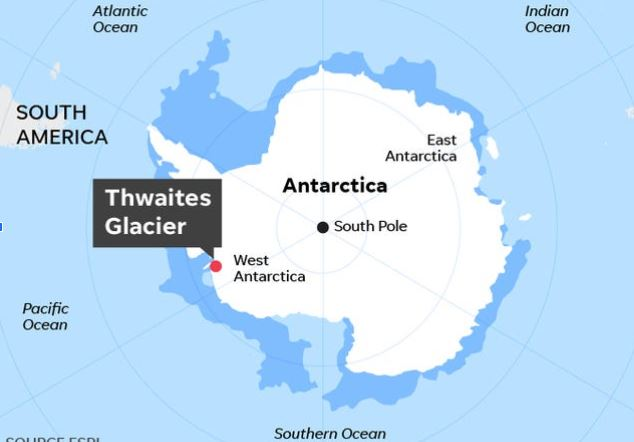
Recent studies highlight the rapid thinning and retreat of Thwaites Glacier in West Antarctica, raising concerns about long-term global sea-level rise.
Thwaites Glacier
- Location & Size: It is popularly known as the “Doomsday Glacier” and is a fast-moving ice mass about 120 km wide, spanning nearly 1.9 lakh sq. km, making it one of Antarctica’s largest and most significant glaciers.
- Sea-Level Risk: It contains enough ice to raise global sea levels by over 0.5 metres if it were to collapse completely, and its ongoing melting already contributes nearly 4% to annual global sea-level rise.
- The glacier’s ice discharge has nearly doubled over the past three decades, with scientific assessments suggesting a possible large-scale collapse within 200–900 years.
- Geographical Vulnerability: The glacier rests on bedrock that slopes downward inland below sea level, enabling warm ocean water to flow beneath its floating ice shelf and melt it from below, weakening its structural stability.
- Role of Ice Shelf: The ice shelf acts like a brace that slows the glacier’s flow into the ocean; as it thins or fractures, the glacier accelerates and loses more ice.
- Global Impact: Its destabilisation could intensify coastal flooding, erosion, and storm surges, threatening low-lying cities, islands, and ports worldwide.
| Read more: Melting of Thwaites Glacier |
Rapid Fire
New Dragonfly Species Discovered in Kerala
Researchers have identified a new dragonfly species, Lyriothemis keralensis, in Kerala, extending its known range beyond northeast India and highlighting the State’s rich biodiversity.
- About: Although present in Kerala since 2013, it was misidentified for over a decade as Lyriothemis acigastra, until detailed microscopic and museum specimen comparisons confirmed its distinct identity.
- Features: The species exhibits distinct sexual dimorphism, with males being bright blood-red with black markings and females yellow with black markings.
- Seasonality: It is seasonally visible during the Southwest Monsoon (late May to August) and persists as aquatic larvae during the rest of the year.
- Concerns: It thrives in human-modified irrigation landscapes such as pineapple and rubber plantations and shaded canals, with most populations occurring outside protected areas, underscoring the need for biodiversity-sensitive land-use practices in plantation-dominated regions.

| Read more: Dragonfly Day - Drishti IAS |



