


International Relations
India-Greece Relations
- 11 Feb 2026
- 12 min read
For Prelims: Information Fusion Centre-Indian Ocean Region, Alexander, Gandhar Art, India-Middle East-Europe Economic Corridor
For Mains: India–Greece Strategic Partnership and Defence Diplomacy, Maritime Security in the Indo-Pacific and Mediterranean, India’s Defence Industrial Policy and Aatmanirbhar Bharat
Why in News?
The Defence Minister of India held bilateral talks with the Minister of National Defence of Greece in New Delhi.
- The meeting resulted in the signing of a Joint Declaration of Intent (JDI) to strengthen defence industrial cooperation.
- This step highlights the growing strategic convergence between the two ancient maritime nations and marks a significant boost to their strategic partnership.
Summary
- India and Greece strengthened their Strategic Partnership by signing a Joint Declaration of Intent on defence industrial cooperation and exchanging a Military Cooperation Plan for 2026, marking a shift toward structured, long-term engagement.
- The partnership enhances maritime security collaboration through IFC-IOR, supports India’s Aatmanirbhar Bharat vision, and positions Greece as a key gateway to Europe under the IMEC framework.
What are the Key Highlights of the India - Greece Bilateral Talks?
- Joint Declaration of Intent: India and Greece signed a JDI to strengthen bilateral defence industrial cooperation, which will lay the foundation for a structured five-year roadmap to guide long-term collaboration.
- Alongside this, both sides exchanged the Bilateral Military Cooperation Plan for 2026, outlining planned military engagements between their armed forces.
- The cooperation aims to link India’s 'Aatmanirbhar Bharat' (Self-Reliant India) initiative with Greece’s defence reforms under Agenda 2030, aiming to expand the capacity of indigenous defence industries in both countries.
- By formalizing sustained industrial collaboration instead of ad-hoc arrangements, the move reflects India’s broader strategy of diversifying defence partnerships beyond traditional suppliers.
- Together, these steps signal a clear shift from dialogue-driven engagement to structured, time-bound cooperation.
- Maritime Security Collaboration: Greece announced the positioning of a Greek International Liaison Officer at the Information Fusion Centre-Indian Ocean Region (IFC-IOR) in Gurugram.
- This move aims to enhance Maritime Domain Awareness (MDA) and information sharing, reflecting the shared maritime interests of both nations in the Indo-Pacific and the Mediterranean.
How are India-Greece Relations?
- Historical Linkages: India–Greece ties go back nearly 2,500 years, with trade links between the Mauryan Empire and Greece reflected in ancient coinage and texts.
- In 326 BC, Alexander reached northwestern India up to the Hyphasis (Beas River) and fought Raja Puru, King of Pauravaa (between the Jhelum and Chenab) and King Ambhi who ruled at Taxila.
- The Mauryan dynasty was contemporary to Alexander. Chanakya’s Arthashastra mentions the Greek (Yavana) ambassador Megasthenes at Chandragupta Maurya’s court.
- The Gandhara school of art later emerged as a blend of Indian and Greek cultural influences.
- Strategic Partnership: The bilateral relationship was elevated to a "Strategic Partnership" in August 2023.
- Diplomatic Support: Greece has consistently supported India’s stance on Kashmir and India’s bid for a permanent seat in the UN Security Council (UNSC). Conversely, India supports Greece’s position on the Cyprus issue.
- India supports a bi-zonal, bi-communal federation for the Cyprus issue, in line with UNSC resolutions, and international law
Significance of the Cooperation
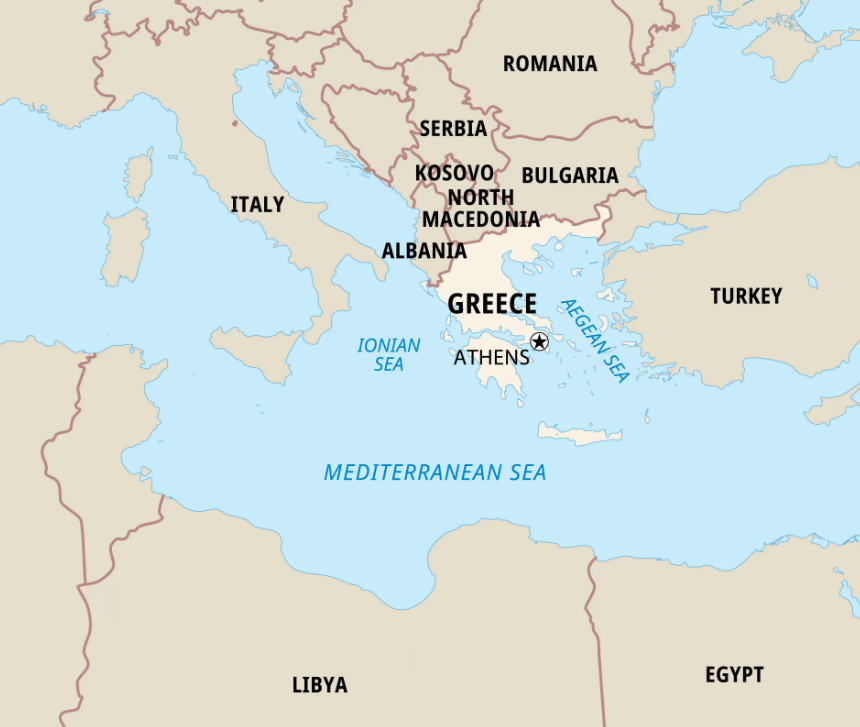
- Gateway to Europe: Greece’s strategic location in the Eastern Mediterranean serves as a vital gateway for India to Europe.
- Greece, having a massive merchant shipping fleet (controlling ~20% of global shipping tonnage), offers India a logistical partner to penetrate the EU market.
- It is a crucial node in the proposed India-Middle East-Europe Economic Corridor (IMEC), with Greek ports (like Piraeus) potentially acting as entry points for Indian goods.
- Countering Geopolitical Adversaries: Closer ties with Greece provide a strategic counterbalance to the Turkey-Pakistan axis.
- Turkey’s close military cooperation with Pakistan makes India’s partnership with Greece (Turkey’s traditional rival) geopolitically significant.
- Indo-Pacific & Mediterranean Convergence: Both nations are maritime powers advocating for a rules-based international order and freedom of navigation, aligning their interests in the Indo-Pacific and the Mediterranean Sea.
- Greece’s interest in the Indo-Pacific Oceans Initiative (IPOI) and India’s naval presence in the Mediterranean (e.g., INS Tabar exercises) create a security continuum stretching from the Arabian Sea to the Aegean.
What are the Challenges in India-Greece Relations?
- Economic Underperformance: Despite the potential, bilateral trade stands at approximately USD 2 billion (2022-23).
- This is significantly lower than India’s trade with other European nations like Germany, France, or Italy.
- The trade is heavily skewed towards primary products (aluminum, mineral fuels, cotton) rather than high-value technology or services, limiting economic depth.
- Connectivity Deficit: The absence of direct shipping lines necessitates trans-shipment, increasing the time and cost for Indian exports to reach Greek ports.
- The "China Factor": Greece is positioned as India's "Gateway to Europe" via the IMEC.
- However, the largest Greek port, Piraeus, is majority-owned by COSCO Shipping, a Chinese state-owned enterprise.
- India’s strategic reliance on a port controlled by a geopolitical rival (China) poses a long-term security dilemma for its European supply chains.
- Institutional Lag: Despite elevation to a Strategic Partnership, India–Greece ties lack regularised high-level mechanisms such as a 2+2 Dialogue and foreign policy review frameworks.
- This limits continuity, policy follow-up, and long-term strategic coordination.
What Steps can Enhance India-Greece Relations?
- Operationalize IMEC: With the Red Sea crisis destabilizing traditional routes, accelerating the India-Middle East-Europe Economic Corridor will automatically resolve connectivity issues, making Greece the primary entry point for Indian goods into the EU.
- Develop a Green Maritime Corridor between Indian and Greek ports, focusing on green hydrogen, ammonia bunkering, and decarbonised shipping.
- Labor Arbitrage: Greece faces a severe demographic crisis and labor shortage (agriculture, construction, tourism), while India has a surplus of skilled workforce.
- Swift implementation of the Migration and Mobility Partnership Agreement (MMPA) will legalize Indian labor flows, curbing illegal migration while boosting remittances.
- Strategic Grouping: India should formalize a minilateral grouping involving India, Greece, Cyprus, and Israel (or France). This "Mediterranean Quad" would focus on energy security and joint naval patrols, effectively extending India’s security perimeter.
- Digital Connectivity: Collaborate on the Blue-Raman cable system (submarine cables) to link India’s digital infrastructure with Europe via Greece, bypassing the vulnerable Suez choke-point.
Conclusion
India–Greece ties are steadily evolving from historical goodwill into a structured and strategic partnership anchored in defence, maritime security, and connectivity. If both sides address economic and logistical gaps while leveraging shared geopolitical interests, this partnership can emerge as a key bridge linking the Indo-Pacific with Europe.
|
Drishti Mains Question: India–Greece defence cooperation reflects a shift from symbolic diplomacy to structured strategic engagement. Discuss |
Frequently Asked Questions (FAQs)
1. What is the significance of the Joint Declaration of Intent (JDI) signed between India and Greece?
It institutionalizes defence industrial cooperation and lays the groundwork for a five-year roadmap aligned with Aatmanirbhar Bharat and Greece’s Agenda 2030 reforms.
2. What role does IFC-IOR play in India–Greece maritime cooperation?
The Information Fusion Centre–Indian Ocean Region enhances Maritime Domain Awareness through real-time information sharing and coordinated maritime surveillance.
3. How does IMEC strengthen India–Greece ties?
IMEC positions Greece as a gateway to Europe, with ports like Piraeus serving as potential entry points for Indian goods into the EU market.
4. Why is Greece strategically important for India in geopolitical terms?
Greece offers a counterbalance to the Turkey–Pakistan axis and strengthens India’s presence in the Eastern Mediterranean.
5. What are the major challenges in India–Greece relations?
Low bilateral trade (~USD 2 billion), lack of direct shipping connectivity, EU regulatory constraints, and China’s control of Piraeus port limit deeper engagement



