International Relations
US-Israel Attack on Iran
For Prelims: Axis of Resistance, Strait of Hormuz, Joint Comprehensive Plan of Action , Hezbollah, Hamas in Gaza, Houthis
For Mains: India’s Middle East policy and strategic autonomy, India’s balancing of relations with US, Israel, Iran, and Gulf states, Conflict resolution in West Asia
Why in News?
The US and Israel launched coordinated strikes on Iran, reportedly killing Iran’s Supreme Leader, Ayatollah Ali Khamenei (a Shia cleric), and targeting key strategic facilities while calling for regime change.
- The joint offensive, referred to as Operation Epic Fury by the US and Operation Lion’s Roar by Israel, marked a major escalation in regional tensions.
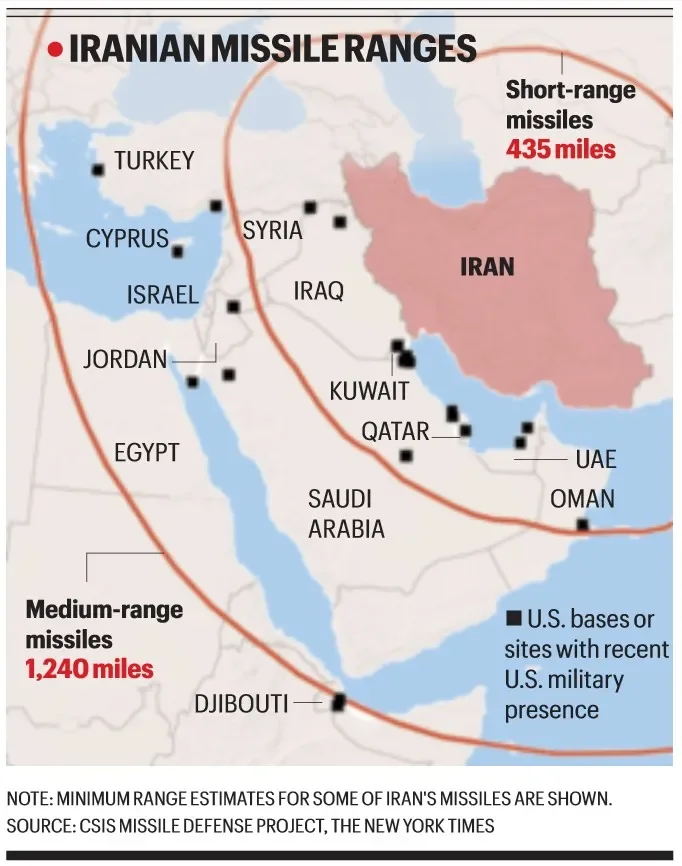
- Iran retaliated through Operation True Promise 4, launching missile attacks against Israel and nearby Gulf states. The escalation comes despite recent progress in US–Iran nuclear talks, raising fears of a wider West Asian conflict with significant global implications.
Summary
- The US–Israel strikes on Iran and Tehran’s retaliation have sharply escalated West Asian tensions, threatening global energy security, trade routes, and geopolitical stability despite ongoing nuclear negotiations.
- For India, the conflict poses serious risks to energy supplies, diaspora safety, and strategic projects, requiring careful diplomatic balancing and strategic autonomy to safeguard national interests.
Why Did the US-Israel Attack on Iran?
- US and Israel Attack on Iran: Dissatisfied with the limited impact of the 2025 strikes and citing Iran’s continuing nuclear ambitions, the US viewed Iran’s large arsenal of ballistic missiles and kamikaze drones as an intolerable threat to US forces in the Gulf and regional allies.
- Unlike earlier operations focused on deterrence, the February 2026 strikes aimed at decapitation.
- The attacks reportedly killed Supreme Leader Ayatollah Ali Khamenei, with Washington calculating that removing him could fracture the highly centralized Islamic Revolutionary Guard Corps (IRGC).
- The US military action was driven by a complex matrix of nuclear concerns, ambitions for regime change, domestic political pressure, deterrence calculations, and the escalation of strategic commitments.
Historical Background
- 1979 Rupture: Before 1979, Iran and Israel were strategic allies. After the Iranian Revolution, the new Islamic regime severed ties with Israel and adopted a strongly anti-Western ideology.
- The new regime branded the US the “Great Satan” and Israel the “Little Satan,” portraying both as sources of regional exploitation and using anti-colonial and anti-imperialist rhetoric as a core pillar of its worldview.
- Iran’s Nuclear Revelation: Tensions escalated sharply in the early 2000s when the world discovered Iran’s secret nuclear program.
- Regional Expansion: After the US-led overthrow of Iraq’s Saddam Hussein (a major regional rival of Tehran), a power vacuum emerged.
- Iran capitalized on this by building its “Axis of Resistance” (a network of allied proxy groups across the Middle East (including Hezbollah in Lebanon, Hamas in Gaza, and the Houthis in Yemen) to counter US and Israeli dominance.
- JCPOA Agreement: To curb Iran's advancing, covert nuclear program, the P5+1 (China, France, Germany, Russia, the United Kingdom, and the United States), the European Union, and Iran signed the Joint Comprehensive Plan of Action (JCPOA) in 2015.
- It offered sanctions relief in exchange for strict limits on uranium enrichment.
- US Withdrawal (2018): Arguing the JCPOA was fatally flawed because it ignored Iran’s ballistic missile program and its funding of the "Axis of Resistance." The US unilaterally withdrew from the JCPOA in 2018. In response, Iran aggressively ramped up its uranium enrichment, pushing close to weapons-grade capability.
- Collapse of the “Axis of Resistance” (2023–24): After the October 2023 Hamas attack, Israel’s multi-front campaign weakened Hamas, decapitated Hezbollah’s leadership, and contributed to the fall of Syria’s Bashar al-Assad, stripping Iran of key regional buffers.
- Operation Midnight Hammer (June 2025): Israel launched pre-emptive strikes on Iran’s nuclear sites at Natanz and Isfahan. The US later joined, using B-2 bombers and bunker-buster bombs to strike the deeply fortified Fordow facility.
- The US claimed the strikes inflicted severe damage on Iran’s nuclear facilities and infrastructure, aiming to delay its nuclear programme by disrupting key enrichment sites and critical capabilities.
What are the Implications of the US and Israel-Iran War?
Global
- Threat to Global Energy Security: The escalation heavily impacts the Strait of Hormuz, a vital maritime chokepoint.
- The strait handles approximately 20 million barrels of crude oil daily (roughly 20% of global consumption) and 20-30% of global Liquefied Natural Gas (LNG) shipments.
- Any blockade or mining of this strait by Iran could paralyze global energy markets, leading to a massive spike in crude oil prices.
- Geopolitical Polarization: The conflict risks drawing in other global powers. Russia and China may deepen their strategic alignment with Iran, while the US consolidates its Western and Arab allies, further polarizing the global order.
- Disruption of Global Supply Chains: The militarization of West Asian skies and waters disrupts crucial trade routes connecting Asia to Europe, increasing freight and insurance costs globally.
- Commodity and Market Volatility: With major traders suspending energy shipments, the conflict has increased the “war premium” in global markets.
- Gold prices have surged as investors seek safety, and stock markets in Dubai and Abu Dhabi have halted trading.
India
- Energy Security and Economy: India is the world’s third-largest crude oil consumer and imports over 85–88% of its needs.
- About 2.5 - 2.7 million barrels/day of oil from Iraq, Saudi Arabia, UAE, and Kuwait passes through the Strait of Hormuz.
- 80–85% of LPG and nearly 60% of LNG imports also transit through Hormuz.
- While India's immediate oil needs are "covered for now" (likely due to strategic petroleum reserves and diversified imports from Russia). India lacks large strategic reserves for LPG and LNG, unlike crude oil.
- Spot availability of LPG and LNG is limited, making supply disruptions harder to manage.
- Prolonged Hormuz disruption could push oil above USD 100 per barrel, sharply raising India’s import bill.
- Short-term needs are manageable due to reserves and diversified suppliers, but a long conflict could widen the current account deficit, fuel inflation, and strain the economy.
- Safety of the Indian Diaspora: West Asia hosts nearly 9 million Indian expatriates who contribute significantly to inward remittances.
- The safety of the diaspora is the primary concern. The government may need to initiate large-scale evacuation operations (akin to Operation Rahat or Operation Ajay) if the situation deteriorates further.
- Diplomatic Tightrope: India shares a deep strategic partnership with the US and Israel, while also maintaining crucial historical, energy, and connectivity ties with Iran.
- Taking a partisan stance is detrimental to India's interests. The challenge lies in advocating for peace and condemning civilian casualties without alienating any strategic partner.
- Disruption of Connectivity Corridors: The militarization of the Gulf severely derails India's strategic connectivity initiatives. Operations at the Chabahar Port (Iran) are jeopardized, and the ambitious India-Middle East-Europe Economic Corridor (IMEC) faces existential viability threats due to the destruction of Arabian Peninsula port infrastructure.
What Measures can India take to Mitigate the Impact of the US and Israel-Iran Conflict?
- Activation of Strategic Buffers: The government must prepare to utilize the Strategic Petroleum Reserves (SPR) to insulate the domestic market from immediate price shocks, while aggressively exploring alternative LPG/LNG procurement from non-Gulf nations like the US or Australia.
- Evacuation Contingency Readiness: Prepare evacuation Standard Operating Procedures (SOPs) with the Ministry of Civil Aviation and the Indian Navy to ensure safe corridors for evacuating the Indian diaspora.
- Keep the Indian Air Force and Air India on standby for large-scale airlifts, similar to Operation Ganga (Ukraine).
- Enhance Indian Navy presence in the Arabian Sea and Gulf of Oman, expanding missions like Operation Sankalp to protect Indian merchant vessels near conflict zones.
- Strategic Autonomy in Diplomacy: India must navigate a diplomatic tightrope. It cannot afford to alienate Washington or Tel Aviv, yet it must heavily back-channel with Tehran and Muscat (Oman) to secure exceptions for Indian vessels and advocate for the de-militarization of commercial shipping lanes.
- Subsidies and Tax Interventions: To prevent the global "war premium" from passing directly to the common citizen, the central and state governments may need to absorb the shock by reducing excise duties and Value Added Tax (VAT) on petrol and diesel.
- Advocating for De-escalation at the UN: India must consistently voice its stance that "this is not an era of war."
- While condemning civilian casualties, India should avoid taking a zero-sum, partisan stance that could alienate either the US-Israel bloc or Iran, focusing entirely on a return to dialogue and the restoration of global supply chains.
Conclusion
The 2026 West Asian escalation exposes India’s vulnerability in energy security and diaspora safety. By maintaining its strategic autonomy and acting as a stabilising, non-partisan voice for peace — embodying the role of a Vishwa Bandhu (global friend) — India can safeguard its interests while reinforcing that this is not an era of war.
|
Drishti Mains Question: Q. The West Asian crisis is not just a regional conflict, but a direct threat to India's macroeconomic stability and strategic autonomy." Analyze the multifaceted impact of the US-Israel-Iran conflict on India |
Frequently Asked Questions (FAQs)
1. What is Operation Epic Fury and Operation Lion’s Roar?
These are the US and Israeli military operations targeting Iran’s leadership and strategic facilities in 2026, marking a major escalation in West Asian tensions.
2. Why is the Strait of Hormuz critical for global energy security?
It carries about 20% of global oil and 20–30% of LNG shipments; any disruption can trigger global price shocks.
3. What is the JCPOA and why did the US withdraw from it?
The 2015 nuclear deal limited Iran’s enrichment in exchange for sanctions relief; the US withdrew in 2018 citing missile programs and proxy support.
4. How does the conflict affect India’s energy security?
India imports over 85% of crude oil, with a major share passing through Hormuz, making it vulnerable to supply disruptions and price spikes.
5. Why is strategic autonomy important for India in this conflict?
It allows India to maintain balanced relations with competing powers while safeguarding energy, diaspora, and trade interests.
UPSC Civil Services Examination, Previous Year Question (PYQ)
Prelims
Q. Which one of the following countries of South-West Asia does not open out to the Mediterranean Sea? (2015)
(a) Syria
(b) Jordan
(c) Lebanon
(d) Israel
Ans: (b)
Q. The term “two-state solution” is sometimes mentioned in the news in the context of the affairs of (2018)
(a) China
(b) Israel
(c) Iraq
(d) Yemen
Ans: (b)
Q. What is the importance of developing Chabahar Port by India? (2017)
(a) India’s trade with African countries will enormously increase.
(b) India’s relations with oil-producing Arab countries will be strengthened.
(c) India will not depend on Pakistan for access to Afghanistan and Central Asia.
(d) Pakistan will facilitate and protect the installation of a gas pipeline between Iraq and India.
Ans: (c)
Mains
Q. “India’s relations with Israel have, of late, acquired a depth and diversity, which cannot be rolled back.” Discuss. (2018)


Indian Polity
Bulldozer Justice
For Prelims: First Information Report, Rule of law, International Covenant on Civil and Political Rights, Article 21, Article 300A
For Mains: Rule of Law and Due Process in Indian Democracy, Separation of Powers and Limits on Executive Authority, Right to Shelter and Livelihood under Article 21
Why in News?
The Allahabad High Court has raised constitutional concerns over the growing practice of “bulldozer justice” in Uttar Pradesh, where properties linked to accused persons are demolished soon after a First Information Report (FIR) is filed.
Summary
- The Allahabad High Court and Supreme Court have flagged punitive demolitions as violations of due process, separation of powers, and fundamental rights, emphasizing that punishment can only follow judicial adjudication.
- Strict adherence to notice, hearing, proportionality, and accountability—along with institutional reforms and international human rights standards—is essential to prevent misuse of demolition powers and uphold the rule of law.
What are the Concerns Regarding “Bulldozer Justice”?
- Violation of the Rule of Law and Due Process: The bedrock of Indian jurisprudence is that the state must act according to established legal procedures, not arbitrary discretion.
- Punitive demolitions fundamentally subvert the constitutional sequence of law enforcement (Allegation, Investigation, Adjudication, and Punishment).
- By destroying property immediately after a criminal accusation, the state effectively eliminates the necessity of a trial, denying the accused their fundamental right to a fair hearing.
- The executive cannot act as the judge, jury, and executioner, as this severely upsets the constitutional balance of power and violates the rule of law.
- Colourable exercise of power(use of lawful authority for an impermissible or mala fide objective) that bypasses due process, undermines the separation of powers, and erodes the presumption of innocence.
- Infringement of Fundamental Constitutional Rights:
- Right to Shelter (Article 21): The right to life includes the right to a dignified shelter.
- Sudden, punitive evictions permanently destroy a family's socioeconomic security and livelihood.
- Right to Property (Article 300A): The Constitution mandates that no person shall be deprived of their property except by the authority of law, necessitating a fair and reasonable procedure before any state seizure or destruction.
- Right to Equality (Article 14): Concerns of discriminatory targeting are highly prominent.
- When authorities selectively raze the properties of specific communities or political dissenters while ignoring similar municipal violations nearby, it constitutes a gross violation of the right to equal protection under the law.
- Collective Punishment Concern: Demolishing shared homes punishes innocent family members for an individual’s alleged crime, violating the principle of individual liability.
- Such collective punishment is alien to Indian criminal law and breaches Geneva Convention 1949 which prohibits collective punishments.
- International Covenant on Civil and Political Rights (ICCPR) states that everyone has the right to own property individually or with others, and no one shall be arbitrarily deprived of their property.
- Right to Shelter (Article 21): The right to life includes the right to a dignified shelter.
What is Bulldozer Justice?
- About: "Bulldozer Justice" refers to the extrajudicial practice where state or municipal authorities use heavy machinery to demolish the homes, shops, or properties of individuals accused of crimes, bypassing established legal procedures.
- Supreme Court Guidelines: In November 2024, the Supreme Court, invoking Article 142, issued pan-India guidelines declaring punitive demolitions unconstitutional and mandating strict due process safeguards before any property demolition.
- Mandatory Notice: Authorities must serve a prior written notice of at least fifteen days to the property owner via registered post.
- Right to be Heard: The affected party must be granted a personal hearing to contest the demolition, and authorities must issue a reasoned, written order explaining why demolition is the only viable option.
- Accountability and Transparency: All demolition proceedings must be recorded on video.
- Any public official found violating these guidelines will face charges for contempt of court and will be held personally liable to pay for the restitution of the destroyed property from their own salary.
- Exception: SC clarified that its directions will not be applicable if there is any unauthorised structure in any public place such as roads, streets, or footpaths, abutting railway lines or any river or water body and also to cases where there is an order for demolition made by a court of law.
Judicial Pronouncements Related to Property Demolitions
- Maneka Gandhi Case, 1978: The SC expanded the scope of "procedure established by law" by ruling that it must be just, fair and reasonable, thereby introducing the principle of "due process of law."
- Therefore, demolitions based on suspicion or unfounded allegations contradict the principles of justice, fairness, and non-arbitrariness.
- Olga Tellis Case, 1985: The SC affirmed that Article 21, guaranteeing the right to life, also includes the right to livelihood and shelter.
- It means demolishing homes without due process violates constitutional rights.
- KT Plantation (P) Ltd Case, 2011: SC ruled that the legislation providing for deprivation of property under Article 300-A must be just, fair, and reasonable.
What Measures can Curb the Practice of Bulldozer Justice?
- Adopting United Nations Guidelines: India should statutorily adopt the United Nations Basic Principles and Guidelines on Development-Based Evictions and Displacement (2007).
- These guidelines strictly prohibit forced evictions as a punitive measure and mandate comprehensive rehabilitation before any state-led demolition occurs.
- Codification of the Proportionality Doctrine: State legislatures must amend municipal laws to explicitly incorporate the test of proportionality.
- Demolition must legally be established as the absolute last resort, permissible only when the unauthorized structure poses an immediate public hazard and cannot be regularized or compounded through financial penalties.
- Creation of Independent Property Tribunals: To strip local civic bodies of absolute adjudicatory power, independent municipal tribunals should be established.
- All final demolition orders must be vetted by these quasi-judicial bodies before execution, ensuring an objective review of the municipal authority's claims.
- Suo Motu Judicial Intervention: High Courts and district judiciaries must proactively exercise their writ jurisdictions to issue pre-emptive stays when a pattern emerges of targeted demolitions following communal clashes or protests.
- Categorizing as a Corrupt Electoral Practice: The Representation of the People Act, 1951 should be amended to classify the public endorsement or ordering of extrajudicial demolitions by elected representatives as a "corrupt practice."
Conclusion
Curbing Bulldozer Justice ultimately requires a cultural shift within the law enforcement and administrative machinery. By legally shielding citizens from arbitrary state power and enforcing severe financial and professional penalties on errant officials, the state can ensure that criminal justice remains the exclusive domain of the courts, thereby preserving the democratic and constitutional fabric of the nation.
|
Drishti Mains Question: Q. “Bulldozer justice undermines the rule of law and due process.” Discuss. |
Frequently Asked Questions (FAQs)
1. What is Bulldozer Justice?
It refers to extrajudicial demolition of properties linked to accused persons, bypassing due process and judicial adjudication.
2. Which constitutional rights are affected by punitive demolitions?
Articles 14 (Equality), 21 (Right to Life and Shelter), and 300A (Right to Property) are implicated when demolitions occur without lawful procedure.
3. What did the Supreme Court rule in 2024 regarding demolitions?
Invoking Article 142, the Court declared punitive demolitions unconstitutional and mandated notice, hearing, transparency, and accountability.
4. How do international norms address collective punishment?
The Geneva Conventions prohibit collective punishment, while the ICCPR protects against arbitrary interference with home and property.
UPSC Civil Services Examination, Previous Year Questions (PYQs)
Prelims
Q. What is the position of the Right to Property in India? (2021)
(a) Legal right available to citizens only
(b) Legal right available to any person
(c) Fundamental Right available to citizens only
(d) Neither Fundamental Right nor legal right
Ans: (b)
Mains
Q. The Right to Fair Compensation and Transparency in Land Acquisition, Rehabilitation and Resettlement Act, 2013 has come into effect from I st January, 2014. What are the key issues which would get addressed with the Act in place? What implications would it have on industrialization and agriculture in India? (2014)


Important Facts For Prelims
Missile Defence in the US-Israel-Iran Conflict
Why in News?
The US–Israel–Iran conflict has brought missile defence and interceptor systems to the forefront of modern warfare. Waves of missiles and drones have tested multi-layered air defence networks, highlighting their strategic importance in high-intensity conflicts.
What is a Missile Defence System?
- About: Missile defense refers to a comprehensive military architecture designed to detect, track, and destroy incoming enemy projectiles before they reach their targets.
- Key Components:
- Sensors: Satellites in Earth's orbit and ground-based radar stations watch the sky to spot threats and track their speed and direction.
- Command Centres: Military personnel use powerful computers to process sensor data, calculate endangered targets, and determine the optimal response.
- Interceptors: The physical missiles launched to fly toward and destroy the incoming threat.
- Strategic Value: Beyond saving lives and infrastructure, these systems act as a deterrent. By rendering enemy missiles ineffective, they discourage the initiation of conflicts and provide political leaders with critical time to deliberate on responses.
How does a Missile Interceptor Work?
- Detection and Tracking: A stationary ground radar steers thousands of radio beams across the sky.
- When a beam bounces off an object, a computer analyzes the signal to estimate the target's speed, altitude, and trajectory.
- Achieving a "Lock": If deemed a threat, the radar concentrates its energy on that specific point in the sky, continuously updating the target's position.
- Launch Command: The Engagement Control Station (ECS) calculates the trajectory and sends a signal to the launcher truck to ignite the interceptor's rocket motor.
- Mid-Air Guidance: As the interceptor flies, the ground radar tracks both the enemy target and the interceptor, sending guidance commands to the latter.
- Terminal Phase Destruction: In its final seconds, the interceptor uses its onboard "seeker" (a miniature radar) to locate the target. It destroys the threat using one of two methods:
- Proximity Fuse: Blows up a powerful warhead near the target, destroying it with shrapnel (used in older models).
- Hit-to-Kill: The interceptor steers directly into the target, shattering it through sheer kinetic energy (used in modern systems).
What are the Key Defence Systems Deployed in the US–Israel–Iran Conflict?
United States
- THAAD (Terminal High Altitude Area Defense): THAAD intercepts short- and intermediate-range ballistic missiles in the terminal phase at high altitudes using hit-to-kill technology, protecting bases and cities.
- Patriot Missile System: Provides last-line defence against ballistic missiles, cruise missiles, and aircraft, widely used to protect critical infrastructure and military installations.
- SM-3 & SM-6 (US Navy): Sea-based interceptors. SM-3 destroys ballistic missiles during midcourse flight, while SM-6 targets missiles, aircraft, and drones in the terminal phase.
- Indirect Fire Protection Capability (IFPC): Uses AIM-9X (a premier, short-range, infrared-tracking, air-to-air, and surface-launched interceptor missile) to defend bases from drones and rockets, helping conserve expensive Patriot missiles.
Israel
- Arrow-2 & Arrow-3: Long-range ballistic missile defence. Arrow-3 intercepts missiles outside the atmosphere (exo-atmospheric), while Arrow-2 operates within the atmosphere.
- David’s Sling: Designed to intercept medium- to long-range rockets, cruise missiles, and tactical ballistic missiles, bridging the gap between Arrow and Iron Dome.
- Iron Dome: Short-range defence system effective against rockets, artillery shells, and drones, with high success rates against low-speed threats.
- Iron Beam: Directed-energy laser system that destroys drones and small projectiles at low cost, reducing reliance on expensive interceptors.
United Arab Emirates
- Cheongung II: South Korean medium-range air defence system with 360° radar and vertical launch capability, effective against low-flying cruise missiles and tactical ballistic threats over the Persian Gulf.
Iran
- Bavar-373: Long-range air defence system designed to intercept aircraft and ballistic missiles, comparable to advanced surface-to-air missile systems.
- Sevom-e-Khordad: Mobile air defence system capable of targeting aircraft and cruise missiles, enhancing survivability through rapid relocation.
- Tor-M1: Short-range system used to intercept precision-guided munitions, drones, and low-flying cruise missiles.
- Majid & Azarakhsh: Systems designed to counter drones and low-flying aerial threats, protecting critical facilities.
| Read more: India's Advancements in Ballistic and Air Defence Systems |
Frequently Asked Questions (FAQs)
1. What is a missile defence system?
A missile defence system is a military architecture that detects, tracks, and destroys incoming missiles using sensors, command centres, and interceptors to protect targets.
2. What is the difference between hit-to-kill and proximity fuse interception?
Hit-to-kill destroys targets through direct collision using kinetic energy, while proximity fuse interceptors detonate nearby to destroy the target with shrapnel.
3. Why is Iron Dome considered highly effective?
Iron Dome has an 80–97% success rate against short-range rockets and drones, making it highly effective for urban and tactical defence.
4. What is the role of THAAD in missile defence?
THAAD intercepts ballistic missiles at high altitudes in the terminal phase, providing wide-area protection for cities and military bases.
UPSC Civil Services Examination, Previous Year Questions (PYQs)
Prelims
Q. What is "Terminal High Altitude Area Defence (THAAD)", sometimes seen in the news? (2018)
(a) An Israeli radar system
(b) India's indigenous anti-missile programme
(c) An American anti-missile system
(d) A defence collaboration between Japan and South Korea.
Ans: (c)
Important Facts For Prelims
Centre Pauses Rice Fortification
Why in News?
The Union government has decided to "temporarily" discontinue rice fortification under the Pradhan Mantri Garib Kalyan Anna Yojana (PMGKAY) and allied schemes after a comprehensive review based on a study from the Indian Institute of Technology (IIT) Kharagpur.
What are the Recent Developments Regarding Rice Fortification?
- Nutrient Degradation: The IIT Kharagpur study assessed the shelf life of Fortified Rice Kernels (FRK) and Fortified Rice (FR) across diverse agro-climatic zones.
- It found that moisture content, storage conditions, temperature, relative humidity, and packaging material critically influence stability, leading to a decline in micronutrient levels over time.
- Storage Cycle and Operational Realities: The problem is exacerbated by the fact that rice in the central pool is often stored for 2-3 years. With an annual allocation of 37.2 million tonnes under PMGKAY and a total projected availability of 67.4 million tonnes, the gap implies extended storage cycles that heighten the risk of nutrient loss.
- Impact on Welfare Schemes and Continuity: The government has clarified that this temporary discontinuation will not reduce foodgrain entitlements and will not affect operations under the Public Distribution System (PDS), Integrated Child Development Services (ICDS), or the PM Poshan Scheme (formerly Mid-Day Meal scheme).
- Industry Distress: The sudden decision has caused distress in the milling industry, with stakeholders reporting huge losses on raw materials like folic acid, broken rice, and premixes, and suggesting the policy should have been aligned with the next crop season (2026–27).
What is Rice Fortification?
- About: Rice fortification is the deliberate addition of essential vitamins and minerals to rice during post-harvest processing to enhance its nutritional quality.
- It addresses hidden hunger (micronutrient deficiencies) without changing the rice's taste, appearance, or cooking properties.
- Rationale for Fortification: Polished white rice, the most commonly consumed form, loses 75–90% of its natural vitamins (like thiamine, niacin, B6, and vitamin E) during milling. Fortification restores these lost nutrients and adds others that rice naturally lacks.
- Common Micronutrients Added: The key nutrients added typically include Iron (to combat anaemia), Folic Acid (Vitamin B9) (to prevent neural tube defects), Vitamin B12, Zinc, Vitamin A, and other B-complex vitamins (B1, B3, B6)
- India's Policy Rollout: It was announced by the Prime Minister on the 75th Independence Day to address malnutrition. The first phase began in October 2021, supplying fortified rice through the Integrated Child Development Services (ICDS) and the Pradhan Mantri Poshan Shakti Nirman (PM Poshan) scheme (formerly the Mid-Day Meal Scheme).
- Regulatory Standards: Fortified rice in India is produced by blending regular rice with Fortified Rice Kernels (FRK). As per standards fixed by the Food Safety and Standards Authority of India (FSSAI), which has prescribed blending rice with three micronutrients, i.e., iron, folic acid and vitamin B12.
Rice Fortification Components
- Iron: A trace mineral key to hemoglobin for oxygen transport. Deficiency causes iron-deficiency anemia, prevalent in women, children, and pregnant women.
- Vitamin B12 (Cobalamin): Essential for DNA synthesis and maintaining the myelin sheath (fatty, insulating layer wrapped around nerve fibers). Deficiency causes megaloblastic anemia and neurological symptoms (numbness, memory issues), which can be irreversible. Found primarily in animal products, posing risks for vegetarians.
- Folic Acid (Vitamin B9): Crucial for cell growth and preventing neural tube defects in fetuses. Deficiency also causes megaloblastic anemia. Naturally, it is found in green leafy vegetables.
Frequently Asked Questions (FAQs)
1. What is rice fortification?
Rice fortification is the deliberate addition of essential micronutrients like Iron, Folic Acid, and Vitamin B12 to rice during processing to enhance its nutritional value and combat "hidden hunger" without altering its taste or properties.
2. Why has the government temporarily discontinued rice fortification?
Due to findings by Indian Institute of Technology Kharagpur showing micronutrient degradation during prolonged storage under varied agro-climatic conditions.
3. What are the key micronutrients mandated in fortified rice by FSSAI?
As per Food Safety and Standards Authority of India (FSSAI) standards, rice must be blended with Iron, Folic Acid (Vitamin B9), and Vitamin B12.
UPSC Civil Services Examination, Previous Year Question (PYQ)
Q. Which of the following are the objectives of ‘National Nutrition Mission’? (2017)
- To create awareness relating to malnutrition among pregnant women and lactating mothers.
- To reduce the incidence of anaemia among young children, adolescent girls and women.
- To promote the consumption of millets, coarse cereals and unpolished rice.
- To promote the consumption of poultry eggs.
Select the correct answer using the code given below:
(a) 1 and 2 only
(b) 1, 2 and 3 only
(c) 1, 2 and 4 only
(d) 3 and 4 only
Ans: (a)
Q. Which of the following is/are the indicators/ indicators used by IFPRI to compute the Global Hunger Index Report? (2016)
- Undernourishment
- Child stunting
- Child mortality
Select the correct answer using the code given below:
(a) 1 only
(b) 2 and 3 only
(c) 1, 2 and 3
(d) 1 and 3 only
Ans: (c)


Rapid Fire
Botswana Cheetah Translocation to India
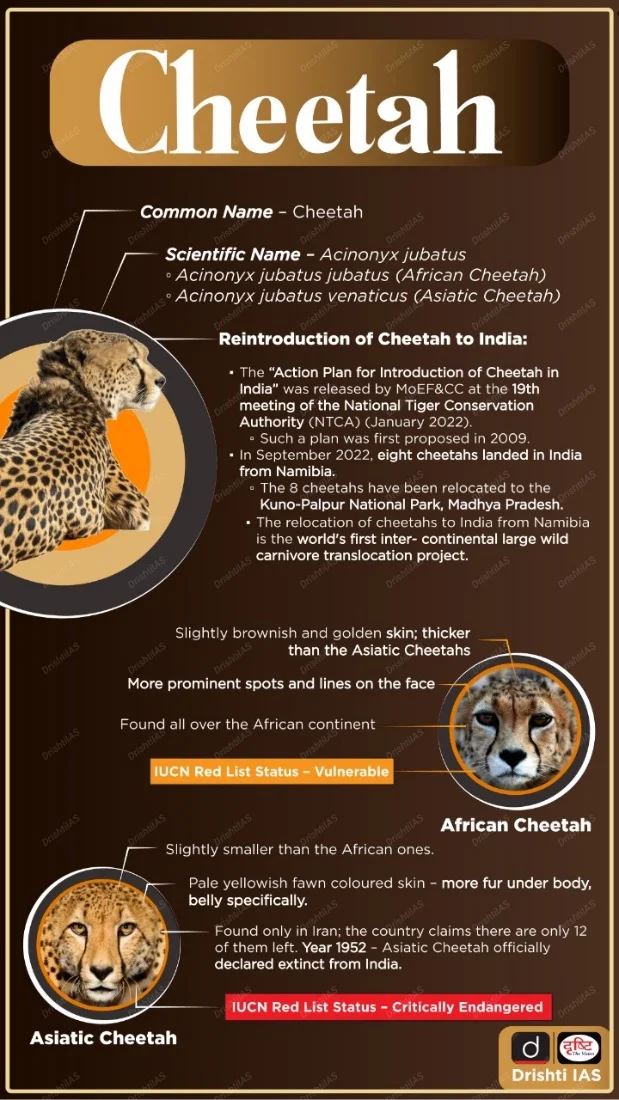
Nine cheetahs arrived from Botswana at Kuno National Park in Madhya Pradesh, marking a significant milestone in India's ambitious cheetah reintroduction project.
- Current Population Status: With this addition, India's cheetah count now stands at 48, which includes 29 Indian-born cubs born at Kuno National Park.
- Previous Introductions: The first batch of 8 cheetahs from Namibia was reintroduced in September 2022, followed by 12 cheetahs from South Africa in February 2023.
- Botswana's Cheetah Significance: Botswana hosts approximately 24% of the global cheetah population of 7,100 individuals. Notably, 76.9% of Botswana's cheetahs live on community and commercial farmlands rather than protected areas, making them uniquely adapted to sharing landscapes with human activity and livestock.
Project Cheetah
- About: Launched in 2022 under Project Tiger, Project Cheetah aims to bring cheetahs back to India that became extinct in 1952. It is the world's first intercontinental wild carnivore translocation project.
- Governance Framework: The National Tiger Conservation Authority (NTCA) serves as the implementing agency, working alongside the Madhya Pradesh Forest Department and the Wildlife Institute of India (WII). In 2023, a Steering Committee was constituted to oversee and guide the project's implementation.
- Cheetah Habitat Designation: Kuno National Park and Gandhi Sagar Wildlife Sanctuary (Madhya Pradesh) currently serve as the primary habitats for translocated cheetahs, with Nauradehi Wildlife Sanctuary (Madhya Pradesh) identified for future expansion of the cheetah landscape.
- Community Engagement: The project is supported by over 350 'Cheetah Mitras' working at the grassroots level to raise local awareness and mitigate potential human-wildlife conflict.
| Read More: Project Cheetah and Gandhi Sagar Wildlife Sanctuary |


Rapid Fire
Revamp of FRA Cells into Project Monitoring Units
The Ministry of Tribal Affairs has decided to expand the mandate of the existing Forest Rights Act (FRA) Cells, revamping them into unified 'one-stop' Project Monitoring Units (PMUs) to streamline the coordination and implementation of all tribal policies.
- FRA Cells: The Forest Rights Act (FRA) Cells were sanctioned under the Ministry’s Dharti Aaba Janjatiya Gram Utkarsh Abhiyaan (DAJGUA) launched in October 2024 to provide States with additional human resources. Their primary objective was to expedite the processing of forest rights claims and digitize records under the Forest Rights Act (FRA), 2006.
- These cells assist in recognition of forest rights, support claim documentation and evidence collection, digitise land records, help beneficiaries access government schemes, and promote conversion of forest villages into revenue villages.
- The New PMU Structure: The Ministry is restructuring these cells into comprehensive Project Monitoring Units (PMUs).
- Each State/UT PMU will now comprise four officials specializing in FRA support, livelihood support, IT/Management Information Systems (MIS) expertise, and overall team leadership.
- At the district level, there will be two experts (one for FRA support and one MIS expert).
- Rationale Behind the Revamp: According to the Ministry, maintaining different cells exclusively for FRA implementation was leading to "increasing administrative costs" and creating communication silos.
- A unified PMU is expected to make policy implementation simpler, faster, and better coordinated.
| Read more: FRA Cells Setup to Facilitate Forest Right Act |


Rapid Fire
Rare Disease Day 2026
Rare Disease Day is observed globally on 28th February (or 29th February in leap years, symbolically the rarest day) to underscore the unique challenges faced by this community.
- Objective: It aims to achieve equity in social opportunities, healthcare, and access to diagnosis and therapies for rare disease patients.
- Origin and Coordination: Established in 2008, it is coordinated by EURORDIS (European Organisation for Rare Diseases) in partnership with over 70 national alliance patient organisations.
Rare Disease
- About: There is no single universal definition of a rare disease. It is primarily determined by prevalence, with a global/emerging consensus defining it as affecting ≤ 1 in 2,000 persons in a WHO-defined region.
- Childhood and Genetic Link: A significant 50–75% of these conditions manifest during childhood or at birth, and approximately 80% are of genetic origin (e.g., Lysosomal storage disorders). The remaining include rare cancers, autoimmune conditions, and infectious diseases.
- Global Context and Treatment Gap: Globally, there are 6,000–10,000 identified rare diseases, affecting an estimated 300–450 million people. Critically, ~95% of rare diseases currently lack approved curative treatments, posing a major public health challenge.
- India's Position: India lacks a formal prevalence-based definition due to limited epidemiological data. Instead, the National Policy for Rare Diseases (NPRD), 2021, categorizes (Group 1, Group 2 and Group 3) disorders based on treatability and clinical experience, not strict numerical thresholds.
- Despite the lack of a definition, an estimated 72–96 million people in India are affected by rare diseases.
- Policy Support in India: Under the NPRD 2021, financial support of up to Rs. 50 lakhs is provided to patients suffering from any of the 63 included rare diseases at designated Centres of Excellence.
- Under the Union Budget 2026–27, 7 additional rare diseases have been included for exemption from import duties on personal imports of drugs, medicines, and food for special medical purposes.
- Rare Diseases were included as a focus area under the Production Linked Incentive (PLI) Scheme for Pharmaceuticals.
| Read More: National Policy of Rare Diseases |


Rapid Fire
Mars-Like Conditions in Salar de Pajonales
Scientists discovered that in the Salar de Pajonales, a salt flat in the Atacama Desert, gypsum acts as a microscopic shield, protecting living microbes and preserving their ancient fossils.
Salar de Pajonales
- About Salar de Pajonales: It is a large playa (salt flat) in northern Chile, situated on the western margin of the Altiplano-Puna plateau at an elevation of approximately 3,500 metres above sea level.
- It is the 3rd-largest salar in the Atacama Region (after Salar de Atacama and Salar de Punta Negra).
- Environmental Conditions: It lies within the hyperarid core of the Atacama Desert and experiences polyextreme conditions, i.e., extreme aridity, high altitude, intense solar and ultraviolet radiation, dramatic temperature fluctuations, and a sulfate-rich mineralogy. These conditions closely mimic those found on Mars.
- Hydrological and Geological Features: It is an endorheic basin (with no outflow) sustained by groundwater. Its surface is dominated by evaporitic deposits, including prominent gypsum (calcium sulfate dihydrate) crusts and layered microbial structures known as stromatolites.
- Astrobiological Significance as a Martian Analogue: Recent research has focused on how gypsum deposits preserve biosignatures. Studies have found:
- Active extremophile microbial communities (halophilic bacteria and archaea) survive in protected microhabitats within the mineral.
- Fossilized microbes and molecular biosignatures trapped within gypsum date back thousands of years.
- Implications for Mars Exploration: Gypsum acts as a protective repository, shielding biological material from desiccation and radiation. As gypsum is abundant on Earth and Mars, the study suggests orbiters and rovers should target these deposits, as they are prime candidates for holding ancient Martian life secrets.
|
Read More: Adverse Effects of Lithium Mining |