


Biodiversity & Environment
Human–Wildlife Conflict
- 25 Dec 2025
- 16 min read
For Prelims: Elephants, Elephant Corridor, International Union for Conservation of Nature (IUCN), Zoonotic Diseases, Tigers, Leopards, Fundamental Duty, Wildlife Protection Act, 1972, National Parks, Biological Diversity Act, 2002, Project Elephant, Project Tiger, Tiger Reserve, National Wildlife Action Plan, NDMA.
For Mains: Status, causes and consequences of human-animal conflict. Key initiatives for minimising human-animal conflict and further steps required to effectively mitigate human-animal conflict.
Why in News?
A tragic train–elephant collision in Assam has brought the issue of human-wildlife conflict (HWC) into sharp focus, with the incident occurring outside a designated elephant corridor, raising concerns over gaps in wildlife movement mapping and preventive infrastructure.
Summary
- Human-animal conflict escalates due to habitat loss and climate change, causing fatalities and economic harm.
- Resolving it requires proactive, integrated strategies that involve securing wildlife corridors, deploying early-warning systems, fostering community-led coexistence, and strengthening legal-policy frameworks to shift from reactive compensation to sustainable landscape management.
What is Human-Animal Conflict?
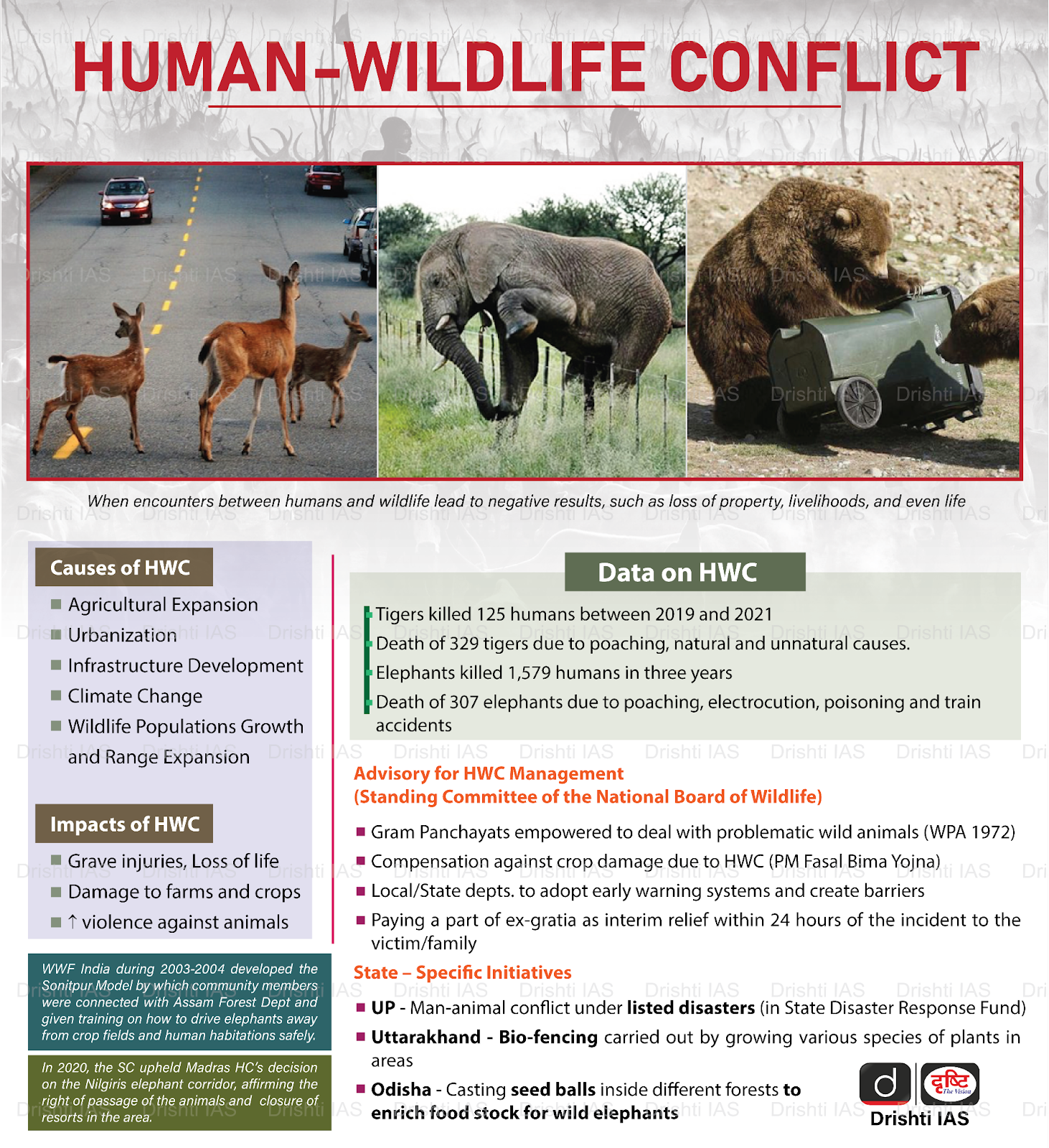
- About: HWC is defined as any interaction between humans and wildlife that results in negative impacts on human social, economic, or cultural life, on the conservation of wildlife populations, or on the environment. It's not just about physical attacks; it's a complex competition for space and resources.
- The International Union for Conservation of Nature (IUCN) identifies it as a major threat to the survival of many species and to human livelihoods.
- HWC in India: Between 2019 and 2024, elephant attacks caused more than 2,700 human deaths in India, while tigers killed 349 people.
- Simultaneously, hundreds of elephants have died from electrocution, train collisions, and poisoning, with projections indicating India will become a global hotspot for human-wildlife conflict by 2070.
What Factors Contribute to the Rise in Human-Wildlife Conflicts?
- Habitat Loss & Fragmentation: The conversion of natural habitats into farms, roads, and settlements directly destroys and fragments wildlife living spaces. As human populations expand into these territories and migration corridors, it forces more frequent encounters at the shared edges of forests and reserves.
- Linear infrastructure like highways, railways, and canals cuts through habitats, fragmenting landscapes, blocking ancient migratory routes, and increasing mortality from vehicle collisions and electrocution.
- E.g., Recent killing of 8 elephants in Assam due to train collision.
- Also in Karnataka’s Kodagu, expanding coffee and ginger farms have disrupted elephant migration, causing intense crop-raiding and property damage.
- Linear infrastructure like highways, railways, and canals cuts through habitats, fragmenting landscapes, blocking ancient migratory routes, and increasing mortality from vehicle collisions and electrocution.
- Adaptation to Human-Dominated Landscapes: Intelligent and adaptable species such as monkeys, elephants, and leopards can become habituated to human presence, learning to associate settlements and farms with reliable sources of food, thereby losing their natural fear.
- Dense sugarcane fields offer ideal cover for carnivores, as seen in Maharashtra where leopards have adapted to living entirely within them, preying on livestock and leading to frequent human conflict.
- These leopards, known as Sugar babies, have become so habituated to human areas that they do not return to forests even after relocation.
- Climate Change and Water Stress: Shifting weather patterns, including prolonged droughts and erratic monsoons, dry up natural forest waterholes, pushing animals toward village ponds and irrigation tanks.
- Disruption of tree fruiting seasons force bears and monkeys to seek food elsewhere.
- E.g., in Jammu & Kashmir, Himalayan brown bears are increasingly descending to lower altitudes due to altered food availability in their natural range.
- Population Recovery Outpacing Habitat Capacity: In some regions, effective protection laws and conservation programs have successfully increased populations of key species like tigers, elephants, and leopards, leading to higher animal densities at the boundaries of finite protected areas.
What are the Key Initiatives Taken by the Government to Minimize Human-Animal Conflict?
- Constitutional Mandate: Article 51A(g) establishes a Fundamental Duty of every citizen to protect and improve the natural environment, including wildlife. This forms the ethical and constitutional bedrock for all other measures.
- Judicial Recognition: In Animal Welfare Board of India vs. A. Nagaraja & Ors. (2014) and State of Gujarat v. Mirzapur Moti Kureshi Kassab Jamat (2005), the Supreme Court (SC) recognized that animals deserve rights similar to humans and emphasized their welfare by granting them legal status.
- Legislative Framework: Wildlife Protection Act, 1972 (WPA) is the primary legal framework establishing national parks and wildlife sanctuaries for their conservation.
- The 2006 amendment to WPA 1972 acknowledges wildlife corridors to aid animal movement and reduce HWC.
- Biological Diversity Act, 2002 aims for holistic conservation of ecosystem, species, and genetic diversity and complements existing wildlife laws.
- A private member’s bill called the Wildlife Corridors Bill, 2019 was also introduced in Lok Sabha in 2019 to tackle the issue of HWC.
- Policy & Planning Instruments: The National Wildlife Action Plan (NWAP) (2017-31) focuses on conserving endangered species and habitats, and promoting research and education for coexistence.
- NDMA guidelines recognize human-wildlife conflict as a disaster risk, advising integration of mitigation measures like early warning systems and habitat management into development projects.
- Technological Interventions: The Gajraj System is an Indian Railways AI surveillance tool that uses fiber-optic sensors to detect elephants on tracks and prevent collisions.
- TrailGuard AI is a compact, real-time camera system that uses AI to identify humans, poachers, and vehicles in protected areas, enabling rapid response.
- Species-Specific Conservation: Project Tiger (1973) establishes Tiger Reserves with core and buffer zones to address habitat loss.
- The Tigers Outside Tiger Reserves (TOTR) Project aims to reduce human-tiger conflict using advanced technology (AI, GPS, cameras), as around 30% of India’s tigers roam outside notified reserves.
- Project Elephant (1992) protects elephant habitats and corridors, securing migratory routes to prevent crop raiding and accidents.
Elephant Corridors
- About: Elephant corridors are narrow strips of natural habitat, typically forested or vegetated land, that connect larger fragmented wildlife areas, enabling safe passage for elephants between protected habitats or seasonal ranges.
- Overall Status: As per the Elephant Corridors of India report, 2023, India has identified 150 elephant corridors across 15 elephant range states. West Bengal has the highest number of elephant corridors (26) accounting for over 17% of all elephant corridors in India.
- Regional Spread: The East-central region has the highest share of corridors (35%, 52 corridors), followed by the North-east (32%), Southern (21%), and Northern (12%) regions.
- Corridor Type: Majority (84%) are intra-state corridors, while 13% are interstate and 6 are transnational corridors with Nepal.
What Steps are Further Required to Effectively Mitigate Human-Animal Conflict?
- Landscape-Level Planning: Adopt an ecosystem-based approach that goes beyond isolated protected areas to manage entire landscapes, ensuring connectivity between forests through scientifically mapped wildlife corridors.
- Integrate wildlife considerations into land-use planning, infrastructure development, and zoning regulations to prevent habitat fragmentation.
- Promote inter-state and inter-agency coordination, as animal movements often transcend administrative boundaries.
- On-Ground Prevention & Deterrence: Deploy context-specific physical barriers like solar-powered fences, trenches, and stone walls, alongside using watchtowers, and mobile apps to track animal movements.
- Economic & Livelihood Support: Revamp compensation schemes to be timely, transparent, and reflect the true market value of lost crops or livestock, using direct bank transfers to build tolerance among people.
- Promote conflict-resistant livelihoods like beekeeping, non-palatable horticulture, and ecotourism services.
- Legal, Institutional & Policy Reforms: Strengthen inter-agency coordination by establishing permanent district/state-level task forces with representatives from forest, revenue, agriculture, police, and local governments for coordinated action and rapid response.
- Mandate Human–Wildlife Conflict Impact Assessments for all development projects and allocate dedicated budgets for mitigation measures such as fencing and wildlife crossings.
- Community Engagement: Promote participatory management by involving local communities through village-level committees, alongside targeted awareness campaigns on safe practices, non-confrontational behavior, and the importance of wildlife protection.
Conclusion
The tragic Assam elephant death underscores that mitigating human-animal conflict requires a paradigm shift from reactive measures to proactive, integrated landscape management. This hinges on legally securing corridors, deploying science-based deterrence, and fostering community-led coexistence within a robust legal-policy framework.
|
Drishti Mains Question: Q. Human-wildlife conflict is not merely a conservation issue, but a significant socio-economic and humanitarian challenge. Analyse and suggest a multi-pronged strategy for sustainable coexistence. |
Frequently Asked Questions (FAQs)
1. What is Human–Animal Conflict (HWC)?
HWC refers to interactions between humans and wildlife that result in loss of life, livelihood, property, or ecological damage, driven by competition for space and resources.
2. How do railways and highways contribute to HWC?
Linear infrastructure cuts across wildlife habitats and corridors, causing animal mortality, disrupted migration, and increased human–wildlife encounters.
3. What legal measures exist to address Human–Animal Conflict?
The Wildlife Protection Act, 1972, its 2006 amendment on corridors, Biological Diversity Act, 2002, and Supreme Court rulings on animal rights form the legal framework.
UPSC Civil Services Examination Previous Year Question (PYQ)
Prelims
Q. Consider the following statements in respect of Trade Related Analysis of Fauna and Flora in Commerce (TRAFFIC): (2017)
- TRAFFIC is a bureau under the United Nations Environment Programme (UNEP).
- The mission of TRAFFIC is to ensure that trade in wild plants and animals is not a threat to the conservation of nature.
Which of the above statements is/are correct?
(a) 1 only
(b) 2 only
(c) Both 1 and 2
(d) Neither 1 nor 2
Ans: (b)
Mains
Q. Rehabilitation of human settlements is one of the important environmental impacts which always attracts controversy while planning major projects. Discuss the measures suggested for mitigation of this impact while proposing major developmental projects. (2016)



