Governance
Reforming Tribunals in India
For Prelims: Supreme Court, Tribunals, NCLAT, High Court, Quasi-judicial Bodies, 42nd Constitutional Amendment Act, 1976, Article 323A and Article 323B, Administrative Tribunals, Chief Justice of India, National Tribunals Commission, Tribunals Reforms Act, 2021, Consolidated Fund of India.
For Mains: Key provisions regarding tribunals, associated concerns and way forward. SC judgements regarding tribunals.
Why in News?
The Supreme Court (SC) has expressed serious concern over the functioning, accountability, and structural deficiencies of tribunals, terming them a “liability” and a “mess” due to systemic flaws in appointments and operations.
Summary
- Tribunals face excessive executive control over appointments and tenure, undermining judicial independence.
- The Supreme Court, via cases like L. Chandra Kumar v. Union of India, has protected the jurisdiction of High Courts as part of the Basic Structure.
- Establishing an independent National Tribunals Commission (NTC) is crucial to ensure accountability and insulation from external interference.
What Systemic Issues Plague the Functioning of Tribunals?
- Lack of Accountability: Tribunals are functioning as a "no-man's land" with no accountability to any authority, which the Supreme Court has stated is not in the national interest. This creates a vacuum in oversight.
- Grave Judicial Malpractice: There is a breakdown of judicial discipline, with technical members "outsourcing the writing of judgements" to judicial members. This includes instances of blackmail to get judgments written in someone else's name, a practice "completely unheard of in the judicial system."
- Poorly written tribunal orders waste the SC's time, forcing it to fix errors instead of focusing on important cases.
- Lack of Subject Expertise: Technical members appointed to tribunals often lack the necessary expertise to adjudicate complex matters, as they "don't understand environmental law, company law and insolvency laws." This defeats the very purpose of having specialized tribunals.
- Vacancies and Backlogs: The persistent non-filling of vacancies by the government forces the Supreme Court to grant extensions it is not inclined to give, merely to prevent a functional breakdown in these crucial quasi-judicial bodies. E.g., nearly 38,000 cases are pending across 11 benches in the Armed Forces Tribunals.
- India’s commercial tribunals are grappling with a mounting backlog of 356,000 cases, worth Rs 24.7 lakh crore, or 7.5% of GDP (2024-25).
- Executive Dominance: The executive branch exercises significant control over appointments, tenure, salaries, service conditions, and removal of tribunal members. This compromises the principle of separation of powers and the independence of the judiciary.
- The government is a major litigant in numerous tribunals (e.g., service, tax, and administrative matters), raising concerns about impartiality when the executive influences tribunal functioning.
- Overlapping Jurisdiction and Tribunalization Concerns: Overlapping jurisdictions among tribunals (e.g., between NCLAT and other appellate bodies) and excessive tribunalization erode the authority of regular courts. Frequent appeals to High Courts and the Supreme Court further undermine the finality of tribunal decisions.
Tribunals
- About: Tribunals are quasi-judicial bodies established by statute to adjudicate specific categories of disputes, functioning as an alternative mechanism to the traditional court system.
- They aim to deliver speedy, cost-effective, and expert resolution in specialized domains such as administrative service matters, taxation, environment, labour, corporate affairs, and other technical or regulatory issues.
- Constitutional Basis: Tribunals derive their constitutional recognition from the 42nd Constitutional Amendment Act, 1976. It inserted Article 323A and Article 323B and added a new Part XIV-A to the Constitution.
- Article 323A specifically empowers Parliament to establish Administrative Tribunals for service matters of public servants.
- Article 323B empowers both Parliament and State Legislatures to establish tribunals for other specific matters like taxation, land reforms, and elections.
- Salient Features of Tribunals:
- Quasi-judicial nature: They exercise judicial functions but are not full-fledged courts.
- Specialized composition: Tribunals typically comprise a mix of judicial members (often serving or retired judges) and technical/expert members possessing domain-specific knowledge.
- Limited jurisdiction: Each tribunal is confined to a designated subject area, unlike the broad jurisdiction of civil or criminal courts.
- Procedural flexibility: Tribunals are not strictly bound by the Code of Civil Procedure, 1908, or the Indian Evidence Act, 1872; they adopt simplified and less formal procedures to expedite disposal.
- Finality with appellate oversight: Decisions are generally binding, though appeals often lie to the High Court or Supreme Court (subject to statutory provisions), and judicial review under Articles 226/227 and 32/136 remains available.
- Distinction from Regular Courts: Regular courts form part of the integrated judiciary under Articles 214–231, possess inherent judicial power, follow rigid procedural laws, and handle a wide spectrum of civil, criminal, and constitutional matters. Tribunals, by contrast, are statutory creations with specialized, limited jurisdiction, flexible procedures, and a blend of judicial and expert adjudication.
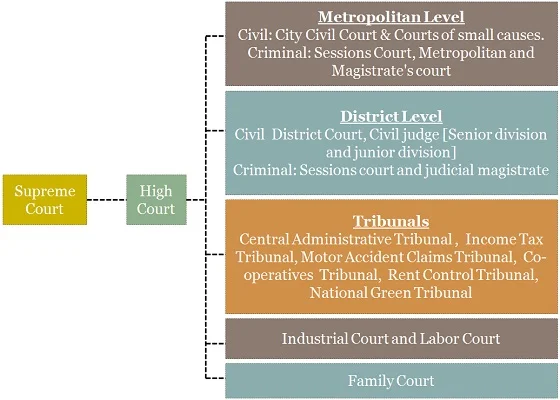
What are the Key Supreme Court Judgments on Tribunals?
Through a series of landmark judgments, the Supreme Court has significantly shaped the tribunal system in India.
- S.P. Sampath Kumar Case (1986): The Court held that tribunals can serve as constitutionally valid substitutes for High Courts provided they possess the same efficacy as the High Court. It also mandated that appointments be made either by the Central Government in consultation with the Chief Justice of India (CJI) or by a high-powered committee headed by a Supreme Court/High Court judge.
- L. Chandra Kumar Case (1997): It declared that clauses excluding the jurisdiction of High Courts (under Articles 226/227) and the Supreme Court (under Article 32) are unconstitutional as they violate the Basic Structure. Crucially, it stated that only persons with judicial experience should be appointed to tribunals substituting High Courts.
- R. Gandhi Case (2010): The Court ruled that technical members must not outnumber judicial members in any bench. It also specified that if a tribunal is solely for expeditious disposal, a technical member may not be needed, and any appointed technical member must be of Secretary-level with specialized knowledge.
- Rojer Mathew Case (2019): It declared executive-led removal provisions as unconstitutional and called for a uniform retirement age for all tribunal members. It also noted that short tenures increase executive control and undermine judicial independence.
- Madras Bar Association Case (2020): The Supreme Court reiterated the need to establish a National Tribunals Commission (NTC) for the centralized supervision of appointments and administration of tribunals. It also favored extending the term of members to five years (the current 4-year term was struck down by the SC in 2025) and the retirement age to 67 years.
- Madras Bar Association Case (2025): The SC struck down several sections of the Tribunals Reforms Act, 2021, including a fixed 4-year tenure deemed arbitrarily short and a minimum age of 50 years found discriminatory under Article 14 for excluding meritorious younger advocates.
- To curb executive discretion, the Court directed the Search-cum-Selection Committee to recommend only one name per post.
What Steps are Needed to Reform Tribunals?
- Establish National Tribunals Commission (NTC): Create an independent, centralized oversight body for all tribunals, responsible for appointments, administration, performance evaluation, infrastructure, and funding as per Supreme Court’s Madras Bar Association v. Union of India, 2025 judgment. It will ensure transparency, uniformity, and insulation from executive control.
- Judicial Independence in Composition: Appoint only persons with judicial experience or suitable legal expertise as judicial members. Removal should follow due process with judicial oversight, not executive discretion.
- Implementation of Binding Judicial Directions: The government must strictly follow the principles laid down in previous court judgments and must not pass new laws that bring back rules already struck down by the SC.
- Until the National Tribunal Commission is set up, all appointments and service conditions of tribunal members will be governed by the existing parent laws and the directions issued by the Supreme Court.
- Address Vacancies, Pendency, and Infrastructure: To improve tribunal functioning, chronic vacancies must be filled quickly through transparent processes. Additionally, dedicated and adequate funding, charged on the Consolidated Fund of India, should be allocated to ensure self-sufficiency, modern infrastructure, digitization, electronic case management, and the establishment of regional benches.
Conclusion
The tribunal system, designed for speedy justice, is plagued by executive overreach, judicial malpractice, and a lack of accountability. While the Supreme Court has consistently protected judicial review as a basic feature, true reform demands establishing an independent National Tribunals Commission (NTC) to ensure insulation from executive control and functional efficacy.
|
Drishti Mains Question: Q. "Tribunals in India were established to provide speedy and specialized justice, but they have become a 'liability' due to executive overreach." Examine the statement in light of recent Supreme Court observations. |
Frequently Asked Questions (FAQs)
1. What is the constitutional basis of tribunals in India?
Tribunals derive constitutional status from the 42nd Constitutional Amendment Act, 1976, inserting Articles 323A and 323B under Part XIV-A.
2. What is the proposed 'National Tribunals Commission' (NTC)?
The NTC is an independent central body, recommended by the Supreme Court, to oversee the appointments, administration, and functioning of all tribunals, insulating them from executive control.
3. How do tribunals differ from regular courts?
Tribunals are statutory, quasi-judicial bodies with limited subject-matter jurisdiction, flexible procedures, and mixed judicial-technical composition.
UPSC Civil Services Examination Previous Year Question (PYQ)
Prelims
Q. The National Green Tribunal Act, 2010 was enacted in consonance with which of the following provisions of the Constitution of India? (2012)
- Right to healthy environment, construed as a part of Right to life under Article 21
- Provision of grants for raising the level of administration in the Scheduled Areas for the welfare of Scheduled Tribes under Article 275(1)
- Powers and functions of Gram Sabha as mentioned under Article 243(A)
Select the correct answer using the codes given below:
(a) 1 only
(b) 2 and 3 only
(c) 1 and 3 only
(d) 1, 2 and 3
Ans: (a)
Mains
Q. How far do you agree with the view that tribunals curtail the jurisdiction of ordinary courts? In view of the above, discuss the constitutional validity and competency of the tribunals in India? (2018)


Agriculture
India's AI Revolution in Rural Development
For Prelims: IndiaAI Mission, Digital India, NITI Aayog, Panchayati Raj Institutions, BHASHINI, BhuPRAHARI, Viksit Bharat-Guarantee for Rozgar and Ajeevika Mission (Gramin) (VB-G RAM G), BharatGen, National Mission on Interdisciplinary Cyber-Physical Systems, BharatNet, National Broadband Mission 2.0 (2025-30).
For Mains: India's AI policy framework, Role of AI in transforming rural development, risks associated and way forward.
Why in News?
The India–AI Impact Summit 2026 has spotlighted Artificial Intelligence's transformative potential in rural livelihoods, social inclusion, and service delivery across agriculture, healthcare, education, and governance.
- With the IndiaAI Mission and Digital India driving institutional coordination, the Summit signals a critical transition from pilot initiatives to system-wide implementation for equitable and sustainable rural development.
How is AI Transforming Rural Development?
- AI Tools for Gram Panchayat and Local Governance: AI is being directly integrated into Panchayati Raj Institutions to strengthen decentralised governance:
- SabhaSaar: An AI-enabled tool that generates structured minutes of Gram Sabha and Panchayat meetings from audio or video inputs. Integrated with BHASHINI, it supports functionality in 14 Indian languages, enabling multilingual accessibility across rural communities.
- eGramSwaraj: Developed under the e-Panchayat Mission Mode Project, it consolidates key Panchayat functions—including planning, budgeting, accounting, monitoring, asset management, and payments—into a unified digital system. In FY 2024-25, the platform onboarded over 2.53 lakh gram panchayats, along with 6,409 block panchayats and 650 Zila panchayats.
- Gram Manchitra: It enables panchayats to map assets, monitor projects, and integrate spatial data into Gram Panchayat Development Plans (GPDPs). It enables evidence-based decision-making across infrastructure planning, natural resource management, and disaster response. As of FY 2024–25, 2.44 lakh gram panchayats have prepared and uploaded GPDPs.
- BhuPRAHARI: BhuPRAHARI integrates AI and geospatial technologies to monitor assets created under MGNREGA. It will now be utilised for monitoring assets created under the Viksit Bharat-Guarantee for Rozgar and Ajeevika Mission (Gramin) (VB-G RAM G).
- AI Infrastructure in Agriculture: In agriculture, AI operates as a decision-support system at the farm level, enabling data-driven management practices.
- Kisan e-Mitra: A virtual assistant providing information on government schemes, including income support programmes.
- National Pest Surveillance System and Crop Health Monitoring: Integrate satellite imagery, meteorological data, and soil information to generate real-time advisories.
- AIKosh: AIKosh serves as a national repository of AI datasets and models to advance public-sector innovation. It consolidates data from governmental and non-governmental sources and offers ready-to-deploy AI models across diverse sectors.
- With more than 7,500 datasets and 273 AI models spanning 20 industries, the platform lowers entry barriers for developers designing governance and service delivery applications.
- AI Infrastructure for Education and Skilling:
- DIKSHA Platform: Incorporates AI-enabled features such as keyword-based video search and read-aloud tools to enhance accessibility and promote inclusive learning, particularly for students with visual impairments and diverse educational needs.
- Youth for Unnati and Vikas with AI (YUVAI): It equips students in Classes VIII-XII with foundational AI and socio-technical skills through experiential learning to foster real-world problem-solving across sectors like agriculture, health, and rural development.
- AI for Rural Healthcare: The Suman Sakhi WhatsApp Chatbot, launched under the National Health Mission 2013 in Madhya Pradesh, uses AI-enabled conversational tools to provide accessible maternal and newborn health information to women and families.
- Multilingual Governance:
- BHASHINI: It is an AI-enabled language platform that reduces digital access barriers by offering translation, speech-to-text, and voice interfaces across 36+ Indian languages. As of October 2025, it integrates with 23+ government services, supports over 350 AI models, and has surpassed one million downloads.
- Adi Vaani: It provides access to governance, education, and healthcare in native tribal languages, addressing communication barriers in remote regions under the Adi Karmayogi framework.
- BharatGen: BharatGen is India's first government-funded, sovereign, multilingual, and multimodal Large Language Model. Developed under the National Mission on Interdisciplinary Cyber-Physical Systems and advanced through the IndiaAI Mission, it supports 22 Indian languages and integrates text, speech, and document-vision capabilities.
- Digital ShramSetu Mission: It deploys AI and frontier technologies in the informal sector to enhance service delivery and livelihood support for rural workers, promoting inclusive and sustainable development.
India's AI Policy Framework for Inclusive Rural Development
- National Strategy for Artificial Intelligence: Launched by NITI Aayog in June 2018, it identifies AI as a transformative tool to address India's development challenges by improving access, affordability, and quality of essential services.
- It emphasises augmentation rather than displacement of human labour, positioning AI as a support system for farmers, health workers, teachers, and administrators.
- It also highlights AI's role in promoting inclusive economic participation through decentralised skilling, digital work opportunities, and technology-aligned training.
- India AI Governance Guidelines: Launched by the Ministry of Electronics and Information Technology (MeitY), the guidelines establish people-centric principles—fairness, accountability, and transparency—to mitigate the risks of bias, exclusion, and opaque decision-making.
- It advocates India-specific risk assessment and protections, especially in welfare delivery systems where automated tools influence targeting and service provision. The framework comprises:
- Seven guiding principles (Sutras) for ethical and responsible AI.
- Key recommendations across six pillars of AI governance.
- An action plan mapped to short, medium, and long-term timelines.
- Practical guidelines for industry, developers, and regulators.
- It advocates India-specific risk assessment and protections, especially in welfare delivery systems where automated tools influence targeting and service provision. The framework comprises:
What are the Key Risks Associated with Use of AI in Rural Development?
- Digital Infrastructure Deficit: The lack of reliable high-speed internet and uninterrupted electricity in rural areas remains a foundational constraint, limiting effective access to AI-enabled governance, welfare delivery, and digital services.
- Limited access to personal digital devices intensifies exclusion, as computer ownership is significantly concentrated in urban households (21.6%) compared to rural households (4.2%), creating a structural “poverty of access” that restricts AI benefits from reaching rural communities.
- Data Deserts & Algorithmic Bias: Rural areas are often "data deserts" with scarce, non-digitized historical records. AI models trained on urban data can suffer from algorithmic discrimination, leading to biased outcomes in welfare eligibility and systematically disadvantageous to rural populations.
- The "Black Box" Problem: The opaque nature of many AI models creates a "Black Box" Problem, making it nearly impossible for citizens to understand why a decision (e.g., denial of a subsidy) was made. This lack of transparency and accountability erodes trust in institutions.
- Rural Job Displacement: AI-powered automation poses a risk of displacing workers in key rural sectors like agriculture (autonomous tractors) and government services (clerical automation), potentially widening the economic gap if not managed carefully.
- Cultural & Linguistic Hurdles: Most AI interfaces are designed in major languages, failing to support local dialects. This creates an immediate barrier and risks cultural insensitivity, where AI recommendations clash with local customs and social norms.
- Infrastructure & Cybersecurity Gaps: Rural bodies lack technical expertise, creating dependency on external vendors. Centralizing citizen data also raises major cybersecurity and data privacy concerns, making systems attractive targets for cyberattacks.
- Displacement of Indigenous Knowledge: FAO (2023) highlights that digital agriculture tools must integrate local agro-ecological knowledge, as over-reliance on AI advisories may marginalize traditional farming practices and weaken community-based knowledge systems.
What Steps are Required to Ensure Inclusive and Sustainable AI Adoption in Rural Development?
- Universal Digital Connectivity: Investing in robust digital infrastructure like BharatNet and the National Broadband Mission 2.0 (2025-30) should be the top priority to ensure reliable high-speed internet and electricity in rural areas, complemented by device availability through subsidies or shared models.
- Representative Datasets: Efforts must focus on creating high-quality, localized datasets that capture rural diversity to mitigate algorithmic bias. This must be balanced with strong data protection frameworks ensuring data sovereignty and privacy, thereby converting data deserts into fertile grounds for equitable AI.
- Transparent and Explainable AI: To uphold transparency and accountability in high-stakes areas like welfare and land records, a "human-in-the-loop" must be maintained with AI serving only as decision-support. Adopting explainable AI models that are "understandable by design" and establishing clear accountability chains are essential to address the "Black Box" Problem and build citizen trust.
- Creating Future-Ready Rural Livelihoods: Proactively addressing job displacement from automation requires investing in reskilling programs like IndiaAI FutureSkills, establishing social safety nets, and creating new green jobs in the rural digital economy to transform disruption into sustainable livelihood opportunities.
- Ethical Procurement and Grievance Redressal: Government procurement should prioritise ethical vendors and open-source platforms to avoid vendor lock-in (customer becomes dependent on a single vendor's products), while simple grievance redressal mechanisms must enable citizens to challenge AI-influenced decisions, ensuring technology serves people.
- Sovereign AI: Sovereign AI should be developed using India's own infrastructure and data to ensure data security and eliminate "Western Hallucinations" (giving answers relevant to US culture) through culturally grounded models like Sarvam Vision. This approach makes AI cheaper and energy-efficient to run while promoting digital inclusion via voice-based tools like Bulbul V3 for illiterate populations in native dialects.
Conclusion
As India advances toward Viksit Bharat@2047, Artificial Intelligence is poised to become the great equalizer in rural development—not by replacing human agency, but by augmenting it. By embedding ethical safeguards, investing in digital infrastructure, and prioritizing inclusive design, India can transform AI from a potential source of exclusion into a powerful catalyst for participatory governance, sustainable livelihoods, and last-mile service delivery.
|
Drishti Mains Question: Q. "Artificial Intelligence has the potential to transform rural governance in India, but it also carries significant risks of exclusion and bias." Discuss |
Frequently Asked Questions (FAQs)
1. What is the objective of India’s National Strategy for Artificial Intelligence?
It aims to leverage AI for inclusive growth, improving access, affordability, and quality of services in sectors like agriculture, healthcare, and education.
2. How does AI strengthen Panchayati Raj Institutions?
Tools like SabhaSaar, eGramSwaraj, and Gram Manchitra enhance documentation, planning, asset monitoring, and evidence-based decision-making.
3. What is the ‘Black Box’ problem in AI governance?
It refers to the lack of transparency in AI decision-making, making it difficult to understand or challenge automated outcomes.
UPSC Civil Services Examination Previous Year Question (PYQ)
Prelims
Q. With the present state of development, Artificial Intelligence can effectively do which of the following? (2020)
- Bring down electricity consumption in industrial units
- Create meaningful short stories and songs
- Disease diagnosis
- Text-to-Speech Conversion
- Wireless transmission of electrical energy
Select the correct answer using the code given below:
(a) 1, 2, 3 and 5 only
(b) 1, 3 and 4 only
(c) 2, 4 and 5 only
(d) 1, 2, 3, 4 and 5
Ans: (b)
Q. The terms ‘WannaCry, Petya and EternalBlue’ sometimes mentioned in the news recently are related to (2018)
(a) Exoplanets
(b) Cryptocurrency
(c) Cyber attacks
(d) Mini satellites
Ans: (c)
Mains
Q. Introduce the concept of Artificial Intelligence (AI). How does AI help clinical diagnosis? Do you perceive any threat to privacy of the individual in the use of AI in healthcare?(2023)
Q. What are the main socio-economic implications arising out of the development of IT industries in major cities of India?(2022)


Important Facts For Prelims
Industrial Corridors And NICDP
Why in News?
The Union Budget 2026–27 has accelerated India’s infrastructure push by prioritising the National Industrial Corridor Development Programme (NICDP) and announcing an Integrated East Coast Industrial Corridor with a key node at Durgapur, West Bengal, to strengthen the Purvodaya initiative.
- Backed by Rs 3,000 crore allocation to the National Industrial Corridor Development and Implementation Trust (NICDIT) in the 2026-27 Budget Estimates, the programme aims to create smart industrial cities, reduce logistics costs, and integrate India into global value chains.
What are Industrial Corridors?
- About: Industrial corridors are strategic linear development zones that connect major economic centres through integrated multimodal infrastructure such as roads, railways, ports, and airports, enabling seamless freight and passenger movement.
- They drive industrial growth, enhance logistics efficiency, and create globally competitive, business-friendly ecosystems that attract investment and boost manufacturing.
- By promoting industrial clustering, leveraging regional strengths, and developing along key transport corridors, these corridors support regional development, strengthen supply chains, and integrate India into global value chains.
- Significance for Indian Economy:
- Plug-and-Play Ecosystems: Ready-to-use land and assured utilities mean businesses can start operations almost immediately, reducing "red tape" and setup time.
- Sustainability: Following "Low-Carbon City" frameworks, these hubs integrate renewable energy, water recycling, and extensive green spaces.
- Walk-to-Work Culture: Modern urban planning reduces commuting times, enhancing the quality of life for workers and productivity for investors.
- Job Creation: As per the Economic Survey 2025-26, the Phase-I cities under NICDP have already attracted Rs 2.02 lakh crore in investments, creating thousands of jobs in high-growth sectors like EVs and semiconductors.
- Investment and Promote Exports: Special Economic Zones offer tax incentives and regulatory advantages that draw foreign investment and enhance India’s position in global value chains.
What is the National Industrial Corridor Development Programme (NICDP)?
- NICDP: It is India’s flagship initiative to develop a network of integrated industrial corridors and greenfield smart industrial cities to strengthen manufacturing, logistics, and global competitiveness.
- Guided by the PM GatiShakti National Master Plan, the programme focuses on multimodal connectivity, plug-and-play infrastructure, and sustainable urban planning to create future-ready economic zones.
- The programme is implemented by the National Industrial Corridor Development Corporation (NICDC), an autonomous body under the Department for Promotion of Industry and Internal Trade (DPIIT), Ministry of Commerce & Industry.
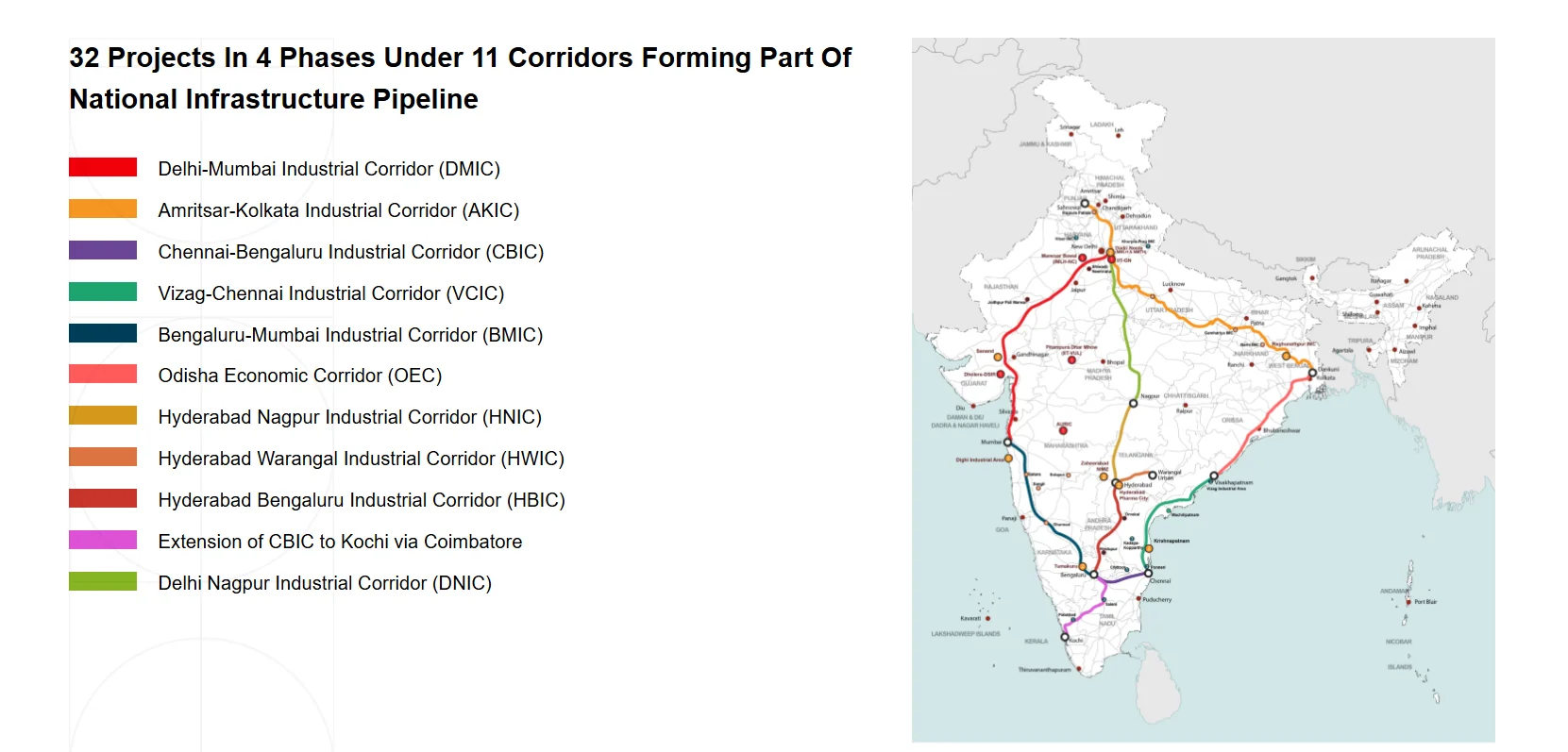
- Major Industrial Corridors: NICDP spans 11 major industrial corridors across the country, including the Delhi–Mumbai, Chennai–Bengaluru, and Amritsar–Kolkata corridors, each supported by dedicated freight corridors, national highways, ports, and rail networks.
- Projects across 11 industrial corridors are being developed under a Low-Carbon Cities framework, featuring green spaces, public transit, renewable energy use, and water and waste recycling to ensure sustainable industrial growth.
- In 2024, the Government approved an additional 12 greenfield industrial smart city projects under the NICDP aimed at boosting manufacturing, attract investment, and creating future-ready infrastructure.
National Industrial Corridor Development Corporation Limited (NICDC)
- NICDC, incorporated in 2008 (formerly Delhi Mumbai Industrial Corridor Development Corporation Limited (DMICDC)), is responsible for planning and implementing the NICDP.
- Inspired by global corridor models such as Tokyo–Osaka and Boston–Washington D.C., NICDC promotes economic growth by developing smart cities, industrial clusters, and multimodal logistics hubs, while creating business-friendly, sustainable ecosystems with plug-and-play infrastructure, seamless connectivity, and modern urban standards to strengthen manufacturing and boost exports.
National Industrial Corridor Development and Implementation Trust (NICDIT):
- NICDIT, formerly known as the DMIC Trust, functions as the primary financing mechanism and investment vehicle for the NICDC.
- It facilitates project funding, negotiates loans, and mobilizes resources for infrastructure development, acting as an intermediary for establishing industrial smart cities.
- The Rs 3,000 crore allocated in the 2026-27 budget will be funneled through this trust to ensure the timely completion of trunk infrastructure.
Frequently Asked Questions (FAQs)
1. What is the National Industrial Corridor Development Programme (NICDP)?
NICDP is India’s flagship initiative to develop integrated industrial corridors and greenfield smart cities to boost manufacturing, logistics efficiency, and global competitiveness.
2. What is the role of NICDC in industrial corridor development?
NICDC plans and implements NICDP projects, developing smart cities, industrial clusters, and logistics hubs to promote exports and economic growth.
3. How does NICDIT support industrial corridor projects?
NICDIT functions as the financing mechanism for NICDP, mobilising funds and ensuring timely infrastructure development through budgetary allocations.
4. Why are industrial corridors important for India’s economy?
They reduce logistics costs, attract investment, create jobs, promote exports, and integrate India into global value chains.
5. What is the significance of the East Coast Industrial Corridor announced in Budget 2026–27?
It strengthens the Purvodaya initiative, promotes eastern India’s industrialisation, and enhances port-led development and export competitiveness.
UPSC Civil Services Examination, Previous Year Questions (PYQs)
Mains
Q. What is the significance of Industrial Corridors in India? Identifying Industrial Corridors, explain their main characteristics. (2018)


Rapid Fire
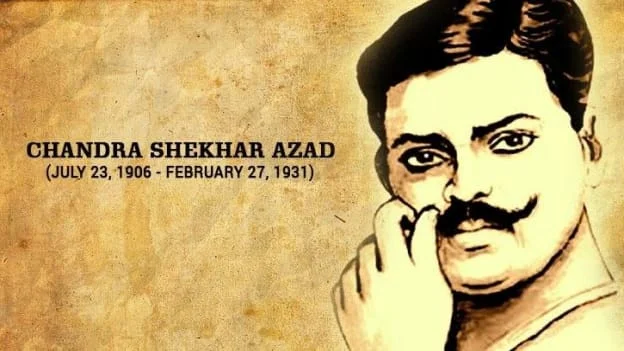
Chandra Shekhar Azad
India paid tributes to freedom fighter Chandra Shekhar Azad on his 95th martyrdom day on 27th February 2026.
- Early Life & the Title 'Azad': Born as Chandra Shekhar Tiwari in 1906 in Alirajpur (present-day Madhya Pradesh), he left home early and actively joined Mahatma Gandhi's Non-Cooperation Movement (1921).
- When arrested and presented before a magistrate, he famously declared his name as 'Azad' (Free), his father as 'Swatantra' (Independence), and his address as a jail cell.
- Ideological Shift: The abrupt withdrawal of the Non-Cooperation Movement in 1922 pushed him away from Gandhian non-violence and towards militant, revolutionary nationalism.
- Hindustan Republican Army (HRA): He joined the HRA, an organization led by prominent revolutionaries Ram Prasad Bismil and Sachindranath Sanyal.
- The Kakori Conspiracy (1925): Azad played a crucial role in raising funds for the armed struggle through political dacoities, most notably the Kakori train robbery (1925).
- Founding the HSRA (1928): Along with Bhagat Singh, he reorganized the revolutionary youth to establish the Hindustan Socialist Republican Association (HSRA) in 1928.
- Under Bhagat Singh's influence, the organization adopted an explicit socialist ideology, while Azad served as its core military leader and strategist.
- Assassination of John Saunders (1928): Azad masterminded and participated in the killing of British police officer John Saunders in Lahore to avenge the death of Lala Lajpat Rai.
- Following the assassination, the HSRA released pamphlets signed under Azad's pseudonym, 'Balraj'.
- The Final Stand (1931): Operating underground after the 1929 Central Assembly Bombing, Azad was eventually cornered by a police battalion on 27th February 1931, at Alfred Park in Allahabad.
- He fought bravely to help his comrade Sukhdev Raj escape and, true to his vow of never being captured alive, shot himself with his last bullet.
| Read more: Chandra Shekhar Azad |


Rapid Fire
Total Lunar Eclipse
A total lunar eclipse will occur on 3rd March 2026, visible across most of India, eastern Asia, Australia, the Pacific Ocean, and the Americas.
Lunar Eclipse
- About: A lunar eclipse is a celestial event that occurs when the Sun, Earth, and Moon align in a straight line (syzygy) during a full Moon phase, and the Moon passes through Earth's shadow. Earth's shadow structure comprises:
- Umbra: The darker, inner cone where direct sunlight is completely blocked.
- Penumbra: The lighter, outer region where sunlight is only partially obstructed.
- Types of Lunar Eclipses:
- Penumbral: Moon passes only through the penumbra, causing a subtle dimming (often difficult to detect).
- Partial: Only a portion of the Moon enters the umbra, causing part of the lunar disk to darken.
- Total: The entire Moon enters the umbra, leading to the most dramatic effect.
- Observational Features: Visible from anywhere on Earth's night side where the Moon is above the horizon. Safe to observe with the naked eye, unlike solar eclipses.
- Blood Moon Phenomenon: During a total lunar eclipse, the Moon often appears reddish or coppery. This is due to Rayleigh scattering—Earth's atmosphere scatters shorter blue wavelengths while refracting (bending) longer red wavelengths toward the Moon, illuminating it indirectly with the light of all of Earth's simultaneous sunrises and sunsets.

| Read More: Types of Eclipses |


Rapid Fire
India Slams Pakistan At UNHRC On J&K
- India strongly rejected Pakistan’s claims on Jammu & Kashmir at the 61st Session of the United Nations Human Rights Council (UNHRC).
- Right Of Reply At UNHRC: India exercised its Right of Reply after Pakistan and the Organisation of Islamic Cooperation (OIC) raised the J&K issue at the UNHRC.
- Jammu & Kashmir As Integral Part Of India: India reiterated that Jammu & Kashmir was, is, and will always remain an integral and inalienable part of India, with accession being legal and irrevocable under the Indian Independence Act, 1947.
- The PoK Dispute: Shifting the narrative, India asserted that the only legitimate outstanding dispute in the region is the illegal and forcible occupation of Indian territories by Pakistan (PoK), calling upon Islamabad to immediately vacate these areas.
- Development As Counter-Narrative: India highlighted that high voter turnout in J&K’s general and Assembly elections reflects people’s rejection of terrorism and support for democracy.
- Countering claims of suppression, India highlighted massive infrastructure growth, specifically citing the recent inauguration of the Chenab Rail Bridge in J&K, which is the highest railway bridge in the world.
- Exposing Pakistan's financial vulnerability, India pointed out that J&K’s developmental budget is more than double the recent bailout package Pakistan received from the International Monetary Fund (IMF) under the Extended Fund Facility (EFF).
- Criticism Of OIC’s Position: India stated that the OIC’s stance reflects bias and co-option by Pakistan, undermining its credibility.
United Nations Human Rights Council (UNHRC)
- The UNHRC is an intergovernmental body of the United Nations, established in 2006 and headquartered in Geneva, mandated to promote and protect human rights globally.
- It replaced the UN Commission on Human Rights and is supported by the Office of the High Commissioner for Human Rights (OHCHR) for technical and secretariat functions.
- The UNHRC has 47 members elected for staggered three-year terms on a regional group basis.
- India has been elected unopposed to the UNHRC for the 7th time for a three-year term (2026-28), reaffirming commitment to human rights.
| Read more: India's Federal Design and J&K Statehood |