


Rapid Fire
Total Lunar Eclipse
- 28 Feb 2026
- 2 min read
A total lunar eclipse will occur on 3rd March 2026, visible across most of India, eastern Asia, Australia, the Pacific Ocean, and the Americas.
Lunar Eclipse
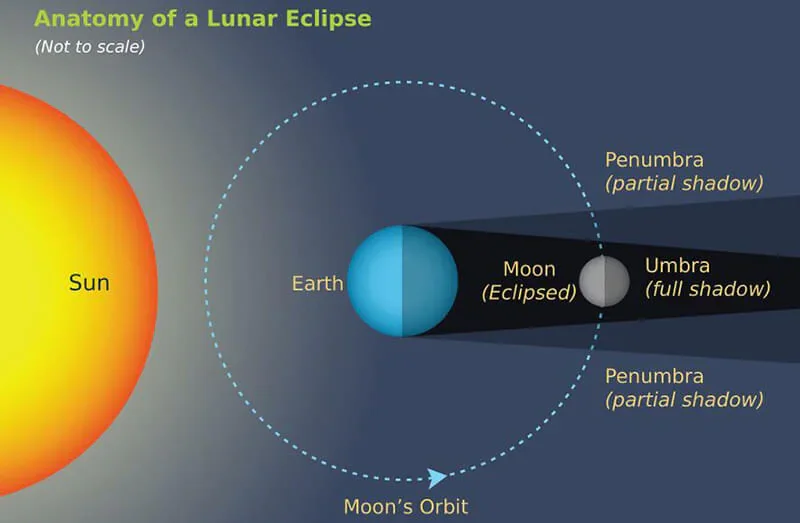
- About: A lunar eclipse is a celestial event that occurs when the Sun, Earth, and Moon align in a straight line (syzygy) during a full Moon phase, and the Moon passes through Earth's shadow. Earth's shadow structure comprises:
- Umbra: The darker, inner cone where direct sunlight is completely blocked.
- Penumbra: The lighter, outer region where sunlight is only partially obstructed.
- Types of Lunar Eclipses:
- Penumbral: Moon passes only through the penumbra, causing a subtle dimming (often difficult to detect).
- Partial: Only a portion of the Moon enters the umbra, causing part of the lunar disk to darken.
- Total: The entire Moon enters the umbra, leading to the most dramatic effect.
- Observational Features: Visible from anywhere on Earth's night side where the Moon is above the horizon. Safe to observe with the naked eye, unlike solar eclipses.
- Blood Moon Phenomenon: During a total lunar eclipse, the Moon often appears reddish or coppery. This is due to Rayleigh scattering—Earth's atmosphere scatters shorter blue wavelengths while refracting (bending) longer red wavelengths toward the Moon, illuminating it indirectly with the light of all of Earth's simultaneous sunrises and sunsets.
| Read More: Types of Eclipses |



