


Science & Technology
India-AI Impact Summit 2026
- 17 Feb 2026
- 17 min read
For Prelims: India-AI Impact Summit 2026, Artificial Intelligence, India AI Mission, Pax Silica initiative, Digital Public Infrastructure
For Mains: Role of AI in inclusive development and governance, India’s Digital Public Infrastructure as a global model, AI and socio-economic transformation in the Global South
Why in News?
The India-AI Impact Summit 2026 commenced at Bharat Mandapam in New Delhi, organised by the Ministry of Electronics and Information Technology (MeitY), marking the first major global Artificial Intelligence (AI) summit hosted in the Global South and showcasing India’s leadership in inclusive, development-focused AI.
- The Summit is hosted under the India AI Mission, shifting the global narrative from "AI Safety" to "AI for Development and Impact."
Summary
- The India AI Impact Summit 2026 positions India as a Global South leader by shifting the focus from AI safety to AI for development, guided by the principles of People, Planet, and Progress and promoting inclusive, responsible AI governance.
- Through the IndiaAI Mission, digital public infrastructure, and global partnerships, the summit advances AI-driven solutions for healthcare, agriculture, climate resilience, governance, and economic growth while strengthening digital sovereignty and workforce readiness.
What are the Key Highlights of the India-AI Impact Summit 2026?
- Theme and Philosophy: The summit is anchored in Indian ethos, specifically the motto "Sarvajana Hitaya, Sarvajana Sukhaya" (Welfare for all, happiness for all). It is structured around two conceptual frameworks:
- The Three Sutras (Pillars): People, Planet, and Progress.
- People: Developing AI that empowers citizens through healthcare, education, and financial inclusion.
- Planet: Using AI for sustainable practices, climate resilience, and resource efficiency.
- Progress: Harnessing AI for economic growth, governance, and public service delivery.
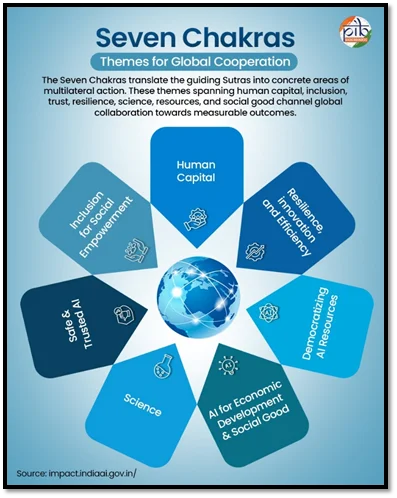
- The Seven Chakras (Working Groups): Focused themes including Health, Agriculture, Safe & Trusted AI, Science, Inclusion, Democratizing AI Resources, and Economic Development.
- The Three Sutras (Pillars): People, Planet, and Progress.
- Key Institutional Frameworks: The India AI Impact Summit 2026 is anchored by key institutional frameworks including MeitY, the IndiaAI Mission, Software Technology Parks of India (STPI) and the Digital India initiative.
- Together these provide policy direction, ecosystem support, innovation infrastructure, and digital foundations to ensure AI adoption aligns with national priorities, inclusive governance, and scalable implementation.
- Expected Outcomes: At least 15 tangible deliverables focused on AI governance, innovation, and inclusive growth.
- India’s entry into the US-led Pax Silica initiative to build a resilient global electronics and semiconductor supply chain.
- Global cooperation on AI governance and ethics, possibly through multistakeholder frameworks rather than a formal treaty body.
- Strengthening AI for jobs and public service delivery, highlighting AI’s role in employment generation and governance efficiency.
- Expansion of India’s AI Safety Institute model, promoting collaborative research on AI safety and standards.
.webp)
Significance of India-AI Impact Summit 2026
- Voice of the Global South: Unlike earlier global AI summits that focused on risks and regulation for developed nations, India’s summit emphasizes developmental outcomes. It showcases how AI can address Global South challenges such as healthcare access, agricultural productivity, and language barriers.
- Democratization of Technology: India is showcasing its Digital Public Infrastructure (DPI) model (like UPI and Aadhaar) as a blueprint for AI.
- The summit advocates for "AI Commons"—making compute power, datasets, and models accessible to developing nations rather than being monopolized by a few tech giants.
- Shift from ‘Regulation’ to ‘Innovation’: The New Delhi summit emphasizes Applied AI.
- The focus is on use cases—how AI can actually be deployed on the ground to improve Human Development Index (HDI) indicators.
- Strategic Diplomacy: By hosting this summit, India positions itself as a bridge power between the developed West (which owns the technology) and the developing South (which needs the technology), reinforcing its diplomatic leverage in technology governance.
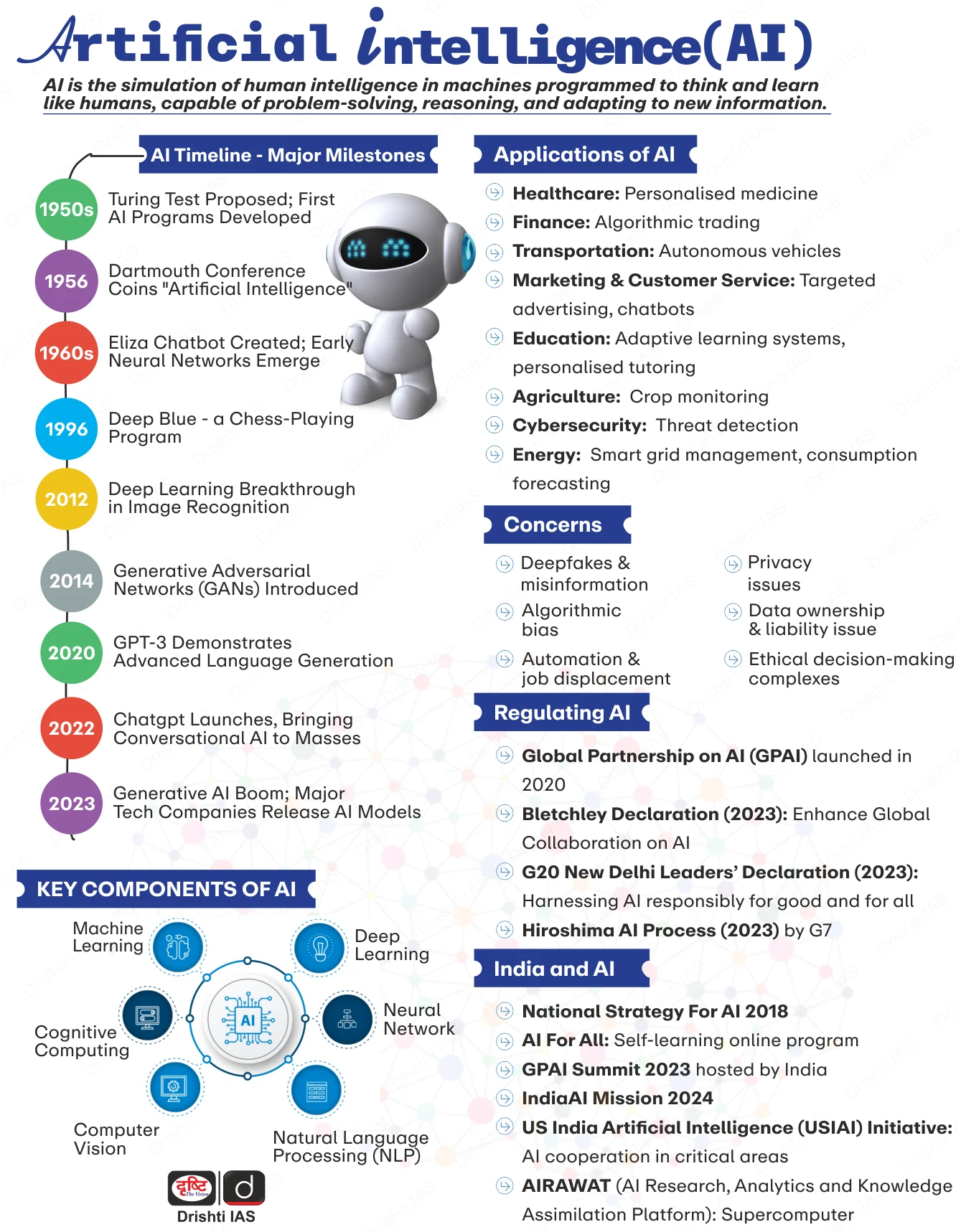
Note: Artificial Intelligence (AI) is the ability of machines to perform tasks that normally require human intelligence. It enables systems to learn from experience, adapt to new situations, and solve complex problems independently.
- AI uses datasets, algorithms, and large language models to analyse information, recognise patterns, and generate responses.
- Over time, these systems improve their performance, allowing them to reason, make decisions, and communicate in ways similar to humans.
What is the Significance of AI for India?
For People: Bridging Social Inequities
- Healthcare: AI-driven diagnostics are bridging the doctor-patient ratio (currently ~1:834 in India).
- Tools like Qure.ai (radiology) and automated blood/urine analysis are providing "lab-grade" results in rural clinics.
- Education: Platforms like DIKSHA and adaptive learning systems personalize curriculum for students with different learning speeds, while AI translation removes the "English barrier" for rural learners.
- YUVAi: Youth for Unnati and Vikas with AI, a national programme aimed at enabling students from Classes 8 to 12 with AI and social skills in an inclusive manner.
- Linguistic Inclusion: With Bhashini, AI enables real-time translation across 22 Scheduled Indian languages, ensuring that digital governance is not restricted by language.
- Sarvam Vision an indigenous model optimized for Indian languages and high-accuracy document processing (OCR), reducing reliance on foreign proprietary models.
For the Planet: Precision and Sustainability
- Agriculture: AI models analyze satellite imagery and soil data to provide localized weather advisories and pest predictions.
- Initiatives like Kisan E-Mitra (AI chatbot) help farmers optimize fertilizer use, reducing costs and environmental runoff.
- MausamGPT an AI-powered chatbot currently under development to provide personalized, conversational climate and weather advisories to farmers in regional languages.
- Energy Management: AI serves as a tool for "Climate-Smart" development, critical for India's 2070 Net Zero targets.
- AI integrates with smart grids to predict peak loads and manage the intermittency of renewable energy (solar/wind), enhancing the efficiency of India’s transition to green energy.
- Flood Forecasting: Systems like BrahmaSATARK use AI-integrated physics modeling to provide impact-based forecasts for the Brahmaputra and Ganga basins.
For Progress: Economic and Governance Transformation
- Governance: AI is projected to add USD 500–600 billion to India's GDP by 2030 through productivity gains.
- India is integrating AI into its Digital Public Infrastructure (Aadhaar, UPI, DigiLocker).
- For example, MuleHunter.AI identifies "mule accounts" in banking to prevent fraud and automates the translation of complex court judgments to improve legal accessibility.
- Digital Sovereignty: Through the IndiaAI Mission, India is building its own compute capacity (38,000+ GPUs) and indigenous models like BharatGen (world’s first government-funded multimodal Large Language Model (LLM) initiative for AI-driven public services).
- This ensures that India’s data stays within its borders and AI models are "culturally representative."
AI Ecosystem in India at Present
- Over 6 million people are employed in the tech and AI ecosystem. India’s AI talent pool is projected to grow over 12.5 lakh by 2027, reflecting strong demand in data science, AI engineering, and analytics.
- To support this growth, MeitY’s FutureSkills PRIME programme has attracted over 18.56 lakh registrations, with more than 3.37 lakh course completions, strengthening India’s AI-ready workforce.
- As of 2025, the country hosts 1,800+ Global Capability Centres, including more than 500 focused on AI.
- India has around 1.8 lakh startups, and nearly 89% of new startups launched last year used AI in their products or services.
- On the NASSCOM AI Adoption Index, India scores 2.45 out of 4, showing that 87% of enterprises are actively using AI solutions.
- Leading sectors in AI adoption include industrial and automotive, consumer goods and retail, banking, financial services and insurance, and healthcare. Together, they contribute around 60% of AI’s total value.
- A Boston Consulting Group (BCG) report confirms that 26% of Indian companies have achieved AI maturity at scale.
What is the India AI Mission?
- About: The IndiaAI Mission, approved by the Cabinet in March 2024 with a budget of Rs 10,371 crore, is a transformative initiative aimed at establishing India as a global leader in AI through the vision of "Making AI in India and Making AI Work for India."
- The mission is implemented by IndiaAI, an independent business division under the MeitY.
- The Seven Pillars of the IndiaAI Mission:
- IndiaAI Compute: Provides affordable access to high-end GPUs, with over 38,000 onboarded and eligible users can access AI compute at up to 40% reduced cost under the India AI Mission.
- IndiaAI Application Development: Promotes AI solutions for India-specific challenges in sectors like healthcare, agriculture, governance, climate change, and cybersecurity through hackathons and approved applications.
- AIKosh (Dataset Platform): Offers a national repository of datasets and AI models, hosting 3,000+ datasets and 243 models across 20 sectors to accelerate AI development.
- IndiaAI Foundation Models: Supports development of indigenous large multimodal AI models using Indian languages and data, with startups like Sarvam AI and Gnani AI selected in the first phase.
- IndiaAI FutureSkills: Builds AI talent through fellowships, academic programmes, and AI labs in Tier 2 and Tier 3 cities to expand workforce readiness.
- IndiaAI Startup Financing: Provides funding and global expansion support to AI startups, including market access initiatives in Europe.
- Safe and Trusted AI: Ensures responsible AI adoption through projects on bias mitigation, privacy, explainability, governance testing, and the IndiaAI Safety Institute.
Conclusion
The India AI Impact Summit 2026 redefines global technology governance by prioritizing developmental outcomes over existential risks, marking the first such leadership from the Global South. Ultimately, it positions India as a "bridge power" that aligns AI innovation with the human-centric principles of People, Planet, and Progress.
|
Drishti Mains Question: “India AI Impact Summit 2026 marks a shift from AI safety to AI for development.” Discuss its implications for the Global South. |
Frequently Asked Questions (FAQs)
1. What is the core objective of the India AI Impact Summit 2026?
It aims to promote AI for development, inclusive growth, and responsible governance, shifting focus from risk-centric regulation to practical deployment.
2. What are the “Three Sutras” of the summit?
People, Planet, and Progress—focusing on social empowerment, sustainability, and economic growth through AI.
3. What is the IndiaAI Mission?
A ₹10,371 crore initiative (2024) to build sovereign AI capabilities through compute access, datasets, indigenous models, skilling, and responsible AI frameworks.
4. How does AI support inclusive development in India?
AI improves healthcare diagnostics, personalized education, language translation, and financial inclusion through Digital Public Infrastructure.
5. Why is India’s AI approach significant for the Global South?
It emphasizes affordable access, AI commons, and developmental use cases, offering a scalable model for emerging economies.
UPSC Civil Services Examination Previous Year Question (PYQ)
Prelims
Q. With the present state of development, Artificial Intelligence can effectively do which of the following? (2020)
- Bring down electricity consumption in industrial units
- Create meaningful short stories and songs
- Disease diagnosis
- Text-to-Speech Conversion
- Wireless transmission of electrical energy
Select the correct answer using the code given below:
(a) 1, 2, 3 and 5 only
(b) 1, 3 and 4 only
(c) 2, 4 and 5 only
(d) 1, 2, 3, 4 and 5
Ans: (b)
Q. The terms ‘WannaCry, Petya and EternalBlue’ sometimes mentioned in the news recently are related to (2018)
(a) Exoplanets
(b) Cryptocurrency
(c) Cyber attacks
(d) Mini satellites
Ans: (c)
Mains
Q. Introduce the concept of Artificial Intelligence (AI). How does AI help clinical diagnosis? Do you perceive any threat to privacy of the individual in the use of AI in healthcare?(2023)
Q. What are the main socio-economic implications arising out of the development of IT industries in major cities of India?(2022)
Q. “The emergence of the Fourth Industrial Revolution (Digital Revolution) has initiated e-Governance as an integral part of government”. Discuss. (2020)



