


Governance
Reforming Tribunals in India
- 28 Feb 2026
- 13 min read
For Prelims: Supreme Court, Tribunals, NCLAT, High Court, Quasi-judicial Bodies, 42nd Constitutional Amendment Act, 1976, Article 323A and Article 323B, Administrative Tribunals, Chief Justice of India, National Tribunals Commission, Tribunals Reforms Act, 2021, Consolidated Fund of India.
For Mains: Key provisions regarding tribunals, associated concerns and way forward. SC judgements regarding tribunals.
Why in News?
The Supreme Court (SC) has expressed serious concern over the functioning, accountability, and structural deficiencies of tribunals, terming them a “liability” and a “mess” due to systemic flaws in appointments and operations.
Summary
- Tribunals face excessive executive control over appointments and tenure, undermining judicial independence.
- The Supreme Court, via cases like L. Chandra Kumar v. Union of India, has protected the jurisdiction of High Courts as part of the Basic Structure.
- Establishing an independent National Tribunals Commission (NTC) is crucial to ensure accountability and insulation from external interference.
What Systemic Issues Plague the Functioning of Tribunals?
- Lack of Accountability: Tribunals are functioning as a "no-man's land" with no accountability to any authority, which the Supreme Court has stated is not in the national interest. This creates a vacuum in oversight.
- Grave Judicial Malpractice: There is a breakdown of judicial discipline, with technical members "outsourcing the writing of judgements" to judicial members. This includes instances of blackmail to get judgments written in someone else's name, a practice "completely unheard of in the judicial system."
- Poorly written tribunal orders waste the SC's time, forcing it to fix errors instead of focusing on important cases.
- Lack of Subject Expertise: Technical members appointed to tribunals often lack the necessary expertise to adjudicate complex matters, as they "don't understand environmental law, company law and insolvency laws." This defeats the very purpose of having specialized tribunals.
- Vacancies and Backlogs: The persistent non-filling of vacancies by the government forces the Supreme Court to grant extensions it is not inclined to give, merely to prevent a functional breakdown in these crucial quasi-judicial bodies. E.g., nearly 38,000 cases are pending across 11 benches in the Armed Forces Tribunals.
- India’s commercial tribunals are grappling with a mounting backlog of 356,000 cases, worth Rs 24.7 lakh crore, or 7.5% of GDP (2024-25).
- Executive Dominance: The executive branch exercises significant control over appointments, tenure, salaries, service conditions, and removal of tribunal members. This compromises the principle of separation of powers and the independence of the judiciary.
- The government is a major litigant in numerous tribunals (e.g., service, tax, and administrative matters), raising concerns about impartiality when the executive influences tribunal functioning.
- Overlapping Jurisdiction and Tribunalization Concerns: Overlapping jurisdictions among tribunals (e.g., between NCLAT and other appellate bodies) and excessive tribunalization erode the authority of regular courts. Frequent appeals to High Courts and the Supreme Court further undermine the finality of tribunal decisions.
Tribunals
- About: Tribunals are quasi-judicial bodies established by statute to adjudicate specific categories of disputes, functioning as an alternative mechanism to the traditional court system.
- They aim to deliver speedy, cost-effective, and expert resolution in specialized domains such as administrative service matters, taxation, environment, labour, corporate affairs, and other technical or regulatory issues.
- Constitutional Basis: Tribunals derive their constitutional recognition from the 42nd Constitutional Amendment Act, 1976. It inserted Article 323A and Article 323B and added a new Part XIV-A to the Constitution.
- Article 323A specifically empowers Parliament to establish Administrative Tribunals for service matters of public servants.
- Article 323B empowers both Parliament and State Legislatures to establish tribunals for other specific matters like taxation, land reforms, and elections.
- Salient Features of Tribunals:
- Quasi-judicial nature: They exercise judicial functions but are not full-fledged courts.
- Specialized composition: Tribunals typically comprise a mix of judicial members (often serving or retired judges) and technical/expert members possessing domain-specific knowledge.
- Limited jurisdiction: Each tribunal is confined to a designated subject area, unlike the broad jurisdiction of civil or criminal courts.
- Procedural flexibility: Tribunals are not strictly bound by the Code of Civil Procedure, 1908, or the Indian Evidence Act, 1872; they adopt simplified and less formal procedures to expedite disposal.
- Finality with appellate oversight: Decisions are generally binding, though appeals often lie to the High Court or Supreme Court (subject to statutory provisions), and judicial review under Articles 226/227 and 32/136 remains available.
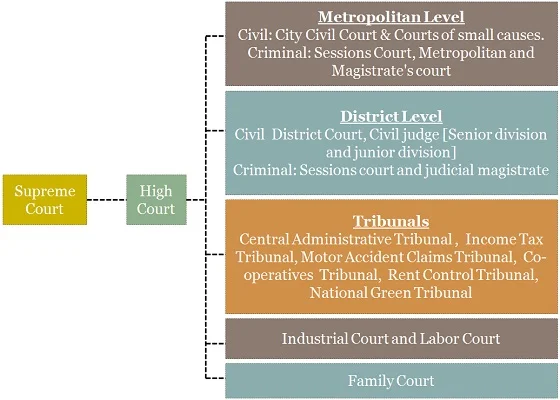
- Distinction from Regular Courts: Regular courts form part of the integrated judiciary under Articles 214–231, possess inherent judicial power, follow rigid procedural laws, and handle a wide spectrum of civil, criminal, and constitutional matters. Tribunals, by contrast, are statutory creations with specialized, limited jurisdiction, flexible procedures, and a blend of judicial and expert adjudication.
What are the Key Supreme Court Judgments on Tribunals?
Through a series of landmark judgments, the Supreme Court has significantly shaped the tribunal system in India.
- S.P. Sampath Kumar Case (1986): The Court held that tribunals can serve as constitutionally valid substitutes for High Courts provided they possess the same efficacy as the High Court. It also mandated that appointments be made either by the Central Government in consultation with the Chief Justice of India (CJI) or by a high-powered committee headed by a Supreme Court/High Court judge.
- L. Chandra Kumar Case (1997): It declared that clauses excluding the jurisdiction of High Courts (under Articles 226/227) and the Supreme Court (under Article 32) are unconstitutional as they violate the Basic Structure. Crucially, it stated that only persons with judicial experience should be appointed to tribunals substituting High Courts.
- R. Gandhi Case (2010): The Court ruled that technical members must not outnumber judicial members in any bench. It also specified that if a tribunal is solely for expeditious disposal, a technical member may not be needed, and any appointed technical member must be of Secretary-level with specialized knowledge.
- Rojer Mathew Case (2019): It declared executive-led removal provisions as unconstitutional and called for a uniform retirement age for all tribunal members. It also noted that short tenures increase executive control and undermine judicial independence.
- Madras Bar Association Case (2020): The Supreme Court reiterated the need to establish a National Tribunals Commission (NTC) for the centralized supervision of appointments and administration of tribunals. It also favored extending the term of members to five years (the current 4-year term was struck down by the SC in 2025) and the retirement age to 67 years.
- Madras Bar Association Case (2025): The SC struck down several sections of the Tribunals Reforms Act, 2021, including a fixed 4-year tenure deemed arbitrarily short and a minimum age of 50 years found discriminatory under Article 14 for excluding meritorious younger advocates.
- To curb executive discretion, the Court directed the Search-cum-Selection Committee to recommend only one name per post.
What Steps are Needed to Reform Tribunals?
- Establish National Tribunals Commission (NTC): Create an independent, centralized oversight body for all tribunals, responsible for appointments, administration, performance evaluation, infrastructure, and funding as per Supreme Court’s Madras Bar Association v. Union of India, 2025 judgment. It will ensure transparency, uniformity, and insulation from executive control.
- Judicial Independence in Composition: Appoint only persons with judicial experience or suitable legal expertise as judicial members. Removal should follow due process with judicial oversight, not executive discretion.
- Implementation of Binding Judicial Directions: The government must strictly follow the principles laid down in previous court judgments and must not pass new laws that bring back rules already struck down by the SC.
- Until the National Tribunal Commission is set up, all appointments and service conditions of tribunal members will be governed by the existing parent laws and the directions issued by the Supreme Court.
- Address Vacancies, Pendency, and Infrastructure: To improve tribunal functioning, chronic vacancies must be filled quickly through transparent processes. Additionally, dedicated and adequate funding, charged on the Consolidated Fund of India, should be allocated to ensure self-sufficiency, modern infrastructure, digitization, electronic case management, and the establishment of regional benches.
Conclusion
The tribunal system, designed for speedy justice, is plagued by executive overreach, judicial malpractice, and a lack of accountability. While the Supreme Court has consistently protected judicial review as a basic feature, true reform demands establishing an independent National Tribunals Commission (NTC) to ensure insulation from executive control and functional efficacy.
|
Drishti Mains Question: Q. "Tribunals in India were established to provide speedy and specialized justice, but they have become a 'liability' due to executive overreach." Examine the statement in light of recent Supreme Court observations. |
Frequently Asked Questions (FAQs)
1. What is the constitutional basis of tribunals in India?
Tribunals derive constitutional status from the 42nd Constitutional Amendment Act, 1976, inserting Articles 323A and 323B under Part XIV-A.
2. What is the proposed 'National Tribunals Commission' (NTC)?
The NTC is an independent central body, recommended by the Supreme Court, to oversee the appointments, administration, and functioning of all tribunals, insulating them from executive control.
3. How do tribunals differ from regular courts?
Tribunals are statutory, quasi-judicial bodies with limited subject-matter jurisdiction, flexible procedures, and mixed judicial-technical composition.
UPSC Civil Services Examination Previous Year Question (PYQ)
Prelims
Q. The National Green Tribunal Act, 2010 was enacted in consonance with which of the following provisions of the Constitution of India? (2012)
- Right to healthy environment, construed as a part of Right to life under Article 21
- Provision of grants for raising the level of administration in the Scheduled Areas for the welfare of Scheduled Tribes under Article 275(1)
- Powers and functions of Gram Sabha as mentioned under Article 243(A)
Select the correct answer using the codes given below:
(a) 1 only
(b) 2 and 3 only
(c) 1 and 3 only
(d) 1, 2 and 3
Ans: (a)
Mains
Q. How far do you agree with the view that tribunals curtail the jurisdiction of ordinary courts? In view of the above, discuss the constitutional validity and competency of the tribunals in India? (2018)



