
Indian Polity
Delimitation and Women’s Reservation in Legislatures
For Prelims: Delimitation, Census, Article 81, Article 82, Nari Shakti Vandan Adhiniyam
For Mains: Delimitation and Representation in Indian Democracy, Federalism and Centre–State Relations, Women’s Political Representation in India, Constitutional Amendments and Electoral Reforms
Why in News?
The Union government has introduced three major Bills: the Constitution (One Hundred and Thirty-First Amendment) Bill, 2026, the Delimitation Bill, 2026, and the Union Territories Laws (Amendment) Bill, 2026, to enable fresh delimitation based on the latest available Census, expand the Lok Sabha, and operationalise 33% women’s reservation in legislatures.
Summary
- The government has introduced three Bills to enable fresh delimitation using recent Census data, expand the Lok Sabha to 850 seats, and implement 33% reservation for women.
- A new Delimitation Commission will redraw constituencies and allocate seats, with its decisions being final and legally binding, though subject to debate over fairness and federal balance.
- The move aims to uphold “one person, one vote, one value,” but raises concerns about reduced representation of southern states and potential impact on federalism.
What are the Key Provisions of Three Bills to Fast-track the Nari Shakti Vandan Adhiniyam?
The Constitution (131st Amendment) Bill, 2026
- Expanding the Lok Sabha: It amends Article 81 to increase the maximum strength of the Lok Sabha from 550 to 850 members (815 from States and 35 from Union Territories).
- Article 81 dictates the principle of equal representation; the ratio between a state's allocated seats and its population must be roughly the same across all states (with exceptions only for very small states under 6 million).
- Removing the Delimitation Freeze: The Bill also amends the marginal heading of Article 82 from “Readjustment after each Census” to “Readjustment of constituencies”, and removes the requirement of readjusting the number of Lok Sabha seats in states after every Census.
- Similarly, it makes amendments to the Articles on state Assemblies (Article 170) and reservation for SCs and STs, changing the basis from the 2001 Census to “such Census” that Parliament decides by law to use.
- As of now, Article 81 (2) and (3) freeze the Lok Sabha seats as per the 1971 Census and the Assembly seats as per the 2001 Census, “until the relevant figures for the first census taken after the year 2026 have been published”.
- By decoupling delimitation from the post-2026 Census, the government can now proceed delimitation using data from the 2011 Census.
- Expediting Women's Quota: It amends Article 334A to allow the immediate implementation of the 33% women's reservation in the Lok Sabha and State Assemblies (Nari Shakti Vandan Adhiniyam (Constitution 106th Amendment Act, 2023)) right after this new delimitation process is completed, targeting the 2029 elections.
- Constitution (131st Amendment) Bill, 2026 requires a special majority in Parliament and ratification by at least half of the States, as it amends the Constitution.
The Delimitation Bill, 2026
- While the Constitution (131st Amendment) Bill, 2026, allows for the overhaul, this Bill creates the actual mechanism to execute it.
- New Delimitation Commission: It replaces the Delimitation Act of 2002 and empowers the Central Government to constitute a new Delimitation Commission.
- This body will be headed by a Supreme Court judge and include the Chief Election Commissioner, State Election Commissioners and give it powers equivalent to a civil court.
- Redrawing Constituencies: The Commission is tasked with readjusting the allocation of seats and redrawing territorial constituencies based on the "latest published census figures" (which currently points to the 2011 Census).
- The Delimitation Commission, as in the past, is required to ensure, as far as possible, that all constituencies are geographically compact. It must also take into account physical features, existing administrative boundaries, communication facilities, and public convenience.
- The Bills provide safeguards like draft publication, objections, and public hearings. However, once notified, the Commission’s orders are final, have the force of law, and cannot be challenged in court, which may invite scrutiny.
- Executing the Quota: The Commission will be tasked with allocating seats across States, redrawing constituency boundaries, and determining reservations for Scheduled Castes (SCs), Scheduled Tribes (STs), and women.
The Union Territories Laws (Amendment) Bill, 2026
- This is the enabling legislation required to extend these structural changes to the Union Territories that have their own legislatures.
- It operationalizes the 33% reservation for women and the corresponding delimitation overhaul in Delhi, Jammu & Kashmir, and Puducherry.
- Delimitation Bill, 2026 & UT Laws (Amendment) Bill, 2026 are ordinary bills that require only a simple majority in Parliament.
Operationalising the Women’s Quota
- Triggering the Nari Shakti Vandan Adhiniyam: The impending delimitation exercise will officially trigger the implementation of the Nari Shakti Vandan Adhiniyam (106th Constitutional Amendment Act, 2023).
- It mandates that one-third (33%) of all seats in the Lok Sabha and State Legislative Assemblies be reserved for women.
- Crucially, this includes a mandatory sub-quota for women within the seats already reserved for Scheduled Castes (SC) and Scheduled Tribes (ST).
- Rotation and Sunset Clause: The specific constituencies reserved for women will be rotated after each subsequent delimitation cycle.
- Furthermore, the reservation comes with a "sunset clause" it is valid for an initial period of 15 years, though Parliament retains the authority to extend it through legislation.
- It does not provide any separate reservation for women belonging to Other Backward Classes (OBCs).
What is Delimitation?
- About: Delimitation is the process of fixing or redrawing the boundaries of territorial constituencies for the Lok Sabha and State Legislative Assemblies to ensure that each seat represents a roughly equal number of voters.
- Objective: To operationalize the democratic principle of “one person, one vote, one value” by adjusting boundaries as population densities shift over time.
- Constitutional Mandate: Article 82 mandates Parliament to enact a Delimitation Act after each census, readjusting Lok Sabha seat allocation to States and dividing States into territorial constituencies.
- Article 170 provides for a similar readjustment of seats and constituencies in State Legislative Assemblies.
- Delimitation Commission: It is a high-powered, independent body appointed by the Central Government, consisting of 3 members, i.e., a Chairperson (a serving or retired Supreme Court Judge), the Chief Election Commissioner (or an Election Commissioner nominated by them), and State Election Commissioners of the concerned states.
- The orders of the Commission have the force of law and cannot be challenged in any court. Its orders are presented to the Lok Sabha and State Assemblies but cannot be modified.
- It has been set up four times till March 2026 i.e., 1952, 1963, 1973, and 2002.
- Freeze on Delimitation: The 42nd Amendment Act, 1976 froze the total number of seats in the Lok Sabha on the 1971 Census to ensure that states implementing population control measures (primarily in the South) were not penalized with reduced political representation.
- The 84th Amendment Act, 2001 extended the freeze on the total number of seats until the first census after 2026.
- While the 2002 Commission redrew internal boundaries within states (based on the 2001 Census), the inter-state allocation of seats remains based on 1971 data.
- Judicial Review: In the Kishorchandra Chhanganlal Rathod Case, 2024, the Supreme Court held that an order by the Delimitation Commission can be reviewed if it is clearly arbitrary and violates constitutional values.
What are the Arguments Regarding the Proposed Delimitation?
Arguments Against
- Penalising Demographic Success: Southern states argue that they are effectively being punished for successfully implementing the Centre's family planning and population control policies over the last 50 years.
- Their population growth has slowed significantly compared to Northern states like Uttar Pradesh and Bihar.
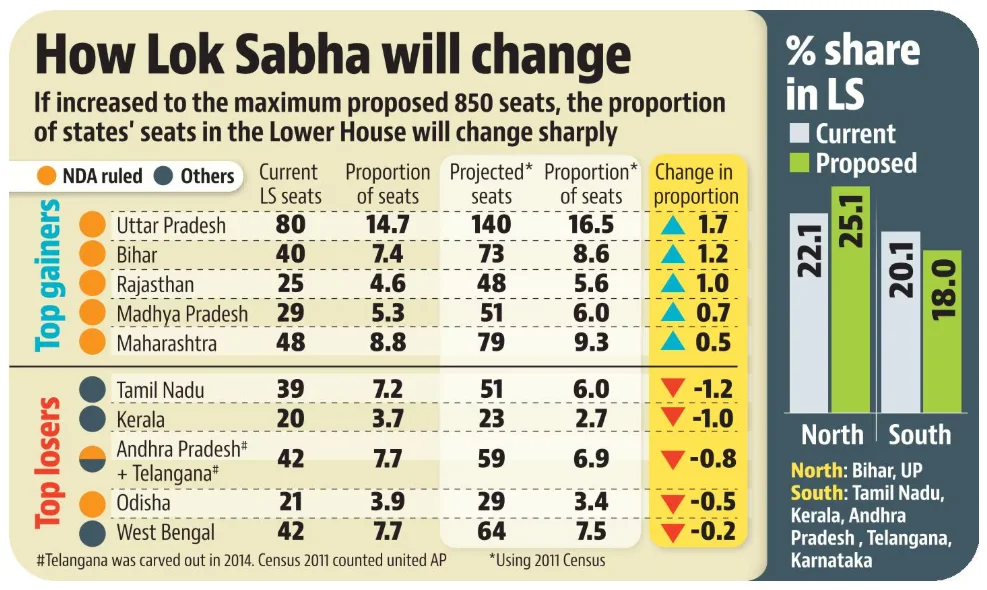
- Loss of Political Representation: If seats are redistributed purely on 2011 population data, the proportion of seats held by Southern states in the Lok Sabha will shrink.
- Uttar Pradesh's share could rise from 14.73% to over 16%. Kerala's share could shrink from 3.68% to 2.7%, and Tamil Nadu's from 7.18% to 5.88%.
- This widens the gap between large Northern states and Southern states, diminishing the South's relative political voice.
- Impact on the Presidential Electoral College: The value of an MP or MLA's vote in the Presidential election is currently pegged to the 1971 Census to ensure parity between states.
- If delimitation alters the number of MLAs and MPs, the fundamental arithmetic of the Electoral College will change. This raises constitutional questions about whether Northern states will gain a disproportionate, unilateral say in electing the President of India.
- Assault on Federalism: Critics argue that this acts as a "backdoor" method to centralize political power.
- It allows a political party to dominate national politics merely by sweeping a few densely populated Northern states, rendering the electoral will of the South largely irrelevant.
- The delimitation process raises concerns that it could enable gerrymandering in the future - the deliberate manipulation of electoral boundaries to give a party an unfair advantage, as feared in cases like Assam.
- Economic Disparity: Southern states contribute a disproportionately higher amount to the national Gross Domestic Product (GDP) and tax revenues.
- Reducing their political representation creates a scenario akin to "taxation without adequate representation."
Arguments For
- Democratic Principle: The core principle of a direct democracy is "One Person, One Vote, One Value."
- A frozen delimitation means an MP in Uttar Pradesh currently represents millions more citizens than an MP in Kerala, which violates the principle of equal democratic representation.
- Absolute Seat Increase: The Centre has clarified that under the expanded 850-seat house, no state will lose its current absolute number of seats.
- In fact, all states are projected to see roughly a 50% increase in their total seat count (e.g., Tamil Nadu moving from 39 to around 58 seats).
- Facilitating Women's Representation: Expanding the house allows the government to introduce the 33% women's quota without drastically shrinking the pool of general seats available for existing political representatives.
Way Forward
- Consensus Building: Delimitation is not merely a mathematical exercise; it is a sensitive redistribution of political power. A national consensus through the Inter-State Council and deep consultations with State governments is imperative.
- A "Hybrid Model" for Seat Allocation: Instead of relying solely on population, a new formula could be devised that gives weightage to demographic performance, economic contribution (GSDP), and geographic size, ensuring performing states are not penalized.
- Strengthening the Rajya Sabha: To balance the population-heavy Lok Sabha, the Rajya Sabha could be reformed to provide equal representation to all states (similar to the US Senate), safeguarding the federal voice of smaller states.
- Decoupling Quotas and Delimitation: Opposition leaders suggest that the 33% Women's Reservation can, and should, be implemented within the existing strength of the Houses, rather than making it contingent on a highly volatile delimitation exercise.
Conclusion
The proposed delimitation aims to uphold the principle of “one person, one vote, one value”, concerns over regional imbalance, federalism, and equity for states with better demographic performance cannot be ignored. A consensus-based and balanced approach, possibly through a hybrid formula and institutional safeguards, is essential to ensure that both representation and federal spirit are preserved.
|
Drishti Mains Question: “Delimitation is essential for democracy but challenging for federalism.” Critically examine in the Indian context. |
Frequently Asked Questions (FAQs)
1. What is delimitation?
It is the process of redrawing electoral constituencies to ensure equal representation based on population.
2. Which constitutional provisions govern delimitation?
Articles 82 and 170 mandate readjustment of seats after every Census.
3. What is the role of the Delimitation Commission?
It is an independent body whose orders have the force of law and cannot be challenged in court.
4. Why is delimitation controversial in India?
It may reduce representation of Southern states despite better population control, raising federal concerns.
5. How does the 2026 proposal impact women’s representation?
It enables 33% reservation for women in Lok Sabha and State Assemblies post-delimitation.
UPSC Civil Services Examination Previous Year Question (PYQ)
Prelims
Q. How many Delimitation Commissions have been constituted by the Government of India till December 2023? (2024)
(a) One
(b) Two
(c) Three
(d) Four
Ans (d)
Q. With reference to the Delimitation Commission consider the following statements:
- The orders of the Delimitation Commission cannot be challenged in a Court of Law.
- When the orders of the Delimitation Commission are laid before the Lok Sabha or State Legislative Assembly, they cannot effect any modification in the orders.
Which of the statements given above is/are correct?
(a) 1 only
(b) 2 only
(c) Both 1 and 2
(d) Neither 1 nor 2
Ans: (c)
Mains
Q. “Demographic Dividend in India will remain only theoretical unless our manpower becomes more educated, aware, skilled and creative.” What measures have been taken by the government to enhance the capacity of our population to be more productive and employable? (2016)
Q. “While we flaunt India’s demographic dividend, we ignore the dropping rates of employability.” What are we missing while doing so? Where will the jobs that India desperately needs come from? Explain.? (2014)
Indian Economy
India’s Food Waste Conundrum
For Prelims: United Nations Environment Programme, Food Waste Index, Global Hunger Index (GHI), Food Corporation of India, Sustainable Development Goal (SDG) 2
For Mains: Food Security and Hunger in India, Agricultural Supply Chain Inefficiencies, Post-Harvest Losses and Cold Chain Infrastructure, Role of Food Processing Sector in Reducing Waste
Why in News?
Following the International Day of Zero Waste (30th March), the United Nations Environment Programme (UNEP) Food Waste Index 2024 highlights that India wastes 78–80 million tonnes of food annually, exposing a stark paradox of widespread hunger alongside massive food wastage.
- The International Day of Zero Waste, highlights the need for better waste management and sustainable consumption. It was proclaimed by the United Nations General Assembly in 2022 and is facilitated by UNEP and United Nations Human Settlements Programme.
- The 2026 International Day of Zero Waste focuses on food waste, a major yet preventable cause of environmental harm.
Summary
- India wastes 78–80 million tonnes of food annually (₹1.55 lakh crore), even as around 194 million people remain undernourished, highlighting a serious gap in food distribution.
- The crisis stems from poor post-harvest infrastructure, weak supply chains, and consumer behaviour, requiring reforms in storage, processing, redistribution, and awareness to achieve food security.
What is the Scale of Food Waste in India?
- India’s Global Standing: The world wastes roughly 1.05 billion tonnes of food annually. Households account for 60% of this waste, food services for 28%, and retail for 12%.
- India ranks 2nd globally in food waste (with 78-80 million tonnes of post-harvest crop and food worth Rs 1.55 lakh crore wasted annually), trailing only behind China (108 million tonnes of food per year).
- In comparison, the US wastes 24.7 million tonnes, while Japan, guided by its zero-waste 'mottainai' culture, wastes just 5.2 million tonnes.
- Per Capita Discard: The per capita household food waste in India is 55 kg annually, which is relatively lower than the US (73 kg) and Germany (75 kg), but highly alarming given India's domestic hunger crisis.
- Economic Value: The economic valuation of this wasted food is estimated at Rs 1.55 lakh crore, severely draining resources and impacting farmer incomes.
- Dual Crisis: India wastes millions of tonnes of food each year, yet nearly 194 million people remain undernourished, revealing a deep structural gap between food production and equitable access.
- The Standing Committee on Food, Consumer Affairs and Public Distribution (2020–2021) reported that the wheat and rice lost in transit over the past four years could have fed 82.30 million people for one month.
- This is reflected in India’s ranking of 111th out of 125 countries in the Global Hunger Index (GHI) 2023, highlighting widespread food insecurity.
- Major Causes of Food Wastage:
- Inadequate Cold Chain Infrastructure: A lack of robust cold storage facilities means that highly perishable items (like fruits, vegetables, dairy, and meat) suffer post-harvest losses to the tune of 30-40%.
- NITI Aayog identifies major hurdles, including under-investment in cold-chain infrastructure, inadequate covered storage, lack of timely mechanization, and poor scientific packaging.
- Poor Logistics and Supply Chain Fragmentation: Fragmented transport networks, a lack of refrigerated vehicles (reefers), and delays in transit lead to rapid spoilage of agricultural produce before it reaches urban markets.
- Storage Inefficiencies: Traditional warehousing (e.g., Food Corporation of India (FCI) storage) often suffers from a lack of scientific preservation methods.
- Open storage and poor packaging (like the mandatory use of porous jute sacks) make grains prone to moisture and rodent damage.
- Between 2019 and 2024, over 8,200 tonnes of foodgrains, spoiled in Food Corporation of India (FCI) facilities in Punjab alone.
- Underutilized Food Processing Sector: India processes only about 8-10% of its agricultural produce, compared to 65% in the USA and 23% in China. A lack of value addition leads to surplus rotting in local markets.
- Consumer and Household Behaviour: Rising urban incomes, changing lifestyles, and the culture of extravagant weddings and banquets contribute heavily to end-consumer food wastage.
- Weather Vulnerabilities: Extreme weather events further exacerbate production and storage vulnerabilities, driving up the rate of spoilage.
- Corruption: The Comptroller and Auditor General of India reported that wheat worth Rs 700 crore was damaged in Punjab (2011–2016) due to poor storage by the FCI, highlighting issues of inefficiency, corruption, and diversion of spoiled food grains.
- Inadequate Cold Chain Infrastructure: A lack of robust cold storage facilities means that highly perishable items (like fruits, vegetables, dairy, and meat) suffer post-harvest losses to the tune of 30-40%.
Food Loss, Food Waste and Food Wastage
- Food Loss: It refers to a decrease in mass (dry matter) or nutritional value (quality) of food intended for human consumption.
- This occurs primarily due to inefficiencies in food supply chains, including poor infrastructure, inadequate logistics, lack of technology, and insufficient skills and management. Additionally, natural disasters contribute to these losses.
- Food Waste: It refers to food suitable for human consumption that is discarded, whether due to spoilage or exceeding its expiry date.
- This waste can result from factors such as market oversupply or individual consumer shopping and eating habits.
- Food Wastage: It refers to any food lost by deterioration or waste. Thus, the term “wastage” encompasses both food loss and food waste.
What are the Impacts of Food Wastage?
- Economic Drain: The Rs 1.55 lakh crore loss annually directly impacts the agrarian economy. It restricts farmers from realizing the true market value of their produce and contributes to inflationary pressures on food prices for consumers.
- Wastage of Vital Resources: Wasting food means wasting the resources used to produce it.
- For instance, producing 1 kg of rice requires around 5,000 litres of water. When this rice is wasted, the groundwater extracted from already depleted regions (like Punjab and Haryana) is also wasted.
- Greenhouse Gas Emissions: Food loss and waste account for 8-10% of global annual greenhouse gas emissions.
- If food waste were a country, it would be the third-largest emitter globally.
- Methane Release: Decomposing food in landfills produces methane, a greenhouse gas significantly more potent than CO₂ in terms of atmospheric warming.
- Social & Humanitarian Crisis: The loss of such vast quantities of food directly undermines Sustainable Development Goal (SDG) 2: Zero Hunger, exacerbating malnutrition, stunting, and wasting among vulnerable populations.
Government Initiatives to Curb Food Wastage
- Pradhan Mantri Kisan Sampada Yojana (PMKSY): Aimed at creating modern infrastructure with efficient supply chain management from farm gate to retail outlet, particularly focusing on mega food parks and cold chain infrastructure.
- PM Formalisation of Micro food processing Enterprises (PMFME): A scheme under the Atmanirbhar Bharat Abhiyan to provide financial, technical, and business support to micro food processing units to enhance local value addition.
- Agriculture Infrastructure Fund (AIF): A medium-long term debt financing facility for investment in viable projects for post-harvest management infrastructure and community farming assets.
- Food Safety and Standards Authority of India (FSSAI) Initiatives: Initiatives like "Save Food, Share Food, Share Joy" to encourage the redistribution of surplus food to the needy.
- e-NAM (National Agriculture Market): A digital platform to integrate mandis and improve price discovery, reducing wastage due to delayed sales.
- PACS (Primary Agricultural Credit Societies): Strengthened to act as multi-service centers for storage, aggregation, and distribution, helping minimize losses at the grassroots level.
- Mission LiFE: Promotes sustainable consumption over "use-and-dispose" habits. Key actions include reducing food waste, composting, and biogas contribution. It aims to foster a "Pro-Planet People" (P3) mass movement (Jan Andolan) to make sustainability a global cultural norm.
How can India Effectively Tackle and Eliminate Food Wastage?
- Build the Cold Chain: Treating cold-chain development as essential food security infrastructure, especially in agrarian states is critical to breaking the loss chain.
- Promoting solar-powered, decentralized cold storage units at the Panchayat or Farmer Producer Organisation (FPO) level can drastically reduce distress sales and post-harvest losses.
- Legislate for Food Sharing: India needs a national law to redistribute surplus food. Taking cues from European nations, supermarkets and institutions should be legally mandated to donate unsold edible food, supported by tax incentives.
- Empower the Farm Gate: Modernize early-stage storage by equipping farmer-producer organizations with mechanized drying and mobile cold units.
- Track and Measure Waste: Establish a consolidated national database, modelled on UNEP's methodology, requiring large food businesses, caterers, and institutional kitchens to publicly report their food waste.
- Boosting the Processing Sector: Transitioning from a purely 'production-centric' approach to a 'processing and preservation-centric' approach. Incentivizing private sector investments in food tech and packaging is critical.
- Revive Cultural Ethics: Rekindle the traditional philosophy of treating food as sacred (Anna Brahma). Schools and public institutions should promote food conservation not merely as an awareness campaign, but as a fundamental civic responsibility.
- Launching a nationwide behavioural change campaign akin to the Swachh Bharat Abhiyan to educate urban consumers, restaurants, and event organizers on food portion control and surplus food donation.
- Circular Economy: Encouraging the conversion of unavoidable food waste into valuable by-products like Compressed Biogas (CBG) under the SATAT scheme or organic compost for agriculture.
- Halving global food waste by 2030 (SDG 12.3) is a key climate action that can reduce global methane emissions by up to 7%.
International Models Addressing Food Waste
- US: The PATH Act (2015) offers tax incentives to encourage businesses to donate surplus food.
- Italy: Provides financial incentives (~USD 10 million annually) to reduce food waste by promoting donations to charities.
- UN Framework: The Food Loss and Waste Protocol sets global standards to measure waste across supply chains and supports SDG 12.3 targets.
Conclusion
India’s food waste crisis reflects deep supply chain inefficiencies amid widespread hunger. Solving it needs better post-harvest systems, food redistribution, and a cultural shift to value food, making it both an economic necessity and a moral duty aligned with Zero Hunger (SDG 2).
|
Drishti Mains Question: “India’s food waste crisis is not a problem of scarcity but of distribution and inefficiency.” Critically examine. |
Frequently Asked Questions (FAQs)
1. What is the difference between food loss and food waste?
Food loss occurs during production and supply chains, while food waste happens at retail or consumer levels due to discarding edible food.
2. What is the UNEP Food Waste Index?
It is a global report measuring food waste across households, retail, and food services to track SDG 12.3 targets.
3. Why is food waste a climate concern?
It contributes 8–10% of global GHG emissions and releases methane, a highly potent greenhouse gas.
4. Which schemes address food wastage in India?
PMKSY, PMFME, Agriculture Infrastructure Fund, and FSSAI initiatives like “Save Food, Share Food”.
5. How can food wastage be reduced in India?
By strengthening cold chains, promoting food redistribution laws, improving processing, and encouraging behavioural change.
UPSC Civil Services Examination Previous Year Question (PYQ)
Mains
Q. What are the challenges and opportunities of food processing sector in the country? How can income of the farmers be substantially increased by encouraging food processing? (2020)
Q. Food Security Bill is expected to eliminate hunger and malnutrition in India. Critically discuss various apprehensions in its effective implementation along with the concerns it has generated in WTO. (2013)
Rapid Fire
IVF in Vegetative State
The Delhi High Court upheld a woman’s right to continue In-vitro Fertilization (IVF) with an Indian Army soldier in a vegetative state (disorder of consciousness), holding that his prior consent remains valid despite his current medical condition.
- Constitutional Rights: The soldier's wife approached the court to resume the IVF treatment, invoking her right to motherhood, dignity, and reproductive autonomy under Article 21 (Right to Life)
- Delhi High Court Ruling on Consent: The court stated that under the Assisted Reproductive Technology (Regulation) Act, 2021, the wife's consent will legally be treated as valid consent on her husband's behalf in this unique situation.
- Despite the medical board noting a "meagre" chance of retrieving viable sperm, the court allowed the procedure.
In-Vitro Fertilization (IVF)
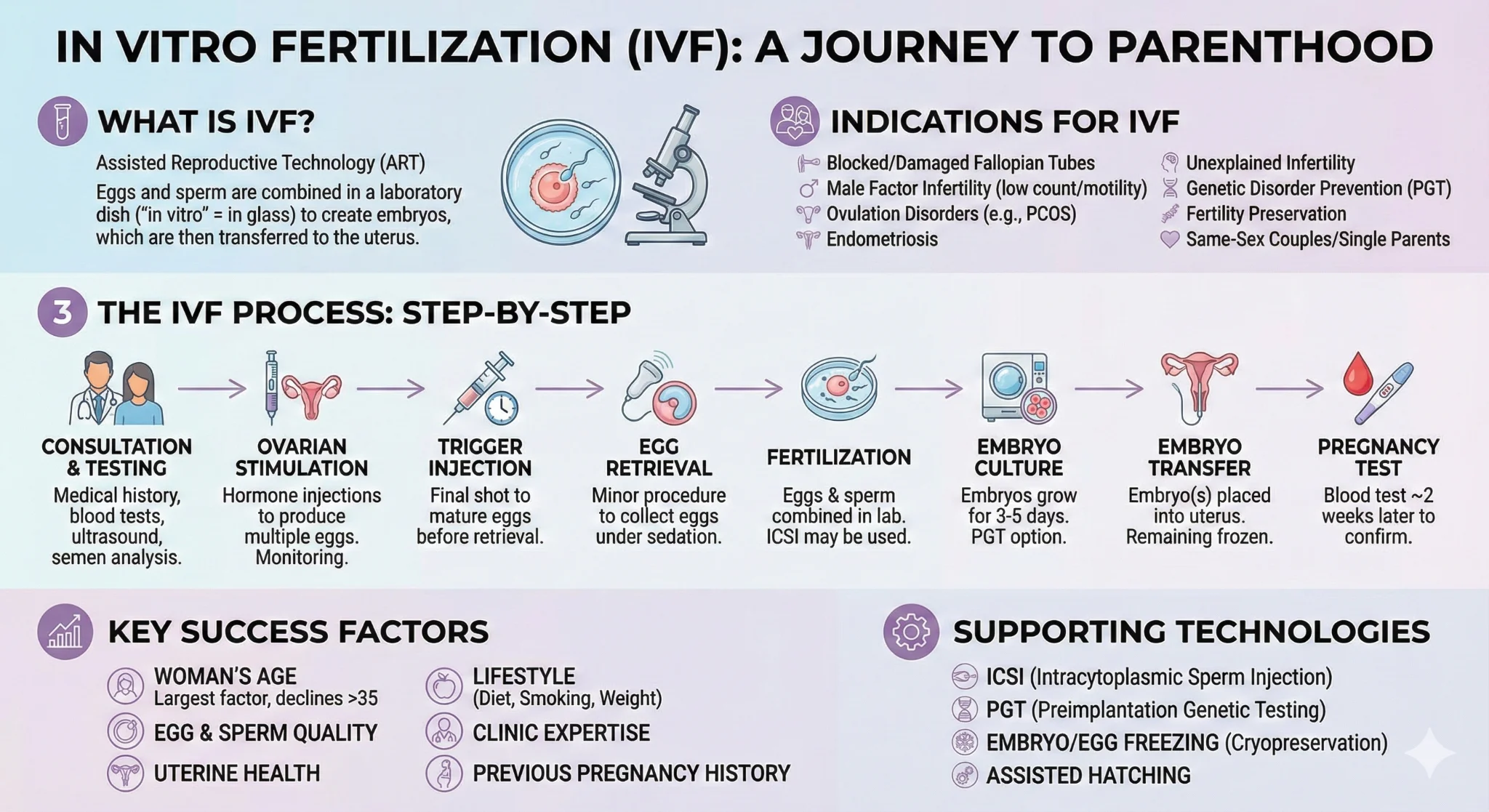
- It is one of the most widely used Assisted Reproductive Technologies (ART) for treating infertility, where a woman’s eggs are fertilized with sperm outside the body in a laboratory, and the resulting embryo is transferred into the uterus to achieve pregnancy.
- In India, ART services are regulated under the Assisted Reproductive Technology (Regulation) Act, 2021, which sets standards for clinics, donation, and cryopreservation, while under the Central Government Health Scheme (CGHS), financial support is provided through reimbursement for IVF cycles subject to eligibility conditions.
| Read more: In-vitro Fertilization (IVF) Technology |
Rapid Fire
Biomass-based Improved Cookstoves (ICS)
Recently, amid the LPG supply crisis, the relevance of modern biomass-based Improved Cookstoves (ICS) has come into focus, especially as many rural households shift back to firewood, raising concerns about cleaner cooking alternatives.
- About: Improved Cookstoves (ICS) are advanced biomass stoves designed to improve combustion efficiency and reduce emissions compared to traditional chulhas.
- Efficiency Improvement: ICS achieve 38–45% efficiency, significantly higher than traditional chulhas, which, due to poor airflow and substantial heat loss, operate at around 10% efficiency.
- Advantages:
- Technologies like secondary aeration in ICS help capture soot and harmful gases before they turn into smoke, improving indoor air quality.
- ICS can reduce firewood consumption by over 50–66%, lowering resource pressure.
- Firewood (≈₹10/kg) is much cheaper than LPG (>₹100/kg), offering potential savings of over 60%, especially during supply disruptions.
- ICS can use pellets, briquettes, crop residue and dung, expanding fuel options and reducing pressure on raw firewood.
- Financing Model: Emission reductions can generate carbon credits, helping subsidise costs through microfinance and CSR initiatives.
- Supply and Scalability: Large-scale adoption does not require massive centralized infrastructure, as fuels like firewood and crop waste are locally available.
- However, scaling depends on strong distribution networks, last-mile delivery, local partnerships, and user awareness. After-sales support is essential for sustained usage.
- Challenges: Key issues include upfront costs, awareness gaps, and logistical constraints; although emissions are reduced compared to traditional stoves, they may still be higher than LPG.
| Read more: Biomass Electricity |
Rapid Fire
Lanjia Saora Tribe
Recently, the Lanjia Saora tribe, a Particularly Vulnerable Tribal Group (PVTG) in Odisha, was highlighted for its evolving cultural practices.
- About Lanjia Saora: The Lanjia Saora are a subgroup of the Saora tribe, inhabiting the forested hills of Rayagada and Gajapati districts in Odisha.
- The Saora are considered among the ancient tribal communities of India and are also found in states like Andhra Pradesh, Jharkhand, and Madhya Pradesh.
- The tribe includes groups such as Lanjia Saora (hill-dwelling, shifting cultivation) and Sudha Saora (plains, settled agriculture and wage work).
- Language: They speak Saora, a Mundari language belonging to the Austroasiatic family.
- Lifestyle and Culture: The community sustains itself through shifting cultivation, foraging, and small-scale farming. Their belief system is closely tied to nature, with rituals, music, and dance forming an integral part of daily life.
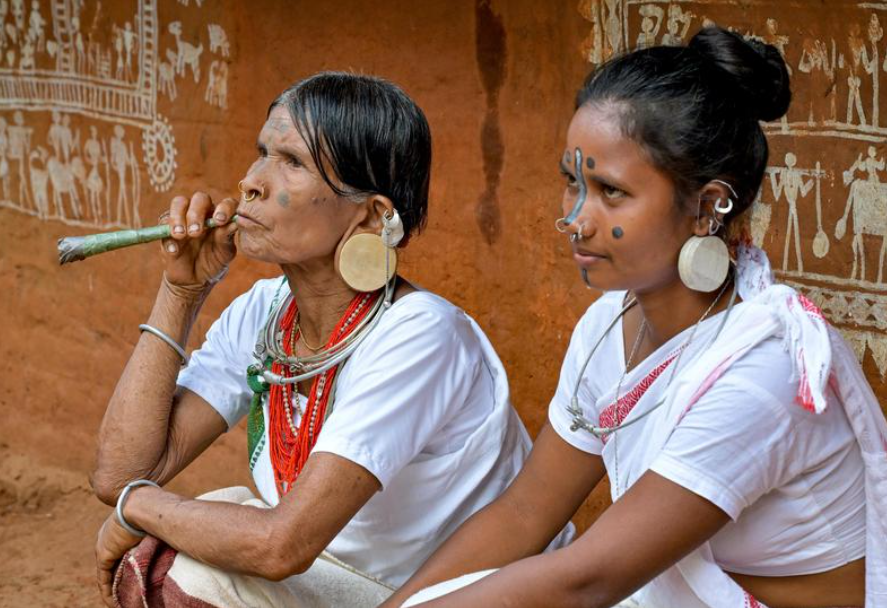
- Traditional Ornaments: They are known for large metal earrings fixed into stretched earlobes and tattoos with geometric and nature-inspired motifs, which hold spiritual significance.
- Younger members are adapting traditions by using detachable ornaments and temporary tattoos, reflecting a balance between tradition and modernity.
- Dance & Music: They perform vibrant dances with spontaneous songs, using instruments like brass pipes, cymbals and gongs, with distinctive attire such as turbans with crane feathers, umbrellas, swords and peacock plumes.
| Read more: Lanjia Saora Tribe |
Rapid Fire
DF-PIBM Tool for Predicting Pollen Spread in Cities
The study, published in Physics of Fluids, introduces a simulation model called DF-PIBM (direct-forcing porous immersed boundary method), which can accurately predict how pollen travels through urban air.
- This helps address rising public health concerns linked to climate change and increased urban tree cover, as airborne allergens become a significant issue due to expanding plantations for urban shade.
- Pollen: It is a fine, powdery substance produced by plants for reproduction, often causing seasonal allergies (hay fever) when inhaled.
- Released by trees (spring), grasses (summer), and weeds (fall), these microscopic grains trigger symptoms like sneezing, congestion, and itchy eyes.
- High wind and dry weather increase airborne pollen, while rain reduces it.
- DF-PIBM: It is a computer simulation model that treats trees as porous structures, allowing air to flow through their leaves and branches.
- It tracks how pollen grains detach under wind pressure and move through urban environments using physical laws.
- The model incorporates factors such as wind speed, pressure, leaf density, and the threshold force required to detach pollen grains, enabling realistic prediction of pollen dispersion in cities.
- Significance & Application: Scaling up this model to simulate entire neighborhoods will assist urban planners and policymakers in strategically selecting and placing tree species, mitigating respiratory health risks and designing healthier smart cities.
| Read more: Pollinator Week |
Rapid Fire
IMF Cuts Global Growth Outlook
Recently, the International Monetary Fund cut its global growth outlook, warning that the world economy is drifting toward a more adverse scenario due to the West Asia conflict, which it cautioned could trigger the largest energy crisis in modern times.
- About: The revision is driven by energy price spikes and disruptions in oil supply, especially the Strait of Hormuz, due to ongoing conflict.
- Without the conflict, the IMF would have upgraded growth by 0.1 percentage point to ~3.4%, supported by strong technology investment, lower interest rates, and fiscal support.
- However, global growth for 2026 has now been cut by about 20 basis points to ~3.1%, inflation is expected to rise before moderating, and emerging economies are likely to be more adversely affected.
- Growth Scenarios: The IMF outlined three scenarios—“weaker, worse and severe”—depending on how the conflict evolves.
- Baseline (Reference) Scenario: Assumes a short-lived conflict, with oil prices averaging ~$82 per barrel in 2026, though this is well below current Brent crude levels (~$96).
- Adverse Scenario: Under a prolonged conflict, global growth may fall to ~2.5% in 2026 (from 3.4% in 2025), with oil prices around $100 per barrel.
- Worst-Case Scenario: The global economy could approach recession, with oil prices rising to $110 (2026) and $125 (2027).
- India Outlook: India’s growth is projected at ~6.5%, reflecting relative resilience despite global uncertainties.
- Current Trend: IMF noted that the global economy is already drifting toward the adverse scenario, and the outlook may already be outdated due to ongoing disruptions and uncertainty.
| Read more: 2025 World Economic Outlook Report |



