


Indian Polity
Delimitation and Women’s Reservation in Legislatures
- 16 Apr 2026
- 20 min read
For Prelims: Delimitation, Census, Article 81, Article 82, Nari Shakti Vandan Adhiniyam
For Mains: Delimitation and Representation in Indian Democracy, Federalism and Centre–State Relations, Women’s Political Representation in India, Constitutional Amendments and Electoral Reforms
Why in News?
The Union government has introduced three major Bills: the Constitution (One Hundred and Thirty-First Amendment) Bill, 2026, the Delimitation Bill, 2026, and the Union Territories Laws (Amendment) Bill, 2026, to enable fresh delimitation based on the latest available Census, expand the Lok Sabha, and operationalise 33% women’s reservation in legislatures.
Summary
- The government has introduced three Bills to enable fresh delimitation using recent Census data, expand the Lok Sabha to 850 seats, and implement 33% reservation for women.
- A new Delimitation Commission will redraw constituencies and allocate seats, with its decisions being final and legally binding, though subject to debate over fairness and federal balance.
- The move aims to uphold “one person, one vote, one value,” but raises concerns about reduced representation of southern states and potential impact on federalism.
What are the Key Provisions of Three Bills to Fast-track the Nari Shakti Vandan Adhiniyam?
The Constitution (131st Amendment) Bill, 2026
- Expanding the Lok Sabha: It amends Article 81 to increase the maximum strength of the Lok Sabha from 550 to 850 members (815 from States and 35 from Union Territories).
- Article 81 dictates the principle of equal representation; the ratio between a state's allocated seats and its population must be roughly the same across all states (with exceptions only for very small states under 6 million).
- Removing the Delimitation Freeze: The Bill also amends the marginal heading of Article 82 from “Readjustment after each Census” to “Readjustment of constituencies”, and removes the requirement of readjusting the number of Lok Sabha seats in states after every Census.
- Similarly, it makes amendments to the Articles on state Assemblies (Article 170) and reservation for SCs and STs, changing the basis from the 2001 Census to “such Census” that Parliament decides by law to use.
- As of now, Article 81 (2) and (3) freeze the Lok Sabha seats as per the 1971 Census and the Assembly seats as per the 2001 Census, “until the relevant figures for the first census taken after the year 2026 have been published”.
- By decoupling delimitation from the post-2026 Census, the government can now proceed delimitation using data from the 2011 Census.
- Expediting Women's Quota: It amends Article 334A to allow the immediate implementation of the 33% women's reservation in the Lok Sabha and State Assemblies (Nari Shakti Vandan Adhiniyam (Constitution 106th Amendment Act, 2023)) right after this new delimitation process is completed, targeting the 2029 elections.
- Constitution (131st Amendment) Bill, 2026 requires a special majority in Parliament and ratification by at least half of the States, as it amends the Constitution.
The Delimitation Bill, 2026
- While the Constitution (131st Amendment) Bill, 2026, allows for the overhaul, this Bill creates the actual mechanism to execute it.
- New Delimitation Commission: It replaces the Delimitation Act of 2002 and empowers the Central Government to constitute a new Delimitation Commission.
- This body will be headed by a Supreme Court judge and include the Chief Election Commissioner, State Election Commissioners and give it powers equivalent to a civil court.
- Redrawing Constituencies: The Commission is tasked with readjusting the allocation of seats and redrawing territorial constituencies based on the "latest published census figures" (which currently points to the 2011 Census).
- The Delimitation Commission, as in the past, is required to ensure, as far as possible, that all constituencies are geographically compact. It must also take into account physical features, existing administrative boundaries, communication facilities, and public convenience.
- The Bills provide safeguards like draft publication, objections, and public hearings. However, once notified, the Commission’s orders are final, have the force of law, and cannot be challenged in court, which may invite scrutiny.
- Executing the Quota: The Commission will be tasked with allocating seats across States, redrawing constituency boundaries, and determining reservations for Scheduled Castes (SCs), Scheduled Tribes (STs), and women.
The Union Territories Laws (Amendment) Bill, 2026
- This is the enabling legislation required to extend these structural changes to the Union Territories that have their own legislatures.
- It operationalizes the 33% reservation for women and the corresponding delimitation overhaul in Delhi, Jammu & Kashmir, and Puducherry.
- Delimitation Bill, 2026 & UT Laws (Amendment) Bill, 2026 are ordinary bills that require only a simple majority in Parliament.
Operationalising the Women’s Quota
- Triggering the Nari Shakti Vandan Adhiniyam: The impending delimitation exercise will officially trigger the implementation of the Nari Shakti Vandan Adhiniyam (106th Constitutional Amendment Act, 2023).
- It mandates that one-third (33%) of all seats in the Lok Sabha and State Legislative Assemblies be reserved for women.
- Crucially, this includes a mandatory sub-quota for women within the seats already reserved for Scheduled Castes (SC) and Scheduled Tribes (ST).
- Rotation and Sunset Clause: The specific constituencies reserved for women will be rotated after each subsequent delimitation cycle.
- Furthermore, the reservation comes with a "sunset clause" it is valid for an initial period of 15 years, though Parliament retains the authority to extend it through legislation.
- It does not provide any separate reservation for women belonging to Other Backward Classes (OBCs).
What is Delimitation?
- About: Delimitation is the process of fixing or redrawing the boundaries of territorial constituencies for the Lok Sabha and State Legislative Assemblies to ensure that each seat represents a roughly equal number of voters.
- Objective: To operationalize the democratic principle of “one person, one vote, one value” by adjusting boundaries as population densities shift over time.
- Constitutional Mandate: Article 82 mandates Parliament to enact a Delimitation Act after each census, readjusting Lok Sabha seat allocation to States and dividing States into territorial constituencies.
- Article 170 provides for a similar readjustment of seats and constituencies in State Legislative Assemblies.
- Delimitation Commission: It is a high-powered, independent body appointed by the Central Government, consisting of 3 members, i.e., a Chairperson (a serving or retired Supreme Court Judge), the Chief Election Commissioner (or an Election Commissioner nominated by them), and State Election Commissioners of the concerned states.
- The orders of the Commission have the force of law and cannot be challenged in any court. Its orders are presented to the Lok Sabha and State Assemblies but cannot be modified.
- It has been set up four times till March 2026 i.e., 1952, 1963, 1973, and 2002.
- Freeze on Delimitation: The 42nd Amendment Act, 1976 froze the total number of seats in the Lok Sabha on the 1971 Census to ensure that states implementing population control measures (primarily in the South) were not penalized with reduced political representation.
- The 84th Amendment Act, 2001 extended the freeze on the total number of seats until the first census after 2026.
- While the 2002 Commission redrew internal boundaries within states (based on the 2001 Census), the inter-state allocation of seats remains based on 1971 data.
- Judicial Review: In the Kishorchandra Chhanganlal Rathod Case, 2024, the Supreme Court held that an order by the Delimitation Commission can be reviewed if it is clearly arbitrary and violates constitutional values.
What are the Arguments Regarding the Proposed Delimitation?
Arguments Against
- Penalising Demographic Success: Southern states argue that they are effectively being punished for successfully implementing the Centre's family planning and population control policies over the last 50 years.
- Their population growth has slowed significantly compared to Northern states like Uttar Pradesh and Bihar.
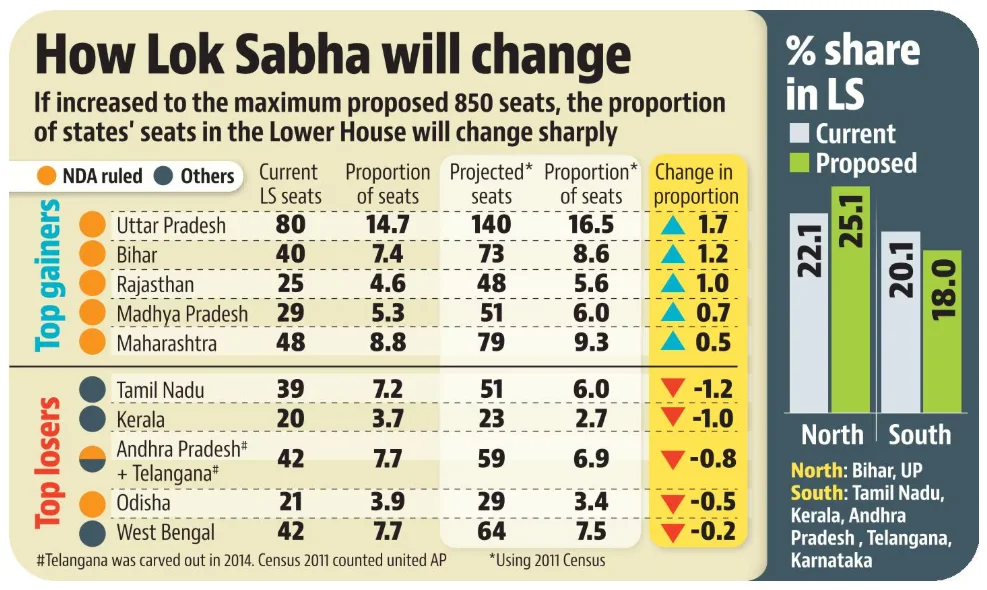
- Loss of Political Representation: If seats are redistributed purely on 2011 population data, the proportion of seats held by Southern states in the Lok Sabha will shrink.
- Uttar Pradesh's share could rise from 14.73% to over 16%. Kerala's share could shrink from 3.68% to 2.7%, and Tamil Nadu's from 7.18% to 5.88%.
- This widens the gap between large Northern states and Southern states, diminishing the South's relative political voice.
- Impact on the Presidential Electoral College: The value of an MP or MLA's vote in the Presidential election is currently pegged to the 1971 Census to ensure parity between states.
- If delimitation alters the number of MLAs and MPs, the fundamental arithmetic of the Electoral College will change. This raises constitutional questions about whether Northern states will gain a disproportionate, unilateral say in electing the President of India.
- Assault on Federalism: Critics argue that this acts as a "backdoor" method to centralize political power.
- It allows a political party to dominate national politics merely by sweeping a few densely populated Northern states, rendering the electoral will of the South largely irrelevant.
- The delimitation process raises concerns that it could enable gerrymandering in the future - the deliberate manipulation of electoral boundaries to give a party an unfair advantage, as feared in cases like Assam.
- Economic Disparity: Southern states contribute a disproportionately higher amount to the national Gross Domestic Product (GDP) and tax revenues.
- Reducing their political representation creates a scenario akin to "taxation without adequate representation."
Arguments For
- Democratic Principle: The core principle of a direct democracy is "One Person, One Vote, One Value."
- A frozen delimitation means an MP in Uttar Pradesh currently represents millions more citizens than an MP in Kerala, which violates the principle of equal democratic representation.
- Absolute Seat Increase: The Centre has clarified that under the expanded 850-seat house, no state will lose its current absolute number of seats.
- In fact, all states are projected to see roughly a 50% increase in their total seat count (e.g., Tamil Nadu moving from 39 to around 58 seats).
- Facilitating Women's Representation: Expanding the house allows the government to introduce the 33% women's quota without drastically shrinking the pool of general seats available for existing political representatives.
Way Forward
- Consensus Building: Delimitation is not merely a mathematical exercise; it is a sensitive redistribution of political power. A national consensus through the Inter-State Council and deep consultations with State governments is imperative.
- A "Hybrid Model" for Seat Allocation: Instead of relying solely on population, a new formula could be devised that gives weightage to demographic performance, economic contribution (GSDP), and geographic size, ensuring performing states are not penalized.
- Strengthening the Rajya Sabha: To balance the population-heavy Lok Sabha, the Rajya Sabha could be reformed to provide equal representation to all states (similar to the US Senate), safeguarding the federal voice of smaller states.
- Decoupling Quotas and Delimitation: Opposition leaders suggest that the 33% Women's Reservation can, and should, be implemented within the existing strength of the Houses, rather than making it contingent on a highly volatile delimitation exercise.
Conclusion
The proposed delimitation aims to uphold the principle of “one person, one vote, one value”, concerns over regional imbalance, federalism, and equity for states with better demographic performance cannot be ignored. A consensus-based and balanced approach, possibly through a hybrid formula and institutional safeguards, is essential to ensure that both representation and federal spirit are preserved.
|
Drishti Mains Question: “Delimitation is essential for democracy but challenging for federalism.” Critically examine in the Indian context. |
Frequently Asked Questions (FAQs)
1. What is delimitation?
It is the process of redrawing electoral constituencies to ensure equal representation based on population.
2. Which constitutional provisions govern delimitation?
Articles 82 and 170 mandate readjustment of seats after every Census.
3. What is the role of the Delimitation Commission?
It is an independent body whose orders have the force of law and cannot be challenged in court.
4. Why is delimitation controversial in India?
It may reduce representation of Southern states despite better population control, raising federal concerns.
5. How does the 2026 proposal impact women’s representation?
It enables 33% reservation for women in Lok Sabha and State Assemblies post-delimitation.
UPSC Civil Services Examination Previous Year Question (PYQ)
Prelims
Q. How many Delimitation Commissions have been constituted by the Government of India till December 2023? (2024)
(a) One
(b) Two
(c) Three
(d) Four
Ans (d)
Q. With reference to the Delimitation Commission consider the following statements:
- The orders of the Delimitation Commission cannot be challenged in a Court of Law.
- When the orders of the Delimitation Commission are laid before the Lok Sabha or State Legislative Assembly, they cannot effect any modification in the orders.
Which of the statements given above is/are correct?
(a) 1 only
(b) 2 only
(c) Both 1 and 2
(d) Neither 1 nor 2
Ans: (c)
Mains
Q. “Demographic Dividend in India will remain only theoretical unless our manpower becomes more educated, aware, skilled and creative.” What measures have been taken by the government to enhance the capacity of our population to be more productive and employable? (2016)
Q. “While we flaunt India’s demographic dividend, we ignore the dropping rates of employability.” What are we missing while doing so? Where will the jobs that India desperately needs come from? Explain.? (2014)



