


Important Facts For Prelims
In-vitro Fertilization (IVF) Technology
- 09 Dec 2025
- 8 min read
Why in News?
A Indian Council of Medical Research–National Institute for Research in Reproductive and Child Health (ICMR-NIRRCH) report shows that infertile couples in India face a heavy financial burden, with a single In-vitro Fertilization (IVF) cycle costing over Rs 1 lakh even in public hospitals.
What is In-vitro Fertilization (IVF)?
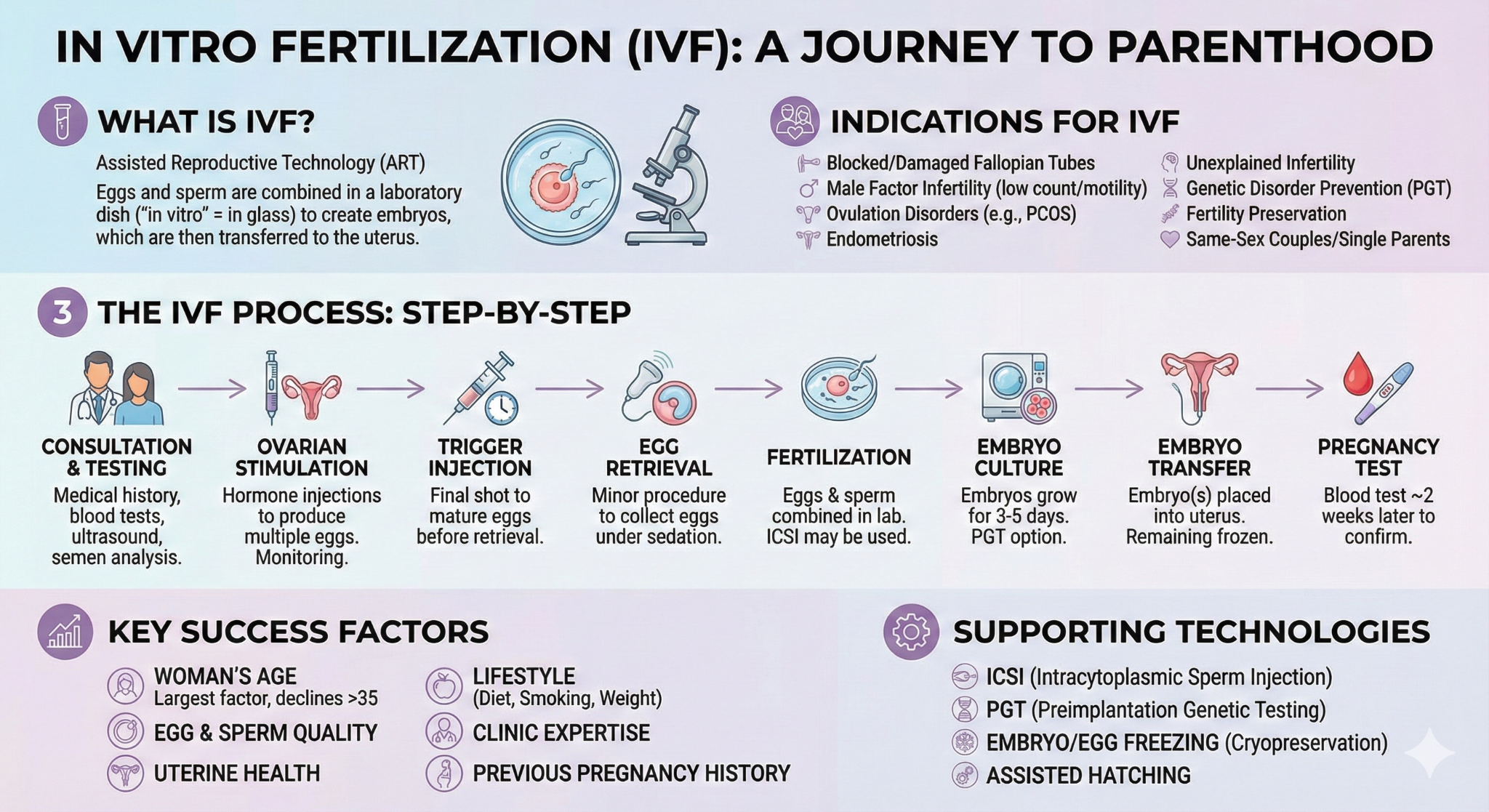
- About: In-Vitro Fertilization (IVF) is one of the most widely used Assisted Reproductive Technologies (ART) for treating infertility.
- In IVF, a woman’s eggs are fertilized by sperm outside the body in a laboratory, and the resulting embryo is then transferred into the uterus to achieve pregnancy.
- IVF is commonly used when natural conception is not possible due to blocked fallopian tubes, low sperm count, ovulation disorders, endometriosis, age-related infertility, or unexplained infertility.
- Importance of IVF: Rising infertility in India due to stress, lifestyle changes, late marriage, Polycystic Ovary Syndrome (PCOS), and obesity has increased the demand for IVF, which helps in repeated miscarriages and fertility preservation for cancer patients.
- With one in six couples affected and fertility rates falling, experts stress the need to make fertility care accessible to protect India’s demographic balance.
- Cost of IVF: According to the ICMR-NIRRCH, a single IVF cycle costs over Rs 1 lakh in both public and private hospitals.
- The public health system spends Rs 6,822 to Rs 11,075 per patient annually, and globally, one ART cycle costs 166% of an average Indian’s yearly income.
- Regulation in India: India’s ART services are regulated under the Assisted Reproductive Technology (Regulation) Act, 2021 and its Rules, which govern egg and sperm donation, cryopreservation, registration of ART clinics, and standards for different types of clinics.
- Under the Central Government Health Scheme (CGHS), a one-time reimbursement of Rs 65,000 or actual cost (whichever is lower) is provided for three fresh IVF cycles, subject to eligibility conditions.
Assisted Reproductive Technology (Regulation) Act, 2021
- About: The ART (Regulation) Act, 2021 was enacted to regulate ART clinics and ART banks in India and ensure ethical, safe, and transparent fertility treatment.
- The Act provides a legal framework to supervise the rapidly growing use of technologies like IVF, while protecting the rights of women, children, and donors.
- The Act mandates compulsory registration of all ART clinics and banks through a National Registry, which acts as a central database.
- Eligibility for Commissioning Parties: ART services are available to single women and infertile married couples, where the woman is 21–50 years and the man is 21–55 years. Foreigners are also allowed to access ART services.
- Eligibility for Donors: Semen donors (21–55 years); Egg donors (23–35 years).
- A woman can donate eggs only once, with a maximum of 7 eggs retrieved.
- A donor’s gametes cannot be supplied by a bank to more than one commissioning party.
- Consent and Screening: Written informed consent is mandatory, and genetic disease screening is compulsory. Sex-selective services are strictly prohibited.
- Insurance for Egg Donor: Commissioning parties must provide insurance coverage to protect the donor against medical loss, injury, or death.
- Children born through ART are legally recognised as the biological children of the commissioning parents, while donors have no parental rights.
Frequently Asked Questions (FAQs)
Q. What is the main finding of the ICMR–NIRRCH study on IVF?
It found that a single IVF cycle costs over ₹1 lakh even in public hospitals, causing high out-of-pocket burden.
Q. Which law regulates IVF and ART services in India?
The Assisted Reproductive Technology (Regulation) Act, 2021 and its Rules regulate ART practices in India.
Q. Which government scheme currently provides limited IVF reimbursement?
CGHS provides one-time reimbursement up to ₹65,000 for three fresh IVF cycles, subject to eligibility.
Q. Why is inclusion of IVF under PM-JAY being demanded?
To reduce financial burden, improve access, and address declining fertility and rising infertility.
Summary
- An ICMR–NIRRCH study reveals that a single IVF cycle in India costs over Rs 1 lakh, even in public hospitals, creating a heavy financial burden.
- Female factors, especially PCOS, are the leading cause of infertility, while male factors contribute significantly.
- Infertility severely affects quality of life due to pain, anxiety, and depression.
- The report recommends including IVF under PM-JAY, expanding public ART services, and regulating treatment costs.
UPSC Civil Services Examination Previous Year Question (PYQ)
Prelims
Q. In the context of recent advances in human reproductive technology, “Pronuclear Transfer” is used for (2020)
(a) fertilization of egg in vitro by the donor sperm
(b) genetic modification of sperm producing cells
(c) development of stem cells into functional embryos
(d) prevention of mitochondrial diseases in offspring
Ans: (d)
Q. Consider the following statements: (2020)
- Genetic changes can be introduced in the cells that produce eggs or sperms of a prospective parent.
- A person’s genome can be edited before birth at the early embryonic stage.
- Human induced pluripotent stem cells can be injected into the embryo of a pig.
Which of the statements given above is/are correct?
(a) 1 only
(b) 2 and 3 only
(c) 2 only
(d) 1, 2 and 3
Ans: (d)



