


Internal Security
Self-Reliance in Defence Sector
- 22 Nov 2025
- 12 min read
For Prelims: Defence Acquisition Procedure (DAP 2020), Defence Procurement Manual (DPM 2025), Defence Industrial Corridors, Hypersonics, INS Vikrant, Tejas LCA, CAG, CVC, CBI, Directed-energy Weapons, Quantum Computing.
For Mains: India’s Defence Indigenisation Status, Key Challenges Hindering Progress, and the Way Forward.
Why in News?
India has reached a new peak in its defence sector with the country’s highest-ever defence production of Rs 1.54 lakh crore in FY 2024-25. This marks a significant leap, underlining the success of the government's Aatmanirbhar Bharat initiative.
What is the Current Status of India’s Defence Sector?
- Record Production: Defence production is projected to reach Rs 1.75 lakh crore this fiscal year, up from Rs 46,429 crore in FY 2014-15. India aims to achieve Rs 3 lakh crore in defence production by 2029.

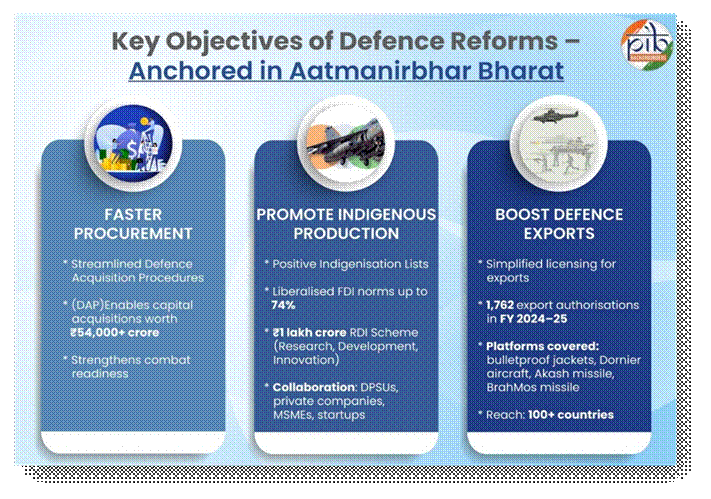
- Defence Procurement: Defence Acquisition Procedure (DAP 2020) and Defence Procurement Manual (DPM 2025) have brought speed, transparency, and innovation to defence procurement, with 65% of equipment now produced domestically, reducing import dependence.
- Boost in Defence Exports: Defence exports reached a record Rs 23,622 crore in FY 2024-25, from less than Rs 1,000 crore in 2014. India now exports to over 100 countries, including the US, France, and Armenia.
- India aims to achieve Rs 50,000 crore in exports by 2029.
- Supportive Industrial Ecosystem: Establishment of Defence Industrial Corridors in Uttar Pradesh and Tamil Nadu attracted over Rs 9,000 crore in investments.
- 16,000 MSMEs are active in defence production, along with start-ups and private companies.
What Factors are Fueling India’s Growth in Indigenous Defence Production?
- Policy Reforms: DAP 2020 and DPM 2025 enable faster, transparent procurement, supported by Positive Indigenisation Lists, liberalised FDI up to 74%, and simplified licensing.
- Rising Defence Budget: Defence budget increased from Rs 2.53 lakh crore in 2013-14 to Rs 6.81 lakh crore in 2025-26, providing ample funds for modernisation and domestic production.

- Public-Private Partnership: Defence DPSUs (DPSUs) contribute ~77% of production, while the private sector share increased to 23%, reflecting growing industry participation.
- Global Market Integration: Simplified export processes, digital systems, and Open General Export Licences (OGEL) have boosted global competitiveness, with defence exports rising to Rs 23,622 crore in FY 2024-25, a 12% increase from the previous year.
- Technological Advancements: Emphasis on indigenously designed, developed, and manufactured systems (IDDM) across AI, robotics, cyber, space, and advanced warfare systems.
- DRDO-led projects and funding through Technology Development Fund (TDF) supporting deep-tech innovation.
What are the Key Challenges in India's Defence Indigenisation?
- Critical Technology Gap: Critical technologies like jet engines, hypersonics, advanced sensors, and missile guidance remain underdeveloped, causing reliance on foreign Original Equipment Manufacturers (OEMs) for core components.
- E.g., the Kaveri engine project for Tejas LCA faced delays, necessitating continued use of American GE F404 engines.
- Inefficient Defence PSU Ecosystem: DPSUs have historically enjoyed a monopsony (a single buyer, the Ministry of Defence), leading to a lack of competitive urgency, cost overruns, and delays.
- E.g., INS Vikrant is 12 years late and 13 times the budgeted cost.
- Developed Abroad Syndrome: The military often prefers proven foreign equipment, slowing the use of indigenous systems. E.g., the induction of the Dhanush artillery gun was delayed despite successful trials.
- Bureaucratic Hurdles: Despite DAP reforms, defence procurement remains slow, complex, and risk-averse. Fear of CAG, CVC, and CBI causes bureaucratic inertia, as seen in the cancelled 126 MMRCA acquisition.
- Inadequate R&D and Innovation Funding: India’s defence R&D budget is much smaller than the US or China.
- Most of the defence budget goes to salaries and pensions, leaving under 1% for research, compared to 20% in China and 12% in the US.
India’s Initiatives Related to Defence Indigenisation
- Defence Production and Export Promotion Policy (DPEPP) 2020
- Technology Development Fund (TDF)
- SRIJAN Portal
- Positive Indigenisation Lists (PILs)
- Innovations for Defence Excellence (iDEX)
- Defence Acquisition Procedure (DAP) 2020

What Steps Can India Take to Boost Defence Indigenisation?
- Implement Long-Term Technology Perspective Plans: The Ministry of Defence (MoD) should publish a detailed, 15-year technology forecast outlining future warfare systems and capabilities required. This will provide the private sector a clear roadmap for investment in R&D.
- Create a Technology Project Agency: Establish a dedicated, agile agency (modeled on US DARPA) with its own budget and autonomy to fund high-risk, high-reward technology projects in areas like hypersonics, directed-energy weapons, and quantum computing.
- Boosting R&D and Technology Absorption: Allocate 10-15% of the defence capital budget to R&D, offer higher profit margins and guaranteed orders for platforms over 80% indigenous.
- Strengthening the Industrial Ecosystem: Choose 2-3 Indian private companies as national champions in critical domains (e.g., submarines, fighters jets) with guaranteed projects to achieve economies of scale.
- Require foreign OEMs to source components from Indian MSMEs for technology transfer and skill development.
- Cultivating a Culture of Indigenisation: Actively promote successful indigenous projects like TEJAS MK‑1A, INS Vikrant, and Dhanush Howitzer to build user confidence.
- Create a fund to support 5–10 tech‑demonstrator projects each year—led by private consortia or start‑ups—to test new ideas such as electric propulsion systems for warships without immediate operational pressure.
Conclusion
India's defence indigenisation has achieved record production and exports, driven by policy reforms like Aatmanirbhar Bharat. However, to become a global hub, it must overcome critical hurdles like technological gaps in areas like jet engines, bureaucratic delays, and inadequate R&D funding by fostering private sector champions and mission-mode projects.
|
Drishti Mains Question: Discuss the key challenges and constraints in India’s defence indigenisation and suggest measures to overcome them. |
Frequently Asked Questions (FAQs)
Q. What is the current status of India’s indigenous defence production?
India’s defence production reached Rs 1.54 lakh crore in FY 2024-25, with 65% of equipment manufactured domestically, reducing import dependence.
Q. Which policies have driven India’s defence indigenisation?
Key policies include Aatmanirbhar Bharat, DAP 2020, DPM 2025, Positive Indigenisation Lists (PILs), iDEX, and DPEPP 2020.
Q. What are India’s targets for defence production and exports by 2029?
India aims to achieve Rs 3 lakh crore in defence production and Rs 50,000 crore in exports, strengthening its global defence manufacturing position.
UPSC Civil Services Examination, Previous Year Questions (PYQs)
Prelims
Q. What is “Terminal High Altitude Area Defense (THAAD)”, sometimes seen in the news? (2018)
(a) An Israeli radar system
(b) India’s indigenous anti-missile programme
(c) An American anti-missile system
(d) A defence collaboration between Japan and South Korea.
Ans: (c)
Q. In the context of the Indian defence, what is ‘Dhruv’? (2008)
(a) Aircraft-carrying warship
(b) Missile-carrying submarine
(c) Advanced light helicopter
(d) Intercontinental ballistic missile
Ans: (c)
Mains
Q. Foreign Direct Investment (FDI) in the defence sector is now set to be liberalized: What influence this is expected to have on Indian defence and economy in the short and long run? (2014)



