


Important Facts For Prelims
India’s Shift Towards PNG from LPG
- 03 Apr 2026
- 8 min read
Why in News?
India is strategically pushing to replace Liquefied Petroleum Gas (LPG) with Piped Natural gas (PNG) for domestic cooking to reduce import dependence, especially after the blockade of the Strait of Hormuz exposed vulnerabilities in LPG supply chains.
What are the Key Facts Regarding LPG and PNG?
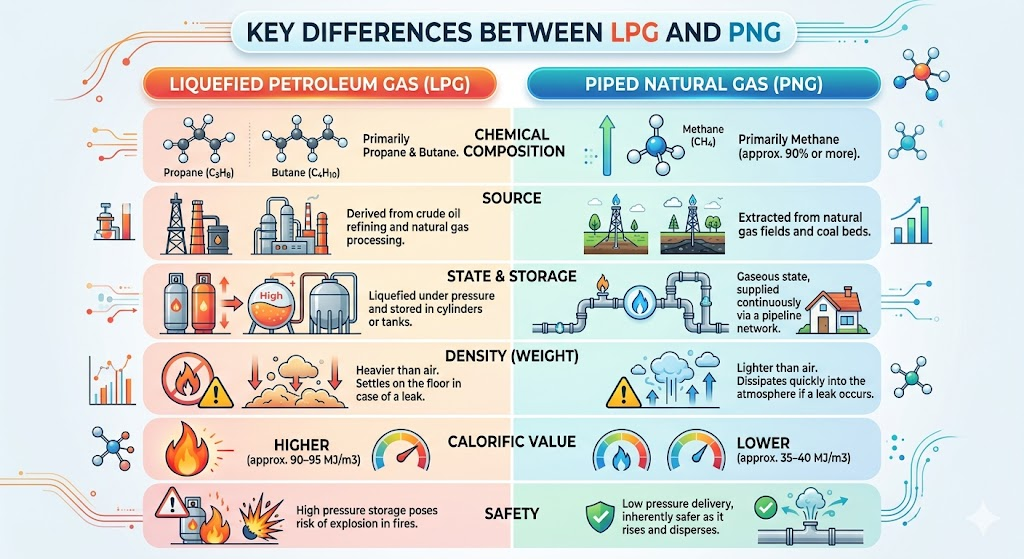
- About: LPG consists of propane and butane. It is liquefied under moderate pressure, stored in cylinders, and is heavier than air.
- PNG is a form of methane and is distributed at low pressure through pipelines directly to homes/industries. It is lighter than air.
- Supply and Logistics: LPG is distributed in pressurized cylinders. This involves a complex supply chain of bottling plants, distributors, and delivery personnel. It requires manual booking.
- While PNG is supplied via a reticulated pipeline network (City Gas Distribution). It provides an uninterrupted 24/7 supply, similar to water or electricity, eliminating the "last-minute booking" anxiety.
- Efficiency: While LPG has a higher calorific value (it heats faster), PNG is more efficient in a continuous flow system. However, using an LPG stove with PNG requires a nozzle change (retrofitting), which can drop thermal efficiency if not done correctly.
- LPG and PNG in India:
- History of LPG and PNG in India: LPG was first introduced in India in 1955 by Burmah Shell Oil Company in Mumbai under the brand Burshane, followed by the first organized distribution in 1965 when Indian Oil Corporation launched its Indane connection in Kolkata.
- A major milestone came with the launch of Pradhan Mantri Ujjwala Yojana in Ballia, which scaled up LPG access for women’s health and rural empowerment.
- Meanwhile, in the case of PNG, Vadodara emerged as the pioneer, becoming the first Indian city to implement a city-wide piped natural gas network for domestic use as early as the 1970s.
- Current Status: India has around 33 crore LPG connections, while domestic natural gas production has the potential to support nearly 30 crore PNG connections if a full transition occurs.
- However, PNG penetration remains limited at about 1.5 crore connections, with a target to expand it to 12 crore by 2034.
- Supply and Production Dynamics: India imports about 60% of its LPG consumption and out of these imports about 90% come through the Strait of Hormuz, which has been impacted due to current happenings. Domestic LPG production has witnessed a 25% increase, driven by government measures.
- On the other hand, domestically, PNG in India comes from gas fields like the Krishna-Godavari (KG) basin, Assam, and Tripura.
- The deepwater Krishna-Godavari (KG) basin off the eastern coast is reportedly the biggest contributor.
- On the other hand, domestically, PNG in India comes from gas fields like the Krishna-Godavari (KG) basin, Assam, and Tripura.
- History of LPG and PNG in India: LPG was first introduced in India in 1955 by Burmah Shell Oil Company in Mumbai under the brand Burshane, followed by the first organized distribution in 1965 when Indian Oil Corporation launched its Indane connection in Kolkata.
Other Forms of Natural Gas
Beyond PNG, natural gas is utilized and transported in several other forms, each serving specific logistical or industrial purposes.
- CNG (Compressed Natural Gas):
- Formation: Natural gas (methane) compressed to less than 1% of its volume at standard atmospheric pressure.
- Primary Use: Fuel for transportation (buses, cars, and autos).
- LNG (Liquefied Natural Gas):
- Formation: Natural gas cooled to approximately -162°C (-260°F), turning it into a clear, colorless liquid.
- Primary Use: Long-distance transport across oceans via specialized tankers.
Frequently Asked Questions (FAQs)
1. What is the primary safety advantage of PNG over LPG in domestic settings?
PNG is lighter than air and disperses rapidly upon leakage, whereas LPG is heavier than air, tending to settle at floor level and creating a higher risk of accumulation and explosion.
2. How does the production of LPG differ fundamentally from Natural Gas?
LPG is a co-product derived from both crude oil refining and natural gas processing, while PNG is primarily methane extracted directly from gas fields or Coal Bed Methane (CBM).
3. Why is the Strait of Hormuz critical to India’s LPG supply chain?
Nearly 90% of India’s LPG imports transit through this narrow chokepoint; any regional conflict or blockade there poses a direct threat to India’s energy security and inflation.
4. What is the significance of the KG-DWN 98/2 Block for India’s energy targets?
Located in the Krishna-Godavari Basin, this block is expected to boost ONGC’s gas output by 15%, reducing the current account deficit by substituting expensive imports with domestic production.
UPSC Civil Services Examination, Previous Year Questions (PYQ)
Prelims
Q. With reference to the Indian Renewable Energy Development Agency Limited (IREDA), which of the following statements is/are correct? (2015)
- It is a Public Limited Government Company.
- It is a Non-Banking Financial Company.
Select the correct answer using the code given below:
(a) 1 only
(b) 2 only
(c) Both 1 and 2
(d) Neither 1 nor 2
Ans: (c)
Mains
Q. Access to affordable, reliable, sustainable and modern energy is the sine qua non to achieve Sustainable Development Goals (SDGs).” Comment on the progress made in India in this regard. (2018)



