Science & Technology
Reforming India’s R&D Ecosystem
For Prelims: NITI Aayog, Corporate Social Responsibility (CSR) funds, Global Innovation Index (GII), Anusandhan National Research Foundation
For Mains: Role of R&D in economic growth and technological self-reliance Government policies and institutional reforms in science & technology Public vs Private Investment in R&D
Why in News?
NITI Aayog released two pivotal reports titled “Ease of Doing Research & Development in India” and the “Survey Report on Ease of Doing R&D in India” aimed at cultivating a more efficient, facilitative, and innovation-driven research ecosystem in the country.
Summary
- NITI Aayog reports focus on improving India’s R&D ecosystem through the ROPE framework, promoting lab-to-market innovation, boosting private/CSR funding, reducing bureaucratic hurdles, and building a trust-based research environment.
- India’s R&D landscape shows progress (GII rank 38, rising patents) but faces low funding (~0.7% GDP); multiple initiatives like NRF, Atal Innovation Mission, and Startup India aim to strengthen innovation, industry linkages, and research output.
What are the Key Highlights of the NITI Aayog Reports on the "Ease of Doing Research & Development in India”?
- The ROPE Framework: The core strategy of the reports is built on the ROPE concept (Removing Obstacles and Promoting Enablers) to clear out administrative and regulatory bottlenecks in the scientific ecosystem.
- "Lab-to-Market" Translation: The reports stress that India must move beyond basic knowledge creation. There is an urgent need for "mission-mode R&D" to translate fundamental research into tangible, commercial technologies and practical applications.
- Boosting Private Sector & CSR Funding: A major highlight is the call to democratize research funding.
- The government wants to actively facilitate private sector participation, specifically by leveraging Corporate Social Responsibility (CSR) funds to back startups and emerging technologies.
- Dismantling Rigid Bureaucracy: The findings highlight that outdated procurement rules, fragmented funding, and rigid institutional structures are stifling innovation. The reports advocate for highly adaptable and responsive administrative frameworks.
- A Trust-Based Ecosystem: To retain top talent and empower early-stage scientists, the reports recommend shifting from an environment of administrative overreach to a trust-based, outcome-oriented ecosystem that grants researchers greater operational autonomy.
What is the Status of R&D in India?
- Gross Expenditure on R&D (GERD): Since Independence, India focused on agriculture and public sector–led industrialisation, but despite significant GDP growth over decades, R&D investment remains low at only ~0.64 –0.7% of GDP, with limited private sector participation.
- Global Innovation Index (GII): India has risen to the 38th position out of 139 economies in the Global Innovation Index (GII) 2025, published by the World Intellectual Property Organization.
- This marks a significant improvement from its 48th rank in 2020. India also continues to hold the top position among lower-middle-income economies and ranks first in the Central and Southern Asia region.
- Patent Filings: According to the WIPO’s World Intellectual Property Indicators (WIPI) 2024, India ranks 6th globally in terms of patent applications.
- Meanwhile, India's patent-to-GDP ratio (a measure of the economic impact of patent activity) grew significantly, from 144 in 2013 to 381 in 2023.
- The country ranks among the global top 10 in patents, trademarks, and industrial designs, and stands 4th globally in trademark filings.
India’s Initiatives Promoting the R&D Ecosystem
What are the Key Challenges Hindering the Research & Development Ecosystem in India?
- Funding and Investment Deficits: India's Gross Expenditure on R&D (GERD) is vastly inadequate when compared to global innovation leaders like the US (~3.5%), China (~2.4%), or South Korea (~4.8%).
- In robust global R&D ecosystems, the private sector drives roughly 70% of research funding. In India, this structure is inverted, the government and public sector institutions bear the major burden (over 60%), while private sector contribution remains disproportionately low.
- Despite the launch of the Research, Development and Innovation (RDI) Scheme, it has not yet delivered the desired outcomes in significantly boosting India’s R&D ecosystem.
- Fragmented Financial Mechanisms: The funding architecture is often disjointed. There is a noticeable lack of performance-linked funding models that consistently reward high-impact, outcome-driven research.
- Bureaucratic and Regulatory Bottlenecks: Outdated, rigid, and heavily bureaucratic procurement frameworks cause immense delays in importing or purchasing critical scientific equipment and raw materials, severely slowing the pace of research.
- Scientific institutions often operate within rigid legacy systems. A heavy bureaucratic culture limits the operational autonomy of researchers, forcing them to spend excessive time on administrative compliances rather than actual scientific inquiry.
- The "Lab-to-Market" Translation Gap: India produces a massive volume of fundamental scientific knowledge and research papers.
- However, the ecosystem systematically struggles to translate this academic research into tangible, commercial technologies, patents, or market-ready solutions.
- There are insufficient institutional structures dedicated specifically to scaling localized innovations into national or global industrial applications.
- Siloed Institutional Frameworks: The University-Industry-Government (UIG) linkage is highly fragmented. Universities largely operate in isolation, focusing primarily on academic publications.
- Conversely, industries often rely on importing established technology rather than collaborating with local academic labs for indigenous solutions.
- This was highlighted in a controversy involving Galgotias University, where claims of indigenous innovation were questioned after links to existing Chinese technology surfaced, underscoring weak industry–academia collaboration in India.
- Rigid departmental structures within universities often discourage cross-disciplinary research. Modern technological breakthroughs usually happen at the intersection of fields (e.g., combining biotechnology with artificial intelligence), but siloed departments make this collaboration difficult.
- Conversely, industries often rely on importing established technology rather than collaborating with local academic labs for indigenous solutions.
- Human Capital and Retention: Despite graduating one of the world's largest pools of STEM (Science, Technology, Engineering, and Math) students, India's density of full-time equivalent (FTE) researchers is only about 260 per million people.
- This is drastically lower than the US or UK, which boast over 4,000 researchers per million people.
- A lack of globally competitive, merit-based career progression models, combined with inadequate institutional support and funding for early-stage scientists, leads to a significant "brain drain" of top scientific talent to Western countries.
- Low Patent Yields: While patent filings in India have increased, the conversion rate to actual granted patents and, more importantly, the commercialization of those patents into viable products remains low.
- Low Impact Factor: While India produces hundreds of thousands of papers annually, its Citation Network Citation Index (CNCI) (a measure of research quality and how often it is cited by peers globally) remains well below that of the US and China.
- Contributions to elite, high-impact journals (like Nature or the Journal of the American Chemical Society) remain disproportionately low.
What Measures can Strengthen India's Research & Development (R&D) Ecosystem?
- Democratizing and Restructuring Funding: The government must actively work to push the GERD to at least 1.5% - 2% of the GDP to compete globally.
- Shift the burden from the public sector by offering robust tax incentives, matching grants, and leveraging Corporate Social Responsibility (CSR) funds directly into deep-tech startups and university incubators.
- Ensure the swift and efficient rollout of the Anusandhan National Research Foundation (ANRF) to seed and promote R&D in state universities and colleges, not just elite institutions like IITs or IISc.
- Overhauling Bureaucracy and Procurement: Implement radical reforms in procurement policies by exempting critical scientific equipment and raw materials from rigid "L1" (Lowest Bidder) tender rules ensuring researchers get materials in days, not months.
- Grant institutional leaders and primary investigators (PIs) greater financial and operational autonomy based on outcome-driven metrics rather than procedural audits.
- Catalyzing "Lab-to-Market" Translation: Build formal, institutionalized pathways connecting the University-Industry-Government triad.
- Academic curricula and research problems should be co-designed with industry leaders to ensure market relevance.
- Mandate the creation of highly professional Technology Transfer Offices (TTOs) in all major universities to help scientists patent their work, navigate intellectual property (IP) laws, and negotiate commercial licensing with private companies.
- Focus national resources on specific, high-priority domains such as Quantum Computing, Green Hydrogen, Semiconductors, and Artificial Intelligence through targeted, time-bound missions.
- Empowering Human Capital: Dismantle seniority-based promotions in public scientific institutions in favor of merit-based, fast-track career structures to retain top-tier talent and reverse the "brain drain."
- Break down rigid academic silos by funding projects that require cross-departmental collaboration (e.g., blending biotechnology with data science).
Conclusion
India can become a global scientific powerhouse by shifting to a trust-based, outcome-driven R&D system, boosting private investment, and easing rules to bridge the lab-to-market gap—advancing technological self-reliance under Atmanirbhar Bharat.
|
Drishti Mains Question “India’s R&D ecosystem is constrained more by structural inefficiencies than lack of talent.” Critically examine. |
Frequently Asked Questions (FAQs)
1. What is the ROPE framework?
Removing Obstacles and Promoting Enablers to reduce bottlenecks and improve R&D efficiency.
2. What is India’s GERD level?
Around 0.64–0.7% of GDP, significantly below the global average (~1.8%).
3. What is the lab-to-market gap?
Weak conversion of research into commercial products and technologies.
4. What is a key issue in R&D funding in India?
Overdependence on public funding, with low private sector contribution.
5. What role does NRF play?
It acts as a central funding body linking academia, industry, and research.
UPSC Civil Services Examination, Previous Year Questions (PYQs)
Prelims
Q. Which of the following statements is/are correct regarding National Innovation Foundation-India (NIF)? (2015)
- NIF is an autonomous body of the Department of Science and Technology under the Central Government.
- NIF is an initiative to strengthen the highly advanced scientific research in India’s premier scientific institutions in collaboration with highly advanced foreign scientific institutions.
Select the correct answer using the code given below:
(a) 1 only
(b) 2 only
(c) Both 1 and 2
(d) Neither 1 nor 2
Ans: (a)
Mains
Q. What are the research and developmental achievements in applied biotechnology? How will these achievements help to uplift the poorer sections of society? (2021)
Q. Scientific research in Indian universities is declining because a career in science is not as attractive as are business professions, engineering or administration, and the universities are becoming consumer-oriented. Critically comment. (2014)

Facts for UPSC Mains
Digital Piracy in India
Why in News?
The Tamil film Jana Nayagan was leaked online in high quality before its theatrical release, raising serious concerns over film piracy and enforcement of intellectual property laws in India.
What is the Legal Framework Regarding the Piracy?
- Copyright Act, 1957: This act protects the intellectual property of creators across mediums (movies, books, software, music).
- Anyone who knowingly infringes or abets copyright infringement is liable for criminal prosecution, with penalties including imprisonment of up to three years and fines of up to Rs 2 lakh.
- These penalties can be strictly applied to repeat offenders for each subsequent violation.
- Bypassing or circumventing Digital Rights Management (DRM) (copy-protection technology) used by Over-the-Top (OTT) platforms and studios is specifically criminalized, carrying a prison sentence of up to 2 years.
- Cinematograph (Amendment) Act, 2023: Introduces massive financial deterrents, allowing courts to impose fines equivalent to 5% of the audited gross budget of a film.
- This is particularly relevant for pre-release leaks that severely dent theatrical and home video valuations.
- Information Technology (IT) Act, 2000: The law does not just target the individual pirate; it also holds the platforms that host the pirated content accountable.
- Under Section 79 of the IT Act, platforms (like Telegram, WhatsApp, ISPs, or social media sites) generally enjoy "safe harbor," meaning they are not legally responsible for what users post.
- However, if they fail to take down pirated content after receiving a lawful court order or government notice, they lose this immunity and can be prosecuted as co-conspirators in the piracy.
- Utilizing this provision, the Ministry of Information & Broadcasting recently ordered the blocking of over 3,100 Telegram channels and 800 websites for facilitating film piracy.
- Judicial Interventions:
- Dynamic Injunctions: Piracy sites constantly change domain names to evade bans, filmmakers utilize dynamic injunctions from High Courts, which allow for the continuous updating and blocking of new, non-compliant URLs (Uniform Resource Locator).
- John Doe Orders: Courts frequently issue these pre-emptive orders before a film is even leaked or released, establishing an immediate legal mechanism to block rogue platforms the moment piracy is detected.
- This forces Internet Service Providers (ISPs) to preemptively block access to known torrent and piracy sites the moment a movie hits theaters.
How do Studios Fight Piracy?
- Digital Rights Management (DRM): Used primarily by OTT platforms, DRM encrypts the video stream.
- It ensures that only authorized devices with the correct "keys" can decrypt and play the content, preventing users from simply saving the video file to their hard drives.
- Encrypted Distribution: For theatrical releases, movies are distributed as Digital Cinema Packages (DCPs) on high-end encrypted hard drives.
- These drives require a specific "Key Delivery Message" (KDM) to unlock, which is often programmed to work only for a specific theatre, on a specific projector, and for a limited time window.
- Forensic Watermarking: Studios embed "invisible" watermarks into the film's audio and video.
- These watermarks are unique to every theatre or digital copy. If a pirated version appears online, investigators can analyze the file to identify exactly where and when the leak originated.
- Most "high-quality" leaks happen due to a breach in the internal supply chain (editing, dubbing, or VFX houses). During the editing phase, every copy of the film sent to a technician has their name tag burned into the video.
What are the Enforcement Deficits Hindering the Fight Against Digital Piracy in India?
- The "Whack-a-Mole" Nature of the Internet: When authorities or anti-piracy agencies block a rogue website, the operators simply register a new domain name (a "mirror site") with a slightly different URL within minutes.
- Sophisticated pirates use Virtual Private Networks (VPNs) and proxy servers to mask their real IP addresses and physical locations, making it incredibly difficult for Indian cyber police to track the actual individuals uploading the content.
- Jurisdictional Roadblocks and Offshore Servers: Major piracy syndicates rarely host their websites on servers located within India.
- They use bulletproof hosting services in countries with lax copyright laws or nations that do not cooperate with Indian law enforcement.
- To take down a server located in Eastern Europe or South America, Indian authorities must navigate sluggish international diplomacy and Mutual Legal Assistance Treaties (MLATs).
- By the time a foreign server is seized, the pirates have already moved their data elsewhere.
- Encryption Shield: The shift from public websites to closed, encrypted platforms like Telegram or WhatsApp has severely handicapped enforcement.
- Because messages are encrypted, authorities cannot easily monitor or intercept the distribution of pirated files without specific tips or infiltrating the private groups.
- Torrent protocols (peer-to-peer file sharing) do not rely on a single central server. Instead, thousands of individual users download and upload small pieces of the file simultaneously, making it practically impossible to shut down the source.
- Slow Trials: The Indian judicial system is notoriously overburdened. Even if a pirate is successfully arrested and chargesheeted, the trial can drag on for years, sometimes decades.
- This delay completely neutralizes the deterrent effect of the harsh penalties prescribed under the Copyright Act.
- The US consistently lists India as a "notorious market" due to historically anemic and sluggish responses to IP piracy. Investigations are rarely pursued with high vigor unless heavily backed by industry pressure.
- While there are commercial courts, the lack of highly specialized Intellectual Property (IP) and Cyber Courts means complex digital piracy cases are often heard by judges who may not be experts in the rapidly evolving technology used by pirates.
Conclusion
To bridge this enforcement deficit, India needs to move beyond just passing harsh laws. The focus must shift toward capacity building in cyber forensics, establishing specialized fast-track IP courts, and forging much stronger, real-time intelligence-sharing networks with international law enforcement agencies.
|
Drishti Mains Question: Examine the challenges posed by cross-border digital crimes in enforcing intellectual property rights in India. |
Frequently Asked Questions (FAQs)
1. What is the punishment for film piracy under Indian law?
Up to 3 years imprisonment and Rs 2 lakh fine under the Copyright Act, plus fines up to 5% of film budget under the Cinematograph Act.
2. What is ‘safe harbour’ under the IT Act, 2000?
Platforms are not liable for user content unless they fail to remove illegal content after official notice.
3. What are dynamic injunctions?
Court orders allowing continuous blocking of new piracy URLs without fresh litigation each time.
4. Why is piracy hard to control in India?
Use of VPNs, torrents, offshore servers, and encrypted platforms like Telegram makes tracking difficult.
5. What technological tools are used to prevent piracy?
DRM encryption, Digital Cinema Packages (DCP), and forensic watermarking help secure content and trace leaks.
UPSC Civil Services Examination, Previous Year Question
Prelims
Q. A recent movie titled The Man Who Knew Infinity is based on the biographyof (2016)
(a) S. Ramanujan
(b) S. Chandrasekhar
(c) S.N. Bose
(d) C.V. Raman
Ans: (a)
Q. What is “Virtual Private Network”? (2011)
(a) It is a private computer network of an organization where the remote users can transmit encrypted information through the server of the organization.
(b) It is a computer network across a public internet that provides users access to their organization’s network while maintaining the security of the information transmitted.
(c) It is a computer network in which users can access a shared pool of computing resources through a service provider.
(d) None of the statements (a), (b) and (c) given above is a correct description of Virtual Private Network.
Ans: (b)
Mains
Q. In a globalized world, Intellectual Property Rights assume significance and are a source of litigation. Broadly distinguish between the terms—Copyrights, Patents and Trade Secrets. (2014)

Place In News
Andaman Sea
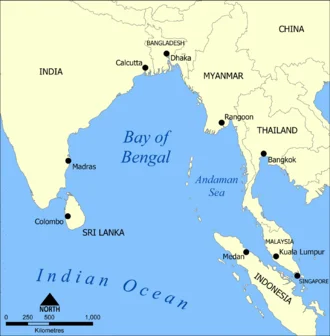
The United Nations refugee agency (UNHCR) reported that a boat carrying approximately 250 individuals, primarily Rohingya refugees and Bangladeshi nationals, is feared to have capsized in the Andaman Sea.
- The Andaman Sea has become one of the deadliest maritime migration routes in the world. Thousands of Rohingya refugees (a stateless Muslim minority from Myanmar's Rakhine State) regularly undertake dangerous journeys across the Andaman Sea from Bangladesh or Myanmar.
- They typically embark on unseaworthy vessels between November and April (when the seas are relatively calm) in an attempt to reach Muslim-majority countries like Indonesia and Malaysia for asylum and better economic opportunities.
Andaman Sea
- The Andaman Sea is a marginal sea of the northeastern Indian Ocean, bordered by Myanmar and Thailand to the north and east, the Malay Peninsula and Sumatra to the south, and separated from the Bay of Bengal by India’s Andaman and Nicobar Islands to the west.
- Its southern end narrows into the Strait of Malacca, a vital global trade corridor linking the Indian Ocean with the Pacific.
- Geographically, it includes the Gulf of Martaban in the north and receives major rivers like the Irrawaddy, Salween, and Sittang, while its seafloor remains tectonically active along the Burma–Sunda plate boundary.
- Strategically and economically, the sea is crucial for global shipping, provides India with significant maritime leverage through the Andaman and Nicobar Command, and supports rich marine biodiversity and fisheries, though these resources face increasing environmental pressures.
| Read more: Sustaining Development in Andaman and Nicobar Islands |

Place In News
India Expresses Concern Over Beirut Strike
India expressed deep concern over the loss of civilian lives following Israeli airstrikes in Beirut (capital of Lebanon) targeting Hezbollah-linked sites amid escalating regional tensions.
- Further, as a troop-contributing country to the United Nations Interim Force in Lebanon (UNIFIL), India expressed concern over the deteriorating security situation and its implications for peacekeeping operations.
- UNIFIL, deployed in Lebanon along the Israel–Lebanon border, plays a crucial role in maintaining peace and stability in the region, and the ongoing escalation poses significant challenges to its mandate.
About Lebanon
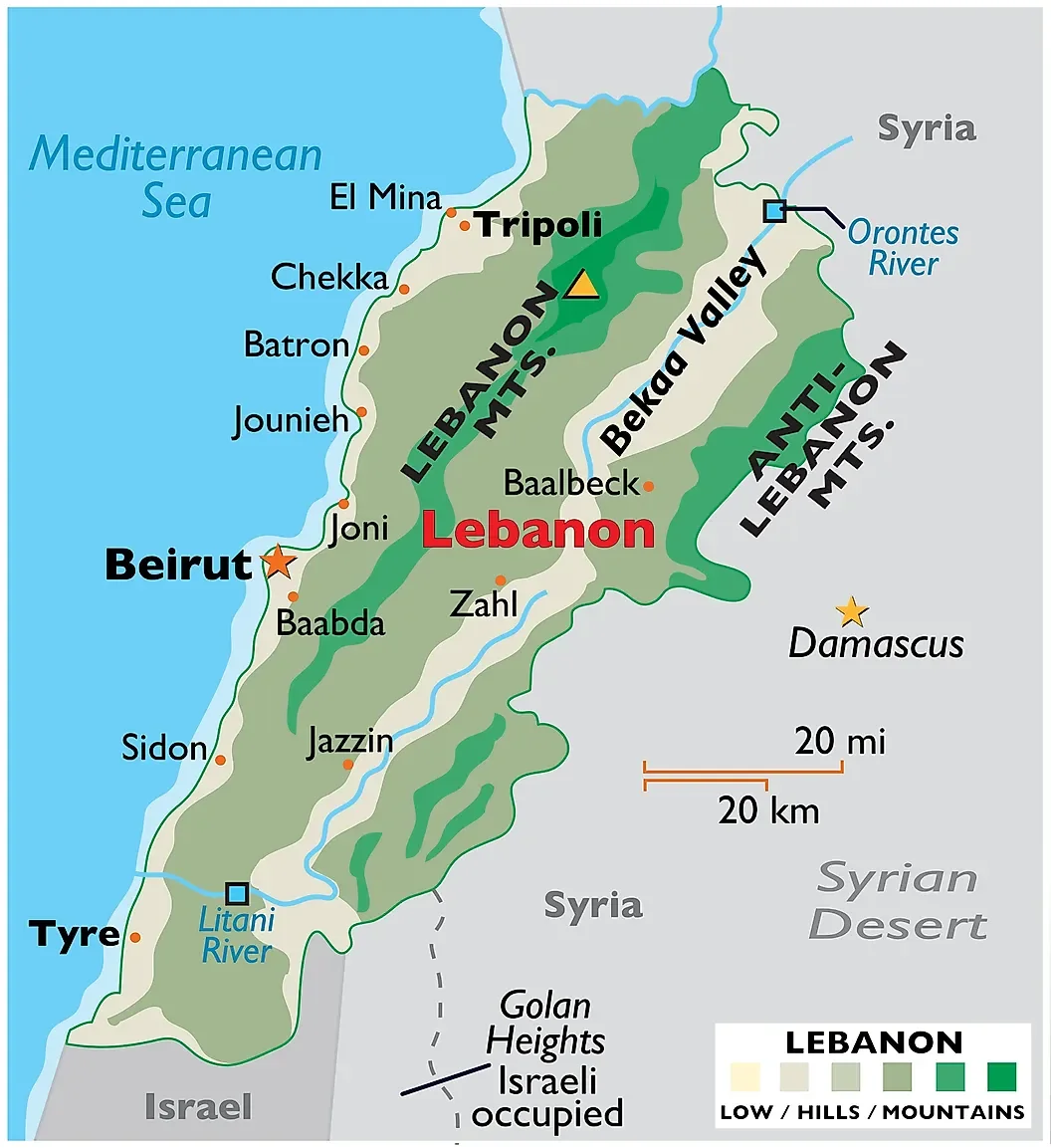
- Lebanon is a country in the Levant region (a region in the eastern Mediterranean Basin) of West Asia.
- Location: Lebanon is located in West Asia, bordered by Syria (north & east) and Israel (south), with a coastline along the Mediterranean Sea.
- Geographical Features: It has mountain ranges (Mount Lebanon & Anti-Lebanon), narrow coastal plains, and fertile Bekaa Valley between the ranges.
| Read more: Israel-Lebanon: Maritime Border Deal |

Rapid Fire
Amaravati Quantum Reference Facility
In a significant boost to India's deep-tech ambitions and indigenous technological capabilities, Andhra Pradesh has inaugurated India’s first open-access Amaravati Quantum Reference Facility (AQRF).
- AQRF: The twin centers Amaravati 1S (SRM University, Neerukonda) and Amaravati 1Q (Medha Towers, Gannavaram), were officially launched on World Quantum Day, coinciding with the celebration of 100 years of quantum science.
- The AQRF was developed domestically in collaboration with premier national institutions, including the Tata Institute of Fundamental Research (TIFR), Indian Institute of Science (IISc), DRDO, and IIT Bombay, alongside tech startups Qubitech and Qbit Force.
- Core Objective: The open-access nature of the facility allows researchers and deep-tech companies to test and certify indigenous quantum hardware, significantly advancing India's vision of self-reliance in quantum technology.
- Sectoral Applications: This infrastructure will provide computing power capable of revolutionizing critical fields such as drug discovery, agriculture, and climate modelling.
- Andhra Pradesh’s Broader Deep-Tech Vision: The state aims to develop Amaravati into a ‘Quantum Valley’.
- Additional tech hubs include a Space City in Tirupati, a Drone Hub in Orvakal, and Semiconductor and Med-tech clusters in Anantapur and Visakhapatnam.
- World Quantum Day: The World Quantum Day is celebrated on 14th April, a reference to 4.14, the rounded first digits of Planck’s constant: 4.1356677×10⁻¹⁵ eV⋅s, a product of energy and time that is the fundamental constant governing quantum physics.
| Read more: India Advances Quantum Technology |

Rapid Fire
Delhi–Dehradun Economic Corridor
Recently, the Delhi–Dehradun Economic Corridor was inaugurated to enhance regional connectivity and economic development.
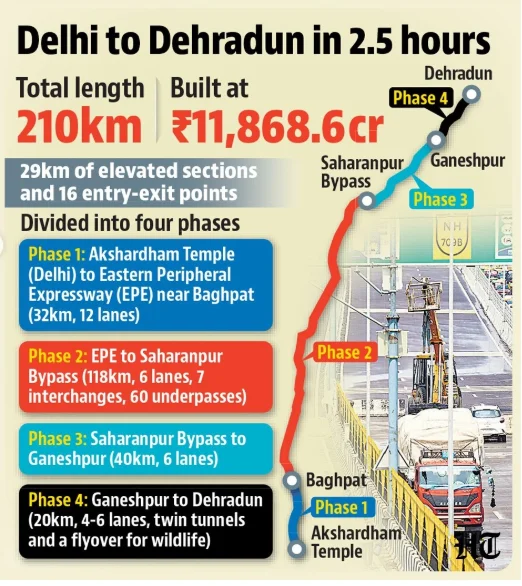
- About: It is a ~210-km, six-lane access-controlled expressway, with a minimum design speed of 100 kmph, extending from Delhi to Dehradun, built at a cost of ~₹11,868 crore, structured into four phases.
- The project is expected to reduce travel time from 5–6 hours to about 2–2.5 hours, along with lower fuel consumption and logistics costs.
- The expressway includes access-controlled entry and exit points, dedicated service roads for local traffic, and FASTag-based toll collection, all aimed at reducing congestion and improving overall driving experience.
- Connectivity: The project includes a 31.6 km brownfield elevated stretch from Akshardham to Khekra, a 120 km greenfield section from Baghpat to Saharanpur, a ~42 km completed stretch up to Ganeshpur, and a final ~20 km segment to Dehradun with partial upgradation.
- It includes a spur to Haridwar connecting to the Char Dham highway, integrates with major corridors like Delhi-Mumbai, Delhi-Katra and Delhi-Meerut expressways, and improves access to Dehradun, Haridwar, Rishikesh and Mussoorie, strengthening connectivity and tourism.
- Environmental Measures: The project includes a ~10.97-km wildlife corridor, featuring one of Asia’s largest elevated wildlife corridors passing through forest areas including Rajaji National Park in the Shiwalik Hills, ensuring safe and uninterrupted animal movement.
- Additional provisions include multiple animal crossings, elephant underpasses, and a tunnel near the Daat Kali temple, facilitating unhindered wildlife movement across the corridor.
- The project is expected to reduce carbon dioxide emissions by about 240 million tonnes over 20 years and achieve fuel savings of around 19%.
- Economic Impact: The corridor is expected to boost trade, logistics, warehousing and industry, enhance market access for farmers and livestock owners, and generate significant employment opportunities.
| Read more: Infrastructure Development in India |

Rapid Fire
Hubble Tension
Recent observations have narrowed the local expansion rate of the universe to about 73.5 km/s per megaparsec, further intensifying the long-standing “Hubble tension” debate.
- Definition: The Hubble tension refers to the disagreement among physicists about the exact rate at which the universe is expanding, measured using the Hubble constant.
- In 1929, Edwin Hubble published the relation between galaxies’ recessional velocity and distance (Hubble’s law), providing the first quantitative evidence that the universe is expanding.
- Core Issue: Two independently validated and highly precise methods produce conflicting results, leading to a significant discrepancy in the estimated expansion rate.
- Local Measurement Method: Using the cosmic distance ladder (observations of nearby stars and supernovae), astronomers estimate a higher expansion rate of about 73–73.5 km/s per megaparsec.
- Early Universe Method: Using the cosmic microwave background (relic radiation from the Big Bang) and mathematical models, scientists estimate a lower expansion rate of about 67 km/s per megaparsec.
- Implications: The mismatch suggests that current understanding of the universe may be incomplete, prompting investigations into possible measurement errors or new physics such as unknown properties of dark energy.
| Read more: New Method to Determine Hubble Constant |