International Relations
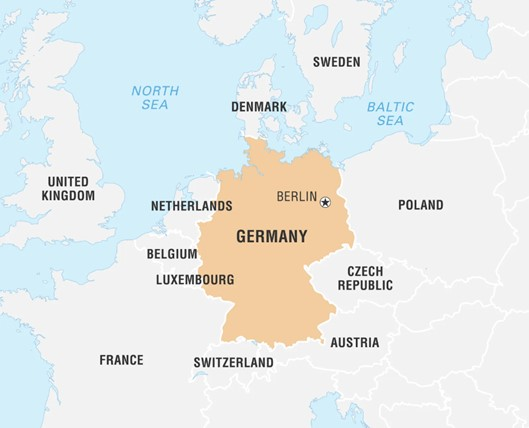
India–Germany Relations
For Prelims: MILAN, Indian Ocean Naval Symposium, Tarang Shakti, Semiconductor, Make in India Mittelstand
For Mains: India–Germany Strategic Partnership: Evolution and Significance, Role of Middle Powers in Global Governance Reforms
Why in News?
India and Germany have given fresh momentum to their strategic partnership during the German Chancellor's visit to India, marking 25 years of strategic partnership and 75 years of diplomatic relations.
Summary
- The German Chancellor’s visit revitalised the India–Germany Strategic Partnership, expanding cooperation in defence, technology, climate action, Indo-Pacific security, and global governance reforms.
- Despite strong momentum, the partnership faces challenges from geopolitical divergences, defence asymmetries, and slow India–EU trade progress, requiring deeper economic integration and strategic coordination.
What are the Key Outcomes of the German Chancellor's visit to India?
- Defence Industrial Cooperation: A joint roadmap was agreed to promote defence co-development, co-production, and technology partnerships, with Germany committing to faster export clearances.
- Germany expressed its intent to participate in Indian naval and air exercises such as MILAN, the Indian Ocean Naval Symposium, and Tarang Shakti.
- In addition, both sides established a Track 1.5 Foreign Policy and Security Dialogue, enabling structured yet informal interactions between government officials and non-governmental experts to enhance strategic understanding and policy coordination.
- Visa-free Airport Transit: Indian passport holders will be allowed visa-free transit through German airports, easing travel and mobility.
- Education and Skilling: A higher education roadmap was adopted, German universities were invited to open campuses in India, and a Centre of Excellence for Renewable Energy skilling was announced.
- Critical Minerals and Semiconductors: Both sides agreed to cooperate on critical minerals and semiconductor ecosystems to strengthen supply-chain resilience.
- Digital and Emerging Technologies: The Indo-German Digital Dialogue work plan (2026–27) was finalised, covering AI, data governance, telecom, and Industry 4.0.
- Indo-Pacific and Connectivity cooperation: A bilateral dialogue mechanism on the Indo-Pacific was launched to support a rules-based regional order.
- Reaffirmed commitment to a free and open Indo-Pacific and support for the India–Middle East–Europe Economic Corridor (IMEC).
- Global Governance Reforms: India and Germany reaffirmed their commitment to reforming global institutions, including the UN Security Council, through the G4 framework.
- Counter-terrorism Cooperation: India and Germany condemned all forms of terrorism, including cross-border terrorism, reaffirmed cooperation against United Nations-designated terrorist groups under the 1267 regime, welcomed Mutual Legal Assistance Treaty ratification, and agreed to deepen intelligence sharing, legal cooperation, and action against terror financing and safe havens.
What are the Key Facets of India–Germany Relations?
- Economic and Commercial Relations: Bilateral trade in goods and services between India and Germany crossed USD 50 billion in 2024, accounting for over 25% of India–EU trade.
- Germany emerged as India’s 8th largest trading partner in 2024–25, while India was Germany’s 23rd largest trading partner in 2024, reflecting deepening economic integration.
- The Make in India Mittelstand (MIIM) programme supports German SMEs and family-owned businesses to invest and manufacture in India.
- Development Cooperation: Under the Green and Sustainable Development Partnership, Germany has committed €1 billion annually till 2030 to support climate action, renewable energy, sustainable urban development, water, forests, and agriculture.
- Both countries also cooperate through Triangular Development Cooperation to implement development projects in third countries aligned with the SDGs.
- Defence: India–Germany defence cooperation is anchored in the 2006 Defence Cooperation Agreement and its 2019 implementation arrangement, supported by regular high-level defence dialogues.
- Military ties have deepened through naval port calls, PASSEX exercises. Air force cooperation has expanded via Exercise Tarang Shakti, reflecting growing interoperability and strategic trust.
What are the Challenges in India–Germany Relations?
- Divergence on Russia and Strategic Autonomy: Germany expects closer alignment on the Russia–Ukraine conflict, while India continues to pursue strategic autonomy, including energy and defence ties with Russia, limiting full political convergence.
- Asymmetry in Defence Cooperation: Defence ties are improving but remain constrained by India’s long-standing dependence on Russian equipment, higher costs and conditionalities of German defence exports, and slow finalisation of major deals (e.g. submarines).
- Uneven Scale of Economic Engagement: Despite growth, bilateral trade is modest compared to Germany–China trade, creating a gap between Germany’s diversification ambitions and the current depth of India–Germany economic integration.
- Germany increasingly views China as a systemic economic rival, whereas India sees China as a direct security and territorial threat, leading to differences in threat perception that constrain deeper strategic alignment in the Indo-Pacific.
- Slow Progress on India–EU Trade Framework: Prolonged negotiations on India–EU Free Trade Agreement create uncertainty for long-term investment and supply-chain planning, affecting bilateral momentum.
- Migration and Integration Challenges: Although skilled migration and student mobility are rising, issues such as language barriers, recognition of qualifications, and social integration persist.
What Steps can Enhance India-Germany Relations?
- Accelerate Economic and Trade Integration: Push for early conclusion of the India–EU Free Trade Agreement, simplify regulatory processes, and strengthen supply-chain partnerships to reduce overdependence on China.
- Enhance Climate and Green Transition: Leverage the GSDP for green hydrogen, renewable energy, sustainable mobility, and climate-resilient infrastructure.
- Promote SME and Mittelstand engagement: Expand programmes like Make in India Mittelstand to attract German SMEs into Indian manufacturing and innovation ecosystems.
- This would reduce Europe’s China-dependence while embedding India deeper into EU-centric value chains, especially for ASEAN and Africa-facing exports.
- Build a Shared Normative Alternative in Global Governance: India and Germany should jointly champion a value-based yet non-coercive model of global governance that is democratic, inclusive, development-oriented, and respectful of sovereignty and diversity.
- Such an approach would offer a credible alternative to both authoritarian revisionism and Western unilateralism, while enhancing their standing as responsible and stabilising global stakeholders.
- Scale up India–Germany Triangular Development Cooperation in Africa and Latin America in sectors like renewable energy, healthcare, skilling, and digital public infrastructure.
- Digital Public Infrastructure: Promote interoperability between India’s Digital Public Infrastructure (Aadhaar-like platforms, UPI, ONDC) and EU digital governance frameworks through the Indo-German Digital Dialogue.
Conclusion
India–Germany ties are gaining strategic depth across defence, technology, climate action, and global governance. Despite differences over geopolitics and trade, the partnership shows strong momentum. Deeper economic integration and shared values can make both countries stabilising global partners.
|
Drishti Mains Question: Evaluate the role of India–Germany cooperation in promoting a rules-based order in the Indo-Pacific. |
Frequently Asked Questions (FAQs)
Q. What was the key significance of the German Chancellor’s visit to India?
It marked 25 years of India–Germany Strategic Partnership and expanded cooperation in defence, technology, climate action, and global governance.
Q. What are the major defence outcomes of the visit?
A Defence Industrial Cooperation Roadmap, participation in MILAN and Tarang Shakti exercises, and launch of a Track 1.5 Security Dialogue.
Q. Why is the India–EU Free Trade Agreement important for India–Germany ties?
It can boost trade, attract investment, and reduce overdependence on China by strengthening resilient supply chains.
Q. What is the Green and Sustainable Development Partnership (GSDP)?
A framework under which Germany commits €1 billion annually till 2030 for climate action, renewable energy, and sustainable development in India.
UPSC Civil Services Examination, Previous Year Question (PYQ)
Prelims
Q. ‘Broad-based Trade and Investment Agreement (BTIA)’ is sometimes seen in the news in the context of negotiations held between India and (2017)
(a) European Union
(b) Gulf Cooperation Council
(c) Organization for Economic Cooperation and Development
(d) Shanghai Cooperation Organization
Ans: (a)
Mains
Q.“Africa was chopped into states artificially created by accident of European competition”. Analyze. (2013)
Q. To what extent can Germany be held responsible for causing the two World Wars? Discuss critically (2015)

Governance
India’s Maritime Strategy
For Prelims: Indian Ocean, Cholas, Indo-Pacific, Blue Economy, SAGAR vision, Belt and Road Initiative
For Mains: Evolution of India’s maritime strategy and naval doctrine, India’s role as a net security provider in the Indian Ocean Region, Maritime India Vision 2030
Why in News?
India’s evolving maritime Strategy has come into sharper focus following insights from The Routledge Handbook of Maritime India, which provides a comprehensive analysis of India’s maritime evolution.
Summary
- India’s maritime strategy has evolved from a historically land-centric outlook to a comprehensive, rules-based approach, drawing on civilisational seafaring traditions and modern initiatives such as SAGAR, MAHASAGAR, and the Indo-Pacific Oceans Initiative to position India as a net security provider and maritime hub.
- India faces challenges from China’s expanding IOR presence, capability gaps, climate risks, and underwater domain vulnerabilities.
- Strengthening legal integration, maritime technology, regional rule-shaping, climate-resilient infrastructure, and human capital is key to securing India’s maritime future and major-power aspirations.
How Has India’s Maritime Strategy Evolved?
- India’s Early Maritime Orientation: India’s strategic geography is defined by the Himalayas in the north and the Indian Ocean in the south, creating both continental and maritime imperatives.
- Historically, while invasions came via land routes, India projected influence seaward through trade, culture, and navigation.
- Ancient and medieval maritime networks connected India with Southeast Asia, the Arab world, and East Africa.
- The Cholas and later the Marathas demonstrated organised naval power, overseas expeditions, and maritime statecraft.
- The Cholas are described as “Nautical Tigers,” symbolising organised naval power and overseas expeditions.
- This early civilisational experience established the Indian Ocean as a space of opportunity rather than threat.
- Colonial and Early Post-Independence Period: British colonial rule subordinated Indian maritime power to imperial interests, dismantling indigenous naval traditions.
- After Independence, India inherited a largely continental security mindset shaped by Partition and hostility with Pakistan, the 1962 war with China, and persistent border and internal security challenges.
- As a result, maritime issues remained secondary despite early strategic warnings.
- Although Jawaharlal Nehru cautioned that control of the Indian Ocean directly affected India’s trade and independence, policy attention continued to remain predominantly land-centric.
- Maritime Reorientation: The mid-1980s marked a strategic shift as rising dependence on seaborne trade and energy imports, naval modernisation, and improved ties with Australia and Southeast Asia led India to view the seas as strategic highways rather than mere defensive buffers.
- Economic liberalisation deepened integration with global maritime supply chains, while the maritime vision expanded from the Indian Ocean to the Indo-Pacific, enabling convergence with Japan, France, Australia, and ASEAN and reinforcing a rule-based order.
- In the early 2000s, the Indian Navy’s expanded reach and anti-piracy operations in the Arabian Sea established India as a net security provider, with maritime diplomacy, joint exercises, and humanitarian assistance becoming key tools of influence.
- India’s maritime strategy now integrates maritime security with capacity-building in neighbouring states and extends beyond defence to include the Blue Economy, underwater domain awareness, maritime technologies, climate resilience, and coastal security, treating oceans as strategic, economic, and ecological assets.
- Legal Backing and Regulatory Modernisation: India has modernised its maritime governance by replacing colonial-era laws with the Merchant Shipping Act, 2025, Carriage of Goods by Sea Act, 2025, and Indian Ports Act, 2025.
- These reforms align Indian law with global conventions, strengthen safety and environmental standards, and improve ease of doing business through a rules-based regulatory framework.
- Policy Vision: India’s Maritime Vision, through Maritime India Vision 2030 and Maritime Amrit Kaal Vision 2047, aims to transform India into a global maritime hub.
- India’s maritime strategy is guided by the SAGAR vision, which frames the Indian Ocean as a shared commons based on collective security and growth, especially for the Global South.
- This approach has been expanded globally through the MAHASAGAR Vision, integrating maritime security with development and sustainability.
- Institutional Preparedness: It has been strengthened through the Indo-Pacific Oceans Initiative, extending India’s focus to the wider Indo-Pacific.
- Engagement with ASEAN, IORA, and BIMSTEC, supported by the Information Fusion Centre–Indian Ocean Region, reinforces a cooperative, rules-based maritime order.
What are the Challenges to India’s Maritime Strategy?
- China’s IOR Penetration: China’s systematic expansion in the Indian Ocean Region—through dual-use ports under the Belt and Road Initiative (Gwadar, Hambantota, Kyaukpyu) and submarine forays has altered the regional balance.
- India faces a structural asymmetry in shipbuilding capacity, defence-industrial scale, and logistics reach. The challenge lies in deterring coercion without triggering a destabilising security dilemma or a zero-sum naval competition.
- Fragile Maritime Governance in the Neighbourhood: Weak institutions, corruption, and elite capture in South Asian littoral states have enabled external strategic leverage.
- Sri Lanka’s Hambantota experience demonstrates how governance deficits, rather than ideology, drive alignment with China.
- India’s difficulty in offering timely, financially competitive, and institutionally credible alternatives limits its ability to shape maritime governance norms in its immediate neighbourhood.
- Capability Gaps and Force Projection Constraints: The Indian Navy operates across an expansive theatre from the Strait of Hormuz to the Malacca Strait, but faces persistent challenges due to delays in indigenous shipbuilding, submarine shortages, and dependence on imported propulsion, sensors, and combat systems.
- Fiscal constraints further complicate the transition from platform-centric modernisation to network-centric maritime dominance.
- Indo-Pacific Dilution and Partner Uncertainty: The Indo-Pacific, once central to global strategic discourse, has lost momentum due to conflicts in Ukraine, Gaza, and the Red Sea, and evolving U.S. threat perceptions of China.
- India must now navigate Quad cooperation without formal alliances, balancing strategic autonomy, partner expectations, and avoidance of bloc politics, making sustained maritime coordination increasingly complex.
- Economic Exposure and Choke-Point Vulnerability: India’s dependence on maritime energy routes through Hormuz and Bab el-Mandeb exposes it to disruptions from regional instability, piracy, and maritime terrorism.
- Technological Deficit in the Underwater Domain: The next frontier of maritime competition lies below the surface.
- India’s lag in Underwater Domain Awareness (UDA), seabed surveillance, autonomous underwater systems, and cyber-maritime integration risks eroding deterrence and situational awareness in contested IOR spaces.
- Climate Change as a Force Multiplier: Sea-level rise, extreme weather, and coastal erosion threaten critical naval infrastructure and island territories such as the Andaman and Nicobar Islands.
- Simultaneously, climate-induced humanitarian crises in the IOR will increasingly draw India into disaster response and stabilisation roles, stretching naval resources beyond traditional security missions.
What Measures can Strengthen India’s Maritime Strategy?
- Statutory Integration: Enact a consolidated National Maritime Security Framework by aligning the Maritime Security Strategy (2015), Sagarmala, and Blue Economy Policy with clear legal roles for Navy, Coast Guard, ports, and coastal states.
- Underwater Domain Awareness: Operationalise UDA as a national mission by integrating Navy–ISRO–scientific institutions to secure seabed cables, offshore assets, and EEZs.
- Regional Rule-shaping: Assist Indian Ocean littorals in implementing UNCLOS-compliant maritime laws, coast guard legislation, and EEZ governance to convert cooperation into long-term alignment.
- Climate–security Convergence: Treat ports, naval bases, and island territories as climate-critical infrastructure, aligning maritime security planning with NAPCC and CRZ norms.
- Human Capital for Maritime Statecraft: Invest in ocean sciences, hydrography, maritime cyber expertise, and strategic studies to build civilian and military expertise essential for long-term maritime leadership.
Conclusion
India’s maritime outlook is no longer optional or secondary; the seas now shape national security, trade and energy flows, climate resilience, and regional leadership. Oceans are central to India’s strategic, economic, and environmental interests, and India’s rise as a major power will depend as much on its engagement with the maritime domain as on developments on land.
|
Drishti Mains Question: Trace the evolution of India’s maritime strategy from a land-centric outlook to an Indo-Pacific orientation. |
Frequently Asked Questions (FAQs)
1. What is SAGAR in India’s maritime strategy?
SAGAR (Security and Growth for All in the Region) frames the Indian Ocean as a shared commons, focusing on collective security, capacity building, and development, especially for the Global South.
2. What is the MAHASAGAR Vision?
MAHASAGAR expands SAGAR globally by integrating maritime security, development, and sustainability beyond the Indian Ocean, reflecting India’s wider leadership ambitions.
3. Why is Underwater Domain Awareness (UDA) important for India?
UDA is critical to monitor submarines, protect seabed cables, offshore assets, and ensure maritime deterrence in contested Indian Ocean spaces.
4. What are the major maritime challenges India faces today?
Key challenges include China’s IOR expansion, naval capability gaps, choke-point vulnerabilities, weak maritime governance in neighbours, and climate-induced security risks.
UPSC Civil Services Examination, Previous Year Question (PYQ)
Prelims
Q. With reference to ‘Indian Ocean Rim Association for Regional Cooperation (IOR-ARC)’, consider the following statements: (2015)
- It was established very recently in response to incidents of piracy and accidents of oil spills.
- It is an alliance meant for maritime security only.
Which of the statements given above is/are correct?
(a) 1 only
(b) 2 only
(c) Both 1 and 2
(d) Neither 1 nor 2
Ans: (d)
Mains
Q. What are the maritime security challenges in India? Discuss the organisational, technical and procedural initiatives taken to improve maritime security. (2022).


Facts for UPSC Mains
Year-End Review 2025: Department of Expenditure
Why in News?
The Department of Expenditure (DoE), Ministry of Finance, has demonstrated transformative fiscal management through large-scale digitization of benefits, strategic capital infusion to states, and comprehensive policy overhauls.
What are the Key Achievements of the Department of Expenditure?
- Scaling DBT for Transparency: The Public Financial Management System (PFMS) has become the backbone for 966 Direct Benefit Transfer (DBT) schemes in 2025-26, enabling Rs 2.87 Lakh Crore in direct, real-time payments to beneficiaries via 210.56 crore transactions (till 31st Dec, 2025).
- Enhanced citizen-centric governance through DBT Open House sessions and regional conclaves, and strengthening Centre-State collaboration for transparent fund management.
- Boosting State Capital Investment: Implemented the ‘Scheme for Special Assistance to States for Capital Expenditure (SASCE)’, increasing its outlay from Rs 12,000 crore (2020-21) to Rs 1,50,000 crore (2025-26).
- Disbursed Rs 4,49,845 crore to states since inception (2020-21) to enhance productive capacity and crowd-in private investment.
- Launched in 2020–21 amid the Covid-19 pandemic, SASCE provides 50-year interest-free loans to states specifically for capital expenditure, boosting economic recovery, as capital spending has a high GDP multiplier effect of Rs 3 for every Rs 1 spent.
- Enabling State Borrowings with Reform Incentives: Fixed the Net Borrowing Ceiling (NBC) for states at 3% of GSDP for 2025-26 as per the 15th Finance Commission (FC).
- Created a performance-linked incentive for additional borrowing of 0.5% of GSDP tied to power sector reforms, driving efficiency, DBT for subsidies, and reduction in distribution losses.
- Modernizing Public Procurement Frameworks: Comprehensively revised procurement manuals (Goods, Consultancy & Non-Consultancy Services, Works) to enhance ease of business, and introduce modern practices like reverse auctions and performance security reforms.
- Managing Finance Commission Grants & Disaster Funds: Implemented the 15th FC awards, releasing grants for Post-Devolution Revenue Deficit, Local Bodies, and Health Sector.
- Released over Rs 18,000 crore as Central share of State Disaster Response Fund and over Rs 5,200 crore for State Disaster Mitigation Fund in 2025-26.
- National Disaster Risk Management Fund (NDRMF), National Disaster Mitigation Fund (NDMF), Prime Minister's National Relief Fund (PMNRF), among others, help in disaster management.
- Grievance Redressal: Streamlined resolution of over 150,000 grievances annually via an automated Customer Redressal Management (CRM) system.
- Pay Reforms: Constituted the 8th Central Pay Commission to review and revise pay structures for central government employees and pensioners.
Borrowing Provisions
- Chapter II of Part XII of the Constitution of India deals with borrowing by the Union and the States. It contains two key provisions:
- Article 292 governs borrowing by the Government of India (the Central Government), authorizing it to borrow upon the security of the Consolidated Fund of India, subject to such limits as may be fixed from time to time by Parliament by law.
- Article 293 governs borrowing by the States.
- Article 293 (3) expressly requires that a State, if it remains indebted to the Central Government (or has any outstanding loan/guarantee from the Centre or its predecessor), must obtain the prior consent of the Government of India before raising any further loan.
Current Debt Structure
- For the central government, the debt-to-GDP ratio is estimated to be 57.1% in 2024–25 and 56.1% in 2025–26. The government aims to bring it down to 50 ± 1% by 2030–31.
- At present, the state governments account for nearly one-third of total General Government debt and contributed to over 50% of the rise in overall public debt between 2014–15 and 2019–20.
Ministry of Finance
- About: The Ministry of Finance manages the government’s finances and oversees all economic and financial matters. Its responsibilities include taxation, financial legislation, financial institutions, capital markets, centre–state finances, and preparation of the Union Budget.
- It also controls cadres such as the Indian Revenue Service, Indian Economic Service, Indian Cost Accounts Service, and Indian Civil Accounts Service.
- Departments under the Ministry of Finance: It operates through six departments, including the Department of Economic Affairs, Revenue, Expenditure, and Financial Services.
- Department of Economic Affairs prepares the Union Budget, manages macro-economic and fiscal policy, public debt, and capital markets. It also handles currency production, external financial relations (G20, BRICS), and oversees investments (FDI, NIIF).
- Department of Financial Services (DFS): It oversees banking, insurance, and pension reforms, managing PSBs, financial institutions like NABARD, and administering key schemes such as PMJDY, PMSBY, and PMMY.
Conclusion
- The Department of Expenditure drives fiscal efficiency and cooperative federalism by leveraging digital platforms, reform-linked incentives, capital expenditure support, and procurement reforms. These efforts strengthen transparent governance, State finances, and service delivery while aligning public spending with long-term economic growth objectives.
|
Drishti Mains Question: Examine the role of the Scheme for Special Assistance to States for Capital Expenditure in boosting economic growth. |
Frequently Asked Questions (FAQs)
Q. What role does PFMS play in India’s DBT ecosystem?
PFMS enables real-time, transparent fund transfers and supports 966 DBT schemes, ensuring efficient last-mile delivery and fiscal accountability.
Q. What is the Scheme for Special Assistance to States for Capital Expenditure?
It provides 50-year interest-free loans to States to boost capital expenditure, crowd-in private investment, and enhance productive capacity.
Q. How does the Net Borrowing Ceiling support fiscal discipline?
The 3% of GSDP NBC, as per the 15th Finance Commission, balances State fiscal autonomy with macroeconomic stability.
UPSC Civil Services Examination, Previous Year Question (PYQ)
Prelims
Q. Which of the following is/are included in the capital budget of the Government of India? (2016)
- Expenditure on acquisition of assets like roads, buildings, machinery, etc.
- Loans received from foreign governments
- Loans and advances granted to the States and Union Territories
Select the correct answer using the code given below:
(a) 1 only
(b) 2 and 3 only
(c) 1 and 3 only
(d) 1, 2 and 3
Ans: (d)
Mains
Q. Reforming the government delivery system through the Direct Benefit Transfer Scheme is a progressive step, but it has its limitations too. Comment. (2022)
Important Facts For Prelims
Indian Miniature Painting
Why in News?
The Golden Temple has engaged artists from the Kangra region, the cradle of Pahari miniature painting, to restore a nearly 200-year-old painting of Guru Gobind Singh, using traditional techniques and natural pigments.
- Guru Gobind Singh (1666–1708), born as Gobind Rai in Patna Sahib (Bihar), was the 10th Guru of Sikhism and the only son of the 9th Guru, Guru Tegh Bahadur.
What is Miniature Painting?
- About: These are small, detailed paintings typically no larger than 25 square inches, with subjects painted at 1/6th of their actual size. The traditional tempera technique is used, involving pigments mixed with water and an emulsion (typically egg yolk).
- Common features include bulging eyes, pointed noses, and slim waists. Artists used brushes with a single bristle for fine details.
- School/Styles of Miniature Painting:
- Pala School of Art (750–1150 AD): Among the earliest examples from eastern India, patronized by Buddhist and Vajrayana School rulers. Characterized by sinuous lines and subdued tones on palm leaf or vellum paper.
- Apabhramsa School of Art: The Western Indian counterpart, from Gujarat and Mewar, Rajasthan. Initially focused on Jain themes, later included Vaishnava subjects and Gita Govinda.
- Known for fish-shaped bulging eyes, pointed nose, and double chin.
- Delhi Sultanate Period: Developed an Indo-Persian style, drawing from Iranian and Jain traditions. Centres included Mandu and Jaunpur. Preceded the major Mughal, Rajput and Deccan styles.
- Mughal Era Miniature Painting: Introduced a Persian-inspired style, shifting focus to secular themes like court scenes and hunting. A key contribution was the technique of foreshortening (look closer and smaller than they really are).
- Akbar: Founded Tasvir Khana. Blended Persian and Indian styles. Illustrated manuscripts like Tutinama and Hamzanama.
- Jahangir: Peak of naturalism, emphasis on flora and fauna portraits. Artist Ustad Mansoor was famous.
- Shah Jahan: Introduced European influence, pencil sketching, and extensive use of gold and silver.
- Rajput Schools: Includes Mewar, Kishangarh, Bundi, Amber-Jaipur, and Marwar. Themes from Ramayana, Mahabharata, Bhagavata Purana, and Ragamala (Garland of Ragas).
- Mewar: Dominated by painter Sahibdin. Known for Ragamala paintings.
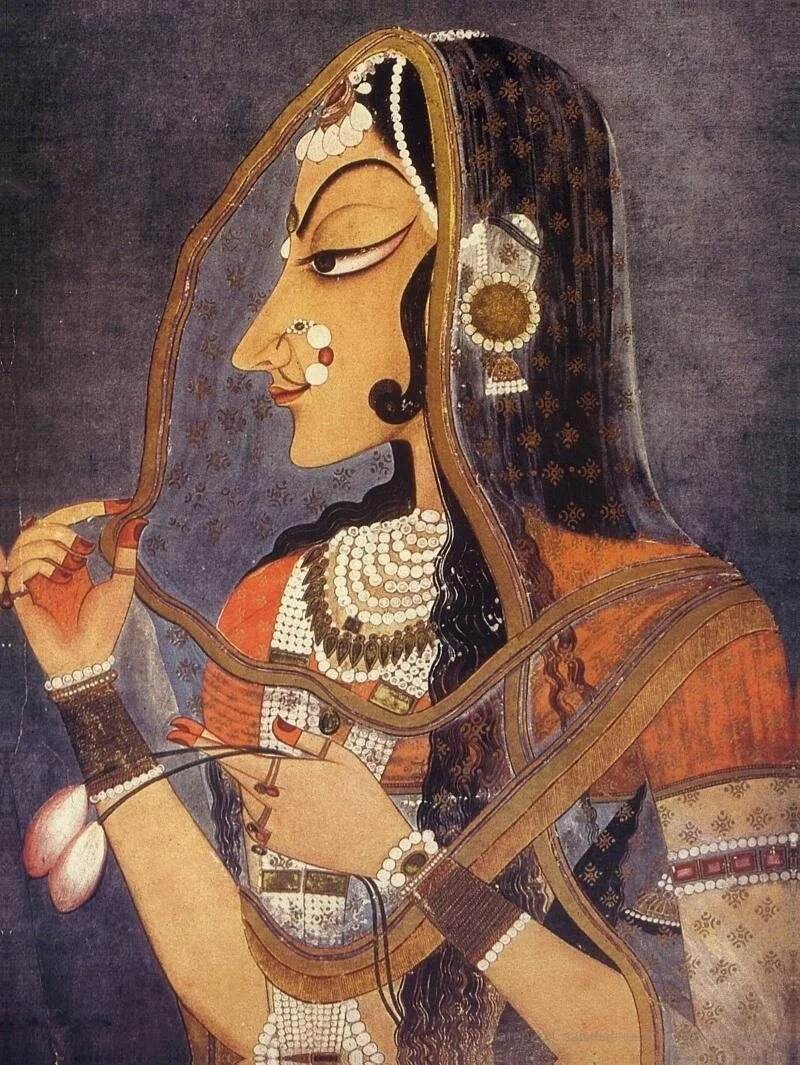
- Kishangarh: Associated with Raja Savant Singh and Bani Thani, painted by Nihal Chand.
- Pahari School: From the Himalayan states (Jammu, Basholi, Kangra).
- Basholi School: Characterized by bold lines and glowing primary colors like red and yellow, it depicts themes from the Rasamanjari and Ramayana.
- Guler–Kangra School: Known for its delicate naturalism and romantic Krishna themes, it illustrates subjects like the Gita Govinda, Bhagavata Purana, Nal-Damayanti, and Baramasa.
- Kullu-Mandi School: Folk style with bold drawing and dark colours.
- Colonial and Modern Developments:
- Company Paintings: Blend of Rajput, Mughal, Indian styles with European realism; commissioned by British officials.
- Bengal School of Art (early 20th century): Reactionary movement against colonial art, used simple colours.
- Materials & Themes: Early works on palm leaves, later on paper. Used natural pigments, including lapis lazuli. Served as illustrations for texts (epics, fables, religious texts) and depicted court life, portraiture, and romantic legends.
Frequently Asked Questions (FAQs)
1. What are miniature paintings in Indian art?
Miniature paintings are small-sized, highly detailed artworks using the tempera technique, often illustrating religious texts, court life, and romantic themes.
2. Why is the Kangra school significant?
The Guler–Kangra school represents refined naturalism and romantic Krishna-centric themes, marking the peak of Pahari painting.
3. Which school of Rajput painting is famous for the 'Bani Thani' portrait?
The Kishangarh School is famous for the 'Bani Thani', characterized by idealized figures with elongated, lotus-like eyes, a sharp chin, and a distinct side profile, often depicting Radha-Krishna themes.
UPSC Civil Services Examination Previous Year Question (PYQ)
Q. The well-known painting “Bani Thani” belongs to the (2018)
(a) Bundi school
(b) Jaipur school
(c) Kangra school
(d) Kishangarh school
Ans: (d)
Q. The painting of Bodhisattva Padmapani is one of the most famous and oft-illustrated paintings at (2017)
(a) Ajanta
(b) Badami
(c) Bagh
(d) Ellora
Ans: (a)
Q. Kalamkari painting refers to (2015)
(a) a hand-painted cotton textile in South India
(b) a handmade drawing on bamboo handicrafts in North-East India
(c) a block-painted woollen cloth in Western Himalayan region of India
(d) a hand-painted decorative silk cloth in NorthWestern India
Ans: (a)
Q. Consider the following historical places: (2013)
- Ajanta Caves
- Lepakshi Temple
- Sanchi Stupa
Which of the above places is/are also known for mural paintings?
(a) 1 only
(b) 1 and 2 only
(c) 1, 2 and 3
(d) None
Ans: (b)
Q. There are only two known examples of cave paintings of the Gupta period in ancient India. One of these is paintings of Ajanta caves. Where is the other surviving example of Gupta paintings? (2010)
(a) Bagh caves
(b) Ellora caves
(c) Lomas Rishi cave
(d) Nasik caves
Ans: (b)


Rapid Fire
PANKHUDI Portal
The Ministry of Women and Child Development has launched PANKHUDI portal aimed at strengthening collaboration and transparency in initiatives for women and child development.
- PANKHUDI: It is an integrated, single-window digital portal launched to facilitate Corporate Social Responsibility (CSR) and partnership initiatives for women and child development.
- Inspired by the vision of technology-driven governance and Jan Bhagidari, PANKHUDI acts as a bridge between the government, citizens, and institutions to promote transparency, participation, and trust.
- It brings together individuals, NRIs, NGOs, CSR contributors, corporate entities, and government agencies on a common digital interface to streamline voluntary and institutional contributions.
- Coverage: The portal covers key thematic areas such as nutrition, health, Early Childhood Care and Education (ECCE), child welfare, protection and rehabilitation, and women’s safety and empowerment.
- Contribution: Through the portal , contributors can register, identify initiatives, submit proposals, and track approvals and project progress, enhancing coordination, monitoring, and accountability.
- To ensure financial transparency and traceability, all contributions are accepted only through non-cash modes.
- Significance: PANKHUDI strengthens the implementation of flagship schemes including Mission Saksham Anganwadi & Poshan 2.0, Mission Vatsalya, and Mission Shakti through structured workflows.
- The portal is expected to improve service delivery across 14+ lakh Anganwadi Centres, ~5,000 Child Care Institutions, ~800 One Stop Centres, 500+ Shakhi Niwas, and 400+ Shakti Sadan.
- PANKHUDI represents a technology-enabled, outcome-oriented governance model, improving ease of doing CSR, strengthening partnerships, and enhancing ease of living for crores of beneficiaries across India.
| Read more: Integrated Child Development Services (ICDS) Programme |

Rapid Fire
Responsible Nations Index (RNI)
The World Intellectual Foundation (WIF) (a global, non-partisan and sector-agnostic think tank) will launch the Responsible Nations Index (RNI), India’s first globally anchored index that evaluates countries on responsible governance, sustainability, and global responsibility.
- Responsible Nations Index (RNI): It assess countries on the basis of responsible governance rather than conventional power or GDP-centric metrics.
- It is developed by the World Intellectual Foundation (WIF) in collaboration with Jawaharlal Nehru University (JNU), IIM Mumbai, and the Dr. Ambedkar International Centre.
- The Index covers 154 countries using transparent and globally sourced data to ensure credibility and comparability..
- Three core dimensions of RNI: The Index is structured around three core dimensions.
- Internal Responsibility evaluates dignity, justice, and citizen well-being.
- Environmental Responsibility assesses stewardship of natural resources, and climate action.
- External Responsibility measures a country’s contribution to peace, multilateral cooperation, and global stability.
- Significance: It shifts global assessment from economic and military power metrics to ethical governance, social well-being, environmental stewardship, and international responsibility.
- It promotes a value-based and human-centric framework aligned with India’s vision of ethical leadership, sustainable development, and reform of global governance.
| Read more: The Moral Authority of Countries in Global Governance |


Place In News
Shaksgam Valley Dispute
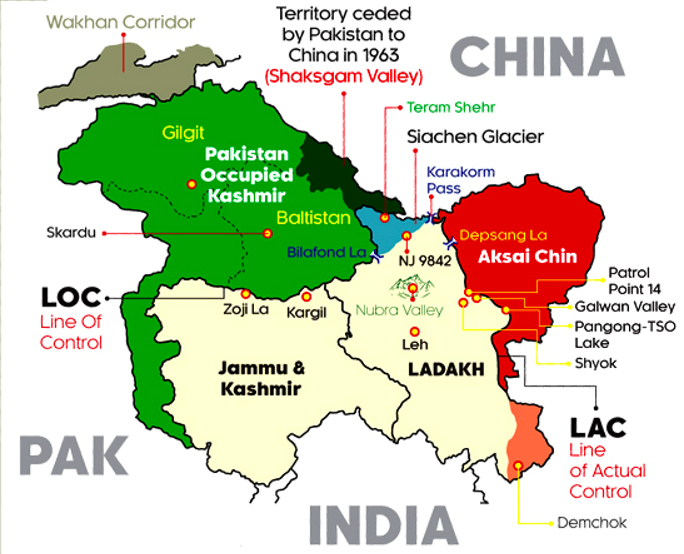
India rejected China’s infrastructure activities in the Shaksgam Valley, termed projects under the China-Pakistan Economic Corridor (CPEC) as illegal and invalid, and asserted that the valley is an inseparable part of India.
Shaksgam Valley
- About: The Shaksgam Valley (Trans-Karakoram Tract) is a high-altitude, sparsely populated region in the eastern Karakoram mountain range. It lies north of the Siachen Glacier, a part of the Hunza-Gilgit region of Pakistan-occupied Kashmir (POK), and borders China’s Xinjiang province to the north.
- Historical Background: Prior to 1947, the region was part of the princely state of Jammu and Kashmir; after the 1947–48 Indo-Pak conflict, Pakistan occupied parts of it and, under the 1963 Sino-Pakistan Boundary Agreement, ceded the Shaksgam Valley to China.
- India rejects the 1963 agreement as illegal, asserting that Pakistan lacked authority to transfer territory belonging to Jammu and Kashmir and Ladakh.
- Current Administration: It is currently administered by China as part of the Xinjiang Uyghur Autonomous Region, where China has developed infrastructure, including roads linked to CPEC.
- CPEC aims to connect Gwadar Port (Pakistan) with Kashgar (Xinjiang, China), giving China an alternative energy route bypassing the Malacca Strait.
- Strategic and Military Significance: Its proximity to the Siachen Glacier allows oversight of Pakistani positions, while access to the Karakoram Pass enables monitoring of Chinese military movements.
| Read More: External Intervention on Kashmir Issue |

Rapid Fire
Tex-RAMPS Scheme
The Ministry of Textiles signed MoUs with 15 states for its new 'Tex-RAMPS' scheme during the National Textile Ministers' Conference in Guwahati, held on the theme “India’s Textiles: Weaving Growth, Heritage & Innovation.”
Textiles Focused Research, Assessment, Monitoring, Planning And Start-Up (Tex-RAMPS)’ scheme
- About: It is aimed at improving the coverage, quality, timeliness, and credibility of textile-related statistical products and research. The scheme seeks to strengthen textile data systems across States and Union Territories to support better planning and decision-making.
- Nature of Scheme: It will be implemented as a Central Sector Scheme, fully funded by the Ministry of Textiles, for the period FY 2025–26 to FY 2030–31, aligned with the 16th Finance Commission cycle.
- Scope and Coverage: It supports integrated planning across key textile sub-sectors, including handlooms, handicrafts, apparel, and technical textiles.
- Financial Assistance: Rs 12 lakh per year as an annual grant to each State or Union Territory and Rs 1 lakh per year per district, linked to the development and implementation of district action plans.
- Key Components: Research & Innovation, Data, Analytics & Diagnostics, Integrated Textiles Statistical System (ITSS), Capacity Development, and Start-up & Innovation Support.
- Expected Outcomes: The MoUs strengthen cooperative federalism by improving textile data systems, bridging critical data gaps, and enabling evidence-based planning to support India’s roadmap towards a USD 350 billion textile industry.
| Read More: India's Textile Industry |