


Important Facts For Prelims
Srimanta Sankardeva
- 30 Dec 2025
- 7 min read
Why in News?
The Union Home Minister inaugurated the redeveloped Batadrava Than, the birthplace of Vaishnavite saint Srimanta Sankardeva, in Assam's Nagaon district.
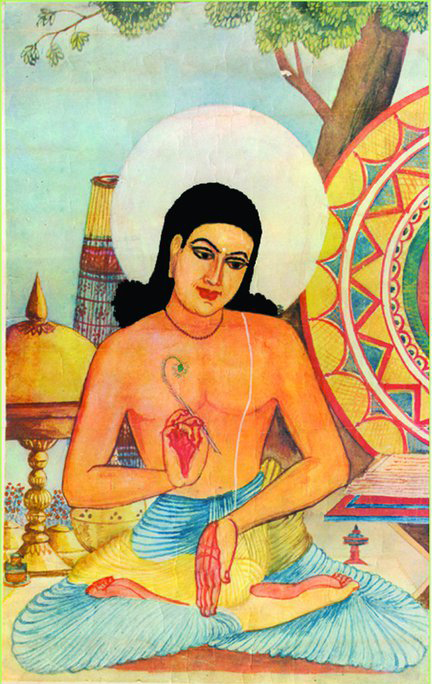
Who was Srimanta Sankardeva?
- About: He was a 15th–16th century Bhakti saint who holds a high position in Assam's history, society, culture, and religious beliefs. His diverse contributions led to a new phase of Assamese literature and culture, making him an important figure in the Indian Bhakti movement.
- Early Life and Background: Born in October 1449 to a family of Siromani Bhuyans (landed gentry), he undertook a transformative pilgrimage across North India in 1481 and composed his first Borgeet (devotional songs) at Badarikashrama (Badrinath).
- He faced opposition from kings and orthodox sections, shifted locations frequently, and passed away in 1568.
- Philosophical & Religious Contributions: Founder and propagator of the Neo-Vaishnava Bhakti movement in 15th-century Assam.
- He established eka-sarana-nama-dharma (also called Mahapurushiya dharma), whose cardinal principle was the worship of the single deity Vishnu (as Krishna), with its essence being the act of seeking refuge (sarana) in one God.
- Emphasized only two of the nine forms of Bhakti i.e., Sravana (hearing God's name) and Kirtana (chanting God's name).
- Preached universal brotherhood and sought to unite Assam's heterogeneous society (multiple tribes, languages, communities) under the Neo-Vaishnava fold.
- Institutional Contributions: He established Namghars (community prayer halls) and Satras (Vaishnava monasteries) which became centers for congregational worship, social equality, moral discipline, and the arts.
- Namghars, in particular, allowed the participation of all castes and communities, promoting social inclusivity.
- Literary Contributions: He translated eight of the twelve books of the Bhagavata Purana into Brajavali (common linguistic style in Assam) to make sacred Vaishnava texts accessible, with the Adi Dasama, covering Krishna's childhood, being the most popular.
- Major works include:
|
Work |
Description |
|
Kirtana-ghosha |
Considered his greatest achievement. A compendium of devotional songs for congregational prayer; one of the four sacred texts revered in Assam and sung daily in Namghars. |
|
Gunamala |
Condensed the essence of the Bhagavata Purana into six kirtans, composed in a single night. |
|
Nimi Nava Siddhi Samvada |
Doctrinal treatise. |
|
Bhakti Pradipa |
Denounces worship of deities other than Krishna. |
|
Bhatimas |
A poetic form he innovated for praising a guru or God. |
|
HariScandra-upakhyana, Rukmini Harana Kavya |
Early works |
- Contributions to Art & Culture:
- Ankiya Naats: One-act plays (devoid of any divisions) blending religious philosophy, indigenous entertainment, and classical Sanskrit drama techniques. Composed in Brajavali.
- Bhaona: The traditional theatrical performance of Ankiya Naats, staged in Namghars.
- Sattriya Dance: A classical dance form with prescribed rules of rhythm, presentation, and singing, performed as part of Bhaona.
- Borgeets: Devotional songs based on ragas and talas, accompanied by musical instruments. He composed an estimated 240 Borgeets, forming a living legacy.
- Legacy: The institutions (Satras, Namghars) and cultural forms (Sattriya, Bhaona, Borgeets, Kirtana-ghosha) he established remain vital, living elements of Assamese identity, promoting literature, music, theatre, dance, and crafts to this day.
|
Aspect |
Shaivism |
Vaishnavism |
Neo-Vaishnavism (Ekasarana Dharma) |
|
Primary Deity |
Shiva (as supreme Brahman, destroyer and transformer) |
Vishnu (or avatars like Krishna/Rama, as preserver) |
Krishna (sole refuge, identified with Narayana) |
|
Geographical Prevalence |
Predominant in South India, Kashmir, Nepal, and parts of North India |
Widespread across India, especially North and East |
Primarily in Assam and parts of Northeast India |
|
Key Practices |
Yoga, meditation, asceticism, tantra; lingam worship |
Bhakti devotion, temple worship, avatars’ narratives |
Congregational naam-kirtan (singing/chanting), sravan (listening); no idol worship |
|
Philosophical Emphasis |
Often non-dualistic (Advaita) or tantric; focus on jnana (knowledge) and self-realization |
Qualified non-dualism or dualism; strong emphasis on bhakti and prapatti (surrender) |
Exclusive shelter in one God (ekasarana); devotion in dasya bhava (servitude); egalitarian |
|
Associated Figures / Texts |
Adi Shankara, various Agama texts |
Ramanuja, Chaitanya, Madhva; Puranas like Bhagavata |
Srimanta Sankardeva, Madhavdeva; texts like Kirtan Ghosa |
|
Cultural Contributions |
Temple architecture, Shaiva Siddhanta philosophy |
Bhakti poetry, festivals like Janmashtami |
Sattras (monasteries), Namghars, Borgeet songs, Ankia Naat plays, Sattriya dance |
Frequently Asked Questions (FAQs)
1. Who was Srimanta Sankardeva?
A 15th–16th century Assamese Bhakti saint, social reformer, and cultural polymath, founder of Neo-Vaishnavism.
2. What are Namghars and Satras?
Community prayer halls (Namghars) and Vaishnava monasteries (Satras) established by Sankardeva to promote worship, social equality, and arts.
3. What are Sankardeva’s major literary contributions?
Works include Kirtana-ghosha, Gunamala, Bhatimas, HariScandra-upakhyana, and Rukmini Harana Kavya, mainly in Brajavali, promoting devotional literature
UPSC Civil Services Examination, Previous Year Questions (PYQs)
Q. With reference to the famous Sattriya dance, consider the following statements: (2014)
- Sattriya is a combination of music, dance and drama.
- It is a centuries-old living tradition of Vaishnavites of Assam.
- It is based on classical Ragas and Talas of devotional songs composed by Tulsidas, Kabir and Mirabai.
Which of the statements given above is/are correct?
(a) 1 only
(b) 1 and 2 only
(c) 2 and 3 only
(d) 1, 2 and 3
Ans: (b)
Q. With reference to the religious history of medieval India, the Sufi mystics were known to pursue which of the following practices? (2012)
- Meditation and control of breath.
- Severe ascetic exercises in a lonely place.
- Recitation of holy songs to arouse a state of ecstasy in their audience
Select the correct answer using the codes given below:
(a) 1 and 2 only
(b) 2 and 3 only
(c) 3 only
(d) 1, 2 and 3
Ans: (d)



