
Biodiversity & Environment
Carbon Capture, Usage and Storage
For Prelims: Carbon Capture, Utilization, and Storage (CCUS), International Energy Agency, Carbon dioxide, Green Steel
For Mains: Role of CCUS in India’s climate commitments and Net Zero pathway, Decarbonization of hard-to-abate sectors, Carbon markets
Why in News?
The Prime Minister of India shared an article titled "Carbon capture can power India’s next steel revolution" (authored by the Union Minister of Steel), emphasizing the role of Carbon Capture, Utilization, and Storage (CCUS) in decarbonizing India’s heavy industries.
- Simultaneously, the Union Budget 2026-27 has earmarked Rs 20,000 crore for a new CCUS scheme, signaling a decisive policy shift from research to commercial deployment.
What is Carbon Capture, Utilization, and Storage (CCUS)?
- About: According to the International Energy Agency (IEA), CCUS refers to a suite of technologies that involve the capture of carbon dioxide (CO2) from large point sources (such as power generation or industrial facilities) or directly from the atmosphere.
- The captured CO2 is then compressed and transported to be used in a range of applications or injected into deep geological formations for permanent storage.
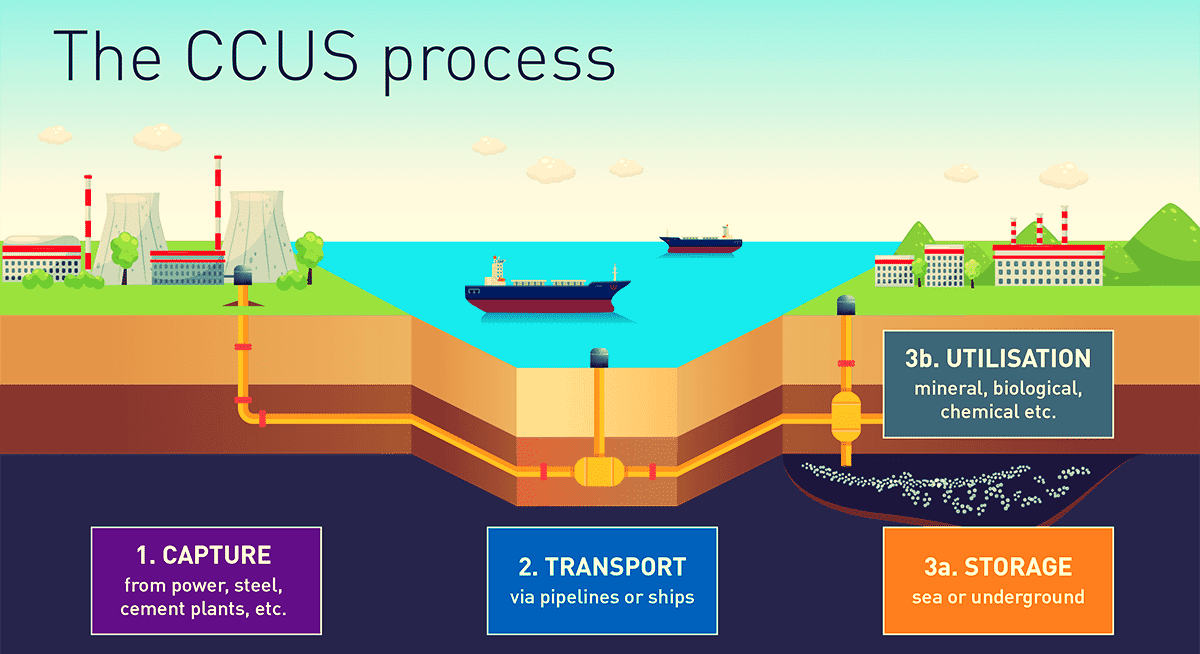
- The Three-Step Process:
- Capture: Separating CO2 from other gases produced during industrial processes (using chemical solvents, membranes, or solid sorbents).
- Transport: Compressing the captured CO2 and transporting it via pipelines, ships, or road tankers.
- Utilization and Storage:
- Utilization (CCU): Using the CO2 to create products like urea (fertilizers), synthetic fuels, building materials (curing concrete), or chemicals (methanol).
- Storage (CCS): Injecting the CO2 deep underground into geological formations (depleted oil/gas fields or saline aquifers) for permanent sequestration.
Why is CCUS Crucial for India?
- Solution for 'Hard-to-Abate' Sectors: Sectors like Steel, Cement, and Chemicals cannot simply switch to renewable energy because their emissions are often process-intrinsic (e.g., CO2 is released chemically when limestone is heated to make cement, regardless of the fuel used).
- CCUS is currently the only viable technology to decarbonize these processes without shutting down the industry.
- Powering the 'Steel Revolution': India is the world’s 2nd-largest crude steel producer after China, with an output of about 152 million tonnes in FY 2024–25.
- Under the National Steel Policy 2017, the country aims to achieve 300 million tonnes of crude steel capacity by FY 2030–31, and further expand to 500 million tonnes by 2047 as part of its Viksit Bharat vision.
- The sector contributes nearly 10 to 12% of the country’s total greenhouse gas emissions.
- While Hydrogen-based steel making is the future, it requires time to scale. CCUS acts as a vital bridge technology, making "Low-Carbon Steel" possible immediately using existing infrastructure.
- Under the National Steel Policy 2017, the country aims to achieve 300 million tonnes of crude steel capacity by FY 2030–31, and further expand to 500 million tonnes by 2047 as part of its Viksit Bharat vision.
- Enhancing Energy Security: India depends heavily on coal for primary energy (approx. 55-60%).
- Immediate abandonment of coal is economically detrimental. CCUS allows for the continued use of fossil fuels with significantly reduced environmental impact, ensuring energy security during the transition phase.
- Circular Economy: Captured CO2 can be converted into Methanol (a clean fuel) or used in Enhanced Oil Recovery (EOR), where CO2 is injected into aging oil fields to extract residual oil, turning a waste product into a revenue stream.
- Countering Carbon Taxes: Global markets are increasingly regulated by sustainability norms, such as the European Union’s Carbon Border Adjustment Mechanism (CBAM).
- Steel produced with integrated carbon capture systems will have a lower carbon footprint, safeguarding exports against cross-border carbon taxes.
- Low-carbon steel manufacturing will attract climate-aligned international investments.
- Longevity of Assets: India has a young fleet of steel plants. CCUS allows these existing assets to continue operating while meeting climate goals, preventing them from becoming "stranded assets."
- Alignment with Goals: CCUS initiatives can help India to meet Paris Agreement targets (limiting warming to 2°C, preferably 1.5°C) and align with five Sustainable Development Goals (SDGs), including Climate Action and Clean Energy.
India's Initiatives Related to CCUS
- Union Budget Allocation (2026-27): Allocated Rs 20,000 crore over five years to support CCUS projects.
- This funding targets five key sectors: Power, Steel, Cement, Refineries, and Chemicals.
- NITI Aayog’s CCUS Policy Framework: It proposed a viability gap funding (VGF) mechanism to lower the cost of capture.
- Development of CCUS Hubs & Clusters (e.g., in Gujarat and Odisha) where multiple industries share transport and storage infrastructure.
- Green Steel Taxonomy: The government has defined benchmarks for "Green Steel," incentivizing producers to adopt low-carbon technologies like CCUS to avoid carbon taxes (like CBAM) on exports.
- Steel produced with emissions of less than 2.2 tonnes of CO2 equivalent per tonne of crude steel (tCO2e/t-fs) can now be officially classified as 'Green Steel' with 3 to 5-star ratings.
- DST’s R&D Roadmap: The Department of Science & Technology (DST) launched a detailed roadmap outlining a phased approach from pilot demonstration (2025-30) to commercial scale-up (2035-45) of CCUS.
- Two National Centres of Excellence in Carbon Capture and Utilization (NCoE-CCU) have been established at IIT Bombay and JNCASR, Bengaluru.
- Mission Innovation Challenge on CCUS: It is a joint initiative by the Department of Science and Technology (DST) and the Department of Biotechnology (DBT).
- Launched in 2018, this call aims to undertake joint R&D with 24 member countries of Mission Innovation. It focuses on breakthrough technologies in CO2 capture, separation, storage, and value addition.
What are the Challenges in Scaling Up CCUS in India?
- Capital Intensive: CCUS technologies are very expensive. It can raise electricity costs by 60–80% and make steel and cement costlier, hurting export competitiveness.
- Energy Penalty: Carbon capture systems consume 15–25% of a plant’s power, reducing efficiency and increasing coal consumption.
- Infrastructural Gaps: India currently lacks a dedicated pipeline network for transporting high-pressure CO2 from industrial clusters (sources) to storage sites (sinks).
- Acquiring land for laying these pipelines is a complex challenge in India due to high population density and land acquisition laws.
- Geological Constraints & Data Deficit: While India has estimated storage capacity (500-1000 GT), there is a lack of high-resolution geological data ("Carbon Storage Atlas") that pinpoints exact, safe locations for permanent storage.
- Much of India's potential storage lies in Basalt formations (Deccan Traps). Storing CO2 in basalt is technically more challenging and less proven globally compared to sedimentary rock formations used in the West.
- Injecting high-pressure gas underground can theoretically trigger minor earthquakes or ground tremors.
- Utilization Constraints: The market for utilizing CO2 (e.g., making carbonated drinks, dry ice, or fire extinguishers) is tiny compared to the volume of emissions.
- Converting CO2 into value-added products like Methanol is currently expensive and requires Green Hydrogen, which is also in early stages of development.
- Regulatory & Legal Vacuum: There is no legal framework defining who is responsible if stored CO2 leaks 50 years from now. (Is it the company, the storage operator, or the government?).
- If geological storage sites are not sealed perfectly, CO2 can leak back into the atmosphere (negating climate benefits) or contaminate groundwater aquifers.
- India lacks a mature Carbon Market or a high Carbon Tax. Without a price on carbon emissions, industries have no financial incentive to invest in expensive CCUS technology.
What Measures can be Taken to Strengthen CCUS Scaling in India?
- Cluster-Based Approach: India should develop Industrial Hubs (e.g., in Gujarat or Odisha) where steel, cement, and power plants are located close together. They can share a common CO2 transport and storage infrastructure to reduce costs.
- Carbon Markets: Strengthen CCUS under the Carbon Credit Trading Scheme (CCTS). If companies can sell carbon credits earned by capturing CO2, the technology becomes financially viable.
- Performance-Linked Incentive (PLI) Scheme: Similar to the PLI for Green Hydrogen, the government should introduce a PLI for CCUS to subsidize the high upfront cost of capture technologies.
- Tax Credits (The '45Q' Model): India should adopt a model similar to the US '45Q' tax credit, offering a fixed tax deduction for every tonne of CO2 permanently stored or utilized.
- R&D in Utilization: Focus should remain on CCU (Utilization) over Storage. Converting CO2 into value-added products (like Green Urea or Green Methanol) suits India’s price-sensitive market better than burying it underground.
- Storage Standards: The Bureau of Indian Standards (BIS) must issue guidelines for the safe injection, monitoring, and verification of geological CO2 storage to prevent environmental hazards.
Conclusion
CCUS is no longer optional but "key" to achieving India’s Net-Zero by 2070 target. Scaling CCUS is not just about technology but about creating a "Carbon Economy". By treating CO2 as a valuable feedstock rather than waste, and by sharing infrastructure costs through clusters, India can turn its decarbonization challenge into an industrial opportunity.
|
Drishti Mains Question: "Carbon Capture, Utilization, and Storage (CCUS) is not just a climate mitigation tool but a prerequisite for sustaining India’s industrial growth in a carbon-constrained world." Discuss |
Frequently Asked Questions (FAQs)
1. What is CCUS?
CCUS is a set of technologies that capture CO₂ from industrial sources, transport it, and either utilize it in products like methanol and urea or store it underground for permanent sequestration.
2. Why is CCUS important for India?
It helps decarbonize hard-to-abate sectors like steel and cement, supports energy security, and protects exports from carbon taxes such as the EU’s CBAM.
3. What is India’s Green Steel benchmark?
Steel with emissions below2.2 tCO₂e per tonne of crude steel qualifies as Green Steel, with a 3–5 star rating system.
4. What are the key government initiatives on CCUS?
₹20,000 crore budget allocation (2026–27), NITI Aayog CCUS framework, CCUS hubs, DST roadmap, and Mission Innovation IC3 collaboration.
5. What are the major challenges in scaling CCUS in India?
High costs, energy penalty, lack of CO₂ pipelines, limited geological data, regulatory gaps, and weak carbon pricing mechanisms.
UPSC Civil Services Examination, Previous Year Questions (PYQs)
Prelims
Q1. Consider the following agricultural practices: (2012)
- Contour bunding
- Relay cropping
- Zero tillage
In the context of global climate change, which of the above helps/help in carbon sequestration/storage in the soil?
(a) 1 and 2 only
(b) 3 only
(c) 1, 2 and 3
(d) None of them
Ans: (b)
Q2. In the context of mitigating the impending global warming due to anthropogenic emissions of carbon dioxide, which of the following can be the potential sites for carbon sequestration? (2017)
- Abandoned and uneconomic coal seams
- Depleted oil and gas reservoirs
- Subterranean deep saline formations
Select the correct answer using the code given below:
(a) 1 and 2 only
(b) 3 only
(c) 1 and 3 only
(d) 1, 2 and 3
Ans: (d)
Mains
Q. What is Carbon Capture, Utilization and Storage (CCUS)? What is the potential role of CCUS in tackling climate change? (2025)
International Relations
US–Bangladesh Cotton Deal: Implications for India
For Prelims: India–US Interim Trade Agreement, Cotton, Manmade fibre, Kasturi Cotton Bharat
For Mains: Impact of Trade Agreements on Domestic Industries, Agricultural Exports and Cotton Economy, Technical Textiles and Industrial Policy
Why in News?
Bangladesh and the US signed a reciprocal trade agreement, colloquially termed the "Cotton for Zero-Tariff" deal.
- The pact has raised significant concerns among Indian exporters, as it threatens to erode the competitive edge India had gained under the India–US Interim Trade Agreement in the US market and could also disrupt India’s raw cotton exports.
Summary
- The US–Bangladesh “Cotton for Zero-Tariff” deal gives Bangladesh a quota-based zero-duty advantage in the US market, eroding India’s tariff edge, threatening textile hubs, and risking a decline in Indian cotton exports as Bangladeshi firms shift to US cotton.
- India must respond through trade negotiations (cotton parity, BTA), MMF reforms, ESG branding, technical textiles, and market diversification to protect its textile sector and farmer incomes.
What are the Key Highlights of the US-Bangladesh Trade Deal?
- Tariff Reduction: The deal secures a 19% reciprocal tariff for Bangladesh, a reduction from the earlier 20%.
- Zero-Tariff Mechanism: The most significant aspect is the commitment to establish a mechanism allowing a specified volume of Bangladeshi textile and apparel goods to enter the US at a zero reciprocal tariff rate.
- Conditionality (Rules of Origin): The zero-tariff benefit is conditional. The volume of duty-free exports will be determined based on Bangladesh’s use of "US-produced cotton and man-made fibre textile inputs."
- Reciprocal Commitments by Bangladesh: Bangladesh has agreed to significantly open its economy to US industrial and agricultural goods.
- It has committed to purchasing USD 3.5 billion of US agricultural products (wheat, soy, cotton, corn) and USD 15 billion worth of energy products over 15 years.
How Does the US-Bangladesh Trade Deal Impact India?
According to the Confederation of Indian Textile Industry (CITI), the deal presents a "two-fold challenge" for India:
- Erosion of Tariff Advantage: Prior to this deal, India had a perceived advantage with an 18% US tariff compared to Bangladesh’s 20%.
- With the new deal, Bangladesh’s general tariff drops to 19%, narrowing India’s margin to just 1%.
- More critically, for the specific quota of goods entering at 0% duty, India now faces a massive 18% disadvantage compared to Bangladesh.
- Bangladesh is already the second-largest apparel exporter globally (after China). This deal further strengthens its position against India (the 6th-largest exporter) in the lucrative US market.
- Industrial hubs like Tiruppur (Tamil Nadu) and Surat (Gujarat) operate on thin profit margins. Global retail giants (like Walmart, GAP) may shift large-volume orders to Bangladesh to capitalize on the duty-free benefits.
- Loss of a Key Market for Indian Cotton: Bangladesh has traditionally been the largest buyer of Indian raw cotton (accounting for nearly 70% of India's cotton exports).
- India exported USD 1.6 billion worth of cotton yarn and about USD 85 million of manmade fibre (MMF) yarn to Bangladesh in 2024.
- To access the 0% US tariff, Bangladeshi manufacturers must use US-produced cotton. This incentivizes them to switch their sourcing from India to the US.
- This will likely lead to a sharp decline in Indian cotton exports to Bangladesh, causing a glut in the Indian domestic market and depressing prices for Indian cotton farmers.
What Measures can India Take to Safeguard its Cotton and Textile Sector?
- Lobby for “Cotton Parity” With the US: India’s cotton imports rose to 4.13 million bales in 2024–25, with the US as the top supplier.
- India should seek a “Cotton Clause” from the US, granting zero-duty access for garments made from US cotton to counter Bangladesh’s new advantage.
- Fast-track the India–US Bilateral Trade Agreement (BTA) to reduce non-tariff barriers and compliance burdens, enabling faster movement of goods to the US market.
- Countering with ESG: Western buyers are sensitive to "Ethical Sourcing." Bangladesh faces scrutiny over labor rights and safety.
- India should aggressively market its "Sustainable & Socially Compliant" manufacturing (zero child labor, better fire safety records than Bangladesh) to premium buyers who fear reputational risk.
- Pivot to Man-Made Fibres (MMF): Global textile trade is 70% MMF (polyester/viscose) and 30% cotton, but India’s exports are largely cotton-based.
- Higher taxes on MMF raw materials than on finished goods have historically discouraged domestic MMF production.
- The GST Council must rationalize the entire MMF value chain to make Indian synthetics price-competitive against Bangladesh, China and Vietnam.
- The "Kasturi" Strategy: Scale up the "Kasturi Cotton Bharat" initiative. By using blockchain to prove that Indian cotton is ethically grown and contamination-free, India can command a premium price that offsets the tariff disadvantage.
- Technical Textiles: India should target high-tech textiles where quality outweighs tariff gaps, shifting toward value-added textile segments like Meditech (surgical implants, sanitary products), Mobiltech (airbags, seatbelts), and Geotech (road construction fabrics).
- Creating a guaranteed domestic market would help firms scale up and compete globally.
- Market Diversification: Reduce over-reliance on the US market by exploring new export destinations in Australia and the UAE (where India already has FTAs) and tapping into emerging markets in Latin America.
|
Drishti Mains Question: “Trade agreements often create both opportunities and vulnerabilities.” Examine this statement in the context of the US–Bangladesh textile deal and its implications for India. |
Frequently Asked Questions (FAQs)
1. What is the key feature of the US–Bangladesh “Cotton for Zero-Tariff” deal?
It grants quota-based zero reciprocal tariffs on Bangladeshi textiles, conditional on the use of US-produced cotton and MMF inputs.
2. How does the deal affect India’s tariff position in the US market?
India faces an 18% tariff, while Bangladesh gets zero duty within quota, creating an effective 18% disadvantage for Indian exporters.
3. Why is Bangladesh crucial for India’s cotton exports?
Bangladesh accounts for nearly 70% of India’s cotton exports, importing $1.6 billion worth of cotton yarn in 2024.
4. What structural weakness exists in India’s textile export basket?
Global trade is 70% Man-Made Fibre (MMF), but India’s exports are predominantly cotton-based due to past tax distortions in the MMF value chain.
UPSC Civil Services Examination, Previous Year Questions (PYQs)
Prelims
1. Consider the following statements: (2020)
- The value of Indo-Sri Lanka trade has consistently increased in the last decade.
- “Textile and textile articles” constitute an important item of trade between India and Bangladesh.
- In the last five years, Nepal has been the largest trading partner of India in South Asia.
Which of the statements given above is/are correct?
(a) 1 and 2 only
(b) 2 only
(c) 3 only
(d) 1, 2 and 3
Ans: (b)
Mains
Q. ‘What introduces friction into the ties between India and the United States is that Washington is still unable to find for India a position in its global strategy, which would satisfy India’s National self-esteem and ambitions’. Explain with suitable examples. (2019)
Important Facts For Prelims
Arctic Warming Amplifies Invasive Species Threat
Why in News?
Recent scientific studies warn that rapid Arctic warming is increasing the risk of invasive alien plant species establishing and transforming fragile Arctic ecosystems.
How is Arctic Warming Increasing the Threat of Invasive Plants?
- Changing Climate Conditions: Climate change and rising human activity are weakening the Arctic’s natural barriers, short growing seasons, harsh climate, and limited disturbance, making previously inhospitable regions suitable for non-native species.
- Scientific Findings: A recent study estimates that 2,554 vascular plant species from across the world could find suitable climatic niches in a warming Arctic.
- Existing Evidence of Spread: An earlier Arctic inventory documented 341 alien taxa, of which 188 have naturalised, and researchers have already observed unexpected non-native species in Svalbard, including common meadow rue.
- Vulnerable Hotspots Identified: Six major potential invasion hotspots were identified: western Alaska, southwestern and southeastern Greenland, northern Iceland, Fennoscandia, and the Kanin–Pechora region, where warming and human connectivity intersect.
- Pathways of Introduction: Invasive plant introductions occur mainly through escape from confinement, transport-stowaway, seed contamination, transport via vehicles, etc.
- Ecological Implications: Alien species that displace native flora threaten the fragile Arctic tundra ecosystem, comprising mosses, lichens, shrubs like bearberry, and unique fauna such as snowy owl, Arctic fox, grizzly bear, seals, walruses, and belugas, and are considered one of the greatest drivers of global biodiversity loss.
What are Invasive Alien Plant Species?
- About: Invasive plant species are non-native plants introduced intentionally or unintentionally into an ecosystem, where they outcompete native species and cause economic, environmental, or human health impacts.
- Invasions are being accelerated by climate change, land-use change, altered fire regimes, soil moisture changes, livestock grazing patterns, and biodiversity loss.
- Invasive Plant Species in India: Key invaders include Lantana camara, Chromolaena odorata and Prosopis juliflora.
- These invasions have spread across 266,954 sq km of natural habitats in India.
- High-risk Regions: Include the Shivalik–Terai belt, the Duar region of the Northeast, the Aravallis, the Dandakaranya forests, and the Nilgiris in the Western Ghats.
- Open ecosystems such as dry grasslands, savannas, shola grasslands, and the wet plains along the Ganga–Brahmaputra are among the most vulnerable to rapid invasive plant expansion.
Frequently Asked Question (FAQ)
1. What are invasive alien species?
Invasive alien species are plants or other organisms introduced outside their natural habitat that establish, spread rapidly, and cause ecological harm by outcompeting native species and altering ecosystems.
2. Why is the Arctic more vulnerable to invasions now? Rapid warming and increasing human activity are reducing natural climatic barriers that earlier prevented non-native species from surviving.
3. Why are invasive alien species harmful? They reduce native biodiversity, disrupt ecosystem balance, and can permanently change fragile habitats such as the Arctic tundra.
UPSC Civil Services Examination, Previous Year Questions (PYQs)
Prelims
Q. Which of the following statements is/are correct about the deposits of ‘methane hydrate’? (2019)
- Global warming might trigger the release of methane gas from these deposits.
- Large deposits of ‘methane hydrate’ are found in Arctic Tundra and under the sea floor.
- Methane in the atmosphere oxidizes to carbon dioxide after a decade or two.
Select the correct answer using the code given below.
(a) 1 and 2 only
(b) 2 and 3 only
(c) 1 and 3 only
(d) 1, 2 and 3
Ans: (d)
Q. Consider the following countries: (2014)
- Denmark
- Japan
- Russian Federation
- United Kingdom
- United States of America
Which of the above are the members of the ‘Arctic Council’?
(a) 1, 2 and 3
(b) 2, 3 and 4
(c) 1, 4 and 5
(d) 1, 3 and 5
Ans: (d)
Rapid Fire
Ricin in Bioterrorism
The National Investigation Agency (NIA) has taken over the probe into the country’s first alleged 'bioterrorism' plot from the Gujarat Anti-Terrorism Squad (ATS).
- The case centers on a Hyderabad-based doctor accused of attempting to weaponize 'Ricin', a lethal toxin extracted from castor beans, marking a concerning shift towards the use of dual-use biological agents for terror activities termed as bioterrorism.
- Ricin: It is an extremely potent, naturally occurring type II ribosome-inactivating protein (lectin) derived from castor beans (Ricinus communis).
- Extraction: Acetone, an industrial solvent, can be used to extract and refine ricin from the residual mash left after castor oil production.
- Threat Level: Ricin blocks protein synthesis within cells, leading to severe cellular damage and death, and is extremely toxic even in minute doses through inhalation, ingestion, or injection, with no known antidote available.
- Security Status: Classified as a Schedule 1 substance under the Chemical Weapons Convention (CWC) due to its high potential for misuse as a biological weapon.
- Operational History: While used in targeted assassinations, Ricin has never been successfully used in mass-casualty events.
- Constraints: Large-scale weaponization remains difficult due to technical challenges in mass production and effective aerosol dissemination.
| Read more: Ricin Poisoning |
Rapid Fire
Bodhan AI & Bharat EduAI Stack
Recently, the government has launched Bodhan AI to build an open-source Bharat EduAI Stack aimed at embedding Artificial Intelligence (AI) across the education system from kindergarten to research.
- Bodhan AI: It is a non-profit organisation under the Ministry of Education, developed by the AI Centre of Excellence for Education at IIT Madras.
- It aims to build an AI-enabled Digital Public Infrastructure (DPI) for education through the creation of the Bharat EduAI Stack.
- Bharat EduAI Stack: It will function as an open-source digital public infrastructure to deploy AI tools across the education ecosystem, including personalised AI tutors, AI-assisted teacher training and support, institutional administration systems, and data-driven policy-making based on large learning datasets.
- Vision: The initiative aims to make AI inclusive, interoperable and sovereign while promoting equitable education under the “AI for All” approach.
- Applications: The initiative seeks to make education equitable, affordable, accessible and high-quality through AI tutors for personalised learning, AI-assisted teacher training, and tools to help parents track children’s development.
| Read more: India’s Digital Public Infrastructure |
Rapid Fire
Sawalkot Hydroelectric Project
Pakistan has officially requested information and consultations from India regarding the Sawalkot hydroelectric project on the River Chenab, invoking the provisions of the Indus Waters Treaty (IWT) of 1960.
- Treaty Status & Context: The development is significant as it comes after India reportedly placed the Indus Waters Treaty of 1960 in "abeyance" as a punitive measure following the Pahalgam terror attack.
- Pakistan's Stance: The Pakistan Foreign Office asserted that "no unilateral actions" can alter the legal reality of the treaty and urged India to return to full treaty compliance and fulfill its obligations.
- Pakistan reiterated its commitment to resolving disputes through dialogue and international legal mechanisms mandated by the IWT.
- Sawalkot Hydroelectric Project:
- Location & River: Situated on the Chenab River (a 'Western River' under the Indus Waters Treaty) in the Ramban district of Jammu & Kashmir.
- Capacity & Type: It is a massive 1,856 MW project designed as a run-of-the-river scheme, utilizing the natural flow of the river with minimal storage.
- The project involves the construction of a concrete gravity dam with a reservoir.
- Status: Although initiated in 1984, it faced long delays and has now been declared a "Project of National Importance."
- Strategic Significance: It is expected to generate over 7,000 million units of electricity annually, making it one of India's largest hydro projects.
- With the Indus Waters Treaty (IWT) in abeyance, the project is strategically vital for enhancing India’s control and optimizing the potential of Western Rivers.
- Hydroelectric Project on Chenab River: The Chenab River hosts the 390-MW Dulhasti project at Kishtwar, the 890-MW Baglihar project at Ramban, and the 690-MW Salal project at Reasi. These projects significantly contribute to the region's energy supply.

| Read more: Pahalgam Terror Attack and Suspension of the Indus Waters Treaty |
Rapid Fire
IAF to Train British Pilots
Indian Air Force instructors will train British pilots at the Royal Air Force(RAF) Valley, for the first time, following the 19th UK-India Air Staff Talks as part of expanding bilateral military training engagements.
- Deployment: Three Indian Air Force Qualified Flight Instructors will be posted at RAF Valley, UK’s training base, for a two-year tenure to train British fast-jet pilots on Hawk T2 and Texan T1 aircraft.
- This follows the first-ever deployment earlier this year of an Indian Air Force officer as an instructor at the Royal Air Force College Cranwell, which trains future RAF officers.
- Broader Defence Engagement: Indian officers are now serving as instructors across all three UK military academies: Dartmouth (Navy), Sandhurst (Army), and Cranwell/RAF training establishments (Air Force).
- Strategic Significance: The initiative enhances interoperability, mutual trust, and long-term defence partnership under the UK-India Vision 2035 framework.
- Military Exercises:
- Cobra Warrior
- Ajeya Warrior
- Tarang Shakti
| Read more: India-UK Vision 2035 and CETA |
Rapid Fire
Indigenous Dogs for Assam Rifles Dog Squad
Assam Rifles plans to gradually phase out foreign dog breeds by 2050, following the 2025 directive of the Ministry of Home Affairs (MHA) to induct more Indian canine breeds into the armed forces’ dog squads.
- Tangkhul Hui Breed: It is native to the Ukhrul district of Manipur, is highly disease-resistant and traditionally used for hunting.
- Kombai Breed: An indigenous breed from Tamil Nadu, Kombai has been identified as a suitable partner breed for Tangkhul Hui.
- Training & Deployment: The dogs are trained at the Assam Rifles Dog Training Centre in Jorhat, the force’s only such facility, before deployment as guard and tracker dogs in operational areas.
- Operational Role: These dogs help in detecting arms, explosives and narcotics, particularly in the Northeast and Jammu & Kashmir regions.
- Current vs Future Composition: The force currently uses Belgian Malinois, German Shepherd and Labrador breeds, but aims for full induction of indigenous breeds by 2027 and gradual replacement by 2050.
Assam Rifles
- The Assam Rifles is a Central Armed Police Force (CAPF) and India’s oldest paramilitary force, primarily responsible for security and counter-insurgency operations in the Northeast and guarding the Indo-Myanmar border.
- It was established in 1835 as the “Cachar Levy,” a militia raised to protect British tea plantations and settlements from tribal raids in the Northeast.
- The force functions under the dual control of the Ministry of Home Affairs (administrative) and the Ministry of Defence (operational).
| Read more: Assam Rifles |



