


Biodiversity & Environment
Carbon Capture, Usage and Storage
- 13 Feb 2026
- 16 min read
For Prelims: Carbon Capture, Utilization, and Storage (CCUS), International Energy Agency, Carbon dioxide, Green Steel
For Mains: Role of CCUS in India’s climate commitments and Net Zero pathway, Decarbonization of hard-to-abate sectors, Carbon markets
Why in News?
The Prime Minister of India shared an article titled "Carbon capture can power India’s next steel revolution" (authored by the Union Minister of Steel), emphasizing the role of Carbon Capture, Utilization, and Storage (CCUS) in decarbonizing India’s heavy industries.
- Simultaneously, the Union Budget 2026-27 has earmarked Rs 20,000 crore for a new CCUS scheme, signaling a decisive policy shift from research to commercial deployment.
What is Carbon Capture, Utilization, and Storage (CCUS)?
- About: According to the International Energy Agency (IEA), CCUS refers to a suite of technologies that involve the capture of carbon dioxide (CO2) from large point sources (such as power generation or industrial facilities) or directly from the atmosphere.
- The captured CO2 is then compressed and transported to be used in a range of applications or injected into deep geological formations for permanent storage.
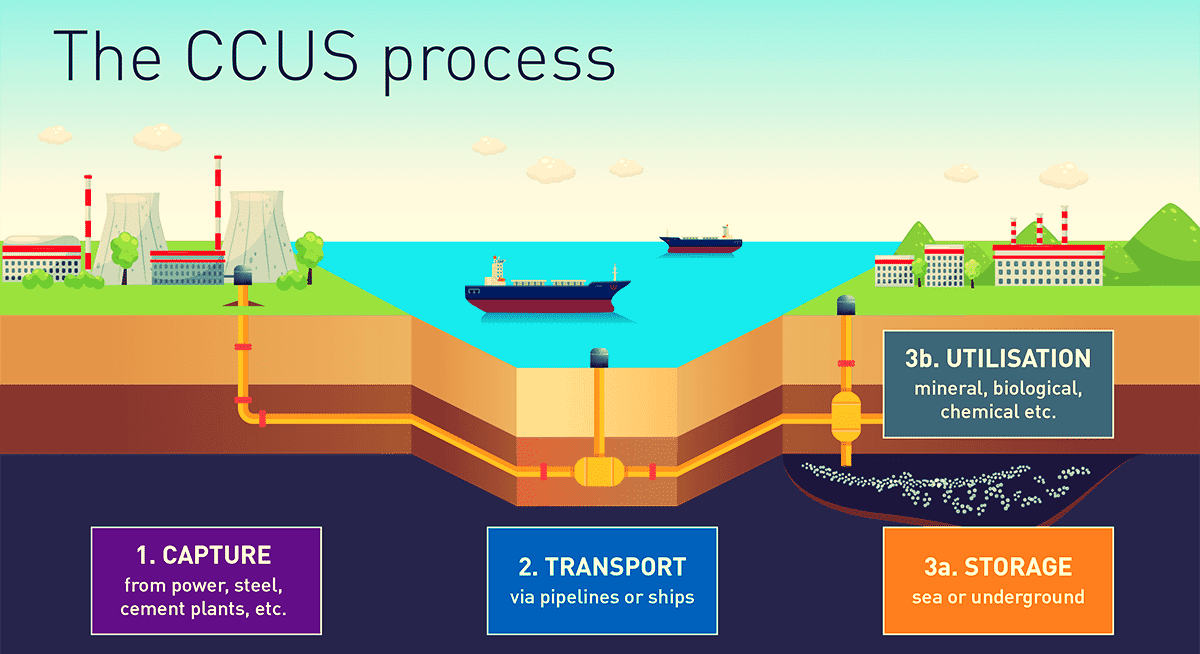
- The Three-Step Process:
- Capture: Separating CO2 from other gases produced during industrial processes (using chemical solvents, membranes, or solid sorbents).
- Transport: Compressing the captured CO2 and transporting it via pipelines, ships, or road tankers.
- Utilization and Storage:
- Utilization (CCU): Using the CO2 to create products like urea (fertilizers), synthetic fuels, building materials (curing concrete), or chemicals (methanol).
- Storage (CCS): Injecting the CO2 deep underground into geological formations (depleted oil/gas fields or saline aquifers) for permanent sequestration.
Why is CCUS Crucial for India?
- Solution for 'Hard-to-Abate' Sectors: Sectors like Steel, Cement, and Chemicals cannot simply switch to renewable energy because their emissions are often process-intrinsic (e.g., CO2 is released chemically when limestone is heated to make cement, regardless of the fuel used).
- CCUS is currently the only viable technology to decarbonize these processes without shutting down the industry.
- Powering the 'Steel Revolution': India is the world’s 2nd-largest crude steel producer after China, with an output of about 152 million tonnes in FY 2024–25.
- Under the National Steel Policy 2017, the country aims to achieve 300 million tonnes of crude steel capacity by FY 2030–31, and further expand to 500 million tonnes by 2047 as part of its Viksit Bharat vision.
- The sector contributes nearly 10 to 12% of the country’s total greenhouse gas emissions.
- While Hydrogen-based steel making is the future, it requires time to scale. CCUS acts as a vital bridge technology, making "Low-Carbon Steel" possible immediately using existing infrastructure.
- Under the National Steel Policy 2017, the country aims to achieve 300 million tonnes of crude steel capacity by FY 2030–31, and further expand to 500 million tonnes by 2047 as part of its Viksit Bharat vision.
- Enhancing Energy Security: India depends heavily on coal for primary energy (approx. 55-60%).
- Immediate abandonment of coal is economically detrimental. CCUS allows for the continued use of fossil fuels with significantly reduced environmental impact, ensuring energy security during the transition phase.
- Circular Economy: Captured CO2 can be converted into Methanol (a clean fuel) or used in Enhanced Oil Recovery (EOR), where CO2 is injected into aging oil fields to extract residual oil, turning a waste product into a revenue stream.
- Countering Carbon Taxes: Global markets are increasingly regulated by sustainability norms, such as the European Union’s Carbon Border Adjustment Mechanism (CBAM).
- Steel produced with integrated carbon capture systems will have a lower carbon footprint, safeguarding exports against cross-border carbon taxes.
- Low-carbon steel manufacturing will attract climate-aligned international investments.
- Longevity of Assets: India has a young fleet of steel plants. CCUS allows these existing assets to continue operating while meeting climate goals, preventing them from becoming "stranded assets."
- Alignment with Goals: CCUS initiatives can help India to meet Paris Agreement targets (limiting warming to 2°C, preferably 1.5°C) and align with five Sustainable Development Goals (SDGs), including Climate Action and Clean Energy.
India's Initiatives Related to CCUS
- Union Budget Allocation (2026-27): Allocated Rs 20,000 crore over five years to support CCUS projects.
- This funding targets five key sectors: Power, Steel, Cement, Refineries, and Chemicals.
- NITI Aayog’s CCUS Policy Framework: It proposed a viability gap funding (VGF) mechanism to lower the cost of capture.
- Development of CCUS Hubs & Clusters (e.g., in Gujarat and Odisha) where multiple industries share transport and storage infrastructure.
- Green Steel Taxonomy: The government has defined benchmarks for "Green Steel," incentivizing producers to adopt low-carbon technologies like CCUS to avoid carbon taxes (like CBAM) on exports.
- Steel produced with emissions of less than 2.2 tonnes of CO2 equivalent per tonne of crude steel (tCO2e/t-fs) can now be officially classified as 'Green Steel' with 3 to 5-star ratings.
- DST’s R&D Roadmap: The Department of Science & Technology (DST) launched a detailed roadmap outlining a phased approach from pilot demonstration (2025-30) to commercial scale-up (2035-45) of CCUS.
- Two National Centres of Excellence in Carbon Capture and Utilization (NCoE-CCU) have been established at IIT Bombay and JNCASR, Bengaluru.
- Mission Innovation Challenge on CCUS: It is a joint initiative by the Department of Science and Technology (DST) and the Department of Biotechnology (DBT).
- Launched in 2018, this call aims to undertake joint R&D with 24 member countries of Mission Innovation. It focuses on breakthrough technologies in CO2 capture, separation, storage, and value addition.
What are the Challenges in Scaling Up CCUS in India?
- Capital Intensive: CCUS technologies are very expensive. It can raise electricity costs by 60–80% and make steel and cement costlier, hurting export competitiveness.
- Energy Penalty: Carbon capture systems consume 15–25% of a plant’s power, reducing efficiency and increasing coal consumption.
- Infrastructural Gaps: India currently lacks a dedicated pipeline network for transporting high-pressure CO2 from industrial clusters (sources) to storage sites (sinks).
- Acquiring land for laying these pipelines is a complex challenge in India due to high population density and land acquisition laws.
- Geological Constraints & Data Deficit: While India has estimated storage capacity (500-1000 GT), there is a lack of high-resolution geological data ("Carbon Storage Atlas") that pinpoints exact, safe locations for permanent storage.
- Much of India's potential storage lies in Basalt formations (Deccan Traps). Storing CO2 in basalt is technically more challenging and less proven globally compared to sedimentary rock formations used in the West.
- Injecting high-pressure gas underground can theoretically trigger minor earthquakes or ground tremors.
- Utilization Constraints: The market for utilizing CO2 (e.g., making carbonated drinks, dry ice, or fire extinguishers) is tiny compared to the volume of emissions.
- Converting CO2 into value-added products like Methanol is currently expensive and requires Green Hydrogen, which is also in early stages of development.
- Regulatory & Legal Vacuum: There is no legal framework defining who is responsible if stored CO2 leaks 50 years from now. (Is it the company, the storage operator, or the government?).
- If geological storage sites are not sealed perfectly, CO2 can leak back into the atmosphere (negating climate benefits) or contaminate groundwater aquifers.
- India lacks a mature Carbon Market or a high Carbon Tax. Without a price on carbon emissions, industries have no financial incentive to invest in expensive CCUS technology.
What Measures can be Taken to Strengthen CCUS Scaling in India?
- Cluster-Based Approach: India should develop Industrial Hubs (e.g., in Gujarat or Odisha) where steel, cement, and power plants are located close together. They can share a common CO2 transport and storage infrastructure to reduce costs.
- Carbon Markets: Strengthen CCUS under the Carbon Credit Trading Scheme (CCTS). If companies can sell carbon credits earned by capturing CO2, the technology becomes financially viable.
- Performance-Linked Incentive (PLI) Scheme: Similar to the PLI for Green Hydrogen, the government should introduce a PLI for CCUS to subsidize the high upfront cost of capture technologies.
- Tax Credits (The '45Q' Model): India should adopt a model similar to the US '45Q' tax credit, offering a fixed tax deduction for every tonne of CO2 permanently stored or utilized.
- R&D in Utilization: Focus should remain on CCU (Utilization) over Storage. Converting CO2 into value-added products (like Green Urea or Green Methanol) suits India’s price-sensitive market better than burying it underground.
- Storage Standards: The Bureau of Indian Standards (BIS) must issue guidelines for the safe injection, monitoring, and verification of geological CO2 storage to prevent environmental hazards.
Conclusion
CCUS is no longer optional but "key" to achieving India’s Net-Zero by 2070 target. Scaling CCUS is not just about technology but about creating a "Carbon Economy". By treating CO2 as a valuable feedstock rather than waste, and by sharing infrastructure costs through clusters, India can turn its decarbonization challenge into an industrial opportunity.
|
Drishti Mains Question: "Carbon Capture, Utilization, and Storage (CCUS) is not just a climate mitigation tool but a prerequisite for sustaining India’s industrial growth in a carbon-constrained world." Discuss |
Frequently Asked Questions (FAQs)
1. What is CCUS?
CCUS is a set of technologies that capture CO₂ from industrial sources, transport it, and either utilize it in products like methanol and urea or store it underground for permanent sequestration.
2. Why is CCUS important for India?
It helps decarbonize hard-to-abate sectors like steel and cement, supports energy security, and protects exports from carbon taxes such as the EU’s CBAM.
3. What is India’s Green Steel benchmark?
Steel with emissions below2.2 tCO₂e per tonne of crude steel qualifies as Green Steel, with a 3–5 star rating system.
4. What are the key government initiatives on CCUS?
₹20,000 crore budget allocation (2026–27), NITI Aayog CCUS framework, CCUS hubs, DST roadmap, and Mission Innovation IC3 collaboration.
5. What are the major challenges in scaling CCUS in India?
High costs, energy penalty, lack of CO₂ pipelines, limited geological data, regulatory gaps, and weak carbon pricing mechanisms.
UPSC Civil Services Examination, Previous Year Questions (PYQs)
Prelims
Q1. Consider the following agricultural practices: (2012)
- Contour bunding
- Relay cropping
- Zero tillage
In the context of global climate change, which of the above helps/help in carbon sequestration/storage in the soil?
(a) 1 and 2 only
(b) 3 only
(c) 1, 2 and 3
(d) None of them
Ans: (b)
Q2. In the context of mitigating the impending global warming due to anthropogenic emissions of carbon dioxide, which of the following can be the potential sites for carbon sequestration? (2017)
- Abandoned and uneconomic coal seams
- Depleted oil and gas reservoirs
- Subterranean deep saline formations
Select the correct answer using the code given below:
(a) 1 and 2 only
(b) 3 only
(c) 1 and 3 only
(d) 1, 2 and 3
Ans: (d)
Mains
Q. What is Carbon Capture, Utilization and Storage (CCUS)? What is the potential role of CCUS in tackling climate change? (2025)



