Indian Polity
Model Code of Conduct
For Prelims: Election Commission of India, Model Code of Conduct, Chief Election Commissioner, Directive Principles of State Policy, Artificial Intelligence, Deepfakes
For Mains: Role of Election Commission of India (ECI) in ensuring free and fair elections, Model Code of Conduct: Significance, limitations, and reforms, Electoral reforms in India and committee recommendations
Why in News?
The Election Commission of India (ECI) has enforced the Model Code of Conduct (MCC) following the announcement of the 2026 General Elections to the Legislative Assemblies of Assam, Kerala, Tamil Nadu, West Bengal, and the Union Territory of Puducherry, alongside bye-elections in multiple states.
- With this announcement, the MCC has come into immediate effect to ensure a level playing field and prevent the misuse of official machinery by the party in power.
Summary
- The Model Code of Conduct (MCC) ensures free and fair elections by regulating political parties, candidates, and the ruling government, but lacks statutory backing, relying on Article 324 and moral authority.
- Its effectiveness is challenged by digital misinformation, misuse of incumbency, freebies, and weak enforcement, highlighting the need for legal and technological reforms.
What is the Model Code of Conduct?
- About: The Model Code of Conduct is a comprehensive set of guidelines issued by the ECI to regulate the behavior of political parties, candidates, and the government during the election period.
- Objective: To maintain the purity of the electoral process, ensure peace and order during campaigning, and prevent the ruling party from gaining an unfair advantage through state resources.
- Statutory Backing and Enforceability:
- No Direct Statutory Backing: The MCC itself is not a legally enforceable statute. It is a moral code built on political consensus.
- Constitutional Authority: The ECI enforces the MCC under Article 324 of the Constitution, which mandates the superintendence, direction, and control of elections.
- Indirect Legal Enforcement: While the MCC is not a law, many of its provisions are enforceable through corresponding sections in existing statutes. For example, bribery, intimidation, and impersonation are punishable under the Indian Penal Code (IPC), 1860 (now Bharatiya Nyaya Sanhita, 2023), and the Representation of the People Act (RPA), 1951 (e.g., Section 123 deals with "corrupt practices").
- Duration: The MCC comes into operation the moment the ECI announces the election schedule and remains active until the election results are declared.
- Evolution: The concept first originated during the 1960 Kerala Assembly elections as a voluntary consensus among political parties.
- It was first widely circulated during the 1962 simultaneous elections, where parties largely followed it. In 1979, the EC introduced a comprehensive MCC, later refined through consultations with political parties to curb money and muscle power.
- In 1991, the MCC was strictly enforced and institutionalized under the leadership of then-Chief Election Commissioner T.N. Seshan, transforming it into a powerful tool for electoral purity.
- Key Provisions of the MCC:
- General Conduct: Prohibits activities that aggregate existing differences, cause tension among communities, or appeal to caste and communal feelings for securing votes.
- Places of worship cannot be used as forums for election propaganda.
- Meetings and Processions: Political parties must inform local police authorities in advance about the venue and time of meetings to ensure adequate security and traffic arrangements.
- Processions by rival parties must not clash or disrupt each other.
- Polling Day: Restricts the entry of unauthorized persons into polling booths. No campaigning is allowed within 100 meters of the polling station, and the serving of liquor or eatables near booths is strictly banned.
- Observers: ECI appoints General, Expenditure, and Police Observers to whom candidates can report breaches.
- Party in Power: Ministers are prohibited from combining official visits with electioneering. Government transport, machinery, and personnel cannot be used for campaign purposes.
- Furthermore, the ruling party cannot announce new financial grants, lay foundation stones, or make ad-hoc appointments that could influence voters.
- Election Manifestos: Added in 2013 following the Supreme Court judgment in the S. Subramaniam Balaji vs Govt. of Tamil Nadu case. It mandates that manifestos must not contain promises that vitiate the purity of elections and should reflect the rationale for promises and ways to meet the financial requirements.
- General Conduct: Prohibits activities that aggregate existing differences, cause tension among communities, or appeal to caste and communal feelings for securing votes.
- Technological Initiatives by ECI:
- c-VIGIL App: Empowers citizens to report MCC violations (like illicit money or liquor distribution) in real-time, with a mandate for flying squads to resolve complaints within 100 minutes.
- SUVIDHA Module: A single-window system for political parties to apply for the use of public spaces, maidans, and helipads on a strict "first come, first serve" basis, preventing the ruling party from monopolizing resources.
- Voluntary Code of Ethics (2019): To address digital challenges, the ECI and social media platforms (like Meta, Google, X) agreed to a "Voluntary Code of Ethics" to process legal requests from the ECI within 3 hours during the 48-hour silence period.
What are the Contemporary Challenges in Enforcing the MCC?
- The "Freebies" Conundrum: Distinguishing between genuine welfare measures (Directive Principles of State Policy) and populist electoral "freebies" (Revdi culture) remains a gray area, often announced just before the MCC kicks in.
- Lack of Statutory Backing: The MCC is a voluntary, consensus-based document, not a legally binding statute.
- The ECI relies heavily on moral persuasion, warnings, or temporary campaign bans. It lacks the explicit, direct authority to deregister political parties or permanently disqualify candidates solely for MCC violations. Critics often refer to MCC as a "tiger without teeth."
- Ineffective Post-Election Redressal: If an MCC violation is booked under the RPA or IPC, the judicial process takes years.
- By the time a verdict is reached, the election cycle is long over, defeating the deterrent value of the law.
- Technological and Digital Disruptions: The rapid proliferation of Artificial Intelligence, deepfakes, and micro-targeted advertising makes it incredibly difficult for the ECI to monitor hate speech and misinformation in real-time.
- Political parties frequently bypass expenditure limits and MCC guidelines by using proxy meme pages, influencers, and unverified social media handles to run smear campaigns (Surrogate Advertising).
- The spread of communal or inflammatory propaganda via encrypted messaging platforms (like WhatsApp) largely escapes the ECI's surveillance, rendering the traditional "48-hour silence period" nearly obsolete in the digital realm.
- Enforcement and Credibility Deficits: Clauses mandating that criticism should be confined to "policies and programs" or maintaining the "purity of the election" are highly subjective.
- This leaves room for varying interpretations and inconsistent enforcement.
- Allegations of Bias and Delayed Action: The ECI frequently faces criticism from civil society and opposition parties for delayed or diluted responses to provocative speeches made by high-profile "star campaigners" and senior leaders, which can erode public trust in the institution's impartiality.
What Measures can Strengthen MCC?
- Power to Deregister Parties: Currently, the ECI can register a party but cannot deregister it.
- The RPA must be amended to empower the ECI to deregister or suspend parties for severe and repeated MCC violations.
- In 2013, the Standing Committee on Personnel, Public Grievances, Law, and Justice proposed legally binding the MCC and integrating it into the RPA 1951.
- Dinesh Goswami Committee on Electoral Reforms (1990) suggested that the weakness of the MCC could be overcome by giving it statutory backing and making it enforceable through law
- Curbing "Paid News" and Surrogate Ads: As recommended by the 255th Law Commission Report (2015), "Paid News" and surrogate digital advertising should be explicitly classified as a "Corrupt Practice" under RPA, making it an electoral offense.
- Expanding the "Silence Period": Based on the Umesh Sinha Committee (2019) recommendations, Section 126 of RPA (which bans campaigning 48 hours before polling) must be amended to explicitly include the internet, social media, and OTT platforms.
- Fast-Track Election Tribunals: Establish special tribunals to dispose of election petitions and severe MCC violations within a strict 6-month timeframe, preventing the weaponization of judicial delays.
- Complete Autonomy: The ECI must be granted an independent secretariat and its budget should be "charged" upon the Consolidated Fund of India (similar to the CAG and UPSC) to insulate it completely from executive pressure.
- Statutory Rules for Big Tech: The 2019 "Voluntary Code of Ethics" for social media platforms is insufficient.
- It must be replaced with mandatory statutory obligations under the IT Rules, 2021, forcing platforms (Meta, Google, X) to take down MCC-violating content (hate speech, deepfakes) within 3 hours of an ECI directive.
- Mandatory AI Watermarking: To combat deepfakes, the ECI should mandate that all political parties use cryptographic watermarks for digital campaign materials, ensuring traceability of fake news back to specific IT cells.
- Integrating the c-VIGIL app with real-time data analytics and AI to auto-flag communal speeches or illicit cash distributions before human complaints are even filed.
- Capping Party Expenditure: While individual candidate expenditure is capped, party expenditure is limitless.
- A statutory cap on total party expenditure is urgently needed to prevent money power from destroying the level playing field.
Conclusion
The efficacy of the Model Code of Conduct (MCC) lies not just in its rules, but in the certainty and swiftness of its enforcement. Its strict implementation, supported by administrative measures and digital monitoring tools, reflects the ECI’s commitment to ensuring free, fair, and credible elections. Strengthening it through legal and technological reforms can transform the MCC from a “tiger without teeth” into an effective safeguard of India’s democratic integrity.
|
Drishti Mains Question: The Model Code of Conduct is often described as a “tiger without teeth.” Critically examine. |
Frequently Asked Questions (FAQs)
1. What is the Model Code of Conduct (MCC)?
It is a set of guidelines issued by the ECI to regulate the conduct of political parties, candidates, and governments during elections.
2. Does the MCC have legal backing?
No, it is not a statutory law, but is enforced under Article 324, with some provisions backed by IPC and RPA, 1951.
3. When does the MCC come into force?
It becomes effective immediately after the announcement of the election schedule and remains till declaration of results.
4. What major restriction applies to the ruling party under MCC?
The ruling party cannot use government machinery, announce new schemes, or combine official duties with campaigning.
5. What are key challenges in enforcing MCC today?
Challenges include lack of statutory backing, digital misinformation (AI, deepfakes), freebies debate, and incumbency advantage.
UPSC Civil Services Examination, Previous Year Question (PYQ)
Prelims
Q. Consider the following statements: (2017)
- The Election Commission of India is a five-member body.
- Union Ministry of Home Affairs decides the election schedule for the conduct of both general elections and bye-elections.
- The Election Commission resolves the disputes relating to splits/mergers of recognised political parties.
Which of the statements given above is/are correct?
(a) 1 and 2 only
(b) 2 only
(c) 2 and 3 only
(d) 3 only
Ans: (d)
Mains:
Q. Discuss the role of the Election Commission of India in the light of the evolution of the Model Code of Conduct. (2022)


Indian Economy
India's Infrastructure Financing
For Prelims: Public-Private Partnerships (PPP), City Economic Regions (CERs), Development Finance Institution (DFI), Partial Credit Enhancement (PCE), Union Budget 2026–27, REITs, National Investment and Infrastructure Fund, National Bank for Financing Infrastructure and Development, UDAN Scheme, National Waterways, PRAGATI Platform, InvITs, REITs, Urban Local Bodies (ULBs), National Monetization Pipeline, Green Hydrogen Hubs, International Financial Services Centre (IFSC), Foreign Direct Investment (FDI).
For Mains: Key pillars of transformation in infrastructure financing, Status of infrastructure development in India, Challenges associated with infrastructure financing in India and way forward.
Why in News?
India has undergone a paradigm shift in infrastructure development, transitioning from a budget-reliant model to a sophisticated ecosystem of public-private partnerships (PPP) and innovative financial instruments.
Summary
- India’s infrastructure financing has shifted from budget reliance to PPP-driven models with institutions like the National Investment and Infrastructure Fund and the National Bank for Financing Infrastructure and Development.
- Despite high capex growth, issues like land delays and low private investment persist.
- Future focus is on asset monetization, risk mitigation, and green finance to reach the USD 7 trillion GDP goal.
What are the Key Pillars of Transformation in Infrastructure Financing?
- Exponential Capex Growth: Public capital expenditure has surged from Rs 2 lakh crore in FY 2014–15 to a Budget Estimate of Rs 12.2 lakh crore in FY 2026–27, creating a massive multiplier effect on economic demand and job creation.
- Urban Growth Engines: The introduction of City Economic Regions (CERs) with an allocation of Rs 5,000 crore each aims to develop Tier II and Tier III cities (population >5 lakh) through a reform-linked challenge mode.
- Institutional Anchors:
- NIIF (National Investment and Infrastructure Fund): Manages USD 4.9 billion in Assets Under Management (AUM), partnering with global sovereign wealth funds (e.g., Temasek) to fund greenfield and brownfield projects.
- NaBFID (National Bank for Financing Infrastructure and Development): Acts as a premier Development Finance Institution (DFI), providing long-term non-recourse finance and Partial Credit Enhancement (PCE) to improve bond ratings.
- IRFC (Indian Railway Finance Corporation): Functions as the dedicated market borrowing arm, financing nearly 75% of the rolling stock for Indian Railways.
- Asset Monetization Models:
- InvITs (Infrastructure Investment Trusts): Enabled developers to unlock Rs 1.5 lakh crore by pooling operational assets, allowing retail investors access to infrastructure yields.
- REITs (Real Estate Investment Trusts): Facilitates monetization of government-owned real estate; the Union Budget 2026–27 specifically introduced dedicated REITs for Central Public Sector Enterprises (CPSEs).
- Risk Mitigation: The newly launched Infrastructure Risk Guarantee Fund provides partial guarantees to lenders, effectively crowding in private capital by reducing default risks during early-stage construction.
- Debt Market Reforms: Measures include the Electronic Book Provider (EBP) framework for transparency and the launch of ESG Financing instruments (Green and Sustainability Bonds) to align with global climate goals.
Status of Infrastructure Development in India
- Roads and Highways: The National Highway network has expanded by over 60% since 2014, reaching 1,46,572 km by late 2025. Access-controlled expressways have surged from a mere 93 km in 2014 to over 5,000 km today, with a construction pace averaging 33–34 km per day.
- Railway Modernization: The broad-gauge network is 99-100% electrified, with Vande Bharat train services exceeding 160 operational trains by early 2026. The Union Budget 2026-27 announced 7 new High-Speed Rail corridors (e.g., Mumbai-Pune, Delhi-Varanasi) to act as "growth connectors."
- Aviation: The number of operational airports has doubled from 74 in 2014 to 164 by 2025, with plans to add 120 more over the next decade under the UDAN scheme.
- Ports: Total port capacity has nearly doubled from 1,400 million metric tonnes per annum in 2014 to 2,762 million metric tonnes in 2025. Under the National Waterways project, 111 waterways have been declared as National Waterways (NWs).
- Urban Economic Regions (CERs): A flagship 2026 initiative targeting cities with populations >5 lakh, providing Rs 5,000 crore per region over 5 years via a "challenge mode" to unlock agglomeration-led growth.
- Digital and Green Transition: Data Centers (with more than 5 megawatt) and Energy Storage Systems now hold "Infrastructure Status," benefiting from a tax holiday until 2047 to promote AI-driven management and climate-resilient growth.
What Challenges are Associated with Infrastructure Financing in India?
- Public Fund Dependence: An estimated USD 2.2 trillion investment in infrastructure development is crucial for India to expand its GDP to USD 7 trillion by 2030. Investment opportunity for the private sector in India’s infrastructure development ranges from USD 103 billion to USD 324 billion.
- However, private capital remains underutilized, with institutional investors (insurance and pension funds) allocating only around 6% to infrastructure due to perceived risks.
- Land Acquisition Bottlenecks: Cited as the single largest cause of project delays, land issues account for nearly 35% of unresolved project hurdles reviewed under the PRAGATI Platform. High costs (up to 4x market value in rural areas) and legal disputes over titles remain primary friction points.
- Asset-Liability Mismatch in Banking: Banks primarily rely on short-term deposits, but infrastructure projects require long-gestation loans (20-30 years). This structural mismatch limits the banking sector's ability to fund greenfield (new) projects without risking systemic instability.
- Asset-Light vs. Substantial Risk Models: There is a persistent trend toward "risk-light" models where private participation is limited. Global investors remain cautious about early-stage construction risks, preferring "brownfield" (operational) assets like those in InvITs and REITs over new, high-risk developments.
- Fragile Municipal Bond Market: While central and state funding is robust, the Municipal Bond market remains shallow. Urban Local Bodies (ULBs) often lack the credit ratings or financial transparency required to raise independent capital, leading to an over-reliance on government grants.
- Weak Project Preparation and Bankability: Many projects lack robust feasibility studies, detailed risk allocation, or realistic revenue models, resulting in delays, cost overruns, and financing stress. Insufficient upfront de-risking discourages lenders and investors.
What Steps are Needed to Ensure Sustainable Infrastructure Financing in India?
- Expansion of Asset Monetization: Recycle capital from operational "brownfield" assets into new "greenfield" projects through the National Monetization Pipeline (NMP) to create a self-sustaining investment loop.
- Institutional De-risking: Deepen the corporate bond market by utilizing Partial Credit Enhancement (PCE), which allows infrastructure projects to "uplift" their credit ratings and attract low-cost, long-term capital from insurance and pension funds.
- Operationalize the Infrastructure Risk Guarantee Fund to provide partial guarantees to lenders, specifically de-risking the high-stakes construction phase and "crowding-in" private developers who are currently risk-averse.
- Green & Integrated Finance: Mainstream Green Bonds and Blue Bonds to finance climate-resilient infrastructure, such as coastal protection and green hydrogen hubs.
- Leverage Blended Finance models where government "seed capital" or grants are used to mobilize much larger volumes of private commercial credit for socially critical but low-margin projects like rural piped water or sewage treatment.
- Reform-Linked Urban Financing (CERs): Move away from unconditional grants to a "Challenge Mode" for City Economic Regions. Cities must implement property tax reforms and digital governance to access the required finance.
- Expand the use of InvITs and REITs beyond roads and power into newer sectors like warehousing, data centers, and urban transit to tap into domestic household savings and global retail capital.
- GIFT City as a Global Gateway: Leverage the International Financial Services Centre (IFSC) in Gujarat to attract foreign direct investment (FDI) via specialized investment arms and tax-neutral sustainable finance instruments.
Conclusion
India's infrastructure financing has transformed through institutional anchors like NIIF and NaBFID, innovative instruments like InvITs, and record capex growth. However, addressing land acquisition bottlenecks, deepening municipal bond markets, and operationalizing risk mitigation mechanisms like the Infrastructure Risk Guarantee Fund remain critical for achieving the USD 7 trillion GDP vision by 2030.
|
Drishti Mains Question: What are the major challenges in mobilizing private investment for infrastructure in India? Suggest reforms. |
Frequently Asked Questions (FAQs)
1. What is the Infrastructure Risk Guarantee Fund?
Announced in the Union Budget 2026-27, it provides partial guarantees to lenders during the high-risk construction phase to crowd in private capital and reduce default risks.
2. What is the significance of City Economic Regions (CERs)?
CERs target cities with population over 5 lakh with ₹5,000 crore allocation per region over five years through challenge mode financing to promote reform-linked urban development.
3. What is the current status of railway electrification in India?
India's broad-gauge network is 99-100% electrified, with over 160 Vande Bharat trains operational and seven new High-Speed Rail corridors announced in Budget 2026-27.
4. What is Partial Credit Enhancement (PCE)?
PCE is a facility that improves credit ratings of bonds issued by infrastructure companies, enabling better terms. NaBFID introduced this product to attract insurance and pension funds.
UPSC Civil Services Examination, Previous Year Questions (PYQs)
Prelims
Q. In India, the term “Public Key Infrastructure” is used in the context of (2020)
(a) Digital security infrastructure
(b) Food security infrastructure
(c) Health care and education infrastructure
(d) Telecommunication and transportation infrastructure
Ans: (a)
Q. With reference to ‘National Investment and Infrastructure Fund’,which of the followingare statements is/are correct? (2017)
- It is an organ of NITI Aayog.
- It has a corpus of `4,00,000 crore at present.
Select the correct answer using the code given below:
(a) 1 only
(b) 2 only
(c) Both 1 and 2
(d) Neither 1 nor 2
Ans: (d)
Mains
Q. “Investment in infrastructure is essential for more rapid and inclusive economic growth.” Discuss in the light of India’s experience. (2021)


Important Facts For Prelims
Pradhan Mantri Jan Arogya Yojana
Why in News?
An evaluation study commissioned by NITI Aayog has revealed that patients availing treatment in private hospitals under the Pradhan Mantri Jan Arogya Yojana (PMJAY) incur significant out-of-pocket expenditure (OOPE).
- The study submitted to the Development Monitoring and Evaluation Office (DEMO) of NITI Aayog highlights the continued financial burden on beneficiaries despite insurance coverage.
What are the Key Findings of the Study on PMJAY?
- High OOPE in Private Facilities: Beneficiaries utilizing private hospitals under the scheme incurred an average OOPE of around Rs 53,965 per hospitalisation.
- Public vs. Private Disparity: In government facilities, the average OOPE was significantly lower at Rs 21,827.
- Thus, out-of-pocket spending in private hospitals is more than double that in public hospitals.
- Prevalence of Financial Burden: Despite PMJAY being promoted as a cashless scheme, 65% of the beneficiaries still had to pay from their own pockets, while only 35% enjoyed completely cashless hospitalisation.
- Primary Cost Drivers: The major expenses forcing patients to spend out of pocket were medicines, diagnostic services, and transportation.
- The study acknowledged that transport costs are explicitly not covered under the scheme.
- Marginal Relief Compared to Uninsured: The average OOPE for PMJAY patients overall was Rs 34,790.
- This is only slightly lower (Rs 3,294 less) than the average spending by uninsured patients (Rs 38,084), indicating that the scheme's financial shield is currently inadequate in entirely preventing distress financing.
What are the Key Facts About Pradhan Mantri Jan Arogya Yojana (AB-PMJAY)?
- About: Launched in September 2018 as a flagship component of the Ayushman Bharat initiative. PMJAY is the world’s largest government-funded health assurance scheme.
- PMJAY aims to achieve Universal Health Coverage (UHC) and mitigate catastrophic healthcare expenditure that pushes millions into poverty annually.
- The National Health Authority (NHA) under the Ministry of Health and Family Welfare implements AB-PMJAY at the national level, while State Health Agencies (SHAs) are responsible for its implementation at the state level.
- Coverage and Financial Architecture
- Insurance Cover: Provides a health cover of Rs. 5 lakhs per family per year.
- Scope of Care: Strictly covers secondary and tertiary care hospitalization (not primary outpatient care).
- Pre and Post-Hospitalization: Covers up to 3 days of pre-hospitalization (diagnostics, consultation) and 15 days of post-hospitalization expenses (medicines, follow-up).
- Pre-existing Diseases: All pre-existing conditions are covered from Day 1 of the policy.
- Funding Pattern: It is a Centrally Sponsored Scheme. Funding is shared between the Centre and States in the ratio of:
- 60:40 for normal States and UTs with a legislature.
- 90:10 for North-Eastern States and Himalayan States.
- 100% Central funding for UTs without a legislature.
- Eligibility and Beneficiary Identification: Originally targeted the bottom 40% of the Indian population (roughly 12 crore vulnerable families or 55 crore individuals).
- Beneficiaries are identified based on the deprivation and occupational criteria of the Socio-Economic Caste Census (SECC) 2011 for rural and urban areas respectively.
- There is no cap on family size, age, or gender, ensuring that women, children, and the elderly are not left behind.
- In September 2024, PM-JAY was expanded to cover all citizens aged 70 years and above, irrespective of income or SECC status, through the Ayushman Vay Vandana Card, benefiting nearly 6 crore elderly persons.
- It was expanded to cover ASHA workers, Anganwadi Workers (AWWs), and Anganwadi Helpers (AWHs).
- Key Operational Features:
- Cashless and Paperless: Beneficiaries experience completely cashless and paperless access to services at the point of care in empanelled hospitals.
- Digital initiatives such as the Ayushman App have simplified self-verification and card creation.
- National Portability: A beneficiary from one state (e.g., Bihar) can avail of treatment in any empanelled hospital across India (e.g., in Maharashtra or Delhi).
- Public and Private Empanelment: Beneficiaries can seek treatment in both public (government) hospitals and empanelled private healthcare facilities.
- Health Benefit Packages (HBP): Treatments are strictly provided based on predefined packages that include all costs related to treatment, medicines, supplies, diagnostics, physician's fees, room charges, and food for the patient.
- Cashless and Paperless: Beneficiaries experience completely cashless and paperless access to services at the point of care in empanelled hospitals.
- Achievements: By December 2025, over 42 crore Ayushman Cards had been issued, enabling nearly 11 crore hospital admissions.
- The scheme has promoted gender equity, with women accounting for nearly half of all cards and hospitalisations.
| Read more: Ayushman Bharat |
Frequently Asked Questions (FAQs)
1. What is PMJAY under Ayushman Bharat?
PMJAY is a government-funded health assurance scheme providing ₹5 lakh per family per year for secondary and tertiary hospitalization.
2. What did the NITI Aayog evaluation reveal about PMJAY?
It found high out-of-pocket expenditure (₹53,965 in private hospitals) and that 65% beneficiaries still pay despite “cashless” claims.
3. What are the major drivers of OOPE under PMJAY?
Key drivers include medicines, diagnostics, and transportation costs, with transport not covered under the scheme.
4. Who implements PMJAY in India?
The National Health Authority (NHA) implements it at the national level, while State Health Agencies (SHAs) handle state-level execution.
UPSC Civil Services Examination, Previous Year Question (PYQ)
Prelims
Q. With reference to the National Rural Health Mission, which of the following are the jobs of ‘ASHA’, a trained community health worker? (2012)
- Accompanying women to the health facility for antenatal care checkup
- Using pregnancy test kits for early detection of pregnancy
- Providing information on nutrition and immunization.
- Conducting the delivery of baby
Select the correct answer using the codes given below:
(a) 1, 2 and 3 only
(b) 2 and 4 only
(c) 1 and 3 only
(d) 1, 2, 3 and 4
Ans: (a)
Mains
Q. The public health system has limitations in providing universal health coverage. Do you think that the private sector could help in bridging the gap? What other viable alternatives would you suggest? (2015)


Important Facts For Prelims
Mahad Satyagraha
Why in News?
The historic Mahad Satyagraha marks its 99th anniversary and the beginning of its centenary year on 20th March 2026. This day is also officially observed across India as Social Empowerment Day to commemorate this landmark movement led by Dr. B.R. Ambedkar in 1927.
- The Mahad Satyagraha serves as a critical reminder of India's foundational struggle for human dignity, equality, and social justice against the oppressive caste system.
What are the Key Facts About Mahad Satyagraha?
- Background: In 1923, social reformer S.K. Bole passed a resolution in the Bombay Legislative Council mandating that public water sources, wells, and dharamshalas be opened to the Depressed Classes.
- The Mahad Municipal Council adopted this resolution in 1924, but severe resistance from dominant-caste Hindus prevented the Depressed Classes from actually accessing the town's Chavdar Tale (Chowder Tank).
- In response, the Mahad Satyagraha was launched under Dr. B.R. Ambedkar to assert the legal and moral right of Dalits to access the Chavdar Tank.
- Events of the Mahad Satyagraha (1927):
- March for Dignity (1927): On 20th March 1927, Dr. B.R. Ambedkar led a peaceful march to the Chavdar Tank and drank water from it, breaking a centuries-old caste taboo and asserting equality.
- Violent Backlash: Upper-caste groups attacked protestors amid rumours of temple entry. The tank was symbolically “purified” with cow dung and urine, reflecting caste prejudice.
- Burning of Manusmriti: Dr. Ambedkar planned a second Satyagraha in December 1927 but was blocked by a court injunction filed by upper-caste Hindus claiming the tank was private property.
- Ambedkar did not access the tank again but burned the Manusmriti, rejecting caste ideology.
- Legal Victory (1937): After a decade-long struggle, the Bombay High Court ruled in favor of Dr. Ambedkar, legally opening the tank to all communities.
Significance and Legacy for Modern India
- Shift to Direct Action: Mahad marked a paradigm shift in Dalit politics moving from submitting petitions and memorials to the British government, to taking direct, mass-mobilized civic action.
- Feminist Underpinnings: During the Satyagraha, Ambedkar specifically addressed Dalit women.
- He urged them to abandon the sartorial markers of untouchability and drape their saris fully, just like dominant-caste women.
- The women immediately complied, making Mahad an early site of intersectional feminist assertion.
- Constitutional Precursor: The ideological battles fought at the Chavdar Tale laid the direct moral groundwork for the drafting of the Indian Constitution, specifically Article 15 (prohibition of discrimination on grounds of religion, race, caste, sex, or place of birth) and Article 17 (abolition of untouchability).
Mahad and Salt Satyagraha
The phrase "Before salt, there was water" draws a powerful, necessary parallel between two of India's greatest non-violent movements: Ambedkar’s Mahad Satyagraha (1927) and Gandhi’s Dandi March (1930).
- Nature of the Oppressor: While Gandhi used salt to mobilize the masses against an external colonizer (British Imperialism), Ambedkar used water to fight an internal colonizer (Social Imperialism and the caste system).
- Symbolism of Resources: Both leaders utilized the most basic elements of human survival.
- Gandhi demonstrated that taxing salt was a denial of a natural right.
- Ambedkar demonstrated that denying water was a denial of humanity itself.
- The Concept of Swaraj: For Ambedkar, the water march proved that political freedom (Swaraj) from the British was meaningless if it was not preceded by social freedom and equality for India's most marginalized citizens.
- Depth of Reform: Mahad demanded a fundamental change in social attitudes and the caste system, while the Salt Satyagraha focused on challenging specific colonial laws like the salt tax.
- Legacy: Mahad laid the foundation for constitutional values of equality and human rights, whereas the Salt Satyagraha strengthened the broader freedom movement against British rule.
Frequently Asked Questions (FAQs)
1. What was the objective of the Mahad Satyagraha?
To assert the right of Dalits to access public water sources, challenging untouchability and caste discrimination.
2. Which constitutional provisions were influenced by the Mahad Satyagraha?
It influenced Article 15 (non-discrimination) and Article 17 (abolition of untouchability).
3. What was the significance of burning the Manusmriti in 1927?
It symbolized the rejection of caste-based social hierarchy and orthodox religious justification of inequality.
4. How is Mahad Satyagraha different from the Salt Satyagraha?
Mahad targeted internal social oppression, while Salt Satyagraha opposed external colonial rule.
5. Why is 20thMarch observed as Social Empowerment Day?
It commemorates the Mahad Satyagraha (1927) and its role in promoting equality and social justice.
UPSC Civil Services Examination, Previous Year Question (PYQ)
Prelims
Q.With reference to the history of ancient India, which of the following statements is/are correct? (2021)
- Mitakshara was the civil law for upper castes and Dayabhaga was the civil law for lower castes.
- In the Mitakshara system, the sons can claim right to the property during the lifetime of the father, whereas in the Dayabhaga system, it is only after the death of the father that the sons can claim right to the property.
- The Mitakshara system deals with the matters related to the property held by male members only of a family, whereas the Dayabhaga system deals with the matters related to the property held by both male and female members of a family.
Select the correct answer using the code given below:
(a) 1 and 2 only
(b) 2 only
(c) 1 and 3 only
(d) 3 only
Ans: (b)
Q.The Vital-Vidhvansak, the first monthly journal to have the untouchable people as its target audience was published by (2020)
(a) Gopal Baba Walangkar
(b) Jyotiba Phule
(c) Mohandas Karamchand Gandhi
(d) Bhimrao Ramji Ambedkar
Ans: (a)
Q.Satya Shodhak Samaj organized (2016)
(a) a movement for upliftment of tribals in Bihar
(b) a temple-entry movement in Gujarat
(c) an anti-caste movement in Maharashtra
(d) a peasant movement in Punjab
Ans: (c)
Q. Which of the following parties were established by Dr. B. R. Ambedkar? (2012)
- The Peasants and Workers Party of India
- All India Scheduled Castes Federation
- The Independent Labour Party
Select the correct answer using the codes given below:
(a) 1 and 2 only
(b) 2 and 3 only
(c) 1 and 3 only
(d) 1, 2 and 3
Ans: (b)
Mains
Q.“Caste system is assuming new identities and associational forms. Hence, caste system cannot be eradicated in India.” Comment. (2018)
Q.Mahatma Gandhi and Dr. B.R. Ambedkar, despite having divergent approaches and strategies, had a common goal of amelioration of the downtrodden. Elucidate. (2015)
Q.Debate the issue of whether and how contemporary movements for assertion of Dalit identity work towards annihilation of caste. (2015)


Place In News
South Pars Gas Field and Middle East Energy Hubs
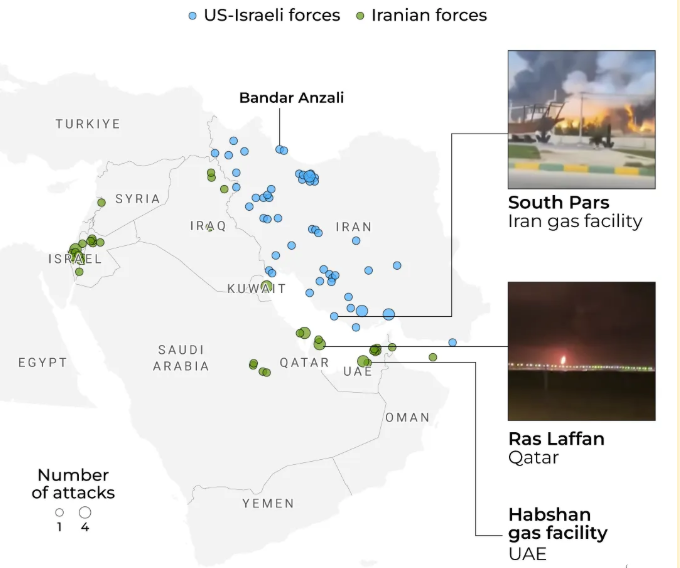
Israel struck Iran’s South Pars gas field, prompting Iran to retaliate by targeting key Gulf energy hubs like Ras Laffan (Qatar) and Habshan (UAE).
- Iran’s Islamic Revolutionary Guard Corps (IRGC) issued evacuation warnings for key Gulf energy sites, including the Al-Hosn Gas Field (UAE), Ras Laffan Refinery (Qatar), Al-Jubail Petrochemical Complex (Saudi Arabia), Mesaieed Holding Company (Qatar), and Samref Refinery (Saudi Arabia), signalling a potential escalation targeting critical regional energy infrastructure.
- South Pars / North Dome Gas Field (Iran / Qatar):
- Location: Situated beneath the waters of the Persian Gulf.
- Significance: It is the world's largest natural gas field, shared territorially between Iran (where it is known as South Pars) and Qatar (where it is known as the North Field).
- Economic Impact: Holding an estimated 1,800 trillion cubic feet of in-situ gas. South Pars is Iran’s biggest source of domestic gas supply, providing 80% of the country’s natural gas needs.
- Ras Laffan Industrial City (Qatar):
- Location: Located on the northeastern coast of the Qatar peninsula.
- Significance: It is the principal nerve center for Qatar's liquefied natural gas (LNG) processing and exports, heavily reliant on gas extracted from the shared North Field.
- Qatar is a leading global LNG supplier; damage to this hub directly threatens energy markets across Europe and Asia.
- Habshan Gas Complex and Bab Oil Field (UAE):
- Location: Inland areas of Abu Dhabi, United Arab Emirates.
- Significance: Habshan is one of the world's largest gas processing facilities, vital for the UAE's domestic power generation and export economy. The nearby Bab field is a massive onshore oil-producing asset.
| Read more: US-Israel Attack on Iran |


Rapid Fire
ASI Approves Site Excavations in Tamil Nadu
The Archaeological Survey of India’s (ASI), under the Ancient Monuments and Archaeological Sites and Remains Rules, 1959, approved excavations at 8 key sites in Tamil Nadu.
- Significance: These 8 sites collectively represent Tamil Nadu's history from the Iron Age to urban settlements like Keeladi, potentially bridging the gap between ancient South Indian urbanization and global trade networks.
Key Sites and Their Significance
|
Key Sites |
Significance |
|
Keeladi |
Urban settlement in the Vaigai basin; evidence of Tamil-Brahmi script and advanced drainage systems. |
|
Adichanallur and Karivalamvanthanallur |
Pre-eminent burial site providing insights into early mortuary practices and Iron Age material culture. |
|
Vellalore |
Evidence of commercial exchange with the Roman Empire, including jewelry and coinage. |
|
Thelunganur |
Signifies early technological advancement in iron usage, potentially dating back several millennia. |
|
Nagapattinam and Pattinamarudur |
Historical Chola-era port reflecting Buddhist influence and Indian Ocean trade networks. |
|
Manikollai |
Production center for glass beads tied to long-distance Southeast Asian trade. |
- Tamil Nadu's Commitment: The Tamil Nadu government has allocated Rs 7 crore in its 2025-26 budget for archaeological work, including advanced scientific methods like DNA testing and optically stimulated luminescence (OSL) dating.
- Dating of Sites:
- DNA testing (genetic testing or DNA profiling) is a scientific process used to identify changes in chromosomes, genes, or proteins to determine biological relationships, and ancestral origins.
- In archaeology, it is used to analyze Ancient DNA (aDNA) extracted from skeletal remains to trace the migration and lineage of ancient civilizations.
- OSL Dating: OSL is a sophisticated geochronological dating technique that determines the last time mineral grains (like quartz or feldspar) were exposed to sunlight.
- In archaeology, it is particularly useful for dating the soil layers in which artifacts are found, especially when organic material for radiocarbon dating is unavailable.
- DNA testing (genetic testing or DNA profiling) is a scientific process used to identify changes in chromosomes, genes, or proteins to determine biological relationships, and ancestral origins.
| Read More: Tamil Literature: Sangam Period |


Rapid Fire
Small Hydro Power Development Scheme
The Union Cabinet has approved the Small Hydro Power (SHP) Development Scheme (FY 2026-27 to FY 2030-31) with an outlay of Rs. 2,584 crore to install approximately 1,500 MW of capacity and revitalize decentralized clean energy.
- Project Scope: The scheme supports small hydro projects with a capacity between 1 MW and 25 MW, focusing on hilly and North Eastern (NE) states as well as districts with international borders.
- Central Financial Assistance (CFA):
- For NE States and Border Districts: Rs. 3.6 crore per MW or 30% of project cost (whichever is lower), with an upper limit of Rs. 30 crore per project.
- Other States: Rs. 2.4 crore per MW or 20% of project cost (whichever is lower), with a cap of Rs. 20 crore per project.
- Proposed Benefits:
- Socio-Economic Impact: It is expected to catalyze Rs. 15,000 crore in private investment and generate 51 lakh person-days of employment during the construction phase.
- It will also stimulate local investment and create sustainable employment in remote areas over project lifespans of 40 to 60 years.
- Atmanirbhar Bharat: The initiative leverages 100% indigenous plant and machinery, strengthening domestic manufacturing in the renewable energy sector.
- Environmental Benefits: SHP projects are environmentally sustainable as they minimize large-scale land acquisition, deforestation, and displacement compared to large dams.
- Technical Advantages: Being decentralized in nature, these projects reduce transmission losses and the need for long-distance transmission infrastructure.
- Socio-Economic Impact: It is expected to catalyze Rs. 15,000 crore in private investment and generate 51 lakh person-days of employment during the construction phase.
- Future Pipeline: An allocation of Rs. 30 crore is set aside to assist agencies in preparing Detailed Project Reports (DPRs) for approximately 200 future projects.
| Read More: India's Water Stress and Hydropower |


Rapid Fire
World Happiness Report 2026
Recently, the Oxford Wellbeing Research Centre published the World Happiness Report 2026 in partnership with Gallup and the UN Sustainable Development Solutions Network on the UN International Day of Happiness (20th March).
Key Findings
- Global Rankings: Finland remains the world's happiest country for the 9th consecutive year, followed by Iceland (2nd) and Denmark (3rd). Costa Rica emerged as a standout performer, rising to 4th place (23rd in 2023) while Israel ranked 8th.
- Afghanistan remains the unhappiest country globally (147th), followed by Sierra Leone (146th) and Malawi (145th). Among BRICS members, China ranked 65th followed by Russia (79th), and Iran (97th).
- Absence of Anglosphere: For the 2nd consecutive year, no English-speaking countries feature in the Top 10. Notable rankings include New Zealand (11th), Ireland (13th), Australia (15th), United States (23rd), Canada (25th), and the United Kingdom (29th).
- India’s Performance: India ranks 116th out of 147 countries, showing a marginal improvement from its 118th position in 2025.
- India continues to trail behind several neighbours; Nepal (99th) and Pakistan (104th) rank higher, while Bangladesh (127th) and Sri Lanka (134th) are lower.
- Measurement Criteria: Rankings are determined by life evaluations (Cantril Ladder) and analyzed through six key variables i.e., GDP per capita, social support, healthy life expectancy, freedom, generosity, and perceptions of corruption.
- "Goldilocks" Rule of Social Media: Researchers found that moderate use (under 1 hour/day) is actually better for well-being than zero use, but the global average has climbed to 2.5 hours/day, crossing into the "harmful" zone.
- A key distinction was made between "Passive/Visual" platforms (Instagram, TikTok)—which trigger social comparison—and "Communication" platforms (WhatsApp, Facebook), which are linked to higher life satisfaction in regions like Latin America and the Middle East.
International Day of Happiness
- Established by the United Nations in 2012, the International Day of Happiness is observed annually on 20th March to recognize well-being as a fundamental human goal.
- The date 20th March was chosen because it coincides with the vernal equinox, a time when day and night are of approximately equal length everywhere on Earth—symbolizing universal equality and balance.
- The initiative was pioneered by Bhutan, a nation famously prioritizing Gross National Happiness (GNH) over traditional Gross Domestic Product (GDP).
| Read More: World Happiness Report 2025 |