


Indian Polity
Independence of the Election Commission of India
- 25 Feb 2026
- 16 min read
For Prelims: Chief Election Commissioner (CEC), Chief Election Commissioner and other Election Commissioners (Appointment, Conditions of Service and Term of Office) Act, 2023, Anoop Baranwal Case, 2023, Election Commission, LoP, CJI, Goswami Committee, Law Commission.
For Mains: Independence and neutrality of constitutional bodies in India, Article 324 and constitutional safeguards for free and fair elections, Electoral reforms in India.
Why in News?
The independence of the Election Commission of India (ECI) is under scrutiny following concerns over voter roll revisions, including the Special Intensive Revision (SIR) in Bihar and the reported deletion of around 65 lakh voters.
- An Opposition alliance has moved a resolution to remove the Chief Election Commissioner (CEC), bringing renewed focus on the neutrality of the ECI and the protection of adult franchise under Article 326.
Summary
- The Election Commission of India’s independence is protected by constitutional safeguards, but concerns over appointments, voter roll revisions, financial autonomy, and enforcement powers have raised questions about its neutrality and effectiveness.
- Strengthening reforms such as a balanced selection process, equal security of tenure, technological transparency, and greater institutional autonomy are essential to ensure free and fair elections and maintain public trust.
What are the Concerns Regarding the Independence of the ECI?
- Appointment Process Debate: Historically, the Constitution did not prescribe a specific legislative process for the appointment of the CEC and ECs, leaving it to the Executive (President acting on the advice of the Council of Ministers).
- In the Anoop Baranwal v. Union of India case (2023), the Supreme Court (SC) ruled that a collegium comprising the Prime Minister, the Leader of the Opposition (LoP) in the Lok Sabha, and the Chief Justice of India (CJI) should make appointments to insulate the body from executive bias, until Parliament passed a law.
- The Parliament subsequently passed the Chief Election Commissioner and Other Election Commissioners Act, 2023 replacing the CJI in the selection committee with a Union Cabinet Minister nominated by the Prime Minister.
- Critics argue this gives the Executive a 2:1 majority in the selection process, potentially compromising institutional neutrality.
- Flaws in the Removal Mechanism: While the CEC enjoys the same protection against removal as a Supreme Court judge (impeachment by Parliament), the two Election Commissioners (ECs) can be removed by the President simply on the recommendation of the CEC.
- This disparity creates a hierarchy and potential vulnerability for the ECs, who might feel pressured to align with the CEC or the Executive.
- Financial Autonomy: Unlike the Comptroller and Auditor General (CAG) or the Supreme Court, the budget of the ECI is not "charged" upon the Consolidated Fund of India.
- Instead, it is a "voted" expenditure, meaning it requires parliamentary approval, which theoretically subjects the ECI's financial independence to the government of the day.
- Enforcement of the MCC: The Model Code of Conduct (MCC) lacks statutory backing, leading to concerns that the ECI is "toothless" or selective when taking action against high-profile political figures for hate speech or campaign violations.
- Post-Retirement Appointments: The Constitution does not debar the retiring CEC or ECs from any further appointment by the government.
- This creates a potential "conflict of interest," as the prospect of post-retirement sinecures (like governorships or commissions) could influence their impartiality while in office.
- Electoral Roll Integrity and "Vote Theft": The Special Intensive Revision (SIR) of electoral rolls has become a flashpoint for allegations of "vote theft": In States like Bihar and West Bengal, allegations have surfaced regarding the potential deletion of millions of voters.
- Opposition parties allege these deletions disproportionately target minority communities and their supporters.
- The ECI’s use of SIR to "weed out foreigners" has been criticized as a "selective disenfranchisement based on religion".
- Concerns have been raised that wide discretion given to Booth Level Officers during house-to-house verification, combined with limited oversight, may lead to arbitrary voter exclusions and undermine electoral fairness.
- Technology and Transparency Debate: The Election Commission has directed state poll officials to destroy CCTV, webcasting, and video footage of elections after 45 days if no court challenge is filed, a move that has raised concerns about transparency.
- There is growing demand to extend the preservation period to at least 180 days to enable credible post-election audits and strengthen public trust.
- At the same time, the rise of AI-generated content and deepfakes, particularly during recent state elections, has tested the ECI’s ability to curb disinformation in a neutral manner, without creating perceptions of bias or favoring any political narrative.
Constitutional Mandate and Safeguards Ensuring the Independence of the ECI
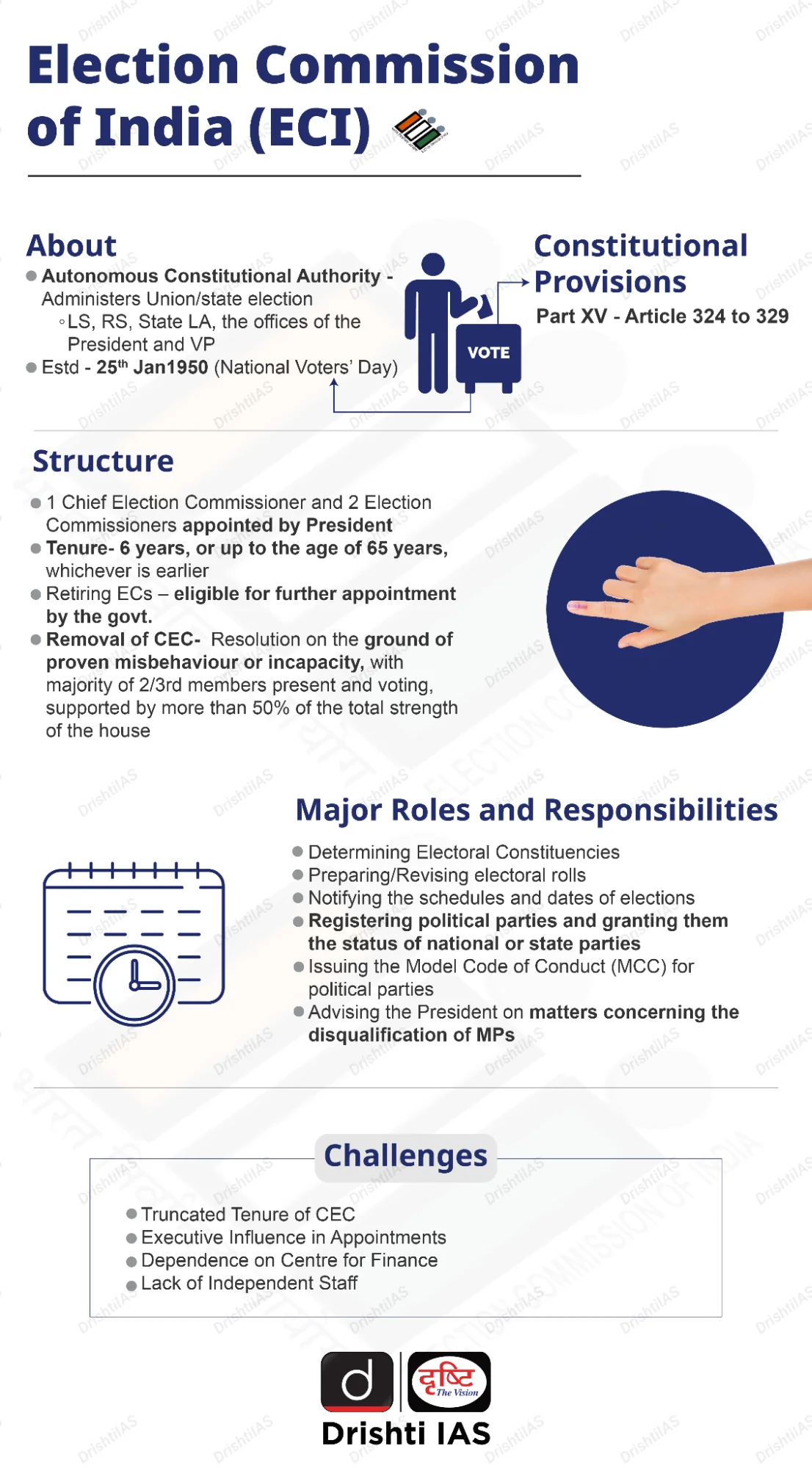
- Vesting of Electoral Authority: Article 324(1) vests the superintendence, direction, and control of electoral roll preparation and conduct of elections to Parliament, State Legislatures, and the offices of President and Vice-President in the Election Commission.
- This centralised authority ensures autonomy in managing the entire electoral process.
- Composition and Appointment: Under Article 324(2), the Election Commission consists of the CEC and other ECs as determined by the President.
- Their appointment by the President, subject to parliamentary law, gives the body constitutional legitimacy while allowing statutory regulation.
- Role of the CEC as Chairman: Article 324(3) provides that when additional ECs are appointed, the CEC acts as Chairman of the Commission.
- This ensures administrative leadership while maintaining a collegial decision-making structure.
- Appointment of Regional Commissioners: Article 324(4) allows the President to appoint Regional Commissioners, in consultation with the ECI, to assist during elections.
- This strengthens the Commission’s operational capacity without undermining its autonomy.
- Security of Tenure and Removal Safeguards: Article 324(5) provides critical safeguards:
- The CEC can be removed only in the same manner and on the same grounds as a Supreme Court judge.
- Service conditions cannot be altered to the CEC’s disadvantage after appointment.
- These provisions protect the Commission from arbitrary executive action.
- Administrative Support: Article 324(6) mandates that the President or Governor must provide necessary staff to the ECI upon request, ensuring it has the resources required to function effectively.
What are the Key Judgments Regarding ECI Independence?
- Indira Nehru Gandhi vs Raj Narain (1975): The SC held that free and fair elections form part of the Basic Structure of the Constitution, ensuring that electoral integrity cannot be compromised and reinforcing the ECI’s central role in protecting democracy.
- Mohinder Singh Gill vs Chief Election Commissioner (1978): The SC ruled that Article 324 grants the ECI plenary powers to act in areas where the law is silent to ensure free and fair elections, thereby strengthening its functional autonomy.
- A.C. Jose vs Sivan Pillai (1984): The SC clarified that the ECI cannot override existing laws, limiting its Article 324 powers to gaps in legislation and ensuring that independence operates within the rule of law.
- T.N. Seshan vs Union of India (1995): The SC upheld the validity of a multi-member Election Commission and stated that the CEC is “first among equals,” not superior to other commissioners, promoting collective decision-making and preventing concentration of power.
- Vineet Narain vs Union of India (1997): The SC held that the CEC cannot recommend the removal of Election Commissioners suo motu, safeguarding their tenure and protecting institutional independence.
- Anoop Baranwal vs Union of India (2023): The SC directed that appointments of the CEC and Election Commissioners be made by a committee including the Prime Minister, Leader of Opposition, and Chief Justice of India, reducing executive dominance in appointments.
Key Committee / Commission Recommendations for ECI Independence
- Dinesh Goswami Committee (1990): Recommended a statutory selection committee and making the Model Code of Conduct (MCC) legally enforceable to prevent its selective application.
- Indrajit Gupta Committee (1998): Advocated for State Funding of Elections to reduce the "money power" that the ECI often struggles to monitor effectively.
- Second Administrative Reforms Commission (ARC) (2005): Suggested a collegium headed by the Prime Minister, with the Speaker of the Lok Sabha, the LoP, the Law Minister, and the Deputy Chairman of the Rajya Sabha as members.
- Law Commission (255th Report) (2015): Proposed that all three Commissioners (CEC and ECs) should have equal constitutional protection against removal, ending the hierarchy that makes ECs vulnerable, ensuring equal constitutional security of tenure.
- Proposed establishment of a permanent, independent Secretariat for the ECI to strengthen administrative autonomy.
What Measures can Strengthen the Independence of the Election Commission of India?
- Parity in Security of Tenure: The Constitution must be amended to provide the same protection against removal to the ECs as is currently guaranteed to the CEC.
- They should only be removable through a rigorous parliamentary impeachment process, insulating them from executive pressure.
- Reforming the Appointment Process: The CEC and Other ECs Act of 2023 should be reviewed to restore a balanced, neutral selection collegium.
- Reintroducing the Chief Justice of India or mandating a unanimous consensus within the committee would mitigate the current executive dominance.
- Granting Contempt Powers: Amending the Contempt of Courts Act of 1971 to empower the ECI to punish those who make baseless, malicious accusations against it would help preserve its institutional credibility and authority.
- Financial and Administrative Autonomy: To guarantee absolute financial independence, the budget of the Election Commission of India should be directly "charged" upon the Consolidated Fund of India.
- Mandatory Cooling-Off Period: To eliminate the lure of future political patronage, a mandatory cooling-off period or a complete constitutional bar on post-retirement government appointments (such as state Governorships) must be instituted for retiring Chief Election Commissioners and Election Commissioners.
- Transparent Electoral Roll Revisions: To prevent arbitrary voter deletions, SIR exercises should include transparent data audits, regular publication of supplementary lists, and strong grievance redressal mechanisms.
- Upholding transparency and addressing stakeholder concerns are essential to maintain trust in elections, the bedrock of democracy.
- Technological Safeguards: Mandating statistically significant cross-verification of Electronic Voting Machines with Voter-Verifiable Paper Audit Trails, especially in cases of data discrepancies, is vital to restoring and maintaining absolute public trust in the electoral machinery.
Conclusion
The independence of the Election Commission of India is vital for preserving free and fair elections and sustaining public trust in democracy. While constitutional safeguards exist, emerging challenges in appointments, electoral roll management demand urgent reforms. Strengthening institutional autonomy and transparency will be key to safeguarding India’s democratic integrity.
|
Drishti Mains Question: Q. “The independence of the Election Commission is central to India’s democratic framework.” Examine the constitutional safeguards and emerging challenges to its autonomy |
Frequently Asked Questions (FAQs)
1. What constitutional provision ensures the independence of the ECI?
Article 324 vests superintendence, direction, and control of elections in the ECI and provides safeguards such as security of tenure and removal procedures.
2. Why is the removal process of the CEC considered a safeguard?
The CEC can be removed only through a process similar to that of a Supreme Court judge, preventing arbitrary executive action.
3. What is the controversy surrounding the 2023 appointment law?
The law replaced the Chief Justice of India with a Union Minister in the selection committee, raising concerns about executive dominance.
4. Why is the Model Code of Conduct seen as weak?
It lacks statutory backing, limiting the ECI’s ability to enforce penalties for violations like hate speech and campaign misconduct.
5. How can technology strengthen electoral transparency?
Measures such as preserving CCTV footage, digital logs, and cross-verifying EVMs with VVPAT can enhance auditability and public trust.
.
UPSC Civil Services Examination, Previous Year Questions (PYQs)
Prelims
Q.Consider the following statements: (2017)
- The Election Commission of India is a five-member body.
- Union Ministry of Home Affairs decides the election schedule for the conduct of both general elections and bye-elections.
- Election Commission resolves the disputes relating to splits/mergers of recognised political parties.
Which of the statements given above is/are correct?
(a) 1 and 2 only
(b) 2 only
(c) 2 and 3 only
(d) 3 only
Ans: (d)
Mains
Q.Discuss the role of the Election Commission of India in the light of the evolution of the Model Code of Conduct. (2022)



