
Facts for UPSC Mains
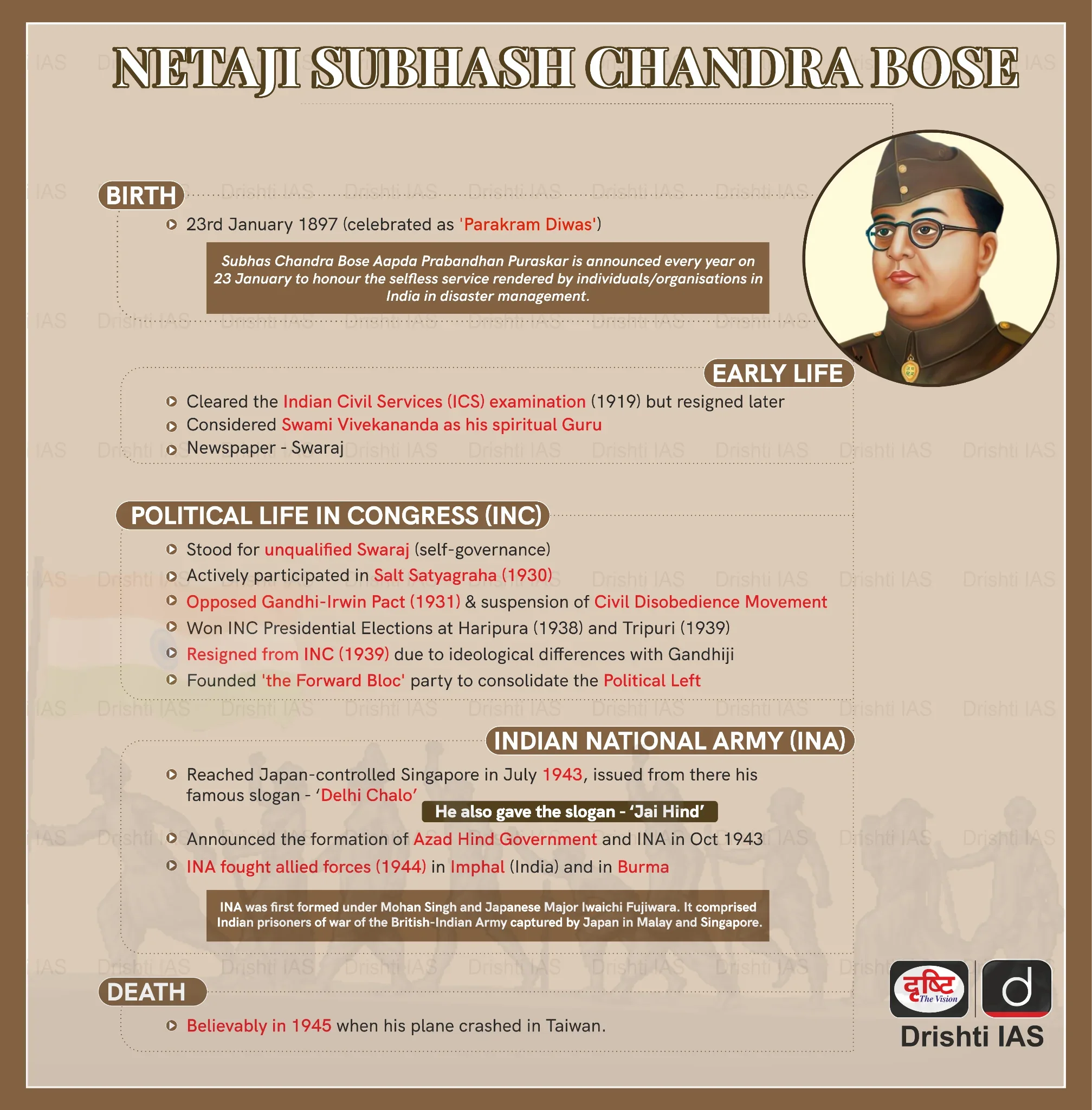
Subhas Chandra Bose’s Philosophical Foundations
Why in News?
The life and ideas of Subhas Chandra Bose are being revisited, highlighting his unique attempt to blend Indian spirituality with Western political thought and his vision for a modern, socialist India.
What were Bose’s Philosophical Foundations and Vision for a Modern Indian State?
- Rejection of the Doctrine of Maya: Initially influenced by Vedanta and Shankaracharya’s Doctrine of Maya, viewing the world as an illusion.
- He adopted a pragmatic stance, stating he must discard whatever is "not workable" for a revolutionary.
- Pragmatic Spirituality: Instead of turning to pure materialism, Bose viewed the world as a real, evolving manifestation of the "Spirit."
- For him, the fundamental, guiding essence of the universe and human life was Love.
- Embracing Hegelian Dialectics: He found the scientific explanation for historical progress in Hegel’s dialectics (a way of understanding how ideas and reality evolve through conflict).
- Bose believed that society progresses through continuous conflict and resolution (thesis, antithesis, and synthesis), making active participation in this political and social conflict a paramount moral duty.
Vision for a Modern Indian State
- Samyavada (Doctrine of Harmony): Subhas Chandra Bose developed Samyavada, the “Doctrine of Harmony,” as an indigenous political philosophy aimed at synthesising the strengths of global ideologies like Fascism and Communism while rejecting their extremes, and articulated it through the Forward Bloc (1939) as India’s unique contribution to world thought.
- In The Anti-Imperialist Struggle and Samyavada (1933), he positioned Samyavada as India’s next major contribution after Western constitutionalism and Marxism.
- In practice, it served as a blueprint for a modern socialist state, as outlined in his 1941 Kabul thesis, focusing on complete independence, scientific industrialisation, social ownership of resources, and the application of equality and social justice, supported by a strong central authority and planned economic reorganisation.
- Industrialization over Agrarianism: Sharply diverging from Mahatma Gandhi’s vision of decentralized, village-based self-sufficiency, Bose championed scientific large-scale production, heavy industries, and the abolition of landlordism.
- This was institutionalized through his creation of the National Planning Committee during his 1938 Haripura presidency.
- Temporary Centralized Authority: Bose's political theories were heavily influenced by the global zeitgeist of his time, where nations like Soviet Russia and Kemalist Turkey had achieved massive modernization through centralized rule.
- Believing that a fractured and impoverished India could not afford the slow pace of democracy during its initial reconstruction.
- Bose advocated for a strong Central Government with temporary authoritarian powers to force through socialist economic reforms.
- Comprehensive Social Equity: His blueprint guaranteed religious freedom, linguistic and cultural autonomy, equal distribution of wealth, and the total eradication of caste differences and communal bigotry.
What is the Relevance of Bose’s Ideas Today?
- The Pioneer of Economic Planning: Bose’s insistence on a "scientific reorganization of agricultural and industrial life" and his establishment of the National Planning Committee laid the intellectual groundwork for post-independence India’s planned economy and the Planning Commission.
- A Cautionary Tale on Authoritarianism: While his advocacy for a centralized, authoritarian state reflected the global zeitgeist of the 1930s and 40s (seen in Soviet Russia or Kemalist Turkey), modern rights-based democracies study this as a critical paradox.
- It serves as a reminder to resist the appeal of authoritarian shortcuts when solving deep-rooted structural and economic problems.
- Blueprint for Inclusive Nationalism: In an era of polarizing identity politics, Bose’s uncompromising stance against communal narrowness, coupled with his demand for a state that acts as the "servant of the masses" while protecting minority cultural autonomy, remains highly relevant for maintaining India's secular and pluralistic fabric.
The Ideological Triad: Comparing Subhas Chandra Bose, Mahatma Gandhi, and Jawaharlal Nehru
Means vs. Ends
- Mahatma Gandhi: Believed in the absolute supremacy of the means over the ends. His entire political strategy was anchored in Ahimsa (non-violence) and Satyagraha (truth-force).
- He firmly believed that freedom achieved through violence would inherently corrupt the newly formed state.
- Subhas Chandra Bose: A geopolitical pragmatist who believed that "freedom is not given, it is taken."
- He famously applied the diplomatic principle of "an enemy’s enemy is a friend," seeking military alliances with Axis powers (Germany and Japan) during WWII to form the Indian National Army (INA).
- Jawaharlal Nehru: A centrist between the two. While he adhered to Gandhi’s non-violent mass movements within India, he was a staunch anti-fascist.
- Nehru vehemently opposed Bose’s strategy of allying with totalitarian regimes, believing that an alliance with fascism would be disastrous for India's democratic soul.
Economic Visions for a Free India
- Mahatma Gandhi: Championed Gram Swaraj (Village Self-Rule). He was deeply suspicious of heavy machinery and rapid urbanization, fearing it would lead to exploitation.
- He advocated for a decentralized agrarian economy, the revival of cottage industries (Khadi), and the Trusteeship model, where capitalists hold their wealth in trust for the welfare of the poor.
- Subhas Chandra Bose: Believed poverty could only be eradicated through rapid, state-led heavy industrialization and large-scale scientific agriculture.
- As Congress President in 1938, he institutionalized this by establishing the National Planning Committee.
- Jawaharlal Nehru: Economically, Nehru was closely aligned with Bose.
- Appointed by Bose to chair the National Planning Committee, Nehru championed a mixed economy with a strong public sector.
- He viewed heavy industries and large dams as the "temples of modern India," marrying Soviet-style central planning with a democratic framework.
Nature of the State and Democracy
- Mahatma Gandhi: He envisioned a decentralized federation of autonomous, self-sustaining village republics with minimal state interference.
- Subhas Chandra Bose: Believed that India's deep socio-economic fractures required radical surgery.
- He openly advocated for a strong Central Government with temporary authoritarian powers to dismantle feudalism, enforce socialist equity, and rebuild the nation before returning power to a democratic system.
- Jawaharlal Nehru: A resolute liberal democrat, he was committed to parliamentary democracy, constitutionalism, universal adult franchise, and fundamental civil liberties, believing that the democratic process itself was the primary tool for social change.
International Outlook and Foreign Policy
- Mahatma Gandhi: His outlook was primarily spiritual and focused on India's internal moral regeneration, though he expressed moral sympathy for the democratic nations fighting totalitarianism during World War II.
- Subhas Chandra Bose: A sharp military and geopolitical strategist. He viewed the Second World War not as a moral crisis, but as India’s golden strategic opportunity to strike a distracted British Empire.
- Jawaharlal Nehru: A dedicated internationalist with a profound understanding of global currents.
- Long before independence, Nehru was shaping India's foreign policy based on anti-imperialism and anti-racism. His staunch refusal to align with either Cold War bloc eventually birthed the Non-Aligned Movement (NAM).
|
Drishti Mains Question: Compare the economic visions of Gandhi, Nehru, and Bose for independent India. |
Frequently Asked Questions (FAQs)
1. What is Samyavada proposed by Subhas Chandra Bose?
Samyavada, or the Doctrine of Harmony, aimed to combine the strengths of Fascism and Communism while rejecting their extremes to build a socialist and strong Indian state.
2. What was the significance of the National Planning Committee (1938)?
It marked the beginning of scientific economic planning in India and laid the foundation for post-independence planned development.
3. How did Gandhi and Bose differ on the use of violence?
Gandhi rejected violence completely, while Bose supported armed struggle as a necessary tool for achieving independence.
4. What was Nehru’s economic approach for India?
Nehru advocated a mixed economy with central planning, focusing on heavy industries and public sector development.
5. Why is Bose’s idea of a strong central state debated today?
It highlights the tension between rapid development through centralized authority and the risks it poses to democratic freedoms.
UPSC Civil Services Examination, Previous Year Questions (PYQs)
Prelims
Q. The Ghadr (Ghadar) was a (2014)
(a) revolutionary association of Indians with headquarters at San Francisco
(b) nationalist organization operating from Singapore
(c) militant organization with headquarters at Berlin
(d) communist movement for India’s freedom with headquarters at Tashkent
Ans: (a)
During the Indian Freedom Struggle, who of the following raised an army called ‘Free Indian Legion’?(2008)
(a) Lala Hardayal
(b) Rashbehari Bose
(c) Subhash Chandra Bose
(d) V.D. Savarkar
Ans: (c)
Mains
Q. Highlight the differences in the approach of Subhash Chandra Bose and Mahatma Gandhi in the struggle for freedom. (2016)
Q. Jawaharlal Nehru, though a declared socialist, was pragmatist enough to focus on providing building blocks to the making of new India.” Examine. (2015)
Important Facts For Prelims
The River Basin Management Scheme
Why in News?
The River Basin Management (RBM) Scheme has been extended for the 16th Finance Commission period spanning 2026–27 to 2030–31, highlighting India’s renewed focus on integrated and sustainable water resource management at the basin level.
What is the River Basin Management (RBM) Scheme?
- About: The RBM Scheme is a central sector initiative spearheaded by the Ministry of Jal Shakti (Department of Water Resources, River Development, and Ganga Rejuvenation).
- Its primary goal is to ensure the integrated planning, sustainable use, and protection of surface and groundwater resources at the river basin level.
- Instead of looking at water resources in isolation, the scheme treats an entire river basin, including its rivers, tributaries, lakes, and groundwater, as a single, interconnected ecosystem.
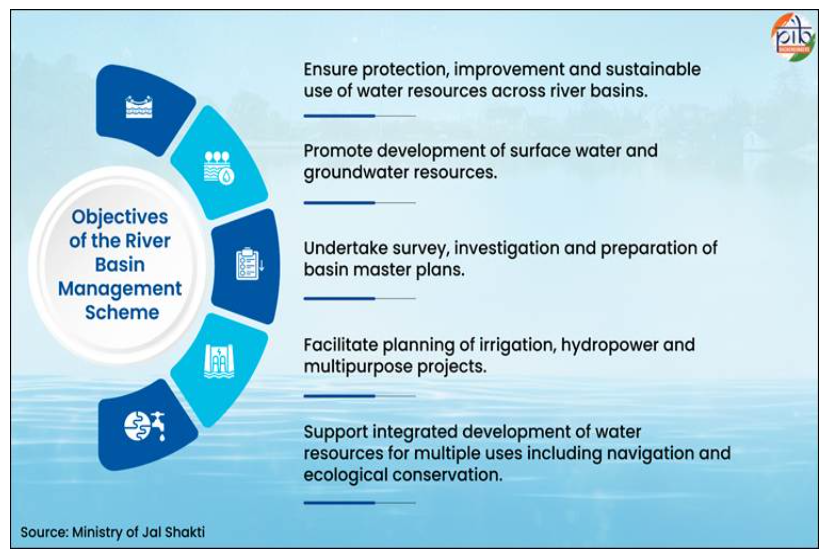
- Institutional Framework: The RBM Scheme consists of two broad components: the Brahmaputra Board and the Investigation of Water Resources Development Scheme (IWRDS) implemented through the Central Water Commission (CWC) and National Water Development Agency (NWDA).
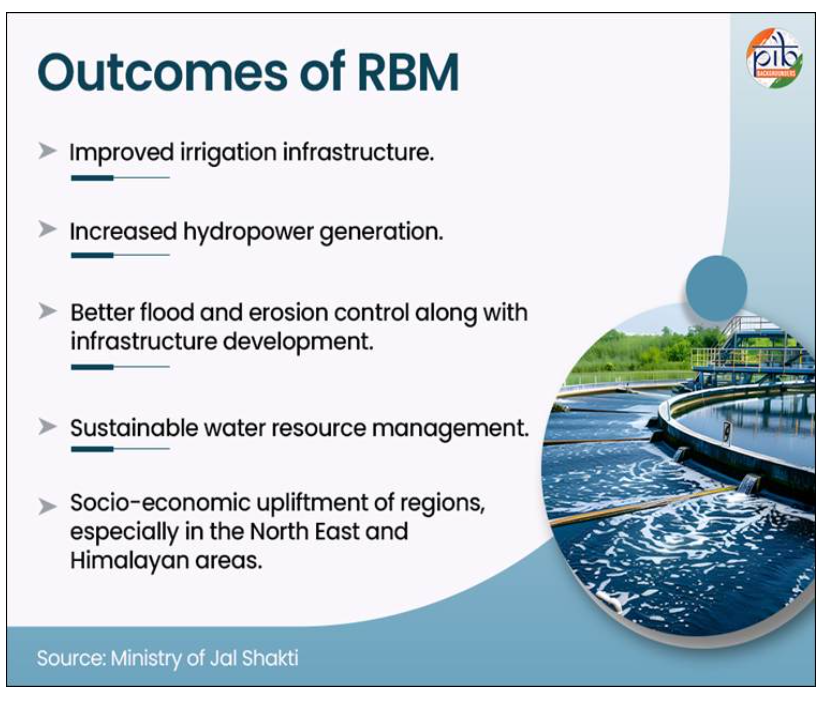
- Brahmaputra Board: Focuses on river basin planning, flood control, erosion management, drainage development, and sustainable water resource management in the North Eastern Region.
- Central Water Commission (CWC): Conducts surveys, investigations, and prepares Detailed Project Reports (DPRs) for water resource projects in remote terrains.
- National Water Development Agency (NWDA): Handles national-level water planning, specifically the preparation of feasibility reports for the Interlinking of Rivers (ILR) programme.
- Geographical Priority: It strategically targets water-rich yet underdeveloped regions that are critical for national security, water security, cross-border management, flood control, and ecological stability.
- Key focus areas include the Brahmaputra, Barak, Teesta, and Indus basins, heavily prioritizing the North Eastern States, Jammu & Kashmir, and Ladakh.
- Key Objectives:
- Flood and Erosion Management: Implementing physical protection measures, such as securing Majuli Island in Assam from severe river currents.
- Project Development: Preparing DPRs to expand irrigation capacity and harness hydropower generation in Himalayan rivers.
- Technological Integration: Utilizing modern mapping and surveying tools like Geographical Information System (GIS), LiDAR, and drone surveys to ensure pinpoint accuracy in topographical and hydrological planning.
- Community Integration: Promoting local practices like springshed management among tribal and rural communities in hilly regions.
River Basin
- About: A river basin is the area of land drained by a river and its tributaries. Its key features include tributaries (smaller streams joining a main river), confluence (the point where rivers meet), watershed (highland boundary separating basins), source (origin of the river), and mouth (where it drains into a sea, lake, or ocean).
- A river basin is regarded as the basic hydrological unit for planning and development of water resources in India.
- River Basins of India: India’s drainage system is classified into 20 river basin groups, comprising 12 major and 8 composite river basins.
- Major river basins, each with a drainage area exceeding 20,000 sq km, include the Indus, Ganga–Brahmaputra–Meghna, Godavari, Krishna, Cauvery, Mahanadi, Pennar, Brahmani–Baitarani, Sabarmati, Mahi, Narmada, and Tapti.
- The Ganga–Brahmaputra–Meghna basin is the largest, with a catchment area of around 11.0 lakh km², accounting for over 43% of the total catchment area of major rivers.
- Medium river basins have drainage areas between 2,000 and 20,000 sq km, while minor basins are below 2,000 sq km.
- The 8 composite basins combine smaller rivers, such as the Subarnarekha group, east-flowing rivers between major basins, west-flowing rivers of Kutch and Saurashtra (including Luni), coastal rivers from Tapi to Kanyakumari, and inland drainage areas of Rajasthan.
- Notably, all major river basins and many medium basins are inter-state in nature, together spanning nearly 81% of India’s geographical area.
- Major river basins, each with a drainage area exceeding 20,000 sq km, include the Indus, Ganga–Brahmaputra–Meghna, Godavari, Krishna, Cauvery, Mahanadi, Pennar, Brahmani–Baitarani, Sabarmati, Mahi, Narmada, and Tapti.
Frequently Asked Questions (FAQs)
1. What is the River Basin Management (RBM) Scheme?
It is aCentral Sector Scheme aimed at integrated planning and sustainable management of surface and groundwater resources at the river basin level.
2. Which institutions implement the RBM Scheme?
It is implemented through theBrahmaputra Board, Central Water Commission (CWC), and National Water Development Agency (NWDA).
3. What are the priority river basins under RBM?
Key basins includeBrahmaputra, Barak, Teesta, and Indus, focusing on the North-East and Himalayan regions.
4. What is the role of NWDA under the RBM Scheme?
NWDA handlesInterlinking of Rivers (ILR), feasibility studies, and inter-basin water transfer planning.
5. What is the significance of RBM Scheme?
It strengthenswater security, flood control, ecological stability, and regional development, especially in vulnerable and border regions.
UPSC Civil Services Examination, Previous Year Question (PYQ)
Prelims:
Q1. With reference to the Indus river system, of the following four rivers, three of them pour into one of them which joins the Indus directly. Among the following, which one is such a river that joins the Indus direct? (2021)
(a) Chenab
(b) Jhelum
(c) Ravi
(d) Sutlej
Ans: (d)
Mains
Q. Discuss the Namami Gange and National Mission for Clean Ganga (NMCG) programmes and causes of mixed results from the previous schemes. What quantum leaps can help preserve the river Ganga better than incremental inputs? (2015)
Rapid Fire
Deputy Chairman of Rajya Sabha
In a historic first, a nominated Member of Parliament, Harivansh Narayan Singh, has been made the Rajya Sabha Deputy Chairman. He was re-elected unopposed for a third consecutive term.
- Election and Position: Article 89(2) of the Constitution of India mandates that the Council of States (Rajya Sabha) shall elect one of its members as the Deputy Chairman.
- Whenever the office becomes vacant, the House must elect a new Deputy Chairman to ensure continuity in its functioning.
- For the election of the Deputy Chairman, any member of the Rajya Sabha can move a motion proposing the name of another member for the post.
- The proposed candidate must submit a declaration expressing willingness to serve if elected, and the motion must be seconded by another member of the House.
- The Deputy Chairman holds office until he ceases to be a member of the Rajya Sabha, resigns, or is removed by the House.
- Role and Functions: He presides over the House in the absence of the Chairman (Vice-President) and exercises all powers of the Chairman during that period.
- Voting Power: Like the Chairman, the Deputy Chairman, while presiding, cannot vote in the first instance. They can only exercise a casting vote in the case of a tie.
- Independence of the Office: He is not subordinate to the Chairman and is directly responsible to the Rajya Sabha.
- Position as Member: When the Chairman presides, the Deputy Chairman acts like a normal member, participating in debates and voting.
- Removal Procedure: He can be removed by a resolution passed by a majority of all the then members of the Rajya Sabha, with 14 days’ prior notice.
- He cannot preside over the House when a resolution for his removal is under consideration.
- Salary and Allowances: His salary and allowances are fixed by Parliament and are charged on the Consolidated Fund of India.
- Vacancy: The office falls vacant if he ceases to be a member, resigns by submitting a resignation to the Chairman, or is removed by the House, after which a new Deputy Chairman is elected.
- Panel of Vice-Chairpersons: Under the Rules of the Rajya Sabha, the Chairman nominates a panel of Vice-Chairpersons from among the members, any of whom can preside over the House in the absence of the Chairman and Deputy Chairman.
- However, they cannot preside when either office is vacant.
| Read more: Role of Rajya Sabha in Indian Democracy |
Rapid Fire
Defeat of the Constitution (131st Amendment) Bill, 2026
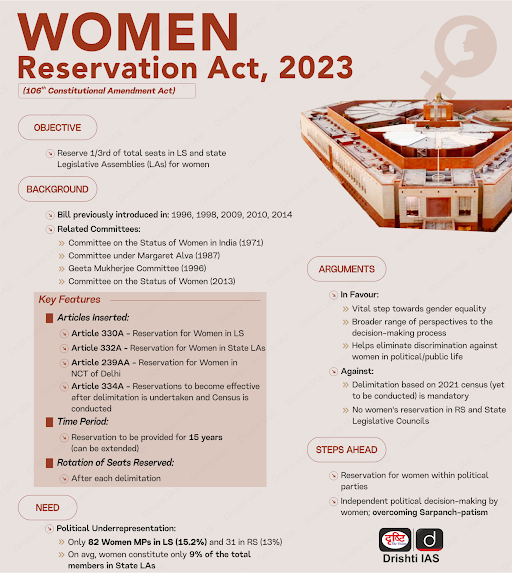
The Lok Sabha failed to pass the Constitution (131st Amendment) Bill, 2026, which aimed to fast-track the implementation of 33% reservation for women in legislatures (introduced by the 106th Constitutional Amendment (2023)) by enabling delimitation based on the 2011 Census.
- Withdrawal of Allied Bills: The collapse of the constitutional amendment bill necessitated the immediate withdrawal of dependent statutory legislation, specifically the Union Territories Laws (Amendment) Bill, 2026, and the Delimitation Bill, 2026.
- Failure of Special Majority: As per Article 368 of the Indian Constitution, the passage of the Bill required a special majority, specifically, a majority of the total membership of the House and a majority of not less than two-thirds of the members present and voting.
- With a House strength of 528, the Bill secured only 298 votes, falling short of the required 352 benchmark.
- Delimitation and Census Linkage: The legislation sought to end the freeze on parliamentary constituency boundaries, which has been in place since the 42nd Constitutional Amendment (1976) based on the 1971 Census, by enabling delimitation using the 2011 Census.
- This was intended to restore the democratic principle of “one person, one vote, one value” by aligning representation with current population patterns.
- The freeze, originally meant to continue until the first Census after 2000, was later extended by the 84th Constitutional Amendment (2001) until the first Census after 2026.
- Federalism Debate (North-South Divide): The primary legislative roadblock was the demographic disparity between states.
- Opposition members argued that population-based delimitation would penalize Southern states for effective population control, demanding the complete delinking of women's reservation from the delimitation exercise.
- The 106th Constitutional Amendment, 2023 (Nari Shakti Vandan Adhiniyam): Providing 33% reservation for women in Lok Sabha and State Assemblies, came into force on 16th April 2026.
- However, its actual implementation is deferred because Article 334A links it to a delimitation exercise after the next Census (post‑ 2027), making it unlikely to take effect before around 2034.
- To address this delay, the Constitution (131st Amendment) Bill, 2026, along with allied legislation, was introduced in the Lok Sabha to advance the implementation of women’s reservation to 2029.
| Read more: Delimitation and Women’s Reservation in Legislatures |
Rapid Fire
SC Warns States Over Chambal Sand Mining
Recently, the Supreme Court warned Madhya Pradesh, Rajasthan and Uttar Pradesh to curb illegal sand mining in the National Chambal Gharial Sanctuary, failing which paramilitary forces may be deployed.
- Illegal mining is causing severe habitat degradation, threatening endangered species like the gharial and damaging river ecosystems.
- States have been asked to implement CCTV surveillance, GPS tracking of mining vehicles, joint patrols and strict enforcement measures.
National Chambal Gharial Sanctuary
- About: The National Chambal Sanctuary, also known as the National Chambal Gharial Wildlife Sanctuary, is one of India's most ecologically significant riverine protected areas.
- It is the first and only tri-state protected area (Rajasthan, Madhya Pradesh, and Uttar Pradesh) in the country, spanning approximately 5,400 sq km along a 600 km stretch of the Chambal River (960-km).
- Biodiversity: It harbors nearly 90% of the world's remaining wild Gharial population and a significant number of endangered Ganges River Dolphins. Other key species are Marsh crocodile (mugger), Red-crowned roof turtle, Smooth-coated otter, striped hyena, and over 330 bird species e.g., Indian skimmer.
- It forms part of India's Project Crocodile initiative launched in 1975 to address the severe decline of crocodilian populations.
- Conservation Status: It is recognized as an Important Bird Area (IBA). It is a proposed Ramsar Site, a candidate for UNESCO World Heritage Site status, and classified as an IUCN Category IV protected area (habitat/species management area).
- Ecological Uniqueness: The Chambal River remains one of India's cleanest and most unpolluted rivers, creating a unique lotic ecosystem of deep channels, sandbanks, and ravines (beehad).
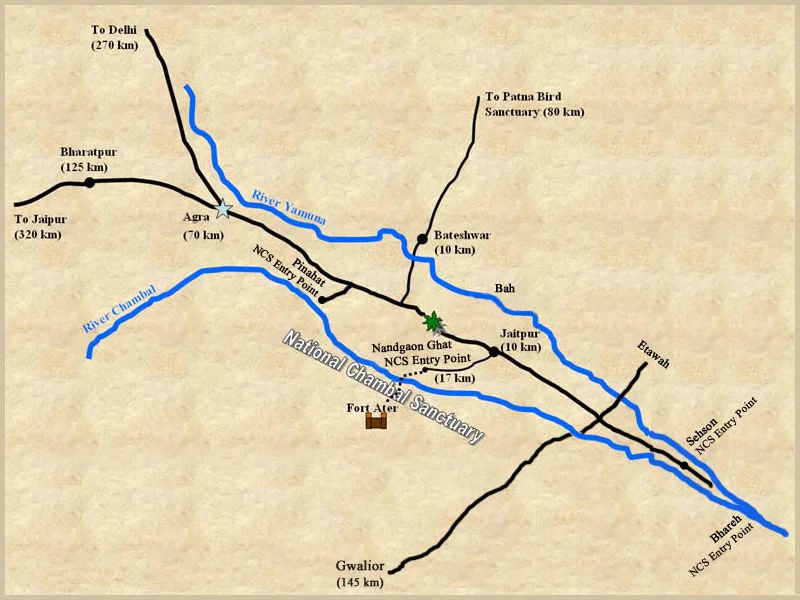
| Read more: National Chambal Sanctuary |
Rapid Fire
RELIEF Scheme Expanded for Export Support
Recently, the government expanded the Resilience & Logistics Intervention for Export Facilitation (RELIEF) Scheme in response to geopolitical tensions and maritime disruptions in West Asia.
- About: RELIEF is a time-bound initiative under the Export Promotion Mission (EPM) with a ₹497 crore outlay, launched by the Ministry of Commerce and Industry to provide a financial and operational safety net for Indian exporters facing rising maritime risks.
- Objective: It seeks to mitigate logistics costs, provide risk protection, ensure supply chain resilience, and maintain export competitiveness during geopolitical disruptions.
- Coverage: The scheme covers exports to West Asia and Gulf countries such as the UAE, Saudi Arabia, Qatar, Oman, Kuwait, Bahrain, Iraq, Iran and Yemen, along with newly added Egypt and Jordan.
- Implementation: It is implemented through the Export Credit Guarantee Corporation of India (ECGC), which handles claims, disbursement and monitoring.
- Three-Part Framework:
- Component 1: Supports exporters already holding ECGC Ltd. cover by maintaining pre-disruption premium rates for consignments issued between 14th February and 15th March, 2026, with enhanced cover up to 100% of loss for war-related risks.
- Component 2: Provides up to 95% loss coverage for consignments (16th March–15th June 2026); includes exporters obtaining fresh ECGC Whole Turnover Policies post 16th March 2026.
- Component 3: Specifically targets MSME exporters who lacked prior insurance, offering a cap of Rs 50 lakh per exporter for affected shipments.
| Read more: Export Promotion Mission |
Rapid Fire
FIU-IND & SEBI MoU on Financial Crime
Recently, the Financial Intelligence Unit-India(FIU) and Securities and Exchange Board of India (SEBI) signed an MoU to strengthen efforts against money laundering and financial crimes.
- Objective: The agreement aims to enhance intelligence sharing, coordination, and enforcement to combat financial crimes and terrorist financing.
- Features: It enables the sharing of financial intelligence and database information between the two agencies, establishing reporting mechanisms under the Prevention of Money-Laundering Rules for regulated entities.
- Capacity Building: Includes training and outreach programmes to strengthen Anti-Money Laundering(AML)/Combating the Financing of Terrorism(CFT) capabilities among SEBI-regulated entities.
- Risk Monitoring: Focus on assessment of money laundering and terror financing risks, identification of red flag indicators, and compliance monitoring.
- Mechanism & Global Cooperation: Ensures regular coordination and alignment with international standards while enabling information exchange with foreign FIUs under the Egmont Principles of Information Exchange.
FIU-IND
- FIU-IND is the central national agency responsible for receiving, processing, analysing, and disseminating information relating to suspect financial transactions and coordinating efforts against money laundering and financing of terrorism.
SEBI
- It is the statutory regulator of securities markets in India, established under the SEBI Act, 1992, to protect investor interests and ensure market integrity.
| Read more: Securities and Exchange Board of India (SEBI) |



