


Facts for UPSC Mains
Subhas Chandra Bose’s Philosophical Foundations
- 18 Apr 2026
- 13 min read
Why in News?
The life and ideas of Subhas Chandra Bose are being revisited, highlighting his unique attempt to blend Indian spirituality with Western political thought and his vision for a modern, socialist India.
What were Bose’s Philosophical Foundations and Vision for a Modern Indian State?
- Rejection of the Doctrine of Maya: Initially influenced by Vedanta and Shankaracharya’s Doctrine of Maya, viewing the world as an illusion.
- He adopted a pragmatic stance, stating he must discard whatever is "not workable" for a revolutionary.
- Pragmatic Spirituality: Instead of turning to pure materialism, Bose viewed the world as a real, evolving manifestation of the "Spirit."
- For him, the fundamental, guiding essence of the universe and human life was Love.
- Embracing Hegelian Dialectics: He found the scientific explanation for historical progress in Hegel’s dialectics (a way of understanding how ideas and reality evolve through conflict).
- Bose believed that society progresses through continuous conflict and resolution (thesis, antithesis, and synthesis), making active participation in this political and social conflict a paramount moral duty.
Vision for a Modern Indian State
- Samyavada (Doctrine of Harmony): Subhas Chandra Bose developed Samyavada, the “Doctrine of Harmony,” as an indigenous political philosophy aimed at synthesising the strengths of global ideologies like Fascism and Communism while rejecting their extremes, and articulated it through the Forward Bloc (1939) as India’s unique contribution to world thought.
- In The Anti-Imperialist Struggle and Samyavada (1933), he positioned Samyavada as India’s next major contribution after Western constitutionalism and Marxism.
- In practice, it served as a blueprint for a modern socialist state, as outlined in his 1941 Kabul thesis, focusing on complete independence, scientific industrialisation, social ownership of resources, and the application of equality and social justice, supported by a strong central authority and planned economic reorganisation.
- Industrialization over Agrarianism: Sharply diverging from Mahatma Gandhi’s vision of decentralized, village-based self-sufficiency, Bose championed scientific large-scale production, heavy industries, and the abolition of landlordism.
- This was institutionalized through his creation of the National Planning Committee during his 1938 Haripura presidency.
- Temporary Centralized Authority: Bose's political theories were heavily influenced by the global zeitgeist of his time, where nations like Soviet Russia and Kemalist Turkey had achieved massive modernization through centralized rule.
- Believing that a fractured and impoverished India could not afford the slow pace of democracy during its initial reconstruction.
- Bose advocated for a strong Central Government with temporary authoritarian powers to force through socialist economic reforms.
- Comprehensive Social Equity: His blueprint guaranteed religious freedom, linguistic and cultural autonomy, equal distribution of wealth, and the total eradication of caste differences and communal bigotry.
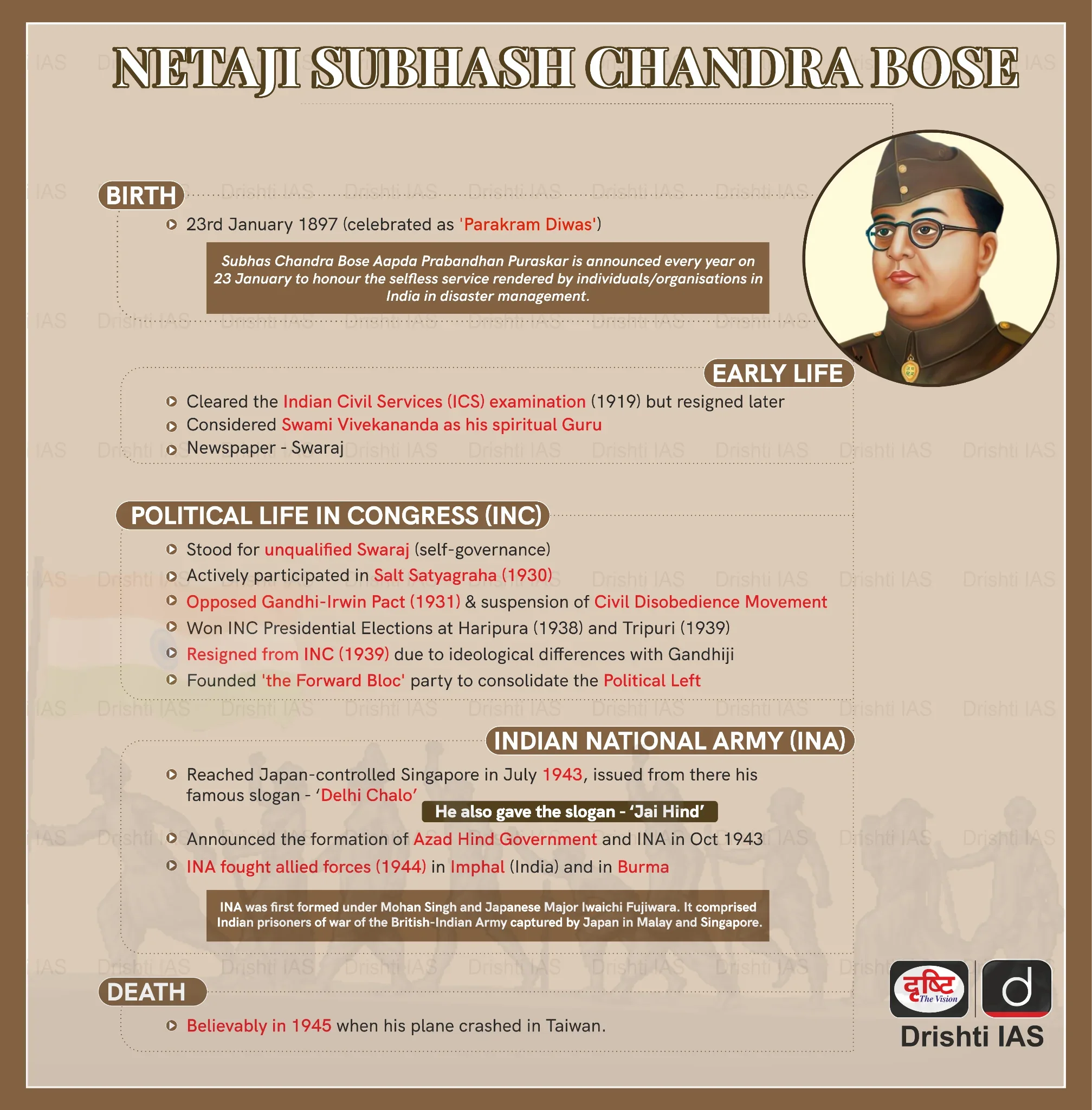
What is the Relevance of Bose’s Ideas Today?
- The Pioneer of Economic Planning: Bose’s insistence on a "scientific reorganization of agricultural and industrial life" and his establishment of the National Planning Committee laid the intellectual groundwork for post-independence India’s planned economy and the Planning Commission.
- A Cautionary Tale on Authoritarianism: While his advocacy for a centralized, authoritarian state reflected the global zeitgeist of the 1930s and 40s (seen in Soviet Russia or Kemalist Turkey), modern rights-based democracies study this as a critical paradox.
- It serves as a reminder to resist the appeal of authoritarian shortcuts when solving deep-rooted structural and economic problems.
- Blueprint for Inclusive Nationalism: In an era of polarizing identity politics, Bose’s uncompromising stance against communal narrowness, coupled with his demand for a state that acts as the "servant of the masses" while protecting minority cultural autonomy, remains highly relevant for maintaining India's secular and pluralistic fabric.
The Ideological Triad: Comparing Subhas Chandra Bose, Mahatma Gandhi, and Jawaharlal Nehru
Means vs. Ends
- Mahatma Gandhi: Believed in the absolute supremacy of the means over the ends. His entire political strategy was anchored in Ahimsa (non-violence) and Satyagraha (truth-force).
- He firmly believed that freedom achieved through violence would inherently corrupt the newly formed state.
- Subhas Chandra Bose: A geopolitical pragmatist who believed that "freedom is not given, it is taken."
- He famously applied the diplomatic principle of "an enemy’s enemy is a friend," seeking military alliances with Axis powers (Germany and Japan) during WWII to form the Indian National Army (INA).
- Jawaharlal Nehru: A centrist between the two. While he adhered to Gandhi’s non-violent mass movements within India, he was a staunch anti-fascist.
- Nehru vehemently opposed Bose’s strategy of allying with totalitarian regimes, believing that an alliance with fascism would be disastrous for India's democratic soul.
Economic Visions for a Free India
- Mahatma Gandhi: Championed Gram Swaraj (Village Self-Rule). He was deeply suspicious of heavy machinery and rapid urbanization, fearing it would lead to exploitation.
- He advocated for a decentralized agrarian economy, the revival of cottage industries (Khadi), and the Trusteeship model, where capitalists hold their wealth in trust for the welfare of the poor.
- Subhas Chandra Bose: Believed poverty could only be eradicated through rapid, state-led heavy industrialization and large-scale scientific agriculture.
- As Congress President in 1938, he institutionalized this by establishing the National Planning Committee.
- Jawaharlal Nehru: Economically, Nehru was closely aligned with Bose.
- Appointed by Bose to chair the National Planning Committee, Nehru championed a mixed economy with a strong public sector.
- He viewed heavy industries and large dams as the "temples of modern India," marrying Soviet-style central planning with a democratic framework.
Nature of the State and Democracy
- Mahatma Gandhi: He envisioned a decentralized federation of autonomous, self-sustaining village republics with minimal state interference.
- Subhas Chandra Bose: Believed that India's deep socio-economic fractures required radical surgery.
- He openly advocated for a strong Central Government with temporary authoritarian powers to dismantle feudalism, enforce socialist equity, and rebuild the nation before returning power to a democratic system.
- Jawaharlal Nehru: A resolute liberal democrat, he was committed to parliamentary democracy, constitutionalism, universal adult franchise, and fundamental civil liberties, believing that the democratic process itself was the primary tool for social change.
International Outlook and Foreign Policy
- Mahatma Gandhi: His outlook was primarily spiritual and focused on India's internal moral regeneration, though he expressed moral sympathy for the democratic nations fighting totalitarianism during World War II.
- Subhas Chandra Bose: A sharp military and geopolitical strategist. He viewed the Second World War not as a moral crisis, but as India’s golden strategic opportunity to strike a distracted British Empire.
- Jawaharlal Nehru: A dedicated internationalist with a profound understanding of global currents.
- Long before independence, Nehru was shaping India's foreign policy based on anti-imperialism and anti-racism. His staunch refusal to align with either Cold War bloc eventually birthed the Non-Aligned Movement (NAM).
|
Drishti Mains Question: Compare the economic visions of Gandhi, Nehru, and Bose for independent India. |
Frequently Asked Questions (FAQs)
1. What is Samyavada proposed by Subhas Chandra Bose?
Samyavada, or the Doctrine of Harmony, aimed to combine the strengths of Fascism and Communism while rejecting their extremes to build a socialist and strong Indian state.
2. What was the significance of the National Planning Committee (1938)?
It marked the beginning of scientific economic planning in India and laid the foundation for post-independence planned development.
3. How did Gandhi and Bose differ on the use of violence?
Gandhi rejected violence completely, while Bose supported armed struggle as a necessary tool for achieving independence.
4. What was Nehru’s economic approach for India?
Nehru advocated a mixed economy with central planning, focusing on heavy industries and public sector development.
5. Why is Bose’s idea of a strong central state debated today?
It highlights the tension between rapid development through centralized authority and the risks it poses to democratic freedoms.
UPSC Civil Services Examination, Previous Year Questions (PYQs)
Prelims
Q. The Ghadr (Ghadar) was a (2014)
(a) revolutionary association of Indians with headquarters at San Francisco
(b) nationalist organization operating from Singapore
(c) militant organization with headquarters at Berlin
(d) communist movement for India’s freedom with headquarters at Tashkent
Ans: (a)
During the Indian Freedom Struggle, who of the following raised an army called ‘Free Indian Legion’?(2008)
(a) Lala Hardayal
(b) Rashbehari Bose
(c) Subhash Chandra Bose
(d) V.D. Savarkar
Ans: (c)
Mains
Q. Highlight the differences in the approach of Subhash Chandra Bose and Mahatma Gandhi in the struggle for freedom. (2016)
Q. Jawaharlal Nehru, though a declared socialist, was pragmatist enough to focus on providing building blocks to the making of new India.” Examine. (2015)



