
Indian Economy
India’s Shift to Domestic-led Capital Markets
For Prelims: Capital markets, Foreign portfolio investment (FPI), Mutual funds, Initial Public Offerings
For Mains: Role of capital markets in economic growth and financial deepening, Impact of declining FPI dependence on macroeconomic stability, Challenges of rising retail participation in equity markets
Why in News?
India’s capital markets are witnessing a structural transformation where domestic household savings are increasingly replacing foreign portfolio investment (FPI) as the primary source of market liquidity.
- While the shift has reduced exposure to volatile global capital and improved market stability, it has also highlighted concerns over unequal participation, investor protection, and inclusive growth in the run-up to Viksit Bharat 2047.
Summary
- India’s capital markets are shifting towards domestic-led growth as household savings replace foreign portfolio investment, improving stability and policy autonomy.
- However, challenges like investor protection, valuation risks, and unequal participation must be addressed to ensure inclusive growth towards Viksit Bharat 2047.
How is Domestic Money Shaping Indian Capital Markets?
- Shift in Market Ownership and Power: FPI ownership of Indian equities has declined to a 15-month low of 16.9%, and to 24.1% in the NIFTY 50.
- In contrast, domestic mutual funds are hitting record highs quarter after quarter, supported by sustained SIP inflows.
- Retail investors, through direct equity holdings and mutual funds, now own nearly 19% of the equity market, the highest level in over two decades.
- This marks a shift in market power from globally mobile capital to domestic savers, making Indian equities less vulnerable to external shocks.
- Boom in Primary Markets and Capital Formation: In 2025, domestic confidence is visible in a booming primary market, with 71 mainboard Initial Public Offerings (IPOs) raising over Rs 1 lakh crore this fiscal.
- Corporate investment announcements in FY25 rose by 39% year-on-year, with nearly 70% led by the private sector, reflecting stronger domestic risk appetite and capital mobilisation.
- Greater Market Stability: Domestic savings act as a stable, long-term anchor, dampening volatility caused by sudden FPI inflows and outflows.
- This was evident in the 2025 October rally in the NIFTY 50, where domestic flows provided a “flight-to-stability” buffer despite global uncertainty.
- Enhanced Policy Space for RBI: Reduced dependence on FPI flows gives the Reserve Bank of India (RBI) greater monetary autonomy.
- This gives RBI greater space to boost bank credit, manage the growth–inflation balance, and reduce the need for frequent rupee defence against capital flight.
- However, this policy flexibility is contingent on sustained household confidence and may quickly reverse if markets correct sharply.
Financial Markets in India
- About: Financial markets are platforms where securities like stocks, bonds, and currencies are traded.
- These markets, including forex, bond, stock, money, and derivatives markets, play a crucial role in a country's economic growth.
- Components of Financial Markets in India:
- Money Market: Deals with short-term financial instruments (less than one year), facilitating borrowing and lending between banks and financial institutions.
- Capital Markets: It involves long-term investments ( maturity period over one year). It includes the primary market (new securities) and secondary market (existing securities).
- Foreign Exchange Market: Facilitates currency trading, crucial for international trade and investment.
- Derivatives Market: Involves trading instruments like options and futures that derive value from underlying assets.
What are the Key Challenges from India’s Shift to Domestic-led Capital Markets?
- Investor Readiness and Financial Literacy Gap: Millions of new retail investors are entering equity markets, many with limited understanding of risk, cycles, and valuation.
- During market corrections, these investors are more likely to suffer losses, which can weaken long-term trust in equity markets.
- Valuation Excesses: Several IPOs and new-age companies are being priced far above their earnings and fundamentals.
- If market sentiment turns, such stretched valuations can lead to sharp corrections, disproportionately affecting small investors.
- Low Investor Returns: Despite their popularity, most active mutual funds fail to consistently outperform the market after accounting for fees and risk, yet dominate investments.
- While low-cost passive funds remain underused, reducing returns for small investors.
- Unequal Participation: Equity and mutual fund ownership remains concentrated among higher-income and urban households with better financial access.
- As a result, market gains are unevenly distributed, limiting the role of capital markets in inclusive growth.
- Corporate Governance Concerns: Declining promoter shareholding raises questions about long-term commitment and the risk of opportunistic exits.
- Stronger governance and transparency are needed to safeguard the interests of domestic savers who now anchor the markets.
What Measures are Needed to Strengthen India’s Capital Markets?
- Fix Access and Information Asymmetry: Strengthen Securities and Exchange Board of India’s investor protection framework by moving beyond disclosure under the SEBI (Listing Obligations and Disclosure Requirements) Regulations 2015 to suitability-based selling, simplified products, and tighter oversight of distributors, especially for first-time investors.
- Promote Low-cost Passive Investing: Encourage index funds and ETFs through lower expense ratios and investor awareness via Mutual Fund Sahi Hai campaign to address poor post-fee returns from active funds.
- Strengthen Financial Literacy and Trust: Scale up financial education under the National Strategy for Financial Education (NSFE), with focused outreach to small investors, women, and first-time market participants.
- Deepen Corporate Governance Reforms: Enforce stronger governance through the Companies Act, 2013, SEBI LODR norms, independent directors, and enhanced disclosure to ensure declining promoter stakes reflect genuine capital formation, not value extraction.
- Adopt Data-driven Inclusion Policies:Leverage data from RBI, SEBI, and NPCI, and align with Jan Dhan–Aadhaar–Mobile (JAM) and Digital India frameworks to identify access gaps and design targeted interventions for underrepresented investors.
Conclusion
The shift to domestic savings has strengthened market stability and reduced external risks, but without inclusion, literacy, and protection, this stability may prove fragile. Deepening governance, improving investor outcomes are essential to sustain growth and trust on the path to Viksit Bharat 2047.
|
Drishti Mains Question: Q. Discuss how the shift from foreign portfolio investment to domestic household savings is reshaping India’s capital markets |
Frequently Asked Questions (FAQs)
1. What is driving the shift towards domestic-led capital markets in India?
Rising household savings, record SIP inflows, and increased retail participation are replacing volatile FPI flows as the main source of market liquidity.
2. How has this shift improved market stability?
Domestic savings provide long-term capital, reducing volatility caused by sudden foreign capital inflows and outflows.
3. What challenges do new retail investors face?
Limited financial literacy, exposure to overvalued IPOs, and poor post-fee returns from active funds increase downside risks.
UPSC Civil Services Examination, Previous Year Questions (PYQs)
Prelims
Q. Convertibility of rupee implies (2015)
(a) being able to convert rupee notes into gold
(b) allowing the value of rupee to be fixed by market forces
(c) freely permitting the conversion of rupee to other currencies and vice versa
(d) developing an international market for currencies in India
Ans: (c)
Mains
Q. Do you agree with the view that steady GDP growth and low inflation have left the Indian economy in good shape? Give reasons in support of your arguments? (2019)


Science & Technology
Year End Review-2025: Department of Atomic Energy
For Prelims: Nuclear Power, Nuclear Power Corporation of India Limited (NPCIL), National Thermal Power Corporation (NTPC), Atomic Energy Commission (AEC), Pressurized Heavy Water Reactors (PHWRs),
For Mains: Key Achievements of Department of Atomic Energy (DAE) in the Year 2025
Why in News?
The Department of Atomic Energy (DAE) released its Year-End Review for 2025, showcasing a remarkable progress in nuclear power generation, healthcare (e.g., cancer care), etc, contributing to rare earth exploration, and achievements in high-tech national security systems.
Summary
- DAE is rapidly expanding nuclear capacity through projects like the Mahi Banswara NPP and new PHWR approvals, achieving record power generation.
- It has advanced cancer care, indigenous radiopharmaceuticals, medical device sterilization, high-yield crops, irradiation facilities, and national security systems
What are the Key Achievements of the Department of Atomic Energy (DAE) in the Year 2025?
- Nuclear Power Expansion: The foundation stone was laid for the Mahi Banswara Nuclear Power Plant (NPP) in Rajasthan, executed by the Nuclear Power Corporation of India Limited (NPCIL)-National Thermal Power Corporation (NTPC) Joint Venture ASHVINI.
- Atomic Energy Commission (AEC) approved an additional 10 units of 700 MWe Pressurized Heavy Water Reactors (PHWRs), signalling expansion beyond the existing 22.5 GW target for 2032.
- NPCIL achieved its highest-ever electricity generation of 56,681 million units in FY 2024-25, avoiding ~49 million tons of CO2 emissions.
- Healthcare & Radiopharmaceuticals: The Homi Bhabha Cancer Hospital and Research Centre was inaugurated in Bihar, extending advanced oncology services to Eastern India.
- Tata Memorial Hospital recognized as an International Atomic Energy Agency (IAEA) Rays of Hope Anchor Center, affirming its global leadership in cancer treatment, research, and capacity building.
- Strategic & High-Technology Autonomy: DAE developed India’s first Certified Reference Material (CRM) for Rare Earth Elements (REEs) – Ferrocarbonatite, gaining a crucial tool for defence, electronics, and green technology.
- First Electronics-grade (99.8% purity) Boron-11 Enrichment Facility, commissioned at Talcher, Odisha, provides ultra-high-purity material for semiconductor manufacturing.
- Contributions to National Security: DAE entities developed Weapon Control System for Astra Missile, and Integrated Power & Pyro Relay Units for Agni missiles.
- Agricultural & Societal Applications: New high-yield, early-maturing mutant crop varieties like TBM-9 banana and RTS-43 Sorghum have been notified. This has taken the number of varieties released by BARC to 72.
- Gamma radiation processing facilities increased to 40 across the country enhancing food preservation, safety, and agricultural productivity.
- Institutional Excellence: DAE hosted the 18th International Olympiad on Astronomy & Astrophysics (IOAA 2025). Homi Bhabha National Institute (HBNI) secured top rankings in National Institutional Ranking Framework (NIRF) 2025 and Nature Index 2024-25, highlighting research excellence.
India's Nuclear Energy Ecosystem
- About: India's nuclear energy ecosystem is a state-led framework under the Department of Atomic Energy (DAE), aimed at energy security through indigenous technology and a 3-Stage Nuclear Power Programme.
- Current Capacity and Targets: India’s current nuclear power capacity is 8.18 GW, with the government targeting an increase to 22.48 GW by 2031–32.
- Small Modular Reactors (SMRs): The 2025-26 Budget launches a Nuclear Energy Mission to develop and deploy 5 indigenous SMRs by 2033. SMRs are advanced reactors with a capacity of up to 300 MW(e) per unit, roughly one-third of the generating capacity of traditional reactors.
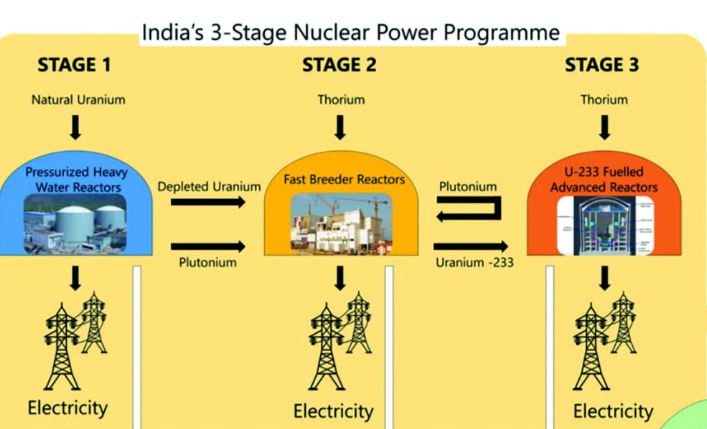
- India's 3-Stage Nuclear Power Program: The strategy uses different reactors to transition to thorium-based power.
- Stage I: PHWRs use natural uranium (U-238) with heavy water; spent fuel is reprocessed to obtain plutonium.
- Stage II: Fast Breeder Reactors (FBRs) use plutonium from Stage I and breed U-233 from thorium.
- Stage III: Thorium-based reactors use U-233 and thorium, aiming to make U-233 India’s primary nuclear fuel.
Conclusion
In 2025, DAE advanced India’s nuclear power, healthcare, strategic capabilities, high technology, agriculture, and research, strengthening national security, scientific excellence, and societal development, while achieving global recognition in innovation, education, and institutional performance.
|
Drishti Mains Question: Q. The Department of Atomic Energy's mandate extends far beyond nuclear power generation. In light of its 2025 achievements, analyse its role as a catalyst for strategic autonomy, healthcare innovation, and agricultural development in India. |
Frequently Asked Questions (FAQs)
1. What is the Mahi Banswara Nuclear Power Plant?
It is a 4-unit PHWR NPP in Rajasthan, laid by the Prime Minister in 2025, executed by NPCIL-NTPC JV 'ASHVINI'.
2. Which DAE hospital was recognized by IAEA in 2025?
Tata Memorial Hospital was recognized as a “Rays of Hope” Anchor Center for cancer treatment and research.
3. What is the significance of Ferrocarbonatite (BARC B1401)?
It is India’s first Certified Reference Material for Rare Earth Elements, aiding defence, electronics, and green technologies.
UPSC Civil Services Examination, Previous Year Questions (PYQs)
Prelims
Q. In India, why are some nuclear reactors kept under “IAEA safeguards” while others are not? (2020)
(a) Some use uranium and others use thorium
(b) Some use imported uranium and others use domestic supplies
(c) Some are operated by foreign enterprises and others are operated by domestic enterprises
(d) Some are State-owned and others are privately owned
Ans: (b)
Mains
Q. With growing energy needs should India keep on expanding its nuclear energy programme? Discuss the facts and fears associated with nuclear energy. (2018)


Science & Technology
National Supercomputing Mission
For Prelims: National Supercomputing Mission (NSM), Centre for Development of Advanced Computing (C-DAC), AIRAWAT, Monsoon, Pratyush, Genome Sequencing, Protein Folding, Semiconductors, Nanomaterials.
For Mains: Key features of National Supercomputing Mission (NSM) and various achievements under it. Applications of high-performance computing (HPC).
Why in News?
India is targeting complete indigenisation of its high-performance computing (HPC) systems by 2030, with indigenous content already reaching 50% and expected to exceed 70% by the decade's end.
- The country aims to deploy 90 petaflops (PF) of computing capacity under the National Supercomputing Mission (NSM) by March 2026.
Summary
- India’s NSM aims to build indigenous high-performance computing (HPC) capacity, targeting near-complete indigenisation by 2030.
- Key achievements: Rudra server, Trinetra network, AIRAWAT AI supercomputer. NSM 2.0 targets indigenous CPUs/GPUs and exascale computing with ISM for strategic autonomy.
What is the National Supercomputing Mission (NSM)?
- About: NSM was launched in 2015 as a flagship initiative by the Government of India to empower the country with high-performance computing capabilities.
- Jointly steered by the Department of Science and Technology (DST) and Ministry of Electronics and Information Technology (MeitY), implemented by Centre for Development of Advanced Computing (C-DAC), Pune and Indian Institute of Science (IISc), Bengaluru.
- Objectives:
- Self-Reliance: Achieve indigenous supercomputing design, development, and manufacturing.
- Research & Accessibility: Promote supercomputing for R&D and make it accessible to scientific and technology communities nationwide.
- National Relevance: Develop applications of national importance through academic, R&D, and government institutions.
- Three-Phase Strategic Implementation:
- Phase I: Focused on creating basic supercomputing infrastructure by installing six supercomputers across various institutions with significant domestic assembly; aimed to build an ecosystem for component assembly within the country.
- Phase II: Moved towards indigenous manufacturing of supercomputers, including developing a local software stack; achieved 40% value addition from India.
- Phase III: Focuses on complete indigenization including design, development, and manufacturing of key components within India.
- Indigenous Technology Development under NSM:
- Trinetra Network: C-DAC developed indigenous high-speed communication network Trinetra to enhance data transfer and communication between computing nodes.
- Trinetra-POC: Proof-of-concept (POC) system to validate key concepts.
- Trinetra-A: 100 Gigabits per second network, successfully deployed and tested in 1 petaflop (PF) PARAM Rudra at C-DAC Pune.
- PF means a computer can perform one quadrillion (10¹⁵) floating-point operations per second.
- Trinetra-B: 200 Gigabits per second upgraded version, set for deployment in the 20PF PARAM Rudra supercomputer at C-DAC Bangalore.
- Rudra Server: First indigenously designed and manufactured HPC server Rudra along with indigenously developed system software stack — first of its kind in India at par with globally available HPC-class servers.
- Trinetra Network: C-DAC developed indigenous high-speed communication network Trinetra to enhance data transfer and communication between computing nodes.
- Major Installations:
- PARAM Rudra (2024): Prime Minister dedicated three PARAM Rudra supercomputers deployed in Pune, Delhi, and Kolkata, facilitating advanced studies in physics, earth sciences, and cosmology.
- PARAM Pravega (2022): Installed at Indian Institute of Science (IISc), Bengaluru with 3.3 petaflops computing power — the largest supercomputer in an Indian academic institution.
- PARAM Shivay (2019): NSM's first indigenously built supercomputer inaugurated by Prime Minister at Indian Institute of Technology (IIT) BHU, Varanasi.
- Achievements:
- Infrastructure Scale: Total of 34 supercomputers with combined compute capacity of 35 petaflops deployed across academic institutions, research organizations, and R&D labs including IISc, IITs, C-DAC, and institutions from Tier-II and Tier-III cities.
- Utilization Efficiency: Supercomputing systems achieved overall utilization rate of over 85%, with many systems exceeding 95%, demonstrating high efficiency in computational capacity.
- Human Resource Development: Five training centers established at Pune, Kharagpur, Chennai, Palakkad, and Goa to expand awareness and familiarization of supercomputing.
- More than 22,000 individuals trained in HPC and AI skills, developing highly professional HPC-aware human resources.
AIRAWAT AI Computing Platform
- About: Government-initiated project AIRAWAT provides a common compute platform for AI research and knowledge assimilation.
- User Base: Used by Technology Innovation Hubs, research labs, scientific community, industry, start-ups, and institutions under NKN.
- Technical Specifications: Proof of Concept developed with 200 petaflops mixed precision AI machine, scalable to peak compute of 790 AI petaflops.
- Global Recognition: Secured 75th position in Top 500 Global Supercomputing List at International Supercomputing Conference (ISC 2023), Germany, positioning India among top AI supercomputing nations worldwide.
What are the Key Applications of High Performance Computing (HPC) Systems in India?
|
Domain |
Key Applications |
|
Weather Forecasting and Climate Modeling |
HPC powers high-resolution models for accurate monsoon predictions, and cyclone tracking. Pratyush, and Mihir can deliver resolutions up to 1 km, supporting disaster management. |
|
Drug Discovery and Bioinformatics |
Accelerates genome sequencing, protein folding, molecular dynamics, and virtual drug screening. e.g., Covid-19 modeling. |
|
Artificial Intelligence and Machine Learning |
Facilities like PARAM Siddhi-AI handle massive datasets for precision medicine and predictive analytics. |
|
Material Science and Nanotechnology |
Enable development of advanced materials, semiconductors, and nanomaterials, supporting self-reliance in electronics and manufacturing. |
|
Defense and National Security |
Supports strategic simulations, cybersecurity, and high-energy physics research for national security. |
|
Other Emerging Areas |
Supports renewable energy modeling, oil/gas exploration, and other large-scale system simulations. |
Conclusion
India’s National Supercomputing Mission is strategically advancing indigenous HPC capabilities to achieve self-reliance, empower R&D across critical sectors, and secure a leading position in global supercomputing and artificial intelligence.
|
Drishti Mains Question: Q. The National Supercomputing Mission (NSM) is pivotal to India’s strategic autonomy and technological advancement. Critically examine its progress in achieving indigenisation and its impact on scientific research and development. |
Frequently Asked Questions (FAQs)
1. What is the National Supercomputing Mission (NSM)?
NSM is a 2015 Government of India initiative to develop indigenous HPC systems, expand compute capacity, and strengthen national R&D through supercomputing infrastructure.
2. What is Trinetra in the context of NSM?
Trinetra is C-DAC’s indigenous high-speed interconnect network enabling 100–200 Gbps node communication, deployed in PARAM Rudra systems.
3. What is the AIRAWAT AI platform?
AIRAWAT is India’s national AI computer infrastructure, offering 200–790 petaflops for AI/ML research; it ranks 75th on the Top500 global supercomputing list.
UPSC Civil Services Examination, Previous Year Questions (PYQs)
Prelims
Q. Which of the following statements is/are correct regarding National Innovation Foundation-India (NIF)? (2015)
- NIF is an autonomous body of the Department of Science and Technology under the Central Government.
- NIF is an initiative to strengthen the highly advanced scientific research in India’s premier scientific institutions in collaboration with highly advanced foreign scientific institutions.
Select the correct answer using the code given below:
(a) 1 only
(b) 2 only
(c) Both 1 and 2
(d) Neither 1 nor 2
Ans: (a)
Mains
Q. What are the research and developmental achievements in applied biotechnology? How will these achievements help to uplift the poorer sections of society? (2021)
Q. Scientific research in Indian universities is declining because a career in science is not as attractive as are business professions, engineering or administration, and the universities are becoming consumer-oriented. Critically comment. (2014)


Important Facts For Prelims
SC Declares Involuntary Narco Test as Unconstitutional
Why in News?
The Supreme Court (SC) of India has ruled that any forced or involuntary narco test is unconstitutional, setting aside a 2025 Patna High Court order that allowed such a test in Amlesh Kumar v. State of Bihar (2025).
Summary
- The SC has held that forced narco tests are unconstitutional, reaffirming protections against self-incrimination and violations of personal liberty under Articles 20(3) and 21.
- The ruling strengthens ethical standards, consent requirements, and limits the evidentiary value of such investigative techniques in India’s criminal justice system.
What is a Narco Test?
- About: A narco test is an investigative technique in which the accused is administered sedative drugs such as barbiturates (a class of sedative-hypnotic drugs) like Sodium Pentothal to lower inhibitions.
- The aim is to extract concealed information by reducing reasoning and conscious control.
- It is considered a non-violent investigative method, similar to polygraph and brain-mapping tests.
- Forced Narco Tests: They violate individual autonomy, a core principle of natural justice, and ethical philosophy, including Immanuel Kant’s ideas, holds that actions without consent are morally invalid.
- In a democratic criminal justice system, justice requires balancing victims’ rights with the rights of the accused, and any compromise of protection against self-incrimination and personal liberty undermines constitutional morality.
- Constitutional Protections:
- Article 20(3): Protection against self-incrimination and no accused can be compelled to testify against oneself.
- Article 21: Guarantees life, personal liberty, and the right to privacy, and any such test without the express consent of the person (accused) would violate it.
- A democratic criminal justice system must balance victims’ rights with the accused’s rights.
- Article 21, along with Articles 14 and 19, forms the Golden Triangle of the Constitution, as held in Maneka Gandhi v. Union of India (1978).
- Any violation of the Right to Privacy therefore amounts to a violation of the Right to Life and Personal Liberty, disrupting this core constitutional framework.
- Legal Provisions: A person may voluntarily opt for a narco test at the defence stage under Section 253 of the Bharatiya Nagarik Suraksha Sanhita (BNSS), 2023. However, there is no absolute or indefeasible right to demand such a test.
- Judicial Pronouncements:
- Selvi v. State of Karnataka (2010): SC held that narco tests without free consent are unconstitutional; results are not admissible as evidence.
- Amlesh Kumar v. State of Bihar (2025): SC struck down forced narco testing.
- Manoj Kumar Saini v. State of MP (2023) and Vinobhai v. State of Kerala (2025): SC held that narco test results do not prove guilt and require corroboration with independent evidence and such tests cannot be treated as substantive evidence.
Frequently Asked Questions (FAQs)
1. What is a narco test?
A narco test is an investigative technique where sedative drugs like barbiturates (e.g., Sodium Pentothal) are administered to lower inhibitions and extract information.
2. Why are forced narco tests unconstitutional?
They violate Article 20(3) by compelling self-incrimination and breach Article 21 by infringing personal liberty and the right to privacy.
3. What did the Supreme Court hold in Selvi v. State of Karnataka (2010)?
The Court ruled that narco tests without free and informed consent are unconstitutional and their results are inadmissible as evidence.
4. Is voluntary narco testing legally allowed?
Yes, a person may voluntarily opt for a narco test at the defence stage under Section 253 of BNSS, but there is no absolute right to demand it.
UPSC Civil Services Examination, Previous Year Questions (PYQs)
Prelims
Q. ‘Right to Privacy’ is protected under which Article of the Constitution of India? (2021)
(a) Article 15
(b) Article 19
(c) Article 21
(d) Article 29
Ans:C


Rapid Fire
Pax Silica Initiative
At the inaugural Pax Silica Summit in 2025, India was excluded from the US-led ‘Pax Silica’ initiative, triggering sharp political criticism.
- Pax Silica Initiative: It is a strategic initiative to build a secure, resilient, and innovation-driven silicon supply chain.
- It aims to reduce China’s dominance and counter coercive dependencies across critical minerals, energy inputs, semiconductors, advanced manufacturing, AI infrastructure, and logistics.
- Key measures under Pax Silica focus on promoting joint ventures and strategic co-investments in high-tech sectors, protecting sensitive technologies and critical infrastructure from countries of concern, and building trusted technology ecosystems.
- Countries Included (as of December 2025): US, Japan, South Korea, Singapore, Netherlands, United Kingdom, Israel, UAE, and Australia.
-
Notably, other Quad members (U.S., Japan, Australia) are included, India is not.
-
-
India’s Position: Experts note that India could join Pax Silica at a later stage, as seen in the case of the Minerals Security Partnership (MSP), a US -led initiative launched in 2022 to secure critical mineral supply chains.
-
India joined the MSP in June 2023 along with partners such as Japan, Australia, the EU, the UK, and Canada.
-
The MSP focuses on minerals like lithium, cobalt, nickel, and the 17 rare earth elements, and is viewed as an effort to counter China’s dominance in rare earth processing and its mining footprint in Africa.
-
| Read more: Critical Minerals Alliance |


Rapid Fire
Global Capability Centres (GCCs)
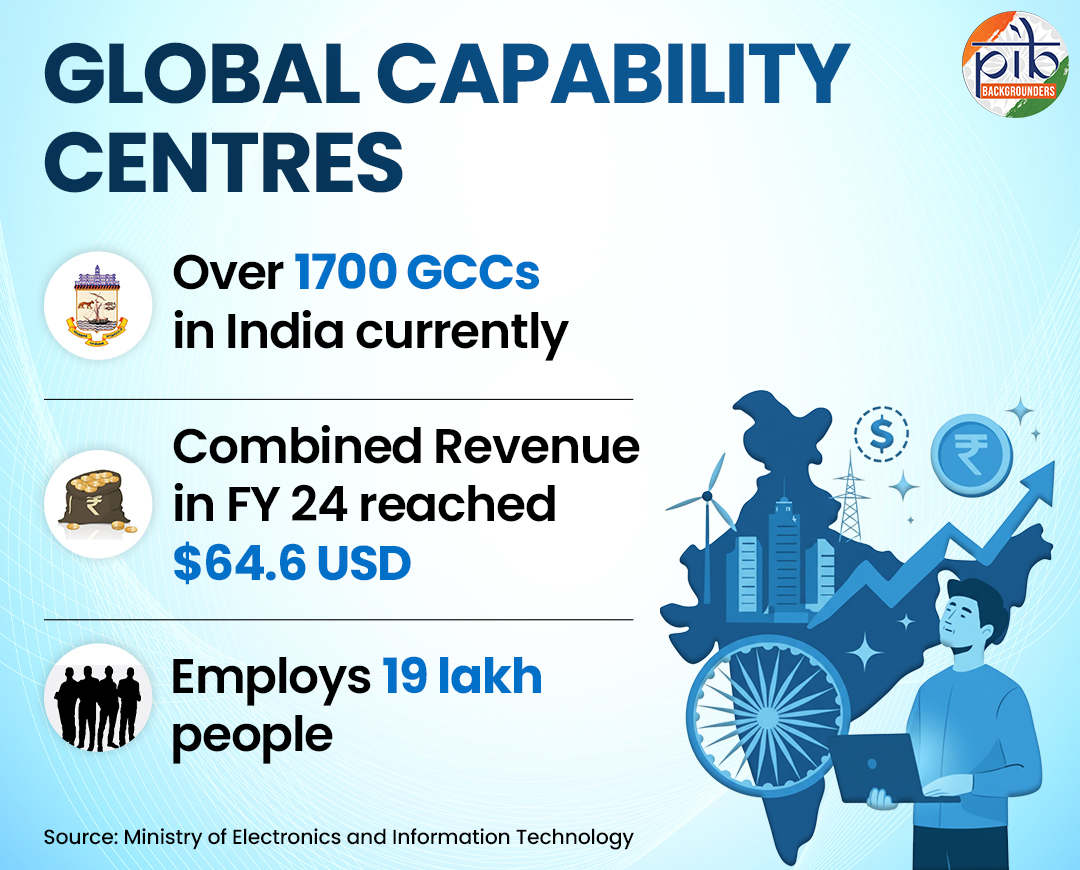
India is emerging as the world’s leading destination for Global Capability Centres (GCCs), With over 1,700 GCCs now operating & projected revenues reaching USD 105 billion by 2030, the sector is becoming a pillar of India’s service-led growth.
Global Capability Centres (GCCs)
- About: Global Capability Centres (GCCs), earlier known as Global In-house Centres (GICs), offshore units set up by multinational companies.
- According to the Economic Survey 2024–25, India’s GCCs now play strategic roles in aerospace, defence, semiconductors, engineering R&D, innovation centres, and global operations, Strengthens Atmanirbhar Bharat.
- Cluster Cities: Major hubs include Bengaluru, Hyderabad, Pune, Chennai, NCR, and Mumbai.
- Significance: India hosts ~1,700 GCCs, employing over 1.9 million people; projected to reach 2,400 centres and 2.8 million employees by 2030.
- India contributes 28% of the global STEM workforce and 23% of the global software engineering talent pool. Projected rise in global leadership roles within GCCs from 6,500 to 30,000 by 2030.
- Engineering R&D GCCs are growing 1.3x faster than the overall sector.
- Targeted Policies and Reforms: GENESIS (Gen-Next Support for Innovative Startups)-₹490 crore scheme to build GCC feeder ecosystems in Tier II & III cities.
- Modified Electronics Manufacturing Clusters (EMC 2.0) by MeitY: Offers plug-and-play infrastructure to attract GCCs.
- Programs like Skill India, Digital India, and FutureSkills Prime (MeitY-NASSCOM) are creating a future-ready digital workforce.
- India allows 100% FDI in most sectors, especially IT & R&D, boosting GCC inflow.
| Read More: Promoting Global Capability Centres in India |


Rapid Fire
Ponduru Khadi Gets GI Tag
Ponduru Khadi, fabric from Andhra Pradesh, has been granted the Geographical Indication (GI) tag by the Geographical Indications Registry.
- Ponduru Khadi: It is a traditional handspun and handwoven cotton fabric, produced in Ponduru village of Srikakulam district, Andhra Pradesh and is locally known as Patnulu.
-
The fabric is made using hill cotton, punasa cotton, or red cotton, all of which are indigenous to the Srikakulam region.
- From cleaning the cotton to spinning and weaving, the entire production process is done manually, preserving traditional skills.
-
- Unique Features of Ponduru Khadi: Cleaning of cotton using the jawbone of the Valuga fish is a globally unique practice, found only in Ponduru Khadi.
- Ponduru is the only place in India where spinners still use single-spindle charkhas with 24 spokes, known as the Gandhi Charkha.
- The fabric is known for its very high yarn count of about 100–120, indicating extreme fineness.
- Historical Significance: During the pre-Independence period, Mahatma Gandhi highlighted the virtues of Ponduru Khadi in his journal Young India, linking it to the ideals of self-reliance, swadeshi, and the freedom movement.
- GI Tag: It identifies goods originating from a specific location and having distinct nature, quality, and characteristics linked to that location.

| Read more: India's Geographical Indication Landscape |


Rapid Fire
One Nation–One Port Process (ONOP)
The One Nation-One Port Process (ONOP) framework will cut 33% of the documentation required at ports, enhancing efficiency, and reducing costs and time.
One Nation–One Port Process (ONOP)
- About: A reform initiative of the Ministry of Ports, Shipping and Waterways (MoPSW) to bring uniformity in port procedures across India.
- Aim: To standardise documentation, approvals and workflows for all major and selected minor ports.
- Features:
- Supports ease of doing business by eliminating port-wise procedural variations.
- Under ONOP, the government is upgrading the National Logistics Portal – Marine (NLP-Marine/“Sagar Setu”) for seamless electronic submission and processing of all ship-related information across all Indian ports.
- It brings uniformity in processes across all major (and selected minor) ports, eliminating procedural inconsistencies that caused operational delays and increased logistics costs.
- Significance: The initiative is expected to substantially improve cargo handling efficiency, reduce turnaround times, lower logistics costs, and strengthen India’s global trade competitiveness by streamlining port operations.
- NLP-Marine / “Sagar Setu” (National Logistics Portal – Marine)
- A centralised digital platform for electronic submission and processing of all ship-related and cargo-related information.
- Integrates port stakeholders on a single window, replacing multiple manual forms and physical documents.
- Being upgraded under ONOP to ensure paperless workflows, faster clearances and real-time data sharing.
| Read More: Initiatives in India’s Maritime Sector |