Governance
Hybrid Model Framework for Generative AI
For Prelims: Copyright Act, 1957, Artificial Intelligence (AI), MSMEs, Generative AI, Machine Learning, High Court.
For Mains: Key provisions of the Copyright Act, 1957 and gaps in the Copyright Act, 1957 in addressing AI-related copyright issues. Proposed changes in the Copyright Act, 1957 to address AI-related copyright issues.
Why in News?
The Indian government is initiating a major overhaul of the Copyright Act, 1957 under the hybrid model to address the challenges posed by artificial intelligence (AI) to copyrighted works.
- The hybrid model involves a mandatory blanket license allowing AI firms to use copyrighted works for training, coupled with a statutory right to remuneration for creators.
Summary
- India proposes amendments to the Copyright Act, 1957, introducing a blanket license for AI training and creator remuneration.
- The reforms aim to balance innovation and creator rights, positioning India differently from the EU (transparency focus) and UK (computer-generated work clause).
What are the Proposed Changes to the Copyright Act, 1957 to Address AI-related Copyright Issues?
- Blanket License for AI Developers: Introduction of a statutory provision granting AI developers mandatory blanket license to use all lawfully accessed copyright-protected works for training AI systems.
- Rights holders will lose the right to withhold their works from being used in AI training.
- The license would be non-negotiable and universal, eliminating the need for individual permissions currently required under Section 14 (copyright as the exclusive right of the owner) of the Act.
- Statutory Remuneration Rights: Creation of a new statutory remuneration right for copyright holders as compensation for use of their works in AI training.
- Copyright holders entitled to royalties even without their explicit consent. Royalty to be calculated as a fixed percentage of revenue generated from AI systems trained on copyrighted content.
- AI firms will pay royalties only after commercialising their models, not while collecting or training data from the internet.
- Collection and Distribution Mechanism: Amendment to establish a centralized non-profit entity designated by the Central Government for collecting payments from AI developers.
Why is There a Need to Amend the Copyright Act, 1957 to Address AI-Related Copyright Issues?
- Absence of AI-Specific Definitions: The Copyright Act, 1957 lacks definitions for key terms like Artificial Intelligence, Generative AI, machine learning, and training data, making it outdated for modern technologies.
- It creates legal uncertainty regarding the applicability of existing provisions to AI systems and text and data mining (TDM).
- Ambiguity on AI Training as Copyright Use: No specific provisions exist addressing whether AI training constitutes reproduction, adaptation, or infringement under Section 14 (exclusive rights).
- Current law is ambiguous on whether AI training falls under fair dealing exceptions under Section 52 (certain acts not to be infringement of copyright).
- Unauthorized Use of Copyrighted Materials: Current practice of AI training bypasses the permission-based framework that forms the foundation of the Copyright Act, 1957.
- Mass-scale scraping and use of copyrighted content for AI training occurs without compensation to creators.
- Copyrightability of AI-Generated Outputs: Section 2(d)(vi) of the 1957 Act defines an author only in human terms, leaving no clarity on authorship of AI-generated content or its copyrightability.
- Although Section 2 (ffc) mentions computer-generated works, it treats the computer as a tool, creating uncertainty over ownership of AI-created works.
- Cross-Border and Jurisdictional Issues: Section 40 of the 1957 Act protects foreign works based on traditional territorial copyright but does not address AI systems trained abroad with Indian works, cloud-based AI training, or cross-border data flows.
- This creates enforcement challenges for AI developers outside India and highlights a gap in international coordination for AI copyright issues.
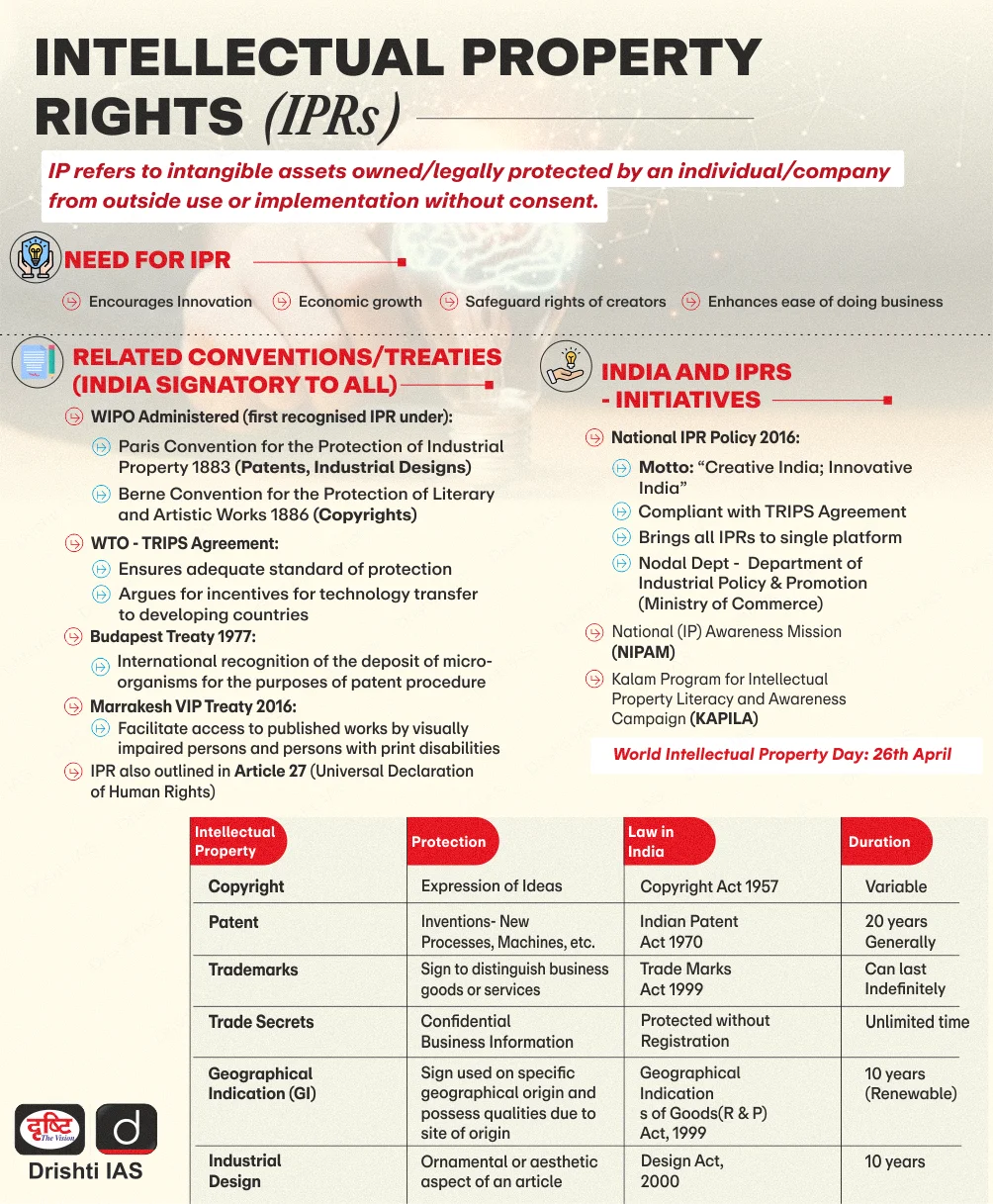
Copyright Act, 1957
- About: Copyright is a legal right in India that protects original works like literature, art, music, films, and computer programs.
- It safeguards the expression of ideas, granting the owner exclusive rights to adapt, reproduce, publish, translate, and communicate the work to the public.
- Key Sections: Section 2 defines the types of works covered under copyright e.g., literary works (2(o)) and dramatic works (2(h)).
- Section 13 extends copyright protection to literary, musical, dramatic works, cinematographic films, and sound recordings.
- Section 14 grants the owner exclusive rights to adapt, reproduce, publish, translate, and communicate the work, which cannot be exercised without the owner’s permission.
- Judicial Interpretation on Copyrighted Material:
- Mr. Dattatray Bapu Dighe v. The State of Maharashtra (2024): The Bombay High Court ruled copyright registration is not mandatory for initiating infringement action; the copyright exists automatically upon creation of the content.
- Star India Pvt. Ltd v. Magicwin.Games (2024): The Delhi High Court emphasized proactive legal action to counter the "hydra-headed" issue of digital piracy, where blocked sites resurface. It permanently barred such rogue websites and entities from unauthorized hosting or streaming of content with exclusive rights.
- India TV v. Yashraj Films (2012): The Delhi HC held that small amounts of usage of songs does not amount to copyright infringement.
- Oxford v. Rameshwari Photocopy Services (2016): The Delhi HC ruled that photocopying book excerpts for educational use was fair dealing (does not amount to infringement), affirming access to knowledge and public interest as guiding principles.
Global Views on AI-Generated Content
- United States: Copyright requires substantial human creativity (Thaler v. Perlmutter, 2023). Purely AI-generated works are not protected.
- European Union: The AI Act (2024) mandates training data transparency. A new sui generis right for AI outputs is under debate, as the current 2019 Copyright Directive lacks specific rules.
- China: The Beijing Internet Court has recognized AI-generated images as protected art, emphasizing the "originality" and intellectual contribution of the human creator.
- United Kingdom: Section 9(3) of the Copyright, Designs and Patents Act, 1988 grants copyright for computer-generated works without a human author, assigning it to the person making the "necessary arrangements." Such works lack moral rights, and the provision is rarely applied due to legal ambiguities.
Conclusion
The proposed amendments to the Copyright Act, 1957 aim to balance AI innovation with protection of creators’ rights through a mandatory blanket license and statutory royalties. The reforms address gaps in definitions, AI training, and authorship while providing a centralized mechanism for royalty collection, fostering fair compensation and legal clarity.
|
Drishti Mains Question: Critically analyze the gaps in the Copyright Act, 1957 concerning AI-generated content and cross-border enforcement. |
Frequently Asked Questions (FAQs)
Q. What is the core objective of the proposed amendments to India's Copyright Act regarding AI?
To establish a mandatory blanket licensing and statutory royalty framework that balances AI innovation with fair compensation for creators whose works are used for training AI models.
Q. Do copyright holders have the right to withhold works from AI training?
No, under the mandatory blanket license, copyright holders cannot withhold lawfully accessed works; they receive statutory remuneration instead.
Q. Why is Section 40 of the Copyright Act, 1957 inadequate in the context of AI?
Section 40 protects foreign works only through traditional territorial copyright reciprocity, but it does not cover AI systems trained abroad using Indian works, cloud-based AI training, or cross-border data flows, creating regulatory gaps in the AI-driven digital economy.
UPSC Civil Services Examination, Previous Year Question (PYQ)
Prelims
Q1.With reference to the ‘National Intellectual Property Rights Policy’, consider the following statements: (2017)
- It reiterates India’s commitment to the Doha Development Agenda and the TRIPS Agreement.
- Department of Industrial Policy and Promotion is the nodal agency for regulating intellectual property rights in India.
Which of the above statements is/are correct?
(a) 1 only
(b) 2 only
(c) Both 1 and 2
(d) Neither 1 nor 2
Ans: (c)
Q2. Consider the following statements: (2019)
- According to the Indian Patents Act, a biological process to create a seed can be patented in India.
- In India, there is no Intellectual Property Appellate Board.
- Plant varieties are not eligible to be patented in India.
Which of te statements given above is/are correct?
(a) 1 and 3 only
(b) 2 and 3 only
(c) 3 only
(d) 1, 2 and 3
Ans: (c)
Mains
Q. In a globalized world, Intellectual Property Rights assume significance and are a source of litigation. Broadly distinguish between the terms—Copyrights, Patents and Trade Secrets. (2014)


Facts for UPSC Mains
Mangroves as Ecological Buffers
Why in News?
A study published in Current Biology has revealed how mangrove plants survive extreme saltwater conditions, offering insights that could help develop salt-tolerant crops amid climate change and rising sea levels.
Summary
- A Current Biology study reveals that mangroves survive extreme salinity through unique cell-level adaptations such as thick cell walls and specialised salt management mechanisms.
- The findings offer actionable insights to develop salt-tolerant crops, strengthening climate resilience, food security, and sustainable agriculture amid rising sea levels.
How Mangroves Survive Saltwater?
- Unique Cellular Traits Identified: Mangroves have smaller epidermal pavement cells and thicker cell walls, which provide the mechanical strength necessary to survive in low osmotic potential conditions caused by saltwater.
- Different Salt Management Mechanisms: Some species exclude salt using a waxy root barrier that filters salt and pulls freshwater into the plant.
- Others accumulate salt and actively excrete it through specialised glands on their leaves.
- Evolutionary Adaptability: Mangroves have evolved over 30 times in the last 200 million years, showing a strong evolutionary capacity to adapt to saline environments.
- Non-dependence on Stomatal Changes:Contrary to expectations, mangroves do not increase stomatal density or reduce stomatal size—commonly seen in other drought-tolerant plants, to enhance photosynthesis or reduce water loss.
Implications
- Climate Resilience in Agriculture: Understanding mangrove cell traits can help engineer salt-tolerant crop varieties, especially for regions facing increased soil salinity due to climate change. Focused research on modifying cell size and wall properties could lead to breakthrough applications in agriculture, particularly for rice, wheat, and pulses in saline-prone areas.
- Policy and Research Alignment: These findings align with goals under the National Mission on Sustainable Agriculture (NMSA) and SDG 13 (Climate Action), offering scientific directions for crop resilience and food security.
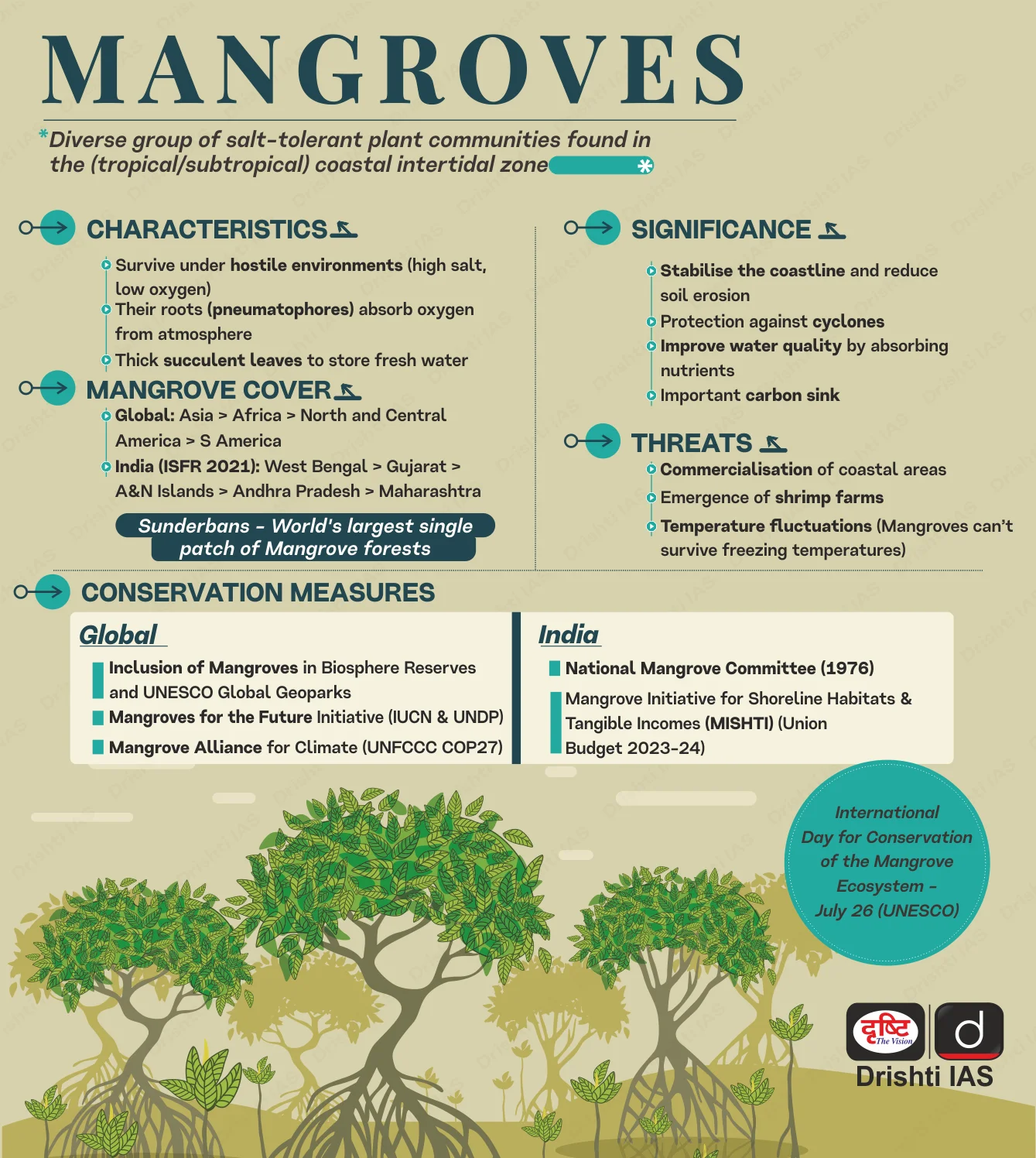
What are the Key Facts About Mangrooves?
- About: Mangroves are coastal ecosystems composed of salt-tolerant trees (halophytes) and shrubs that thrive in intertidal zones of tropical and subtropical regions.
- These ecosystems thrive in high-rainfall areas (1,000–3,000 mm) with temperatures ranging from 26°C to 35°C.
- Some common mangrove trees include Red mangrove, Grey mangrove, and Rhizophora.
- Habitat: They are found in tidal flats, estuaries, and river deltas with high silt deposition and bi-daily tidal flooding.
- They thrive in saline, anaerobic (low-oxygen), slow-moving waters, where fine sediments tend to accumulate.
- Key Characteristics:
- Physiological Adaptations: They develop pneumatophores (Avicennia) for respiration, prop roots (Rhizophora) for stability, and lenticellated bark for water loss and salt secretion.
- Their salt-secreting glands aid salt excretion, while roots trap silt and sediments, stabilising coastlines and preventing erosion.
- Reproductive Adaptations: Mangroves exhibit viviparity, where seeds germinate on the tree before falling, ensuring survival in saline conditions.
- Physiological Adaptations: They develop pneumatophores (Avicennia) for respiration, prop roots (Rhizophora) for stability, and lenticellated bark for water loss and salt secretion.
- Mangroves Distribution: Thrive only in tropical and subtropical latitudes near the equator, as they cannot withstand freezing temperatures.
- Largest mangrove areas are in South and Southeast Asia, followed by South America, Africa, North and Central America, and Oceania.
- Mangroves in India: As per India State of Forest Report (ISFR) 2023, India’s mangrove cover is 4,991.68 sq. km (0.15% of total geographical area).
- West Bengal holds the largest share of India’s mangrove cover at 42.45%, followed by Gujarat with 23.32% and the Andaman & Nicobar Islands with 12.19%.
- Key Regulatory Measures: The Environment (Protection) Act, 1986, categorises mangroves as Ecologically Sensitive Areas (ESAs), restricting activities within a 50-metre buffer zone where mangrove cover exceeds 1,000 sq. m.
- It mandates compensatory replantation at a 3:1 ratio if mangroves are affected by development.
- Additional protection under the Wildlife (Protection) Act, 1972, Indian Forest Act, 1927, and Biological Diversity Act, 2002, among others.
.webp)
Significance of Mangroves:
- Climate Change Mitigation: Mangroves are major blue carbon sinks, storing 7.5–10 times more carbon per acre than tropical forests and helping reduce greenhouse gas emissions.
- Biodiversity Conservation: They serve as nursery grounds for fish and crustaceans and provide habitat for birds, reptiles, and threatened species.
- Livelihood Support: Sustain coastal and rural livelihoods through fisheries, honey collection, fuelwood, and eco-tourism.
- Disaster Risk Reduction: Mangroves act as natural barriers against storm surges, tsunamis, and coastal erosion, reducing wave energy by 5-35%.
- They lower flood depths by 15-20% and up to 70% in certain areas, playing a crucial role in disaster risk reduction.
- Nature-based Solutions: Mangrooves represent a key ecosystem-based adaptation strategy for sustainable development and climate resilience.
.webp)
|
Drishti Mains Question: Examine the role of mangroves as both ecological buffers and knowledge systems for sustainable agriculture under climate change. |
Frequently Asked Questions (FAQs)
Q. Why are mangroves able to survive in saltwater?
They possess small epidermal cells, thick cell walls, and specialised salt exclusion or salt secretion mechanisms, enabling survival under low osmotic potential.
Q. What are the two main salt management strategies in mangroves?
Salt exclusion at roots using waxy barriers and salt accumulation followed by secretion through leaf glands.
Q. Why is the mangrove study important for agriculture?
It provides a blueprint to engineer salt-tolerant crops like rice, wheat, and pulses for saline-prone regions under climate change.
Q. Why are mangroves crucial for climate action?
They are powerful blue carbon sinks, store 7.5–10 times more carbon than tropical forests, and reduce flood and storm surge impacts.
UPSC Civil Services Examination Previous Year Question (PYQ)
Prelims
Q. Which one of the following regions of India has a combination of mangrove forest, evergreen forest and deciduous forest? (2015)
(a) North Coastal Andhra Pradesh
(b) South-West Bengal
(c) Southern Saurashtra
(d) Andaman and Nicobar Islands
Ans: (d)


Important Facts For Prelims
Methane Emissions
Why in News?
Methane, a crucial fuel for domestic and industrial applications, becomes a major environmental hazard when released uncontrolled from landfills, threatening India’s climate objectives and urban ecological health.
Summary
- Satellite data show India's landfill methane emissions are far higher than estimated, revealing a major information gap for a gas 84 times more potent than CO₂ over 20 years.
- Satellite monitoring, ground validation, and integrated policies enable precise methane hotspot detection, supporting effective waste management, climate action, and energy recovery initiatives.
What is Methane?
- About: Methane is a chemical compound with the molecular formula CH₄, consisting of one carbon atom bonded to four hydrogen atoms. It is the simplest alkane and a primary component of natural gas.
- Physical Properties: It is odourless, colourless, tasteless, and lighter than air. Under complete combustion, it burns with a blue flame, producing carbon dioxide (CO₂) and water (H₂O) in the presence of oxygen.
- Applications: As the main constituent of natural gas (typically 80–95%), methane serves as a major energy source for heating, electricity generation, and cooking.
- It is also employed in chemical synthesis to produce hydrogen, ammonia, methanol, and other compounds.
- Emission: India is the world’s 3rd-largest methane emitter after China and the United States, releasing 31 million tonnes annually (9% of global emissions).
- As per India’s 3rd Biennial Update Report to the UNFCCC, India’s methane emissions in 2016 (excluding Land Use, Land-Use Change, and Forestry) were 409 million tonne CO₂e.
- Major Sources of Methane:
- Natural Sources: Wetlands, where organic matter decomposes anaerobically.
- Agricultural Activities: Flooded rice paddies, which create anaerobic conditions, and livestock enteric fermentation, primarily from cattle.
- Combustion and Industrial Processes: Fossil fuel extraction, transport, and combustion.
- Biomass burning (e.g., wood, crop residues).
- Landfills and wastewater treatment (anaerobic decomposition of organic waste): Approximately 15% of India's methane emissions originate from the waste sector.
- Fertilizer production and other industrial activities.
- Global Warming Potential (GWP): It is a potent greenhouse gas (GHG), absorbing infrared radiation and contributing to the greenhouse effect.
- Over a 20-year period, methane is approximately 84 times more effective at trapping heat than CO₂, and over 100 years, about 28–34 times more potent.

- Initiatives to Reduce Methane:
- India’s Initiatives: Harit Dhara, BS VI Emission Norms, National Action Plan on Climate Change (NAPCC).
- Global Initiatives:
- Satellite Monitoring: Missions like CarbonMapper’s Tanager help detect methane hotspots with high accuracy. E.g., Ghazipur and Okhla in Delhi.
- Global Methane Pledge (GMP): Launched at UNFCCC COP26 in Glasgow (2021), the GMP targets a minimum 30% reduction in methane emissions from 2020 levels by 2030. India has not joined the GMP.
- Global Methane Tracker: The International Energy Agency’s Global Methane Tracker is a key tool for reducing methane emissions from the energy sector.
- UNEP Initiatives: The UN Environment Programme (UNEP) spearheads initiatives like the International Methane Emissions Observatory (IMEO) and the Oil and Gas Methane Partnership to monitor and reduce methane emissions from key sectors like agriculture.
- Methane Cycle: It is the process by which methane (CH₄) is produced, released, and removed from the environment.
- Produced by microbes under anaerobic conditions (wetlands, rice fields, ruminants, landfills).
- Released into the atmosphere through natural and human activities.
- Removed by oxidation in soils and the atmosphere (mainly by OH radicals).

Frequently Asked Questions (FAQs)
Q. Why is methane considered more dangerous than carbon dioxide?
Methane has a Global Warming Potential of 84 times CO₂ over 20 years, making it a major driver of near-term climate change.
Q. What share of India’s methane emissions comes from the waste sector?
Nearly 15% of India’s methane emissions originate from landfills and wastewater treatment due to anaerobic decomposition of organic waste.
Q. What is the Global Methane Pledge?
Launched at COP26, it aims for a 30% reduction in global methane emissions by 2030. India has not joined the pledge.
UPSC Civil Services Examination, Previous Year Questions (PYQs)
Q. Which of the following statements is/are correct about the deposits of ‘methane hydrate’? (2019)
- Global warming might trigger the release of methane gas from these deposits.
- Large deposits of ‘methane hydrate’ are found in Arctic Tundra and under the sea floor.
- Methane in the atmosphere oxidises to carbon dioxide after a decade or two.
Select the correct answer using the code given below.
(a) 1 and 2 only
(b) 2 and 3 only
(c) 1 and 3 only
(d) 1, 2 and 3
Ans: (d)
Q. Due to their extensive rice cultivation, some regions may be contributing to global warming. To what possible reason/reasons is this attributable? (2010)
- The anaerobic conditions associated with rice cultivation cause the emission of methane.
- When nitrogen based fertilizers are used, nitrous oxide is emitted from the cultivated soil.
Which of the statements given above is/are correct?
(a) 1 only
(b) 2 only
(c) Both 1 and 2
(d) Neither 1 nor 2
Ans: (c)
Mains
Q. Discuss global warming and mention its effects on the global climate. Explain the control measures to bring down the level of greenhouse gases which cause global warming in the light of the Kyoto Protocol, 1997. (2022)
Q. ‘Climate change’ is a global problem. How India will be affected by climate change? How Himalayan and coastal states of India will be affected by climate change? (2017)


Rapid Fire
National Energy Conservation Awards 2025
On National Energy Conservation Day 2025 (14th December), the President presented the National Energy Conservation Awards 2025 in New Delhi.
National Energy Conservation Awards
- About: It is an initiative of the Bureau of Energy Efficiency (BEE), instituted in 1991 to recognize outstanding achievements in reducing energy consumption while maintaining or enhancing productivity.
- Sectors Covered: Industries, commercial buildings, transport, institutions, and energy-efficient appliances.
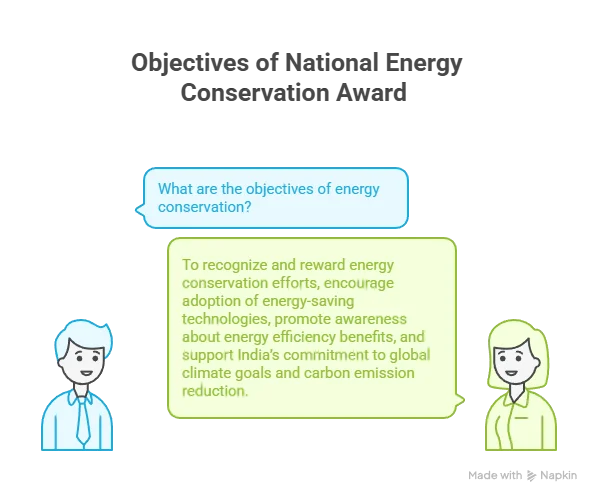
- Objectives:
Bureau of Energy Efficiency (BEE)
- About: BEE is a statutory body, established on 1st March 2002 under the Energy Conservation Act, 2001.
- Functions: BEE promotes energy efficiency in India through initiatives such as the
- Standards and Labeling (S&L) Programme.
- Perform, Achieve and Trade scheme (now replaced by the Carbon Credit Trading Scheme (CCTS), 2023).
- Demand Side Management (DSM) programmes, and
- Public awareness campaigns, in line with the Energy Conservation Act, 2001.
| Read More: Bureau of Energy Efficiency |


Rapid Fire
Illicit Cannabis Cultivation in Kandhamal
The verdant hills of Kandhamal district in Odisha have emerged as a major hotspot of illicit cannabis cultivation, drawing national attention due to record seizures in 2025.
- Policy Irony: Kandhamal is known for geographical indication (GI)-tagged Kandhamal turmeric, yet economic distress has pushed villagers towards illicit cultivation, underscoring gaps in inclusive rural development.
- Favourable Geography: The district’s remote, forested, hilly terrain, coupled with a climate suitable for cannabis, makes surveillance and access extremely difficult, aiding clandestine cultivation.
- Cannabis: Cannabis is a generic term used by the World Health Organization (WHO) for various psychoactive preparations derived from the plant Cannabis sativa.
- The major psychoactive constituent in cannabis is delta-9 tetrahydrocannabinol (THC). Compounds which are structurally similar to THC are referred to as cannabinoids.
- Cannabis grows best in moderate temperatures of 20–30°C, with humidity levels between 40–70% depending on the growth stage.
- Cannabis Growth in India: Found in Indo-Gangetic plains and Deccan region.
- Regulation of Cannabis: It is primarily governed by the Narcotic Drugs and Psychotropic Substances (NDPS) Act, 1985, which criminalises the cultivation, possession, sale, purchase, transport, and consumption of cannabis, especially its resin (charas) and flowering tops (ganja).
- The Act empowers the Central Government to permit the cultivation for industrial purposes, including fibre, seeds, oils, and horticultural uses.
- However, the Act excludes seeds and leaves when not accompanied by the tops, allowing states to regulate products like bhang through their own laws.
- Uttarakhand is the first state to legalize industrial cannabis cultivation (hemp).
- The UN removed cannabis from Schedule IV of the 1961 Single Convention on Narcotic Drugs, recognising its therapeutic potential, while retaining it in Schedule I for regulated medical use.
| Read more: Himachal Pradesh Contemplates Legalizing Cannabis Cultivation |


Rapid Fire
India Nears 100% Rail Electrification
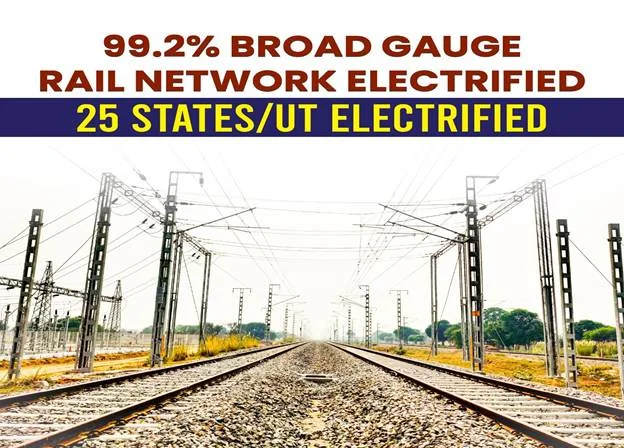
Indian Railways is close to completing the electrification of almost its entire broad-gauge network, with more than 99% already electrified, underlining India's rapid push toward sustainable, low-emission transport systems.
- Emission Reduction & Energy Efficiency: Near-total electrification has led to reduced diesel consumption, lower emissions, supporting Indian Railways’ goal of becoming a net-zero carbon emitter.
- Indian Railways aims to achieve net-zero by 2030, one of the earliest targets globally for a national railway system.
- Indian Railways is one of the largest electricity consumers in India, and a shift to electrification allows integration with renewable energy sources.
- Economic & Operational Benefits: Reduced operational costs due to lower maintenance and energy expenses.
- Enhanced average speed and reliability of services, improving logistics and freight operations.
- Electrification supports India’s goal of becoming a USD 5 trillion economy by ensuring faster goods movement.
- Global Significance: India's 99.2% electrification of its broad-gauge network across 25 states surpasses several advanced economies that still rely on diesel.
- The electrified route kilometres (RKM) added between 2019–2025 equals Germany's total rail network, showcasing India’s global leadership in green transport infrastructure.
| Read More: Electrification of Railways |


Rapid Fire
Annual Survey of Unincorporated Sector Enterprises (ASUSE) 2026
The Ministry of Statistics and Programme Implementation (MoSPI) has released the Draft Establishment Schedule (ESU) for the Annual Survey of Unincorporated Sector Enterprises (ASUSE) 2026 for public consultation.
Annual Survey of Unincorporated Sector Enterprises (ASUSE)
- About: ASUSE, a critical statistical tool, measures the operational and economic parameters of India’s vast unincorporated non-agricultural sector.
- The NSO has been conducting ASUSE annually since 2021–22.
- Comprehensive Data Coverage: ASUSE collects data on employment size, gross value added, emoluments, asset ownership, digital adoption (ICT usage), and loan status.
- It excludes agricultural and construction sectors, focusing on manufacturing, trade, and other services.
- Support for Policy Targets: The data aids key ministries like MSME, Textiles, and Labour in framing welfare schemes, credit access policies, and formalisation drives.
Unincorporated Non-Agricultural Sector
- Employment Contribution: The unincorporated sector employs a large share of India’s informal workforce, providing livelihoods to millions without formal contracts.
- As per previous NSSO surveys, over 90% of India's workforce is engaged in the informal sector, underscoring its socio-economic importance.
- Economic Linkages: These enterprises serve as suppliers of goods and services to the formal economy, supporting domestic value chains in manufacturing, trade, and services.
| Read More: Strengthening India's Statistical System |