Science & Technology
The New Nuclear Frontier in Space
For Prelims: Lunar Fission Surface Power Project, Small Nuclear Reactor, Voyager Spacecraft, Mars, Methane, Radioactive Materials, Outer Space Treaty, UN Committee on the Peaceful Uses of Outer Space (COPUOS), IAEA, 1972 Liability Convention.
For Mains: Various Nuclear Technologies for Space, their need, associated challenges and legal framework to govern them, Steps Needed to Secure a Responsible Nuclear Future in Space.
Why in News?
The United States has announced an ambitious plan under its Lunar Fission Surface Power Project to deploy a small nuclear reactor on the Moon by the early 2030s.
- This initiative is part of NASA's Artemis Base Camp strategy and marks the beginning of large-scale use of nuclear energy for off-Earth habitats. If executed, it will become the first permanent nuclear power source beyond Earth orbit,
How do Nuclear Technologies Shape the Future of Space Exploration?
- Evolving Radioisotope Thermoelectric Generators (RTGs): They convert heat from decaying plutonium-238 into electricity but produce only a few hundred watts—enough for instruments, not for human bases. It is currently in use (e.g., on Voyager spacecraft).
- Compact Fission Reactors: About the size of a shipping container, they can generate 10 to 100 kilowatts, capable of powering habitats and initial industrial units.
- Nuclear Thermal Propulsion (NTP): Nuclear Thermal Propulsion (like the US DRACO programme, testing by 2026) heats propellant for thrust, potentially shortening Mars trips by months.
- Nuclear Electric Propulsion (NEP): It uses reactor electricity to ionise propellant and provides years of stable, efficient thrust, ideal for deep-space probes and cargo transport.
Why is Nuclear Power Needed for Space-based Operations?
- Solar Limitations: A lunar night lasts about 14 Earth days, with temperatures dropping below –170°C, making solar power unreliable due to the need for massive battery arrays.
- On Mars, month-long dust storms reduce solar efficiency. NASA's developing KRUSTY system can provide up to 10 kilowatts of steady, reliable power.
- Reliability Problem: Human outposts must operate 24/7/365, requiring reliable power for life support, habitat heating, communication, and science & industry tasks like fuel production and manufacturing.
- A nuclear reactor offers a constant, predictable base-load power supply, unaffected by sunlight or weather.
- Location Flexibility Problem: With nuclear power, missions can operate anywhere, including permanently shadowed craters with water ice, explore diverse regions beyond sun-rich zones, and establish bases or robotic stations across the planet without dependence on sunlight.
- Scalability Problem: A small crew could manage with solar plus batteries, but larger crews, in-situ resource utilization (ISRU) plants, agriculture, and industrial projects require megawatt-level power. Only nuclear fission is a proven technology capable of scaling to meet these high energy demands in extraterrestrial environments.
- Mission Architecture Problem: Many Mars mission plans require fuel production on the surface, but processes like splitting water ice and reacting gases to make methane are highly energy-intensive. A reliable nuclear reactor can power this “gas station on Mars,” making missions safer and reducing fuel launched from Earth.
Current Legal Framework for Nuclear Power Use in Space
- Outer Space Treaty (OST) 1967: Article IV of the Outer Space Treaty (OST) 1967 bans countries from putting nuclear weapons or any weapons of mass destruction in Earth orbit, on the Moon, or anywhere in outer space.
- However, it allows the use of nuclear-powered equipment for peaceful space exploration.
- Principles Relevant to the Use of Nuclear Power Sources in Outer Space 1992: Adopted in 1992, the UN treaty ensures safe nuclear power use in space, requiring public safety assessments. Radioisotope generators may be used for interplanetary missions or stored in high Earth orbit after use, with proper disposal mandated.
What are the Legal and Environmental Challenges in Using Nuclear Power in Space?
- Irreversible Environmental Contamination: A reactor malfunction could cause permanent pollution of pristine extraterrestrial environments like the Moon or Mars, spreading radioactive materials that destroy unique scientific records of solar system history and compromise future habitability.
- The Safety Zone Dilemma: While logical for safety, establishing exclusion zones around nuclear sites creates a legal conflict. Unregulated zones could allow a single nation de facto control over resource-rich areas, violating the Outer Space Treaty’s prohibition on national appropriation and blocking access for others.
- Escalation to International Conflict: A nuclear incident in space has transboundary consequences—such as radioactive debris or perceived weaponization—that could damage diplomatic trust, trigger accusations, and lead to retaliatory measures, turning exploration cooperation into suspicion and conflict.
- Unregulated and Risky Testing: Without universally accepted safety standards, states or private entities may conduct experimental tests of powerful reactors or propulsion systems, leading to a “race to the bottom” in safety protocols and increasing the probability of accidents that endanger all spacefaring nations.
What can be done to Lead a Responsible Space Nuclear Framework?
- Strengthen the Core Legal Framework: The UN Committee on the Peaceful Uses of Outer Space (COPUOS) must modernize the 1992 Principles to expand scope to include nuclear thermal and electric propulsion and establish binding safety standards for design, operational safety, fuel integrity, and end-of-life disposal.
- Multilateral Oversight and Transparency: Form an International Technical Advisory Body (e.g., an International Space Nuclear Safety Group similar to the IAEA) to certify designs, verify compliance with safety protocols, for all nuclear systems in space.
- Specific Protocols for Critical Scenarios: Establish rules for temporary, non-discriminatory safety perimeters on celestial bodies that prevent sovereignty claims. Update 1972 Liability Convention for nuclear incidents in space with a clear responsibility and emergency response protocols for transboundary accidents.
- Foster Pre-emptive Norm-Setting: Major space powers like the US, Russia, China, and emerging actors like India should lead negotiations, showing that safety is a shared priority.
- Involve commercial space companies in rule-making to ensure regulatory certainty for key users.
- Ethical and Legal Standards: Ensure technological advancements are guided by coherent legal and ethical frameworks to prevent accidents with long-lasting environmental or geopolitical consequences.
Conclusion
The deployment of nuclear reactors in space promises reliable, scalable power for lunar and Martian missions, enabling life support, industrial operations, and propulsion technologies. However, without robust legal frameworks and multilateral oversight, the risks of contamination, conflict, and unsafe testing could undermine space exploration, making international cooperation and regulation essential.
|
Drishti Mains Question: Q. Discuss the strategic and technological significance of deploying nuclear fission reactors on the Moon. What are the associated environmental and legal challenges? |
Frequently Asked Questions (FAQs)
Q. What is the Lunar Fission Surface Power Project?
A US initiative to deploy a small nuclear reactor on the Moon by the early 2030s to provide continuous, reliable power for lunar operations.
Q. What are the main types of nuclear technology used in space?
RTGs for low-power instruments, Compact Fission Reactors for habitats, Nuclear Thermal Propulsion (NTP), and Nuclear Electric Propulsion (NEP) for spacecraft thrust.
Q. What are the key legal guidelines for using nuclear power in space?
The 1992 UN Principles and the Outer Space Treaty permit peaceful nuclear use but lack binding safety standards for modern systems like propulsion reactors.
Summary
- Solar power is insufficient for sustained lunar/Martian operations, necessitating compact fission reactors for reliable, scalable energy.
- The 1967 Outer Space Treaty allows nuclear power but the law is outdated, lacking binding safety standards, liability rules, and accident protocols.
- Major risks are radioactive contamination, territorial "safety zones," and international conflict from an incident.
- Urgent international governance is needed to create binding rules, a global oversight body, and clear safety zones.
UPSC Civil Services Examination, Previous Year Question (PYQ)
Prelims
Q. In India, why are some nuclear reactors kept under “IAEA safeguards” while others are not? (2020)
(a) Some use uranium and others use thorium
(b) Some use imported uranium and others use domestic supplies
(c) Some are operated by foreign enterprises and others are operated by domestic enterprises
(d) Some are State-owned and others are privately owned
Ans: (b)
Q. Consider the following statements: (2017)
- The Nuclear Security Summits are periodically held under the aegis of the United Nations.
- The International Panel on Fissile Materials is an organ of the International Atomic Energy Agency.
Which of the statements given above is/are correct?
(a) 1 only
(b) 2 only
(c) Both 1 and 2
(d) Neither 1 nor 2
Ans: (d)
Mains
Q. With growing energy needs should India keep on expanding its nuclear energy programme? Discuss the facts and fears associated with nuclear energy. (2018)
Q. Give an account of the growth and development of nuclear science and technology in India. What is the advantage of the fast breeder reactor programme in India? (2017)


Science & Technology
Bioremediation in India
For Prelims: Bioremediation, Biotechnology, Synthetic biology, Biosensing,
For Mains: Need for Bioremediation, Environmental Pollution & Degradation
Why in News?
India is revisiting bioremediation as pollution from sewage, industrial waste, pesticides, plastics, and oil spills continues to strain the country’s soil, water, and air. With traditional clean-up technologies proving costly and unsustainable, bioremediation is emerging as a promising, science-backed alternative.
What is Bioremediation?
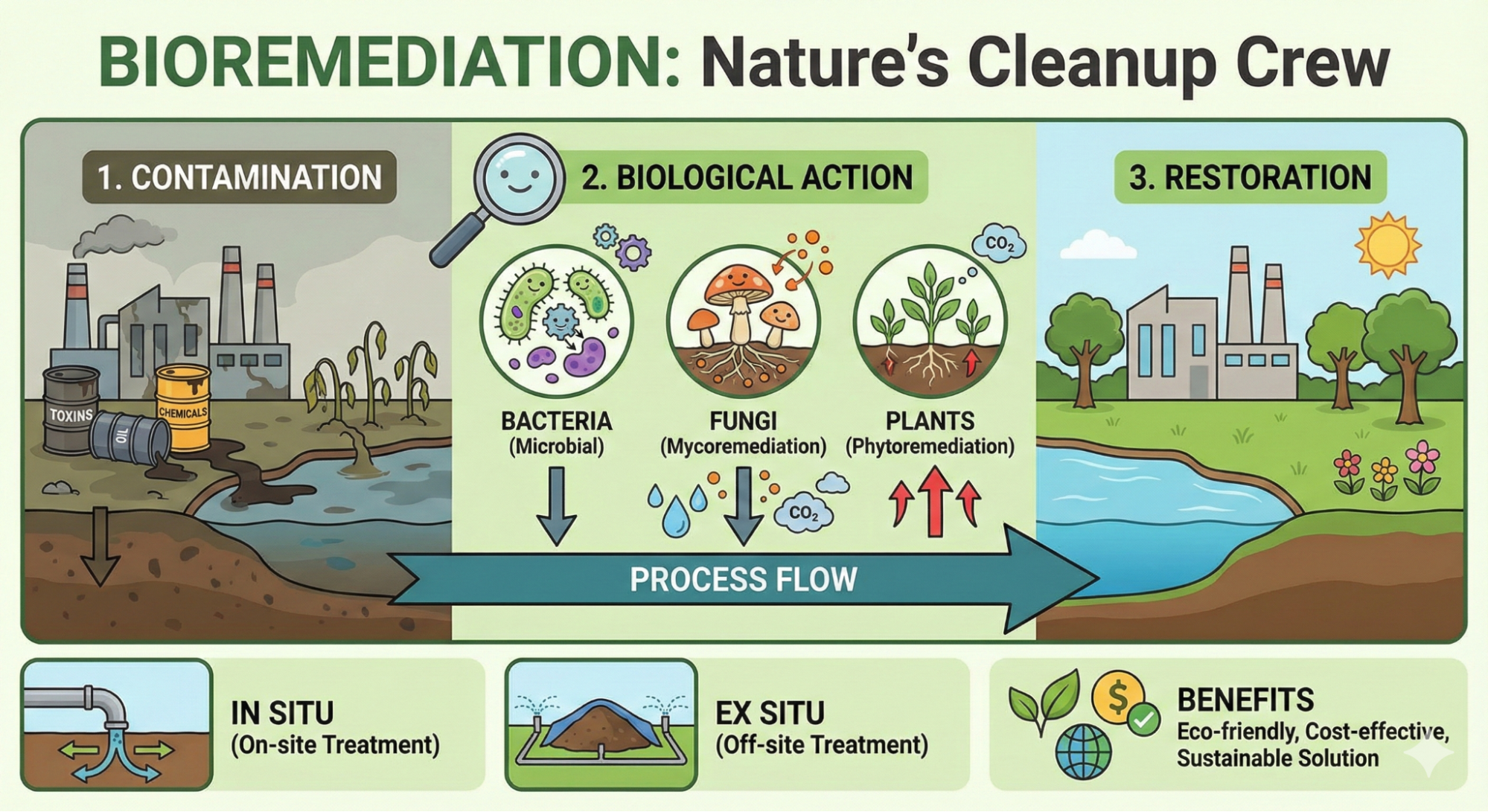
- About: Bioremediation is the use of living organisms (bacteria, fungi, algae, or plants) to break down or neutralise toxic pollutants.
- These organisms convert contaminants like oil, pesticides, plastics, and heavy metals into harmless end-products such as water, carbon dioxide, or organic acids.
- It is a cost-effective, eco-friendly method compared to chemical or mechanical clean-up technologies.
- Types:
- In situ bioremediation: Treatment takes place at the contaminated site itself.
- Example: oil-eating bacteria sprayed on an ocean spill.
- Ex situ bioremediation: Contaminated soil or water is excavated or pumped out, treated in a controlled facility, and returned after cleaning.
- In situ bioremediation: Treatment takes place at the contaminated site itself.
- Advancements in Bioremediation: Modern bioremediation combines traditional microbiology with biotechnology and synthetic biology.
- Genetically modified (GM) microbes are now designed to break down stubborn chemicals like plastics and oil residues.
- Synthetic biology enables “biosensing” organisms that change colour when they detect toxins, offering early contamination warnings.
- New biotechnologies help identify useful biomolecules and reproduce them under controlled conditions, allowing their use in settings like sewage plants or agricultural fields.
- Development of nanomaterials and microbes–nanocomposite systems are useful for faster pollutant capture.
- Bioremediation Status in India: Bioremediation is expanding in India but remains mostly in pilot stages.
- The Department of Biotechnology (DBT) supports projects through its Clean Technology Programme.
- IITs have developed cotton-based nanocomposites for oil spills and identified pollutant-degrading bacteria.
- Startups such as Econirmal Biotech now supply microbial formulations for soil and wastewater treatment.
Why Does India Need Bioremediation?
- Severe Pollution: Rapid industrialisation and urban growth continue to burden rivers like the Ganga and Yamuna, which receive thousands of liters per day of untreated sewage and industrial effluents every day.
- Multiple Contaminant Types: Widespread oil leaks, pesticide residues, and heavy-metal pollution degrade ecosystems, contaminate groundwater, and increase long-term public-health risks.
- Limitations of Traditional Clean-up: Mechanical and chemical remediation is expensive, energy-intensive, and often generates secondary pollution.
- Bioremediation provides a cheaper, sustainable, and decentralised solution—critical in a country where resources for environmental restoration are limited.
- Leverages India’s Rich Biodiversity: Indigenous microbial species, naturally adapted to high temperatures, salinity, acidity, and varied ecological conditions, consistently outperform imported strains, improving recovery efficiency.
- Suitable for large-scale contamination: India has extensive polluted stretches e.g., over 300 polluted river stretches identified by Central Pollution Control Board (CPCB) where biological clean-up is far more feasible than conventional methods.
- India's Technology Gaps: Large-scale adoption is limited by technical gaps like site-specific microbial knowledge and complex pollutants, as well as regulatory challenges, including the absence of uniform national standards.
International Practices in Bioremediation
- Japan: Uses microbial and plant-based systems as part of its urban waste management strategy.
- European Union: Funds cross-country bioremediation projects to clean oil spills and rehabilitate mining-affected areas.
- China: Prioritises bioremediation under its soil pollution control laws, deploying genetically improved bacteria to restore contaminated industrial sites.
What are the Opportunities and Risks of Bioremediation for India?
|
Opportunities |
Risks |
|
Helps restore polluted rivers, lakes, and wetlands |
Release of genetically modified organisms may cause unintended ecological impacts |
|
Enables reclamation of contaminated land and industrial sites |
Inadequate testing or poor containment can worsen pollution problems |
|
Creates jobs in biotechnology, environmental consulting, and waste management |
Lack of public awareness may lead to resistance or misuse of new technologies |
|
Supports national missions like Swachh Bharat, Namami Gange and National Clean Air Programme, ensuring long-term ecological restoration. |
Weak monitoring systems and absence of strong biosafety guidelines and certification systems can limit safety and effectiveness |
How Can India Scale Bioremediation Effectively?
- Develop national guidelines for bioremediation and biomining protocols and microbial applications with input from DBT, CPCB, and State Pollution Control Boards.
- Biomining is the process of using microorganisms to extract metals of economic interest from rock ores or mine waste.
- Create regional bioremediation hubs linking universities, industries, and local bodies.
- Support startups and community projects through DBT–BIRAC.
- Strengthen biosafety norms for GM organisms, expand certification and training for field-level staff, and adopt real-time monitoring through biosensors and digital dashboards to track advances in bioremediation.
- Improve public engagement to build trust and awareness about microbial solutions.
Conclusion
Bioremediation offers India a sustainable and affordable pathway to restore polluted ecosystems while supporting SDG 6 (Clean Water) and SDG 13 (Climate Action). With strong standards, skilled manpower, and public trust, it can become a key pillar of long-term environmental recovery.
|
Drishti Mains Question: Q. Bioremediation can reduce remediation costs and environmental footprints compared to conventional methods. Discuss |
Frequently Asked Questions (FAQs)
1. What is bioremediation?
Bioremediation is the use of living organisms (microbes, fungi, algae, plants) to degrade or neutralise pollutants like oil, pesticides, plastics and heavy metals into harmless products.
2. How does bioremediation support national missions like Namami Gange?
Bioremediation offers decentralised, low-cost treatment for sewage and organic pollution, complementing infrastructure upgrades under Namami Gange and Swachh Bharat to restore river health.
3. What are the main risks of bioremediation?
Risks include unintended ecological impacts from genetically modified organisms, inadequate testing, poor containment, and weak monitoring — necessitating strict biosafety guidelines and certification.
Summary
- Bioremediation uses microbes and biotech to safely break down pollutants, offering a cheaper and greener alternative to conventional clean-up methods.
- India needs it due to severe river, soil and groundwater pollution, with 300+ polluted stretches identified by CPCB and rising industrial waste.
- India’s efforts are growing through DBT, IITs and startups, though adoption is slowed by technical gaps and lack of national standards.
- Strong biosafety rules, regional hubs, and public awareness are essential to scale bioremediation and support missions like Swachh Bharat and Namami Gange
UPSC Civil Services Examination, Previous Year Questions (PYQs)
PrelimsQ. In the context of solving pollution problems, what is/are the advantage/advantages of bioremediation techniques? (UPSC Prelims 2017)
- It is a technique for cleaning up pollution by enhancing the same biodegradation process that occurs in nature.
- Any contaminant with heavy metals such as cadmium and lead can be readily and completely treated by bioremediation using microorganisms
- Genetic engineering can be used to create microorganisms specifically designed for bioremediation
Select the correct answer using the codes given below
(a) 1 only
(b) 2 and 3 only
(c) 1 and 3 only
(d) 1, 2 and
Ans. (c)


Facts for UPSC Mains
Indian Maritime Doctrine 2025
Why in News?
The Chief of the Naval Staff released the Indian Maritime Doctrine 2025 on India Navy Day, aligning it with India’s long-term strategic vision and maritime priorities.
Note: Indian Navy Day is celebrated on 4th December every year to honor the efforts & role of the Indian Navy in Operation Trident conducted during the Indo-Pakistan war in 1971.
- Under Operation Trident, the Indian Navy launched a surprise attack on Karachi harbour, crippling the centre of Pakistan’s maritime operations.
- It was carried out using three Vidyut-class missile boats INS Nipat, Nirghat and Veer supported by corvettes INS Kiltan, INS Katchall and the fleet tanker INS Poshak.
- Indian Navy Day 2025 Theme: Combat Ready, Cohesive, Credible and Aatmanirbhar Force — safeguarding the seas for a Viksit, Samriddha Bharat.
What is Indian Maritime Doctrine 2025?
- About: The Indian Maritime Doctrine 2025 is the Navy’s apex guidance document that defines how India plans, prepares, and operates across the entire maritime conflict spectrum.
- It outlines the Navy’s strategic principles, roles, force employment, capability development, and its approach to emerging maritime challenges
- First issued in 2004 and updated in 2009 and 2015, the 2025 edition reflects major changes in India’s maritime environment and strategic outlook over the past decade.
- Key Highlights of 2025 Edition: Formally recognises “no-war, no-peace” as a distinct operational category, acknowledging the grey zone between peace and conflict as a critical space where contemporary maritime competition increasingly occurs.
- The doctrine prioritises jointness and interoperability among the three services to support theaterisation.
- Integrates lessons on grey-zone, hybrid, and irregular warfare, and multi-domain threats.
- The doctrine emphasises emerging domains like space, cyber, and cognitive warfare.
- Promotes adoption of uncrewed systems, autonomous platforms, and advanced technologies.
- Significance: The doctrine promotes a maritime-conscious nation that recognises the strategic importance of the oceans and positions maritime power as a key pillar of Viksit Bharat 2047.
- It aligns with major national initiatives such as Sagarmala, PM Gati Shakti, Maritime India Vision 2030, Maritime Amrit Kaal Vision 2047 and MAHASAGAR, while reflecting India’s shift toward a more proactive maritime posture in the Indo-Pacific.
- The document also supports tri-service joint doctrines (Special Forces, Airborne/Heliborne and Multi-Domain Operations) to strengthen interoperability and integrated operations.
- It emphasises a coherent maritime strategy that supports economic growth, infrastructure expansion and blue economy development.
History of the Indian Navy
- Ancient Maritime Roots: India’s maritime tradition dates back over 4,000 years, with ancient civilisations like Harappa, Mohenjodaro and Lothal engaged in extensive sea trade with Africa, Arabia and Mesopotamia.
- By the 4th century BCE, India had advanced riverine and oceanic navigation; the word “navigation” comes from the Sanskrit Navagati.
- Indian traders, along with Hindu and Buddhist scholars, carried culture to Southeast Asia by the 1st century CE, shaping the region’s religious and cultural landscape.
- Medieval Maritime Power: Medieval Indian powers, including the Cholas, Zamorins and Marathas (Magadh navy), developed strong naval forces.
- The Maratha Navy under Kanhoji Angre challenged European powers along India’s west coast.
- European Naval Dominance: European arrival began with Vasco da Gama in 1498, introducing powerful blue-water navies (Portuguese, Dutch, British, French) that eventually dominated Indian waters.
- Rise of the Modern Indian Navy: The modern Indian Navy traces its roots to the Royal Indian Navy (RIN), established during British rule.
- Following India's Republic status, the Navy dropped the "Royal" prefix and was renamed the Indian Navy.
- Leadership and Motto: The Indian Navy is headed by the President of India, who serves as its Supreme Commander.
- Its motto is “Sam No Varunah”, meaning may the god of the waters, Varuna, be auspicious to us.
- Role and Capabilities: Today, the Indian Navy is a multi-dimensional, blue-water force, focusing on maritime security, power projection, and safeguarding India’s interests across the Indo-Pacific.
- MARCOS (Marine Commandos) are the Navy’s elite special forces, trained for amphibious warfare, counter-terrorism, special reconnaissance, hostage rescue, and asymmetric operations.
- Operations: The Navy expanded its capabilities post-independence, playing major roles in conflicts such as the 1961 liberation of Goa, 1971 Indo-Pak War (Operation Trident & Python) and modern maritime security operations.
|
Drishti Mains Question: The Indian Maritime Doctrine 2025 marks a shift from a platform-centric to a strategy-driven Navy. Discuss. |
Frequently Asked Questions (FAQs)
Q. What is the Indian Maritime Doctrine 2025?
It is the Indian Navy’s apex guidance document outlining strategic principles, force employment, capability development and operational roles across the full maritime conflict spectrum.
Q. Which national initiatives are aligned with IMD-2025?
The doctrine aligns with Sagarmala, PM Gati Shakti, Maritime India Vision 2030, Maritime Amrit Kaal Vision 2047 and MAHASAGAR.
Q. What modern threat domains are emphasised in IMD-2025?
It highlights grey-zone warfare, hybrid warfare, irregular threats, space, cyber and cognitive domains.
Q. Why is 4 December celebrated as Navy Day?
It commemorates Operation Trident (1971), when the Indian Navy launched a successful missile-boat attack on Karachi harbour.
Summary
- The Indian Navy released the Indian Maritime Doctrine 2025 on Navy Day, aligning naval strategy with long-term national priorities and formally recognising “no-war, no-peace” as a key operational category.
- The doctrine emphasises jointness, multi-domain preparedness, and adoption of emerging technologies to support future theatre commands.
- It aligns with national initiatives like Sagarmala, PM Gati Shakti, Maritime India Vision 2030 and Viksit Bharat 2047, reinforcing India’s proactive maritime posture.
UPSC Civil Services Examination, Previous Year Questions (PYQs)
Prelims
Q. Consider the following in respect of Indian Ocean Naval Symposium (IONS): (2017)
- Inaugural IONS was held in India in 2015 under the chairmanship of the Indian Navy.
- IONS is a voluntary initiative that seeks to increase maritime co-operation among navies of the littoral states of the Indian Ocean Region.
Which of the above statements is/are correct?
(a) 1 only
(b) 2 only
(c) Both 1 and 2
(d) Neither 1 nor 2
Ans: (b)
Q. Which one of the following is the best description of ‘INS Astradharini’, that was in the news recently? (2016)
(a) Amphibious warfare ship
(b) Nuclear-powered submarine
(c) Torpedo launch and recovery vessel
(d) Nuclear-powered aircraft carrier
Ans: (c)

Important Facts For Prelims
Fully Accessible Route (FAR) Bonds
Why in News?
Foreign portfolio investment (FPI) through Fully Accessible Route (FAR) eligible bonds stood at Rs 5,760 crore in November, drawing attention to India’s debt market and the factors influencing FPI participation.
What is a Fully Accessible Route (FAR)?
- About: The FAR is an Reserve Bank of India (RBI) framework introduced in 2020 that allows unrestricted foreign investment in select Government of India securities known as FAR Bonds.
- Key Features:
- No Investment Limits: Under FAR, Foreign Portfolio Investors (FPIs), Non-Resident Indians, Overseas Citizens of India and other eligible entities can invest in these government securities without quantitative caps.
- Open Access: These bonds offer free buy–sell access, making them more attractive for global investors.
- Significance: FAR bonds are crucial for making India’s debt market more competitive and internationally visible.
- In 2024, JP Morgan added 29 Indian FAR-designated G-secs to its Emerging Market Bond Index (EMBI), marking India’s first entry into a major global bond benchmark.
- This inclusion is expected to attract significant foreign inflows into Indian government bonds.
Other Routes for Foreign Investment in Indian Debt
- General Route (GR): The standard route FPIs use to invest in corporate bonds. It is subject to quantitative limits, unlike FAR.
- Voluntary Retention Route (VRR): It is a special RBI framework that allows FPIs to invest in Indian debt with fewer regulatory restrictions, provided they voluntarily commit to retain a minimum share of their investments in India for a fixed period.
Foreign Portfolio Investment (FPI)
- Foreign Portfolio Investment (FPI): It refers to foreign investment in a country’s financial assets such as stocks and bonds, without taking control of a business.
- It is passive, short-term in nature, and aimed at capital gains and diversification.
- FPIs improve market liquidity and reflect investor confidence.
- In India, an FPI can hold up to 10% of a company’s shares without being treated as Foreign Direct Investment (FDI).
- Factors Influencing FPI Participation in India:
- Interest Rate Differential: Higher Indian bond yields compared to other emerging markets make Indian assets more attractive.
- Exchange Rate Stability: A stable or appreciating rupee supports FPI inflows, while sharp depreciation triggers outflows.
- Monetary Policy Expectations: Anticipation of RBI rate cuts, Open Market Operations (OMOs), or liquidity support shapes investor sentiment.
- Sovereign Ratings & Index Inclusion: India’s potential inclusion in major global bond indices (like Bloomberg Global Aggregate Index) encourages early, front-loaded inflows.
- Regulatory Environment: Liberal policies such as the FAR improve ease of investment and repatriation.

Frequently Asked Questions (FAQs)
1. What are FAR Bonds?
FAR Bonds are Government of India securities designated under the Fully Accessible Route (FAR) (RBI, 2020) that permit unrestricted foreign investment with no quantitative caps, improving market access and repatriation ease.
2. How do FAR bonds affect FPI inflows?
FAR makes Indian G-secs more attractive to global investors and index funds, raising inflows and bond-market liquidity.
3. What is the Voluntary Retention Route (VRR)?
VRR is an RBI scheme that invites FPIs to commit to retaining a stipulated share of investment for a fixed period (encouraging long-term flows) in exchange for relaxed regulatory norms
Summary
- The Fully Accessible Route (FAR), introduced by the RBI in 2020, allows unrestricted foreign investment in select Government of India securities.
- FAR bonds have boosted India’s global debt visibility, with JP Morgan including 29 FAR-designated G-secs in its Emerging Market Bond Index in 2024.
- FPIs are influenced by factors like interest rate differentials, rupee stability, monetary policy expectations, and global index inclusion.
- FAR, along with routes like GR and VRR, is helping attract stronger foreign participation and deepen India’s debt market.
UPSC Civil Services Examination, Previous Year Questions (PYQ)
Prelims
Q. Which one of the following groups of items is included in India’s foreign-exchange reserves? (2013)
(a) Foreign-currency assets, Special Drawing Rights (SDRs) and loans from foreign countries
(b) Foreign-currency assets, gold holdings of the RBI and SDRs
(c) Foreign-currency assets, loans from the World Bank and SDRs
(d) Foreign-currency assets, gold holdings of the RBI and loans from the World Bank.
Ans: (b)
Q. With reference to Foreign Direct Investment in India, which one of the following is considered its major characteristic? (2020)
(a) It is the investment through capital instruments essentially in a listed company.
(b) It is a largely non-debt creating capital flow.
(c) It is an investment which involves debt-servicing.
(d) It is the investment made by foreign institutional investors in the Government securities.
Ans: (b)


Important Facts For Prelims
ANEEL Fuel for Thorium-based Reactors
Why in News?
US‑based Clean Core Thorium Energy (CCTE) aims to bring a new thorium‑based nuclear fuel called Advanced Nuclear Energy for Enriched Life (ANEEL) to India’s reactors as a next-generation fuel suitable for India’s Pressurized Heavy Water Reactors (PHWRs).
What is Advanced Nuclear Energy for Enriched Life (ANEEL)?
- About: It is a unique blend of thorium and a small amount of enriched uranium (High Assay Low Enriched Uranium). It is specifically designed to power India's fleet of PHWRs and currently in the advanced stages of testing in the US.
- The fuel is named to honor Dr. Anil Kakodkar, one of India’s foremost nuclear scientists.
- Target Reactor: Designed as a drop-in fuel for PHWRs (like India’s indigenous reactors), it can operate within existing systems with only minimal adjustments.
- India currently has 22 operating reactors, 18 are PHWRs and 4 are Light Water Reactors (LWRs). Additionally, India is constructing 10 new PHWRs, each rated at 700 MW.
- Significance of ANEEL: The Levelized Cost of Electricity (LCOE) from India's natural uranium reactors is about Rs 6/kWh, and ANEEL fuel could cut this by 20–30%, boosting nuclear power competitiveness.
- It offers higher efficiency, better fuel performance, over 85% less nuclear waste, and uses thorium, which is abundantly available.
- Conditions Favouring ANEEL:
- Government Push: The 2024 budget outlined plans to partner with the private sector to develop Bharat Small Reactors (BSRs) and new nuclear technologies.
- Rising Demand: Nuclear capacity is projected to grow from 8.2 GW to 22 GW by 2032, creating huge demand for advanced fuel like ANEEL.
- Industrial Decarbonization: BSRs are envisioned to provide clean power for industries like steel, cement, and fertilizers.
- Powering New-Age Infrastructure: The boom in data centers and AI requires vast, reliable clean power, which small nuclear reactors can supply.
- Renewed Indo-US nuclear cooperation: A major obstacle in Indo-US nuclear cooperation was India’s Civil Liability for Nuclear Damage Act (2010), which held equipment suppliers responsible for accidents.
- CCTE says this is not a problem because it only supplies fuel technology, not reactors, and the fuel will be managed by India’s Department of Atomic Energy.
What is a Thorium-based Nuclear Reactor?
- About: It is a type of nuclear reactor that uses thorium (Th-232) as its primary fertile fuel material, as opposed to the conventional use of uranium (U-235) or plutonium (Pu-239).
- Thorium itself is not fissile (cannot sustain a chain reaction on its own), so it must be combined with a fissile "driver" material (like U-235, U-233, or plutonium) to initiate and sustain the nuclear reaction.
- Advantages:
- Abundance: Thorium is 3–4 times more abundant than uranium and widely available in India, Australia, and the USA.
- Energy Density: CERN notes that one ton of thorium can yield energy equivalent to 200 tons of enriched uranium while generating 100 times less nuclear waste.
- Inherent Safety Features: Thorium designs like Molten Salt Reactors (MSRs) operate at atmospheric pressure and use passive safety systems—e.g., a frozen salt plug melts during overheating, draining fuel into a cooling tank and stopping the reaction.
- Proliferation Resistance: The thorium cycle produces less long-lived weapon-grade transuranic waste; U-233 is contaminated with U-232, whose strong gamma radiation makes it detectable and hard to handle.
- India's Special Interest: India holds around 25% of the world’s thorium reserves and has a 3-stage nuclear program where thorium is a key component, aimed at achieving long-term energy independence.
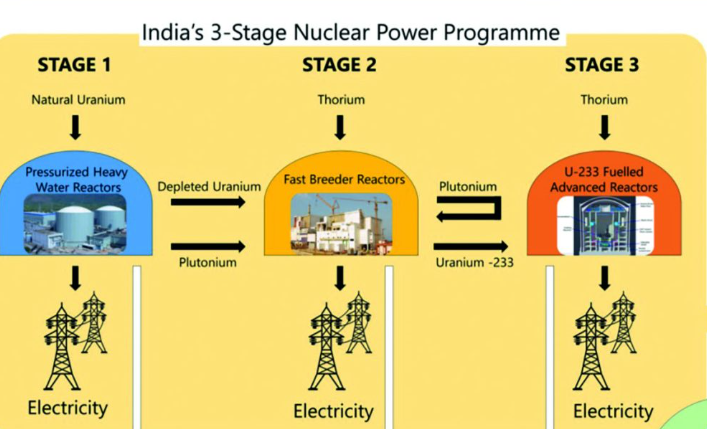
India's 3-Stage Nuclear Power Program
- About: It is a strategy to develop nuclear energy by efficiently using India’s limited uranium and abundant thorium.
- Formulated by Dr. Homi Bhabha in the 1950s, it aims to meet India’s long-term energy needs and ensure self-reliance.
- 3-Stages: The strategy uses different reactors to transition to thorium-based power.
- Stage I: PHWRs use natural uranium (U-238) with heavy water; spent fuel is reprocessed to obtain plutonium.
- Stage II: Fast Breeder Reactors (FBRs) use plutonium from Stage I and breed U-233 from thorium.
- Stage III: Thorium-based reactors use U-233 and thorium, aiming to make U-233 India’s primary nuclear fuel.
Frequently Asked Questions (FAQs)
Q. What is ANEEL fuel?
ANEEL fuel is a thorium-enriched uranium fuel designed for India’s PHWRs, enhancing efficiency, safety, and reducing nuclear waste by over 85%.
Q. How does ANEEL fuel reduce electricity costs?
By increasing fuel efficiency and reducing waste, ANEEL can cut the Levelized Cost of Electricity (LCOE) from ₹6/kWh to ₹4.2–4.8/kWh.
Q. What is India’s 3-stage nuclear program?
A strategic roadmap using PHWRs, Fast Breeder Reactors, and thorium-based reactors to transition from uranium to thorium and ensure long-term energy security.
Summary
- The ANEEL fuel, a blend of thorium and enriched uranium, can reduce power costs by 20–30% and cut waste by over 85% in India's existing PHWRs.
- It serves as a crucial bridging technology for India's three-stage nuclear program, enabling early thorium use to progress towards the ultimate goal of sustainable thorium-based reactors.
- This Indo-US collaboration gains traction from renewed diplomatic efforts and India's policy push for private sector involvement in Bharat Small Reactors (BSRs) for industrial decarbonization.
- Leveraging India's vast thorium reserves, ANEEL aligns with the national strategy for energy security and clean, baseload power to meet rising demands from industries and new-age infrastructure like data centers.
UPSC Civil Services Examination, Previous Year Questions (PYQs)
Q. In India, why are some nuclear reactors kept under “IAEA safeguards” while others are not? (2020)
(a) Some use uranium and others use thorium
(b) Some use imported uranium and others use domestic supplies
(c) Some are operated by foreign enterprises and others are operated by domestic enterprises
(d) Some are State-owned and others are privately owned
Ans: (b)
Q. In the Indian context, what is the implication of ratifying the ‘Additional Protocol’ with the ‘International Atomic Energy Agency (IAEA)’?(2018)
(a) The civilian nuclear reactors come under IAEA safeguards.
(b) The military nuclear installations come under the inspection of IAEA.
(c) The country will have the privilege to buy uranium from the Nuclear Suppliers Group (NSG).
(d) The country automatically becomes a member of the NSG.
Ans: (a)

Rapid Fire
8th Economic Census (EC) in 2027
India will carry out its 8th Economic Census (EC) in 2027, following the two-phase Population Census (2026–27).
- Economic Census (EC): It is the complete count of all establishments (i.e. units engaged in production and/or distribution of goods and services not for the purpose of sole consumption) located within the geographical boundaries of the country.
- The first EC was held in 1977. EC is conducted nationwide by the Ministry of Statistics & Programme Implementation (MOSPI), National Statistics Office in collaboration with the Directorates of Economics and Statistics (DES) of all States and Union Territories.
- Data from 8th EC will be used to create the Statistical Business Register (SBR), a unified database mapping all enterprises across states.
- The SBR will help track whether enterprises are active or closed, improving the accuracy of national economic statistics.
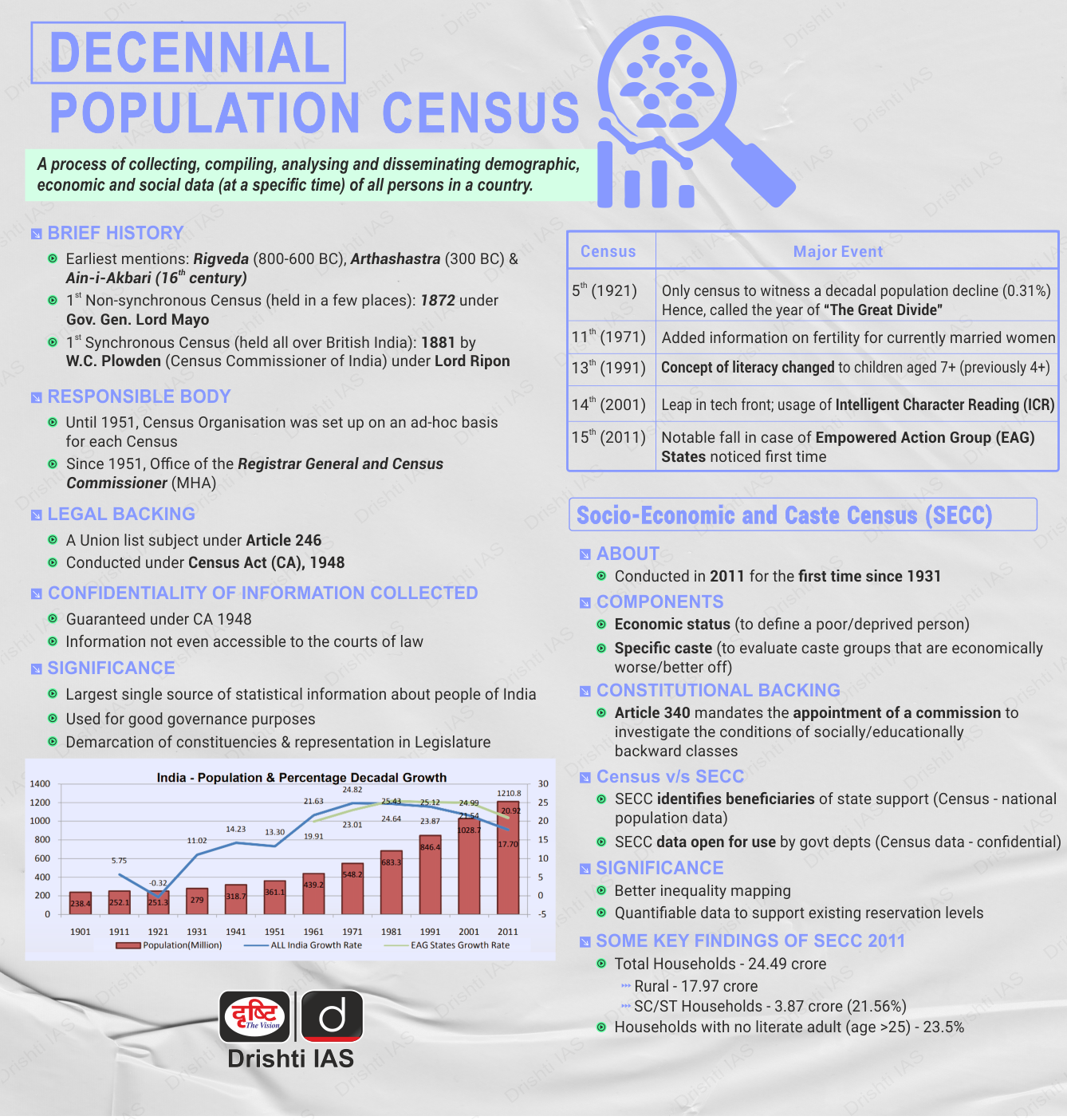
- Population Census: The Census is the largest source of primary data at the village, town and ward level, offering detailed information on housing, amenities, demography, religion, SC/ST, language, literacy, education, economic activity, migration, and fertility.
-
It is conducted under the legal framework of the Census Act, 1948 and the Census Rules, 1990.
- The Census organisation is headed by the Registrar General of India and Census Commissioner of India.
- The 2027 Census will be India’s 16th decennial Census since the first nationwide Census in 1872.
-
| Read more: Census in India |


Rapid Fire
Samagra Shiksha
The Union government has clarified that States will receive pending Samagra Shiksha funds only after meeting all scheme conditions, including utilisation certificates, audit reports, progress details, State share contributions, and compliance with National Education Policy (NEP) 2020.
- Samagra Shiksha: Announced in the 2018–19 Union Budget, it is a unified programme covering pre-school to Class 12.
- It aims to improve school effectiveness by ensuring universal access, equal opportunities, and better learning outcomes.
- It merges the earlier Schemes of Sarva Shiksha Abhiyan (SSA), Rashtriya Madhyamik Shiksha Abhiyan (RMSA) and Teacher Education (TE) into a single integrated framework for holistic school education.
- It is implemented as a Centrally Sponsored Scheme by the Department of School Education and Literacy (DoSEL).
- Funding follows a 90:10 pattern for Northeastern and Himalayan States, 60:40 for other States with legislatures, and 100% central funding for UTs without legislatures.
- Objectives: The scheme focuses on improving quality education and learning outcomes, reducing social and gender gaps, and ensuring equity and inclusion across all levels of schooling.
- It aims to maintain minimum standards, promote vocational education, and support states in implementing the Right of Children to Free and Compulsory Education (RTE) Act, 2009.
- Vision and Alignment with SDGs: Samagra Shiksha treats the school as a continuum from pre-school to higher secondary.
- It aligns with Sustainable Development Goal (SDG) 4.1 (free, equitable, quality primary and secondary education) and SDG 4.5 (removing gender disparities and ensuring access for vulnerable groups).
| Read more: NEP 2020 and Samagra Shiksha Abhiyan |


Rapid Fire
‘Seva Teerth’
The Union Home Minister referred to the upcoming new Prime Minister’s Office (PMO) in the Central Vista complex as “Seva Teerth”, calling it a landmark in India’s administrative evolution.
- The term signifies a shift towards citizen-centric governance rooted in service, aligning with the broader ethos of Seva (service) in Indian political philosophy.
- Seva Teerth’ Symbolise:
- Spiritual-Administrative Fusion: The term ‘Teerth’, traditionally denoting pilgrimage sites, reinforces the Gandhian ideal of public office as a form of service, not privilege.
- Reinforces the view of administrative spaces as citizen-centric, not aloof bureaucratic enclaves.
- Symbolic Governance: Echoes the principle of “Minimum Government, Maximum Governance”. Projects the PMO as a space of accountability, transparency, and citizen responsiveness.
- Spiritual-Administrative Fusion: The term ‘Teerth’, traditionally denoting pilgrimage sites, reinforces the Gandhian ideal of public office as a form of service, not privilege.
- Central Vista Project: The revamped PMO is part of the broader Central Vista redevelopment project.
- Inaugurated in 1931, Central Vista comprised Rashtrapati Bhavan, North and South Blocks, new Parliament House, the National Archives, India Gate, and the civic gardens along kartavya path.
- Central Vista redevelopment aims to enhance administrative efficiency, sustainability, and public spaces in New Delhi.
| Read More: Kartavya Path |


Rapid Fire
Tariff Cover Hits One‑Fifth of Imports: WTO
World Trade Organisation reported that imports worth USD 2,640 billion (11.1% of global imports) were affected by tariffs and other trade-restrictive measures between mid-October 2024 and mid-2025.
- Factors Driving the Surge in Tariffs:
- Rising Protectionism: Sharp increase in tariff coverage reflects protectionist measures by major economies.
- Trade Tensions & Unilateral Actions: Some countries imposed tariffs up to 50%, affecting global trade.
- Supply-Chain Disruptions: With supply‑chain disruptions and security‑related import restrictions (e.g., on strategic materials), many countries, particularly major economies, have raised tariff barriers, leading to a broad impact across sectors.
- Impact on India:
- Exports: Higher tariffs make Indian goods costlier, affecting sectors like textiles, engineering, chemicals.
- Trade Balance: Slower export growth may widen trade deficit.
- Supply Chains: Tariffs on raw materials and technology increase production costs, impacting electronics, pharma, and machinery.
- Tariffs: A tariff is a tax imposed by one country on the goods and services imported from another country to influence it, raise revenues, or protect competitive advantages.

World Trade Organization (WTO)
- WTO is an international institution formed to regulate the rules for global trade among nations.
- It was formed under the Marrakesh Agreement signed on 15th April 1994 by 123 countries after the Uruguay Round negotiations (1986-94) of the General Agreement on Tariffs and Trade (GATT), leading to the birth of WTO in 1995.
- WTO succeeded the GATT which had regulated world trade since 1948.
- Promotes free and fair trade, reduces tariff & non-tariff barriers, settles disputes.
- Has 166 members, covering 98% of global trade.
- Headquarters: Geneva, Switzerland.
| Read More: US Tariff on Indian Imports |