Governance
SC Directions on ‘Digital-Arrest’ Scams
For Prelims: Central Bureau of Investigation, Digital Arrest, Machine Learning and Artificial Intelligence, Indian Cybercrime Coordination Centre
For Mains: Challenges of Rising Digital Tradecraft, Challenges to Internal Security Through Communication Networks, Cyber security
Why in News?
The Supreme Court of India has given the Central Bureau of Investigation (CBI) a free hand to investigate ‘digital arrest’ scams nationwide, after the Union government reported that fraudsters had siphoned off about Rs 3,000 crore, largely from senior citizens.
What are the Supreme Court Directions on Digital Arrest Scams?
- Fast- Track Digital Arrest Cases: CBI authorised to investigate digital arrest first, followed by fraudulent investment and part-time job scams.
- SC directed all concerned states to grant consent under Delhi Special Police Establishment (DSPE) Act, 1946 to enable CBI jurisdiction.
- SC asked the CBI to work with INTERPOL to identify offshore cybercrime networks.
- Financial Tracking: SC issued notice to the Reserve Bank of India (RBI) to explore use of Machine Learning and Artificial Intelligence tools for detecting money “layering” across multiple bank accounts.
- Intermediary Compliance: Ordered digital platforms to cooperate under Information Technology (Intermediary Guidelines and Digital Media Ethics Code) Rules of 2021, and provide necessary data to investigators.
- Institutional Strengthening: Directed states/UTs to operationalise regional cybercrime coordination centres and integrate them with Indian Cybercrime Coordination Centre (I4C).
- Telecom Accountability: Asked the Telecom Department to propose measures for strict SIM issuance norms and better Know Your Customer (KYC) verification.
What is Digital Arrest?
- About: Digital arrest is a cyber scam in which fraudsters impersonate law-enforcement agencies to extort money by creating fear and urgency.
- Scammers contact victims, falsely link them to criminal cases, and threaten arrest or freezing of bank accounts using spoofed numbers and fake documents.
- They exploit this fear to pressure victims into paying a fake fine or security deposit to avoid the fabricated legal action.
- Menace of Digital Arrest: As of 2024, I4C has blocked over 59,000 WhatsApp accounts linked to digital arrests.
What are the Challenges in Curtailing Digital-Arrest Scams?
- Advanced Digital Tradecraft: Scammers use sophisticated digital tradecraft (spoofed numbers, deepfakes, fake documents, and encrypted apps) making detection and attribution difficult.
- Powerful Social Engineering: Fraudsters exploit fear, urgency, and impersonation of agencies like CBI or ED, especially targeting senior citizens and low-awareness users.
- Weak Cybersecurity Practices: Poor password hygiene, outdated software, and unsafe device use make it easier for scammers to access personal data and impersonate victims.
- Rise of Digital Payments: Widespread use of Unified Payments Interface, Quick Response (QR) codes, and online banking has expanded avenues for fraud, enabling fake payment alerts, SIM swaps, and investment scams.
- Dark Web–Driven Crime Networks: Organised groups access stolen data, malware kits, and ransomware-as-a-service on the dark web, making scams more sophisticated and coordinated.
- Weak Laws & Enforcement Gaps: Slow investigations, limited cyber policing capacity, and cross-border jurisdiction issues allow scammers to operate with low risk and high reward.
- Rapidly Evolving Cybercrime Techniques: Fraudsters constantly upgrade their tools—spoofed numbers, deepfakes, and AI-generated documents—to bypass security checks.
- Slow Reporting & Stigma: Many victims hesitate to report due to embarrassment or fear, allowing scammers to operate undetected.
What are India's Initiatives to Tackle Digital Arrest?
- Indian Cyber Crime Coordination Centre (I4C): The I4C set up by the Ministry of Home Affairs to coordinate national cybercrime response, capacity building, monitoring, and intelligence sharing.
- National Cyber Crime Reporting Portal: Enables citizens to report cybercrimes online, cases are forwarded to respective State/UT police for action.
- Citizen Financial Cyber Fraud Reporting System (Helpline 1930): Allows immediate reporting of financial frauds.
- Anti-Spoofing Measures: Department of Telecommunications (DoT) and telecom operators now identify and block international spoofed calls appearing as Indian numbers—frequently used in digital-arrest, FedEx, and impersonation scams.
- Digital Safety Awareness: Government spreads awareness about digital arrests through SMS alerts, CyberDost social media platforms, and digital displays at airports and railway stations.
Conclusion
Digital-arrest scams show how rapidly cybercrime is evolving and why stronger enforcement and public awareness are essential. With coordinated action from the CBI, states, and I4C, India can better protect citizens and strengthen its digital security ecosystem.
|
Drishti Mains Question: What is Digital Arrest? Explain how it works and why it is rising in India. |
Frequently Asked Questions (FAQs)
Q. What is a “digital-arrest” scam?
Digital-arrest is a cyber fraud where scammers impersonate law-enforcement agencies to coerce victims into paying “fines” or “security deposits” by threatening arrest, account freezes, or passport cancellation.
Q. What is I4C and how does it help?
The Indian Cyber Crime Coordination Centre (I4C) (Ministry of Home Affairs) coordinates cybercrime intelligence, blocks malicious IDs/accounts, runs the National Cyber Crime Reporting Portal, and supports capacity building for state LEAs.
Q. How can victims report digital fraud quickly?
Victims can use the National Cyber Crime Reporting Portal (cybercrime.gov.in) or call the Citizen Financial Cyber Fraud Helpline — 1930, which enables immediate action like blocking suspicious transfers.
Summary
- The Supreme Court authorised the CBI to freely investigate digital-arrest scams after fraudsters extorted nearly ₹3,000 crore from citizens, mainly seniors.
- States were directed to grant DSPE Act consent, and the CBI was asked to coordinate with INTERPOL to track global cybercrime networks.
- Digital tradecraft, social engineering, weak cybersecurity, and rising digital payments are driving the surge in such scams.
- India’s response includes I4C, the cybercrime reporting portal, Helpline 1930, anti-spoofing systems, and nationwide digital-safety awareness campaigns.
UPSC Civil Services Examination, Previous Year Question (PYQ)
Prelims
Q.1 In India, under cyber insurance for individuals, which of the following benefits are generally covered, in addition to payment for the loss of funds and other benefits? (2020)
- Cost of restoration of the computer system in case of malware disrupting access to one’s computer
- Cost of a new computer if some miscreant wilfully damages it, if proved so
- Cost of hiring a specialised consultant to minimise the loss in case of cyber extortion
- Cost of defence in the Court of Law if any third party files a suit
Select the correct answer using the code given below:
(a) 1, 2 and 4 only
(b) 1, 3 and 4 only
(c) 2 and 3 only
(d) 1, 2, 3 and 4
Ans: (b)
Q.2 In India, it is legally mandatory for which of the following to report on cyber security incidents? (2017)
- Service providers
- Data centres
- Body corporate
Select the correct answer using the code given below:
(a) 1 only
(b) 1 and 2 only
(c) 3 only
(d) 1, 2 and 3
Ans: (d)
Mains
Q. What are the different elements of cyber security ? Keeping in view the challenges in cyber security, examine the extent to which India has successfully developed a comprehensive National Cyber Security Strategy. (2022)


Governance
Police Reforms in India
For Prelims: Police, Status of Policing in India Report, 2025, Janamaithri, Human Rights, Supreme Court, NATGRID, Citizens’ Charters, Prakash Singh Directives.
For Mains: Primary Challenges Facing Police Forces in India, Key Recommendations for Police Reforms, Strategies Needed to Improve the Effectiveness of Policing in India.
Why in News?
At the 60th All India Conference of Director Generals/Inspector Generals of police in Raipur, held on the theme ‘Viksit Bharat: Security Dimensions’, the Prime Minister stressed the urgent need to improve public perception of the police by enhancing their professionalism, sensitivity, and responsiveness.
What are the Major Challenges Facing Police Forces in India?
- Colonial Legacy of the Police Act of 1861: The police system still operates under the shadow of archaic colonial law that leads to frequent excessive use of force, especially including tear gas, rubber bullets, and baton charges.
- According to the Status of Policing in India Report, 2025, even for minor offences like theft, 30% of personnel supported third-degree (custodial torture).
- Public Perception and Trust Deficit: Many marginalized communities, such as Dalits, Adivasis, and minorities, fear the police due to historical discrimination and brutality.
- This erosion of trust weakens community intelligence and crime prevention, making successful outreach models like Janamaithri (Kerala) and Mohalla Committees (Maharashtra) rare exceptions rather than the norm.
- Excessive Police Workload: India faces a major police personnel shortage, resulting in excessive workloads and weakened law enforcement.
- Against the UN norm of 222 officers per 100,000 people, India has only 154.84, far below global standards.
- About 24% of officers work over 16 hours daily, 44% work over 12 hours, and the average workday is 14 hours.
- Many also handle multiple duties—including law enforcement and election work—without adequate rest or fair compensation.
- Poor Infrastructure and Technology: Many police personnel lack adequate training in modern investigation, forensics, and cybercrime, leading to poor investigations, wrongful arrests, and growing case backlogs.
- This problem is compounded by a severe shortage of forensic scientists—India has only 0.33 per 100,000 people, compared to 20 to 50 in many foreign countries.
- Political Interference: The political executive’s control over transfers, suspensions, and promotions undermines police operational autonomy, leading to partisan use rather than impartial law enforcement.
- A 2019 study found that 72% of police officers faced political pressure while investigating cases involving influential persons.

What are the Key Committee/Commission Related to Police Reforms in India?
|
Committee/Commission/Judgement |
Key Reforms Proposed |
|
Gore Committee (1971) |
Shift towards professional, service-oriented policing. Emphasized human rights and ethics in training. |
|
National Police Commission (NPC) (1977-1981) |
Separate investigation from law and order, ensure fixed tenures for senior officers and draft a new Model Police Act to replace the 1861 Act. |
|
Ribeiro Committee (1998) and Padmanabhaiah Committee (2000) |
Reinforced earlier recommendations, advocating for independent oversight bodies, modern training, and community policing. |
|
Malimath Committee (2003) |
Strengthen forensic and investigative capabilities, create a Central Law Enforcement Agency for federal crimes and proposed a witness protection program. |
|
Supreme Court (Prakash Singh Judgment) (2006) |
Issued 7 Directives:
Set up National Security Commission at Centre level |
|
Model Police Act (2006) and NHRC Recommendations (2021) |
Emphasize police autonomy, accountability, and regulation of surveillance. |
|
Smart Policing Initiative (2015) |
Leverage technology, AI, and data analytics for predictive policing. Focus on community engagement. |
|
Modernisation of Police Forces (MPF) Scheme |
Upgrade weaponry, communication, forensic labs, and cybercrime infrastructure. |
What Reforms are Needed to Improve the Effectiveness of Policing in India?
- Implement Court Directives Fully: Enforce fully the Supreme Court’s 7 Directives (2006) by creating independent State Security Commissions (SSC) with majority non-political members to set policy and prevent misuse.
- Establish effective Police Complaints Authorities (PCA) at state and district levels with statutory powers to investigate misconduct independently.
- Strengthen Internal Accountability: Empower the Police Establishment Boards (for transfers/postings) and introduce performance audits based on objective metrics like public satisfaction, crime prevention, and investigation quality—not just crime rates.
- Functional Specialization: Separate the Investigation wing from Law & Order at all police stations to enable specialized detectives and improve conviction rates. Upgrade cybercrime units and forensic labs nationwide, and implement a nationwide NATGRID to connect security agencies’ databases for counter-terrorism.
- Institutionalize Community Policing: Establish structured police-public partnerships for collaborative problem-solving, intelligence gathering, and building trust with marginalized communities.
- Adopt a Police-as-Service model with Citizens’ Charters and social media to ensure service standards and transparent grievance redressal.
- Addressing New-Age Challenges: As per Padmanabhaiah Committee recommendations:
- Create specialized units for financial fraud, cyberterrorism, organized crime, and narcotics with pan-India coordination, and
- Ensure inter-agency data-sharing and joint operation protocols among state police, central agencies, and intelligence bureaus.
Conclusion
Police reform in India requires moving beyond colonial structures. Full implementation of the Supreme Court's Prakash Singh directives, functional autonomy, technological modernization, and a shift to community-oriented service are essential to transform policing into a professional, accountable, and trusted institution for a "Viksit Bharat."
|
Drishti Mains Question: Q. Discuss the impact of the colonial Police Act of 1861 on contemporary policing in India. What key judicial directives aim to address this legacy? |
Frequently Asked Questions (FAQs)
Q. What is the significance of the Supreme Court's Prakash Singh judgement (2006) for police reforms?
It issued seven binding directives, including creating State Security Commissions and Police Complaints Authorities, to ensure police autonomy, accountability, and reduce political interference.
Q. How does the police personnel shortage in India compare to global standards?
India has about 155 police officers per 100,000 people, which is significantly below the UN-recommended standard of 222, leading to overburdening and weakened law enforcement.
Q. Which committees influenced modern police reforms in India?
Key committees include Gore Committee (1971), National Police Commission (1977–1981), Ribeiro (1998), Padmanabhaiah (2000), and Malimath (2002–03).
Summary
- India's police remain bound by the colonial 1861 Act, enabling political interference and eroding autonomy.
- Severe understaffing and outdated infrastructure cripple investigations and overburden personnel.
- This, alongside historical bias, fosters deep public distrust, especially among marginalized communities.
- Crucially, Supreme Court directives like the Prakash Singh reforms(2006) remain unimplemented.
- Effective transformation requires modern technology, specialized units, and a shift to a service-oriented, community-policing model.
UPSC Civil Services Examination, Previous Year Question (PYQ)
Mains
Q.1 Instances of the President’s delay in commuting death sentences have come under public debate as a denial of justice. Should there be a time specified for the President to accept/reject such petitions? Analyse. (2014)
Q.2 The National Human Rights Commission (NHRC) in India can be most effective when its tasks are adequately supported by other mechanisms that ensure the accountability of a government. In light of the above observation assess the role of NHRC as an effective complement to the judiciary and other institutions in promoting and protecting human rights standards. (2014)


Important Facts For Prelims
Alaknanda Galaxy
Why in News?
Researchers at National Centre for Radio Astrophysics - Tata Institute of Fundamental Research (NCRA–TIFR), Pune, have discovered a well-structured spiral galaxy named Alaknanda, dating back to just 1.5 billion years after the Big Bang.
- Found using the NASA’s James Webb Space Telescope (JWST), this finding challenges current models, which state that well-structured galaxies do not form so early in the universe’s history
What are the Key Facts About Alaknanda Galaxy?
- About: Alaknanda is located about 12 billion light-years away and shows a textbook spiral structure. It formed when the universe was only about 10% of its current age, roughly 1.5 billion years old.
- It has two clear spiral arms and a bright central bulge, strikingly similar to the Milky Way.
- Named after the Himalayan river Alaknanda, considered the sister river of Mandakini, which is also the Hindi name for the Milky Way.
- The name reflects its resemblance to a distant sister of the Milky Way.
- Significance: Early galaxies were expected to be chaotic, clumpy, hot, and unstable, but Alaknanda stands out as a mature and well-ordered spiral system.
- Its structure adds to growing evidence that the early universe was far more evolved than previously believed.
- The galaxy’s unexpected maturity suggests that complex galactic structures began forming much earlier than current models predict.

What are the Key Facts About the Galaxy?
- About: Galaxies are immense systems made up of stars, planets, and huge clouds of gas and dust, all held together by gravity.
- Their sizes vary widely from small galaxies with only a few thousand stars to giant ones containing trillions of stars and stretching over a million light-years.
- Most large galaxies host supermassive black holes at their centers, some weighing billions of times the Sun’s mass.
- Galaxies are generally classified as spiral, elliptical, or irregular, based on their structure and appearance.
- Galaxies in the Cosmic Web: Galaxies gather into groups of up to 100 members, while larger clusters can contain thousands.
- These clusters link together to form superclusters, which make up the vast cosmic web of galaxies, voids, and large-scale structures.
- Key Processes in Galaxy Evolution:
- Spiral Structures & Bars: Many mature spiral galaxies develop stellar bars, temporary dense bands of stars that connect to spiral arms and influence star formation.
- Collisions: When galaxies collide, gas clouds compress, triggering new star formation, and each galaxy deforms under gravitational forces.
- Mergers: Colliding galaxies may merge into a single larger system, often transforming their shapes and sometimes forming ring galaxies or fueling central black holes.
- Galactic Cannibalism: Larger galaxies can gradually absorb smaller ones, stripping their gas, dust, and stars and adding them to their own structure.
- Milky Way Galaxy: The Milky Way is a spiral galaxy more than 100,000 light-years across. Earth lies along one of its spiral arms, about halfway from the center.
- The Milky Way belongs to the Local Group, a collection of over 50 galaxies that includes several dwarfs and the large Andromeda Galaxy.
- This group sits near the Virgo Cluster and forms part of the vast Laniakea Supercluster, a major structure within the cosmic web.
- Our solar system takes about 240 million years to orbit the Milky Way just once.
- The Milky Way belongs to the Local Group, a collection of over 50 galaxies that includes several dwarfs and the large Andromeda Galaxy.

Frequently Asked Questions (FAQs)
Q. What are galaxies made of?
Galaxies consist of stars, planets, gas, dust, and dark matter, all bound together by gravity.
Q. What is Alaknanda?
Alaknanda is a well-formed spiral galaxy discovered by NCRA–TIFR researchers using JWST data; it existed when the universe was ~1.5 billion years old and lies about 12 billion light-years away.
Q. Where is the Milky Way located in the cosmic web?
The Milky Way is part of the Local Group, sits near the Virgo Cluster, and is within the Laniakea Supercluster.
Summary
- Researchers at NCRA–TIFR, Pune, using JWST data, have discovered Alaknanda, a well-formed spiral galaxy that existed when the universe was only 1.5 billion years old.
- The galaxy lies 12 billion light-years away and resembles the Milky Way, challenging theories that early galaxies were chaotic and unstructured.
- Its mature spiral arms suggest that complex galactic structures formed much earlier than current models predict.
UPSC Civil Services Examination, Previous Year Question (PYQ)
Prelims:
Q. Consider the following phenomena: (2018)
- Light is affected by gravity.
- The Universe is constantly expanding.
- Matter warps its surrounding space-time.
Which of the above is/are the prediction/predictions of Albert Einstein’s General Theory of Relativity, often discussed in media?
(a) 1 and 2 only
(b) 3 only
(c) 1 and 3 only
(d) 1, 2 and 3
Ans: (d)
Q. Consider the following phenomena: (2013)
- Size of the sun at dusk
- Colour of the sun at dawn
- Moon being visible at dawn
- Twinkle of stars in the sky
- Polestar being visible in the sky
Which of the above are optical illusions?
(a) 1, 2 and 3
(b) 3, 4 and 5
(c) 1, 2 and 4
(d) 2, 3 and 5
Ans: (c)


Rapid Fire
Sanchar Saathi App
The directive by the Department of Telecommunications (DoT) mandating the pre-installation of the Sanchar Saathi app on all new mobile phones has triggered strong concerns about user consent, privacy, and constitutional validity.
- Sanchar Saathi App: Launched in January 2025, it is a citizen-centric platform designed by the DoT to strengthen mobile security and help users protect themselves from rising cyber fraud.
- Key Features: It lets users track, block, and trace lost or stolen phones through IMEI services and also verify all mobile connections in their name, reporting any suspicious or forged KYC entries.
- The Chakshu feature enables reporting of fraud calls, SMS, WhatsApp messages, and digital arrest scams.
- It verifies the genuineness of mobile handsets, helping prevent counterfeit devices in the market.
- The app allows reporting of international spoofed calls disguised as +91 numbers.
- Impact: Since launch, the app has blocked over 42 lakh stolen/lost devices, and helped trace 26 lakh phones, with 7.23 lakh returned.
- Privacy and User Control: The app is voluntary, works only with user consent, and can be activated or deleted at any time.
- It promotes Jan Bhagidari by involving citizens in reporting and verification, and adheres to the IT Act 2000 and Digital Personal Data Protection Act 2023, collecting minimal data and sharing it only when legally required.
- Concerns: The mandate for pre-installation is being assessed against the KS Puttaswamy (2017) judgment, which upheld the right to privacy and laid down the three-fold test (legality, necessity, and proportionality) for any state action that intrudes on personal privacy.
- Experts warn that pre-installed apps usually remain because users rarely delete them, raising the risk of passive surveillance and function creep. Their default presence also undermines informed consent.
| Read more: Chakshu and the Digital Intelligence Platform |


Rapid Fire
Exercise EKUVERIN
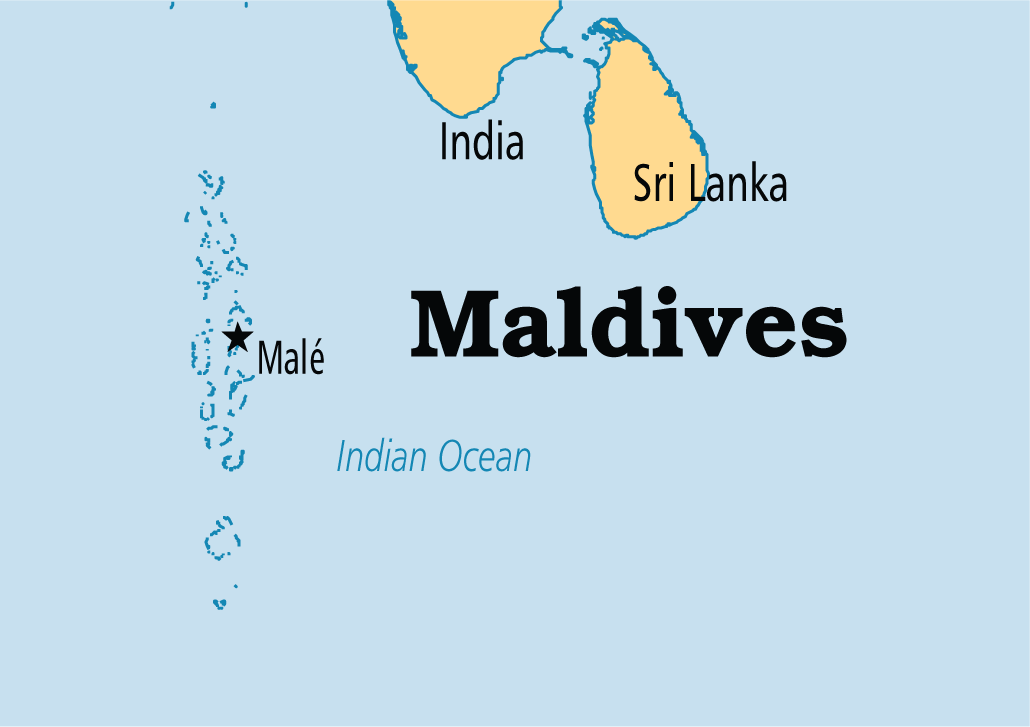
The 14th edition of the Joint Military Exercise, EKUVERIN, between the Indian Army and the Maldives National Defence Force (MNDF) commenced in Thiruvananthapuram, Kerala.
- EKUVERIN means friends in Dhivehi and reflects the strong defence ties between India and the Maldives.
- Held alternately in India and the Maldives since 2009, it aligns with India’s Neighbourhood First policy and strengthens regional partnerships.
- It reinforces both countries’ commitment to security and stability in the Indian Ocean Region.
- The exercise improves interoperability in Counter-Insurgency and Counter-Terrorism operations operations across jungle, semi-urban and coastal areas.
India-Maldives Defence Relations
- Key bilateral exercises like "Ekuverin" and "Ekatha," along with trilateral exercises such as "Dosti" (including India, Sri Lanka, and the Maldives) are conducted to enhance operational synergy and interoperability.
- India is the Maldives’ key defence partner and first responder in crises, seen in Operation Cactus (1988) and post-2004 tsunami. assistance. India’s Neighbourhood First and SAGAR vision guide this cooperation.
- The Annual Defence Cooperation Dialogue (DCD), launched in 2016 at the Defence Secretary level, serves as the main platform for reviewing and guiding India–Maldives defence cooperation.
| Read more: Strengthening India-Maldives Defence Cooperation |

Rapid Fire
India Re-elected to IMO Council
India has been re-elected to the International Maritime Organization (IMO) Council in Category B (countries with major seaborne trade interests) for 2026–27 securing 154 out of 169.
- The IMO Council (40 members across Categories A, B, and C) acts as the executive body between Assembly sessions and shapes global maritime policies.
International Maritime Organization (IMO)
- About: The IMO is a specialized agency of the United Nations, established to regulate global shipping. It functions as the global standard-setting authority for the shipping industry, creating a fair, effective, and universally adopted regulatory framework.
- Genesis and Membership: Established in 1948 as the Inter-Governmental Maritime Consultative Organization (name changed to IMO in 1982), it currently has 176 Member States and. 3 Associate Members. India has been a member since 1959.
- Primary Mandate: Its core responsibility is to improve the safety and security of international shipping and prevent marine and atmospheric pollution from ships.
- A critical feature is that the IMO itself does not enforce its policies; implementation is the responsibility of its member states.
- Key Conventions & Strategies related to IMO:
- International Convention for the Prevention of Pollution from Ships (MARPOL, 1973): To minimize pollution (oil, garbage, air) from ships.
- International Convention for the Safety of Life at Sea (SOLAS, 1974): Establishes minimum safety standards for ships. E.g., fire protection.
- International Convention on Standards of Training, Certification, and Watchkeeping for Seafarers (STCW, 1978): Sets criteria for seafarer training and certification.
- 2023 IMO Strategy on Reduction of GHG Emissions from Ships: To achieve net-zero GHG emissions by 2050.
- Kong Convention (2009): For sustainable ship recycling.
- Ballast Water Management Convention (2004): To prevent the spread of invasive aquatic species.
| Read More: India Re-elected to International Maritime Organisation Council |


Rapid Fire
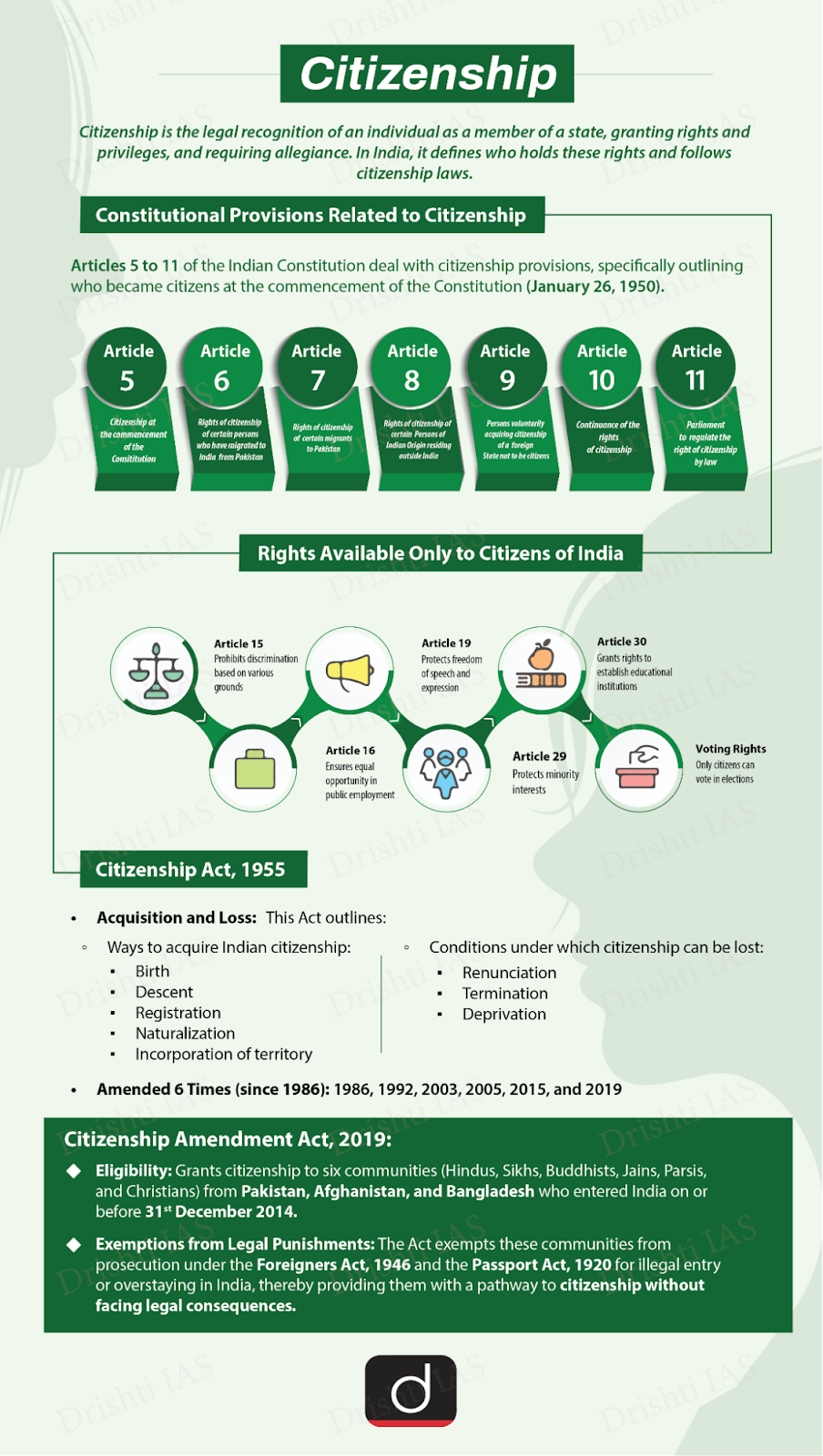
Centre’s Power to Scrutinise Citizenship is Limited: EC tells SC
The Election Commission of India (ECI) has clarified its authority in matters of electoral roll registration (Special Intensive Revision (SIR)), particularly refuting opposition claims that only the Union Government has the exclusive right to scrutinise citizenship.
Key Legal Provisions & Controversy Regarding ECI’s Role
- Section 9, Citizenship Act, 1955: Grants the Centre power to terminate citizenship only in cases where Indian citizens voluntarily acquire foreign citizenship.
- ECI's Clarification: This power is narrow and does not prevent other authorities, including the ECI, from verifying citizenship for purposes such as electoral enrolment.
- Constitutional and Statutory Basis for EC’s Role:
- Article 324: Grants ECI supervisory powers over elections.
- Article 326: Makes Indian citizenship a constitutional requirement to vote.
- Article 327: Allows Parliament to make laws on elections, which must align with ECI’s constitutional authority.
- Representation of the People Act (RPA), 1950:
- Section 16: Non-citizens are disqualified from voter lists.
- Section 19: Voters must be ordinarily resident in their constituency.
- Section 21(3): Empowers ECI to conduct SIR when necessary.
- ECI’s Jurisdictional Limits: The ECI’s role is confined to verifying citizenship for the purpose of including or excluding names in electoral rolls under Sections 16 and 19 of the RPA, 1950.
SIR
- The SIR, under Section 21(3) of the Representation of the People Act, 1950 (RPA), is an intensive revision of electoral rolls prompted by “felt necessities” to maintain accuracy.
- It ensures the purity of rolls, essential for free and fair elections. SIR does not determine citizenship, only verifies voter registration eligibility.
- Controversy: Opposition parties in several states allege SIR of electoral rolls is a covert citizenship test.
| Read More: Special Intensive Revision of Electoral Rolls |